Chapter 5 The Structure and Function of Macromolecules BIO 101 Southwest Virginia Community College Kevin Stilwell Assistant Professor of Biology BIOLOGY 7th edition  Neil Campbell, Jane Reece and Chris Romero
Macromolecules   “macro” = large Are large molecules composed of smaller molecules Are complex in their structures 4  Major categories of macromolecules are  Carbohydrates, Lipids, Proteins, Nucleic Acids
For each of the 4 major groups of macromolecules know the   Elements they are composed of Know their chemical structures Know specific examples within each group and each subgroup.  For example Monosaccharides, disaccharides, and polysaccharides Phospholipids Primary, Secondary, Tertiary and Quaternary structures of proteins
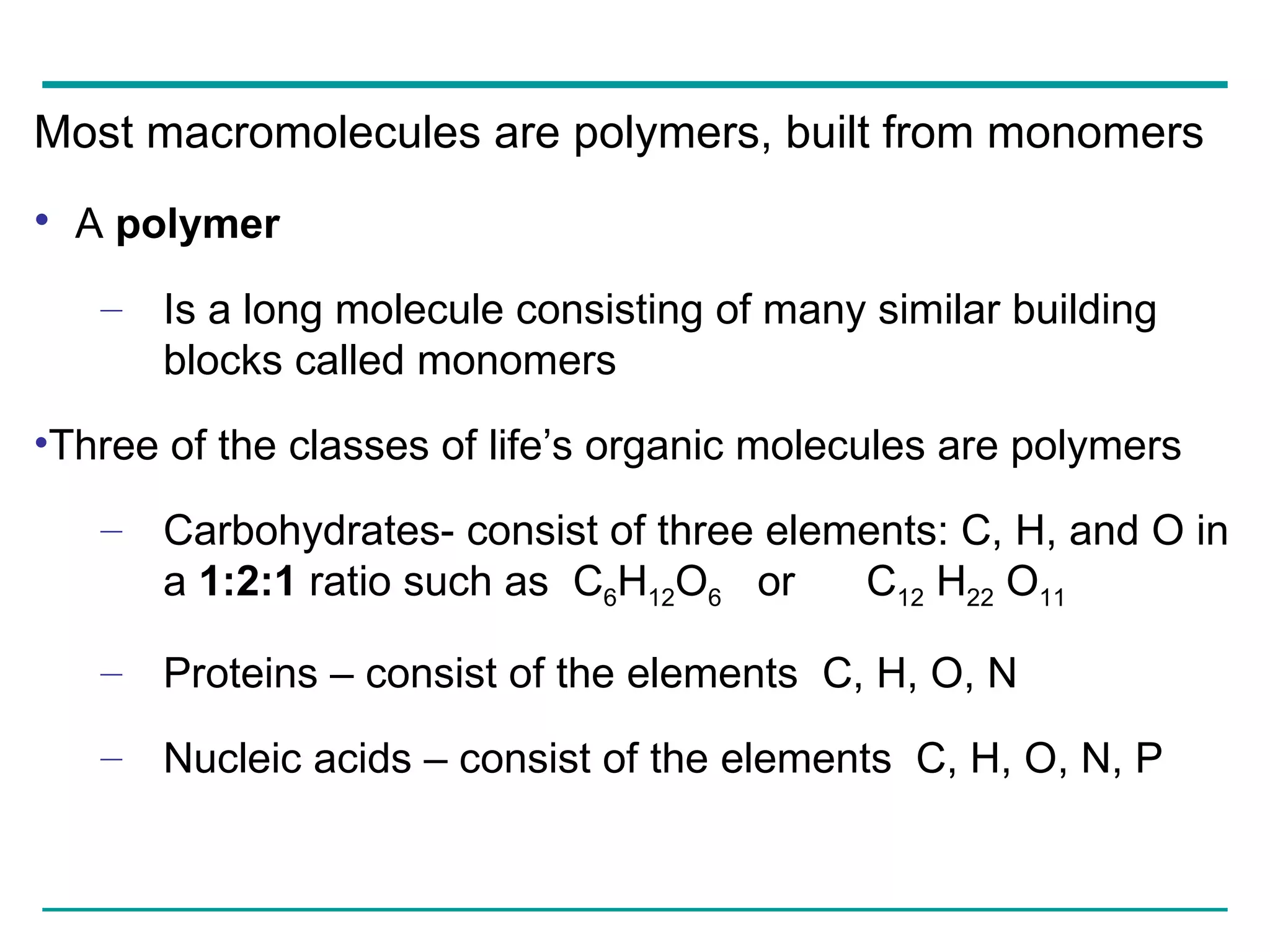
Most macromolecules are polymers, built from monomers A  polymer Is a long molecule consisting of many similar building blocks called monomers Three of the classes of life’s organic molecules are polymers Carbohydrates- consist of three elements: C, H, and O in a  1:2:1  ratio such as  C 6 H 12 O 6   or  C 12  H 22  O 11 Proteins – consist of the elements  C, H, O, N Nucleic acids – consist of the elements  C, H, O, N, P
The Diversity of Polymers Each class of polymer Is formed from a specific set of monomers Large carbohydrate polymers are made of monomers called  monosaccharides  (simple sugars) Large polypeptide and protein polymers are made of monomers called  amino acids Large nucleic acid polymers (DNA and RNA) are made of monomers called  nucleotides 1 2 3 HO H
Although organisms share the same limited number of monomer types, each organism is unique based on the arrangement of monomers into polymers An immense variety of polymers can be built from a small set of monomers.  Variation is accomplished by rearranging the order of the monomers within the polymer. (scrambling the components that make up a polymer creates a different polymer with different biological and chemical and physical properties)
Carbohydrates Carbohydrates serve as fuel (energy source) for metabolism and serves as a building material Carbohydrates - Include sugars and their polymers Monosaccharides  – Are  Simple Sugars , such as glucose, fructose and galactose Are the simplest sugars (have about 3 to 7 carbon atoms in their chemical structure) Can be used for fuel (energy)  Glucose is the most important energy source for cells Can be converted into other organic molecules Can be combined into polymers
Polysaccharides Polysaccharides or Complex Carbohydrates Are polymers of sugars Serve many roles in organisms Examples of polysaccharides are: Starch Cellulose Glycogen Chitin  (pronounced  “Kite – in” )
Lipids are a diverse group of hydrophobic molecules consisting of the elements C, H, and O, ( not  a 1:2:1 ratio) because there is less oxygen in Lipids than in carbohydrates Lipids Are the one class of large biological molecules that do not consist of polymers All types of lipids share the common trait of being hydrophobic Insoluble in water – They do not dissolve in water due to their nonpolar, hydrophobic properties Contain twice as much energy per gram as carbohydrates or proteins
Phospholipids  p 76 Phospholipids Have only two fatty acids Have a phosphate group instead of a third  fatty acid Make up an important component of the plasma membrane (called the phospholipid bilayer) of cells
Enzymes, Polypeptides, and Proteins Enzymes  p 78 Are a type of protein that function as catalysts, speeding up chemical reactions Polypeptides Are polymers of amino acids (containing fewer than 100 amino acids) Proteins Consist of one or more polypeptides Are large polymers of amino acids with more than 100 amino acids, usually several hundred to over 1000 amino acids linked together by  peptide bonds
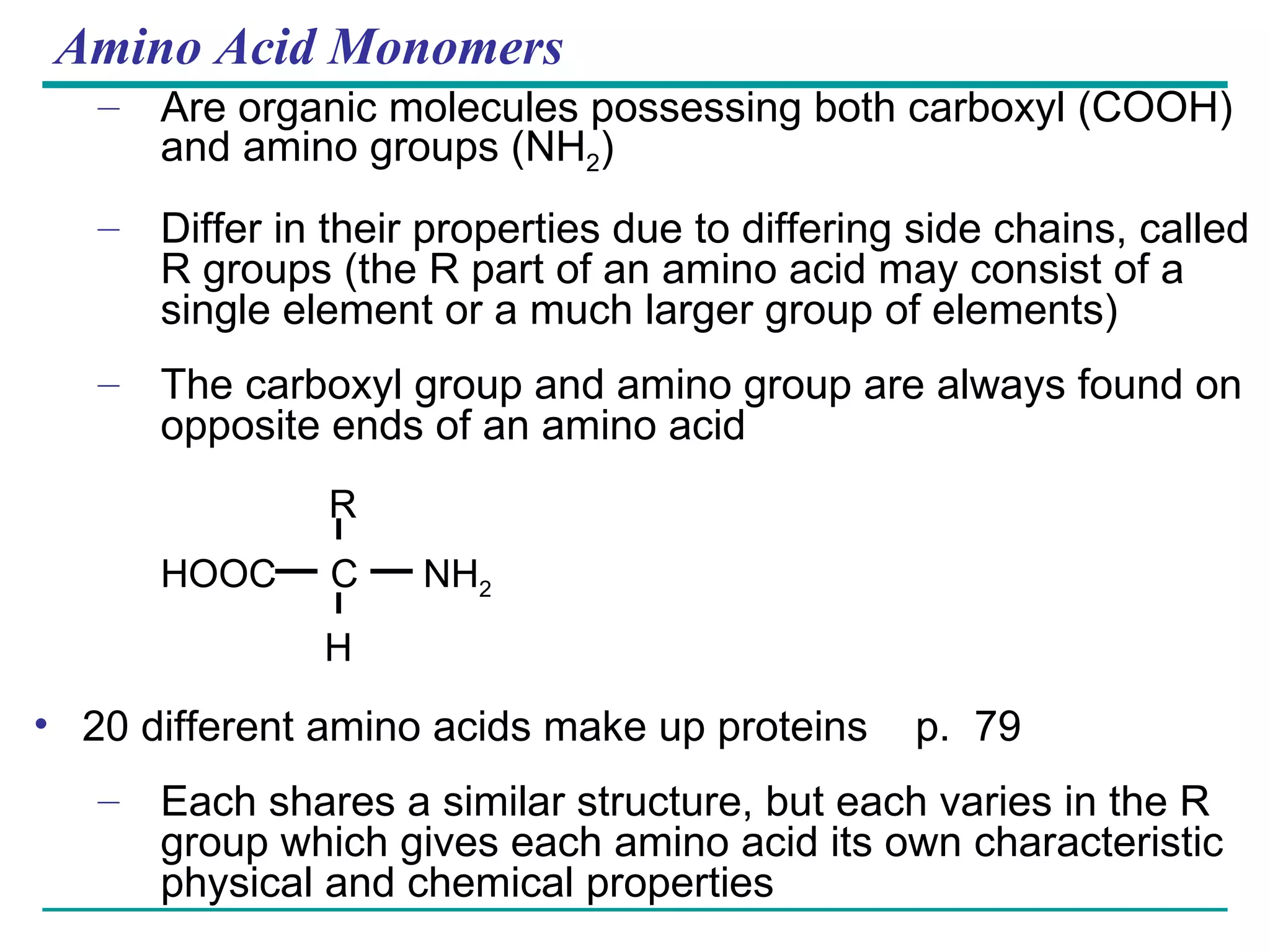
Amino Acid Monomers Are organic molecules possessing both carboxyl (COOH) and amino groups (NH 2 ) Differ in their properties due to differing side chains, called R groups (the R part of an amino acid may consist of a single element or a much larger group of elements) The carboxyl group and amino group are always found on opposite ends of an amino acid   R HOOC  C  NH 2   H 20 different amino acids make up proteins  p.  79 Each shares a similar structure, but each varies in the R group which gives each amino acid its own characteristic physical and chemical properties
Determining the Amino Acid Sequence of a Polypeptide Amino Acid sequences within a cell are determined by the cell’s genetic information (DNA) In the laboratory, the amino acid sequences of polypeptides Were first determined using chemical means Can now be determined by automated machines
Nucleic acids  store and transmit hereditary information Genes – segments of DNA on a chromosome Are the units of inheritance Contain the program (or genetic code) that sets the amino acid sequence of polypeptides Are made of nucleic acids and are located on chromosomes
The Roles of Nucleic Acids There are two types of nucleic acids Deoxyribonucleic acid ( DNA ) Ribonucleic acid ( RNA )
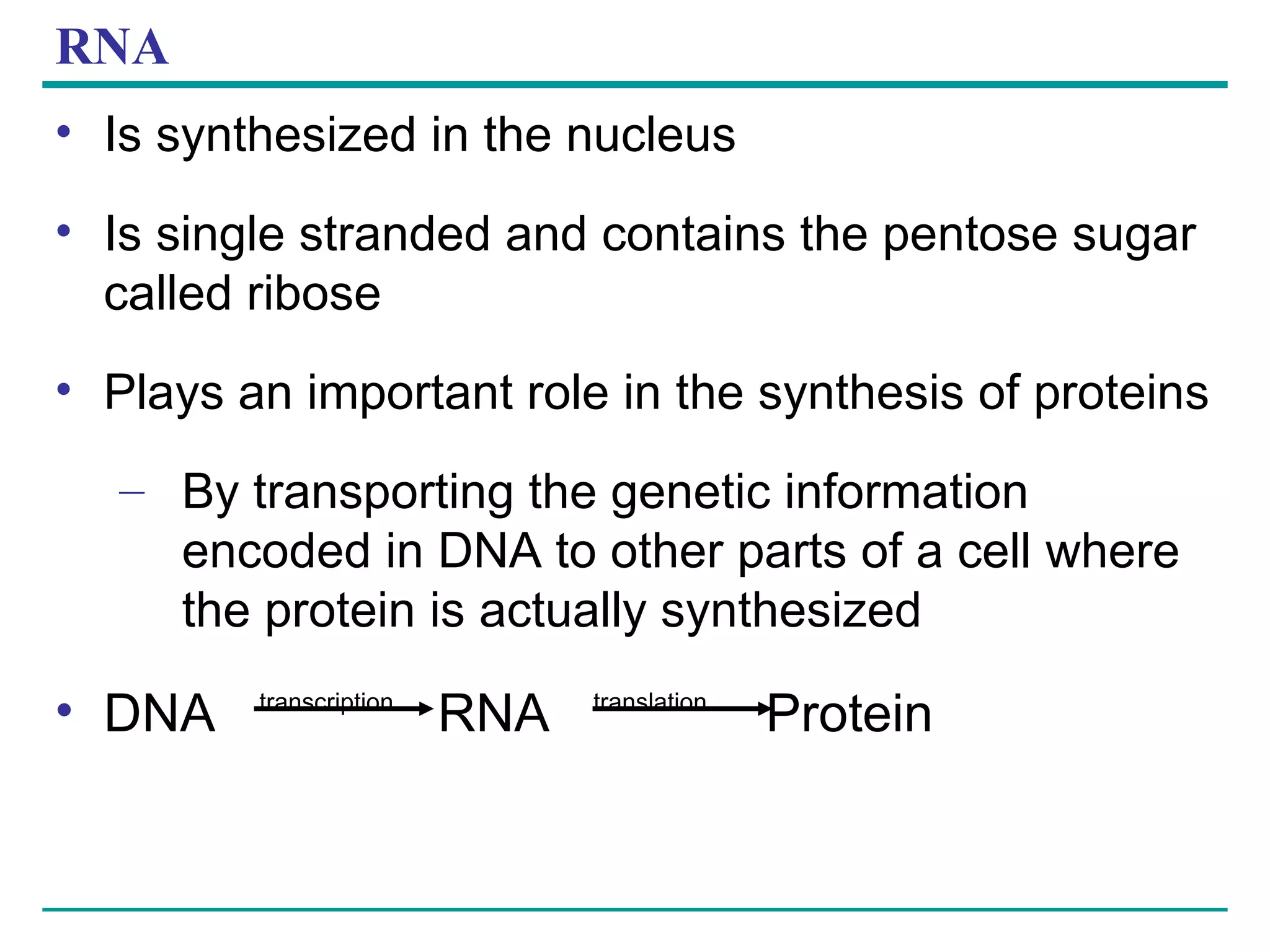
RNA Is synthesized in the nucleus Is single stranded and contains the pentose sugar called ribose Plays an important role in the synthesis of proteins By transporting the genetic information encoded in DNA to other parts of a cell where the protein is actually synthesized DNA  transcription   RNA  translation   Protein
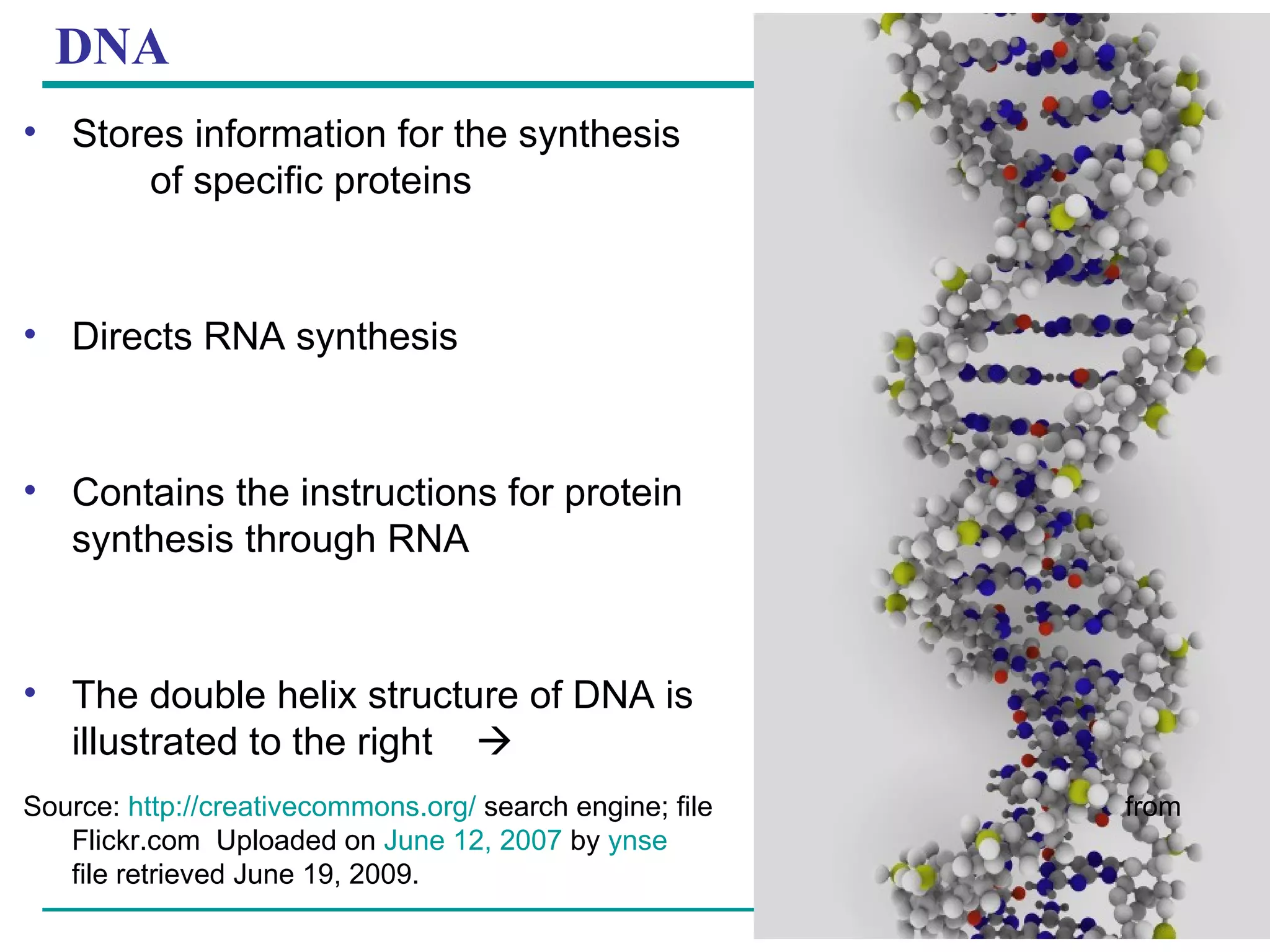
DNA Stores information for the synthesis  of specific proteins Directs RNA synthesis Contains the instructions for protein  synthesis through RNA The double helix structure of DNA is  illustrated to the right     Source:  http://creativecommons.org/  search engine; file    from Flickr.com  Uploaded on  June 12, 2007  by  ynse     file retrieved June 19, 2009.
The DNA Double Helix Cellular DNA molecules Have two polynucleotides that spiral around an imaginary axis Often referred to as being “double stranded” DNA exhibits a structure called a double helix The double helix structure of DNA is often compared to a spiral staircase

Bio Ch05 For Idol

  • 1.
    Chapter 5 TheStructure and Function of Macromolecules BIO 101 Southwest Virginia Community College Kevin Stilwell Assistant Professor of Biology BIOLOGY 7th edition Neil Campbell, Jane Reece and Chris Romero
  • 2.
    Macromolecules “macro” = large Are large molecules composed of smaller molecules Are complex in their structures 4 Major categories of macromolecules are Carbohydrates, Lipids, Proteins, Nucleic Acids
  • 3.
    For each ofthe 4 major groups of macromolecules know the Elements they are composed of Know their chemical structures Know specific examples within each group and each subgroup. For example Monosaccharides, disaccharides, and polysaccharides Phospholipids Primary, Secondary, Tertiary and Quaternary structures of proteins
  • 4.
    Most macromolecules arepolymers, built from monomers A polymer Is a long molecule consisting of many similar building blocks called monomers Three of the classes of life’s organic molecules are polymers Carbohydrates- consist of three elements: C, H, and O in a 1:2:1 ratio such as C 6 H 12 O 6 or C 12 H 22 O 11 Proteins – consist of the elements C, H, O, N Nucleic acids – consist of the elements C, H, O, N, P
  • 5.
    The Diversity ofPolymers Each class of polymer Is formed from a specific set of monomers Large carbohydrate polymers are made of monomers called monosaccharides (simple sugars) Large polypeptide and protein polymers are made of monomers called amino acids Large nucleic acid polymers (DNA and RNA) are made of monomers called nucleotides 1 2 3 HO H
  • 6.
    Although organisms sharethe same limited number of monomer types, each organism is unique based on the arrangement of monomers into polymers An immense variety of polymers can be built from a small set of monomers. Variation is accomplished by rearranging the order of the monomers within the polymer. (scrambling the components that make up a polymer creates a different polymer with different biological and chemical and physical properties)
  • 7.
    Carbohydrates Carbohydrates serveas fuel (energy source) for metabolism and serves as a building material Carbohydrates - Include sugars and their polymers Monosaccharides – Are Simple Sugars , such as glucose, fructose and galactose Are the simplest sugars (have about 3 to 7 carbon atoms in their chemical structure) Can be used for fuel (energy) Glucose is the most important energy source for cells Can be converted into other organic molecules Can be combined into polymers
  • 8.
    Polysaccharides Polysaccharides orComplex Carbohydrates Are polymers of sugars Serve many roles in organisms Examples of polysaccharides are: Starch Cellulose Glycogen Chitin (pronounced “Kite – in” )
  • 9.
    Lipids are adiverse group of hydrophobic molecules consisting of the elements C, H, and O, ( not a 1:2:1 ratio) because there is less oxygen in Lipids than in carbohydrates Lipids Are the one class of large biological molecules that do not consist of polymers All types of lipids share the common trait of being hydrophobic Insoluble in water – They do not dissolve in water due to their nonpolar, hydrophobic properties Contain twice as much energy per gram as carbohydrates or proteins
  • 10.
    Phospholipids p76 Phospholipids Have only two fatty acids Have a phosphate group instead of a third fatty acid Make up an important component of the plasma membrane (called the phospholipid bilayer) of cells
  • 11.
    Enzymes, Polypeptides, andProteins Enzymes p 78 Are a type of protein that function as catalysts, speeding up chemical reactions Polypeptides Are polymers of amino acids (containing fewer than 100 amino acids) Proteins Consist of one or more polypeptides Are large polymers of amino acids with more than 100 amino acids, usually several hundred to over 1000 amino acids linked together by peptide bonds
  • 12.
    Amino Acid MonomersAre organic molecules possessing both carboxyl (COOH) and amino groups (NH 2 ) Differ in their properties due to differing side chains, called R groups (the R part of an amino acid may consist of a single element or a much larger group of elements) The carboxyl group and amino group are always found on opposite ends of an amino acid R HOOC C NH 2 H 20 different amino acids make up proteins p. 79 Each shares a similar structure, but each varies in the R group which gives each amino acid its own characteristic physical and chemical properties
  • 13.
    Determining the AminoAcid Sequence of a Polypeptide Amino Acid sequences within a cell are determined by the cell’s genetic information (DNA) In the laboratory, the amino acid sequences of polypeptides Were first determined using chemical means Can now be determined by automated machines
  • 14.
    Nucleic acids store and transmit hereditary information Genes – segments of DNA on a chromosome Are the units of inheritance Contain the program (or genetic code) that sets the amino acid sequence of polypeptides Are made of nucleic acids and are located on chromosomes
  • 15.
    The Roles ofNucleic Acids There are two types of nucleic acids Deoxyribonucleic acid ( DNA ) Ribonucleic acid ( RNA )
  • 16.
    RNA Is synthesizedin the nucleus Is single stranded and contains the pentose sugar called ribose Plays an important role in the synthesis of proteins By transporting the genetic information encoded in DNA to other parts of a cell where the protein is actually synthesized DNA transcription RNA translation Protein
  • 17.
    DNA Stores informationfor the synthesis of specific proteins Directs RNA synthesis Contains the instructions for protein synthesis through RNA The double helix structure of DNA is illustrated to the right  Source: http://creativecommons.org/ search engine; file from Flickr.com Uploaded on June 12, 2007 by ynse file retrieved June 19, 2009.
  • 18.
    The DNA DoubleHelix Cellular DNA molecules Have two polynucleotides that spiral around an imaginary axis Often referred to as being “double stranded” DNA exhibits a structure called a double helix The double helix structure of DNA is often compared to a spiral staircase