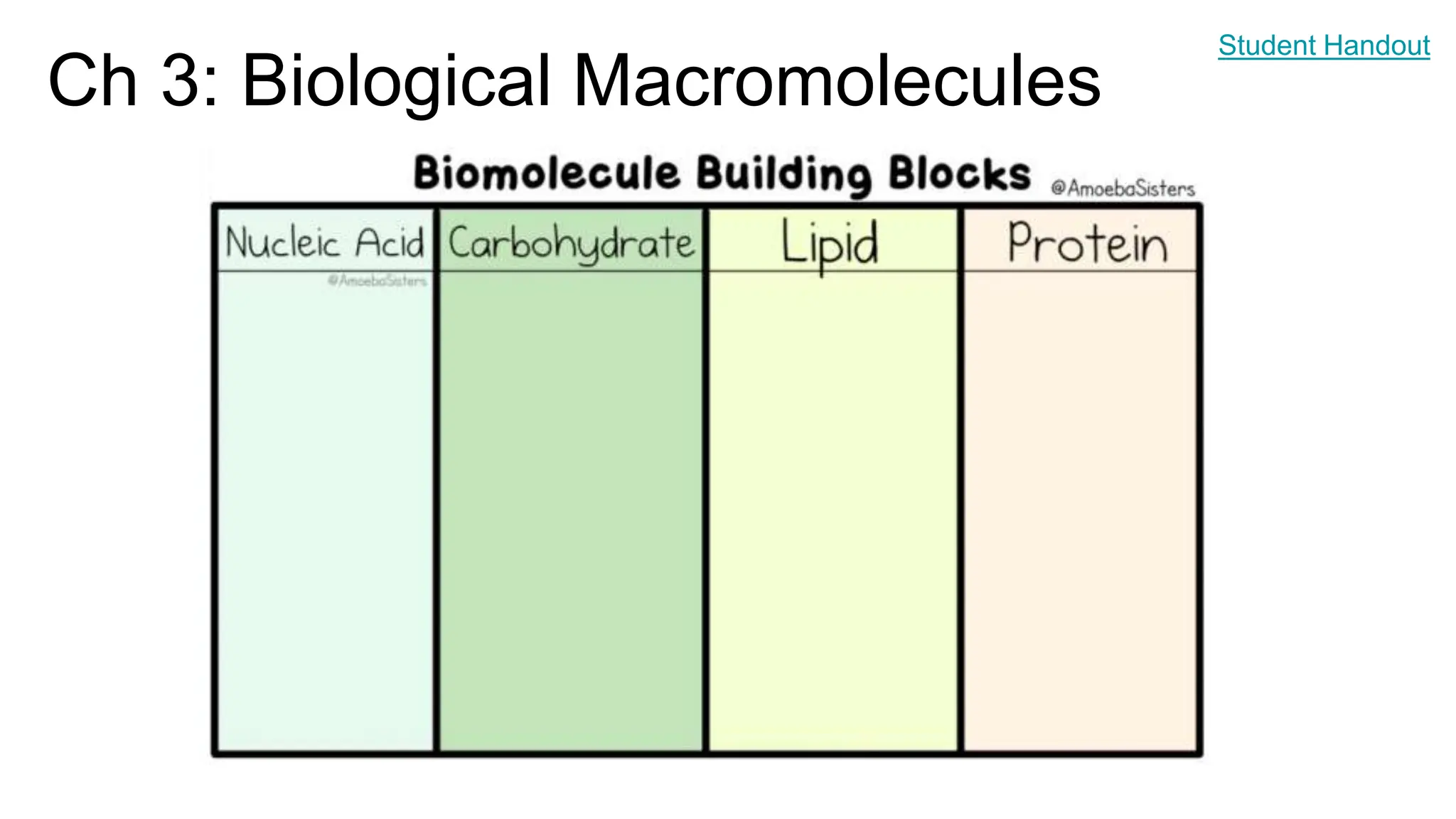
Ch 3: Biological Macromolecules
Student Handout
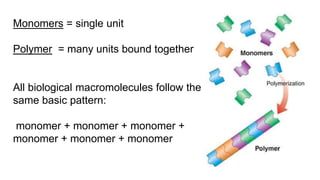
Monomers = single unit
Polymer = many units bound together
All biological macromolecules follow the
same basic pattern:
monomer + monomer + monomer +
monomer + monomer + monomer
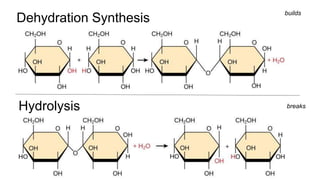
Dehydration Synthesis
Hydrolysis
builds
breaks
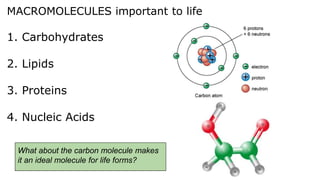
MACROMOLECULES important to life
1. Carbohydrates
2. Lipids
3. Proteins
4. Nucleic Acids
What about the carbon molecule makes
it an ideal molecule for life forms?
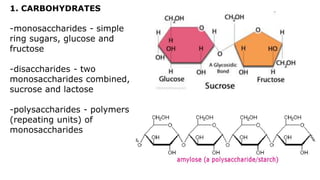
1. CARBOHYDRATES
-monosaccharides - simple
ring sugars, glucose and
fructose
-disaccharides - two
monosaccharides combined,
sucrose and lactose
-polysaccharides - polymers
(repeating units) of
monosaccharides
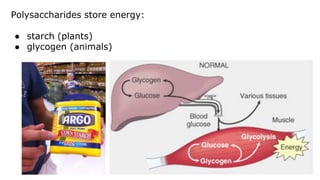
Polysaccharides store energy:
● starch (plants)
● glycogen (animals)
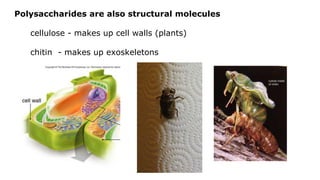
Polysaccharides are also structural molecules
cellulose - makes up cell walls (plants)
chitin - makes up exoskeletons
What you need to know about carbohydrates
1. Distinguish between monosaccharides, disaccharides
and polysaccharides. (Give examples of each)
2. Understand how carbohydrates are used in plants and
animals as energy storage molecules.
3. Understand how carbohydrates are used in plants and
animals as structural molecules.
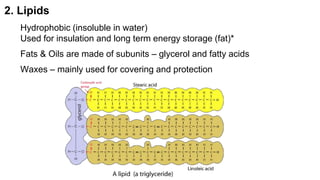
2. Lipids
Hydrophobic (insoluble in water)
Used for insulation and long term energy storage (fat)*
Fats & Oils are made of subunits – glycerol and fatty acids
Waxes – mainly used for covering and protection
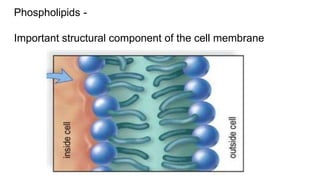
Phospholipids -
Important structural component of the cell membrane
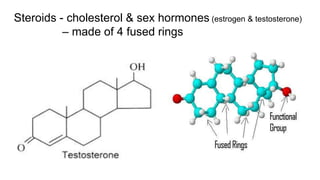
Steroids - cholesterol & sex hormones (estrogen & testosterone)
– made of 4 fused rings
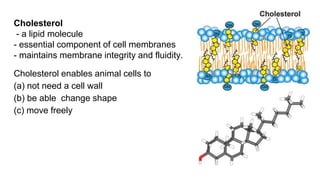
Cholesterol
- a lipid molecule
- essential component of cell membranes
- maintains membrane integrity and fluidity.
Cholesterol enables animal cells to
(a) not need a cell wall
(b) be able change shape
(c) move freely
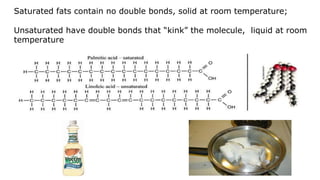
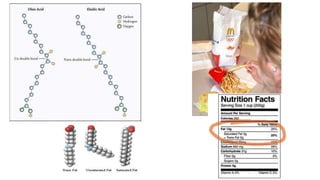
Saturated fats contain no double bonds, solid at room temperature;
Unsaturated have double bonds that “kink” the molecule, liquid at room
temperature
What you need to know about lipids
1. Compare saturated to unsaturated fats.
2. List the functions of lipids
3. Identify a steroid from a picture (4 rings)
4. Identify the main component of the cell membrane.
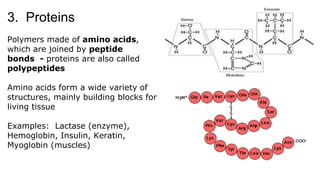
3. Proteins
Polymers made of amino acids,
which are joined by peptide
bonds - proteins are also called
polypeptides
Amino acids form a wide variety of
structures, mainly building blocks for
living tissue
Examples: Lactase (enzyme),
Hemoglobin, Insulin, Keratin,
Myoglobin (muscles)
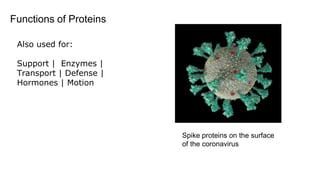
Also used for:
Support | Enzymes |
Transport | Defense |
Hormones | Motion
Functions of Proteins
Spike proteins on the surface
of the coronavirus
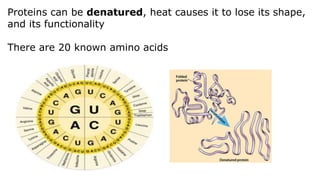
Proteins can be denatured, heat causes it to lose its shape,
and its functionality
There are 20 known amino acids
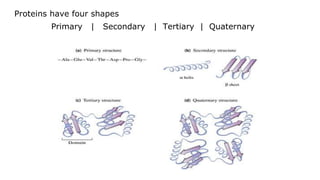
Proteins have four shapes
Primary | Secondary | Tertiary | Quaternary
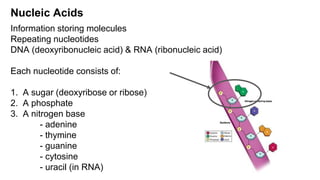
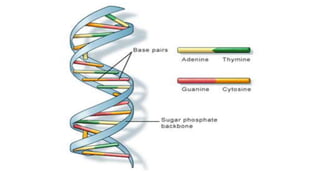
Nucleic Acids
Information storing molecules
Repeating nucleotides
DNA (deoxyribonucleic acid) & RNA (ribonucleic acid)
Each nucleotide consists of:
1. A sugar (deoxyribose or ribose)
2. A phosphate
3. A nitrogen base
- adenine
- thymine
- guanine
- cytosine
- uracil (in RNA)
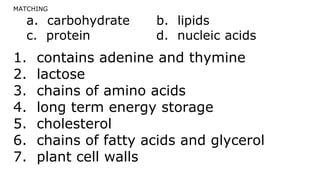
MATCHING
a. carbohydrate b. lipids
c. protein d. nucleic acids
1. contains adenine and thymine
2. lactose
3. chains of amino acids
4. long term energy storage
5. cholesterol
6. chains of fatty acids and glycerol
7. plant cell walls

Ch 03 Biological Macromolecules.powerpointptx

  • 1.
    Ch 3: BiologicalMacromolecules Student Handout
  • 2.
    Monomers = singleunit Polymer = many units bound together All biological macromolecules follow the same basic pattern: monomer + monomer + monomer + monomer + monomer + monomer
  • 3.
  • 4.
    MACROMOLECULES important tolife 1. Carbohydrates 2. Lipids 3. Proteins 4. Nucleic Acids What about the carbon molecule makes it an ideal molecule for life forms?
  • 5.
    1. CARBOHYDRATES -monosaccharides -simple ring sugars, glucose and fructose -disaccharides - two monosaccharides combined, sucrose and lactose -polysaccharides - polymers (repeating units) of monosaccharides
  • 6.
    Polysaccharides store energy: ●starch (plants) ● glycogen (animals)
  • 7.
    Polysaccharides are alsostructural molecules cellulose - makes up cell walls (plants) chitin - makes up exoskeletons
  • 8.
    What you needto know about carbohydrates 1. Distinguish between monosaccharides, disaccharides and polysaccharides. (Give examples of each) 2. Understand how carbohydrates are used in plants and animals as energy storage molecules. 3. Understand how carbohydrates are used in plants and animals as structural molecules.
  • 9.
    2. Lipids Hydrophobic (insolublein water) Used for insulation and long term energy storage (fat)* Fats & Oils are made of subunits – glycerol and fatty acids Waxes – mainly used for covering and protection
  • 10.
    Phospholipids - Important structuralcomponent of the cell membrane
  • 11.
    Steroids - cholesterol& sex hormones (estrogen & testosterone) – made of 4 fused rings
  • 12.
    Cholesterol - a lipidmolecule - essential component of cell membranes - maintains membrane integrity and fluidity. Cholesterol enables animal cells to (a) not need a cell wall (b) be able change shape (c) move freely
  • 13.
    Saturated fats containno double bonds, solid at room temperature; Unsaturated have double bonds that “kink” the molecule, liquid at room temperature
  • 15.
    What you needto know about lipids 1. Compare saturated to unsaturated fats. 2. List the functions of lipids 3. Identify a steroid from a picture (4 rings) 4. Identify the main component of the cell membrane.
  • 16.
    3. Proteins Polymers madeof amino acids, which are joined by peptide bonds - proteins are also called polypeptides Amino acids form a wide variety of structures, mainly building blocks for living tissue Examples: Lactase (enzyme), Hemoglobin, Insulin, Keratin, Myoglobin (muscles)
  • 17.
    Also used for: Support| Enzymes | Transport | Defense | Hormones | Motion Functions of Proteins Spike proteins on the surface of the coronavirus
  • 18.
    Proteins can bedenatured, heat causes it to lose its shape, and its functionality There are 20 known amino acids
  • 19.
    Proteins have fourshapes Primary | Secondary | Tertiary | Quaternary
  • 20.
    Nucleic Acids Information storingmolecules Repeating nucleotides DNA (deoxyribonucleic acid) & RNA (ribonucleic acid) Each nucleotide consists of: 1. A sugar (deoxyribose or ribose) 2. A phosphate 3. A nitrogen base - adenine - thymine - guanine - cytosine - uracil (in RNA)
  • 22.
    MATCHING a. carbohydrate b.lipids c. protein d. nucleic acids 1. contains adenine and thymine 2. lactose 3. chains of amino acids 4. long term energy storage 5. cholesterol 6. chains of fatty acids and glycerol 7. plant cell walls

Editor's Notes

  • #21 Notes outline available at https://docs.google.com/document/d/1HIC37UMhPt0RKZhFurgOJO94Lhiq8l64nczPXjUHZFI/edit?usp=sharing