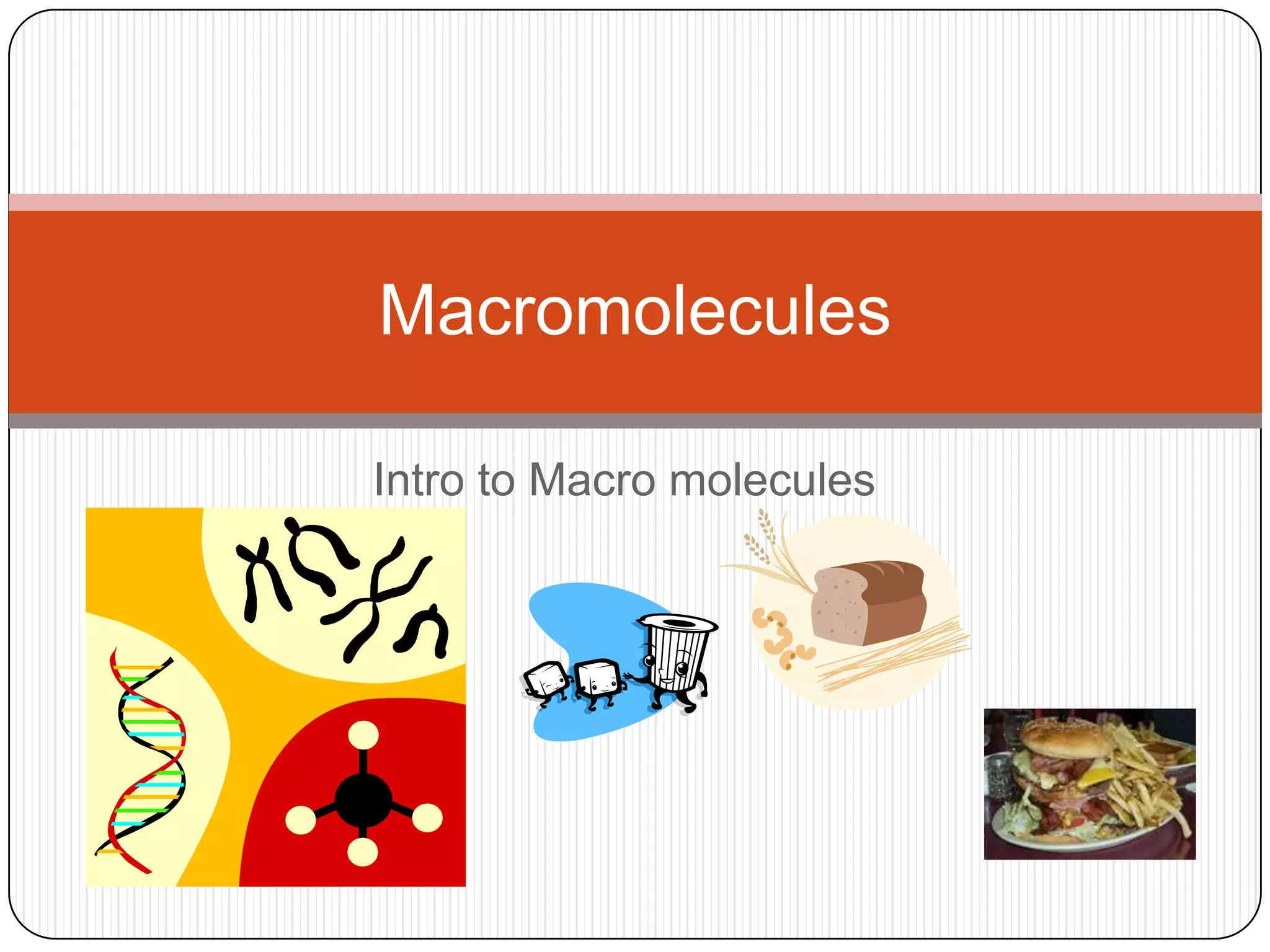
Intro to Macro moleculesMacromolecules
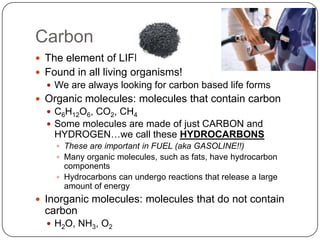
CarbonThe element of LIFE!Found in all living organisms! We are always looking for carbon based life formsOrganic molecules: molecules that contain carbonC6H12O6, CO2, CH4Some molecules are made of just CARBON and HYDROGEN…we call these HYDROCARBONSThese are important in FUEL (aka GASOLINE!!)Many organic molecules, such as fats, have hydrocarbon componentsHydrocarbons can undergo reactions that release a large amount of energyInorganic molecules: molecules that do not contain carbonH2O, NH3, O2
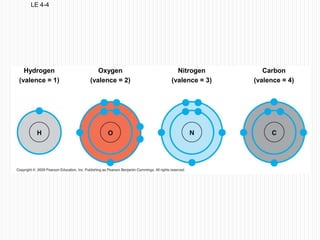
LE 4-4Hydrogen(valence = 1)Oxygen(valence = 2)Nitrogen(valence = 3)Carbon(valence = 4)
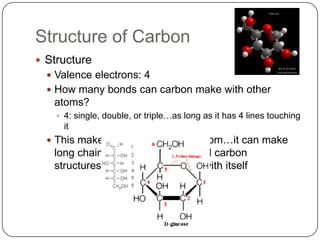
Structure of CarbonStructureValence electrons: 4How many bonds can carbon make with other atoms?4: single, double, or triple…as long as it has 4 lines touching itThis makes carbon a versatile atom…it can make long chains of carbons, branched carbon structures, even ring structures with itself
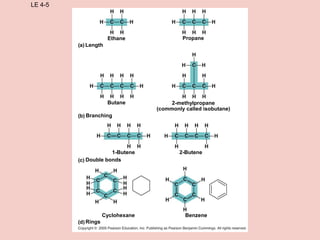
LE 4-5PropaneEthaneLength2-methylpropane(commonly called isobutane)ButaneBranching1-Butene2-ButeneDouble bondsCyclohexaneBenzeneRings
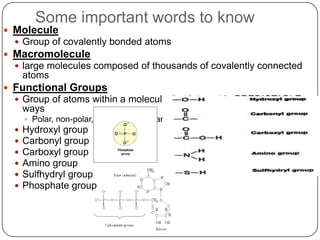
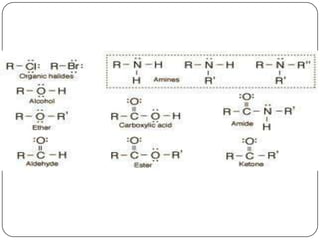
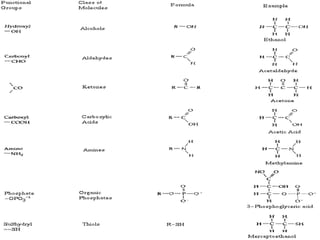
Some important words to knowMoleculeGroup of covalently bonded atomsMacromoleculelarge molecules composed of thousands of covalently connected atomsFunctional GroupsGroup of atoms within a molecule that interact in PREDICTABLE waysPolar, non-polar, acidic, basic, charged (+/-)Hydroxyl groupCarbonyl group  Carboxyl groupAmino groupSulfhydryl groupPhosphate group
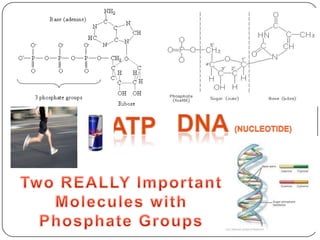
DNA (nucleotide)ATPTwo REALLY ImportantMolecules with Phosphate Groups
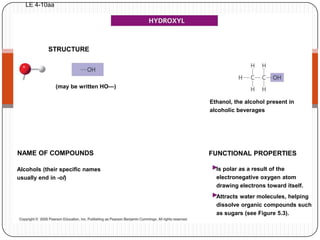
LE 4-10aaSTRUCTURE(may be written HO—)Ethanol, the alcohol present inalcoholic beveragesNAME OF COMPOUNDSFUNCTIONAL PROPERTIESIs polar as a result of theelectronegative oxygen atomdrawing electrons toward itself.Alcohols (their specific namesusually end in -ol)Attracts water molecules, helpingdissolve organic compounds suchas sugars (see Figure 5.3).
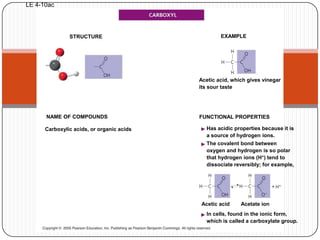
LE 4-10acEXAMPLESTRUCTUREAcetic acid, which gives vinegarits sour tasteFUNCTIONAL PROPERTIESNAME OF COMPOUNDSHas acidic properties because it isa source of hydrogen ions.Carboxylic acids, or organic acidsThe covalent bond betweenoxygen and hydrogen is so polarthat hydrogen ions (H+) tend todissociate reversibly; for example,Acetic acidAcetate ionIn cells, found in the ionic form,which is called a carboxylate group.
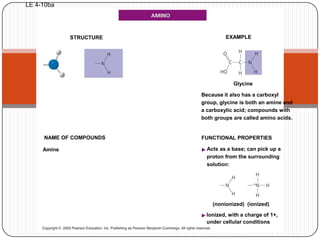
LE 4-10baEXAMPLESTRUCTUREGlycineBecause it also has a carboxylgroup, glycine is both an amine anda carboxylic acid; compounds withboth groups are called amino acids.FUNCTIONAL PROPERTIESNAME OF COMPOUNDSActs as a base; can pick up aproton from the surroundingsolution:Amine(nonionized)(ionized)Ionized, with a charge of 1+,under cellular conditions
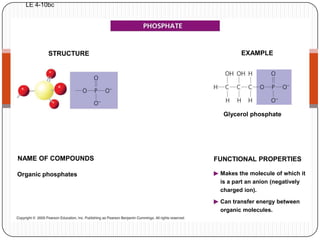
LE 4-10bcEXAMPLESTRUCTUREGlycerol phosphateNAME OF COMPOUNDSFUNCTIONAL PROPERTIESMakes the molecule of which itis a part an anion (negativelycharged ion).Organic phosphatesCan transfer energy between      organic molecules.
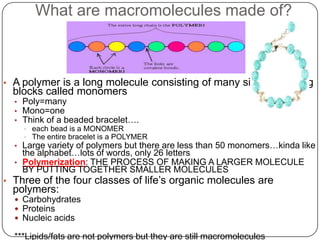
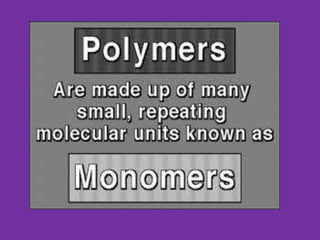
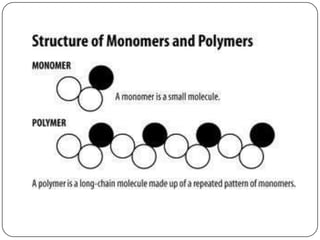
What are macromolecules made of?A polymer is a long molecule consisting of many similar building blocks called monomers
Poly=many
Mono=one
Think of a beaded bracelet….
each bead is a MONOMER
The entire bracelet is a POLYMER
Large variety of polymers but there are less than 50 monomers…kinda like the alphabet…lots of words, only 26 letters
Polymerization: THE PROCESS OF MAKING A LARGER MOLECULE BY PUTTING TOGETHER SMALLER MOLECULES
Three of the four classes of life’s organic molecules are polymers:CarbohydratesProteinsNucleic acids***Lipids/fats are not polymers but they are still macromolecules
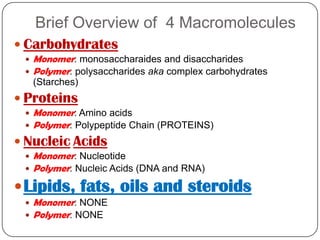
Brief Overview of  4 MacromoleculesCarbohydratesMonomer: monosaccharaides and disaccharidesPolymer: polysaccharides aka complex carbohydrates (Starches)ProteinsMonomer: Amino acidsPolymer: Polypeptide Chain (PROTEINS)NucleicAcidsMonomer: NucleotidePolymer: Nucleic Acids (DNA and RNA)Lipids, fats, oils and steroidsMonomer: NONEPolymer: NONE
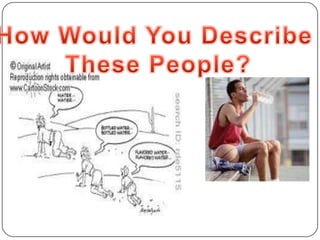
How Would You Describe These People?
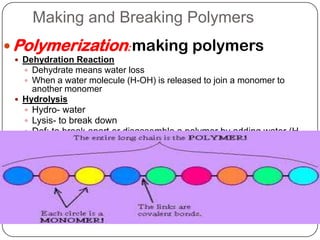
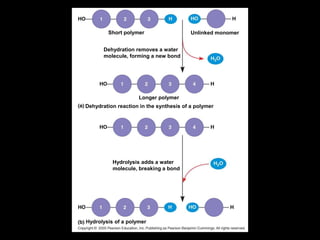
Making and Breaking PolymersPolymerization:making polymersDehydration ReactionDehydrate means water lossWhen a water molecule (H-OH) is released to join a monomer to another monomerHydrolysisHydro- waterLysis- to break downDef: to break apart or disassemble a polymer by adding water (H-OH)
LE 5-2Short polymerUnlinked monomerDehydration removes a watermolecule, forming a new bondLonger polymerDehydration reaction in the synthesis of a polymerHydrolysis adds a watermolecule, breaking a bondHydrolysis of a polymer
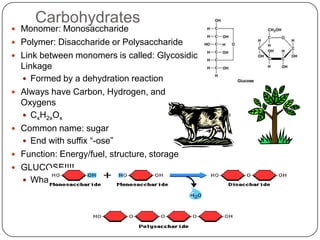
CarbohydratesMonomer: MonosaccharidePolymer: Disaccharide or PolysaccharideLink between monomers is called: Glycosidic LinkageFormed by a dehydration reactionAlways have Carbon, Hydrogen, and OxygensCxH2xOxCommon name: sugarEnd with suffix “-ose”Function: Energy/fuel, structure, storageGLUCOSE!!!! What all cells need for energy
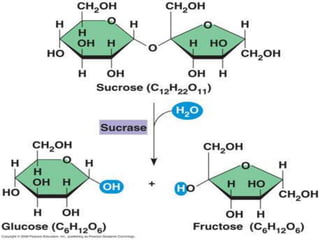
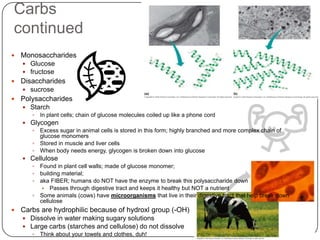
Carbs continuedMonosaccharidesGlucosefructoseDisaccharidessucrosePolysaccharidesStarchIn plant cells; chain of glucose molecules coiled up like a phone cordGlycogenExcess sugar in animal cells is stored in this form; highly branched and more complex chain of glucose monomersStored in muscle and liver cellsWhen body needs energy, glycogen is broken down into glucose CelluloseFound in plant cell walls; made of glucose monomer; building material; aka FIBER; humans do NOT have the enzyme to break this polysaccharide downPasses through digestive tract and keeps it healthy but NOT a nutrientSome animals (cows) have microorganisms that live in their digestive tract that help break down celluloseCarbs are hydrophilic because of hydroxl group (-OH)Dissolve in water making sugary solutionsLarge carbs (starches and cellulose) do not dissolve Think about your towels and clothes, duh!
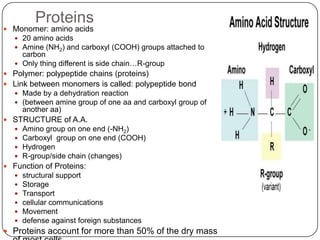
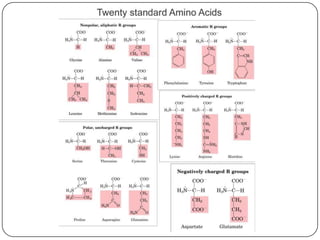
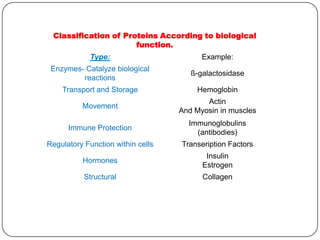
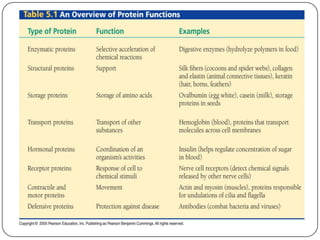
ProteinsMonomer: amino acids20 amino acidsAmine (NH2) and carboxyl (COOH) groups attached to carbonOnly thing different is side chain…R-groupPolymer: polypeptide chains (proteins)Link between monomers is called: polypeptide bond Made by a dehydration reaction (between amine group of one aa and carboxyl group of another aa)STRUCTURE of A.A.Amino group on one end (-NH2)Carboxyl  group on one end (COOH)HydrogenR-group/side chain (changes)Function of Proteins:structural supportStorageTransportcellular communicationsMovementdefense against foreign substancesProteins account for more than 50% of the dry mass of most cells
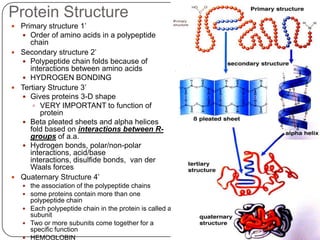
Protein StructurePrimary structure 1’Order of amino acids in a polypeptide chainSecondary structure 2’Polypeptide chain folds because of interactions between amino acidsHYDROGEN BONDINGTertiary Structure 3’Gives proteins 3-D shapeVERY IMPORTANT to function of proteinBeta pleated sheets and alpha helices fold based on interactions between R-groups of a.a.Hydrogen bonds, polar/non-polar interactions, acid/base interactions, disulfide bonds,  van der Waals forcesQuaternary Structure 4’the association of the polypeptide chainssome proteins contain more than one polypeptide chainEach polypeptide chain in the protein is called a subunitTwo or more subunits come together for a specific functionHEMOGLOBINOn Red blood cellsIts shape allows RBCs to carry oxygen all around your body!
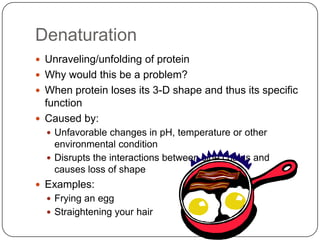
DenaturationUnraveling/unfolding of proteinWhy would this be a problem?When protein loses its 3-D shape and thus its specific functionCaused by:Unfavorable changes in pH, temperature or other environmental conditionDisrupts the interactions between side chains and causes loss of shapeExamples:Frying an eggStraightening your hair

Macromolecule intro

  • 1.
    Intro to MacromoleculesMacromolecules
  • 2.
    CarbonThe element ofLIFE!Found in all living organisms! We are always looking for carbon based life formsOrganic molecules: molecules that contain carbonC6H12O6, CO2, CH4Some molecules are made of just CARBON and HYDROGEN…we call these HYDROCARBONSThese are important in FUEL (aka GASOLINE!!)Many organic molecules, such as fats, have hydrocarbon componentsHydrocarbons can undergo reactions that release a large amount of energyInorganic molecules: molecules that do not contain carbonH2O, NH3, O2
  • 3.
    LE 4-4Hydrogen(valence =1)Oxygen(valence = 2)Nitrogen(valence = 3)Carbon(valence = 4)
  • 4.
    Structure of CarbonStructureValenceelectrons: 4How many bonds can carbon make with other atoms?4: single, double, or triple…as long as it has 4 lines touching itThis makes carbon a versatile atom…it can make long chains of carbons, branched carbon structures, even ring structures with itself
  • 5.
    LE 4-5PropaneEthaneLength2-methylpropane(commonly calledisobutane)ButaneBranching1-Butene2-ButeneDouble bondsCyclohexaneBenzeneRings
  • 6.
    Some important wordsto knowMoleculeGroup of covalently bonded atomsMacromoleculelarge molecules composed of thousands of covalently connected atomsFunctional GroupsGroup of atoms within a molecule that interact in PREDICTABLE waysPolar, non-polar, acidic, basic, charged (+/-)Hydroxyl groupCarbonyl group Carboxyl groupAmino groupSulfhydryl groupPhosphate group
  • 7.
    DNA (nucleotide)ATPTwo REALLYImportantMolecules with Phosphate Groups
  • 10.
    LE 4-10aaSTRUCTURE(may bewritten HO—)Ethanol, the alcohol present inalcoholic beveragesNAME OF COMPOUNDSFUNCTIONAL PROPERTIESIs polar as a result of theelectronegative oxygen atomdrawing electrons toward itself.Alcohols (their specific namesusually end in -ol)Attracts water molecules, helpingdissolve organic compounds suchas sugars (see Figure 5.3).
  • 11.
    LE 4-10acEXAMPLESTRUCTUREAcetic acid,which gives vinegarits sour tasteFUNCTIONAL PROPERTIESNAME OF COMPOUNDSHas acidic properties because it isa source of hydrogen ions.Carboxylic acids, or organic acidsThe covalent bond betweenoxygen and hydrogen is so polarthat hydrogen ions (H+) tend todissociate reversibly; for example,Acetic acidAcetate ionIn cells, found in the ionic form,which is called a carboxylate group.
  • 12.
    LE 4-10baEXAMPLESTRUCTUREGlycineBecause italso has a carboxylgroup, glycine is both an amine anda carboxylic acid; compounds withboth groups are called amino acids.FUNCTIONAL PROPERTIESNAME OF COMPOUNDSActs as a base; can pick up aproton from the surroundingsolution:Amine(nonionized)(ionized)Ionized, with a charge of 1+,under cellular conditions
  • 13.
    LE 4-10bcEXAMPLESTRUCTUREGlycerol phosphateNAMEOF COMPOUNDSFUNCTIONAL PROPERTIESMakes the molecule of which itis a part an anion (negativelycharged ion).Organic phosphatesCan transfer energy between organic molecules.
  • 14.
    What are macromoleculesmade of?A polymer is a long molecule consisting of many similar building blocks called monomers
  • 15.
  • 16.
  • 17.
    Think of abeaded bracelet….
  • 18.
    each bead isa MONOMER
  • 19.
  • 20.
    Large variety ofpolymers but there are less than 50 monomers…kinda like the alphabet…lots of words, only 26 letters
  • 21.
    Polymerization: THE PROCESSOF MAKING A LARGER MOLECULE BY PUTTING TOGETHER SMALLER MOLECULES
  • 22.
    Three of thefour classes of life’s organic molecules are polymers:CarbohydratesProteinsNucleic acids***Lipids/fats are not polymers but they are still macromolecules
  • 25.
    Brief Overview of 4 MacromoleculesCarbohydratesMonomer: monosaccharaides and disaccharidesPolymer: polysaccharides aka complex carbohydrates (Starches)ProteinsMonomer: Amino acidsPolymer: Polypeptide Chain (PROTEINS)NucleicAcidsMonomer: NucleotidePolymer: Nucleic Acids (DNA and RNA)Lipids, fats, oils and steroidsMonomer: NONEPolymer: NONE
  • 26.
    How Would YouDescribe These People?
  • 27.
    Making and BreakingPolymersPolymerization:making polymersDehydration ReactionDehydrate means water lossWhen a water molecule (H-OH) is released to join a monomer to another monomerHydrolysisHydro- waterLysis- to break downDef: to break apart or disassemble a polymer by adding water (H-OH)
  • 28.
    LE 5-2Short polymerUnlinkedmonomerDehydration removes a watermolecule, forming a new bondLonger polymerDehydration reaction in the synthesis of a polymerHydrolysis adds a watermolecule, breaking a bondHydrolysis of a polymer
  • 30.
    CarbohydratesMonomer: MonosaccharidePolymer: Disaccharideor PolysaccharideLink between monomers is called: Glycosidic LinkageFormed by a dehydration reactionAlways have Carbon, Hydrogen, and OxygensCxH2xOxCommon name: sugarEnd with suffix “-ose”Function: Energy/fuel, structure, storageGLUCOSE!!!! What all cells need for energy
  • 31.
    Carbs continuedMonosaccharidesGlucosefructoseDisaccharidessucrosePolysaccharidesStarchIn plantcells; chain of glucose molecules coiled up like a phone cordGlycogenExcess sugar in animal cells is stored in this form; highly branched and more complex chain of glucose monomersStored in muscle and liver cellsWhen body needs energy, glycogen is broken down into glucose CelluloseFound in plant cell walls; made of glucose monomer; building material; aka FIBER; humans do NOT have the enzyme to break this polysaccharide downPasses through digestive tract and keeps it healthy but NOT a nutrientSome animals (cows) have microorganisms that live in their digestive tract that help break down celluloseCarbs are hydrophilic because of hydroxl group (-OH)Dissolve in water making sugary solutionsLarge carbs (starches and cellulose) do not dissolve Think about your towels and clothes, duh!
  • 32.
    ProteinsMonomer: amino acids20amino acidsAmine (NH2) and carboxyl (COOH) groups attached to carbonOnly thing different is side chain…R-groupPolymer: polypeptide chains (proteins)Link between monomers is called: polypeptide bond Made by a dehydration reaction (between amine group of one aa and carboxyl group of another aa)STRUCTURE of A.A.Amino group on one end (-NH2)Carboxyl group on one end (COOH)HydrogenR-group/side chain (changes)Function of Proteins:structural supportStorageTransportcellular communicationsMovementdefense against foreign substancesProteins account for more than 50% of the dry mass of most cells
  • 34.
    Protein StructurePrimary structure1’Order of amino acids in a polypeptide chainSecondary structure 2’Polypeptide chain folds because of interactions between amino acidsHYDROGEN BONDINGTertiary Structure 3’Gives proteins 3-D shapeVERY IMPORTANT to function of proteinBeta pleated sheets and alpha helices fold based on interactions between R-groups of a.a.Hydrogen bonds, polar/non-polar interactions, acid/base interactions, disulfide bonds, van der Waals forcesQuaternary Structure 4’the association of the polypeptide chainssome proteins contain more than one polypeptide chainEach polypeptide chain in the protein is called a subunitTwo or more subunits come together for a specific functionHEMOGLOBINOn Red blood cellsIts shape allows RBCs to carry oxygen all around your body!
  • 35.
    DenaturationUnraveling/unfolding of proteinWhywould this be a problem?When protein loses its 3-D shape and thus its specific functionCaused by:Unfavorable changes in pH, temperature or other environmental conditionDisrupts the interactions between side chains and causes loss of shapeExamples:Frying an eggStraightening your hair