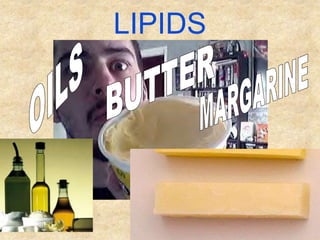
There are four classes of
 biological macromolecules:
Proteins, lipids, carbohydrates
       and nucleic acids
Before you can understand the topics in this
unit there are some key vocabulary terms you
                 need to know.


           Macromolecule
                Polymer
               Monomer
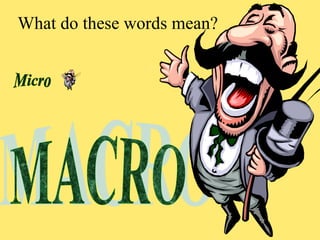
What do these words mean?
So What Is A
 Macromolecule
      ?
  A very large molecule, such as a
  polymer or protein, consisting of
many smaller structural units linked
together. Also called supermolecule.
Biological
 Macromolecule
  All biological macro-molecule are
    made up of a small number of
elements: Carbon, Hydrogen, Oxygen,
   Nitrogen, Phosphorus and Sulfur
Next Word…..
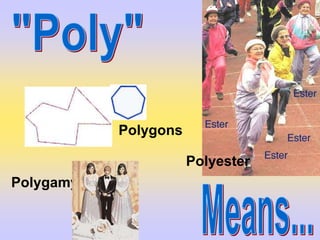
Polygons

                      Polyester
Polygamy
What does
 “Mono”
  mean?
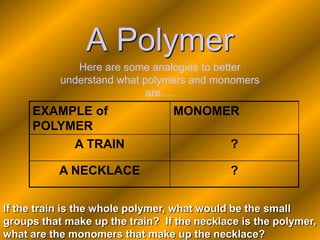
A Polymer
              Here are some analogies to better
           understand what polymers and monomers
                            are….
     EXAMPLE of                  MONOMER
     POLYMER
          A TRAIN                            ?

           A NECKLACE                        ?


If the train is the whole polymer, what would be the small
groups that make up the train? If the necklace is the polymer,
what are the monomers that make up the necklace?
A Polymer
              Here are some analogies to better
           understand what polymers and monomers
                            are….
     EXAMPLE of                  MONOMER
     POLYMER
          A TRAIN

           A NECKLACE


If the train is the whole polymer, what would be the small
groups that make up the train? If the necklace is the polymer,
what are the monomers that make up the necklace?
Three out of the 4 types of
biochemical macromolecules
    can be found on food
      nutrition labels…
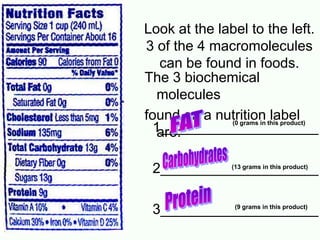
Look at the label to the left.
3 of the 4 macromolecules
   can be found in foods.
The 3 biochemical
   molecules
found on a nutrition this product)
              (0 grams in
                          label
  1____________________
   are:

 2____________________
           (13 grams in this product)


 3____________________
           (9 grams in this product)
The 4th type of biochemical
 macromolecules are the
   NUCLEIC ACIDS
    The types of Nucleic Acids
   –DNA (DeoxyriboNucleic Acid)
     –RNA (RiboNucleic Acid)
“DNA” is short for
   DeoxyriboNucleic
        Acid
• Now you know why they just
  call it DNA!
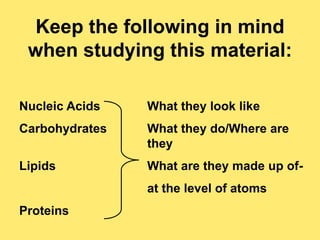
Keep the following in mind
 when studying this material:

Nucleic Acids   What they look like
Carbohydrates   What they do/Where are
                they
Lipids          What are they made up of-
                at the level of atoms
Proteins
LET’S BEGIN WITH
         CARBOHYDRATES

They are the main source for the body to gain energy.
They are our fuel!
They make up the cell wall in plants which allow them
to grow tall, without this carbohydrate, a plant would be
a mushy mess! This type of carbohydrate is called
Cellulose.


THINK:       CARBS= ENERGY and CELL WALLS
CARBOHYDRATES

•In plant foods- in the cell walls of
plants --- in fruits, vegetables, peas,
beans, SUGAR comes from a plant
and so does FLOUR! (pasta,
potatoes, bread, candy, cookies)
---------------------------------------------------
•In animal products- in MILK
CARBOHYDRATES

THERE ARE 2 TYPES OF
  CARBOHYDRATES


Simple      Complex
Simple Sugars are carbohydrates
  made up of 1 or 2 monomers.
     They also taste sweet.
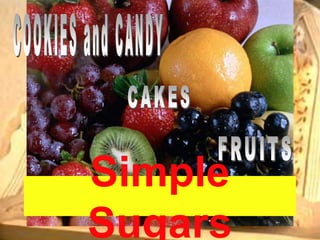
Simple
Sugars
Complex
  Carbohydrates
        …
  What are they?

Complex Cabohydrates are
polymers made up of many
       monomers.
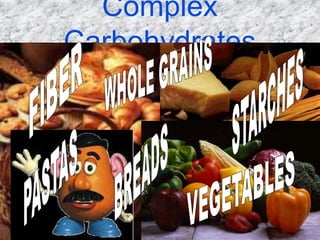
Complex
Carbohydrates
CARBOHYDRATES

     Carbohydrates are chains
(polymers) made of monomers. The
    most common monomer of
        carbohydrates is…
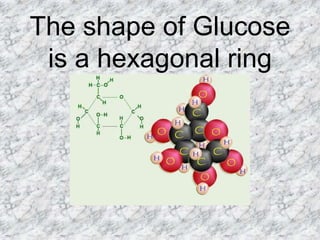
The shape of Glucose
 is a hexagonal ring
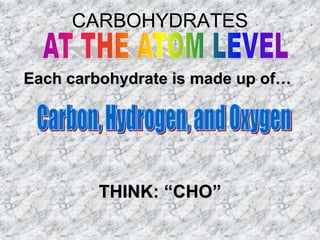
CARBOHYDRATES

Each carbohydrate is made up of…


        THINK: “CHO”
NOW ONTO PROTEINS

They are the major structural molecules in living things
for growth and repair : muscles, ligaments, tendons, bones,
hair, skin, nails…IN FACT ALL CELL MEMBRANES have
protein in them
They make up antibodies in the immune system
They make up enzymes for helping chemical reactions
They makeup non-steriod hormones which
THINK: Proteins= membranes, enzymes, antibodies, non-
steriod hormones, structural molecules, “MEANS”
MORE ON PROTEINS…
The following slides give
you a little more in depth
 info on things that are
   made of proteins…
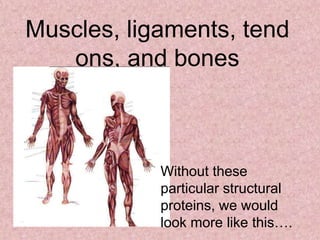
Muscles, ligaments, tend
   ons, and bones


            Without these
            particular structural
            proteins, we would
            look more like this….
Well, maybe not exactly…
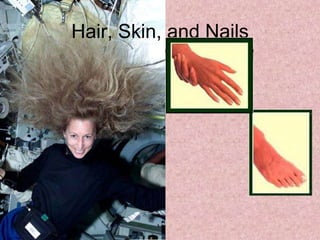
Hair, Skin, and Nails
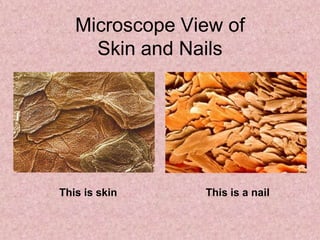
Microscope View of
     Skin and Nails


This is skin    This is a nail
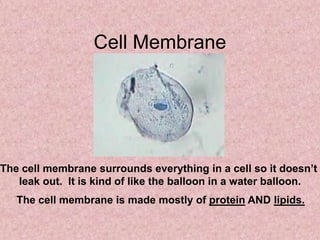
Cell Membrane


The cell membrane surrounds everything in a cell so it doesn’t
   leak out. It is kind of like the balloon in a water balloon.
   The cell membrane is made mostly of protein AND lipids.
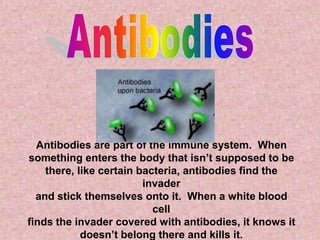
Antibodies are part of the immune system. When
something enters the body that isn’t supposed to be
    there, like certain bacteria, antibodies find the
                         invader
  and stick themselves onto it. When a white blood
                           cell
finds the invader covered with antibodies, it knows it
            doesn’t belong there and kills it.
Enzymes are proteins that
 speed up chemical reactions.
 If you didn’t have enzymes in
   your stomach to speed up
digestion, the food would rot in
your stomach because it would
          take so long!
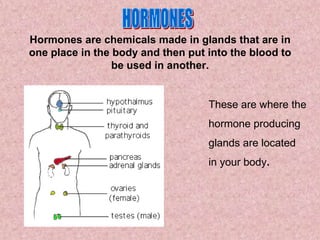
Hormones are chemicals made in glands that are in
one place in the body and then put into the blood to
                 be used in another.


                                   These are where the
                                   hormone producing
                                   glands are located
                                   in your body.
PROTEINS

•In plant foods- in the cell
membranes
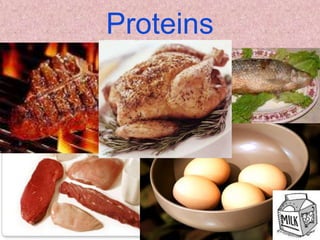
•In animal products- in the cell
membranes- in the muscles or
living things- cows, chicken, fish…
Proteins
Proteins
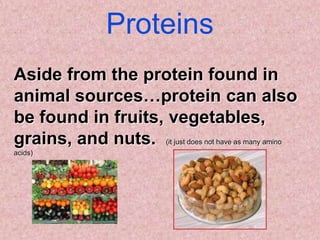
Aside from the protein found in
animal sources…protein can also
be found in fruits, vegetables,
grains, and nuts.
                (it just does not have as many amino
acids)
PROTEINS

 Proteins are made of long chains
(polymers) made of monomers. All
     proteins are made of the
            monomer…
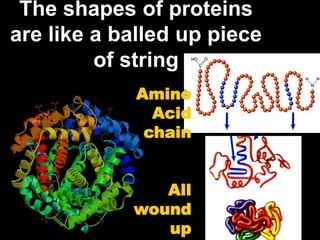
The shapes of proteins
are like a balled up piece
         of string
             Amino
               Acid
              chain


               All
            wound
               up
PROTEINS

Each protein is made up of…


    THINK: “CHONS”
LIPIDS ARE NEXT

They are a great source of STORED ENERGY so we
have it in the future.
They INSULATE the body to maintain normal body
temperature and they CUSHION the internal organs for
protection.
They produce hormones for the body called
STERIODS
They waterproof surfaces of animals,plants, and
fruits- these are waxes!
THINK: Waterproof, insulate, steriods, energy,
cushion… “WISE C”
LIPIDS…Some interesting
              info

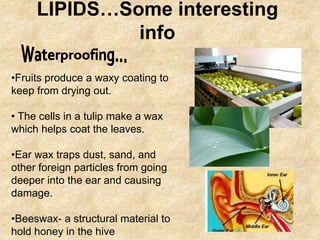
•Fruits produce a waxy coating to
keep from drying out.

• The cells in a tulip make a wax
which helps coat the leaves.

•Ear wax traps dust, sand, and
other foreign particles from going
deeper into the ear and causing
damage.

•Beeswax- a structural material to
hold honey in the hive
LIPIDS…Some interesting
              info

There are many different types of steroids.
  They are all lipids. Their functions vary.
  Some common steroids are:
SEX STEROIDS            ANABOLIC STERIODS
               CHOLESTEROL
Like testosterone and      They increase muscle
estrogen
LIPIDS…Some interesting
           info
NATURAL STERIODS IN OUR
 BODY INCREASE MUSCLE
   GROWTH AND BONE
 DEVELOPMENT AND ARE
GOOD. THE ILLEGAL ONES
THAT ARE SYNTHETIC ARE
         BAD.
LIPIDS

•In plants- in the seeds
---------------------------------------------------
•In animals- in adipose tissue,
connective tissue, in animals
---------------------------------------------------
•Lipids make up the cell membrane of
all cells.
LIPIDS
LIPIDS

Lipids are chains (polymers) made
 of monomers. The most common
      monomer of lipids is…
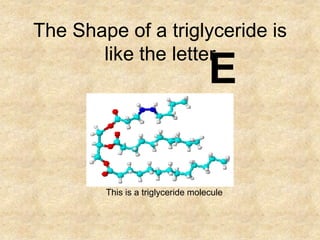
The Shape of a triglyceride is
       like the letter
                                   E

        This is a triglyceride molecule
LIPIDS

Each carbohydrate is made up of…


        THINK: “CHO”
OH NO CHO!
               Lipids like Carbs?
You might have noticed that both carbohydrates and lipids
have the elements Carbon, Hydrogen, and Oxygen.
                          “CHO”
A carbohydrate, has twice as many hydrogen atoms as
the number of oxygen atoms.
                       EX: C6H12O6
    (This is a carb= there are double the number of H
                      compared to O)
On the other hand, lipids have a lot more than twice the
amount hydrogen atoms as the number of oxygen atoms.
                  EX: C27H46O cholesterol
ENERGY
 Three of the BIG 4 provide us
with energy through the food we
              eat.
ENERGY
Energy that is gained by
consuming food is called a
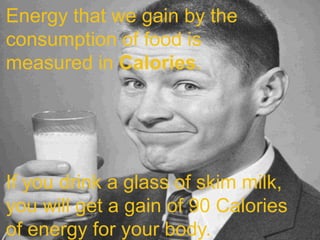
Energy that we gain by the
consumption of food is
measured in Calories.


If you drink a glass of skim milk,
you will get a gain of 90 Calories
of energy for your body.
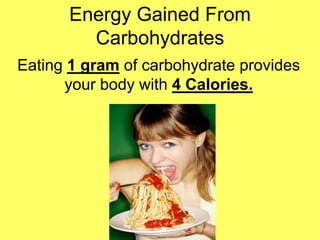
Energy Gained From
        Carbohydrates
Eating 1 gram of carbohydrate provides
      your body with 4 Calories.
Energy Gained from Lipids
Eating 1 gram of fat provides your body
         with 9   Calories.
  Notice if you eat 1 gram of fat, you
   are gaining more than twice the
   amount of Calories than from a
   gram of carbohydrate or protein!
Nucleic acids
The nucleic acids in food are not
considered a substance that the
   body uses to gain energy.
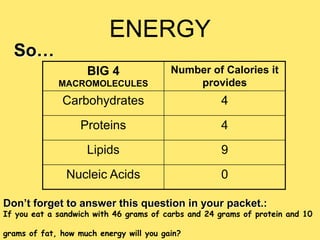
ENERGY
  So…
                    BIG 4                Number of Calories it
             MACROMOLECULES                  provides
              Carbohydrates                         4
                   Proteins                         4
                    Lipids                          9
               Nucleic Acids                        0

Don’t forget to answer this question in your packet.:
If you eat a sandwich with 46 grams of carbs and 24 grams of protein and 10

grams of fat, how much energy will you gain?

Macromolecules

  • 1.
    There are fourclasses of biological macromolecules: Proteins, lipids, carbohydrates and nucleic acids
  • 2.
    Before you canunderstand the topics in this unit there are some key vocabulary terms you need to know. Macromolecule Polymer Monomer
  • 4.
    What do thesewords mean?
  • 5.
    So What IsA Macromolecule ? A very large molecule, such as a polymer or protein, consisting of many smaller structural units linked together. Also called supermolecule.
  • 6.
    Biological Macromolecule All biological macro-molecule are made up of a small number of elements: Carbon, Hydrogen, Oxygen, Nitrogen, Phosphorus and Sulfur
  • 7.
  • 8.
    Polygons Polyester Polygamy
  • 10.
  • 11.
    A Polymer Here are some analogies to better understand what polymers and monomers are…. EXAMPLE of MONOMER POLYMER A TRAIN ? A NECKLACE ? If the train is the whole polymer, what would be the small groups that make up the train? If the necklace is the polymer, what are the monomers that make up the necklace?
  • 12.
    A Polymer Here are some analogies to better understand what polymers and monomers are…. EXAMPLE of MONOMER POLYMER A TRAIN A NECKLACE If the train is the whole polymer, what would be the small groups that make up the train? If the necklace is the polymer, what are the monomers that make up the necklace?
  • 15.
    Three out ofthe 4 types of biochemical macromolecules can be found on food nutrition labels…
  • 16.
    Look at thelabel to the left. 3 of the 4 macromolecules can be found in foods. The 3 biochemical molecules found on a nutrition this product) (0 grams in label 1____________________ are: 2____________________ (13 grams in this product) 3____________________ (9 grams in this product)
  • 18.
    The 4th typeof biochemical macromolecules are the NUCLEIC ACIDS The types of Nucleic Acids –DNA (DeoxyriboNucleic Acid) –RNA (RiboNucleic Acid)
  • 19.
    “DNA” is shortfor DeoxyriboNucleic Acid • Now you know why they just call it DNA!
  • 20.
    Keep the followingin mind when studying this material: Nucleic Acids What they look like Carbohydrates What they do/Where are they Lipids What are they made up of- at the level of atoms Proteins
  • 21.
    LET’S BEGIN WITH CARBOHYDRATES They are the main source for the body to gain energy. They are our fuel! They make up the cell wall in plants which allow them to grow tall, without this carbohydrate, a plant would be a mushy mess! This type of carbohydrate is called Cellulose. THINK: CARBS= ENERGY and CELL WALLS
  • 22.
    CARBOHYDRATES •In plant foods-in the cell walls of plants --- in fruits, vegetables, peas, beans, SUGAR comes from a plant and so does FLOUR! (pasta, potatoes, bread, candy, cookies) --------------------------------------------------- •In animal products- in MILK
  • 23.
    CARBOHYDRATES THERE ARE 2TYPES OF CARBOHYDRATES Simple Complex
  • 24.
    Simple Sugars arecarbohydrates made up of 1 or 2 monomers. They also taste sweet.
  • 25.
  • 26.
    Complex Carbohydrates … What are they? Complex Cabohydrates are polymers made up of many monomers.
  • 27.
  • 28.
    CARBOHYDRATES Carbohydrates are chains (polymers) made of monomers. The most common monomer of carbohydrates is…
  • 29.
    The shape ofGlucose is a hexagonal ring
  • 30.
    CARBOHYDRATES Each carbohydrate ismade up of… THINK: “CHO”
  • 31.
    NOW ONTO PROTEINS Theyare the major structural molecules in living things for growth and repair : muscles, ligaments, tendons, bones, hair, skin, nails…IN FACT ALL CELL MEMBRANES have protein in them They make up antibodies in the immune system They make up enzymes for helping chemical reactions They makeup non-steriod hormones which THINK: Proteins= membranes, enzymes, antibodies, non- steriod hormones, structural molecules, “MEANS”
  • 32.
    MORE ON PROTEINS… Thefollowing slides give you a little more in depth info on things that are made of proteins…
  • 33.
    Muscles, ligaments, tend ons, and bones Without these particular structural proteins, we would look more like this….
  • 34.
    Well, maybe notexactly…
  • 35.
  • 36.
    Microscope View of Skin and Nails This is skin This is a nail
  • 37.
    Cell Membrane The cellmembrane surrounds everything in a cell so it doesn’t leak out. It is kind of like the balloon in a water balloon. The cell membrane is made mostly of protein AND lipids.
  • 38.
    Antibodies are partof the immune system. When something enters the body that isn’t supposed to be there, like certain bacteria, antibodies find the invader and stick themselves onto it. When a white blood cell finds the invader covered with antibodies, it knows it doesn’t belong there and kills it.
  • 39.
    Enzymes are proteinsthat speed up chemical reactions. If you didn’t have enzymes in your stomach to speed up digestion, the food would rot in your stomach because it would take so long!
  • 40.
    Hormones are chemicalsmade in glands that are in one place in the body and then put into the blood to be used in another. These are where the hormone producing glands are located in your body.
  • 41.
    PROTEINS •In plant foods-in the cell membranes •In animal products- in the cell membranes- in the muscles or living things- cows, chicken, fish…
  • 42.
  • 43.
    Proteins Aside from theprotein found in animal sources…protein can also be found in fruits, vegetables, grains, and nuts. (it just does not have as many amino acids)
  • 44.
    PROTEINS Proteins aremade of long chains (polymers) made of monomers. All proteins are made of the monomer…
  • 45.
    The shapes ofproteins are like a balled up piece of string Amino Acid chain All wound up
  • 46.
    PROTEINS Each protein ismade up of… THINK: “CHONS”
  • 47.
    LIPIDS ARE NEXT Theyare a great source of STORED ENERGY so we have it in the future. They INSULATE the body to maintain normal body temperature and they CUSHION the internal organs for protection. They produce hormones for the body called STERIODS They waterproof surfaces of animals,plants, and fruits- these are waxes! THINK: Waterproof, insulate, steriods, energy, cushion… “WISE C”
  • 48.
    LIPIDS…Some interesting info •Fruits produce a waxy coating to keep from drying out. • The cells in a tulip make a wax which helps coat the leaves. •Ear wax traps dust, sand, and other foreign particles from going deeper into the ear and causing damage. •Beeswax- a structural material to hold honey in the hive
  • 49.
    LIPIDS…Some interesting info There are many different types of steroids. They are all lipids. Their functions vary. Some common steroids are: SEX STEROIDS ANABOLIC STERIODS CHOLESTEROL Like testosterone and They increase muscle estrogen
  • 50.
    LIPIDS…Some interesting info NATURAL STERIODS IN OUR BODY INCREASE MUSCLE GROWTH AND BONE DEVELOPMENT AND ARE GOOD. THE ILLEGAL ONES THAT ARE SYNTHETIC ARE BAD.
  • 51.
    LIPIDS •In plants- inthe seeds --------------------------------------------------- •In animals- in adipose tissue, connective tissue, in animals --------------------------------------------------- •Lipids make up the cell membrane of all cells.
  • 52.
  • 53.
    LIPIDS Lipids are chains(polymers) made of monomers. The most common monomer of lipids is…
  • 54.
    The Shape ofa triglyceride is like the letter E This is a triglyceride molecule
  • 55.
    LIPIDS Each carbohydrate ismade up of… THINK: “CHO”
  • 56.
    OH NO CHO! Lipids like Carbs? You might have noticed that both carbohydrates and lipids have the elements Carbon, Hydrogen, and Oxygen. “CHO” A carbohydrate, has twice as many hydrogen atoms as the number of oxygen atoms. EX: C6H12O6 (This is a carb= there are double the number of H compared to O) On the other hand, lipids have a lot more than twice the amount hydrogen atoms as the number of oxygen atoms. EX: C27H46O cholesterol
  • 57.
    ENERGY Three ofthe BIG 4 provide us with energy through the food we eat.
  • 58.
    ENERGY Energy that isgained by consuming food is called a
  • 59.
    Energy that wegain by the consumption of food is measured in Calories. If you drink a glass of skim milk, you will get a gain of 90 Calories of energy for your body.
  • 60.
    Energy Gained From Carbohydrates Eating 1 gram of carbohydrate provides your body with 4 Calories.
  • 62.
    Energy Gained fromLipids Eating 1 gram of fat provides your body with 9 Calories. Notice if you eat 1 gram of fat, you are gaining more than twice the amount of Calories than from a gram of carbohydrate or protein!
  • 63.
    Nucleic acids The nucleicacids in food are not considered a substance that the body uses to gain energy.
  • 64.
    ENERGY So… BIG 4 Number of Calories it MACROMOLECULES provides Carbohydrates 4 Proteins 4 Lipids 9 Nucleic Acids 0 Don’t forget to answer this question in your packet.: If you eat a sandwich with 46 grams of carbs and 24 grams of protein and 10 grams of fat, how much energy will you gain?