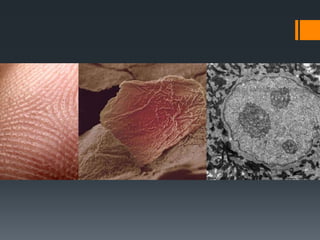
Macromolecules
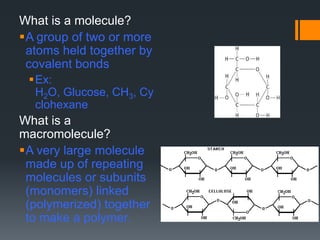
What is a molecule?
A group of two or more
 atoms held together by
 covalent bonds
 Ex:
  H2O, Glucose, CH3, Cy
  clohexane
What is a
macromolecule?
A very large molecule
 made up of repeating
 molecules or subunits
 (monomers) linked
 (polymerized) together
 to make a polymer.
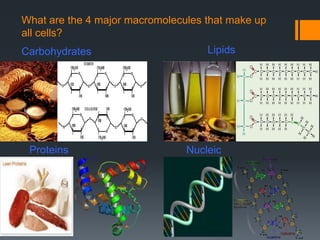
What are the 4 major macromolecules that make up
all cells?
Carbohydrates                       Lipids


 Proteins                       Nucleic
                                Acids
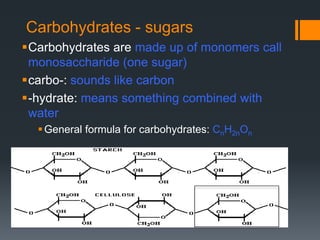
Carbohydrates - sugars
Carbohydrates are made up of monomers call
 monosaccharide (one sugar)
carbo-: sounds like carbon
-hydrate: means something combined with
 water
   General formula for carbohydrates: CnH2nOn
Carbohydrates - sugars
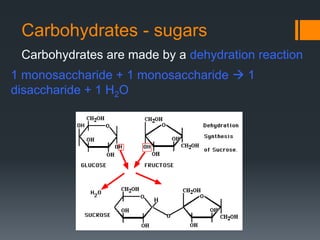
 Carbohydrates are made by a dehydration reaction
1 monosaccharide + 1 monosaccharide  1
disaccharide + 1 H2O
Polysaccharide sugars- made of 100’s to
1000’s of glucose (a type of monosaccharide)
monomer units linked by dehydration
reactions
      ex: starch
Function of a carbohydrate is usually to be an
energy source for cells
Lipids - Fats
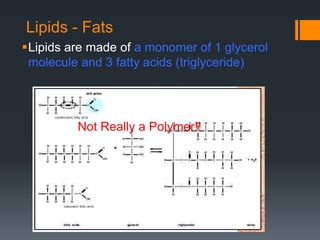
Lipids are made of a monomer of 1 glycerol
 molecule and 3 fatty acids (triglyceride)


         Not Really a Polymer!!


Proteins
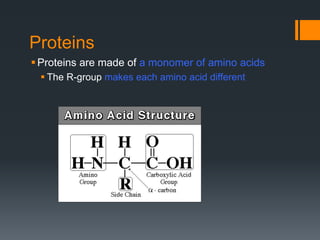
 Proteins are made of a monomer of amino acids
  The R-group makes each amino acid different
Proteins
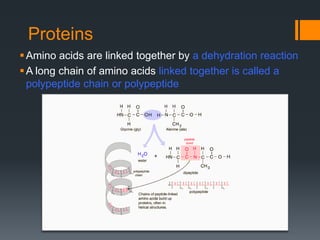
 Amino acids are linked together by a dehydration reaction
 A long chain of amino acids linked together is called a
  polypeptide chain or polypeptide


Proteins
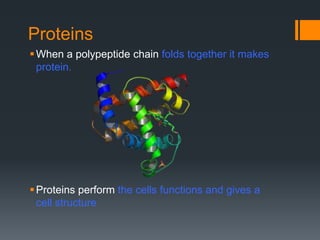
 When a polypeptide chain folds together it makes
  protein.


 Proteins perform the cells functions and gives a
  cell structure
Nucleic Acids – DNA/RNA
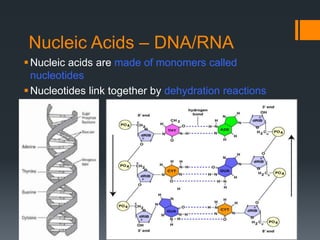
 Nucleic acids are made of monomers called
  nucleotides
 Nucleotides link together by dehydration reactions
Nucleic Acids – DNA/RNA
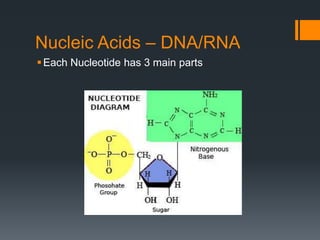
 Each Nucleotide has 3 main parts
Macromolecules slides

Macromolecules slides

  • 1.
  • 2.
    What is amolecule? A group of two or more atoms held together by covalent bonds Ex: H2O, Glucose, CH3, Cy clohexane What is a macromolecule? A very large molecule made up of repeating molecules or subunits (monomers) linked (polymerized) together to make a polymer.
  • 3.
    What are the4 major macromolecules that make up all cells? Carbohydrates Lipids Proteins Nucleic Acids
  • 4.
    Carbohydrates - sugars Carbohydratesare made up of monomers call monosaccharide (one sugar) carbo-: sounds like carbon -hydrate: means something combined with water  General formula for carbohydrates: CnH2nOn
  • 5.
    Carbohydrates - sugars Carbohydrates are made by a dehydration reaction 1 monosaccharide + 1 monosaccharide  1 disaccharide + 1 H2O
  • 6.
    Polysaccharide sugars- madeof 100’s to 1000’s of glucose (a type of monosaccharide) monomer units linked by dehydration reactions ex: starch Function of a carbohydrate is usually to be an energy source for cells
  • 7.
    Lipids - Fats Lipidsare made of a monomer of 1 glycerol molecule and 3 fatty acids (triglyceride) Not Really a Polymer!!  
  • 8.
    Proteins  Proteins aremade of a monomer of amino acids  The R-group makes each amino acid different
  • 9.
    Proteins  Amino acidsare linked together by a dehydration reaction  A long chain of amino acids linked together is called a polypeptide chain or polypeptide  
  • 10.
    Proteins  When apolypeptide chain folds together it makes protein.  Proteins perform the cells functions and gives a cell structure
  • 11.
    Nucleic Acids –DNA/RNA  Nucleic acids are made of monomers called nucleotides  Nucleotides link together by dehydration reactions
  • 12.
    Nucleic Acids –DNA/RNA  Each Nucleotide has 3 main parts

Editor's Notes

  • #8 Add glycerol always has 3 carbons and 3 hydroxyl groups…also made by dehydration reactionNot really a polymer
  • #14 http://learn.genetics.utah.edu/content/begin/cells/scale