Introduction of hormone &
Anterior pituitary drugs
By
Dr. Manoj Kumar
Assistant Professor
Department of Pharmacology
Adesh Medical College & Hospital Ambala Can’t
 .
HYPOTHALAMUS&ANTERIOR
PITUITARY HORMONES
Hormones secreted by hypothalamus and anterior pituitary
They act by binding to specific receptor sites on their target tissues.
These hormones regulate the body's growth, metabolism (the
physical and chemical processes of the body), and sexual
development and function.
The hormones are released into the bloodstream and may affect one
or several organs throughout the body.
Regulated by neuropeptides that are called either ‘ Releasing’ or
‘Inhibiting’ factors or hormones
General Functions of Hormones
Help regulate:
 Extracellular fluid
 Metabolism
 Biological clock
 Contraction of cardiac & smooth muscle
 Glandular secretion
 Some immune functions
Growth & development
Reproduction
Endocrine Glands Defined
• Exocrine glands
Sweat, oil, mucous, & digestive glands
• Endocrine glands
Pituitary, thyroid, parathyroid, adrenal, pineal
• hypothalamus, thymus, pancreas, ovaries, testes, kidneys,
stomach, liver, small intestine, heart & placenta
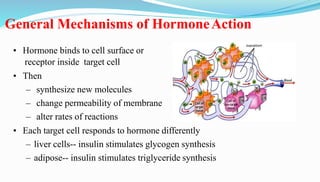
General Mechanisms of HormoneAction
• Hormone binds to cell surface or
receptor inside target cell
• Then
– synthesize new molecules
– change permeability of membrane
– alter rates of reactions
• Each target cell responds to hormone differently
– liver cells-- insulin stimulates glycogen synthesis
– adipose-- insulin stimulates triglyceride synthesis
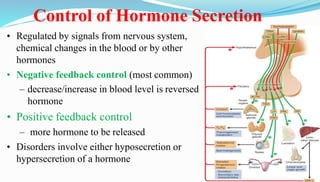
Control of Hormone Secretion
• Regulated by signals from nervous system,
chemical changes in the blood or by other
hormones
• Negative feedback control (most common)
– decrease/increase in blood level is reversed
hormone
• Positive feedback control
– more hormone to be released
• Disorders involve either hyposecretion or
hypersecretion of a hormone
 Overproduction of a hormone
 Underproduction of a hormone
 Nonfunctional receptors that cause target cells to
become insensitive to hormones
Endocrine-related Problems
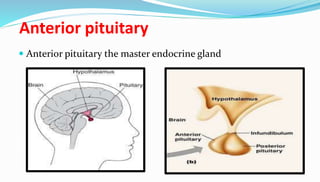
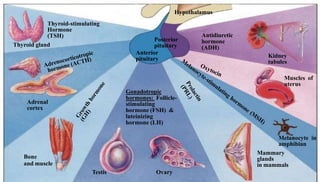
Anterior pituitary
 Anterior pituitary the master endocrine gland
2004-2005
1
18
8-
-1
19
9
Hypothalamus
Gonadotropic
hormones: Follicle-
stimulating
hormone (FSH) &
luteinizing
hormone (LH)
Mammary
glands
in mammals
Muscles of
uterus
Kidney
tubules
Posterior
pituitary
Anterior
pituitary
Thyroid-stimulating
Hormone
(TSH)
Thyroid gland
Antidiuretic
hormone
(ADH)
Adrenal
cortex
Bone
and muscle
Testis Ovary
Melanocyte in
amphibian
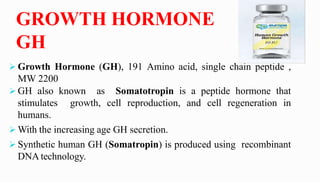
GROWTH HORMONE
GH
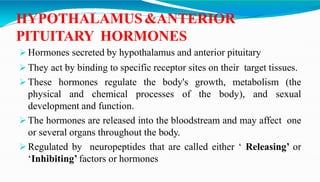
 Growth Hormone (GH), 191 Amino acid, single chain peptide ,
MW 2200
 GH also known as Somatotropin is a peptide hormone that
stimulates growth, cell reproduction, and cell regeneration in
humans.
 With the increasing age GH secretion.
 Synthetic human GH (Somatropin) is produced using recombinant
DNA technology.
Physiological role:
GH promotes growth by inducing hyperplasia.
But GH is not responsible for growth of brain and eye.
It promotes retention of nitrogen, Calcium & other tissue constituents
Increased uptake of amino acids by tissues and their synthesis into
proteins.
GH promotes utilization of fat and carbohydrates;
Reduce uptake of glucose by muscles but output from liver is
enhanced.
Induce lipolysis in adipose tissue.
GH mediates some anabolic effects on skeletal muscle & promotes
bone growth.
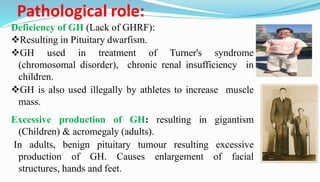
Pathological role:
Deficiency of GH (Lack of GHRF):
Resulting in Pituitary dwarfism.
GH used in treatment of Turner's syndrome
(chromosomal disorder), chronic renal insufficiency in
children.
GH is also used illegally by athletes to increase muscle
mass.
Excessive production of GH: resulting in gigantism
(Children) & acromegaly (adults).
In adults, benign pituitary tumour resulting excessive
production of GH. Causes enlargement of facial
structures, hands and feet.
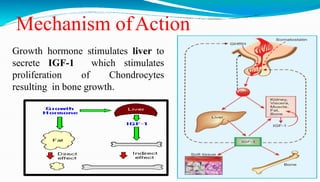
Mechanism ofAction
Growth hormone stimulates liver to
secrete IGF-1 which stimulates
proliferation of Chondrocytes
resulting in bone growth.
Therapeutic Use
 Pituitarydwarfism
 Used in treatment of GH deficiency adult.
 Turner syndrome
 Chronic renal insufficiency
 Constitutional short stature children
 AIDS related wasting
 Used in adults to increase lean body mass
 Bone density and skin thickness
 Used as an Anti AgingAgent.
.
PHARMACOKINETICS
Somatropin is administered by subcutaneous or IM injection.
Half life of GH is short (approximately 25 min).
Preparations/ Dosing:
For treatment of pituitary dwarfism-0.03-0.07 mg/kg (0.06-0.16
Units/kg) i.m. or s.c. 3 times a week upto the age of 20-25 years.
Treatment of excess GH secretion is with dopamine agonist
bromocriptine and octreotide is advised.
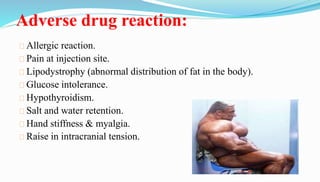
Adverse drug reaction:
Allergic reaction.
Pain at injection site.
Lipodystrophy (abnormal distribution of fat in the body).
Glucose intolerance.
Hypothyroidism.
Salt and water retention.
Hand stiffness & myalgia.
Raise in intracranial tension.
Somatostatin
 14 amino acid peptide
Produce mainly by hypothalamus and also in GIT
Inhibits secretion of GH, TSH, prolactin by pituitary and
insulin, glucagon by pancreas
All GIT secretions are inhibited including (Gastrin, HCl) -
ADR
Diarrhoea, nausea, dyspepsia, stetorrhoea, hypochlorhydria .
Constrict hepatic, splanchnic and renal blood vessels
Uses:
Acromegaly: limited use due to short half-life (2-3 min)
GI haemorrhages (250 mcg slow IV, 3 mg infusion for 12 Hrs)
Pancreatic, biliary and intestinal fistulae – antisecretory effects
GIT tumors producing excess HCl
Diabetic ketoacidosis (inhibits glucagon and GH secretion)
Drawbacks: Short duration (2-3 min) and rebound GH secretion
Octreotide
Synthetic analogue of Somatostatin and 40 times more potent
Longer duration of action (t 1/2 – 90 min)
In acromegaly preferred - Injection (100 μg) s.c thrice daily
Monitor serum GH and IGF-1 levels to assess effectiveness
Goal – decrease GH levels < 2ng/ml & IGF-1 levels within
normal range.
Binds to receptors on GH secreting tumors - decreases tumor
size
Inhibits TSH secretion and is treatment of choice in thyrotrope
adenoma that over secrete TSH.
Other Uses:
– Secretory diarrhoeas associated with carcinoid, AIDS, cancer
chemotherapy or diabetes (100 mcg SC twice daily)
– Oesophageal bleeding (100 mcg followed by 25-50 mcg/hr)
– Used for diagnostic imaging of neuroendocrine tumors
– such as pituitary adenoma and carcinoids
• Adverse effects:
• abdominal pain, steatorrhoea, diarrhoea and gall
stones
• Lanreotide and Pegvisomant (acromegaly)
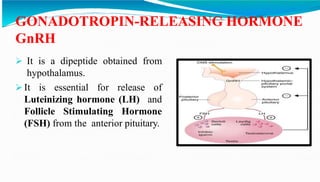
GONADOTROPIN-RELEASING HORMONE
GnRH
 It is a dipeptide obtained from
hypothalamus.
It is essential for release of
Luteinizing hormone (LH) and
Follicle Stimulating Hormone
(FSH) from the anterior pituitary.
SyntheticAnalogs
Leuprolide
Goserelin
Nafarelin
Histrelin
Therapeutic use:
Prostatic cancer.
Endometriosis.
Precocious puberty.
Adverse Effect
 In women
Hot flushes
Sweating
Depression
Ovarian cysts
 In men:
Hot flushes
Edema
Gynecomastia
PROLACTIN
 production 199 Amino acid, single chain peptide , MW 23000
Hypothalamus regulates lactotroph cells (PRH)
Lactotrophs produce prolactin
Primary stimulate = prolaction + estrogen + progestron + other
Increase growth & development
Prolactin causes milk production
Suckling reduces levels of hypothalamic inhibition and prolactin
levels rise along with milk production
 GH and development of breast during pregnancy.
 It causes proliferation of ductal as well as acinar cells in the
breast and induces synthesis of milk proteins and lactose.
Pathological role:
Hyper prolactinaemia is responsible for the galactorrhoea,
amenorrhoea, infertility syndrome in males.
Disorders of hypothalamus decreases inhibitory control over
pituitary.
Antidopaminergic and DA depleting drugs causes hyper
prolactinaemia.
Physiological role:
Prolactin inhibitor:
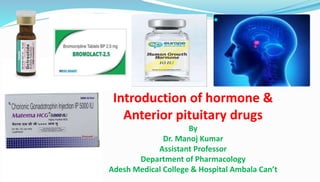
a)Bromocriptine: synthetic ergot derivative 2-bromo-aergocryptine is a potent
dopamine agonist weak a adrenergic blocker .
b) Cabergoline: It is a newer D2 agonist; more potent; more D2 selective
and longer acting (t½> 60 days) than bromocriptine less side effects than
bromocriptine.
Pharmacological actions:
Activating dopaminergic receptors and decreases Prolactin release.
In normal individuals increases GH release but decreases the same from
pituitary tumours that cause acromegaly.
It has levodopa like actions in CNS-antiparkinsonian and behavioural effects
produces nausea and vomiting by stimulating dopaminergic receptor in CTZ.
Decreases GI motility.
Pharmcokinetics: Partially absorbed (1/3rd), high first pass
reaches peak plasma concentration within 1-2 Hrs, crosses BBB,
metabolites are excreted in Bile, t1/2 - 3-6 Hrs
Uses:
Hyperprolactinemia: In women it shows galactorrhoea, amenorrhoea and
infertility & men gynaecomastia, impotence and sterility.
lower doses ( bromocriptine 2.5-10 mg/ day or cabergoline 0.25-1.0 mg twice
weekly) are effective.
Acromegaly (Due to small pituitary tumours) : Slightly higher doses of
bromocriptine required (5-20 mg/day) .
Parkinsonism: Bromocriptine effective only at high doses (20-80 mg/day) and
response is similar to that of levodopa .
Adverse drug reaction:
 Nausea
 Vomiting
 Constipation
 Nasal blockage.
 Postural hypotension in patients taking antihypertensives.
Late:
 Behavioral alterations
 Mental confusion
 Hallucinations
 Psychosis and abnormal movements
Cabergoline
• New D2 agonist
• More potent and more D2 selective
• Very long half life – 60 days or more
• Twice weekly dose
• Lesser nausea and vomiting
• Better patient compliance and tolerance
• Preferred for hyperprolactinemia and acromegaly
Gonadotropins – FSH and LH
 FSH: induces follicular growth, development of ovum and secretion of estrogen.
 In male – spermatogenesis and trophic to seminiferous tubules.
Atrophy of ovary and testes in absence
LH: Ripening of graafian follicles, triggers ovulation, rupture of follicles and
sustaining of corpus luteum.
 In male stimulates testosterone secretion
Receptors: GPCR – cAMP – gametogenesis
Regulation: GnRH (FSH/LH-RH) – single releasing factor for both
Secretes in pulses – high frequency, low amplitude and low frequency, high
amplitude
estrogen and progesteron are feedback inhibitors
Also Testosterone – weak inhibitor of FSH and LH secretion
Inhibin – inhibits FSH and Dopamine inhibits LH
Source of gonadotropins
Preparations
– Menotropin (FSH + LH)
– Urofollitropin or pure menotropins (pure FSH)
– Placenta: human chorionic gonadotropin (hCG) – only
LH activity – urine of pregnant women
– Recombinant: rFSH and rLH
Adverse effects: Ovarian bleeding, polycystic ovary, pain
in lower abdomen – due to hyper stimulation
– Precocious puberty
– Allergic reactions (skin test)
– edema, headache, mood changes
uses
1. Infertility in men & women
2. Diagnosis of hypogonadism
3. Control ovarian hyp0stimulation
4. Endometriosis
5. Uterine fibroids
6. Central precocious puberty
7. Prostatic cancer
Gonadotropin Releasing Hormone
(GnRH)
• Synthetic GnRH – 100 mg IV – causes release of FSH and
LH
• Short plasma half-life: 4-8 minutes (rapid enzymatic
degradation)
• Used for testing pituitary gonadal axis in male and female
hypogonadism
– Desensitization of pituitary gonadotropes – loss of Gn release
GnRH antagonists
•
•
•
•
•
Inhibits Gn without initial stimulation
Older ones - Reactions due to histamine release
Newer – Ganirelix, cetrorelix
Used in in vitro fertilization for suppression of LH surge
Advantages:
– Quick – competitive antagonist
– Lower risk of ovarian hyperstimulation
– Complete suppression
Nafarelin
 Long acting GnRH agonist and 150 times more potent than GnRH - Plasma
half-life 2 -3 hrs
 Peak down regulation of pituitary GnRH receptors – 1 month
Goserelin:
 Long acting – used as depot – Gn suppression, Ca Prostate, endometriosis
etc. – 1-3 weeks earlier before ovulation
Triptorelin
 SC injection (female infertility). For long-term use – IM injection monthly
 Leuprolide: Long acting IM/SC
ADRENOCORTICOTROPIC HORMONE ACTH
Hypothalamus secretes Corticotropin releasing hormone which
releases peptide Pro- Opiomelanocortin by the pituitary.
Then Pro-opiomelanocortin is converted into Adrenocorticotropic
hormone.
Physiological role:
ACTH plays a role in glucose metabolism and immune function.
The highest levels of cortisol are seen in the early morning, and
the lowest levels are in the evening.
This concept is important for diagnostic testing.
Promotes sterodogenesis in adrenal cortex by stimulating cAMP
Pathological role:
Addison‘s disease (autoimmune destruction of adrenal cortex
causes decreases level of Adrenocorticotrophic Hormone)
Cushing's disease (Increased ACTH caused by a non-cancerous
tumour called an adenoma located in the pituitary gland produces
hyperfunctioning of gland)
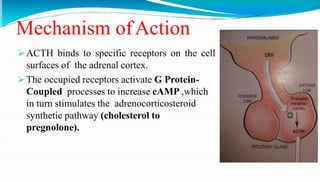
Mechanism ofAction
ACTH binds to specific receptors on the cell
surfaces of the adrenal cortex.
The occupied receptors activate G Protein-
Coupled processes to increase cAMP ,which
in turn stimulates the adrenocorticosteroid
synthetic pathway (cholesterol to
pregnolone).
Therapeutic Use:
Addison‘s disease
Adrenal insufficiency
Infantile spams
Adverse Effects:
Hypertension.
Peripheral edema.
Hypokalemia.
Emotional disturbance.
Thyroid stimulating hormone (TSH, Thyrotropin)
It is a 210 amino acid, two chain glycoprotein (22% sugar), MW
30000.
Physiological function:
TSH stimulates thyroid to synthesize and secrete thyroxine (T4) and
triiodothyronine (T3).
Induces hyperplasia and hypertrophy of thyroid follicles and
increases blood supply to the gland.
Promotes synthesis of thyroid hormones.
Pathological role:
Hypo-or hyperthyroidism are due to inappropriate TSH secretion.
Uses:
Thyrotropin has no therapeutic use only used for diagnosis purpose
of myxoedema.
Thank you