Chloramphenicol
DR. J.N. CHATURVEDI
ASSOC. PROF. (DESIG.), PHARMACOLOGY
S.S. MEDICAL COLLEGE, REWA (M.P.)
Chloramphenicol- Introduction
 Chloramphenicol, an antibiotic produced by Streptomyces venezuele,
was introduced into clinical practice in 1948.
 With the drug’s wide use, it became evident that chloramphenicol
could cause serious and fatal blood dyscrasias.
For this reason, chloramphenicol is now reserved for:
life-threatening infections (e.g., meningitis, rickettsial infections) in
patients who cannot take safer alternatives because of resistance or
allergies
Chloramphenicol- Mechanism of action
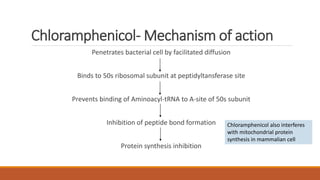
Penetrates bacterial cell by facilitated diffusion
Binds to 50s ribosomal subunit at peptidyltansferase site
Prevents binding of Aminoacyl-tRNA to A-site of 50s subunit
Inhibition of peptide bond formation
Protein synthesis inhibition
Chloramphenicol also interferes
with mitochondrial protein
synthesis in mammalian cell
Chloramphenicol- Antimicrobial Spectrum
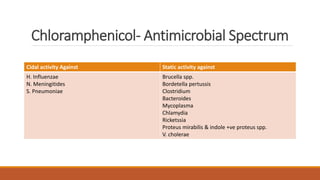
Cidal activity Against Static activity against
H. Influenzae
N. Meningitides
S. Pneumoniae
Brucella spp.
Bordetella pertussis
Clostridium
Bacteroides
Mycoplasma
Chlamydia
Ricketssia
Proteus mirabilis & indole +ve proteus spp.
V. cholerae
Chloramphenicol- Mechanism of
resistance
1. Plasmid mediated production of acetyltransferase
inactivation of drug.
2. Decreased permeability
3. Production of altered ribosomes.
Chloramphenicol- Pharmacokinetics
Absorption:
◦Well and rapidly absorbed orally
◦Tmax (oral)= 2-3 hrs.
Chloramphenicol succinate is used for parenteral
purpose.
Distribution:
◦Widely distributed throughout the body including CSF (60%
of plasma conc.)
Chloramphenicol- Pharmacokinetics
Metabolism:
◦Hepatic metabolism to inactive glucuronides (major).
Excretion:
◦Metabolites & chloramphenicol itself are excreted in urine.
Chloramphenicol- Therapeutic Uses
General Points:
◦ Therapy with chloramphenicol must be limited to infections for
which the benefits of the drug outweigh the risks of the
potential toxicities.
◦ When other antimicrobial drugs that are equally effective and
potentially less toxic are available, they should be used instead
of chloramphenicol.
Chloramphenicol- Therapeutic Uses
1. Typhoid fever:
◦ NOT PREFERRED
◦ 1 g every 6 hours for 4 weeks.
2. Bacterial Meningitis
◦ patients who have severe allergy to beta-lactams.
◦ 50mg/kg/d in four divided doses for children.
3. Rickettsial Diseases:
◦ Patients allergic to tetracycline, pregnant women & children <8 years of age
requiring prolong therapy.
◦ Rocky Mountain spotted fever, epidemic, murine, scrub, and recrudescent typhus,
and Q fever.
◦ 50mg/kg/d in four divided doses. Dose may be doubled in case of resistance.
Chloramphenicol- Adverse Drug reactions
1. Hypersensitivity reactions
2. Haematological toxicities
◦ Dose related: anaemia, leukopenia or thrombocytopenia.
◦ Idiosyncratic: Aplastic anaemia resulting in fatal pancytopenia.
3. Other toxic & irritative effects
◦ Nausea, vomiting, unpleasant taste, diarrhoea & perineal irritation.
◦ Encephalopathy
◦ Cardiomyopathy
◦ Gray baby syndrome:
◦ Occurs in neonates (esp. premature). Vomiting, refusal to suck, irregular & rapid respiration,
abdominal distention, periods of cyanosis and passage of loose green stool. Over next 24 hours
babies may turn ashen grey & become flaccid and hypothermic.
Chloramphenicol

Chloramphenicol

  • 1.
    Chloramphenicol DR. J.N. CHATURVEDI ASSOC.PROF. (DESIG.), PHARMACOLOGY S.S. MEDICAL COLLEGE, REWA (M.P.)
  • 2.
    Chloramphenicol- Introduction  Chloramphenicol,an antibiotic produced by Streptomyces venezuele, was introduced into clinical practice in 1948.  With the drug’s wide use, it became evident that chloramphenicol could cause serious and fatal blood dyscrasias. For this reason, chloramphenicol is now reserved for: life-threatening infections (e.g., meningitis, rickettsial infections) in patients who cannot take safer alternatives because of resistance or allergies
  • 3.
    Chloramphenicol- Mechanism ofaction Penetrates bacterial cell by facilitated diffusion Binds to 50s ribosomal subunit at peptidyltansferase site Prevents binding of Aminoacyl-tRNA to A-site of 50s subunit Inhibition of peptide bond formation Protein synthesis inhibition Chloramphenicol also interferes with mitochondrial protein synthesis in mammalian cell
  • 4.
    Chloramphenicol- Antimicrobial Spectrum Cidalactivity Against Static activity against H. Influenzae N. Meningitides S. Pneumoniae Brucella spp. Bordetella pertussis Clostridium Bacteroides Mycoplasma Chlamydia Ricketssia Proteus mirabilis & indole +ve proteus spp. V. cholerae
  • 5.
    Chloramphenicol- Mechanism of resistance 1.Plasmid mediated production of acetyltransferase inactivation of drug. 2. Decreased permeability 3. Production of altered ribosomes.
  • 6.
    Chloramphenicol- Pharmacokinetics Absorption: ◦Well andrapidly absorbed orally ◦Tmax (oral)= 2-3 hrs. Chloramphenicol succinate is used for parenteral purpose. Distribution: ◦Widely distributed throughout the body including CSF (60% of plasma conc.)
  • 7.
    Chloramphenicol- Pharmacokinetics Metabolism: ◦Hepatic metabolismto inactive glucuronides (major). Excretion: ◦Metabolites & chloramphenicol itself are excreted in urine.
  • 8.
    Chloramphenicol- Therapeutic Uses GeneralPoints: ◦ Therapy with chloramphenicol must be limited to infections for which the benefits of the drug outweigh the risks of the potential toxicities. ◦ When other antimicrobial drugs that are equally effective and potentially less toxic are available, they should be used instead of chloramphenicol.
  • 9.
    Chloramphenicol- Therapeutic Uses 1.Typhoid fever: ◦ NOT PREFERRED ◦ 1 g every 6 hours for 4 weeks. 2. Bacterial Meningitis ◦ patients who have severe allergy to beta-lactams. ◦ 50mg/kg/d in four divided doses for children. 3. Rickettsial Diseases: ◦ Patients allergic to tetracycline, pregnant women & children <8 years of age requiring prolong therapy. ◦ Rocky Mountain spotted fever, epidemic, murine, scrub, and recrudescent typhus, and Q fever. ◦ 50mg/kg/d in four divided doses. Dose may be doubled in case of resistance.
  • 10.
    Chloramphenicol- Adverse Drugreactions 1. Hypersensitivity reactions 2. Haematological toxicities ◦ Dose related: anaemia, leukopenia or thrombocytopenia. ◦ Idiosyncratic: Aplastic anaemia resulting in fatal pancytopenia. 3. Other toxic & irritative effects ◦ Nausea, vomiting, unpleasant taste, diarrhoea & perineal irritation. ◦ Encephalopathy ◦ Cardiomyopathy ◦ Gray baby syndrome: ◦ Occurs in neonates (esp. premature). Vomiting, refusal to suck, irregular & rapid respiration, abdominal distention, periods of cyanosis and passage of loose green stool. Over next 24 hours babies may turn ashen grey & become flaccid and hypothermic.