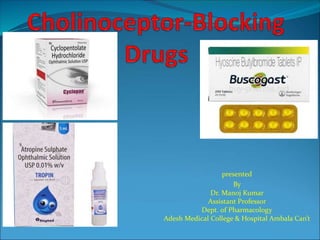
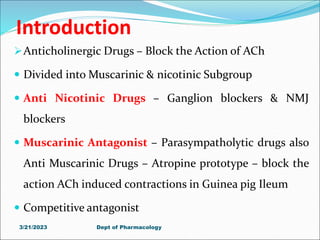
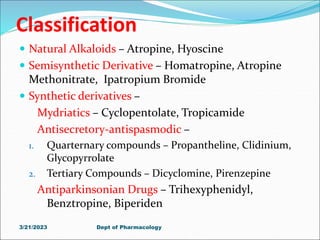
presented
By
Dr. Manoj Kumar
Assistant Professor
Dept. of Pharmacology
Adesh Medical College & Hospital Ambala Can’t
Introduction
Anticholinergic Drugs – Block the Action of ACh
 Divided into Muscarinic & nicotinic Subgroup
 Anti Nicotinic Drugs – Ganglion blockers & NMJ
blockers
 Muscarinic Antagonist – Parasympatholytic drugs also
Anti Muscarinic Drugs – Atropine prototype – block the
action ACh induced contractions in Guinea pig Ileum
 Competitive antagonist
3/21/2023 Dept of Pharmacology
Classification
 Natural Alkaloids – Atropine, Hyoscine
 Semisynthetic Derivative – Homatropine, Atropine
Methonitrate, Ipatropium Bromide
 Synthetic derivatives –
Mydriatics – Cyclopentolate, Tropicamide
Antisecretory-antispasmodic –
1. Quarternary compounds – Propantheline, Clidinium,
Glycopyrrolate
2. Tertiary Compounds – Dicyclomine, Pirenzepine
Antiparkinsonian Drugs – Trihexyphenidyl,
Benztropine, Biperiden
3/21/2023 Dept of Pharmacology
Atropine
 Atropine sulphate is a tertiary amine & the
naturally occurring levorotatory form is active.
 Administered IV/IM in a range of 0.01-0.02 mg/kg
upto adult dose of 0.4-0.6 mg.
 Larger IV doses upto 2 mg may be required to
completely block the cardiac vagal nerves in
treating severe bradycardia.
3/21/2023 Dept of Pharmacology
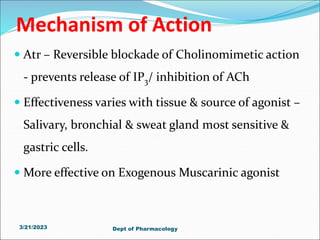
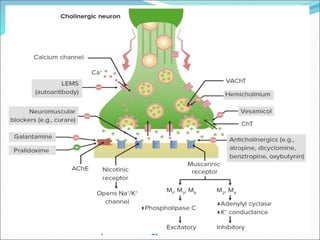
Mechanism of Action
 Atr – Reversible blockade of Cholinomimetic action
- prevents release of IP3/ inhibition of ACh
 Effectiveness varies with tissue & source of agonist –
Salivary, bronchial & sweat gland most sensitive &
gastric cells.
 More effective on Exogenous Muscarinic agonist
3/21/2023 Dept of Pharmacology
Pharmacological Actions CNS : -
 Atropine has CNS stimulant action.
 These effects are not appreciable at low doses.
 Atropine stimulates many medullary centers –
vagal, respiratory, vasomotor.
 It depresses vestibular excitation and has anti-
motion sickness property.
 It suppresses tremor & rigidity of parkinsonism.
3/21/2023 Dept of Pharmacology
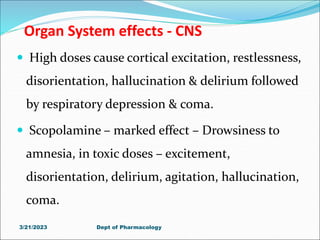
Organ System effects - CNS
 High doses cause cortical excitation, restlessness,
disorientation, hallucination & delirium followed
by respiratory depression & coma.
 Scopolamine – marked effect – Drowsiness to
amnesia, in toxic doses – excitement,
disorientation, delirium, agitation, hallucination,
coma.
3/21/2023 Dept of Pharmacology
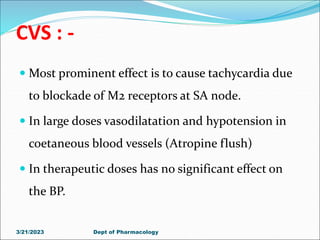
CVS : -
 Most prominent effect is to cause tachycardia due
to blockade of M2 receptors at SA node.
 In large doses vasodilatation and hypotension in
coetaneous blood vessels (Atropine flush)
 In therapeutic doses has no significant effect on
the BP.
3/21/2023 Dept of Pharmacology
Organ system effect Eye –
 Topical instillation of atropine causes mydriasis by
blocking muscarinic receptors in sphincter pupillae.
 Abolition of light reflex
 Photophobia & blurring of near vision.
 Weakening of contraction of ciliary muscle – Cycloplegia.
 Reduction of Lachrymal secretion,
 Increase in IOP
3/21/2023 Dept of Pharmacology
Respiratory system –
 Even in normal individual – Bronchodilation &
reduction in secretion significant in Airway disease
– effectiveness limited as block of auto inhibitory
M2 opposes Bronchodilation by block of M3.
 Used prior to GA
3/21/2023 Dept of Pharmacology
Smooth muscles : -
 All visceral smooth muscles that receive parasympathetic
motor innervations are relaxed by atropine due to M3
blockade.
 Genitourinary Tract –
 Atropine Relaxes Sm of Ureters, bladder, which cause
urinary retention in elderly men
3/21/2023 Dept of Pharmacology
Organ system effect GIT –
 Dry mouth
 Gastric secretion blocked – vol & amt of acid, pepsin
& mucin reduced.
 Basal secretion more effectively blocked, Pirenzepine
& Telenzepine, tone & propulsive movement
decreased, prolongs gastric emptying & intestinal
transit time.
3/21/2023 Dept of Pharmacology
Glands : -
 Atropine markedly decreases sweat, salivary,
tracheobronchial & lacrimal secretions by M3
blockade.
 Skin & eyes become dry.
 Talking & swallowing may be difficult.
3/21/2023 Dept of Pharmacology
Body temperature : -
 Rise in body temperature occur at high doses due
to both inhibition of sweating as well as
stimulation of temperature regulating centre in
the hypothalamus.
 Children are highly susceptible to Atropine fever.
3/21/2023 Dept of Pharmacology
Local anaesthetic :
 Atropine has mild anesthetic action on the cornea.
 Sensitivity of different organs & tissues to atropine
varies & can be graded as –
 Saliva, sweat, bronchial secretion > eye, bronchial
muscle, heart > smooth muscle of intestine,
bladder > gastric glands & smooth muscles.
3/21/2023 Dept of Pharmacology
Drugs
 Atropine Methonitrate – abdominal colics,
hyperacidity, bronchial asthma, asthmaticus bronchitis
 Ipatropium - bronchial muscle
 Propantheline – peptic ulcer, gastritis
 Clidinium – with benzodiazepines for nervous
dyspepsia, gastritis, irritable colon, peptic ulcer
 Glycopyrrolate – rapidly acting for pre anesthetic
medication
 Dicyclomine –direct smooth muscle relaxant effect
 Drotaverine – non anti-cholinergic smooth muscle
antispasmodic inhibits Phosphodiesterase-4,
 AE – headache, dizziness, constipation, flushing
3/21/2023 Dept of Pharmacology
Uses
 As anti-secretory :
 Pre-anesthetic medication : reduces excessive
salivation & respiratory secretions.
 Peptic ulcer : decreases gastric secretions & provide
symptomatic relief in peptic ulcer now
 Superseded by H2 blockers.
 As anti-spasmodic : - If there is no mechanical
obstruction intestinal & renal colic, abdominal cramps
symptomatic relief is affordable.
 Gastritis, gastric hypermortility.
 To relive urinary frequency & urgency.
3/21/2023 Dept of Pharmacology
.
 Can be given in patients of Bronchial Asthma
 As mydiatric & cycloplegic.
 As cardiac vagolytic
 For central actions in Parkinsonism as an adjuvant to
levodopa.
 To antagonize muscarinic effects of anti-
Cholinesterase i.e. OP Poisoning with dose 2mg IV
with repeated doses and early mushroom poisoning.
3/21/2023 Dept of Pharmacology
Therapeutic Applications
 CNS disorders – Parkinson's Disease – practice of
poly pharmacy.
 Motion Sickness – sea sickness – scopolamine – inj,
po, TTS, lie detector
 Ophthalmologic disorders – Accurate measurement
of refractory error in uncooperative patients,
 Examination of retina, not used unless mydriasis
required for prolonged duration
 prevents synechia formation in uveitis & iritis
3/21/2023 Dept of Pharmacology
Therapeutic Applications
 Respiratory Disorders – Pre anesthetic medication
(Ether) – Decrease Secretion, amnesia,
 Asthma – hyperactive Neural bronchoconstrictor
reflex
 Ipatropium used – Through aerosol. Also COPD
3/21/2023 Dept of Pharmacology
Therapeutic Applications
 CVS – Parenteral Atr for depressed SAN/ AVN
following AMI, in Hyperactive carotid sinus
reflexes,
 In Idiopathic dilated cardiomyopathy –
Circulating AB – Parasympathomimetic action
3/21/2023 Dept of Pharmacology
 GIT – Traveler’s diarrhea, hypermotility disorder,
in peptic ulcer,
 Nervous & drug induced diarrhea, spastic
constipation, irritable colon,
 Urinary Disorder – symptomatic relief in urinary
urgency,
 Oxybutynin – after urologic surgery
3/21/2023 Dept of Pharmacology
Therapeutic Applications
 Cholinergic Poisoning – Antimuscarinic therapy (to
reverse muscarinic effect – tertiary amine – 1-2 mg every
5-15 min till reversal of miosis),
 Cholinesterase regenerator Compounds (Oxime agents
–Pralidoxime (PAM) – 1-2 g every 15-30 min,
Diacetylmonoxime (DAM) not for Carbamates reversal)
 Other application – Hyperhidrosis
3/21/2023 Dept of Pharmacology
Side effects
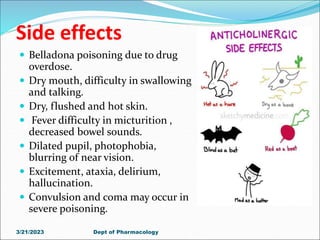
 Belladona poisoning due to drug
overdose.
 Dry mouth, difficulty in swallowing
and talking.
 Dry, flushed and hot skin.
 Fever difficulty in micturition ,
decreased bowel sounds.
 Dilated pupil, photophobia,
blurring of near vision.
 Excitement, ataxia, delirium,
hallucination.
 Convulsion and coma may occur in
severe poisoning.
3/21/2023 Dept of Pharmacology
Diagnosis -
 – Methacholine/neostigmine inj fail to induce
muscarinic effects
 Treatment Symptomatic
 Contraindication – Glaucoma, history of
Prostatic hyperplasia, acid peptic disease (non
selective)
3/21/2023 Dept of Pharmacology
Glycopyrolate
 Glycopyrolate is a synthetic product that differs from
atropine in being a quaternary amine.
 The pre-medication dose is 0.005 – 0.01 mg/kg upto
0.2-0.3 mg in adults.
Clinical consideration :
 Glycopyrolate can’t cross.
 Potent inhibition of salivary gland & respiratory tract
secretions
 Glycopyrolate as pre-medication.
 Heart rate increases after IV administration.
 It has longer duration of action than atropine sulphate
i.e 2- 4 hrs.
3/21/2023 Dept of Pharmacology
Scopolamine
 Scopolamine is a naturally occurring tertiary amine.
 It’s dose is 0.3-0.5 micro gram I/M.
 Clinical Consideration : Lipid soluble.
 Easy penetrate BBB.
 More potent antisialagogue than Atropine & causes greater
CNS effects
 Clinical doses results in restlessness, drowsiness, amnesia,
dizziness & delirium.
 It has the added virtue of preventing motion sickness.
 The lipid solubility allows trans-dermal absorption & has
been used to prevent post-operative nausea & vomiting
 Avoided in patients with closed angle glaucoma.
3/21/2023 Dept of Pharmacology
Central Anticholinergic Syndrome
 Anticholinergic drugs like scopolamine, atropine can
enter central nervous system (CNS) and produce some
unusual symptoms which are characterized in a
syndrome which is known as central anticholinergic
syndrome.
Symptoms are -
 Restlessness
 Hallucination to somnolence
 Unconsciousness
Glycopyrrolate does not easily cross BBB & not likely
cause CAS.
3/21/2023 Dept of Pharmacology

Anticholinergics drugs

  • 1.
    presented By Dr. Manoj Kumar AssistantProfessor Dept. of Pharmacology Adesh Medical College & Hospital Ambala Can’t
  • 2.
    Introduction Anticholinergic Drugs –Block the Action of ACh  Divided into Muscarinic & nicotinic Subgroup  Anti Nicotinic Drugs – Ganglion blockers & NMJ blockers  Muscarinic Antagonist – Parasympatholytic drugs also Anti Muscarinic Drugs – Atropine prototype – block the action ACh induced contractions in Guinea pig Ileum  Competitive antagonist 3/21/2023 Dept of Pharmacology
  • 3.
    Classification  Natural Alkaloids– Atropine, Hyoscine  Semisynthetic Derivative – Homatropine, Atropine Methonitrate, Ipatropium Bromide  Synthetic derivatives – Mydriatics – Cyclopentolate, Tropicamide Antisecretory-antispasmodic – 1. Quarternary compounds – Propantheline, Clidinium, Glycopyrrolate 2. Tertiary Compounds – Dicyclomine, Pirenzepine Antiparkinsonian Drugs – Trihexyphenidyl, Benztropine, Biperiden 3/21/2023 Dept of Pharmacology
  • 4.
    Atropine  Atropine sulphateis a tertiary amine & the naturally occurring levorotatory form is active.  Administered IV/IM in a range of 0.01-0.02 mg/kg upto adult dose of 0.4-0.6 mg.  Larger IV doses upto 2 mg may be required to completely block the cardiac vagal nerves in treating severe bradycardia. 3/21/2023 Dept of Pharmacology
  • 5.
    Mechanism of Action Atr – Reversible blockade of Cholinomimetic action - prevents release of IP3/ inhibition of ACh  Effectiveness varies with tissue & source of agonist – Salivary, bronchial & sweat gland most sensitive & gastric cells.  More effective on Exogenous Muscarinic agonist 3/21/2023 Dept of Pharmacology
  • 6.
    3/21/2023 Dept ofPharmacology
  • 7.
    Pharmacological Actions CNS: -  Atropine has CNS stimulant action.  These effects are not appreciable at low doses.  Atropine stimulates many medullary centers – vagal, respiratory, vasomotor.  It depresses vestibular excitation and has anti- motion sickness property.  It suppresses tremor & rigidity of parkinsonism. 3/21/2023 Dept of Pharmacology
  • 8.
    Organ System effects- CNS  High doses cause cortical excitation, restlessness, disorientation, hallucination & delirium followed by respiratory depression & coma.  Scopolamine – marked effect – Drowsiness to amnesia, in toxic doses – excitement, disorientation, delirium, agitation, hallucination, coma. 3/21/2023 Dept of Pharmacology
  • 9.
    CVS : - Most prominent effect is to cause tachycardia due to blockade of M2 receptors at SA node.  In large doses vasodilatation and hypotension in coetaneous blood vessels (Atropine flush)  In therapeutic doses has no significant effect on the BP. 3/21/2023 Dept of Pharmacology
  • 10.
    Organ system effectEye –  Topical instillation of atropine causes mydriasis by blocking muscarinic receptors in sphincter pupillae.  Abolition of light reflex  Photophobia & blurring of near vision.  Weakening of contraction of ciliary muscle – Cycloplegia.  Reduction of Lachrymal secretion,  Increase in IOP 3/21/2023 Dept of Pharmacology
  • 11.
    Respiratory system – Even in normal individual – Bronchodilation & reduction in secretion significant in Airway disease – effectiveness limited as block of auto inhibitory M2 opposes Bronchodilation by block of M3.  Used prior to GA 3/21/2023 Dept of Pharmacology
  • 12.
    Smooth muscles :-  All visceral smooth muscles that receive parasympathetic motor innervations are relaxed by atropine due to M3 blockade.  Genitourinary Tract –  Atropine Relaxes Sm of Ureters, bladder, which cause urinary retention in elderly men 3/21/2023 Dept of Pharmacology
  • 13.
    Organ system effectGIT –  Dry mouth  Gastric secretion blocked – vol & amt of acid, pepsin & mucin reduced.  Basal secretion more effectively blocked, Pirenzepine & Telenzepine, tone & propulsive movement decreased, prolongs gastric emptying & intestinal transit time. 3/21/2023 Dept of Pharmacology
  • 14.
    Glands : - Atropine markedly decreases sweat, salivary, tracheobronchial & lacrimal secretions by M3 blockade.  Skin & eyes become dry.  Talking & swallowing may be difficult. 3/21/2023 Dept of Pharmacology
  • 15.
    Body temperature :-  Rise in body temperature occur at high doses due to both inhibition of sweating as well as stimulation of temperature regulating centre in the hypothalamus.  Children are highly susceptible to Atropine fever. 3/21/2023 Dept of Pharmacology
  • 16.
    Local anaesthetic : Atropine has mild anesthetic action on the cornea.  Sensitivity of different organs & tissues to atropine varies & can be graded as –  Saliva, sweat, bronchial secretion > eye, bronchial muscle, heart > smooth muscle of intestine, bladder > gastric glands & smooth muscles. 3/21/2023 Dept of Pharmacology
  • 17.
    Drugs  Atropine Methonitrate– abdominal colics, hyperacidity, bronchial asthma, asthmaticus bronchitis  Ipatropium - bronchial muscle  Propantheline – peptic ulcer, gastritis  Clidinium – with benzodiazepines for nervous dyspepsia, gastritis, irritable colon, peptic ulcer  Glycopyrrolate – rapidly acting for pre anesthetic medication  Dicyclomine –direct smooth muscle relaxant effect  Drotaverine – non anti-cholinergic smooth muscle antispasmodic inhibits Phosphodiesterase-4,  AE – headache, dizziness, constipation, flushing 3/21/2023 Dept of Pharmacology
  • 18.
    Uses  As anti-secretory:  Pre-anesthetic medication : reduces excessive salivation & respiratory secretions.  Peptic ulcer : decreases gastric secretions & provide symptomatic relief in peptic ulcer now  Superseded by H2 blockers.  As anti-spasmodic : - If there is no mechanical obstruction intestinal & renal colic, abdominal cramps symptomatic relief is affordable.  Gastritis, gastric hypermortility.  To relive urinary frequency & urgency. 3/21/2023 Dept of Pharmacology
  • 19.
    .  Can begiven in patients of Bronchial Asthma  As mydiatric & cycloplegic.  As cardiac vagolytic  For central actions in Parkinsonism as an adjuvant to levodopa.  To antagonize muscarinic effects of anti- Cholinesterase i.e. OP Poisoning with dose 2mg IV with repeated doses and early mushroom poisoning. 3/21/2023 Dept of Pharmacology
  • 20.
    Therapeutic Applications  CNSdisorders – Parkinson's Disease – practice of poly pharmacy.  Motion Sickness – sea sickness – scopolamine – inj, po, TTS, lie detector  Ophthalmologic disorders – Accurate measurement of refractory error in uncooperative patients,  Examination of retina, not used unless mydriasis required for prolonged duration  prevents synechia formation in uveitis & iritis 3/21/2023 Dept of Pharmacology
  • 21.
    Therapeutic Applications  RespiratoryDisorders – Pre anesthetic medication (Ether) – Decrease Secretion, amnesia,  Asthma – hyperactive Neural bronchoconstrictor reflex  Ipatropium used – Through aerosol. Also COPD 3/21/2023 Dept of Pharmacology
  • 22.
    Therapeutic Applications  CVS– Parenteral Atr for depressed SAN/ AVN following AMI, in Hyperactive carotid sinus reflexes,  In Idiopathic dilated cardiomyopathy – Circulating AB – Parasympathomimetic action 3/21/2023 Dept of Pharmacology
  • 23.
     GIT –Traveler’s diarrhea, hypermotility disorder, in peptic ulcer,  Nervous & drug induced diarrhea, spastic constipation, irritable colon,  Urinary Disorder – symptomatic relief in urinary urgency,  Oxybutynin – after urologic surgery 3/21/2023 Dept of Pharmacology Therapeutic Applications
  • 24.
    Therapeutic Applications  CholinergicPoisoning – Antimuscarinic therapy (to reverse muscarinic effect – tertiary amine – 1-2 mg every 5-15 min till reversal of miosis),  Cholinesterase regenerator Compounds (Oxime agents –Pralidoxime (PAM) – 1-2 g every 15-30 min, Diacetylmonoxime (DAM) not for Carbamates reversal)  Other application – Hyperhidrosis 3/21/2023 Dept of Pharmacology
  • 25.
    Side effects  Belladonapoisoning due to drug overdose.  Dry mouth, difficulty in swallowing and talking.  Dry, flushed and hot skin.  Fever difficulty in micturition , decreased bowel sounds.  Dilated pupil, photophobia, blurring of near vision.  Excitement, ataxia, delirium, hallucination.  Convulsion and coma may occur in severe poisoning. 3/21/2023 Dept of Pharmacology
  • 26.
    Diagnosis -  –Methacholine/neostigmine inj fail to induce muscarinic effects  Treatment Symptomatic  Contraindication – Glaucoma, history of Prostatic hyperplasia, acid peptic disease (non selective) 3/21/2023 Dept of Pharmacology
  • 27.
    Glycopyrolate  Glycopyrolate isa synthetic product that differs from atropine in being a quaternary amine.  The pre-medication dose is 0.005 – 0.01 mg/kg upto 0.2-0.3 mg in adults. Clinical consideration :  Glycopyrolate can’t cross.  Potent inhibition of salivary gland & respiratory tract secretions  Glycopyrolate as pre-medication.  Heart rate increases after IV administration.  It has longer duration of action than atropine sulphate i.e 2- 4 hrs. 3/21/2023 Dept of Pharmacology
  • 28.
    Scopolamine  Scopolamine isa naturally occurring tertiary amine.  It’s dose is 0.3-0.5 micro gram I/M.  Clinical Consideration : Lipid soluble.  Easy penetrate BBB.  More potent antisialagogue than Atropine & causes greater CNS effects  Clinical doses results in restlessness, drowsiness, amnesia, dizziness & delirium.  It has the added virtue of preventing motion sickness.  The lipid solubility allows trans-dermal absorption & has been used to prevent post-operative nausea & vomiting  Avoided in patients with closed angle glaucoma. 3/21/2023 Dept of Pharmacology
  • 29.
    Central Anticholinergic Syndrome Anticholinergic drugs like scopolamine, atropine can enter central nervous system (CNS) and produce some unusual symptoms which are characterized in a syndrome which is known as central anticholinergic syndrome. Symptoms are -  Restlessness  Hallucination to somnolence  Unconsciousness Glycopyrrolate does not easily cross BBB & not likely cause CAS. 3/21/2023 Dept of Pharmacology
  • 30.
    3/21/2023 Dept ofPharmacology