UNIT III-THIN FILM DEPOSITION
TECHNIQUES
8/2/2020
DEPARTMENT OF PHYSICS, CATHOLICATE
COLLEGE, PATHANAMTHITTA
1
Presented by
Dr. Dhanya I.
Department of Physics
Catholicate College
Pathanamthitta
III. CATHODIC SPUTTERING
1. OVERVIEW OF SPUTTERING PROCESS
i) GLOW DISCHARGE SPUTTERING
ii) LOW PRESSURE SPUTTERING
1) Assisted/Triode Sputtering
CATHODIC SPUTTERING
Sputtering Process:
Ejection of atoms from
the surface of a material
target by bombardment
with energetic particles.
Cathodic Sputtering :
Ejection is due to positive
ion bombardment
Ejected or sputtered
atoms can be condensed
on a substrate to form
thinfilm
8/2/2020
DEPARTMENT OF PHYSICS,
CATHOLICATE COLLEGE,
PATHANAMTHITTA
2
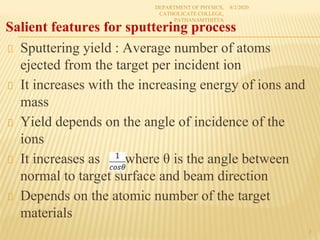
Sputtering yield : Average number of atoms
ejected from the target per incident ion
It increases with the increasing energy of ions and
mass
Yield depends on the angle of incidence of the
ions
It increases as where θ is the angle between
normal to target surface and beam direction
Depends on the atomic number of the target
materials
8/2/2020
DEPARTMENT OF PHYSICS,
CATHOLICATE COLLEGE,
PATHANAMTHITTA
3
Salient features for sputtering process
8/2/2020
DEPARTMENT OF PHYSICS,
CATHOLICATE COLLEGE,
PATHANAMTHITTA
4
Depends on the target temperature at its high value
Yield for single crystal target increases with
decreasing transparency of the crystal in the
direction of ion beam
As the yield increases, the ejected particles are
evaporated as atoms/clusters of atoms
Ejected atom leave the surface in an excited or
ionized state and show characteristic recombination
during emission
DIFFERENT TYPES OF SPUTTERING
8/2/2020
DEPARTMENT OF PHYSICS,
CATHOLICATE COLLEGE,
PATHANAMTHITTA
5
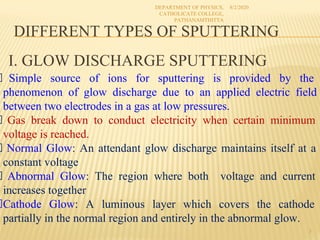
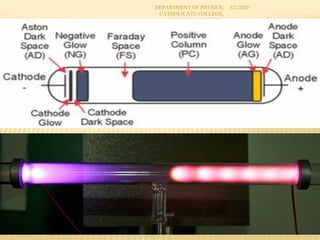
I. GLOW DISCHARGE SPUTTERING
Simple source of ions for sputtering is provided by the
phenomenon of glow discharge due to an applied electric field
between two electrodes in a gas at low pressures.
Gas break down to conduct electricity when certain minimum
voltage is reached.
Normal Glow: An attendant glow discharge maintains itself at a
constant voltage
Abnormal Glow: The region where both voltage and current
increases together
Cathode Glow: A luminous layer which covers the cathode
partially in the normal region and entirely in the abnormal glow.
8/2/2020
DEPARTMENT OF PHYSICS,
CATHOLICATE COLLEGE,
PATHANAMTHITTA
6
8/2/2020
DEPARTMENT OF PHYSICS,
CATHOLICATE COLLEGE,
PATHANAMTHITTA
7
Cathode Dark Space: A fairly well defined region of
relatively low luminosity. A region where most of the
applied voltage is dropped[cathode fall]
Negative Glow region: Region followed by cathode dark
space where ions and electrons created in breakdown
region are accelerated and can collide with the gas
Positive Column: Due to collision of gas atoms in
negative glow region with energetic ions can create
secondary electrons to sustain glow and hit the anode to
give sputtering
8/2/2020
DEPARTMENT OF PHYSICS, CATHOLICATE
COLLEGE, PATHANAMTHITTA
8
FACTORS INFLUENCING GLOW DISCHARGE
SPUTTERING
Pressure: As the gas pressure increases, voltage falls, cathode
dark space decreases and number of ions increases and favors
the sputtering process. Optimum pressure range for glow
discharge sputtering is between 25-75mTorr
Deposit distribution: Due to the collision of ions with ambient
gas atoms at high pressure, the sputtered atoms are diffusely
scattered results in a well collimated transport of material to
yield good quality of films.
Current and Voltage Dependence: Sputtering rate is
proportional to the current for a constant voltage. Glow
discharge sputtering is proportional to the product of current
and voltage. Typical voltage: 1-5KV and current density :
1-10mA/Cm2
.
8/2/2020
DEPARTMENT OF PHYSICS, CATHOLICATE
COLLEGE, PATHANAMTHITTA
9
II. LOW PRESSURE SPUTTERING
Decreasing influence of gas atoms
lower concentration of trapped gas atoms
control direction
generate a high mean energy for ejected atoms.
It results in a smaller collision losses and results
in reasonable sputtering rate
4-types of Low pressure sputtering processes
8/2/2020
DEPARTMENT OF PHYSICS, CATHOLICATE
COLLEGE, PATHANAMTHITTA
10
1. ASSISTED/ TRIODE SPUTTERING
8/2/2020
DEPARTMENT OF PHYSICS, CATHOLICATE
COLLEGE, PATHANAMTHITTA
11
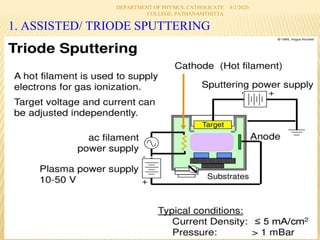
• Auxiliary electrons may be supplied thermionically
from a filament for ionization of gases
•Total ionization and efficiency are increased by
accelerating the electrons by means of third electrode
•Ejection of beams from triode to gas produce plasma
triode sputtering
•Uses: sputtering of noble metals: 20Ao
/min at
1mTorr pressure.
8/2/2020
DEPARTMENT OF PHYSICS, CATHOLICATE
COLLEGE, PATHANAMTHITTA
12
THANK YOU FOR YOUR LISTENING

sputtering process

  • 1.
    UNIT III-THIN FILMDEPOSITION TECHNIQUES 8/2/2020 DEPARTMENT OF PHYSICS, CATHOLICATE COLLEGE, PATHANAMTHITTA 1 Presented by Dr. Dhanya I. Department of Physics Catholicate College Pathanamthitta III. CATHODIC SPUTTERING 1. OVERVIEW OF SPUTTERING PROCESS i) GLOW DISCHARGE SPUTTERING ii) LOW PRESSURE SPUTTERING 1) Assisted/Triode Sputtering
  • 2.
    CATHODIC SPUTTERING Sputtering Process: Ejectionof atoms from the surface of a material target by bombardment with energetic particles. Cathodic Sputtering : Ejection is due to positive ion bombardment Ejected or sputtered atoms can be condensed on a substrate to form thinfilm 8/2/2020 DEPARTMENT OF PHYSICS, CATHOLICATE COLLEGE, PATHANAMTHITTA 2
  • 3.
    Sputtering yield :Average number of atoms ejected from the target per incident ion It increases with the increasing energy of ions and mass Yield depends on the angle of incidence of the ions It increases as where θ is the angle between normal to target surface and beam direction Depends on the atomic number of the target materials 8/2/2020 DEPARTMENT OF PHYSICS, CATHOLICATE COLLEGE, PATHANAMTHITTA 3 Salient features for sputtering process
  • 4.
    8/2/2020 DEPARTMENT OF PHYSICS, CATHOLICATECOLLEGE, PATHANAMTHITTA 4 Depends on the target temperature at its high value Yield for single crystal target increases with decreasing transparency of the crystal in the direction of ion beam As the yield increases, the ejected particles are evaporated as atoms/clusters of atoms Ejected atom leave the surface in an excited or ionized state and show characteristic recombination during emission
  • 5.
    DIFFERENT TYPES OFSPUTTERING 8/2/2020 DEPARTMENT OF PHYSICS, CATHOLICATE COLLEGE, PATHANAMTHITTA 5 I. GLOW DISCHARGE SPUTTERING Simple source of ions for sputtering is provided by the phenomenon of glow discharge due to an applied electric field between two electrodes in a gas at low pressures. Gas break down to conduct electricity when certain minimum voltage is reached. Normal Glow: An attendant glow discharge maintains itself at a constant voltage Abnormal Glow: The region where both voltage and current increases together Cathode Glow: A luminous layer which covers the cathode partially in the normal region and entirely in the abnormal glow.
  • 6.
  • 7.
    8/2/2020 DEPARTMENT OF PHYSICS, CATHOLICATECOLLEGE, PATHANAMTHITTA 7 Cathode Dark Space: A fairly well defined region of relatively low luminosity. A region where most of the applied voltage is dropped[cathode fall] Negative Glow region: Region followed by cathode dark space where ions and electrons created in breakdown region are accelerated and can collide with the gas Positive Column: Due to collision of gas atoms in negative glow region with energetic ions can create secondary electrons to sustain glow and hit the anode to give sputtering
  • 8.
    8/2/2020 DEPARTMENT OF PHYSICS,CATHOLICATE COLLEGE, PATHANAMTHITTA 8 FACTORS INFLUENCING GLOW DISCHARGE SPUTTERING Pressure: As the gas pressure increases, voltage falls, cathode dark space decreases and number of ions increases and favors the sputtering process. Optimum pressure range for glow discharge sputtering is between 25-75mTorr Deposit distribution: Due to the collision of ions with ambient gas atoms at high pressure, the sputtered atoms are diffusely scattered results in a well collimated transport of material to yield good quality of films. Current and Voltage Dependence: Sputtering rate is proportional to the current for a constant voltage. Glow discharge sputtering is proportional to the product of current and voltage. Typical voltage: 1-5KV and current density : 1-10mA/Cm2 .
  • 9.
    8/2/2020 DEPARTMENT OF PHYSICS,CATHOLICATE COLLEGE, PATHANAMTHITTA 9 II. LOW PRESSURE SPUTTERING Decreasing influence of gas atoms lower concentration of trapped gas atoms control direction generate a high mean energy for ejected atoms. It results in a smaller collision losses and results in reasonable sputtering rate 4-types of Low pressure sputtering processes
  • 10.
    8/2/2020 DEPARTMENT OF PHYSICS,CATHOLICATE COLLEGE, PATHANAMTHITTA 10 1. ASSISTED/ TRIODE SPUTTERING
  • 11.
    8/2/2020 DEPARTMENT OF PHYSICS,CATHOLICATE COLLEGE, PATHANAMTHITTA 11 • Auxiliary electrons may be supplied thermionically from a filament for ionization of gases •Total ionization and efficiency are increased by accelerating the electrons by means of third electrode •Ejection of beams from triode to gas produce plasma triode sputtering •Uses: sputtering of noble metals: 20Ao /min at 1mTorr pressure.
  • 12.
    8/2/2020 DEPARTMENT OF PHYSICS,CATHOLICATE COLLEGE, PATHANAMTHITTA 12 THANK YOU FOR YOUR LISTENING