
Monte Carlo simulations of production
of collimated panoramic X-rays using a
conical anode-type X-ray tube
Andrii Sofiienko, PhD, University of Bergen
Chad Jarvis, PhD, CMR Computing, Bergen
Ådne Voll, Visuray AS, Stavanger
2014 1
Introduction
The general purpose of this research was to investigate, using
Monte Carlo simulations, the X-ray generation process in an X-
ray tube with a conical tungsten anode and cylindrical
symmetry.
We determined the following:
 the intensity of generated X-rays in the energy range of
250-500 keV;
 the optimal target shape;
 the angular distribution of the intensity of the generated X-
rays and collimated through a cylindrical hole from an
external collimator;
 the efficiency of X-ray generation.
2
Monte Carlo simulations
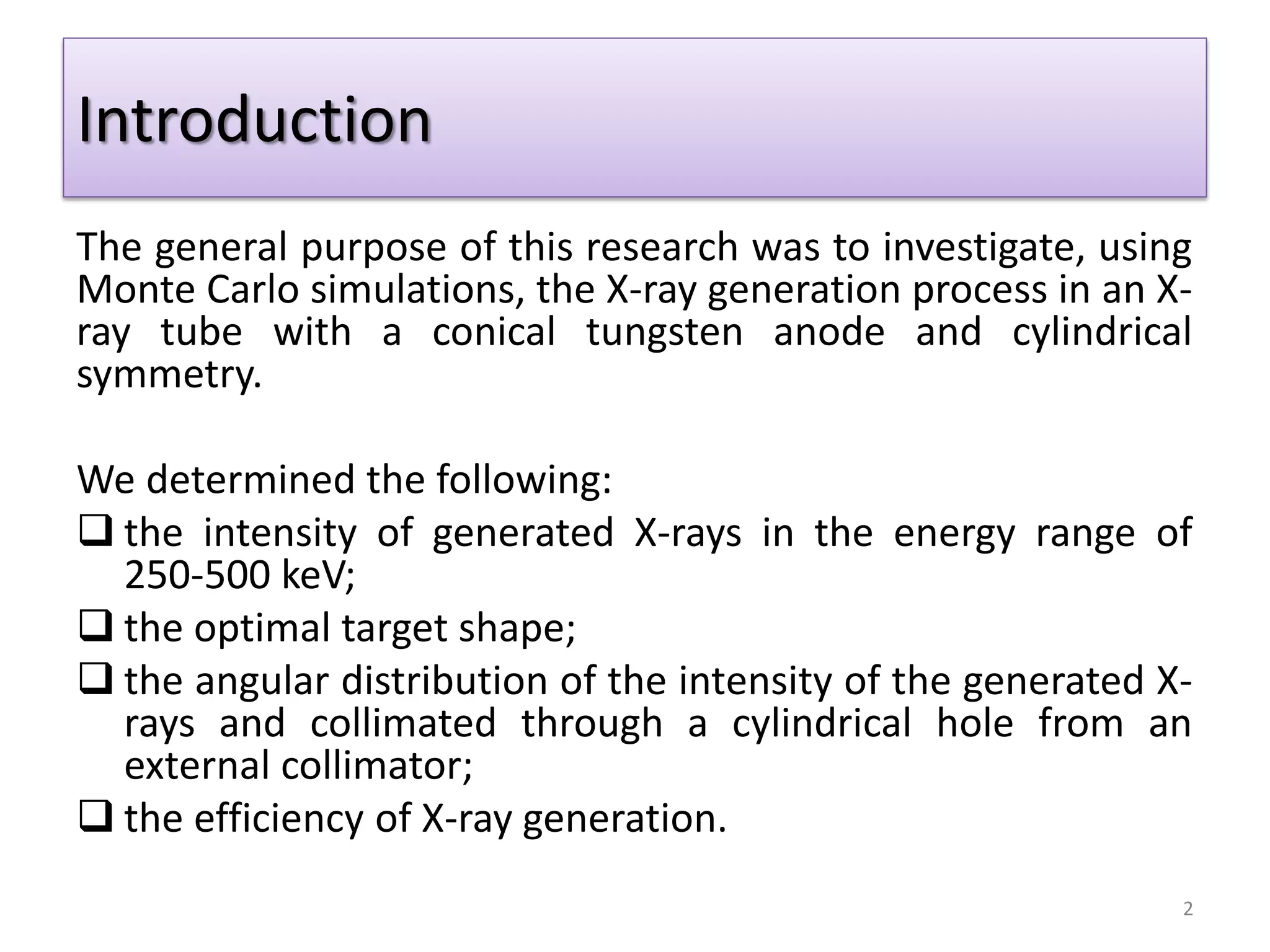
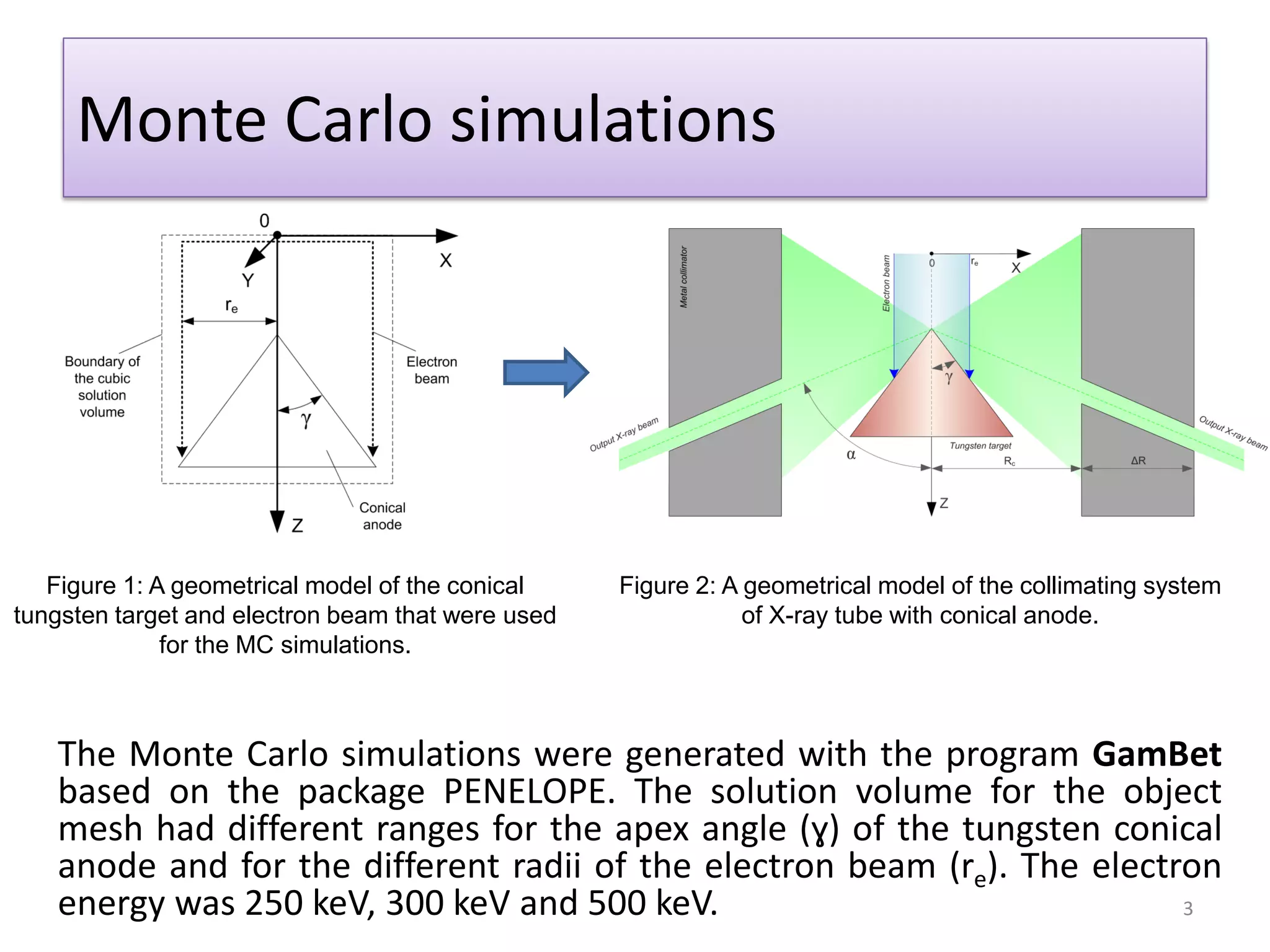
The Monte Carlo simulations were generated with the program GamBet
based on the package PENELOPE. The solution volume for the object
mesh had different ranges for the apex angle (ɣ) of the tungsten conical
anode and for the different radii of the electron beam (re). The electron
energy was 250 keV, 300 keV and 500 keV. 3
Figure 1: A geometrical model of the conical
tungsten target and electron beam that were used
for the MC simulations.
Figure 2: A geometrical model of the collimating system
of X-ray tube with conical anode.
Modelling of the external collimator
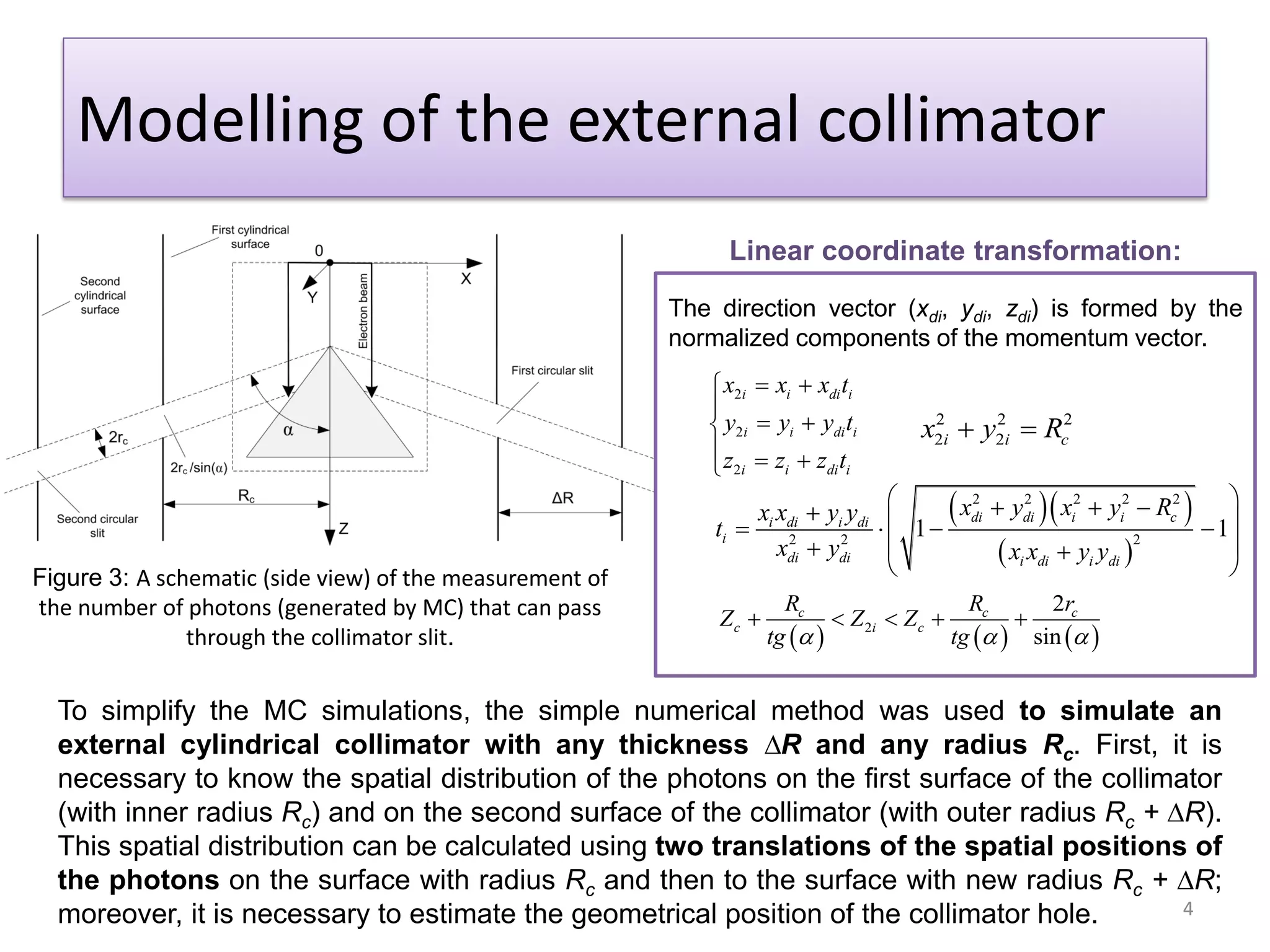
To simplify the MC simulations, the simple numerical method was used to simulate an
external cylindrical collimator with any thickness ∆R and any radius Rc. First, it is
necessary to know the spatial distribution of the photons on the first surface of the collimator
(with inner radius Rc) and on the second surface of the collimator (with outer radius Rc + ∆R).
This spatial distribution can be calculated using two translations of the spatial positions of
the photons on the surface with radius Rc and then to the surface with new radius Rc + ∆R;
moreover, it is necessary to estimate the geometrical position of the collimator hole. 4
Figure 3: A schematic (side view) of the measurement of
the number of photons (generated by MC) that can pass
through the collimator slit.
Linear coordinate transformation:
The direction vector (xdi, ydi, zdi) is formed by the
normalized components of the momentum vector.
2
2
2
i i di i
i i di i
i i di i
x x x t
y y y t
z z z t
 

 
  
2 2 2
2 2i i cx y R 
  
 
2 2 2 2 2
22 2
1 1
di di i i ci i
i
di di i i
di di
di di
x y x y Rx y y
t
x y x y
x
yx
        
  
 
     2
2
sin
c c c
c i c
R R r
Z Z Z
tg tg  
    
Results
5
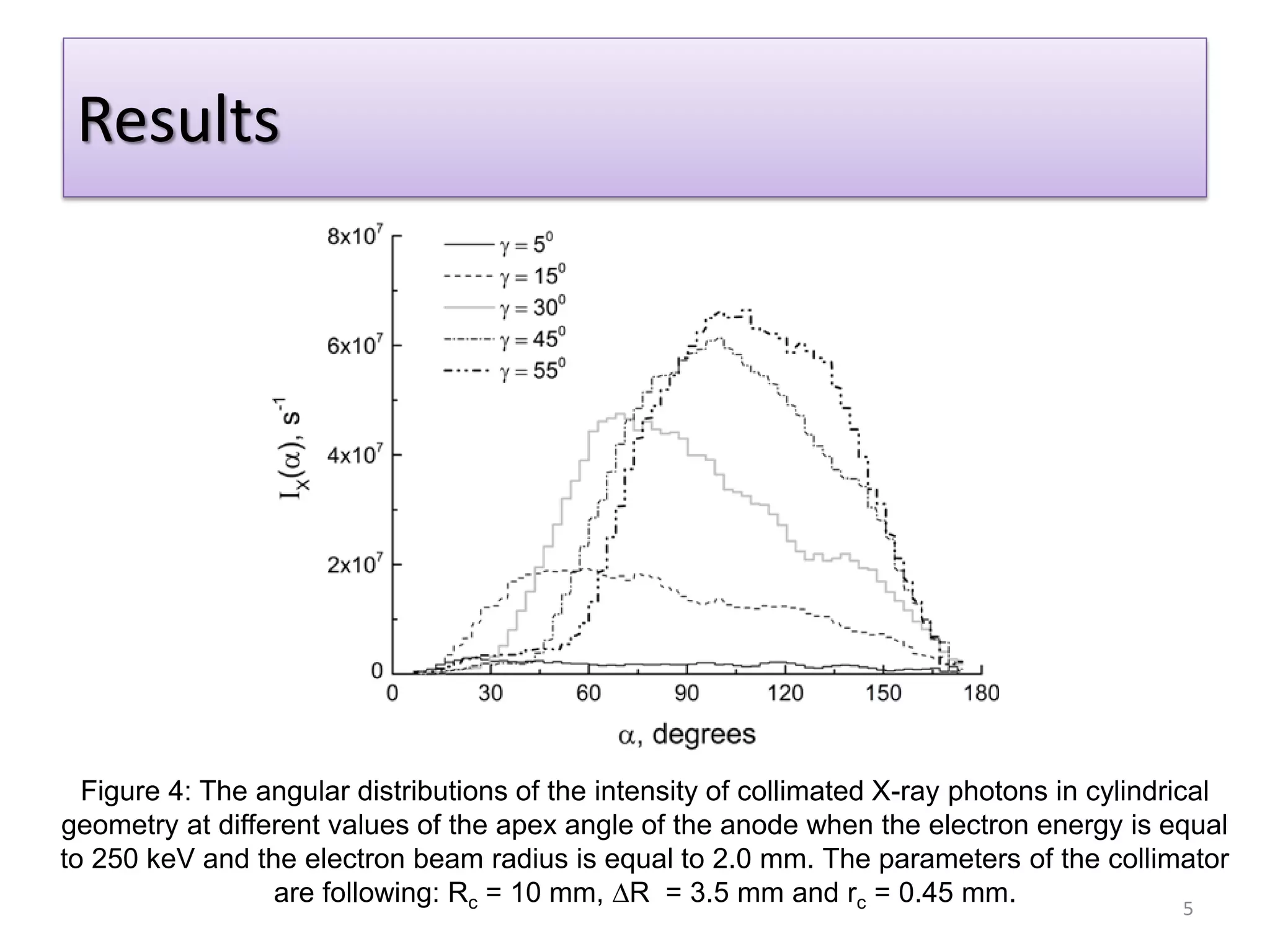
Figure 4: The angular distributions of the intensity of collimated X-ray photons in cylindrical
geometry at different values of the apex angle of the anode when the electron energy is equal
to 250 keV and the electron beam radius is equal to 2.0 mm. The parameters of the collimator
are following: Rc = 10 mm, ∆R = 3.5 mm and rc = 0.45 mm.
Results
6
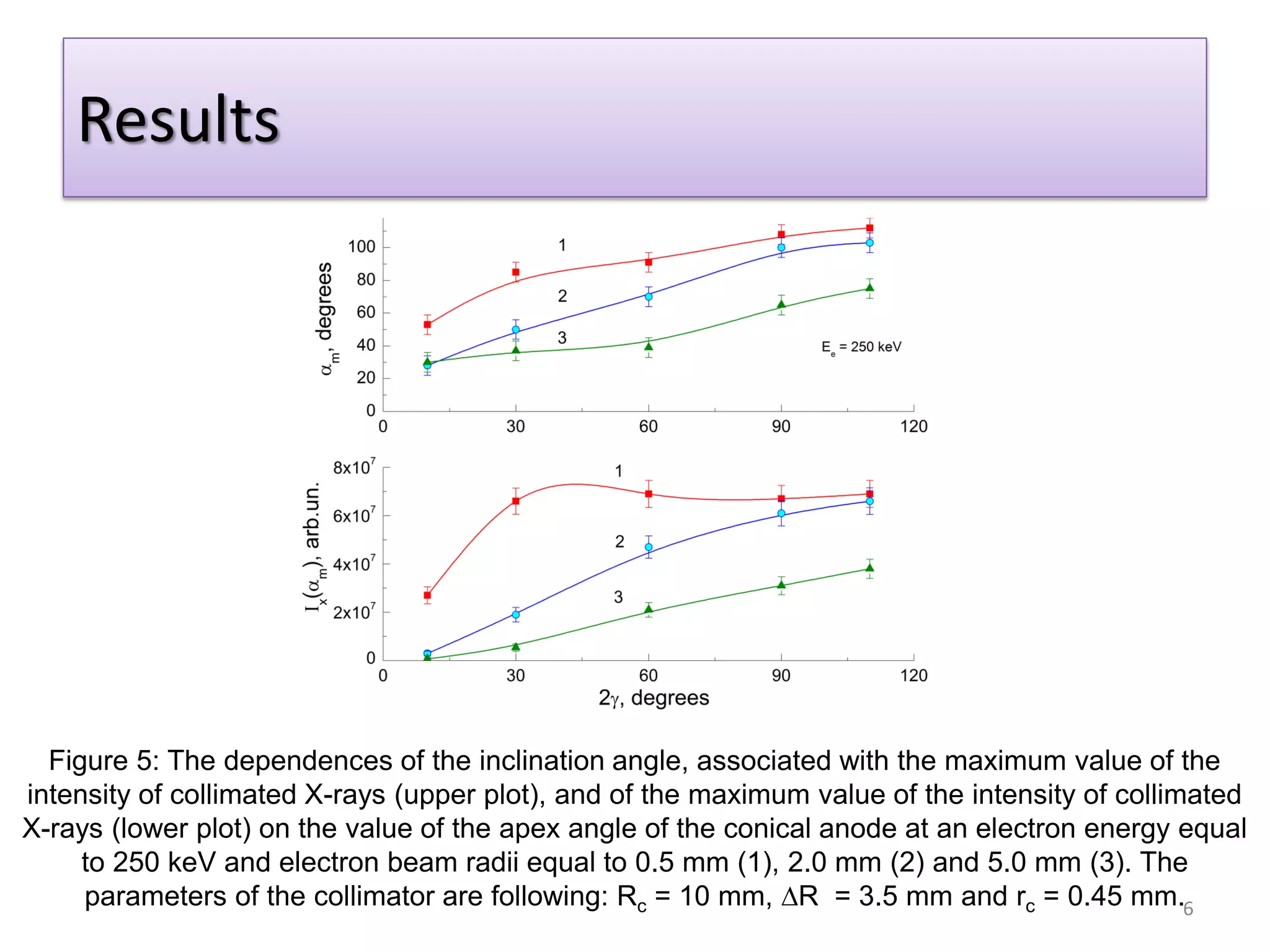
Figure 5: The dependences of the inclination angle, associated with the maximum value of the
intensity of collimated X-rays (upper plot), and of the maximum value of the intensity of collimated
X-rays (lower plot) on the value of the apex angle of the conical anode at an electron energy equal
to 250 keV and electron beam radii equal to 0.5 mm (1), 2.0 mm (2) and 5.0 mm (3). The
parameters of the collimator are following: Rc = 10 mm, ∆R = 3.5 mm and rc = 0.45 mm.
Thank you for your attention!
Any questions?
7

Monte Carlo simulations of production of collimated panoramic X-rays using a conical anode-type X-ray tube

  • 1.
    Monte Carlo simulationsof production of collimated panoramic X-rays using a conical anode-type X-ray tube Andrii Sofiienko, PhD, University of Bergen Chad Jarvis, PhD, CMR Computing, Bergen Ådne Voll, Visuray AS, Stavanger 2014 1
  • 2.
    Introduction The general purposeof this research was to investigate, using Monte Carlo simulations, the X-ray generation process in an X- ray tube with a conical tungsten anode and cylindrical symmetry. We determined the following:  the intensity of generated X-rays in the energy range of 250-500 keV;  the optimal target shape;  the angular distribution of the intensity of the generated X- rays and collimated through a cylindrical hole from an external collimator;  the efficiency of X-ray generation. 2
  • 3.
    Monte Carlo simulations TheMonte Carlo simulations were generated with the program GamBet based on the package PENELOPE. The solution volume for the object mesh had different ranges for the apex angle (ɣ) of the tungsten conical anode and for the different radii of the electron beam (re). The electron energy was 250 keV, 300 keV and 500 keV. 3 Figure 1: A geometrical model of the conical tungsten target and electron beam that were used for the MC simulations. Figure 2: A geometrical model of the collimating system of X-ray tube with conical anode.
  • 4.
    Modelling of theexternal collimator To simplify the MC simulations, the simple numerical method was used to simulate an external cylindrical collimator with any thickness ∆R and any radius Rc. First, it is necessary to know the spatial distribution of the photons on the first surface of the collimator (with inner radius Rc) and on the second surface of the collimator (with outer radius Rc + ∆R). This spatial distribution can be calculated using two translations of the spatial positions of the photons on the surface with radius Rc and then to the surface with new radius Rc + ∆R; moreover, it is necessary to estimate the geometrical position of the collimator hole. 4 Figure 3: A schematic (side view) of the measurement of the number of photons (generated by MC) that can pass through the collimator slit. Linear coordinate transformation: The direction vector (xdi, ydi, zdi) is formed by the normalized components of the momentum vector. 2 2 2 i i di i i i di i i i di i x x x t y y y t z z z t         2 2 2 2 2i i cx y R       2 2 2 2 2 22 2 1 1 di di i i ci i i di di i i di di di di x y x y Rx y y t x y x y x yx                    2 2 sin c c c c i c R R r Z Z Z tg tg       
  • 5.
    Results 5 Figure 4: Theangular distributions of the intensity of collimated X-ray photons in cylindrical geometry at different values of the apex angle of the anode when the electron energy is equal to 250 keV and the electron beam radius is equal to 2.0 mm. The parameters of the collimator are following: Rc = 10 mm, ∆R = 3.5 mm and rc = 0.45 mm.
  • 6.
    Results 6 Figure 5: Thedependences of the inclination angle, associated with the maximum value of the intensity of collimated X-rays (upper plot), and of the maximum value of the intensity of collimated X-rays (lower plot) on the value of the apex angle of the conical anode at an electron energy equal to 250 keV and electron beam radii equal to 0.5 mm (1), 2.0 mm (2) and 5.0 mm (3). The parameters of the collimator are following: Rc = 10 mm, ∆R = 3.5 mm and rc = 0.45 mm.
  • 7.
    Thank you foryour attention! Any questions? 7