Course MM-501:
Phase Transformations in Solids
MM 501
Ashraf Ali NED University
Diffusion in Solids
ISSUES TO ADDRESS...
• How does diffusion occur?
• Why is it an important part of processing?
• How can the rate of diffusion be predicted for
some simple cases?
• How does diffusion depend on structure
and temperature?
• What is Diffusion?
MM 501
Ashraf Ali NED University
•Often think of diffusion in a medium where atoms are relatively
free to move around such as liquids and gases…
e.g. making chocolate milk. Really need to stir the milk to
get that viscous chocolate syrup evenly mixed!
•Even in solids, atom is not fixed at its position but constantly
moves around. The degree of movement depends on its
temperature (extrinsically) and structure (intrinsically).
Mechanisms
•Gases & Liquids – random (Brownian) motion
•Solids – vacancy diffusion or interstitial diffusion
•But all movements are random motion in nature!
What is diffusion?
•Phenomenon of material transport by atomic motion.
MM 501
Ashraf Ali NED University
Diffusion in Solids
Diffusion plays an important role in…
• Alloying
• Strengthening and Heat Treatment Processes
• High Temperature Mechanical Behavior
• Phase Transformations
• Environmental Degradation
MM 501
Ashraf Ali NED University
Why do we care about diffusion in solids?
e.g., Materials processing
1. Chemical reactions/treatments require mass transfer (i.e.
diffusion).
e.g. alloying, strengthening of materials via case
hardening etc…
2. Many materials are heat treated to achieve necessary
properties: prefer to develop methods that will allow relatively
high diffusion rates to achieve an efficient/cost-effectively
process, Homogenisation for example.
MM 501
Ashraf Ali NED University
1. Hard Facing (Carburizing of Steels)
Tough Tools and Parts.
Wear Facing of Gears, Wheels and Rails
2. Chemical Tempering of Glass and Ceramics
Toughened Ceramics (Corel Ware)
Shard resistant safety glass
3. Thin Film Electronics (CMOS and Bipolar Transistors)
Doping of Semiconductors
Applications of Diffusion in Solids
(besides nucleation and growth)
MM 501
Ashraf Ali NED University
4. Diffusion Bonding -- (Adhesives and Cements -
ceramic, metallic and polymer)
a. Portland Cement as Bonding for Construction
b. Solvent Cements for PVC Polymeric Piping
c. Thermocouple Junctions
5. Corrosion Protection
Galvanizing, Electroplating, Anodizing, Inhibiting
6. Gas (Chemical) Separation Processes -
Diffusion membranes
Applications of Diffusion in Solids….
MM 501
Ashraf Ali NED University
PROCESSING USING
DIFFUSION (1)
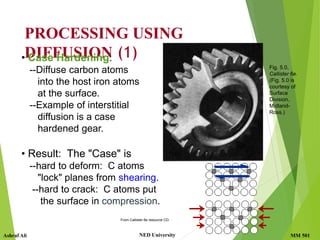
• Case Hardening:
--Diffuse carbon atoms
into the host iron atoms
at the surface.
--Example of interstitial
diffusion is a case
hardened gear.
• Result: The "Case" is
--hard to deform: C atoms
"lock" planes from shearing.
--hard to crack: C atoms put
the surface in compression.
Fig. 5.0,
Callister 6e.
(Fig. 5.0 is
courtesy of
Surface
Division,
Midland-
Ross.)
From Callister 6e resource CD.
MM 501
Ashraf Ali NED University
Diffusion Bonding
 Diffusion bonding is a method of creating a joint between similar or
dissimilar metals, alloys, and nonmetals.
 Two materials are pressed together (typically in a vacuum) at a specific
bonding pressure with a bonding temperature for a specific holding time.
PROCESSING USING DIFFUSION (2)
MM 501
Ashraf Ali NED University
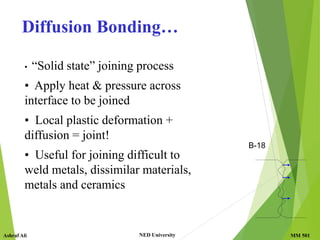
• “Solid state” joining process
• Apply heat & pressure across
interface to be joined
• Local plastic deformation +
diffusion = joint!
• Useful for joining difficult to
weld metals, dissimilar materials,
metals and ceramics
B-18
Diffusion Bonding…
MM 501
Ashraf Ali NED University
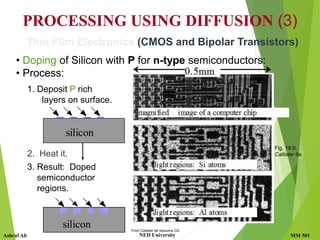
• Doping of Silicon with P for n-type semiconductors:
• Process:
1. Deposit P rich
layers on surface.
2. Heat it.
3. Result: Doped
semiconductor
regions.
silicon
silicon
Fig. 18.0,
Callister 6e.
From Callister 6e resource CD.
PROCESSING USING DIFFUSION (3)
Thin Film Electronics (CMOS and Bipolar Transistors)
MM 501
Ashraf Ali NED University
DIFFUSION: THE
PHENOMENON
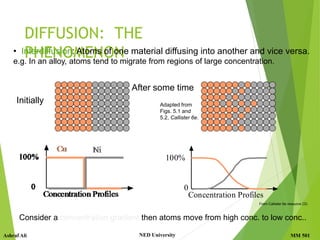
• Interdiffusion: Atoms of one material diffusing into another and vice versa.
e.g. In an alloy, atoms tend to migrate from regions of large concentration.
Initially
After some time
100%
Concentration Profiles
0
Adapted from
Figs. 5.1 and
5.2, Callister 6e.
From Callister 6e resource CD.
Consider a concentration gradient then atoms move from high conc. to low conc..
MM 501
Ashraf Ali NED University
DIFFUSION: THE
PHENOMENON
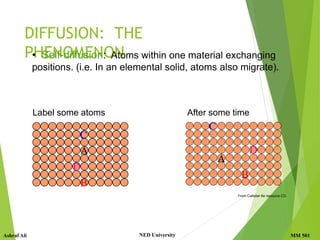
• Self-diffusion: Atoms within one material exchanging
positions. (i.e. In an elemental solid, atoms also migrate).
Label some atoms After some time
A
B
C
D
From Callister 6e resource CD.
MM 501
Ashraf Ali NED University
Diffusion mechanisms
How do atoms move in a crystalline solid?
For diffusion to occur:
1. Adjacent site needs to be empty (vacancy or
interstitial).
2. Sufficient energy must be available to break
bonds and overcome lattice distortion.
There are many possible mechanisms but let’s consider
the simple cases:
1. Vacancy diffusion.
2. Interstitial diffusion.
MM 501
Ashraf Ali NED University
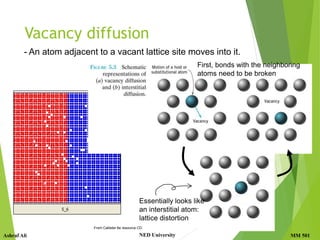
Vacancy diffusion
- An atom adjacent to a vacant lattice site moves into it.
Essentially looks like
an interstitial atom:
lattice distortion
First, bonds with the neighboring
atoms need to be broken
From Callister 6e resource CD.
MM 501
Ashraf Ali NED University
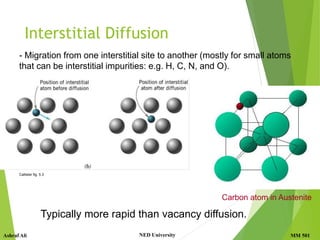
Interstitial Diffusion
- Migration from one interstitial site to another (mostly for small atoms
that can be interstitial impurities: e.g. H, C, N, and O).
Typically more rapid than vacancy diffusion.
Callister fig. 5.3
Carbon atom in Austenite
MM 501
Ashraf Ali NED University
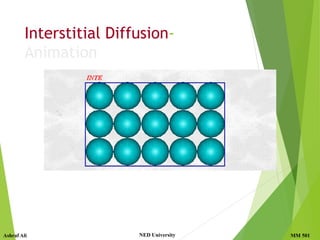
Interstitial Diffusion-
Animation
MM 501
Ashraf Ali NED University
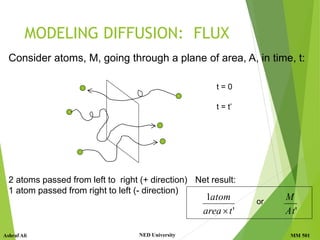
MODELING DIFFUSION: FLUX
Consider atoms, M, going through a plane of area, A, in time, t:
t = 0
t = t’
2 atoms passed from left to right (+ direction)
1 atom passed from right to left (- direction)
Net result:
'
1
t
area
atom

or
'
At
M
MM 501
Ashraf Ali NED University
MODELING DIFFUSION: FLUX
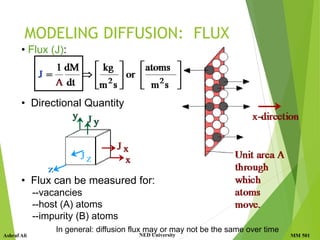
• Flux (J):
• Directional Quantity
• Flux can be measured for:
--vacancies
--host (A) atoms
--impurity (B) atoms
In general: diffusion flux may or may not be the same over time
MM 501
Ashraf Ali NED University
MODELING DIFFUSION
What causes net flow of atoms?
• Concentration Profile, C(x): [kg/m3]
• Fick's First Law:
Concentration
of Cu [kg/m 3]
Concentration
of Ni [kg/m 3]
Position, x
Cu flux Ni flux
• The steeper the concentration profile,
the greater the flux!
Adapted from
Fig. 5.2(c),
Callister 6e.
MM 501
Ashraf Ali NED University
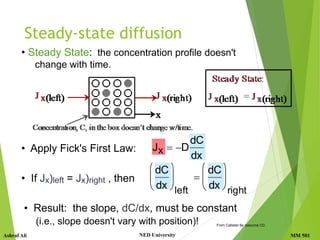
• Steady State: the concentration profile doesn't
change with time.
Steady-state diffusion
• Apply Fick's First Law:
• Result: the slope, dC/dx, must be constant
(i.e., slope doesn't vary with position)!
Jx  D
dC
dx
dC
dx






left

dC
dx






right
• If Jx)left = Jx)right , then
From Callister 6e resource CD.
MM 501
Ashraf Ali NED University
MM 501
Ashraf Ali NED University
Thanks!
Any questions?
You can find me at
● @hamzaahmed
● hamzaahmed0696@mail.me

Diffusion in Solids-Lecture-1.ppt

  • 1.
  • 2.
    MM 501 Ashraf AliNED University Diffusion in Solids ISSUES TO ADDRESS... • How does diffusion occur? • Why is it an important part of processing? • How can the rate of diffusion be predicted for some simple cases? • How does diffusion depend on structure and temperature? • What is Diffusion?
  • 3.
    MM 501 Ashraf AliNED University •Often think of diffusion in a medium where atoms are relatively free to move around such as liquids and gases… e.g. making chocolate milk. Really need to stir the milk to get that viscous chocolate syrup evenly mixed! •Even in solids, atom is not fixed at its position but constantly moves around. The degree of movement depends on its temperature (extrinsically) and structure (intrinsically). Mechanisms •Gases & Liquids – random (Brownian) motion •Solids – vacancy diffusion or interstitial diffusion •But all movements are random motion in nature! What is diffusion? •Phenomenon of material transport by atomic motion.
  • 4.
    MM 501 Ashraf AliNED University Diffusion in Solids Diffusion plays an important role in… • Alloying • Strengthening and Heat Treatment Processes • High Temperature Mechanical Behavior • Phase Transformations • Environmental Degradation
  • 5.
    MM 501 Ashraf AliNED University Why do we care about diffusion in solids? e.g., Materials processing 1. Chemical reactions/treatments require mass transfer (i.e. diffusion). e.g. alloying, strengthening of materials via case hardening etc… 2. Many materials are heat treated to achieve necessary properties: prefer to develop methods that will allow relatively high diffusion rates to achieve an efficient/cost-effectively process, Homogenisation for example.
  • 6.
    MM 501 Ashraf AliNED University 1. Hard Facing (Carburizing of Steels) Tough Tools and Parts. Wear Facing of Gears, Wheels and Rails 2. Chemical Tempering of Glass and Ceramics Toughened Ceramics (Corel Ware) Shard resistant safety glass 3. Thin Film Electronics (CMOS and Bipolar Transistors) Doping of Semiconductors Applications of Diffusion in Solids (besides nucleation and growth)
  • 7.
    MM 501 Ashraf AliNED University 4. Diffusion Bonding -- (Adhesives and Cements - ceramic, metallic and polymer) a. Portland Cement as Bonding for Construction b. Solvent Cements for PVC Polymeric Piping c. Thermocouple Junctions 5. Corrosion Protection Galvanizing, Electroplating, Anodizing, Inhibiting 6. Gas (Chemical) Separation Processes - Diffusion membranes Applications of Diffusion in Solids….
  • 8.
    MM 501 Ashraf AliNED University PROCESSING USING DIFFUSION (1) • Case Hardening: --Diffuse carbon atoms into the host iron atoms at the surface. --Example of interstitial diffusion is a case hardened gear. • Result: The "Case" is --hard to deform: C atoms "lock" planes from shearing. --hard to crack: C atoms put the surface in compression. Fig. 5.0, Callister 6e. (Fig. 5.0 is courtesy of Surface Division, Midland- Ross.) From Callister 6e resource CD.
  • 9.
    MM 501 Ashraf AliNED University Diffusion Bonding  Diffusion bonding is a method of creating a joint between similar or dissimilar metals, alloys, and nonmetals.  Two materials are pressed together (typically in a vacuum) at a specific bonding pressure with a bonding temperature for a specific holding time. PROCESSING USING DIFFUSION (2)
  • 10.
    MM 501 Ashraf AliNED University • “Solid state” joining process • Apply heat & pressure across interface to be joined • Local plastic deformation + diffusion = joint! • Useful for joining difficult to weld metals, dissimilar materials, metals and ceramics B-18 Diffusion Bonding…
  • 11.
    MM 501 Ashraf AliNED University • Doping of Silicon with P for n-type semiconductors: • Process: 1. Deposit P rich layers on surface. 2. Heat it. 3. Result: Doped semiconductor regions. silicon silicon Fig. 18.0, Callister 6e. From Callister 6e resource CD. PROCESSING USING DIFFUSION (3) Thin Film Electronics (CMOS and Bipolar Transistors)
  • 12.
    MM 501 Ashraf AliNED University DIFFUSION: THE PHENOMENON • Interdiffusion: Atoms of one material diffusing into another and vice versa. e.g. In an alloy, atoms tend to migrate from regions of large concentration. Initially After some time 100% Concentration Profiles 0 Adapted from Figs. 5.1 and 5.2, Callister 6e. From Callister 6e resource CD. Consider a concentration gradient then atoms move from high conc. to low conc..
  • 13.
    MM 501 Ashraf AliNED University DIFFUSION: THE PHENOMENON • Self-diffusion: Atoms within one material exchanging positions. (i.e. In an elemental solid, atoms also migrate). Label some atoms After some time A B C D From Callister 6e resource CD.
  • 14.
    MM 501 Ashraf AliNED University Diffusion mechanisms How do atoms move in a crystalline solid? For diffusion to occur: 1. Adjacent site needs to be empty (vacancy or interstitial). 2. Sufficient energy must be available to break bonds and overcome lattice distortion. There are many possible mechanisms but let’s consider the simple cases: 1. Vacancy diffusion. 2. Interstitial diffusion.
  • 15.
    MM 501 Ashraf AliNED University Vacancy diffusion - An atom adjacent to a vacant lattice site moves into it. Essentially looks like an interstitial atom: lattice distortion First, bonds with the neighboring atoms need to be broken From Callister 6e resource CD.
  • 16.
    MM 501 Ashraf AliNED University Interstitial Diffusion - Migration from one interstitial site to another (mostly for small atoms that can be interstitial impurities: e.g. H, C, N, and O). Typically more rapid than vacancy diffusion. Callister fig. 5.3 Carbon atom in Austenite
  • 17.
    MM 501 Ashraf AliNED University Interstitial Diffusion- Animation
  • 18.
    MM 501 Ashraf AliNED University MODELING DIFFUSION: FLUX Consider atoms, M, going through a plane of area, A, in time, t: t = 0 t = t’ 2 atoms passed from left to right (+ direction) 1 atom passed from right to left (- direction) Net result: ' 1 t area atom  or ' At M
  • 19.
    MM 501 Ashraf AliNED University MODELING DIFFUSION: FLUX • Flux (J): • Directional Quantity • Flux can be measured for: --vacancies --host (A) atoms --impurity (B) atoms In general: diffusion flux may or may not be the same over time
  • 20.
    MM 501 Ashraf AliNED University MODELING DIFFUSION What causes net flow of atoms? • Concentration Profile, C(x): [kg/m3] • Fick's First Law: Concentration of Cu [kg/m 3] Concentration of Ni [kg/m 3] Position, x Cu flux Ni flux • The steeper the concentration profile, the greater the flux! Adapted from Fig. 5.2(c), Callister 6e.
  • 21.
    MM 501 Ashraf AliNED University • Steady State: the concentration profile doesn't change with time. Steady-state diffusion • Apply Fick's First Law: • Result: the slope, dC/dx, must be constant (i.e., slope doesn't vary with position)! Jx  D dC dx dC dx       left  dC dx       right • If Jx)left = Jx)right , then From Callister 6e resource CD.
  • 22.
    MM 501 Ashraf AliNED University
  • 23.
    MM 501 Ashraf AliNED University Thanks! Any questions? You can find me at ● @hamzaahmed ● hamzaahmed0696@mail.me