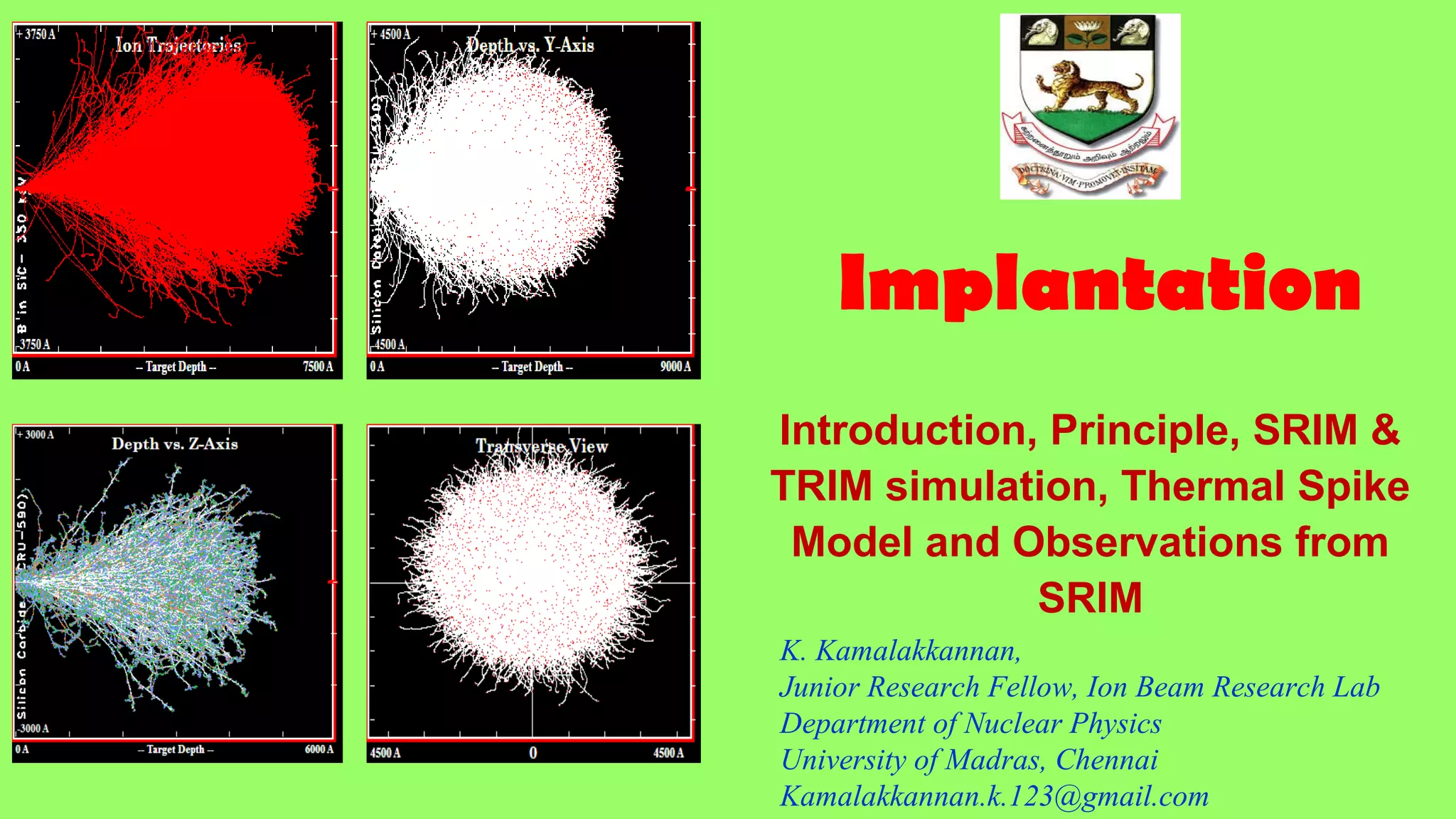
Implantation
Introduction, Principle, SRIM &
TRIM simulation, Thermal Spike
Model and Observations from
SRIM
K. Kamalakkannan,
Junior Research Fellow, Ion Beam Research Lab
Department of Nuclear Physics
University of Madras, Chennai
Kamalakkannan.k.123@gmail.com
Department of Nuclear Physics
Introduction
 All the electronic equipment needs Semiconducting materials (p-n type).
 Doping of impurities (carriers) can be processed by two ways- Diffusion and
Implantation.
 Diffusion is limiting process due to saturation limit and so, we can’t make high
concentrated carriers.
 To overcome the diffusion issues of dopants & activation of dopants in material- ion
implantation or ion irradiation is the best.
 In general using particle accelerators to shoot energetic ions on a material is the basic
process of implantation and irradiation.
 Ion implantation is a variety of ion irradiation, as is swift heavy ions irradiation from
particle accelerators with very high energies induces ion tracks.
Department of Nuclear Physics
Ion Implantation- Introduction
 Ion implantation- a materials engineering process by which ions of a material are
accelerated in an electrical field and impacted into a solid.
 This process is used to change the physics, chemical and/or electrical properties of
the solid- cause many chemical and physical changes in the target by transferring
their energy and momentum to the electrons and atomic nuclei of the target
material- causes a structural change, in that the crystal structure of the target.
 Major components are,
1. Ion source
2. Accelerator
3. Target chamber
Department of Nuclear Physics
Ion Implanter
Implantation
Structuring
Thin Film
Deposition
Ex: Simulation of
B ions in SiC 300 keV
Department of Nuclear Physics
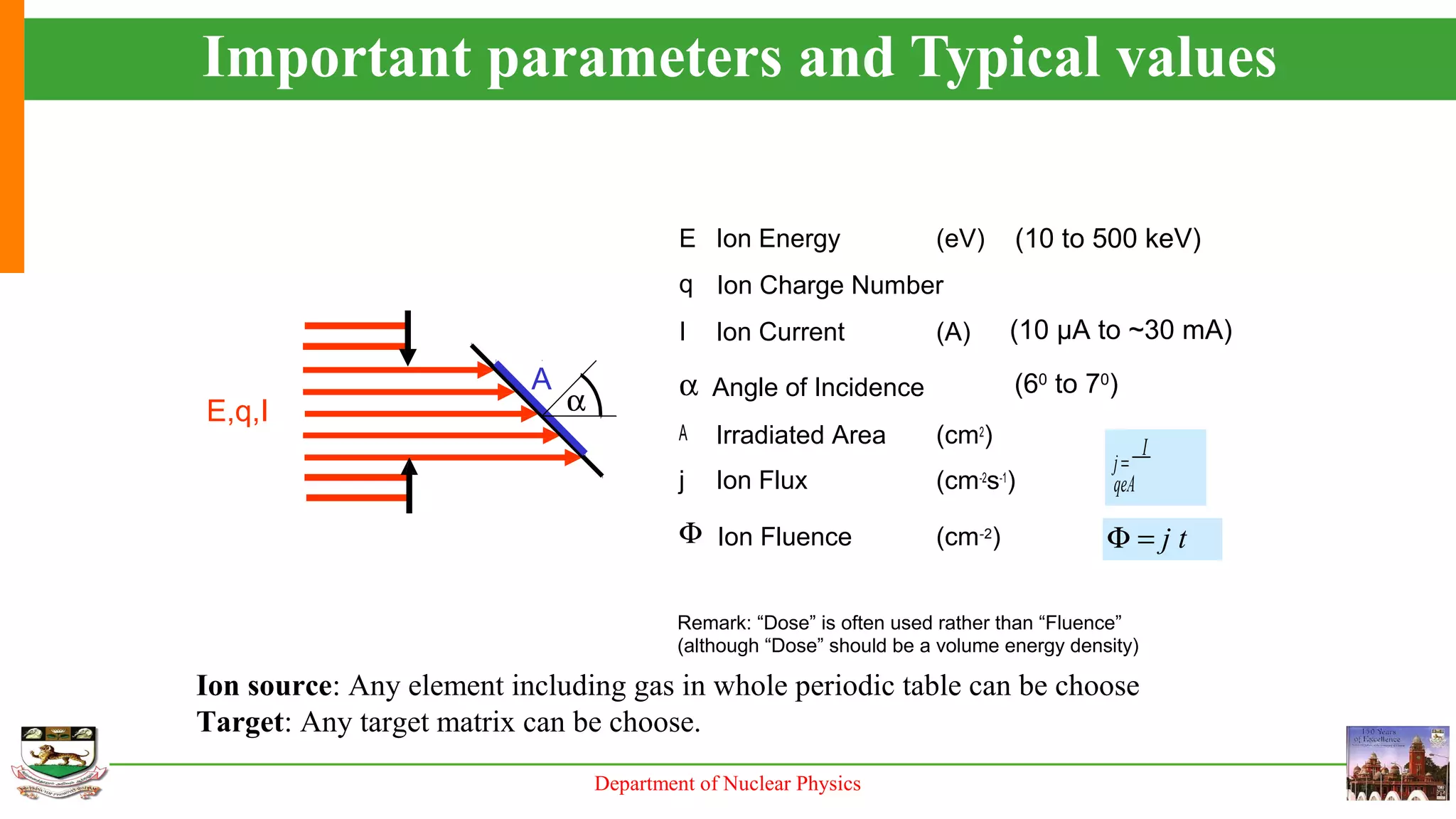
Important parameters and Typical values
E
q
I
α
A
j
Φ
Ion Energy (eV)
Ion Charge Number
Ion Current (A)
A Angle of Incidence
αE,q,I
(cm2)
(cm-2s-1)
Irradiated Area
Ion Flux
(cm-2)Ion Fluence
Remark: “Dose” is often used rather than “Fluence”
(although “Dose” should be a volume energy density)
Φ = j t
j=
I
qeA
(10 to 500 keV)
(10 μA to ~30 mA)
(60
to 70
)
Ion source: Any element including gas in whole periodic table can be choose
Target: Any target matrix can be choose.
Department of Nuclear Physics
Ion- Solid interactions
Multiple collision
With electrons
 E= Energy of ions
 m1, Z1 and m2, Z2= Mass No., At. No. of
Incident ions and Target material
 Rp= Range of ions
 When energetic ions passes through matter, it
looses its energy in two ways,
1. Electronic energy loss due to inelastic collision
with electrons(Se) [Electronic stopping]
2. Nuclear energy loss due to elastic collision with
atoms of the solid(Sn) [Nuclear stopping]
 Electronic stopping- Dominant at higher
energies (tens of MeV & more)- Swift Heavy
ion irradiation (SHI)
 Nuclear stopping- Dominant at low energies
(tens of keV to MeV)
Department of Nuclear Physics
Implantation Simulations- SRIM and TRIM
 SRIM- The Stopping and Range of Ions in Matter
- Group of programs which calculate the stopping and range of ions (up to 2
GeV/amu) into matter using a quantum mechanical treatment of ion-atom
collisions.
 TRIM- The Transport of Ions in Matter
- Most comprehensive program, accept complex targets made of compound
materials with up to eight layers, each of different materials. It calculate all
kinetic phenomena associated with the ion's energy loss: target damage,
sputtering, ionization, and phonon production.
 Based on a Monte-Carlo calculation which follows the ion into the target, making
detailed calculations of the energy transferred to every target atom collision. (multi-
layer complex targets) Developed by J. F. Ziegler and J. P. Biersack
Department of Nuclear Physics
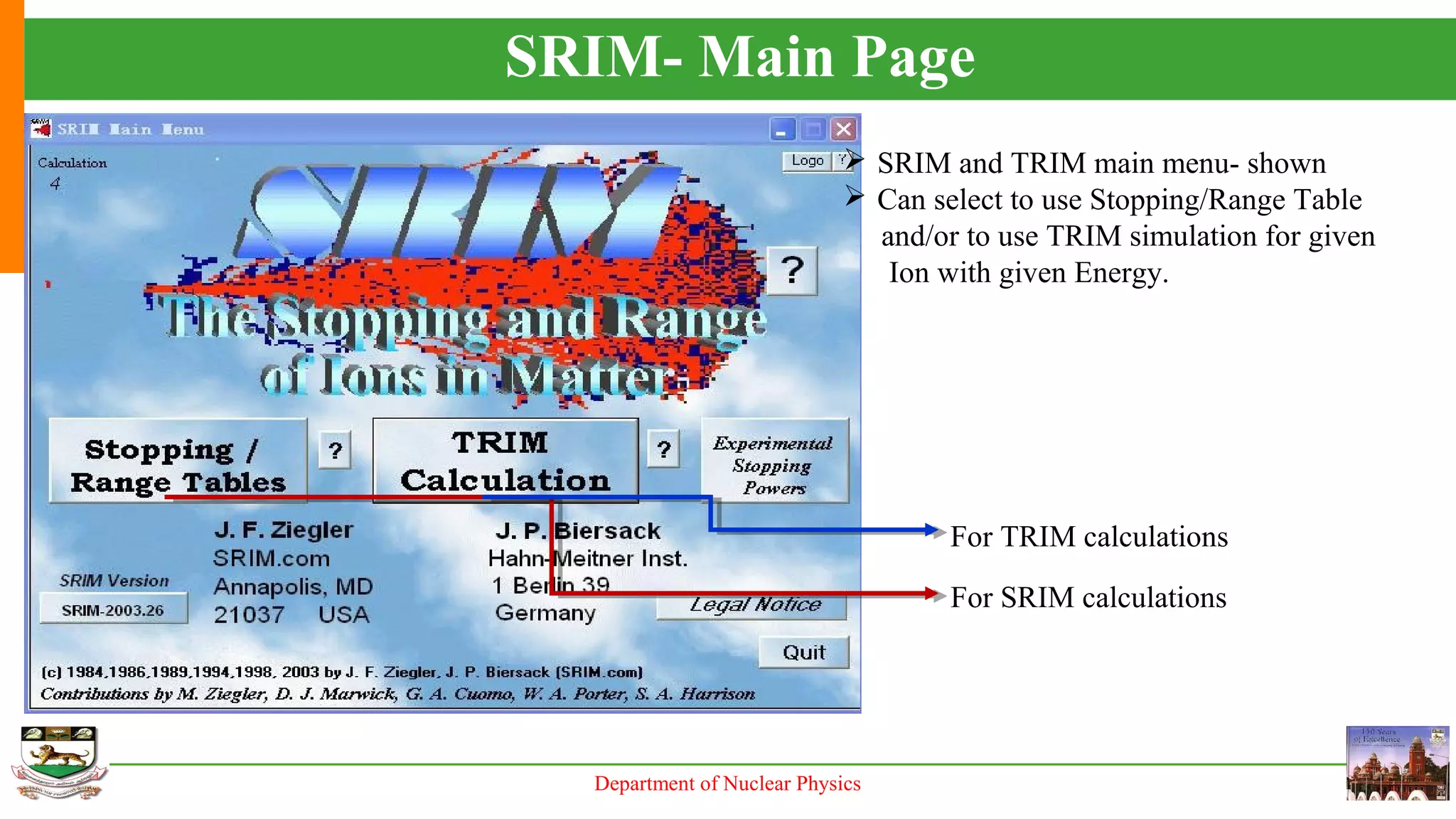
SRIM- Main Page
 SRIM and TRIM main menu- shown
 Can select to use Stopping/Range Table
and/or to use TRIM simulation for given
Ion with given Energy.
For SRIM calculations
For TRIM calculations
Department of Nuclear Physics
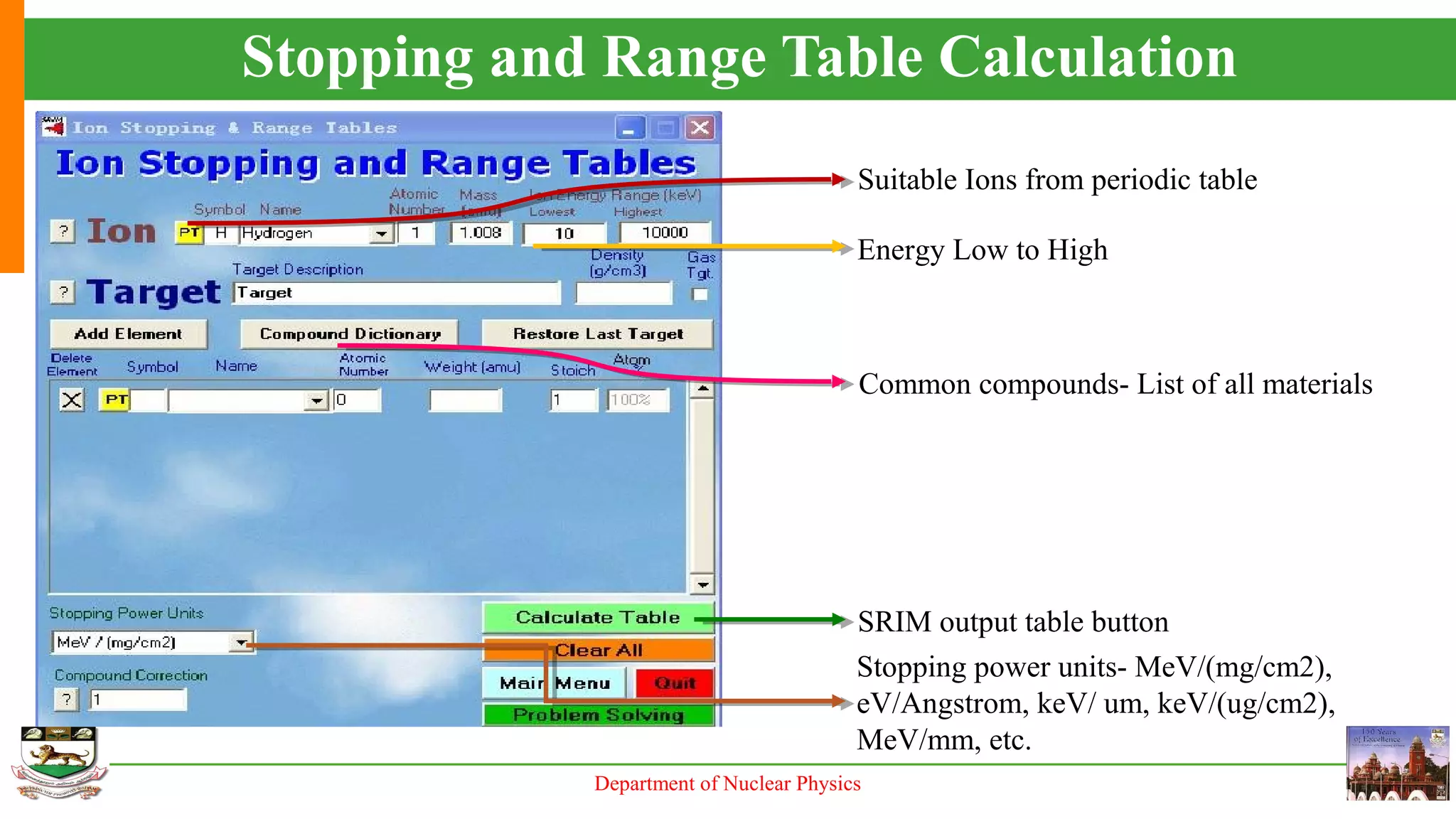
Stopping and Range Table Calculation
Suitable Ions from periodic table
Common compounds- List of all materials
SRIM output table button
Stopping power units- MeV/(mg/cm2),
eV/Angstrom, keV/ um, keV/(ug/cm2),
MeV/mm, etc.
Energy Low to High
Department of Nuclear Physics
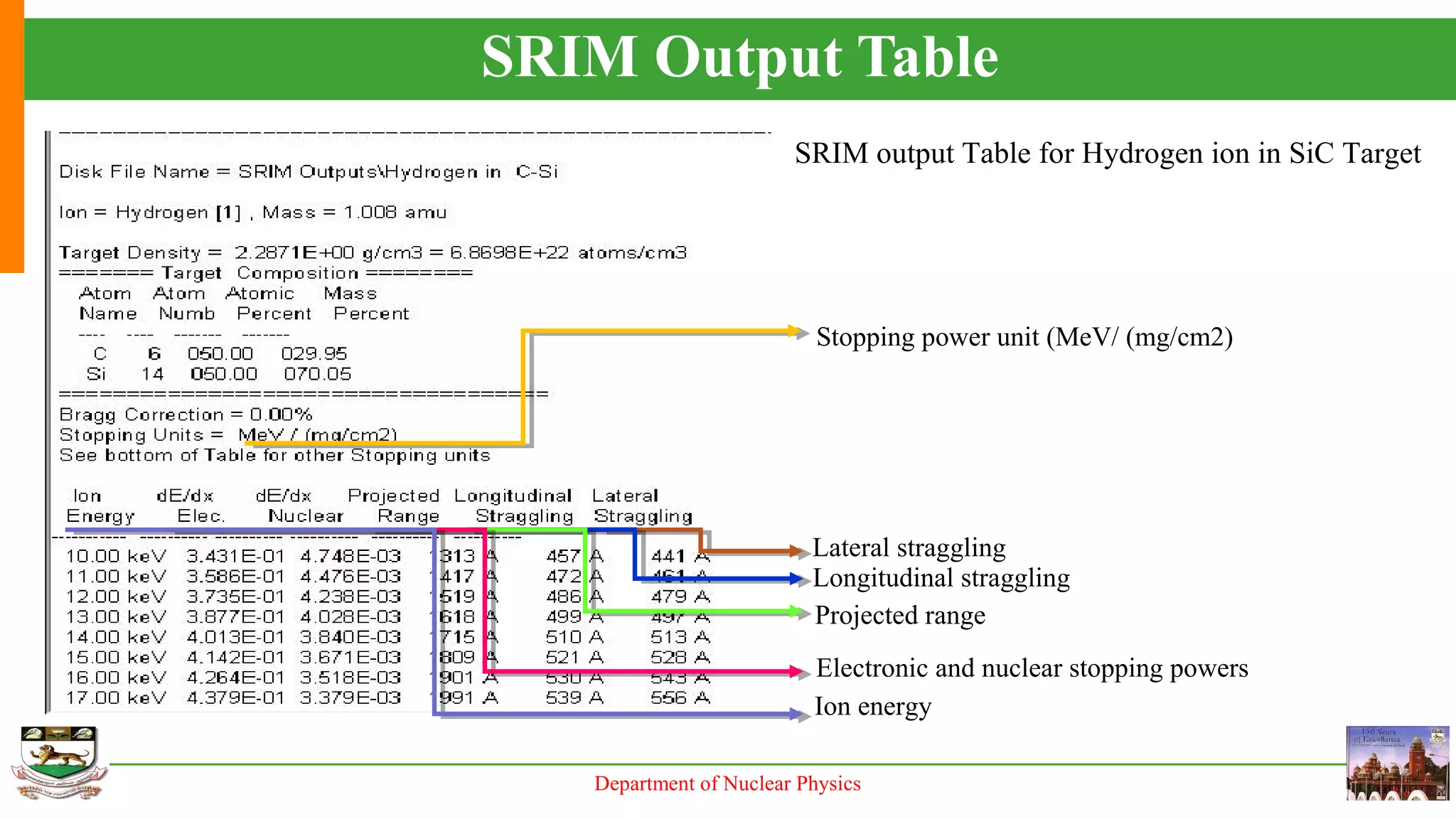
SRIM Output Table
SRIM output Table for Hydrogen ion in SiC Target
Stopping power unit (MeV/ (mg/cm2)
Lateral straggling
Longitudinal straggling
Projected range
Electronic and nuclear stopping powers
Ion energy
Department of Nuclear Physics
SRIM calculations: Energy Loss- Stopping powers
 Stopping powers Sn= dE/dx (Differential energy loss per unit length)
 Low energy ions <2MeV – elastic collision – nuclear energy loss
 High energy ions > 2MeV – Inelastic collision – electronic energy loss - SHI.
 Electronic stopping- (Electronic energy loss) Interaction of heavily charged ions
with electrons of the target material through Coulomb forces, produce track of
ionization and highly kinetic electrons along the path of the primary ion - latent
track (Se>Sth) – Sthdepends on the material.
 This Electronic stopping forms huge defects (defect clusters, dislocation loop
disordered lattice, amorphous etc.)
 Nuclear Energy loss- Due to elastic collision at lower energies dominant nuclear
stopping. This Causes damage and dislocation of nuclei from their lattice sites due
to elastic collisions.
 Always produce lattice defects(Interstitial atoms, anionic or cationic vacancies)
Department of Nuclear Physics
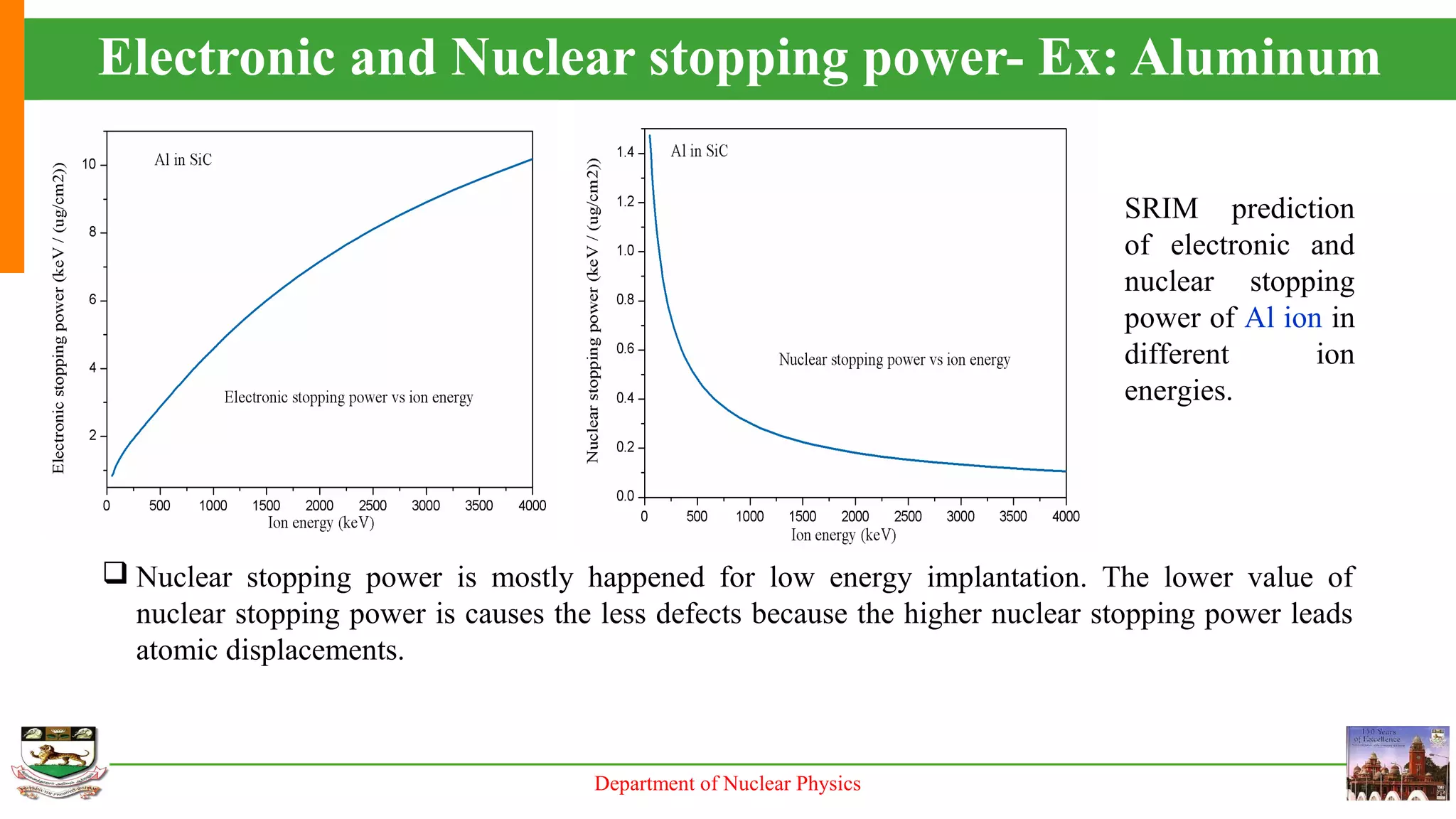
Electronic and Nuclear stopping power- Ex: Aluminum
SRIM prediction
of electronic and
nuclear stopping
power of Al ion in
different ion
energies.
 Nuclear stopping power is mostly happened for low energy implantation. The lower value of
nuclear stopping power is causes the less defects because the higher nuclear stopping power leads
atomic displacements.
Department of Nuclear Physics
Thermal Spike Model
 The energy-loss mechanism of the projectile-ion leads to electronic and atomic collision-cascades
 This model replaces the complex process of the atomic collision-cascades by an abrupt temperature
rise in an infinitesimal cylindrical volume around the ion trajectory at the time-of-passage t = 0.
Basic steps of thermal-spike model.
(a) Undisturbed solid at temperature T0.
(b) At the time-of-passage the tem-perature within
a small cylinder rises rapidly to a much higher
temperature T »T0.
(c) After the passage of the ion, defects are
thermally created while the thermal energy
gradually dif-fuses away radially from the ion
trajectory.
(d) Remaining are "frozen" defects.
Department of Nuclear Physics
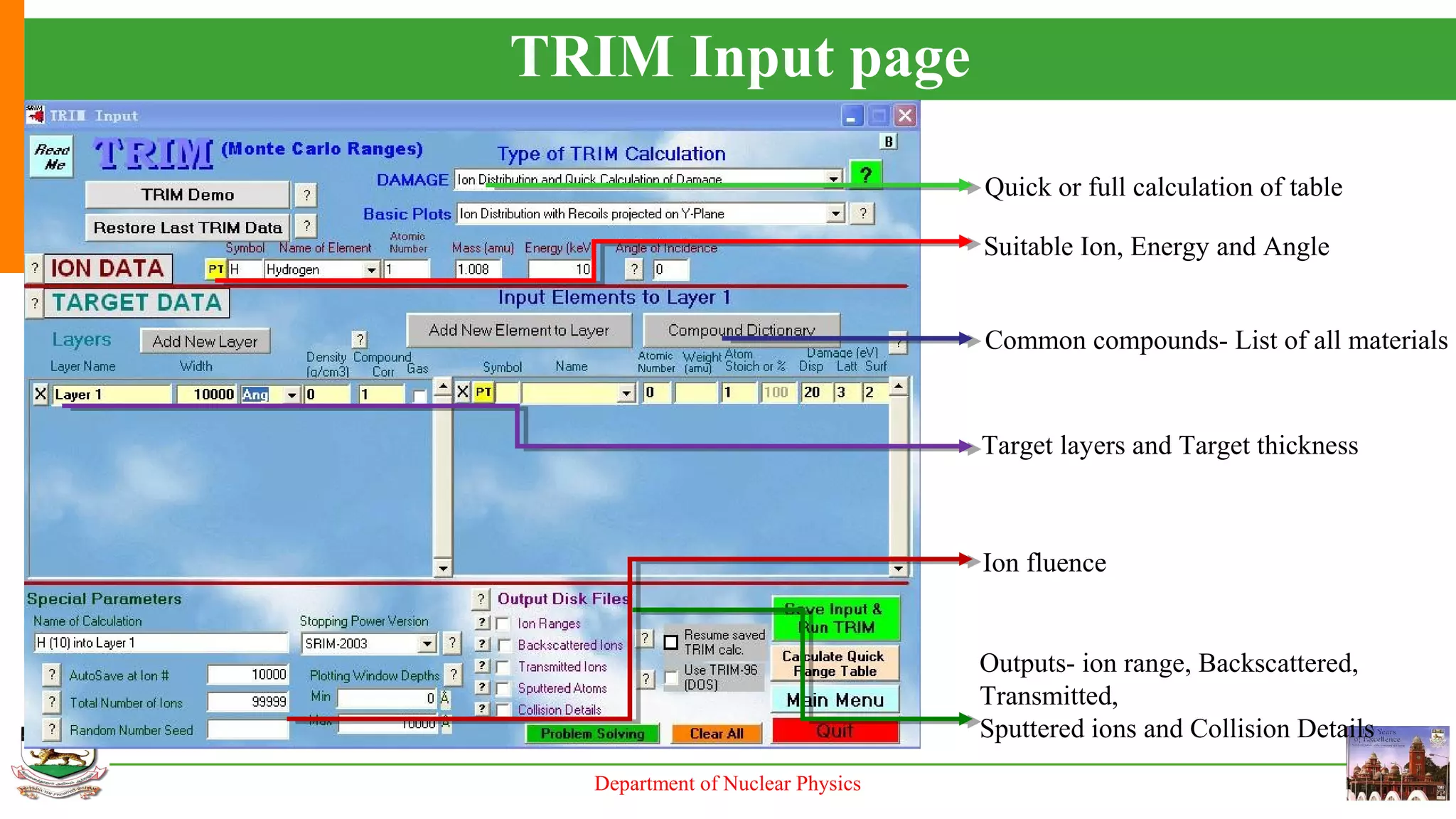
TRIM Input page
Suitable Ion, Energy and Angle
Quick or full calculation of table
Common compounds- List of all materials
Outputs- ion range, Backscattered,
Transmitted,
Sputtered ions and Collision Details
Ion fluence
Target layers and Target thickness
Department of Nuclear Physics
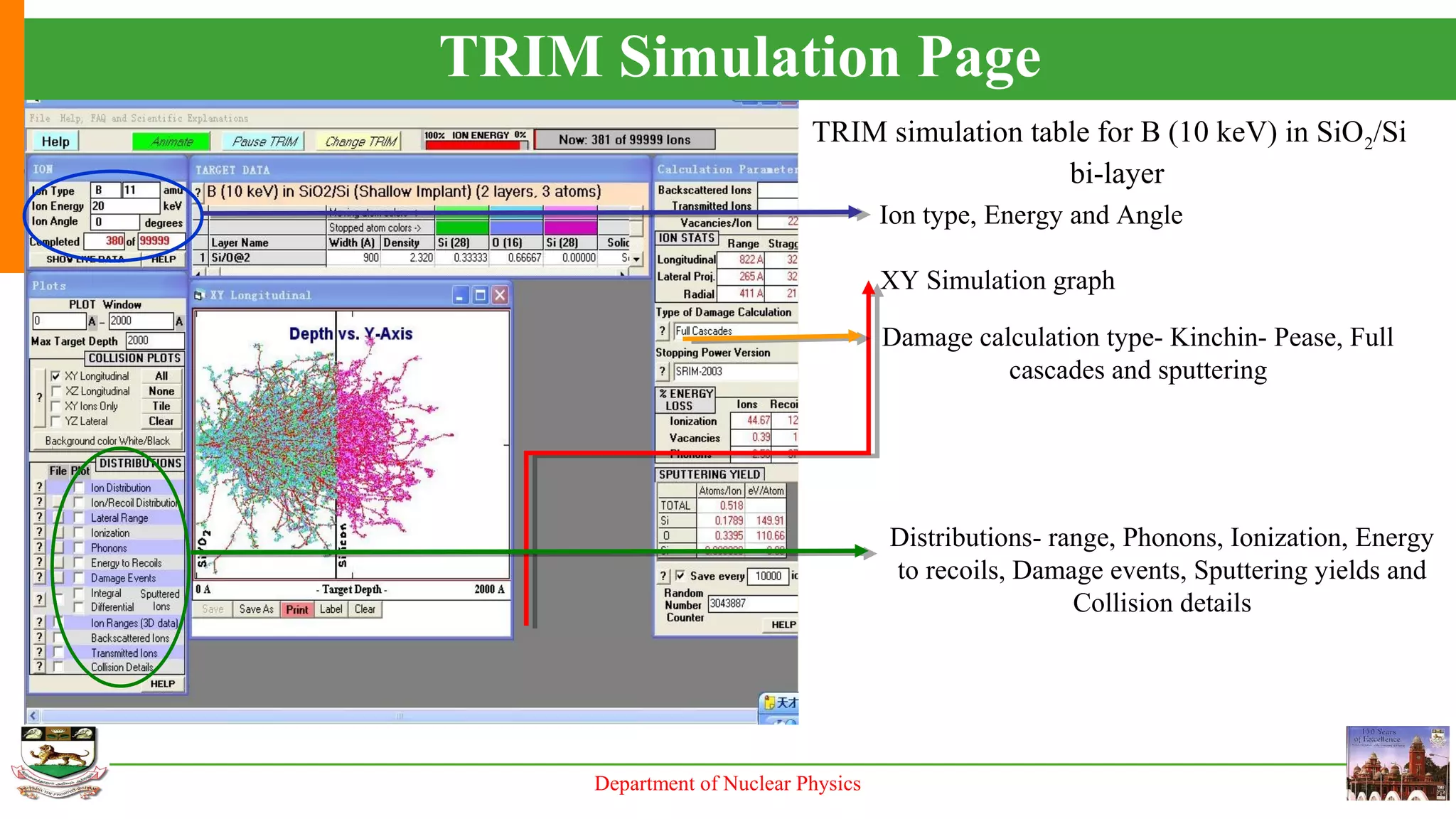
TRIM Simulation Page
TRIM simulation table for B (10 keV) in SiO2/Si
bi-layer
Ion type, Energy and Angle
XY Simulation graph
Distributions- range, Phonons, Ionization, Energy
to recoils, Damage events, Sputtering yields and
Collision details
Damage calculation type- Kinchin- Pease, Full
cascades and sputtering
Department of Nuclear Physics
Observations from SRIM and TRIM
Ion Range (Rp)= Range of ion
Ex: Boron 100 keV in SiC (Rp= 2010 Å)
XY Ions Simulation
Ex: Boron 100 keV in SiC
Damage events
Ex: Boron 100 keV in SiC
Department of Nuclear Physics
Observations from SRIM and TRIM
Recoil Energy
Ex: Al 300 keV in SiC
Energy Loss due to ionization
Ex: Al 300 keV in SiC
Also,
3D views of ion damages, Range of
ions, Recoil energy, Phonon and
Lateral range distribution XY ions
simulations- Lateral, Longitudinal
view and Vacancies can be
calculated
Thank You

Implantation srim trim

  • 1.
    Implantation Introduction, Principle, SRIM& TRIM simulation, Thermal Spike Model and Observations from SRIM K. Kamalakkannan, Junior Research Fellow, Ion Beam Research Lab Department of Nuclear Physics University of Madras, Chennai Kamalakkannan.k.123@gmail.com
  • 2.
    Department of NuclearPhysics Introduction  All the electronic equipment needs Semiconducting materials (p-n type).  Doping of impurities (carriers) can be processed by two ways- Diffusion and Implantation.  Diffusion is limiting process due to saturation limit and so, we can’t make high concentrated carriers.  To overcome the diffusion issues of dopants & activation of dopants in material- ion implantation or ion irradiation is the best.  In general using particle accelerators to shoot energetic ions on a material is the basic process of implantation and irradiation.  Ion implantation is a variety of ion irradiation, as is swift heavy ions irradiation from particle accelerators with very high energies induces ion tracks.
  • 3.
    Department of NuclearPhysics Ion Implantation- Introduction  Ion implantation- a materials engineering process by which ions of a material are accelerated in an electrical field and impacted into a solid.  This process is used to change the physics, chemical and/or electrical properties of the solid- cause many chemical and physical changes in the target by transferring their energy and momentum to the electrons and atomic nuclei of the target material- causes a structural change, in that the crystal structure of the target.  Major components are, 1. Ion source 2. Accelerator 3. Target chamber
  • 4.
    Department of NuclearPhysics Ion Implanter Implantation Structuring Thin Film Deposition Ex: Simulation of B ions in SiC 300 keV
  • 5.
    Department of NuclearPhysics Important parameters and Typical values E q I α A j Φ Ion Energy (eV) Ion Charge Number Ion Current (A) A Angle of Incidence αE,q,I (cm2) (cm-2s-1) Irradiated Area Ion Flux (cm-2)Ion Fluence Remark: “Dose” is often used rather than “Fluence” (although “Dose” should be a volume energy density) Φ = j t j= I qeA (10 to 500 keV) (10 μA to ~30 mA) (60 to 70 ) Ion source: Any element including gas in whole periodic table can be choose Target: Any target matrix can be choose.
  • 6.
    Department of NuclearPhysics Ion- Solid interactions Multiple collision With electrons  E= Energy of ions  m1, Z1 and m2, Z2= Mass No., At. No. of Incident ions and Target material  Rp= Range of ions  When energetic ions passes through matter, it looses its energy in two ways, 1. Electronic energy loss due to inelastic collision with electrons(Se) [Electronic stopping] 2. Nuclear energy loss due to elastic collision with atoms of the solid(Sn) [Nuclear stopping]  Electronic stopping- Dominant at higher energies (tens of MeV & more)- Swift Heavy ion irradiation (SHI)  Nuclear stopping- Dominant at low energies (tens of keV to MeV)
  • 7.
    Department of NuclearPhysics Implantation Simulations- SRIM and TRIM  SRIM- The Stopping and Range of Ions in Matter - Group of programs which calculate the stopping and range of ions (up to 2 GeV/amu) into matter using a quantum mechanical treatment of ion-atom collisions.  TRIM- The Transport of Ions in Matter - Most comprehensive program, accept complex targets made of compound materials with up to eight layers, each of different materials. It calculate all kinetic phenomena associated with the ion's energy loss: target damage, sputtering, ionization, and phonon production.  Based on a Monte-Carlo calculation which follows the ion into the target, making detailed calculations of the energy transferred to every target atom collision. (multi- layer complex targets) Developed by J. F. Ziegler and J. P. Biersack
  • 8.
    Department of NuclearPhysics SRIM- Main Page  SRIM and TRIM main menu- shown  Can select to use Stopping/Range Table and/or to use TRIM simulation for given Ion with given Energy. For SRIM calculations For TRIM calculations
  • 9.
    Department of NuclearPhysics Stopping and Range Table Calculation Suitable Ions from periodic table Common compounds- List of all materials SRIM output table button Stopping power units- MeV/(mg/cm2), eV/Angstrom, keV/ um, keV/(ug/cm2), MeV/mm, etc. Energy Low to High
  • 10.
    Department of NuclearPhysics SRIM Output Table SRIM output Table for Hydrogen ion in SiC Target Stopping power unit (MeV/ (mg/cm2) Lateral straggling Longitudinal straggling Projected range Electronic and nuclear stopping powers Ion energy
  • 11.
    Department of NuclearPhysics SRIM calculations: Energy Loss- Stopping powers  Stopping powers Sn= dE/dx (Differential energy loss per unit length)  Low energy ions <2MeV – elastic collision – nuclear energy loss  High energy ions > 2MeV – Inelastic collision – electronic energy loss - SHI.  Electronic stopping- (Electronic energy loss) Interaction of heavily charged ions with electrons of the target material through Coulomb forces, produce track of ionization and highly kinetic electrons along the path of the primary ion - latent track (Se>Sth) – Sthdepends on the material.  This Electronic stopping forms huge defects (defect clusters, dislocation loop disordered lattice, amorphous etc.)  Nuclear Energy loss- Due to elastic collision at lower energies dominant nuclear stopping. This Causes damage and dislocation of nuclei from their lattice sites due to elastic collisions.  Always produce lattice defects(Interstitial atoms, anionic or cationic vacancies)
  • 12.
    Department of NuclearPhysics Electronic and Nuclear stopping power- Ex: Aluminum SRIM prediction of electronic and nuclear stopping power of Al ion in different ion energies.  Nuclear stopping power is mostly happened for low energy implantation. The lower value of nuclear stopping power is causes the less defects because the higher nuclear stopping power leads atomic displacements.
  • 13.
    Department of NuclearPhysics Thermal Spike Model  The energy-loss mechanism of the projectile-ion leads to electronic and atomic collision-cascades  This model replaces the complex process of the atomic collision-cascades by an abrupt temperature rise in an infinitesimal cylindrical volume around the ion trajectory at the time-of-passage t = 0. Basic steps of thermal-spike model. (a) Undisturbed solid at temperature T0. (b) At the time-of-passage the tem-perature within a small cylinder rises rapidly to a much higher temperature T »T0. (c) After the passage of the ion, defects are thermally created while the thermal energy gradually dif-fuses away radially from the ion trajectory. (d) Remaining are "frozen" defects.
  • 14.
    Department of NuclearPhysics TRIM Input page Suitable Ion, Energy and Angle Quick or full calculation of table Common compounds- List of all materials Outputs- ion range, Backscattered, Transmitted, Sputtered ions and Collision Details Ion fluence Target layers and Target thickness
  • 15.
    Department of NuclearPhysics TRIM Simulation Page TRIM simulation table for B (10 keV) in SiO2/Si bi-layer Ion type, Energy and Angle XY Simulation graph Distributions- range, Phonons, Ionization, Energy to recoils, Damage events, Sputtering yields and Collision details Damage calculation type- Kinchin- Pease, Full cascades and sputtering
  • 16.
    Department of NuclearPhysics Observations from SRIM and TRIM Ion Range (Rp)= Range of ion Ex: Boron 100 keV in SiC (Rp= 2010 Å) XY Ions Simulation Ex: Boron 100 keV in SiC Damage events Ex: Boron 100 keV in SiC
  • 17.
    Department of NuclearPhysics Observations from SRIM and TRIM Recoil Energy Ex: Al 300 keV in SiC Energy Loss due to ionization Ex: Al 300 keV in SiC Also, 3D views of ion damages, Range of ions, Recoil energy, Phonon and Lateral range distribution XY ions simulations- Lateral, Longitudinal view and Vacancies can be calculated
  • 18.

Editor's Notes