Ion Beams and Materials
Ion Beams Allow Modification and
Measurement of the Properties of
Solids Near Their Surfaces
1. Near Surface Modification
2. Material Analysis
3. Material Erosion
Ion Beams and Materials
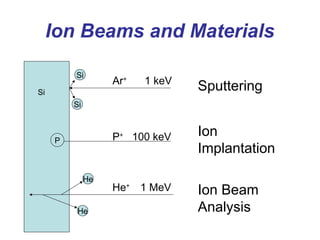
Ar+
1 keV
P+
100 keV
He+
1 MeV
Si
Sputtering
Ion
Implantation
Ion Beam
Analysis
P
Si
Si
He
He
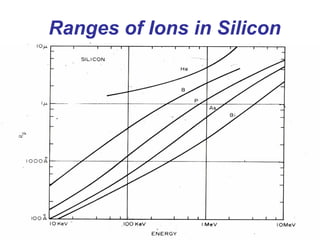
Ranges of Ions in Silicon
Ion Beams and Materials
1. Near Surface Modification
Ion Implantation
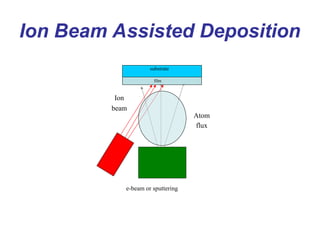
Ion Beam Assisted Deposition
2. Material Analysis
3. Material Erosion
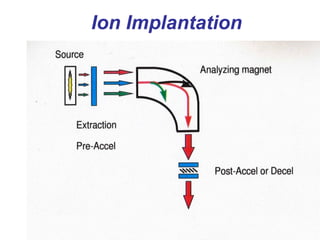
Ion Implantation
Ion Implantation
• Silicon Doping
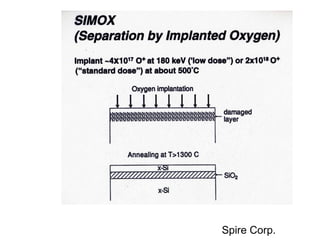
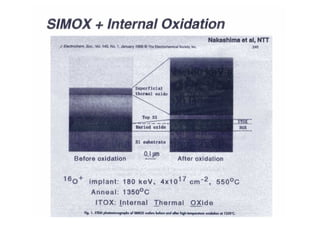
• Silicon on Insulator
Simox
Smart Cut
• Medical Devices
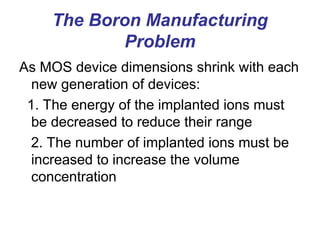
The Boron Manufacturing
Problem
As MOS device dimensions shrink with each
new generation of devices:
1. The energy of the implanted ions must
be decreased to reduce their range
2. The number of implanted ions must be
increased to increase the volume
concentration
Ion Implantation
• Silicon Doping
• Silicon on Insulator
Simox
Smart Cut
• Medical Devices
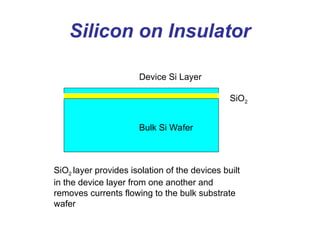
Silicon on Insulator
SiO2
Device Si Layer
Bulk Si Wafer
SiO2 layer provides isolation of the devices built
in the device layer from one another and
removes currents flowing to the bulk substrate
wafer
Ion Implantation
• Silicon Doping
• Silicon on Insulator
Simox
Smart Cut
• Medical Devices
Spire Corp.
Ion Implantation
• Silicon Doping
• Silicon on Insulator
Simox
Smart Cut
• Medical Devices
Schematic flow of Smart
Cut process

 Initial
Initial Silicon
Silicon

 Oxidation
Oxidation

 Smart
Smart Cut
Cut
Implantation
Implantation

 Cleaning
Cleaning &
&
Bonding
Bonding

 Splitting
Splitting

 Annealing
Annealing &
&
Finishing
Finishing

 Re
Re-
-use of A
use of A
or B
or B New A
New A New B
New B
A
A
B
B
A
A
A
A
H
H+
+ ions
ions
SOI wafer
SOI wafer
Si
Si bulk
bulk
A
A
B
B
A
A
B
B
Or
Or

 Initial
Initial Silicon
Silicon

 Oxidation
Oxidation

 Smart
Smart Cut
Cut
Implantation
Implantation

 Cleaning
Cleaning &
&
Bonding
Bonding

 Splitting
Splitting

 Annealing
Annealing &
&
Finishing
Finishing

 Re
Re-
-use of A
use of A
or B
or B New A
New A New B
New B
A
A
B
B
A
A
A
A
H
H+
+ ions
ions
SOI wafer
SOI wafer
Si
Si bulk
bulk
A
A
B
B
A
A
B
B
Or
Or
New A
New A New B
New B
A
A
B
B
B
B
A
A
A
A
H
H+
+ ions
ions
SOI wafer
SOI wafer
Si
Si bulk
bulk
Si
Si bulk
bulk
A
A
B
B
A
A
B
B
B
B
Or
Or
Soitec Corp
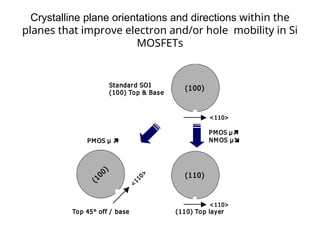
Crystalline plane orientations and directions within the
planes that improve electron and/or hole mobility in Si
MOSFETs
(100)
(100)
<110>
Standard SOI
(100) Top & Base
(
1
0
0
)
(
1
0
0
)
<
1
1
0
>
Top 45° off / base
PMOS µ 
(110)
(110)
<110>
PMOS µ
NMOS µ
(110) Top layer
(100)
(100)
<110>
(100)
(100)
<110>
Standard SOI
(100) Top & Base
(
1
0
0
)
(
1
0
0
)
<
1
1
0
>
(
1
0
0
)
(
1
0
0
)
<
1
1
0
>
Top 45° off / base
PMOS µ 
(110)
(110)
<110>
PMOS µ
NMOS µ
(110) Top layer
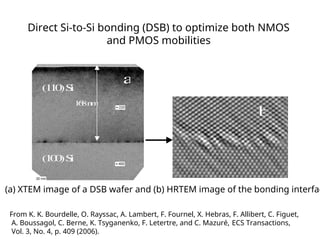
Direct Si-to-Si bonding (DSB) to optimize both NMOS
and PMOS mobilities
(1
1
0
)S
i
(1
0
0
)S
i
a
b
1
6
8n
m
From K. K. Bourdelle, O. Rayssac, A. Lambert, F. Fournel, X. Hebras, F. Allibert, C. Figuet,
A. Boussagol, C. Berne, K. Tsyganenko, F. Letertre, and C. Mazuré, ECS Transactions,
Vol. 3, No. 4, p. 409 (2006).
(a) XTEM image of a DSB wafer and (b) HRTEM image of the bonding interfac
Stress
(GPa)
FWHM
(MPa)
sSi thickness (nm)
1.4
1.5
1.6
20 50 60 70
0
2
4
6
8
10
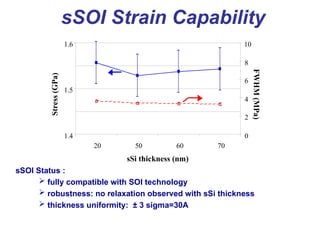
sSOI Status :
 fully compatible with SOI technology
 robustness: no relaxation observed with sSi thickness
 thickness uniformity: ± 3 sigma=30A
sSOI Strain Capability
Ion Implantation
• Silicon Doping
• Silicon on Insulator
Simox
Smart Cut
• Medical Devices
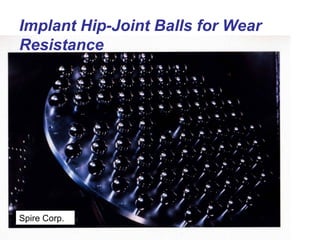
Hip Joint Replacement
Pictures from Veeco Website, 2003
Spire Corp.
Implant Hip-Joint Balls for Wear
Resistance
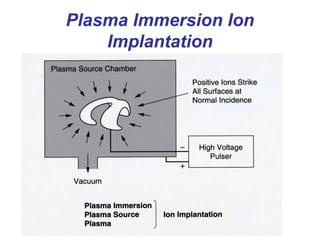
Plasma Immersion Ion
Implantation
Ion Beams and Materials
1. Near Surface Modification
Ion Implantation
Ion Beam Assisted Deposition
2. Material Analysis
3. Material Erosion
Ion
beam
Atom
flux
e-beam or sputtering
substrate
film
Ion Beam Assisted Deposition
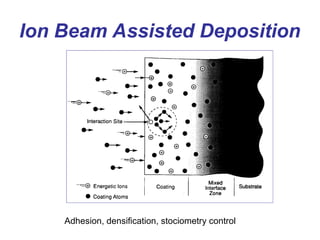
Adhesion, densification, stociometry control
Ion Beam Assisted Deposition
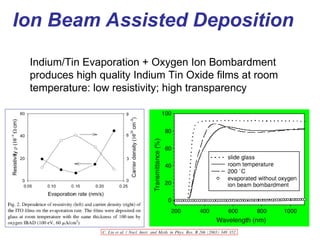
Indium/Tin Evaporation + Oxygen Ion Bombardment
produces high quality Indium Tin Oxide films at room
temperature: low resistivity; high transparency
Ion Beams and Materials
Modification and Measurement of the
Properties of Solids Near Their
Surfaces
1. Near Surface Modification
2. Material Analysis
3. Material Erosion
Material Analysis
• Secondary Ion Mass Spectroscopy (SIMS)
• Rutherford Backscattering
• Resonant Nuclear Scattering
• Ion Induced X-ray Spectroscopy
• Ion Produced Secondary Electron
Microscopy
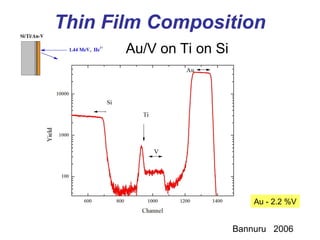
Rutherford Backscatting
He+
Larger target
element mass =
larger K. For
1800
scattering
K= [(M-4)/(M+4)]2
KAu = 0 .92
KV = 0.73
KTi = 0.71
Thin Film Composition
Au - 2.2 %V
Bannuru 2006
Au/V on Ti on Si
Ion Beams and Materials
Modification and Measurement of the
Properties of Solids Near Their
Surfaces
1. Near Surface Modification
2. Material Analysis
3. Material Erosion (Sputtering)
Material Erosion (Sputtering)
• SIMS
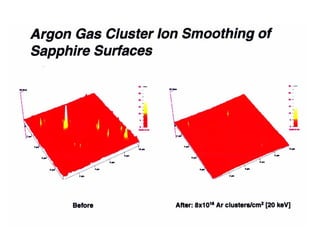
• Molecular Cluster Surface Smoothing
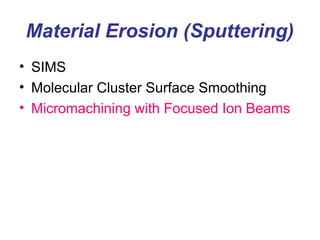
• Micromachining with Focused Ion Beams
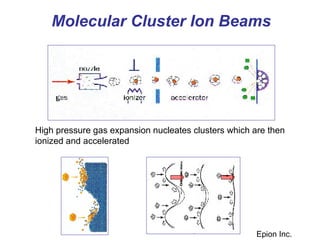
Molecular Cluster Ion Beams
Epion Inc.
High pressure gas expansion nucleates clusters which are then
ionized and accelerated
Material Erosion (Sputtering)
• SIMS
• Molecular Cluster Surface Smoothing
• Micromachining with Focused Ion Beams
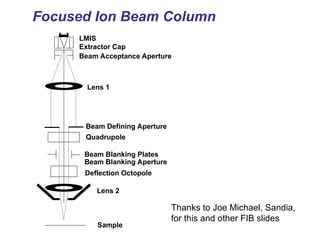
Beam Defining Aperture
Quadrupole
LMIS
Extractor Cap
Beam Acceptance Aperture
Lens 1
Lens 2
Beam Blanking Plates
Beam Blanking Aperture
Deflection Octopole
Sample
Focused Ion Beam Column
Thanks to Joe Michael, Sandia,
for this and other FIB slides
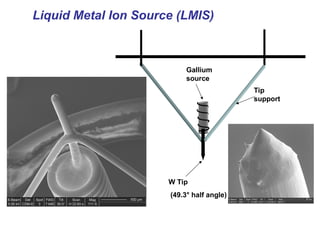
Liquid Metal Ion Source (LMIS)
Gallium
source
W Tip
(49.3° half angle)
Tip
support
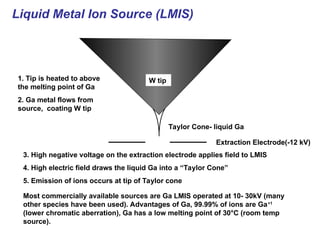
Liquid Metal Ion Source (LMIS)
W tip
Taylor Cone- liquid Ga
Extraction Electrode(-12 kV)
1. Tip is heated to above
the melting point of Ga
2. Ga metal flows from
source, coating W tip
3. High negative voltage on the extraction electrode applies field to LMIS
4. High electric field draws the liquid Ga into a “Taylor Cone”
5. Emission of ions occurs at tip of Taylor cone
Most commercially available sources are Ga LMIS operated at 10- 30kV (many
other species have been used). Advantages of Ga, 99.99% of ions are Ga+1
(lower chromatic aberration), Ga has a low melting point of 30°C (room temp
source).
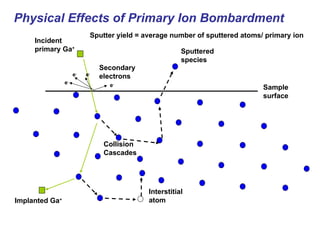
Physical Effects of Primary Ion Bombardment
Implanted Ga+
Incident
primary Ga+
Collision
Cascades
Sputtered
species
Sputter yield = average number of sputtered atoms/ primary ion
Sample
surface
Interstitial
atom
e-
e-
e-
e-
Secondary
electrons
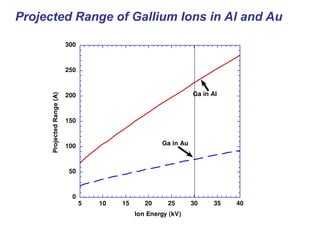
0
50
100
150
200
250
300
5 10 15 20 25 30 35 40
Projected
Range
(A)
Ion Energy (kV)
Ga in Al
Ga in Au
Projected Range of Gallium Ions in Al and Au
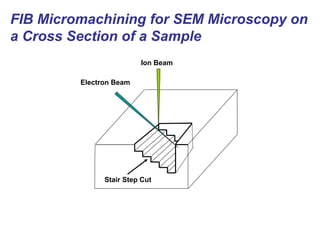
Ion Beam
Electron Beam
FIB Micromachining for SEM Microscopy on
a Cross Section of a Sample
Stair Step Cut
FIB Micromachining to Produce SEM Cross
Sections
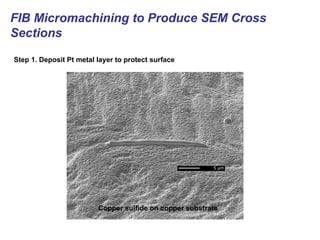
Copper sulfide on copper substrate
Step 1. Deposit Pt metal layer to protect surface
FIB Micromachining to Produce SEM Cross
Sections
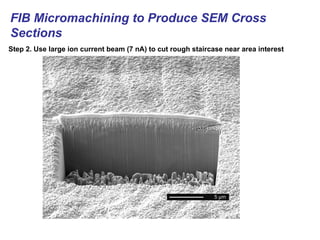
Step 2. Use large ion current beam (7 nA) to cut rough staircase near area interest
FIB Micromachining to Produce SEM Cross
Sections
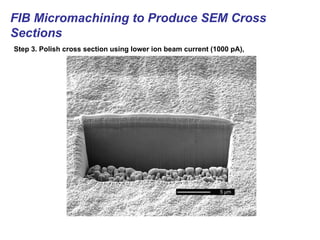
Step 3. Polish cross section using lower ion beam current (1000 pA),
FIB Micromachining to Produce SEM Cross
Sections
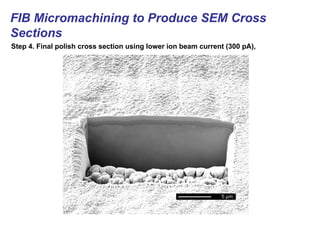
Step 4. Final polish cross section using lower ion beam current (300 pA),
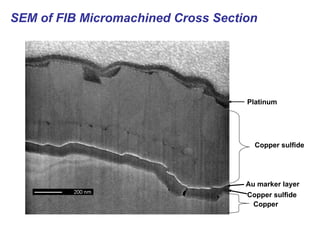
SEM of FIB Micromachined Cross Section
Platinum
Copper sulfide
Au marker layer
Copper sulfide
Copper
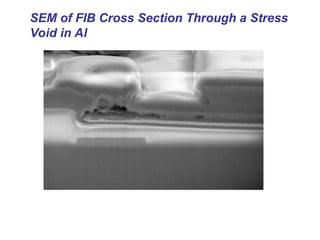
SEM of FIB Cross Section Through a Stress
Void in Al
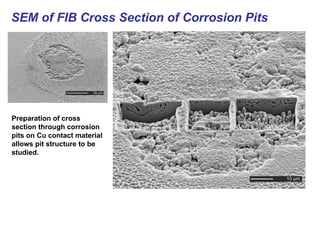
SEM of FIB Cross Section of Corrosion Pits
Preparation of cross
section through corrosion
pits on Cu contact material
allows pit structure to be
studied.
FIB Micromachining to Produce TEM Cross
Sections
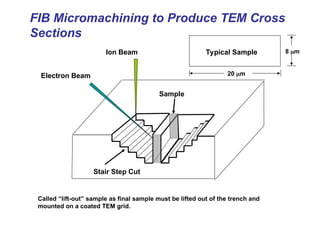
8 m
Stair Step Cut
Ion Beam
Electron Beam
Sample
Called “lift-out” sample as final sample must be lifted out of the trench and
mounted on a coated TEM grid.
Typical Sample
20 m
FIB Micromachining to Produce TEM Cross
Sections
Step 4. Polish both sides of cross section using lower ion beam current (1000 pA) to
about 1 m thickness,
500 pA beam size
300 nA beam size
FIB Micromachining to Produce TEM Cross
Sections
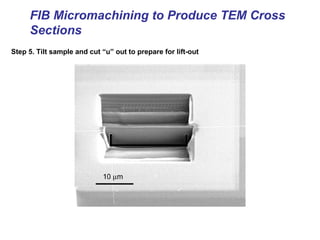
Step 5. Tilt sample and cut “u” out to prepare for lift-out
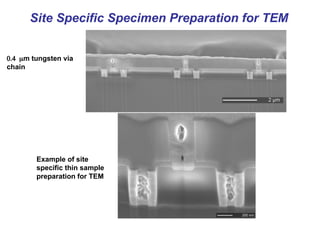
Site Specific Specimen Preparation for TEM
Example of site
specific thin sample
preparation for TEM
m tungsten via
chain
Material Analysis
• Secondary Ion Mass Spectroscopy (SIMS)
• Rutherford Backscattering
• Resonant Nuclear Scattering
• Ion Induced X-ray Spectroscopy
• Ion Produced Secondary Electron
Microscopy
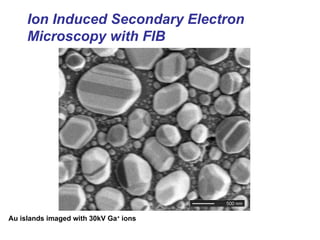
Ion Induced Secondary Electron
Microscopy with FIB
Au islands imaged with 30kV Ga+
ions
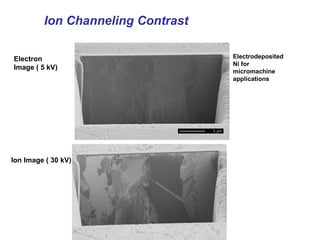
Ion Channeling Contrast
Electron
Image ( 5 kV)
Ion Image ( 30 kV)
Electrodeposited
Ni for
micromachine
applications
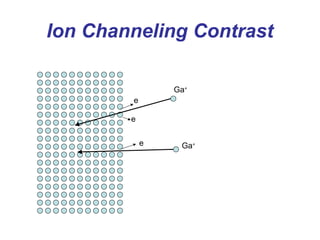
Ion Channeling Contrast
e
e
e
Ga+
Ga+
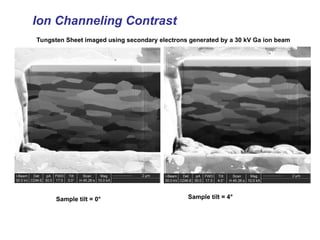
Ion Channeling Contrast
Tungsten Sheet imaged using secondary electrons generated by a 30 kV Ga ion beam
Sample tilt = 0° Sample tilt = 4°
SUMMARY
Ions of different atoms, molecules and
atomic clusters and having energies
between 1 keV and 3 MeV are highly
effective in modifying and measuring the
composition and structure of materials
close to their surfaces. This field has
developed over the last 50 years and
continues to evolve year after year as new
applications are recognized and new
techniques are developed.
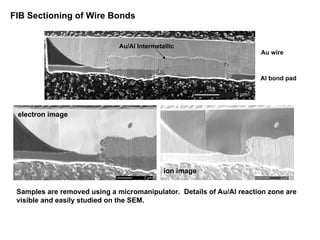
FIB Sectioning of Wire Bonds
Samples are removed using a micromanipulator. Details of Au/Al reaction zone are
visible and easily studied on the SEM.
electron image
ion image
Au wire
Al bond pad
Au/Al Intermetallic
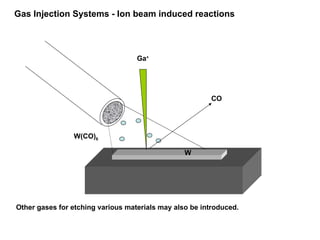
Gas Injection Systems - Ion beam induced reactions
W(CO)6
Ga+
CO
W
Other gases for etching various materials may also be introduced.
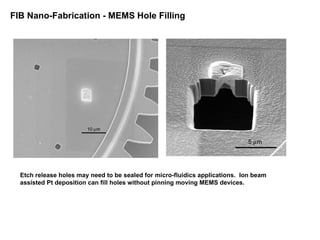
FIB Nano-Fabrication - MEMS Hole Filling
Etch release holes may need to be sealed for micro-fluidics applications. Ion beam
assisted Pt deposition can fill holes without pinning moving MEMS devices.
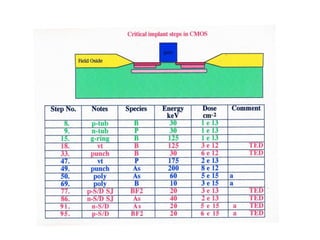
Ion Implantation - Semiconductor manufaturing technology

  • 1.
    Ion Beams andMaterials Ion Beams Allow Modification and Measurement of the Properties of Solids Near Their Surfaces 1. Near Surface Modification 2. Material Analysis 3. Material Erosion
  • 2.
    Ion Beams andMaterials Ar+ 1 keV P+ 100 keV He+ 1 MeV Si Sputtering Ion Implantation Ion Beam Analysis P Si Si He He
  • 3.
    Ranges of Ionsin Silicon
  • 4.
    Ion Beams andMaterials 1. Near Surface Modification Ion Implantation Ion Beam Assisted Deposition 2. Material Analysis 3. Material Erosion
  • 5.
  • 6.
    Ion Implantation • SiliconDoping • Silicon on Insulator Simox Smart Cut • Medical Devices
  • 8.
    The Boron Manufacturing Problem AsMOS device dimensions shrink with each new generation of devices: 1. The energy of the implanted ions must be decreased to reduce their range 2. The number of implanted ions must be increased to increase the volume concentration
  • 9.
    Ion Implantation • SiliconDoping • Silicon on Insulator Simox Smart Cut • Medical Devices
  • 10.
    Silicon on Insulator SiO2 DeviceSi Layer Bulk Si Wafer SiO2 layer provides isolation of the devices built in the device layer from one another and removes currents flowing to the bulk substrate wafer
  • 11.
    Ion Implantation • SiliconDoping • Silicon on Insulator Simox Smart Cut • Medical Devices
  • 12.
  • 14.
    Ion Implantation • SiliconDoping • Silicon on Insulator Simox Smart Cut • Medical Devices
  • 15.
    Schematic flow ofSmart Cut process   Initial Initial Silicon Silicon   Oxidation Oxidation   Smart Smart Cut Cut Implantation Implantation   Cleaning Cleaning & & Bonding Bonding   Splitting Splitting   Annealing Annealing & & Finishing Finishing   Re Re- -use of A use of A or B or B New A New A New B New B A A B B A A A A H H+ + ions ions SOI wafer SOI wafer Si Si bulk bulk A A B B A A B B Or Or   Initial Initial Silicon Silicon   Oxidation Oxidation   Smart Smart Cut Cut Implantation Implantation   Cleaning Cleaning & & Bonding Bonding   Splitting Splitting   Annealing Annealing & & Finishing Finishing   Re Re- -use of A use of A or B or B New A New A New B New B A A B B A A A A H H+ + ions ions SOI wafer SOI wafer Si Si bulk bulk A A B B A A B B Or Or New A New A New B New B A A B B B B A A A A H H+ + ions ions SOI wafer SOI wafer Si Si bulk bulk Si Si bulk bulk A A B B A A B B B B Or Or Soitec Corp
  • 16.
    Crystalline plane orientationsand directions within the planes that improve electron and/or hole mobility in Si MOSFETs (100) (100) <110> Standard SOI (100) Top & Base ( 1 0 0 ) ( 1 0 0 ) < 1 1 0 > Top 45° off / base PMOS µ  (110) (110) <110> PMOS µ NMOS µ (110) Top layer (100) (100) <110> (100) (100) <110> Standard SOI (100) Top & Base ( 1 0 0 ) ( 1 0 0 ) < 1 1 0 > ( 1 0 0 ) ( 1 0 0 ) < 1 1 0 > Top 45° off / base PMOS µ  (110) (110) <110> PMOS µ NMOS µ (110) Top layer
  • 17.
    Direct Si-to-Si bonding(DSB) to optimize both NMOS and PMOS mobilities (1 1 0 )S i (1 0 0 )S i a b 1 6 8n m From K. K. Bourdelle, O. Rayssac, A. Lambert, F. Fournel, X. Hebras, F. Allibert, C. Figuet, A. Boussagol, C. Berne, K. Tsyganenko, F. Letertre, and C. Mazuré, ECS Transactions, Vol. 3, No. 4, p. 409 (2006). (a) XTEM image of a DSB wafer and (b) HRTEM image of the bonding interfac
  • 18.
    Stress (GPa) FWHM (MPa) sSi thickness (nm) 1.4 1.5 1.6 2050 60 70 0 2 4 6 8 10 sSOI Status :  fully compatible with SOI technology  robustness: no relaxation observed with sSi thickness  thickness uniformity: ± 3 sigma=30A sSOI Strain Capability
  • 19.
    Ion Implantation • SiliconDoping • Silicon on Insulator Simox Smart Cut • Medical Devices
  • 20.
    Hip Joint Replacement Picturesfrom Veeco Website, 2003
  • 22.
    Spire Corp. Implant Hip-JointBalls for Wear Resistance
  • 23.
  • 24.
    Ion Beams andMaterials 1. Near Surface Modification Ion Implantation Ion Beam Assisted Deposition 2. Material Analysis 3. Material Erosion
  • 25.
  • 26.
    Ion Beam AssistedDeposition Adhesion, densification, stociometry control
  • 27.
    Ion Beam AssistedDeposition Indium/Tin Evaporation + Oxygen Ion Bombardment produces high quality Indium Tin Oxide films at room temperature: low resistivity; high transparency
  • 28.
    Ion Beams andMaterials Modification and Measurement of the Properties of Solids Near Their Surfaces 1. Near Surface Modification 2. Material Analysis 3. Material Erosion
  • 29.
    Material Analysis • SecondaryIon Mass Spectroscopy (SIMS) • Rutherford Backscattering • Resonant Nuclear Scattering • Ion Induced X-ray Spectroscopy • Ion Produced Secondary Electron Microscopy
  • 30.
    Rutherford Backscatting He+ Larger target elementmass = larger K. For 1800 scattering K= [(M-4)/(M+4)]2 KAu = 0 .92 KV = 0.73 KTi = 0.71
  • 31.
    Thin Film Composition Au- 2.2 %V Bannuru 2006 Au/V on Ti on Si
  • 32.
    Ion Beams andMaterials Modification and Measurement of the Properties of Solids Near Their Surfaces 1. Near Surface Modification 2. Material Analysis 3. Material Erosion (Sputtering)
  • 33.
    Material Erosion (Sputtering) •SIMS • Molecular Cluster Surface Smoothing • Micromachining with Focused Ion Beams
  • 34.
    Molecular Cluster IonBeams Epion Inc. High pressure gas expansion nucleates clusters which are then ionized and accelerated
  • 36.
    Material Erosion (Sputtering) •SIMS • Molecular Cluster Surface Smoothing • Micromachining with Focused Ion Beams
  • 37.
    Beam Defining Aperture Quadrupole LMIS ExtractorCap Beam Acceptance Aperture Lens 1 Lens 2 Beam Blanking Plates Beam Blanking Aperture Deflection Octopole Sample Focused Ion Beam Column Thanks to Joe Michael, Sandia, for this and other FIB slides
  • 38.
    Liquid Metal IonSource (LMIS) Gallium source W Tip (49.3° half angle) Tip support
  • 39.
    Liquid Metal IonSource (LMIS) W tip Taylor Cone- liquid Ga Extraction Electrode(-12 kV) 1. Tip is heated to above the melting point of Ga 2. Ga metal flows from source, coating W tip 3. High negative voltage on the extraction electrode applies field to LMIS 4. High electric field draws the liquid Ga into a “Taylor Cone” 5. Emission of ions occurs at tip of Taylor cone Most commercially available sources are Ga LMIS operated at 10- 30kV (many other species have been used). Advantages of Ga, 99.99% of ions are Ga+1 (lower chromatic aberration), Ga has a low melting point of 30°C (room temp source).
  • 40.
    Physical Effects ofPrimary Ion Bombardment Implanted Ga+ Incident primary Ga+ Collision Cascades Sputtered species Sputter yield = average number of sputtered atoms/ primary ion Sample surface Interstitial atom e- e- e- e- Secondary electrons
  • 41.
    0 50 100 150 200 250 300 5 10 1520 25 30 35 40 Projected Range (A) Ion Energy (kV) Ga in Al Ga in Au Projected Range of Gallium Ions in Al and Au
  • 42.
    Ion Beam Electron Beam FIBMicromachining for SEM Microscopy on a Cross Section of a Sample Stair Step Cut
  • 43.
    FIB Micromachining toProduce SEM Cross Sections Copper sulfide on copper substrate Step 1. Deposit Pt metal layer to protect surface
  • 44.
    FIB Micromachining toProduce SEM Cross Sections Step 2. Use large ion current beam (7 nA) to cut rough staircase near area interest
  • 45.
    FIB Micromachining toProduce SEM Cross Sections Step 3. Polish cross section using lower ion beam current (1000 pA),
  • 46.
    FIB Micromachining toProduce SEM Cross Sections Step 4. Final polish cross section using lower ion beam current (300 pA),
  • 47.
    SEM of FIBMicromachined Cross Section Platinum Copper sulfide Au marker layer Copper sulfide Copper
  • 48.
    SEM of FIBCross Section Through a Stress Void in Al
  • 49.
    SEM of FIBCross Section of Corrosion Pits Preparation of cross section through corrosion pits on Cu contact material allows pit structure to be studied.
  • 50.
    FIB Micromachining toProduce TEM Cross Sections 8 m Stair Step Cut Ion Beam Electron Beam Sample Called “lift-out” sample as final sample must be lifted out of the trench and mounted on a coated TEM grid. Typical Sample 20 m
  • 51.
    FIB Micromachining toProduce TEM Cross Sections Step 4. Polish both sides of cross section using lower ion beam current (1000 pA) to about 1 m thickness, 500 pA beam size 300 nA beam size
  • 52.
    FIB Micromachining toProduce TEM Cross Sections Step 5. Tilt sample and cut “u” out to prepare for lift-out
  • 53.
    Site Specific SpecimenPreparation for TEM Example of site specific thin sample preparation for TEM m tungsten via chain
  • 54.
    Material Analysis • SecondaryIon Mass Spectroscopy (SIMS) • Rutherford Backscattering • Resonant Nuclear Scattering • Ion Induced X-ray Spectroscopy • Ion Produced Secondary Electron Microscopy
  • 55.
    Ion Induced SecondaryElectron Microscopy with FIB Au islands imaged with 30kV Ga+ ions
  • 56.
    Ion Channeling Contrast Electron Image( 5 kV) Ion Image ( 30 kV) Electrodeposited Ni for micromachine applications
  • 57.
  • 58.
    Ion Channeling Contrast TungstenSheet imaged using secondary electrons generated by a 30 kV Ga ion beam Sample tilt = 0° Sample tilt = 4°
  • 59.
    SUMMARY Ions of differentatoms, molecules and atomic clusters and having energies between 1 keV and 3 MeV are highly effective in modifying and measuring the composition and structure of materials close to their surfaces. This field has developed over the last 50 years and continues to evolve year after year as new applications are recognized and new techniques are developed.
  • 61.
    FIB Sectioning ofWire Bonds Samples are removed using a micromanipulator. Details of Au/Al reaction zone are visible and easily studied on the SEM. electron image ion image Au wire Al bond pad Au/Al Intermetallic
  • 62.
    Gas Injection Systems- Ion beam induced reactions W(CO)6 Ga+ CO W Other gases for etching various materials may also be introduced.
  • 63.
    FIB Nano-Fabrication -MEMS Hole Filling Etch release holes may need to be sealed for micro-fluidics applications. Ion beam assisted Pt deposition can fill holes without pinning moving MEMS devices.