What are lysosomes
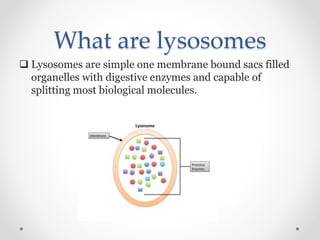
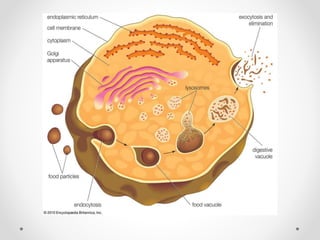
 Lysosomes are simple one membrane bound sacs filled
organelles with digestive enzymes and capable of
splitting most biological molecules.
Structure of lysosomes
 They are Globular having diameter of 0.2 to 0.8 microns
 Bounded by lipo protein layer that insulates enzymes
from the rest of the cell
 A single lysosomes contains many enzymes
• Some of these enzymes are:
• Nucleases, phosphateses , proteases, lipases and
sulphatases
• These enzymes are prepared By RER
Origin of lysosomes
• They have multiple origins depending upon the tissue in
which they are located or on their function in a specific
cell.
• 1. Extracellular origin:
• Lysosomes may be the vacuoles absorbed into cell by the
process, pinocytosis. Pinocytic vacuole may later become
cytoplasmic particle
• 2. Origin from Golgi complex:
Golgi complex forms tiny vesicles that separate from the
ends of the golgi cistarnae
Function of lysosomes
• Lysosomes digest the organic waste that is produced due
to the various metabolic activities of the cell.
• They play an important function is removing the worn
out cell organelles and organic debris by a process called
Autolysis.
• It protects the cell by destroying any foreign bacteria or
virus that invades the cell
• When a cell gets old or damaged, lysosomes burst and
the enzymes digest their own cells. This is called as
Autolysis. Therefore, lysosomes are also referred to as
‘Suicide Bags’.
Importance
• These organelles are important because they carry
enzymes which can harm other structures within a cell
• Also performs functions concerned with removing
unwanted material
Reference :
• Molcular biology of cell , sixth edition by Bruce Alberts

lysosomes

  • 2.
    What are lysosomes Lysosomes are simple one membrane bound sacs filled organelles with digestive enzymes and capable of splitting most biological molecules.
  • 3.
    Structure of lysosomes They are Globular having diameter of 0.2 to 0.8 microns  Bounded by lipo protein layer that insulates enzymes from the rest of the cell  A single lysosomes contains many enzymes • Some of these enzymes are: • Nucleases, phosphateses , proteases, lipases and sulphatases • These enzymes are prepared By RER
  • 4.
    Origin of lysosomes •They have multiple origins depending upon the tissue in which they are located or on their function in a specific cell. • 1. Extracellular origin: • Lysosomes may be the vacuoles absorbed into cell by the process, pinocytosis. Pinocytic vacuole may later become cytoplasmic particle • 2. Origin from Golgi complex: Golgi complex forms tiny vesicles that separate from the ends of the golgi cistarnae
  • 6.
    Function of lysosomes •Lysosomes digest the organic waste that is produced due to the various metabolic activities of the cell. • They play an important function is removing the worn out cell organelles and organic debris by a process called Autolysis. • It protects the cell by destroying any foreign bacteria or virus that invades the cell • When a cell gets old or damaged, lysosomes burst and the enzymes digest their own cells. This is called as Autolysis. Therefore, lysosomes are also referred to as ‘Suicide Bags’.
  • 7.
    Importance • These organellesare important because they carry enzymes which can harm other structures within a cell • Also performs functions concerned with removing unwanted material Reference : • Molcular biology of cell , sixth edition by Bruce Alberts