 Historical background
 Introduction
 Lysosomal enzymes
 Structure
 Functions
 Lysosomes and human disease
 Chaperone-mediated autophagy: roles in disease
and aging
 References
 Christian de Duve, discovered
lysosomes in 1955.
 In 1949 he was studying insulin action,
wanted to find location of glucose-6-
phosphatase on liver cells.
 de Duve and colleagues ruptured the
rat liver cells and then fractionated the
samples using differential
centrifugation.
 They found sacs containing large
amount of acid phosphatase, later de
Duve coined the term lysosomes.
 The name “lysosomes” is derived from the Latin word
“Lyein” (means to dissolve /to release/ to loosen) and
“Soma” (means body).
 These structures are termed as the “digestive system of
the cell” or “suicide bags”.
 Are present in animal cells, while in yeast and plants
same roles are performed by lytic vacuoles.
 These are membrane bound vesicles (0.1–1.2 μm).
 They vary greatly in size and shape.
 lysosomes are formed by the fusion of transport vesicles
budded from the trans Golgi network with endosomes,
which contain molecules taken up by endocytosis at the
plasma membrane.
- Primary lysosomes
( do not contain
particle or
membrane for
digestion)
- Secondary
lysosomes ( contain
particles or
membranes for
digestion)
 Contain over 50 hydrolytic enzymes which breaks down
- proteins, nucleic acids, carbohydrates, and lipids.
 Enzymes include proteases, nucleases, lipases,
glycosidases, phosphatases, phospholipases and
sulfatases.
 All enzymes are acid hydrolases because for
optimal activity they require an acid environment and
the lysosome provides a pH of about 5.0 in its interior.
 synthesized in the cytosol and the endoplasmic
reticulum, where they receive a mannose-6-phosphate
tag that targets them for transport to the lysosome.
 A membrane seals off the lysosome's acidic
environment, preventing its enzymes from harming the
rest of the cell.
 A H+ pump in the lysosomal membrane uses the energy
of ATP hydrolysis to pump H+ into the lysosome,
thereby maintaining the acidic pH of lumen.
Generally spherical, but they can vary in
and shape as a result of differences in
materials that have been taken up for
digestion
Enzyme-filled sacs
Surrounded by single membrane
Hydrolytic enzymes and lysosomal
membrane are made by RER and then
transferred to the Golgi apparatus for
processing
It is the lysosomal digestion of
extracellular materials by the process of
endocytosis. Heterophagy are of two types namely
Phagocytosis and Pinocytosis.
cellular process of ingestion, in
which the plasma membrane engulfs substances and
pinches off to form a particle containing vacuole.
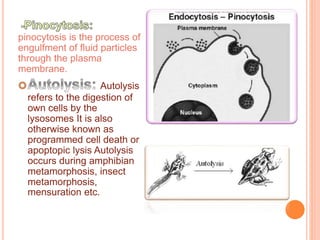
pinocytosis is the process of
engulfment of fluid particles
through the plasma
membrane.
Autolysis
refers to the digestion of
own cells by the
lysosomes It is also
otherwise known as
programmed cell death or
apoptopic lysis Autolysis
occurs during amphibian
metamorphosis, insect
metamorphosis,
mensuration etc.
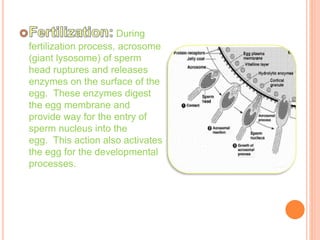
During
fertilization process, acrosome
(giant lysosome) of sperm
head ruptures and releases
enzymes on the surface of the
egg. These enzymes digest
the egg membrane and
provide way for the entry of
sperm nucleus into the
egg. This action also activates
the egg for the developmental
processes.
Due to the
presence of DNase
enzyme, lysosome had an
ability to attacks
chromosome and cause
chromosomal
breakages. These
breakages can leads to
diseases like cancer etc.
- Caused by the deficiency of an enzyme
N-acetyglucosamine phosphotransferase.
Symptoms: A rare inherited metabolic disorder
characterized by coarse facial features, skeletal
abnormalities and mental retardation.
Characterized by
the deficiency of a single lysosomal enzyme and
corresponding accumulation of undegraded substance.
 Eg:
Result from the absence of a lysosomal
enzyme, α-glucosidase.
 Symptoms: accumulation of glycogen in all organs,
cardiorespiratory failure and death , usually before age 2.
 Treatment: Enzyme replacement therapy.
Deficiency of the enzyme
β-N-hexosaminidase.
 Symptoms: brain impairment by accumulation of lipids.
 Treatment: preventing problems with the lungs and
airways ,relieving any feeding or swallowing problems
(dysphagia), medication to control fits and muscle
stiffness.
It is caused by a
hereditary deficiency of the enzyme glucocerebrosidase.
 Symptoms: bruising, fatigue, anemia, low blood
platelets, and enlargement of the liver and spleen.
Treatment: Enzyme replacement treatment with
intravenous recombinant glucocerebrosidase.
 Cytosolic Proteins are targeted to the lysosomal membrane
and then gain access to the lumen by directly crossing its
membrane This process is chaperone-mediated autophagy.
 Most of the lysosomal delivery involves vesicles but CMA
don’t.
 Proteins that undergo degradation are selected individually
through a recognition motif in their amino acid sequences. This
allows for the removal of specific proteins without disturbance
of neighboring ones and makes CMA an efficient system for
degradation of damaged or abnormal proteins.
 This selectivity permits CMA to play a regulatory role in
multiple cellular processes by contributing to modulate
intracellular levels of enzymes, transcription factors and cell
maintenance proteins.
 CMA involves:
 substrate recognition and lysosomal targeting;
 substrate binding and unfolding;
 substrate translocation
 substrate degradation in the lysosomal lumen
 Recognition takes place in cytosol through binding of
constitutive chaperone hsc70 to a pentapeptide motif present
in the amino acid sequences of all CMA substrates.
 Once bound to the chaperone, the substrate is targeted to the
surface of the lysosomes where it interacts with the cytosolic
tail of the single-span membrane protein LAMP-2A.
 Substrate unfolding is mediated by hsc70 and some of its
cochaperones present at lysosomal membrane, and is
completed before the LAMP-2A complex is fully assembled.
 As inserting LAMP-2A in proteoliposomes in the presence of
hsc70 mediate substrate translocation.
 After substrate translocation into the lysosomal lumen, LAMP-
2A is rapidly dissembled from the translocation complex into
monomers where substrates can bind again.
 Although both CMA and endosomal microautophagy share
hsc70 as the targeting chaperone, the dependence on LAMP-
2A is exclusive for CMA.
 The best way to confirm that a protein is a CMA substrate is,
to reproduce its binding and translocation across the
membrane of isolated lysosomes.
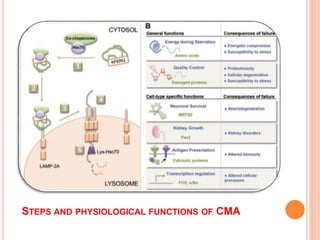
 amino acid recycling during prolonged starvation:
- CMA is gradually activated after 8-10 h of starvation and
persists at maximal activity for up to three days
-this form degradation allows for changes in the proteome
aimed at adapting the cell to the new conditions. For example,
degradation of regulatory metabolic enzymes by CMA has been
shown to contribute to the metabolic changes that allow for
cancer cells to adapt to low nutrient conditions.
 quality control- remove single proteins from the cytosol
 CMA is upregulated during oxidative stress, where it
contributes to the degradation of oxidized proteins.
 CMA is also upregulated in other conditions that lead to protein
damage such as exposure to denaturing toxic compounds.
 Activation of CMA has also been shown to support survival of
retinal cells upon activation of a pro-apoptotic program in those
cells.
 degradation of the transcription factor Pax2 by CMA in kidney
is important to control tubular cell growth.
STEPS AND PHYSIOLOGICAL FUNCTIONS OF CMA
 Parkinson’s disease (PD):
 Caused by loss of dopaminergic neurons
 subsequent motor deficits Dysfunction in CMA has been
described in both familial and sporadic PD.
 In the case of familial PD, sequence analysis reveals the
presence of CMA-targeting motifs in the majority of PD-related
proteins, supporting an important role for CMA in the control of
their intracellular levels.
 the 2 most commonly mutated proteins in patients with familial
PD, α-synuclein and LRRK2, degrade in lysosomes via CMA
using various experimental systems such as isolated
lysosomes, primary mouse neuronal cultures, mouse models
of PD and even neuronal-differentiated induced pluripotent
stem cells and brains from familial, and sporadic PD patients.
 These protein fail to reach the lysosomal lumen to be
degraded by CMA
 It is caused due to aberrant interactions of these toxic proteins
with LAMP-2A
 toxic interactions of α-synuclein and LRRK2 mutants with the
CMA transporter preclude not only their own degradation, but
also inhibit the degradation of other CMA substrates
 Abnormally enhanced CMA and cancer:
 upregulation of CMA has been linked to the survival and
proliferation of cancer cells.
 Activation of CMA is mostly due to an increase in the LAMP-
2A levels in these cancer cells and tumors.
 Genetic knock-down of LAMP-2A in cancer cells helped to
establish that CMA is required for cancer cell proliferation,
optimal tumor growth and metastasis.
 Selective blockage of CMA in cancer cells results in
transcriptional attenuation of several rate-limiting glycolytic
enzymes, and the subsequent reduction in glycolysis and ATP
production.
 the inactive forms of PKM2, one of the rate-limiting glycolytic
enzymes, are eliminated via CMA.
 CMA takes on an anti-oncogenic role in non proliferating
tumor cells by reducing the cellular levels of mutant p53
through CMA degradation.
 blockage of CMA in human tumor explants in mice through
knock-down of LAMP-2A has proven effective in not only
reducing tumor growth and metastasis but also in inducing
tumor shrinkage through cancer cell necrotic death.
 How does aging affect CMA?
 Reduced CMA activity has been observed in many cell types
and tissues of old rodents, as well as in cells derived from
aged individuals.
 Age-dependent decay in CMA appears to be caused by age-
related changes in the lipid constituents of lysosomal
membrane that alter the dynamics and stability of LAMP-2A in
the lysosomes of old organisms.
 Experimental blockage of CMA activity in cultured cells
suggests that a direct consequence of the age dependent
failure in CMA is the loss of CMA-mediated homeostasis such
as the removal of oxidatively damaged proteins and the ability
to respond to stressors.
 Genetic manipulation to preserve CMA function in old rodents
by expressing an exogenous copy of LAMP-2A in mouse liver
has proven effective in improving the health span of aged
animals.
 http://www.newworldencyclopedia.org/entry/Lysosome#
 http://www.ncbi.nlm.nih.gov/books/NBK9953/
 http://www.sivabio.50webs.com/lysosomes.htm
 http://www.nature.com/scitable/topicpage/the-discovery-of-
lysosomes-and-autophagy-14199828
 http://www.ncbi.nlm.nih.gov/pmc/articles/PMC3746853/
 https://books.google.co.in/books
 https://en.wikipedia.org/wiki/Gaucher%27s_disease
 http://www.mayoclinic.org/diseases-conditions/tay-sachs-
disease/care-at-mayo-clinic/treatment/con-20036799
 http://www.ncbi.nlm.nih.gov/books/NBK9953/figure/A1524/?report
=objectonly
 http://centennial.rucares.org/index.php?page=Exploring_Cells_Ce
ntriguge
 http://www.ivyroses.com/Biology/Organelles/Lysosomes.php
 Cell Research (2014) Ana Maria Cuervo1, Esther Wong2 24:92-
104 © 2014 IBCB, SIBS, CAS, http://www.nature.com/cr

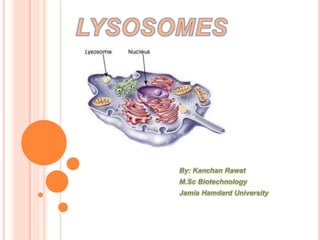
Lysosomes

  • 2.
     Historical background Introduction  Lysosomal enzymes  Structure  Functions  Lysosomes and human disease  Chaperone-mediated autophagy: roles in disease and aging  References
  • 4.
     Christian deDuve, discovered lysosomes in 1955.  In 1949 he was studying insulin action, wanted to find location of glucose-6- phosphatase on liver cells.  de Duve and colleagues ruptured the rat liver cells and then fractionated the samples using differential centrifugation.  They found sacs containing large amount of acid phosphatase, later de Duve coined the term lysosomes.
  • 5.
     The name“lysosomes” is derived from the Latin word “Lyein” (means to dissolve /to release/ to loosen) and “Soma” (means body).  These structures are termed as the “digestive system of the cell” or “suicide bags”.  Are present in animal cells, while in yeast and plants same roles are performed by lytic vacuoles.  These are membrane bound vesicles (0.1–1.2 μm).  They vary greatly in size and shape.
  • 6.
     lysosomes areformed by the fusion of transport vesicles budded from the trans Golgi network with endosomes, which contain molecules taken up by endocytosis at the plasma membrane.
  • 7.
    - Primary lysosomes (do not contain particle or membrane for digestion) - Secondary lysosomes ( contain particles or membranes for digestion)
  • 8.
     Contain over50 hydrolytic enzymes which breaks down - proteins, nucleic acids, carbohydrates, and lipids.  Enzymes include proteases, nucleases, lipases, glycosidases, phosphatases, phospholipases and sulfatases.  All enzymes are acid hydrolases because for optimal activity they require an acid environment and the lysosome provides a pH of about 5.0 in its interior.  synthesized in the cytosol and the endoplasmic reticulum, where they receive a mannose-6-phosphate tag that targets them for transport to the lysosome.
  • 9.
     A membraneseals off the lysosome's acidic environment, preventing its enzymes from harming the rest of the cell.  A H+ pump in the lysosomal membrane uses the energy of ATP hydrolysis to pump H+ into the lysosome, thereby maintaining the acidic pH of lumen.
  • 11.
    Generally spherical, butthey can vary in and shape as a result of differences in materials that have been taken up for digestion Enzyme-filled sacs Surrounded by single membrane Hydrolytic enzymes and lysosomal membrane are made by RER and then transferred to the Golgi apparatus for processing
  • 12.
    It is thelysosomal digestion of extracellular materials by the process of endocytosis. Heterophagy are of two types namely Phagocytosis and Pinocytosis. cellular process of ingestion, in which the plasma membrane engulfs substances and pinches off to form a particle containing vacuole.
  • 14.
    pinocytosis is theprocess of engulfment of fluid particles through the plasma membrane. Autolysis refers to the digestion of own cells by the lysosomes It is also otherwise known as programmed cell death or apoptopic lysis Autolysis occurs during amphibian metamorphosis, insect metamorphosis, mensuration etc.
  • 16.
    During fertilization process, acrosome (giantlysosome) of sperm head ruptures and releases enzymes on the surface of the egg. These enzymes digest the egg membrane and provide way for the entry of sperm nucleus into the egg. This action also activates the egg for the developmental processes.
  • 17.
    Due to the presenceof DNase enzyme, lysosome had an ability to attacks chromosome and cause chromosomal breakages. These breakages can leads to diseases like cancer etc.
  • 18.
    - Caused bythe deficiency of an enzyme N-acetyglucosamine phosphotransferase. Symptoms: A rare inherited metabolic disorder characterized by coarse facial features, skeletal abnormalities and mental retardation. Characterized by the deficiency of a single lysosomal enzyme and corresponding accumulation of undegraded substance.  Eg: Result from the absence of a lysosomal enzyme, α-glucosidase.  Symptoms: accumulation of glycogen in all organs, cardiorespiratory failure and death , usually before age 2.  Treatment: Enzyme replacement therapy.
  • 19.
    Deficiency of theenzyme β-N-hexosaminidase.  Symptoms: brain impairment by accumulation of lipids.  Treatment: preventing problems with the lungs and airways ,relieving any feeding or swallowing problems (dysphagia), medication to control fits and muscle stiffness. It is caused by a hereditary deficiency of the enzyme glucocerebrosidase.  Symptoms: bruising, fatigue, anemia, low blood platelets, and enlargement of the liver and spleen. Treatment: Enzyme replacement treatment with intravenous recombinant glucocerebrosidase.
  • 20.
     Cytosolic Proteinsare targeted to the lysosomal membrane and then gain access to the lumen by directly crossing its membrane This process is chaperone-mediated autophagy.  Most of the lysosomal delivery involves vesicles but CMA don’t.  Proteins that undergo degradation are selected individually through a recognition motif in their amino acid sequences. This allows for the removal of specific proteins without disturbance of neighboring ones and makes CMA an efficient system for degradation of damaged or abnormal proteins.  This selectivity permits CMA to play a regulatory role in multiple cellular processes by contributing to modulate intracellular levels of enzymes, transcription factors and cell maintenance proteins.
  • 21.
     CMA involves: substrate recognition and lysosomal targeting;  substrate binding and unfolding;  substrate translocation  substrate degradation in the lysosomal lumen  Recognition takes place in cytosol through binding of constitutive chaperone hsc70 to a pentapeptide motif present in the amino acid sequences of all CMA substrates.  Once bound to the chaperone, the substrate is targeted to the surface of the lysosomes where it interacts with the cytosolic tail of the single-span membrane protein LAMP-2A.  Substrate unfolding is mediated by hsc70 and some of its cochaperones present at lysosomal membrane, and is completed before the LAMP-2A complex is fully assembled.
  • 22.
     As insertingLAMP-2A in proteoliposomes in the presence of hsc70 mediate substrate translocation.  After substrate translocation into the lysosomal lumen, LAMP- 2A is rapidly dissembled from the translocation complex into monomers where substrates can bind again.  Although both CMA and endosomal microautophagy share hsc70 as the targeting chaperone, the dependence on LAMP- 2A is exclusive for CMA.  The best way to confirm that a protein is a CMA substrate is, to reproduce its binding and translocation across the membrane of isolated lysosomes.
  • 23.
     amino acidrecycling during prolonged starvation: - CMA is gradually activated after 8-10 h of starvation and persists at maximal activity for up to three days -this form degradation allows for changes in the proteome aimed at adapting the cell to the new conditions. For example, degradation of regulatory metabolic enzymes by CMA has been shown to contribute to the metabolic changes that allow for cancer cells to adapt to low nutrient conditions.
  • 24.
     quality control-remove single proteins from the cytosol  CMA is upregulated during oxidative stress, where it contributes to the degradation of oxidized proteins.  CMA is also upregulated in other conditions that lead to protein damage such as exposure to denaturing toxic compounds.  Activation of CMA has also been shown to support survival of retinal cells upon activation of a pro-apoptotic program in those cells.  degradation of the transcription factor Pax2 by CMA in kidney is important to control tubular cell growth.
  • 25.
    STEPS AND PHYSIOLOGICALFUNCTIONS OF CMA
  • 26.
     Parkinson’s disease(PD):  Caused by loss of dopaminergic neurons  subsequent motor deficits Dysfunction in CMA has been described in both familial and sporadic PD.  In the case of familial PD, sequence analysis reveals the presence of CMA-targeting motifs in the majority of PD-related proteins, supporting an important role for CMA in the control of their intracellular levels.  the 2 most commonly mutated proteins in patients with familial PD, α-synuclein and LRRK2, degrade in lysosomes via CMA using various experimental systems such as isolated lysosomes, primary mouse neuronal cultures, mouse models of PD and even neuronal-differentiated induced pluripotent stem cells and brains from familial, and sporadic PD patients.
  • 27.
     These proteinfail to reach the lysosomal lumen to be degraded by CMA  It is caused due to aberrant interactions of these toxic proteins with LAMP-2A  toxic interactions of α-synuclein and LRRK2 mutants with the CMA transporter preclude not only their own degradation, but also inhibit the degradation of other CMA substrates
  • 29.
     Abnormally enhancedCMA and cancer:  upregulation of CMA has been linked to the survival and proliferation of cancer cells.  Activation of CMA is mostly due to an increase in the LAMP- 2A levels in these cancer cells and tumors.  Genetic knock-down of LAMP-2A in cancer cells helped to establish that CMA is required for cancer cell proliferation, optimal tumor growth and metastasis.  Selective blockage of CMA in cancer cells results in transcriptional attenuation of several rate-limiting glycolytic enzymes, and the subsequent reduction in glycolysis and ATP production.  the inactive forms of PKM2, one of the rate-limiting glycolytic enzymes, are eliminated via CMA.  CMA takes on an anti-oncogenic role in non proliferating tumor cells by reducing the cellular levels of mutant p53 through CMA degradation.
  • 30.
     blockage ofCMA in human tumor explants in mice through knock-down of LAMP-2A has proven effective in not only reducing tumor growth and metastasis but also in inducing tumor shrinkage through cancer cell necrotic death.
  • 31.
     How doesaging affect CMA?  Reduced CMA activity has been observed in many cell types and tissues of old rodents, as well as in cells derived from aged individuals.  Age-dependent decay in CMA appears to be caused by age- related changes in the lipid constituents of lysosomal membrane that alter the dynamics and stability of LAMP-2A in the lysosomes of old organisms.  Experimental blockage of CMA activity in cultured cells suggests that a direct consequence of the age dependent failure in CMA is the loss of CMA-mediated homeostasis such as the removal of oxidatively damaged proteins and the ability to respond to stressors.  Genetic manipulation to preserve CMA function in old rodents by expressing an exogenous copy of LAMP-2A in mouse liver has proven effective in improving the health span of aged animals.
  • 32.
     http://www.newworldencyclopedia.org/entry/Lysosome#  http://www.ncbi.nlm.nih.gov/books/NBK9953/ http://www.sivabio.50webs.com/lysosomes.htm  http://www.nature.com/scitable/topicpage/the-discovery-of- lysosomes-and-autophagy-14199828  http://www.ncbi.nlm.nih.gov/pmc/articles/PMC3746853/  https://books.google.co.in/books  https://en.wikipedia.org/wiki/Gaucher%27s_disease  http://www.mayoclinic.org/diseases-conditions/tay-sachs- disease/care-at-mayo-clinic/treatment/con-20036799  http://www.ncbi.nlm.nih.gov/books/NBK9953/figure/A1524/?report =objectonly  http://centennial.rucares.org/index.php?page=Exploring_Cells_Ce ntriguge  http://www.ivyroses.com/Biology/Organelles/Lysosomes.php  Cell Research (2014) Ana Maria Cuervo1, Esther Wong2 24:92- 104 © 2014 IBCB, SIBS, CAS, http://www.nature.com/cr