PRESENTATION ON LYSOSOMES
Presented by : Bhanu Tiwari
B.Tech.Biotehnology
Dr.RPCAU Pusa
Exceptions
 Lysosomes is a membrane bound organelle that
contain an array of enzymes capable of breaking
down all types of biological polymers.
 Discovered by Christian De Duve in liver cells.
 Enzymes are acid hydrolytic in nature.
 pH of enzymes ranging from 4.5 to 5.0.
 Maintains pH differential by pumping protons(H+).
 Found in nearly all eukaryotes.
Absent in some fungi like yeast, neurospora.
Absent in some protists like Euglina.
Absent in meristemetic cells.
Also absent in mature mammalian RBC.
INTRODUCTION
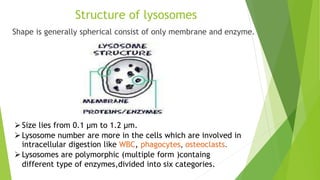
Structure of lysosomes
Shape is generally spherical consist of only membrane and enzyme.
Size lies from 0.1 µm to 1.2 µm.
Lysosome number are more in the cells which are involved in
intracellular digestion like WBC, phagocytes, osteoclasts.
Lysosomes are polymorphic (multiple form )containg
different type of enzymes,divided into six categories.
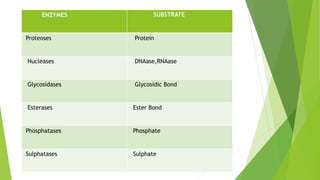
ENZYMES SUBSTRATE
Proteoses Protein
Nucleases DNAase,RNAase
Glycosidases Glycosidic Bond
Esterases Ester Bond
Phosphatases Phosphate
Sulphatases Sulphate
Types/forms of lysosomes
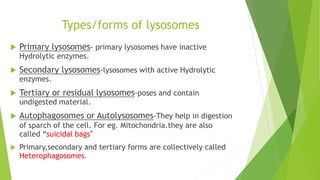
 Primary lysosomes- primary lysosomes have inactive
Hydrolytic enzymes.
 Secondary lysosomes-lysosomes with active Hydrolytic
enzymes.
 Tertiary or residual lysosomes-poses and contain
undigested material.
 Autophagosomes or Autolysosomes-They help in digestion
of sparch of the cell. For eg. Mitochondria.they are also
called “suicidal bags”
 Primary,secondary and tertiary forms are collectively called
Heterophagosomes.
Functions of lysosomes
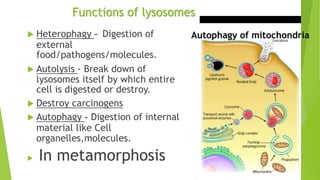
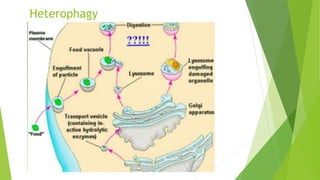
 Heterophagy - Digestion of
external
food/pathogens/molecules.
 Autolysis - Break down of
lysosomes itself by which entire
cell is digested or destroy.
 Destroy carcinogens
 Autophagy - Digestion of internal
material like Cell
organelles,molecules.
 In metamorphosis
Autophagy of mitochondria
Heterophagy
References
 Cell and Molecular Biology: Concept and Experiment, G.Karp
 Darnell, J.E.; Lodish, H.F.; Baltimore, D. Molecular Cell Biology, 2nd ed., Chapter 26.
New York:
 Alberts molecular biology.

Lysosome structure and function

  • 1.
    PRESENTATION ON LYSOSOMES Presentedby : Bhanu Tiwari B.Tech.Biotehnology Dr.RPCAU Pusa
  • 2.
    Exceptions  Lysosomes isa membrane bound organelle that contain an array of enzymes capable of breaking down all types of biological polymers.  Discovered by Christian De Duve in liver cells.  Enzymes are acid hydrolytic in nature.  pH of enzymes ranging from 4.5 to 5.0.  Maintains pH differential by pumping protons(H+).  Found in nearly all eukaryotes. Absent in some fungi like yeast, neurospora. Absent in some protists like Euglina. Absent in meristemetic cells. Also absent in mature mammalian RBC. INTRODUCTION
  • 3.
    Structure of lysosomes Shapeis generally spherical consist of only membrane and enzyme. Size lies from 0.1 µm to 1.2 µm. Lysosome number are more in the cells which are involved in intracellular digestion like WBC, phagocytes, osteoclasts. Lysosomes are polymorphic (multiple form )containg different type of enzymes,divided into six categories.
  • 4.
    ENZYMES SUBSTRATE Proteoses Protein NucleasesDNAase,RNAase Glycosidases Glycosidic Bond Esterases Ester Bond Phosphatases Phosphate Sulphatases Sulphate
  • 5.
    Types/forms of lysosomes Primary lysosomes- primary lysosomes have inactive Hydrolytic enzymes.  Secondary lysosomes-lysosomes with active Hydrolytic enzymes.  Tertiary or residual lysosomes-poses and contain undigested material.  Autophagosomes or Autolysosomes-They help in digestion of sparch of the cell. For eg. Mitochondria.they are also called “suicidal bags”  Primary,secondary and tertiary forms are collectively called Heterophagosomes.
  • 6.
    Functions of lysosomes Heterophagy - Digestion of external food/pathogens/molecules.  Autolysis - Break down of lysosomes itself by which entire cell is digested or destroy.  Destroy carcinogens  Autophagy - Digestion of internal material like Cell organelles,molecules.  In metamorphosis Autophagy of mitochondria
  • 7.
  • 8.
    References  Cell andMolecular Biology: Concept and Experiment, G.Karp  Darnell, J.E.; Lodish, H.F.; Baltimore, D. Molecular Cell Biology, 2nd ed., Chapter 26. New York:  Alberts molecular biology.