
Presented by
Surya Pratap Singh
M.Sc. Life Sciences
Central University of Gujarat
INTRODUCTION
• Lysosomes discovered by the cytologist
Christian de Duve in the 1960.
• Lysosomes are spherical organelles that
contain enzymes . They break up food so it is
easier to digest. They are found in animal
cells, while in yeast and plants .
• Lysosomes are common in animal cells but
rare in plant cells contain hydrolytic enzymes
necessary for intracellular digestion.
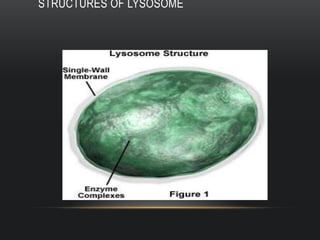
STRUCTURES OF LYSOSOME
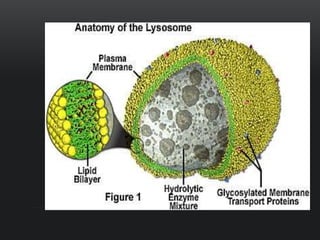
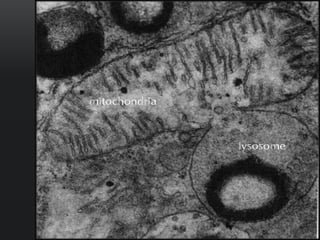
• Lysosomes are spherical structures bounded by a
single unit membrane.
• The size of lysosomes varies from 0.2 to 0.8 nm.
• lysosomal membranes are sensitive to many
labilizers and stabilizers
ENZYMES OF LYSOSOMES

• Lysosomes
are
membrane
enclosed
compartments filled with soluble hydrolytic
enzymes.
•

Lysosomes contain about 40 types of
hydrolytic enzymes, including proteases,
nucleases,
glycosidases,
lipases,
phospolipases, phosphatases, and sulfatases.

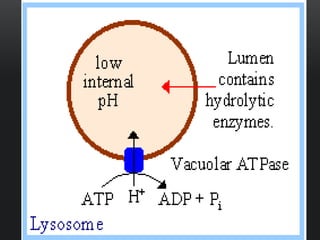
• Lysosome provides by maintanining a pH
about 4.5 to 5.0.
LYSOSOMES ARE HETROGENEOUS
• The hetrogeneity of lysosomal morphology
contrasts with realatively uniform structures
of most other cell organelles.
• The late endosomes contain material
received from both the plasma membrane by
endocytosis
and
newly
synthesized
lysosomal hydrolases.
• Late endosomes fuse
lysosomes
to
form
endolysosomes.

with preexisting
structures
that
• Endolysosomes fuse and form lysosomes.
• This reason lysosomes are sometimes
view as a hetrogeneous.
PLANT AND FUNGAL VACUOLES ARE SIMILAR TO
LYSOSOMES
• Plant and fungal cells contain one or several very
large fluid-filled vesicles called vacuoles.

• It is related to animal cell lysosomes and
contain a variety of hydrolytic enzymes.
• The plant vacuole can act as a storage organelle
for both nutrients and waste products.
• The vacuole is important as a homeostatic
device.
• All these hydrolytic enzymes are produced
in the endoplasmic reticulum, and to some
extent in cytoplasm are transported and
processed through the Golgi apparatus.

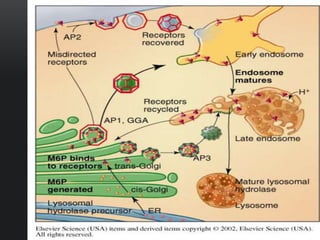
• Lysosomal enzymes are synthesized in the
cytosol and the endoplasmic reticulum,
where they receive a mannose-6-phosphate
tag that targets them for the lysosome.
• If the lysosomal enzymes do not reach the
target it causes inclusion-cell disease,
resulting in accumulation of waste within
these organelles
THE FUNCTION OF LYSOSOMES
• A lysosome is a membrane bag containing
digestive enzymes.

• For digest food, the lysosome membrane
fuses with the membrane of a food vacuole
and squirts the enzymes inside.
• The digested food can then diffuse through
the vacuole membrane and enter the cell to
be used for energy or growth.
• Lysosomes are sometimes called "suicide bags’’
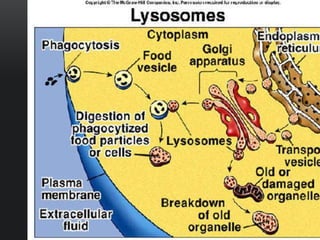
• Lysosomes are the cells' garbage disposal
system. They are used for the digestion of
macromolecules from phagocytosis.
• Lysosome's pick up foreign invaders such
as bacteria, food and old organelles and
break them into small pieces that can
hopefully be used again.
• Autophagy may also lead to autophagic
cell death, a form of programmed selfdestruction, or autolysis of the cell, which
means that the cell is digesting itself.
CONCLUSION
• Lysosmes are specialized for the intracellular
digestion of macromolecules.
• These enzymes work only at low pH (highly
acidic) levels.
• Uncontrolled release of lysosome contents into the
cytoplasm can also cause cell death (necrosis).
Sps.final

Sps.final

  • 1.
    Presented by Surya PratapSingh M.Sc. Life Sciences Central University of Gujarat
  • 2.
    INTRODUCTION • Lysosomes discoveredby the cytologist Christian de Duve in the 1960. • Lysosomes are spherical organelles that contain enzymes . They break up food so it is easier to digest. They are found in animal cells, while in yeast and plants . • Lysosomes are common in animal cells but rare in plant cells contain hydrolytic enzymes necessary for intracellular digestion.
  • 3.
  • 4.
    • Lysosomes arespherical structures bounded by a single unit membrane. • The size of lysosomes varies from 0.2 to 0.8 nm. • lysosomal membranes are sensitive to many labilizers and stabilizers
  • 6.
    ENZYMES OF LYSOSOMES •Lysosomes are membrane enclosed compartments filled with soluble hydrolytic enzymes. • Lysosomes contain about 40 types of hydrolytic enzymes, including proteases, nucleases, glycosidases, lipases, phospolipases, phosphatases, and sulfatases. • Lysosome provides by maintanining a pH about 4.5 to 5.0.
  • 8.
    LYSOSOMES ARE HETROGENEOUS •The hetrogeneity of lysosomal morphology contrasts with realatively uniform structures of most other cell organelles. • The late endosomes contain material received from both the plasma membrane by endocytosis and newly synthesized lysosomal hydrolases. • Late endosomes fuse lysosomes to form endolysosomes. with preexisting structures that
  • 9.
    • Endolysosomes fuseand form lysosomes. • This reason lysosomes are sometimes view as a hetrogeneous.
  • 10.
    PLANT AND FUNGALVACUOLES ARE SIMILAR TO LYSOSOMES • Plant and fungal cells contain one or several very large fluid-filled vesicles called vacuoles. • It is related to animal cell lysosomes and contain a variety of hydrolytic enzymes. • The plant vacuole can act as a storage organelle for both nutrients and waste products. • The vacuole is important as a homeostatic device.
  • 11.
    • All thesehydrolytic enzymes are produced in the endoplasmic reticulum, and to some extent in cytoplasm are transported and processed through the Golgi apparatus. • Lysosomal enzymes are synthesized in the cytosol and the endoplasmic reticulum, where they receive a mannose-6-phosphate tag that targets them for the lysosome. • If the lysosomal enzymes do not reach the target it causes inclusion-cell disease, resulting in accumulation of waste within these organelles
  • 13.
    THE FUNCTION OFLYSOSOMES • A lysosome is a membrane bag containing digestive enzymes. • For digest food, the lysosome membrane fuses with the membrane of a food vacuole and squirts the enzymes inside. • The digested food can then diffuse through the vacuole membrane and enter the cell to be used for energy or growth. • Lysosomes are sometimes called "suicide bags’’
  • 15.
    • Lysosomes arethe cells' garbage disposal system. They are used for the digestion of macromolecules from phagocytosis. • Lysosome's pick up foreign invaders such as bacteria, food and old organelles and break them into small pieces that can hopefully be used again. • Autophagy may also lead to autophagic cell death, a form of programmed selfdestruction, or autolysis of the cell, which means that the cell is digesting itself.
  • 17.
    CONCLUSION • Lysosmes arespecialized for the intracellular digestion of macromolecules. • These enzymes work only at low pH (highly acidic) levels. • Uncontrolled release of lysosome contents into the cytoplasm can also cause cell death (necrosis).