NAME ALISHBA RAFAQAT
ROLL NO F24-2604
SUBJECT CYTOLOGY
DEPARTMENT ZOOLOGY
SEMESTER 3rd
SUBMITTED TO DR. KAMRAN
DATED 9-12-2024
Lysosomes:
Discovery:
Christian de Duve discovered lysosomes in 1955 while working in his laboratory in
Louvain. De Duve was awarded the Nobel Prize in Physiology or Medicine in 1974
for his discovery, along with Albert Claude and George Palade.
Definition:
A lysosome is a membrane-bound cell organelle that contains digestive
enzymes. Lysosomes are involved with various cell processes. They break
down excess or worn-out cell parts. They may be used to destroy invading
viruses and bacteria.
Structure of Lysosomes:
Lysosomes are membrane-bound organelles and the area within the membrane is called
the lumen, which contains the hydrolytic enzymes and other cellular debris.
Lysosome show enzyme complexes within the single-walled membrane.
The pH level of the lumen lies between 4.5 and 5.0, which makes it quite acidic. It is
almost comparable to the function of acids found in the stomach.
Besides breaking down biological polymers, lysosomes are also involved in various other
cell processes such as counting discharged materials, energy metabolism, cell signalling,
and restoration of the plasma membrane.
The sizes of lysosomes vary, with the largest ones measuring in more at than 1.2 μm. But
they typically range from 0.1 μm to 0.6 μm.
Formation of Lysosomes:
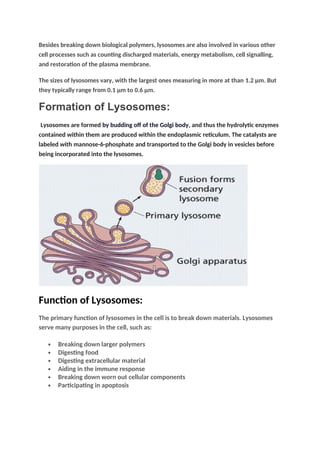
Lysosomes are formed by budding off of the Golgi body, and thus the hydrolytic enzymes
contained within them are produced within the endoplasmic reticulum. The catalysts are
labeled with mannose-6-phosphate and transported to the Golgi body in vesicles before
being incorporated into the lysosomes.
Function of Lysosomes:
The primary function of lysosomes in the cell is to break down materials. Lysosomes
serve many purposes in the cell, such as:
 Breaking down larger polymers
 Digesting food
 Digesting extracellular material
 Aiding in the immune response
 Breaking down worn out cellular components
 Participating in apoptosis
Lysosomes break down larger polymers, such as lipids, carbohydrates, and proteins
into their component parts. As a result, some protists use lysosomes to help digest
food taken in from the environment.
Types of Lysosomes:
There are Two types of lysosomes.
1. Primary Lysosomes
2. Secondary Lysosomes
Primary Lysosomes:
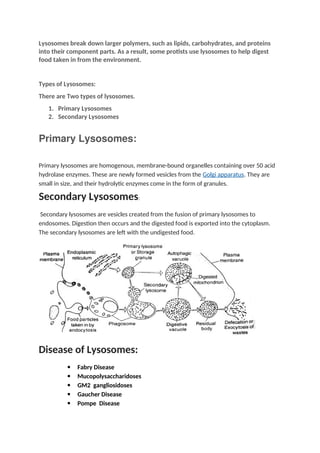
Primary lysosomes are homogenous, membrane-bound organelles containing over 50 acid
hydrolase enzymes. These are newly formed vesicles from the Golgi apparatus. They are
small in size, and their hydrolytic enzymes come in the form of granules.
Secondary Lysosomes:
Secondary lysosomes are vesicles created from the fusion of primary lysosomes to
endosomes. Digestion then occurs and the digested food is exported into the cytoplasm.
The secondary lysosomes are left with the undigested food.
Disease of Lysosomes:
 Fabry Disease
 Mucopolysaccharidoses
 GM2 gangliosidoses
 Gaucher Disease
 Pompe Disease
 Tay –Sachs Disease
 Shortness of breath
 Niemann disease
 Batten Disease
Conclusion:
In conclusion, lysosomes are membrane-bound organelles that play a vital role in
maintaining cellular homeostasis. They are responsible for cellular digestion, recycling,
and defense against pathogens. The unique structure and function of lysosomes enable
them to perform these critical functions. Understanding the biology of lysosomes is
essential for appreciating their importance in maintaining cellular health and preventing
diseases.
Lysosomes.docx......................................

Lysosomes.docx......................................

  • 1.
    NAME ALISHBA RAFAQAT ROLLNO F24-2604 SUBJECT CYTOLOGY DEPARTMENT ZOOLOGY SEMESTER 3rd SUBMITTED TO DR. KAMRAN DATED 9-12-2024
  • 2.
    Lysosomes: Discovery: Christian de Duvediscovered lysosomes in 1955 while working in his laboratory in Louvain. De Duve was awarded the Nobel Prize in Physiology or Medicine in 1974 for his discovery, along with Albert Claude and George Palade. Definition: A lysosome is a membrane-bound cell organelle that contains digestive enzymes. Lysosomes are involved with various cell processes. They break down excess or worn-out cell parts. They may be used to destroy invading viruses and bacteria. Structure of Lysosomes: Lysosomes are membrane-bound organelles and the area within the membrane is called the lumen, which contains the hydrolytic enzymes and other cellular debris. Lysosome show enzyme complexes within the single-walled membrane. The pH level of the lumen lies between 4.5 and 5.0, which makes it quite acidic. It is almost comparable to the function of acids found in the stomach.
  • 3.
    Besides breaking downbiological polymers, lysosomes are also involved in various other cell processes such as counting discharged materials, energy metabolism, cell signalling, and restoration of the plasma membrane. The sizes of lysosomes vary, with the largest ones measuring in more at than 1.2 μm. But they typically range from 0.1 μm to 0.6 μm. Formation of Lysosomes: Lysosomes are formed by budding off of the Golgi body, and thus the hydrolytic enzymes contained within them are produced within the endoplasmic reticulum. The catalysts are labeled with mannose-6-phosphate and transported to the Golgi body in vesicles before being incorporated into the lysosomes. Function of Lysosomes: The primary function of lysosomes in the cell is to break down materials. Lysosomes serve many purposes in the cell, such as:  Breaking down larger polymers  Digesting food  Digesting extracellular material  Aiding in the immune response  Breaking down worn out cellular components  Participating in apoptosis
  • 4.
    Lysosomes break downlarger polymers, such as lipids, carbohydrates, and proteins into their component parts. As a result, some protists use lysosomes to help digest food taken in from the environment. Types of Lysosomes: There are Two types of lysosomes. 1. Primary Lysosomes 2. Secondary Lysosomes Primary Lysosomes: Primary lysosomes are homogenous, membrane-bound organelles containing over 50 acid hydrolase enzymes. These are newly formed vesicles from the Golgi apparatus. They are small in size, and their hydrolytic enzymes come in the form of granules. Secondary Lysosomes: Secondary lysosomes are vesicles created from the fusion of primary lysosomes to endosomes. Digestion then occurs and the digested food is exported into the cytoplasm. The secondary lysosomes are left with the undigested food. Disease of Lysosomes:  Fabry Disease  Mucopolysaccharidoses  GM2 gangliosidoses  Gaucher Disease  Pompe Disease
  • 5.
     Tay –SachsDisease  Shortness of breath  Niemann disease  Batten Disease Conclusion: In conclusion, lysosomes are membrane-bound organelles that play a vital role in maintaining cellular homeostasis. They are responsible for cellular digestion, recycling, and defense against pathogens. The unique structure and function of lysosomes enable them to perform these critical functions. Understanding the biology of lysosomes is essential for appreciating their importance in maintaining cellular health and preventing diseases.