GOLGI APPARATUS | 1
GOLGI APPARATUS
 Golgi apparatus is a complex network of smooth membrane enclosed organelle which
helps in collection, packaging, distribution and secretion of biomolecules.
 Golgi apparatus is referred as Golgi complex, Golgi bodies, Golgi some,
dictyosomes, lipochondria, Dalton Complex, Baker’s bodies, Carbohydrate factory,
‘traffic police’ of cell.
DISCOVERY:
 Italian histologist CAMILLO GOLGI (1898) first discovered Golgi apparatus in the nerve
cells of bran owl and cat by metallic impregnation technique using, mixtures of silver
salt osmium chloride.
 DALTON and Felix (1954) described its electron microscopic structure.
OCCURRENCE:
 The Golgi apparatus occurs in all eukaryotic cells. Exception: male gametes of bryophytes and
pteridophytes, mature sieve tubes, some fungal cells, and mature sperms and RBCs of animals.
 It is absent in prokaryotic cells.
 The Golgi apparatus constitutes about 2 % of total cell volume.
ULTRASTRUCTURE OF GOLGI APPARATUS
Golgi apparatus consists of different components such as
1. Cisternae
2. Tubules
3. Golgi vesicles
4. Large vacuoles
1. CISTERNAE
 The cisternae are flattened sacs like closed compartments. They are stacks of parallel
double membrane lamellae.
 Golgi apparatus consists of a stack of 3-10 flatted sacs or cisternae with a complex
irregular network of tubules vesicles and vacuoles on the outer edges.
 The adjacent cisternae are separated by an inter-cisternal space of 10-30 nm.
 The intercisternal space contains protein cross-links that hold the cisternae together.
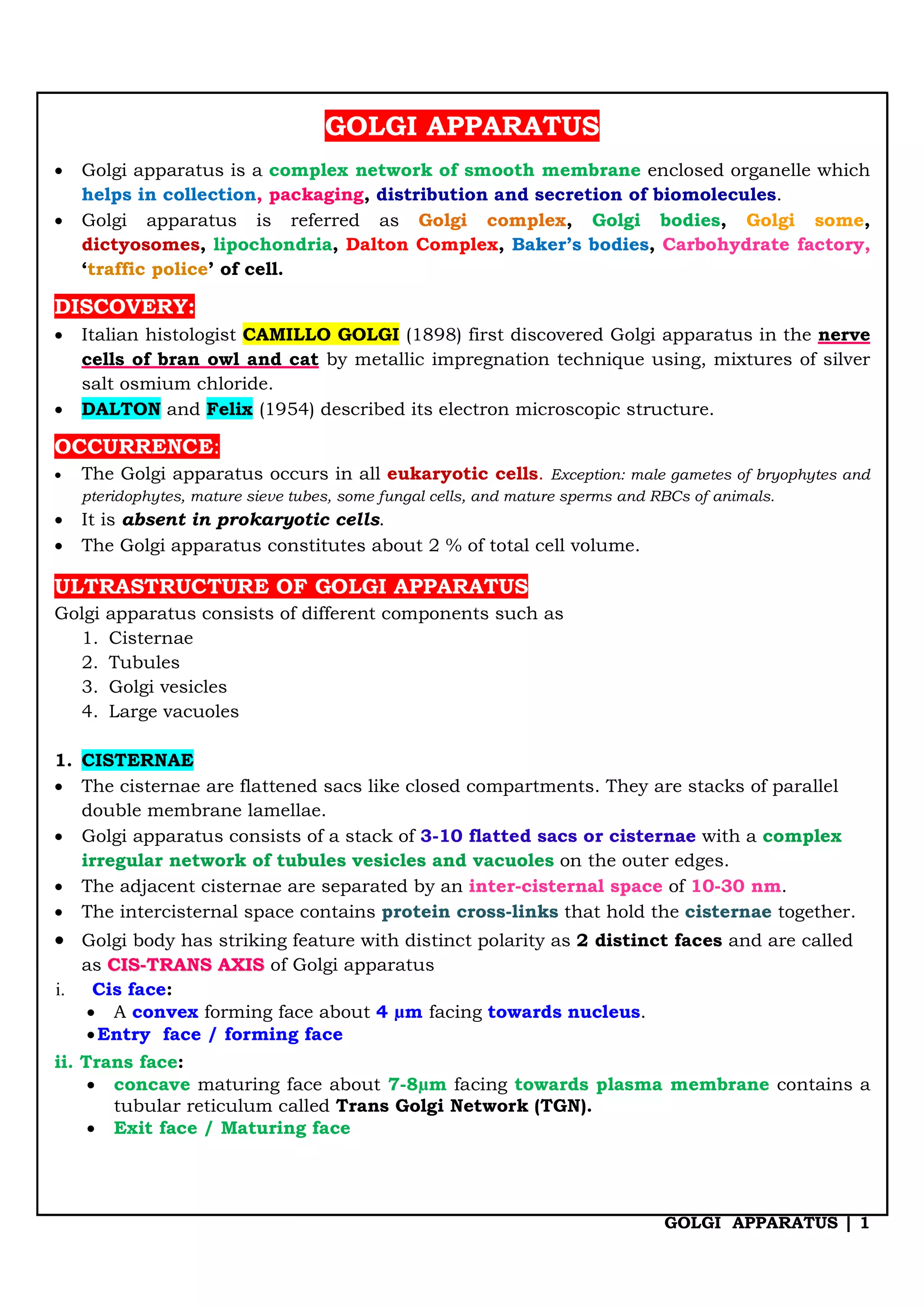
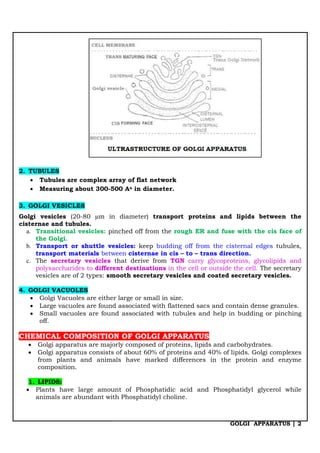
 Golgi body has striking feature with distinct polarity as 2 distinct faces and are called
as C
CI
IS
S-
-T
TR
RA
AN
NS
S A
AX
XI
IS
S of Golgi apparatus
i. Cis face:
 A convex forming face about 4 µm facing towards nucleus.
Entry face / forming face
ii. Trans face:
 concave maturing face about 7-8µm facing towards plasma membrane contains a
tubular reticulum called Trans Golgi Network (TGN).
 Exit face / Maturing face
2. TUBULES
 Tubules are complex array of flat network
 Measuring about 300-500
3. GOLGI VESICLES
Golgi vesicles (20-80 µm in diameter)
cisternae and tubules.
a. Transitional vesicles: pinched off from the
the Golgi.
b. Transport or shuttle vesicles:
transport materials between
c. The secretary vesicles
polysaccharides to different destinations
vesicles are of 2 types: smooth secretary vesicles and coated secretary vesicles.
4. GOLGI VACUOLES
 Golgi Vacuoles are eithe
 Large vacuoles are found
 Small vacuoles are foun
off.
CHEMICAL COMPOSITIO
 Golgi apparatus are majorly
 Golgi apparatus consists of about 60% of proteins and 40% of
from plants and animals have marked differences in the prot
composition.
1. LIPIDS:
 Plants have large amount of
animals are abundant wit
complex array of flat network
500 Ao in diameter.
80 µm in diameter) transport proteins and lipids between the
pinched off from the rough ER and fuse
Transport or shuttle vesicles: keep budding off from the cisternal edges
between cisternae in cis – to – trans direction.
secretary vesicles that derive from TGN carry glycoproteins, glycol
different destinations in the cell or outside the cell.
smooth secretary vesicles and coated secretary vesicles.
er large or small in size.
d associated with flattened sacs and
nd associated with tubules and help
ON OF GOLGI APPARATUS
majorly composed of proteins, lipids and
consists of about 60% of proteins and 40% of
from plants and animals have marked differences in the prot
amount of Phosphatidic acid and Phos
th Phosphatidyl choline.
GOLGI APPARATUS | 2
transport proteins and lipids between the
and fuse with the cis face of
budding off from the cisternal edges tubules,
trans direction.
carry glycoproteins, glycolipids and
in the cell or outside the cell. The secretary
smooth secretary vesicles and coated secretary vesicles.
contain dense granules.
p in budding or pinching
carbohydrates.
consists of about 60% of proteins and 40% of lipids. Golgi complexes
from plants and animals have marked differences in the protein and enzyme
sphatidyl glycerol while
GOLGI APPARATUS | 3
2. CARBOHYDRATES:
 Glucosamine, galactose, glucose, mannose and fucose are found commonly in both
plants and animals.
 only plants are pentose
 animals have salicylic acid and abundant glucospingolipids
3. PROTEINS
• Different classes of enzymes are concentrated in golgi apparatus such as glycosyl
transferase, thiamine pyrophosphatase and acid phosphatase.
• Golgi complex have enzymes like NADH Cyt b3 reductase, NADH cyt C reductase
and 5’ – nucleotidase
• Low density lipoproteins are also found accumulated
FUNCTIONS OF GOLGI APPARATUS
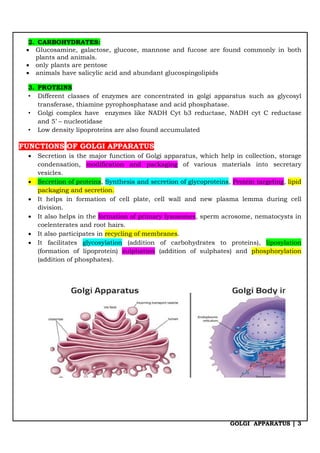
 Secretion is the major function of Golgi apparatus, which help in collection, storage
condensation, modification and packaging of various materials into secretary
vesicles.
 Secretion of proteins, Synthesis and secretion of glycoproteins, Protein targeting, lipid
packaging and secretion.
 It helps in formation of cell plate, cell wall and new plasma lemma during cell
division.
 It also helps in the formation of primary lysosomes, sperm acrosome, nematocysts in
coelenterates and root hairs.
 It also participates in recycling of membranes.
 It facilitates glycosylation (addition of carbohydrates to proteins), liposylation
(formation of lipoprotein) sulphation (addition of sulphates) and phosphorylation
(addition of phosphates).

Golgi complex - Basics

  • 1.
    GOLGI APPARATUS |1 GOLGI APPARATUS  Golgi apparatus is a complex network of smooth membrane enclosed organelle which helps in collection, packaging, distribution and secretion of biomolecules.  Golgi apparatus is referred as Golgi complex, Golgi bodies, Golgi some, dictyosomes, lipochondria, Dalton Complex, Baker’s bodies, Carbohydrate factory, ‘traffic police’ of cell. DISCOVERY:  Italian histologist CAMILLO GOLGI (1898) first discovered Golgi apparatus in the nerve cells of bran owl and cat by metallic impregnation technique using, mixtures of silver salt osmium chloride.  DALTON and Felix (1954) described its electron microscopic structure. OCCURRENCE:  The Golgi apparatus occurs in all eukaryotic cells. Exception: male gametes of bryophytes and pteridophytes, mature sieve tubes, some fungal cells, and mature sperms and RBCs of animals.  It is absent in prokaryotic cells.  The Golgi apparatus constitutes about 2 % of total cell volume. ULTRASTRUCTURE OF GOLGI APPARATUS Golgi apparatus consists of different components such as 1. Cisternae 2. Tubules 3. Golgi vesicles 4. Large vacuoles 1. CISTERNAE  The cisternae are flattened sacs like closed compartments. They are stacks of parallel double membrane lamellae.  Golgi apparatus consists of a stack of 3-10 flatted sacs or cisternae with a complex irregular network of tubules vesicles and vacuoles on the outer edges.  The adjacent cisternae are separated by an inter-cisternal space of 10-30 nm.  The intercisternal space contains protein cross-links that hold the cisternae together.  Golgi body has striking feature with distinct polarity as 2 distinct faces and are called as C CI IS S- -T TR RA AN NS S A AX XI IS S of Golgi apparatus i. Cis face:  A convex forming face about 4 µm facing towards nucleus. Entry face / forming face ii. Trans face:  concave maturing face about 7-8µm facing towards plasma membrane contains a tubular reticulum called Trans Golgi Network (TGN).  Exit face / Maturing face
  • 2.
    2. TUBULES  Tubulesare complex array of flat network  Measuring about 300-500 3. GOLGI VESICLES Golgi vesicles (20-80 µm in diameter) cisternae and tubules. a. Transitional vesicles: pinched off from the the Golgi. b. Transport or shuttle vesicles: transport materials between c. The secretary vesicles polysaccharides to different destinations vesicles are of 2 types: smooth secretary vesicles and coated secretary vesicles. 4. GOLGI VACUOLES  Golgi Vacuoles are eithe  Large vacuoles are found  Small vacuoles are foun off. CHEMICAL COMPOSITIO  Golgi apparatus are majorly  Golgi apparatus consists of about 60% of proteins and 40% of from plants and animals have marked differences in the prot composition. 1. LIPIDS:  Plants have large amount of animals are abundant wit complex array of flat network 500 Ao in diameter. 80 µm in diameter) transport proteins and lipids between the pinched off from the rough ER and fuse Transport or shuttle vesicles: keep budding off from the cisternal edges between cisternae in cis – to – trans direction. secretary vesicles that derive from TGN carry glycoproteins, glycol different destinations in the cell or outside the cell. smooth secretary vesicles and coated secretary vesicles. er large or small in size. d associated with flattened sacs and nd associated with tubules and help ON OF GOLGI APPARATUS majorly composed of proteins, lipids and consists of about 60% of proteins and 40% of from plants and animals have marked differences in the prot amount of Phosphatidic acid and Phos th Phosphatidyl choline. GOLGI APPARATUS | 2 transport proteins and lipids between the and fuse with the cis face of budding off from the cisternal edges tubules, trans direction. carry glycoproteins, glycolipids and in the cell or outside the cell. The secretary smooth secretary vesicles and coated secretary vesicles. contain dense granules. p in budding or pinching carbohydrates. consists of about 60% of proteins and 40% of lipids. Golgi complexes from plants and animals have marked differences in the protein and enzyme sphatidyl glycerol while
  • 3.
    GOLGI APPARATUS |3 2. CARBOHYDRATES:  Glucosamine, galactose, glucose, mannose and fucose are found commonly in both plants and animals.  only plants are pentose  animals have salicylic acid and abundant glucospingolipids 3. PROTEINS • Different classes of enzymes are concentrated in golgi apparatus such as glycosyl transferase, thiamine pyrophosphatase and acid phosphatase. • Golgi complex have enzymes like NADH Cyt b3 reductase, NADH cyt C reductase and 5’ – nucleotidase • Low density lipoproteins are also found accumulated FUNCTIONS OF GOLGI APPARATUS  Secretion is the major function of Golgi apparatus, which help in collection, storage condensation, modification and packaging of various materials into secretary vesicles.  Secretion of proteins, Synthesis and secretion of glycoproteins, Protein targeting, lipid packaging and secretion.  It helps in formation of cell plate, cell wall and new plasma lemma during cell division.  It also helps in the formation of primary lysosomes, sperm acrosome, nematocysts in coelenterates and root hairs.  It also participates in recycling of membranes.  It facilitates glycosylation (addition of carbohydrates to proteins), liposylation (formation of lipoprotein) sulphation (addition of sulphates) and phosphorylation (addition of phosphates).