
Biology SOL Review
A General Overview
Created by Rhonda Taylor,
Menchville High School
2014
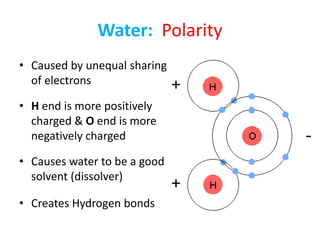
Water: Polarity
• Caused by unequal sharing
of electrons
• H end is more positively
charged & O end is more
negatively charged
• Causes water to be a good
solvent (dissolver)
• Creates Hydrogen bonds
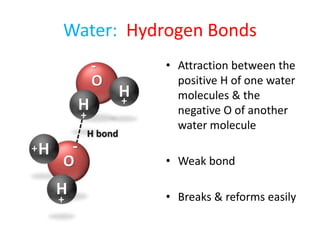
Water: Hydrogen Bonds
• Attraction between the
positive H of one water
molecules & the
negative O of another
water molecule
• Weak bond
• Breaks & reforms easily
Other Water Properties
• Cohesion – water bonds to water
• Adhesion – water bonds to other
• Neutral – pH of 7
• Surface Tension – cohesion, adhesion &
H bonds resistance to breakage
• High Heat Capacity – absorbs a lot of
heat before getting hot & takes a long
time to lose heat
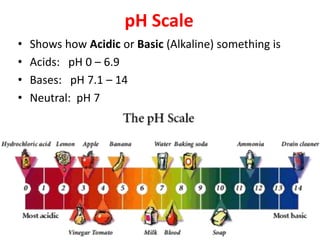
pH Scale
• Shows how Acidic or Basic (Alkaline) something is
• Acids: pH 0 – 6.9
• Bases: pH 7.1 – 14
• Neutral: pH 7
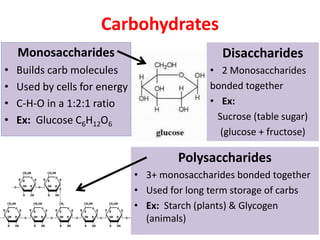
Carbohydrates
Monosaccharides
• Builds carb molecules
• Used by cells for energy
• C-H-O in a 1:2:1 ratio
• Ex: Glucose C6H12O6
Disaccharides
• 2 Monosaccharides
bonded together
• Ex:
Sucrose (table sugar)
(glucose + fructose)
Polysaccharides
• 3+ monosaccharides bonded together
• Used for long term storage of carbs
• Ex: Starch (plants) & Glycogen
(animals)
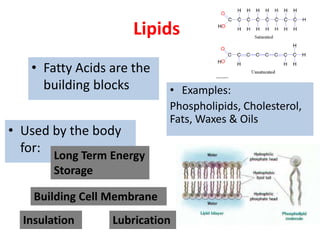
Lipids
• Fatty Acids are the
building blocks • Examples:
Phospholipids, Cholesterol,
Fats, Waxes & Oils
• Used by the body
for:
Long Term Energy
Storage
Building Cell Membrane
Insulation Lubrication
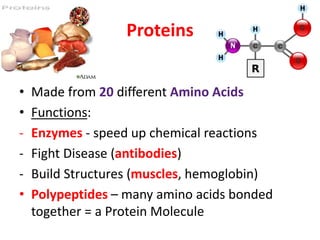
Proteins
• Made from 20 different Amino Acids
• Functions:
- Enzymes - speed up chemical reactions
- Fight Disease (antibodies)
- Build Structures (muscles, hemoglobin)
• Polypeptides – many amino acids bonded
together = a Protein Molecule
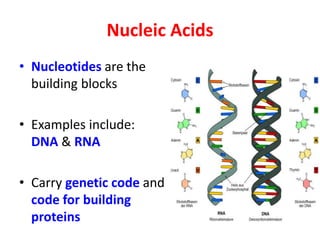
Nucleic Acids
• Nucleotides are the
building blocks
• Examples include:
DNA & RNA
• Carry genetic code and
code for building
proteins
Cells & Processes
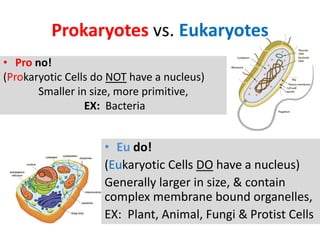
Prokaryotes vs. Eukaryotes
• Pro no!
(Prokaryotic Cells do NOT have a nucleus)
Smaller in size, more primitive,
EX: Bacteria
• Eu do!
(Eukaryotic Cells DO have a nucleus)
Generally larger in size, & contain
complex membrane bound organelles,
EX: Plant, Animal, Fungi & Protist Cells
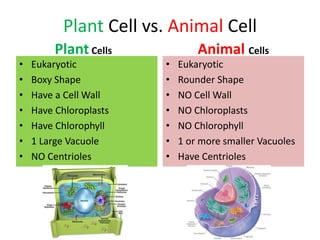
Plant Cell vs. Animal Cell
PlantCells
• Eukaryotic
• Boxy Shape
• Have a Cell Wall
• Have Chloroplasts
• Have Chlorophyll
• 1 Large Vacuole
• NO Centrioles
Animal Cells
• Eukaryotic
• Rounder Shape
• NO Cell Wall
• NO Chloroplasts
• NO Chlorophyll
• 1 or more smaller Vacuoles
• Have Centrioles
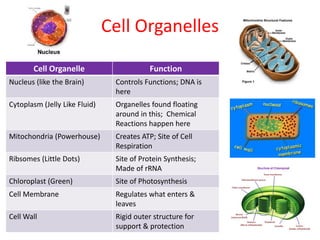
Cell Organelles
Cell Organelle Function
Nucleus (like the Brain) Controls Functions; DNA is
here
Cytoplasm (Jelly Like Fluid) Organelles found floating
around in this; Chemical
Reactions happen here
Mitochondria (Powerhouse) Creates ATP; Site of Cell
Respiration
Ribsomes (Little Dots) Site of Protein Synthesis;
Made of rRNA
Chloroplast (Green) Site of Photosynthesis
Cell Membrane Regulates what enters &
leaves
Cell Wall Rigid outer structure for
support & protection
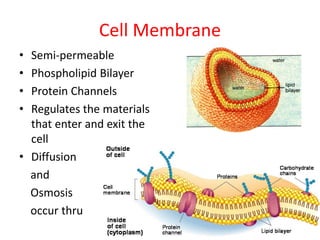
Cell Membrane
• Semi-permeable
• Phospholipid Bilayer
• Protein Channels
• Regulates the materials
that enter and exit the
cell
• Diffusion
and
Osmosis
occur thru
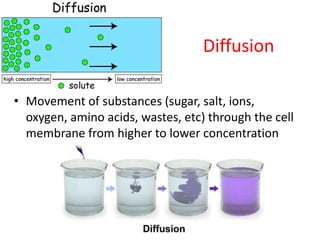
Diffusion
• Movement of substances (sugar, salt, ions,
oxygen, amino acids, wastes, etc) through the cell
membrane from higher to lower concentration
Osmosis
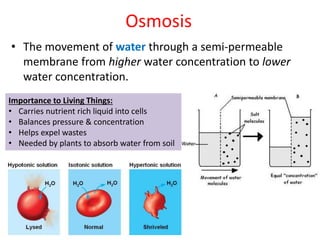
• The movement of water through a semi-permeable
membrane from higher water concentration to lower
water concentration.
Importance to Living Things:
• Carries nutrient rich liquid into cells
• Balances pressure & concentration
• Helps expel wastes
• Needed by plants to absorb water from soil
Photosynthesis
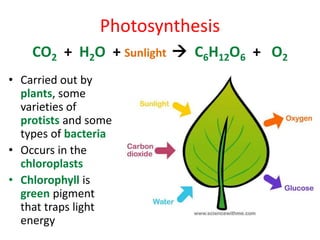
• Carried out by
plants, some
varieties of
protists and some
types of bacteria
• Occurs in the
chloroplasts
• Chlorophyll is
green pigment
that traps light
energy
CO2 + H2O + Sunlight  C6H12O6 + O2
Cellular Respiration
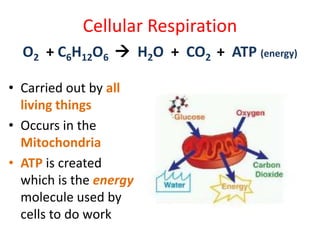
• Carried out by all
living things
• Occurs in the
Mitochondria
• ATP is created
which is the energy
molecule used by
cells to do work
O2 + C6H12O6  H2O + CO2 + ATP (energy)
DNA
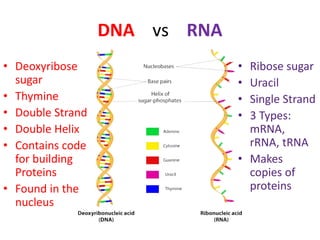
DNA vs RNA
• Deoxyribose
sugar
• Thymine
• Double Strand
• Double Helix
• Contains code
for building
Proteins
• Found in the
nucleus
• Ribose sugar
• Uracil
• Single Strand
• 3 Types:
mRNA,
rRNA, tRNA
• Makes
copies of
proteins
DNA Technology
• Human Genome Project – mapping all human
genes on each of our 46 chromosomes
• Detection & prevention of genetic disorders &
diseases
• Advances in Genetic Engineering (insulin, disease
resistant fruits & vegetables, medicine)
• Eugenics – the practice of improving the genetics
of the human race
• Cloning – producing genetically identical
individuals
• Forensics – using DNA evidence for identification
purposes
Genetics
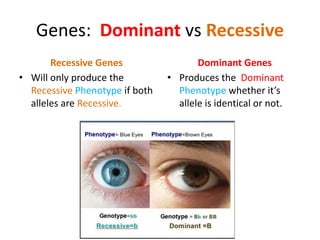
Genes: Dominant vs Recessive
Dominant Genes
• Produces the Dominant
Phenotype whether it’s
allele is identical or not.
Recessive Genes
• Will only produce the
Recessive Phenotype if both
alleles are Recessive.
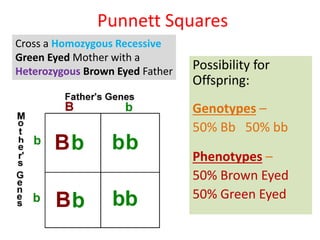
Punnett Squares
Possibility for
Offspring:
Genotypes –
50% Bb 50% bb
Phenotypes –
50% Brown Eyed
50% Green Eyed
Cross a Homozygous Recessive
Green Eyed Mother with a
Heterozygous Brown Eyed Father
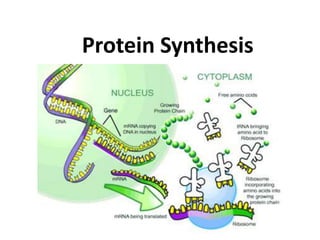
Protein Synthesis
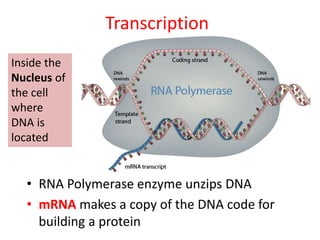
Transcription
• RNA Polymerase enzyme unzips DNA
• mRNA makes a copy of the DNA code for
building a protein
Inside the
Nucleus of
the cell
where
DNA is
located
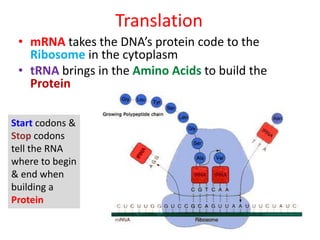
Translation
• mRNA takes the DNA’s protein code to the
Ribosome in the cytoplasm
• tRNA brings in the Amino Acids to build the
Protein
Start codons &
Stop codons
tell the RNA
where to begin
& end when
building a
Protein
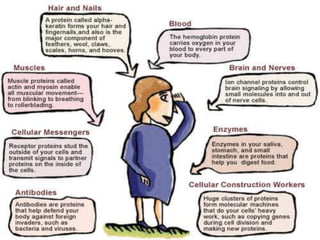
Protein Structure & Function in the Body
• Involved in virtually all cell functions
• Each protein has a specific role.
• Constructed from 20 types of amino acids
• Have a distinct 3-D shape (Lock & Key Model)
• If shape is altered (Denatured), it won’t
function
Proteins build many structures
in our bodies…
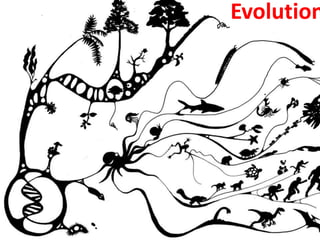
Evolution
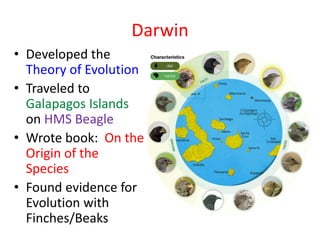
Darwin
• Developed the
Theory of Evolution
• Traveled to
Galapagos Islands
on HMS Beagle
• Wrote book: On the
Origin of the
Species
• Found evidence for
Evolution with
Finches/Beaks
Natural vs Artificial Selection
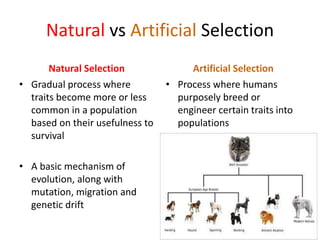
Natural Selection
• Gradual process where
traits become more or less
common in a population
based on their usefulness to
survival
• A basic mechanism of
evolution, along with
mutation, migration and
genetic drift
Artificial Selection
• Process where humans
purposely breed or
engineer certain traits into
populations
Common Ancestry
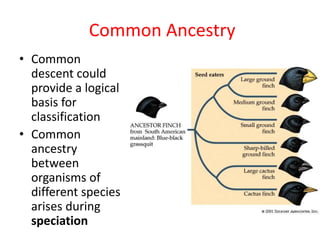
• Common
descent could
provide a logical
basis for
classification
• Common
ancestry
between
organisms of
different species
arises during
speciation
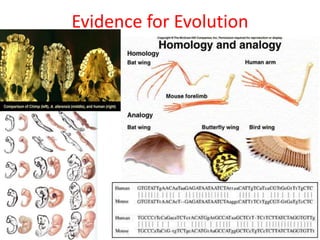
Evidence for Evolution
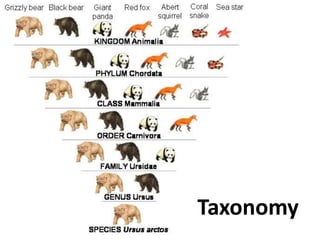
Taxonomy
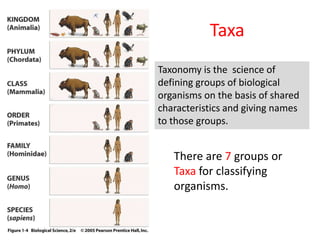
Taxa
Taxonomy is the science of
defining groups of biological
organisms on the basis of shared
characteristics and giving names
to those groups.
There are 7 groups or
Taxa for classifying
organisms.
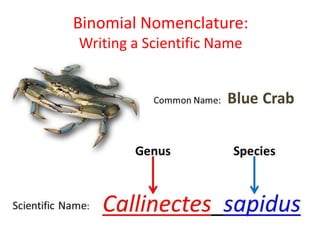
Binomial Nomenclature:
Writing a Scientific Name
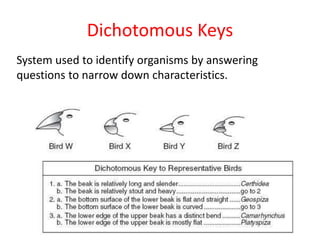
Dichotomous Keys
System used to identify organisms by answering
questions to narrow down characteristics.
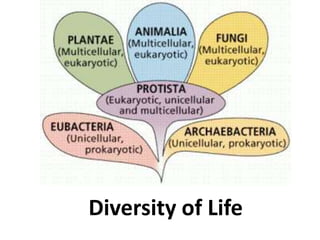
Diversity of Life
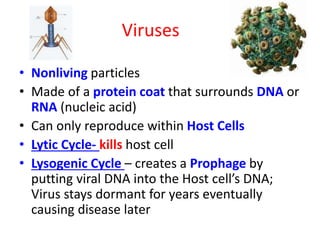
Viruses
• Nonliving particles
• Made of a protein coat that surrounds DNA or
RNA (nucleic acid)
• Can only reproduce within Host Cells
• Lytic Cycle- kills host cell
• Lysogenic Cycle – creates a Prophage by
putting viral DNA into the Host cell’s DNA;
Virus stays dormant for years eventually
causing disease later
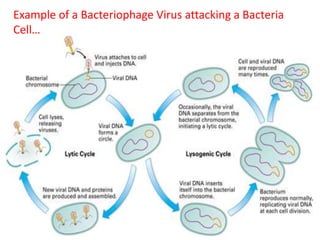
Example of a Bacteriophage Virus attacking a Bacteria
Cell…
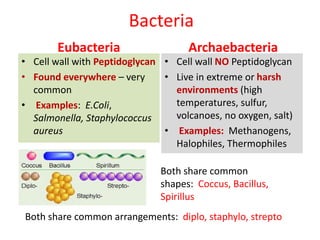
Bacteria
Eubacteria
• Cell wall with Peptidoglycan
• Found everywhere – very
common
• Examples: E.Coli,
Salmonella, Staphylococcus
aureus
Archaebacteria
• Cell wall NO Peptidoglycan
• Live in extreme or harsh
environments (high
temperatures, sulfur,
volcanoes, no oxygen, salt)
• Examples: Methanogens,
Halophiles, Thermophiles
Both share common
shapes: Coccus, Bacillus,
Spirillus
Both share common arrangements: diplo, staphylo, strepto
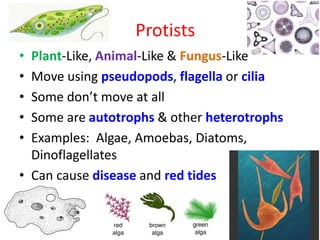
Protists
• Plant-Like, Animal-Like & Fungus-Like
• Move using pseudopods, flagella or cilia
• Some don’t move at all
• Some are autotrophs & other heterotrophs
• Examples: Algae, Amoebas, Diatoms,
Dinoflagellates
• Can cause disease and red tides
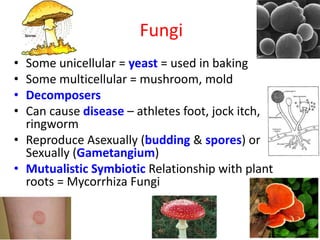
Fungi
• Some unicellular = yeast = used in baking
• Some multicellular = mushroom, mold
• Decomposers
• Can cause disease – athletes foot, jock itch,
ringworm
• Reproduce Asexually (budding & spores) or
Sexually (Gametangium)
• Mutualistic Symbiotic Relationship with plant
roots = Mycorrhiza Fungi
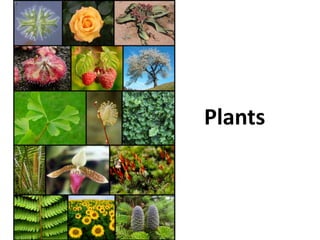
Plants
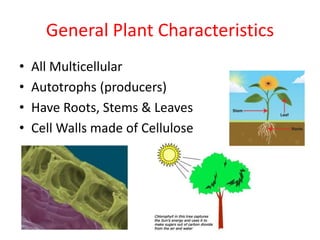
General Plant Characteristics
• All Multicellular
• Autotrophs (producers)
• Have Roots, Stems & Leaves
• Cell Walls made of Cellulose
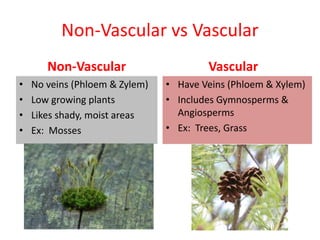
Non-Vascular vs Vascular
Non-Vascular
• No veins (Phloem & Zylem)
• Low growing plants
• Likes shady, moist areas
• Ex: Mosses
Vascular
• Have Veins (Phloem & Xylem)
• Includes Gymnosperms &
Angiosperms
• Ex: Trees, Grass
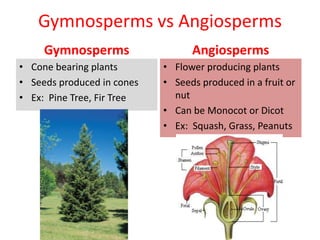
Gymnosperms vs Angiosperms
Angiosperms
• Cone bearing plants
• Seeds produced in cones
• Ex: Pine Tree, Fir Tree
Gymnosperms
• Flower producing plants
• Seeds produced in a fruit or
nut
• Can be Monocot or Dicot
• Ex: Squash, Grass, Peanuts
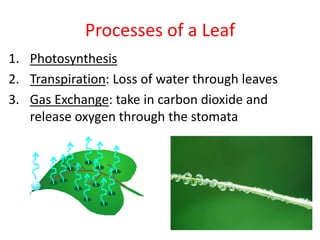
1. Photosynthesis
2. Transpiration: Loss of water through leaves
3. Gas Exchange: take in carbon dioxide and
release oxygen through the stomata
Processes of a Leaf
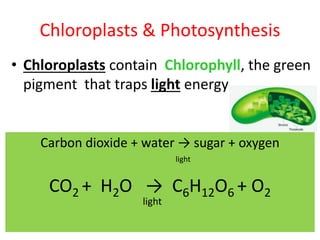
• Chloroplasts contain Chlorophyll, the green
pigment that traps light energy
Chloroplasts & Photosynthesis
Carbon dioxide + water → sugar + oxygen
light
CO2 + H2O → C6H12O6 + O2
light
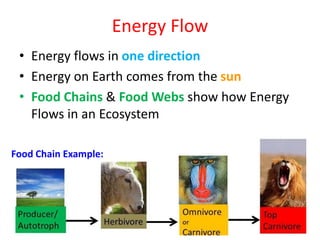
Energy Flow
• Energy flows in one direction
• Energy on Earth comes from the sun
• Food Chains & Food Webs show how Energy
Flows in an Ecosystem
Food Chain Example:
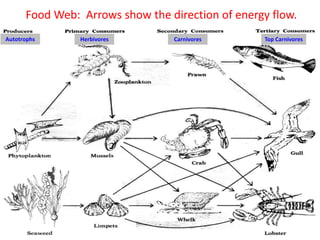
Food Web: Arrows show the direction of energy flow.
Autotrophs Herbivores Carnivores Top Carnivores
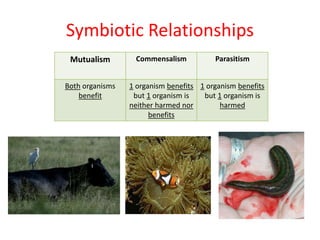
Symbiotic Relationships
Mutualism Commensalism Parasitism
Both organisms
benefit
1 organism benefits
but 1 organism is
neither harmed nor
benefits
1 organism benefits
but 1 organism is
harmed
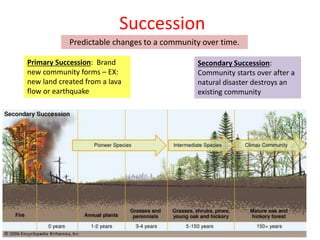
Succession
Predictable changes to a community over time.
Primary Succession: Brand
new community forms – EX:
new land created from a lava
flow or earthquake
Secondary Succession:
Community starts over after a
natural disaster destroys an
existing community
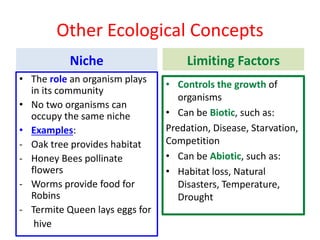
Other Ecological Concepts
Niche
• The role an organism plays
in its community
• No two organisms can
occupy the same niche
• Examples:
- Oak tree provides habitat
- Honey Bees pollinate
flowers
- Worms provide food for
Robins
- Termite Queen lays eggs for
hive
Limiting Factors
• Controls the growth of
organisms
• Can be Biotic, such as:
Predation, Disease, Starvation,
Competition
• Can be Abiotic, such as:
• Habitat loss, Natural
Disasters, Temperature,
Drought
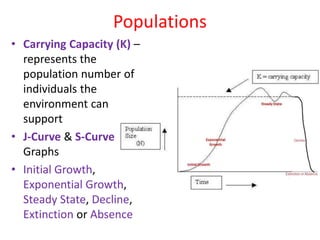
Populations
• Carrying Capacity (K) –
represents the
population number of
individuals the
environment can
support
• J-Curve & S-Curve
Graphs
• Initial Growth,
Exponential Growth,
Steady State, Decline,
Extinction or Absence
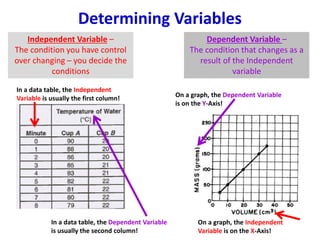
Determining Variables
Independent Variable –
The condition you have control
over changing – you decide the
conditions
Dependent Variable –
The condition that changes as a
result of the Independent
variable
In a data table, the Independent
Variable is usually the first column!
In a data table, the Dependent Variable
is usually the second column!
On a graph, the Dependent Variable
is on the Y-Axis!
On a graph, the Independent
Variable is on the X-Axis!
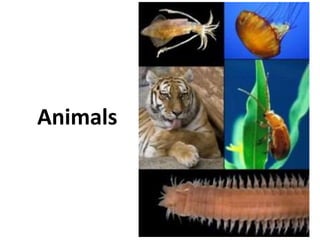
Animals
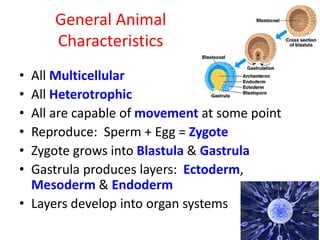
General Animal
Characteristics
• All Multicellular
• All Heterotrophic
• All are capable of movement at some point
• Reproduce: Sperm + Egg = Zygote
• Zygote grows into Blastula & Gastrula
• Gastrula produces layers: Ectoderm,
Mesoderm & Endoderm
• Layers develop into organ systems
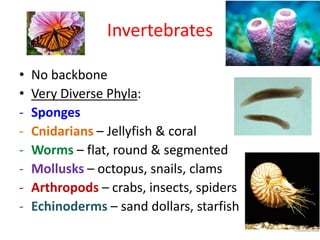
Invertebrates
• No backbone
• Very Diverse Phyla:
- Sponges
- Cnidarians – Jellyfish & coral
- Worms – flat, round & segmented
- Mollusks – octopus, snails, clams
- Arthropods – crabs, insects, spiders
- Echinoderms – sand dollars, starfish
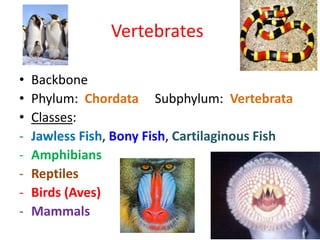
Vertebrates
• Backbone
• Phylum: Chordata Subphylum: Vertebrata
• Classes:
- Jawless Fish, Bony Fish, Cartilaginous Fish
- Amphibians
- Reptiles
- Birds (Aves)
- Mammals
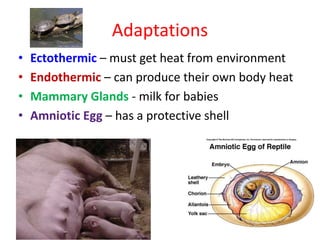
Adaptations
• Ectothermic – must get heat from environment
• Endothermic – can produce their own body heat
• Mammary Glands - milk for babies
• Amniotic Egg – has a protective shell

Biology sol review 2014

  • 1.
    Biology SOL Review AGeneral Overview Created by Rhonda Taylor, Menchville High School 2014
  • 3.
    Water: Polarity • Causedby unequal sharing of electrons • H end is more positively charged & O end is more negatively charged • Causes water to be a good solvent (dissolver) • Creates Hydrogen bonds
  • 4.
    Water: Hydrogen Bonds •Attraction between the positive H of one water molecules & the negative O of another water molecule • Weak bond • Breaks & reforms easily
  • 5.
    Other Water Properties •Cohesion – water bonds to water • Adhesion – water bonds to other • Neutral – pH of 7 • Surface Tension – cohesion, adhesion & H bonds resistance to breakage • High Heat Capacity – absorbs a lot of heat before getting hot & takes a long time to lose heat
  • 6.
    pH Scale • Showshow Acidic or Basic (Alkaline) something is • Acids: pH 0 – 6.9 • Bases: pH 7.1 – 14 • Neutral: pH 7
  • 7.
    Carbohydrates Monosaccharides • Builds carbmolecules • Used by cells for energy • C-H-O in a 1:2:1 ratio • Ex: Glucose C6H12O6 Disaccharides • 2 Monosaccharides bonded together • Ex: Sucrose (table sugar) (glucose + fructose) Polysaccharides • 3+ monosaccharides bonded together • Used for long term storage of carbs • Ex: Starch (plants) & Glycogen (animals)
  • 8.
    Lipids • Fatty Acidsare the building blocks • Examples: Phospholipids, Cholesterol, Fats, Waxes & Oils • Used by the body for: Long Term Energy Storage Building Cell Membrane Insulation Lubrication
  • 9.
    Proteins • Made from20 different Amino Acids • Functions: - Enzymes - speed up chemical reactions - Fight Disease (antibodies) - Build Structures (muscles, hemoglobin) • Polypeptides – many amino acids bonded together = a Protein Molecule
  • 10.
    Nucleic Acids • Nucleotidesare the building blocks • Examples include: DNA & RNA • Carry genetic code and code for building proteins
  • 11.
  • 12.
    Prokaryotes vs. Eukaryotes •Pro no! (Prokaryotic Cells do NOT have a nucleus) Smaller in size, more primitive, EX: Bacteria • Eu do! (Eukaryotic Cells DO have a nucleus) Generally larger in size, & contain complex membrane bound organelles, EX: Plant, Animal, Fungi & Protist Cells
  • 13.
    Plant Cell vs.Animal Cell PlantCells • Eukaryotic • Boxy Shape • Have a Cell Wall • Have Chloroplasts • Have Chlorophyll • 1 Large Vacuole • NO Centrioles Animal Cells • Eukaryotic • Rounder Shape • NO Cell Wall • NO Chloroplasts • NO Chlorophyll • 1 or more smaller Vacuoles • Have Centrioles
  • 14.
    Cell Organelles Cell OrganelleFunction Nucleus (like the Brain) Controls Functions; DNA is here Cytoplasm (Jelly Like Fluid) Organelles found floating around in this; Chemical Reactions happen here Mitochondria (Powerhouse) Creates ATP; Site of Cell Respiration Ribsomes (Little Dots) Site of Protein Synthesis; Made of rRNA Chloroplast (Green) Site of Photosynthesis Cell Membrane Regulates what enters & leaves Cell Wall Rigid outer structure for support & protection
  • 15.
    Cell Membrane • Semi-permeable •Phospholipid Bilayer • Protein Channels • Regulates the materials that enter and exit the cell • Diffusion and Osmosis occur thru
  • 16.
    Diffusion • Movement ofsubstances (sugar, salt, ions, oxygen, amino acids, wastes, etc) through the cell membrane from higher to lower concentration
  • 17.
    Osmosis • The movementof water through a semi-permeable membrane from higher water concentration to lower water concentration. Importance to Living Things: • Carries nutrient rich liquid into cells • Balances pressure & concentration • Helps expel wastes • Needed by plants to absorb water from soil
  • 18.
    Photosynthesis • Carried outby plants, some varieties of protists and some types of bacteria • Occurs in the chloroplasts • Chlorophyll is green pigment that traps light energy CO2 + H2O + Sunlight  C6H12O6 + O2
  • 19.
    Cellular Respiration • Carriedout by all living things • Occurs in the Mitochondria • ATP is created which is the energy molecule used by cells to do work O2 + C6H12O6  H2O + CO2 + ATP (energy)
  • 20.
  • 21.
    DNA vs RNA •Deoxyribose sugar • Thymine • Double Strand • Double Helix • Contains code for building Proteins • Found in the nucleus • Ribose sugar • Uracil • Single Strand • 3 Types: mRNA, rRNA, tRNA • Makes copies of proteins
  • 22.
    DNA Technology • HumanGenome Project – mapping all human genes on each of our 46 chromosomes • Detection & prevention of genetic disorders & diseases • Advances in Genetic Engineering (insulin, disease resistant fruits & vegetables, medicine) • Eugenics – the practice of improving the genetics of the human race • Cloning – producing genetically identical individuals • Forensics – using DNA evidence for identification purposes
  • 23.
  • 24.
    Genes: Dominant vsRecessive Dominant Genes • Produces the Dominant Phenotype whether it’s allele is identical or not. Recessive Genes • Will only produce the Recessive Phenotype if both alleles are Recessive.
  • 25.
    Punnett Squares Possibility for Offspring: Genotypes– 50% Bb 50% bb Phenotypes – 50% Brown Eyed 50% Green Eyed Cross a Homozygous Recessive Green Eyed Mother with a Heterozygous Brown Eyed Father
  • 27.
  • 28.
    Transcription • RNA Polymeraseenzyme unzips DNA • mRNA makes a copy of the DNA code for building a protein Inside the Nucleus of the cell where DNA is located
  • 29.
    Translation • mRNA takesthe DNA’s protein code to the Ribosome in the cytoplasm • tRNA brings in the Amino Acids to build the Protein Start codons & Stop codons tell the RNA where to begin & end when building a Protein
  • 30.
    Protein Structure &Function in the Body • Involved in virtually all cell functions • Each protein has a specific role. • Constructed from 20 types of amino acids • Have a distinct 3-D shape (Lock & Key Model) • If shape is altered (Denatured), it won’t function Proteins build many structures in our bodies…
  • 32.
  • 33.
    Darwin • Developed the Theoryof Evolution • Traveled to Galapagos Islands on HMS Beagle • Wrote book: On the Origin of the Species • Found evidence for Evolution with Finches/Beaks
  • 34.
    Natural vs ArtificialSelection Natural Selection • Gradual process where traits become more or less common in a population based on their usefulness to survival • A basic mechanism of evolution, along with mutation, migration and genetic drift Artificial Selection • Process where humans purposely breed or engineer certain traits into populations
  • 35.
    Common Ancestry • Common descentcould provide a logical basis for classification • Common ancestry between organisms of different species arises during speciation
  • 36.
  • 37.
  • 38.
    Taxa Taxonomy is thescience of defining groups of biological organisms on the basis of shared characteristics and giving names to those groups. There are 7 groups or Taxa for classifying organisms.
  • 39.
  • 40.
    Dichotomous Keys System usedto identify organisms by answering questions to narrow down characteristics.
  • 41.
  • 42.
    Viruses • Nonliving particles •Made of a protein coat that surrounds DNA or RNA (nucleic acid) • Can only reproduce within Host Cells • Lytic Cycle- kills host cell • Lysogenic Cycle – creates a Prophage by putting viral DNA into the Host cell’s DNA; Virus stays dormant for years eventually causing disease later
  • 43.
    Example of aBacteriophage Virus attacking a Bacteria Cell…
  • 44.
    Bacteria Eubacteria • Cell wallwith Peptidoglycan • Found everywhere – very common • Examples: E.Coli, Salmonella, Staphylococcus aureus Archaebacteria • Cell wall NO Peptidoglycan • Live in extreme or harsh environments (high temperatures, sulfur, volcanoes, no oxygen, salt) • Examples: Methanogens, Halophiles, Thermophiles Both share common shapes: Coccus, Bacillus, Spirillus Both share common arrangements: diplo, staphylo, strepto
  • 45.
    Protists • Plant-Like, Animal-Like& Fungus-Like • Move using pseudopods, flagella or cilia • Some don’t move at all • Some are autotrophs & other heterotrophs • Examples: Algae, Amoebas, Diatoms, Dinoflagellates • Can cause disease and red tides
  • 46.
    Fungi • Some unicellular= yeast = used in baking • Some multicellular = mushroom, mold • Decomposers • Can cause disease – athletes foot, jock itch, ringworm • Reproduce Asexually (budding & spores) or Sexually (Gametangium) • Mutualistic Symbiotic Relationship with plant roots = Mycorrhiza Fungi
  • 47.
  • 48.
    General Plant Characteristics •All Multicellular • Autotrophs (producers) • Have Roots, Stems & Leaves • Cell Walls made of Cellulose
  • 49.
    Non-Vascular vs Vascular Non-Vascular •No veins (Phloem & Zylem) • Low growing plants • Likes shady, moist areas • Ex: Mosses Vascular • Have Veins (Phloem & Xylem) • Includes Gymnosperms & Angiosperms • Ex: Trees, Grass
  • 50.
    Gymnosperms vs Angiosperms Angiosperms •Cone bearing plants • Seeds produced in cones • Ex: Pine Tree, Fir Tree Gymnosperms • Flower producing plants • Seeds produced in a fruit or nut • Can be Monocot or Dicot • Ex: Squash, Grass, Peanuts
  • 51.
    1. Photosynthesis 2. Transpiration:Loss of water through leaves 3. Gas Exchange: take in carbon dioxide and release oxygen through the stomata Processes of a Leaf
  • 52.
    • Chloroplasts containChlorophyll, the green pigment that traps light energy Chloroplasts & Photosynthesis Carbon dioxide + water → sugar + oxygen light CO2 + H2O → C6H12O6 + O2 light
  • 54.
    Energy Flow • Energyflows in one direction • Energy on Earth comes from the sun • Food Chains & Food Webs show how Energy Flows in an Ecosystem Food Chain Example:
  • 55.
    Food Web: Arrowsshow the direction of energy flow. Autotrophs Herbivores Carnivores Top Carnivores
  • 56.
    Symbiotic Relationships Mutualism CommensalismParasitism Both organisms benefit 1 organism benefits but 1 organism is neither harmed nor benefits 1 organism benefits but 1 organism is harmed
  • 57.
    Succession Predictable changes toa community over time. Primary Succession: Brand new community forms – EX: new land created from a lava flow or earthquake Secondary Succession: Community starts over after a natural disaster destroys an existing community
  • 58.
    Other Ecological Concepts Niche •The role an organism plays in its community • No two organisms can occupy the same niche • Examples: - Oak tree provides habitat - Honey Bees pollinate flowers - Worms provide food for Robins - Termite Queen lays eggs for hive Limiting Factors • Controls the growth of organisms • Can be Biotic, such as: Predation, Disease, Starvation, Competition • Can be Abiotic, such as: • Habitat loss, Natural Disasters, Temperature, Drought
  • 59.
    Populations • Carrying Capacity(K) – represents the population number of individuals the environment can support • J-Curve & S-Curve Graphs • Initial Growth, Exponential Growth, Steady State, Decline, Extinction or Absence
  • 61.
    Determining Variables Independent Variable– The condition you have control over changing – you decide the conditions Dependent Variable – The condition that changes as a result of the Independent variable In a data table, the Independent Variable is usually the first column! In a data table, the Dependent Variable is usually the second column! On a graph, the Dependent Variable is on the Y-Axis! On a graph, the Independent Variable is on the X-Axis!
  • 62.
  • 63.
    General Animal Characteristics • AllMulticellular • All Heterotrophic • All are capable of movement at some point • Reproduce: Sperm + Egg = Zygote • Zygote grows into Blastula & Gastrula • Gastrula produces layers: Ectoderm, Mesoderm & Endoderm • Layers develop into organ systems
  • 64.
    Invertebrates • No backbone •Very Diverse Phyla: - Sponges - Cnidarians – Jellyfish & coral - Worms – flat, round & segmented - Mollusks – octopus, snails, clams - Arthropods – crabs, insects, spiders - Echinoderms – sand dollars, starfish
  • 65.
    Vertebrates • Backbone • Phylum:Chordata Subphylum: Vertebrata • Classes: - Jawless Fish, Bony Fish, Cartilaginous Fish - Amphibians - Reptiles - Birds (Aves) - Mammals
  • 66.
    Adaptations • Ectothermic –must get heat from environment • Endothermic – can produce their own body heat • Mammary Glands - milk for babies • Amniotic Egg – has a protective shell