A
SEMINAR
ON
LYSOSOME
 PROF. J.P. SHRMA(Director)
 DR. R. K. RAO (Principal)
 DR. ARUNIMA KARKUN
(Guided by)
PRESENTED BY..
NIKITA DEWANGAN
M.Sc.1stSEM
BIOTECHNOLOGY
G.D. RUNGTA COLLEGE OF SCIENCE & TECHNOLOGY
KOHKA-KURUD, BHILAI DURG (C.G.)
LYSOSOMES
 Introduction
 Definition
 History
 Origin
 Occurrence
 Structure of lysosomes
 Polymorphisms
 Function of lysosomes
 Summary
 Conclusion
 References
S
Y
N
O
P
S
I
S
1
 Lysosomes are spherical organelle that contain enzymes acid hydrolases.
They break up food so it is easier to digest. They are found in animal cells,
while in yeast and plants the same roles are performed by Lytic vacuoles.
 Lysosomes were discovered by the Belgium cytologist
Christian de Duve in 1955, and named as "suicide bags" or "suicide sacs“.
ORIGIN – lysosomes may originated from the endoplasmic reticulum and
Golgi membranes from the process of budding off.
 Novikoff ( 1960 ) found that acid phosphatase one of the characteristic
enzymes of the lysosome.
I
N
T
R
O
D
U
C
T
I
O
N
2
LYSOSOMES
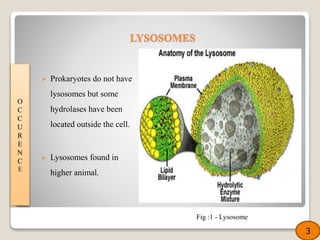
 Prokaryotes do not have
lysosomes but some
hydrolases have been
located outside the cell.
 Lysosomes found in
higher animal.
O
C
C
U
R
E
N
C
E
Fig :1 - Lysosome
3
LYSOSOMES
 Lysosomes are globular and range in diameter from 0.2 to 0.8 microns.
 Under the electron microscope lysosomes appear dense and finely granular.
 Lysosome is essentially a sphere of lipoprotein membrane containing
enzymes.
 The membrane insulates the enzyme from the rest of the cell. If the enzymes
are released they can digest the cell and hence lysosomes are sometime called
‘’ suicide bags.’’
Lysosomal membrane - lysosomes are bounded by a single
lipoprotein membrane.
 The membrane is impermeable to substrates of the enzymes contained in the
lysosome.
 Certain substances called labilizers caused instability of the lysosomal
membrane, leading to release of enzyme from the lysosome.
S
T
R
U
C
T
U
R
E
o
F
L
Y
S
O
S
O
M
E
4
LYSOSOMES
 Other substance called stabilizers have a stabilizing action on the membrane.
 Labilizers E.g; - vitamin A , vitamin B, vitamin K, vitamin E.
 Stabilizers E.g. – cholesterol, cortisone, cortisol.
 Molecular weight and molecular structure play an important part in the
permeability of the lysosomal membrane.
 Compound having a molecular weight higher than 200 do not diffuse through
the membrane.
S
T
R
U
C
T
U
R
E
5
LYSOSOMES
S
T
R
U
C
T
U
R
E
6
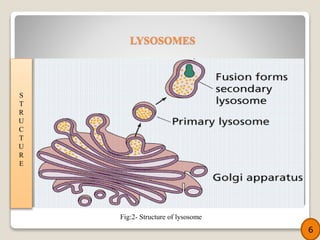
Fig:2- Structure of lysosome
LYSOSOMES
 Lysosomes contain these type of enzymes -
1. Nucleases – which include ribonuclease and deoxyribonuclease , break
down polynucleotides into nitrogen bases, phosphates and pentose sugars.
2. Phosphatases – acid phosphate, breakdown phoshate esters to
monophosphates.
3. Lipases – lipids, breakdown them into fragments.
4. Proteases - protein, breakdown into their costituent amino acids.
5. Glycosidases – β- galactosidase, β – glucoronidase, ά- mannosidase,
breakdown into polysaccharides to monosaccharides.
6. Sulphatases – act on sulphat esters, breaking down into fragments.
E
N
Z
Y
M
E
S
7
LYSOSOMES
 The lysosomes shows polymorphism in different cell types and even within
the single cell.
 Previously, there are two types of lysosomes - primary and secondary
lysosomes .
 The latter are of three type - phagosomes, residual bodies, autophagic
vacuoles.
P
O
L
Y
M
O
R
P
H
I
S
M
8
LYSOSOMES
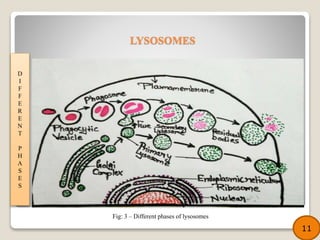
1. Primary lysosome is formed from endoplasmic reticulum and Golgi
complex. The enzymes of the primary lysosome are synthesized by
ribosomes, it can secrete its enzyme outside the cell or store them.
2. Phagosome is formed by phagocytosis and pinocytosis of foreign
material. The phagosome associates with a primary lysosome and
undergoes fusion to form secondary lysosome.
P
O
L
Y
M
O
R
P
H
I
S
M
9
LYSOSOMES
3. Residual body is the final particle containing indigestible
material. It is formed when digestion is incomplete.
4. The autophagic vacuole or autophagosome is a lysosome
containing some parts of cell in the process digestion.
P
O
L
Y
M
O
R
P
H
I
S
M
10
LYSOSOMES
D
I
F
F
E
R
E
N
T
P
H
A
S
E
S
11
Fig: 3 – Different phases of lysosomes
LYSOSOMES
 The lysosome is essentially a bag containing digestive enzymes. The enzymes
may be released within the cell itself or out side the cell.
 LYSOSOMES SERVES SEVERAL FUNCTION -
A. Extracellular digestion
B. Intracellular digestion
C. Hormone secretion
D. Fertilization
E. Autolysis
F. Chromosomal breaks
F
U
N
C
T
I
O
N
S
12
LYSOSOMES
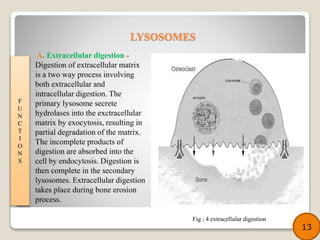
A. Extracellular digestion -
Digestion of extracellular matrix
is a two way process involving
both extracellular and
intracellular digestion. The
primary lysosome secrete
hydrolases into the exctracellular
matrix by exocytosis, resulting in
partial degradation of the matrix.
The incomplete products of
digestion are absorbed into the
cell by endocytosis. Digestion is
then complete in the secondary
lysosomes. Extracellular digestion
takes place during bone erosion
process.
LYSOSOMES
F
U
N
C
T
I
O
N
S
13
Fig ; 4 extracellular digestion
B. Intracellular digestion – Intracellular digestion may involve autophagy and
heterophagy.
Autophagy – It is intracellular digestion in which enzymes produced by the
cell breakdown molecules and pieces of cytoplasmic material
from the cell itself.
Heterophagy – It is the intake of exogenous material into the cell and
the subsequent breakdown of this material by enzymes by the process
of endocytosis. Heterophagy are two types namely - Phagocytosis and
Pinocytosis.
F
U
N
C
T
I
O
N
S
14
LYSOSOMES
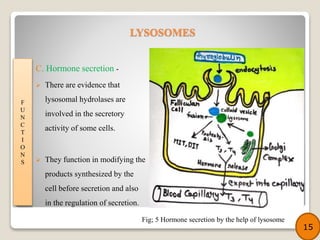
C. Hormone secretion -
 There are evidence that
lysosomal hydrolases are
involved in the secretory
activity of some cells.
 They function in modifying the
products synthesized by the
cell before secretion and also
in the regulation of secretion.
F
U
N
C
T
I
O
N
S
15
LYSOSOMES
Fig; 5 Hormone secretion by the help of lysosome
D. Fertilization -
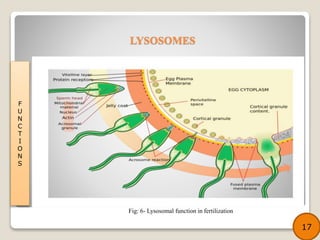
 During fertilization process, acrosome (giant lysosome) of sperm head
ruptures and releases enzymes on the surface of the egg.
 These enzymes digest the egg membrane and provide way for the entry of
sperm nucleus into the egg.
F
U
N
C
T
I
O
N
S
16
LYSOSOMES
F
U
N
C
T
I
O
N
S
Fig: 6- Lysosomal function in fertilization
17
LYSOSOMES
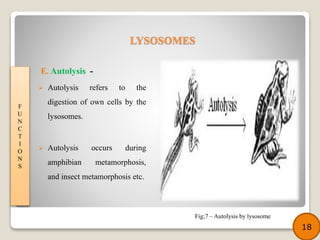
E. Autolysis -
 Autolysis refers to the
digestion of own cells by the
lysosomes.
 Autolysis occurs during
amphibian metamorphosis,
and insect metamorphosis etc.
F
U
N
C
T
I
O
N
S
Fig;7 – Autolysis by lysosome
18
LYSOSOMES
F. Chromosomal breaks -
 Lysosome contain the enzyme deoxyribonuclease (DNase) which
attacks DNA and causes chromosomal breaks and rearrangement.
Thus release of hydrolases from lysosomes can result in structural
abnormalities in chromosomes. That can leads to cause disease like
cancer etc.
F
U
N
C
T
I
O
N
S
19
LYSOSOMES
 Lysosomes are small vesicles of cell organelle.
 Formed by the budding off of Golgi complex and endoplasmic
reticulum.
 Lysosome contain hydrolytic enzymes.
 These enzyme play an important role in digestion
 Lysosomal enzymes are – Nucleases , Phosphatases, Lipases, Proteases,
Glycosidases, Sulphatases
 Abundantly found in cells related with enzymatic reactions such as liver
cells, pancreatic cells, kidney cells, spleen cells etc..
S
U
M
M
A
R
Y
20
LYSOSOMES
 Lysosomes are a very important cell organelle.
 Their prime function is to breakup biomolecules because they
contain hydrolytic enzymes. But these enzymes sometimes is
harmful for the cell.
 During starvation of organism, lysosomes shows autophagy activity
and cause cell death.
 Also they cause chromosomal abnormalities due to their DNase
enzyme.
C
O
N
C
L
U
S
I
O
N
21
LYSOSOMES
 C. B. Power Third edition , 2010 Cell biology
 Some content from net -
www. Study. com
www.biologydiscussion. com
yrll biology-rivisionwikispace.com
www.tutorvisita.com
www.sivabio.50webs.com
R
E
F
R
E
N
C
E
S
22
LYSOSOMES
lysosome-160930161420 (1).pdf

lysosome-160930161420 (1).pdf

  • 1.
    A SEMINAR ON LYSOSOME  PROF. J.P.SHRMA(Director)  DR. R. K. RAO (Principal)  DR. ARUNIMA KARKUN (Guided by) PRESENTED BY.. NIKITA DEWANGAN M.Sc.1stSEM BIOTECHNOLOGY G.D. RUNGTA COLLEGE OF SCIENCE & TECHNOLOGY KOHKA-KURUD, BHILAI DURG (C.G.)
  • 2.
    LYSOSOMES  Introduction  Definition History  Origin  Occurrence  Structure of lysosomes  Polymorphisms  Function of lysosomes  Summary  Conclusion  References S Y N O P S I S 1
  • 3.
     Lysosomes arespherical organelle that contain enzymes acid hydrolases. They break up food so it is easier to digest. They are found in animal cells, while in yeast and plants the same roles are performed by Lytic vacuoles.  Lysosomes were discovered by the Belgium cytologist Christian de Duve in 1955, and named as "suicide bags" or "suicide sacs“. ORIGIN – lysosomes may originated from the endoplasmic reticulum and Golgi membranes from the process of budding off.  Novikoff ( 1960 ) found that acid phosphatase one of the characteristic enzymes of the lysosome. I N T R O D U C T I O N 2 LYSOSOMES
  • 4.
     Prokaryotes donot have lysosomes but some hydrolases have been located outside the cell.  Lysosomes found in higher animal. O C C U R E N C E Fig :1 - Lysosome 3 LYSOSOMES
  • 5.
     Lysosomes areglobular and range in diameter from 0.2 to 0.8 microns.  Under the electron microscope lysosomes appear dense and finely granular.  Lysosome is essentially a sphere of lipoprotein membrane containing enzymes.  The membrane insulates the enzyme from the rest of the cell. If the enzymes are released they can digest the cell and hence lysosomes are sometime called ‘’ suicide bags.’’ Lysosomal membrane - lysosomes are bounded by a single lipoprotein membrane.  The membrane is impermeable to substrates of the enzymes contained in the lysosome.  Certain substances called labilizers caused instability of the lysosomal membrane, leading to release of enzyme from the lysosome. S T R U C T U R E o F L Y S O S O M E 4 LYSOSOMES
  • 6.
     Other substancecalled stabilizers have a stabilizing action on the membrane.  Labilizers E.g; - vitamin A , vitamin B, vitamin K, vitamin E.  Stabilizers E.g. – cholesterol, cortisone, cortisol.  Molecular weight and molecular structure play an important part in the permeability of the lysosomal membrane.  Compound having a molecular weight higher than 200 do not diffuse through the membrane. S T R U C T U R E 5 LYSOSOMES
  • 7.
  • 8.
     Lysosomes containthese type of enzymes - 1. Nucleases – which include ribonuclease and deoxyribonuclease , break down polynucleotides into nitrogen bases, phosphates and pentose sugars. 2. Phosphatases – acid phosphate, breakdown phoshate esters to monophosphates. 3. Lipases – lipids, breakdown them into fragments. 4. Proteases - protein, breakdown into their costituent amino acids. 5. Glycosidases – β- galactosidase, β – glucoronidase, ά- mannosidase, breakdown into polysaccharides to monosaccharides. 6. Sulphatases – act on sulphat esters, breaking down into fragments. E N Z Y M E S 7 LYSOSOMES
  • 9.
     The lysosomesshows polymorphism in different cell types and even within the single cell.  Previously, there are two types of lysosomes - primary and secondary lysosomes .  The latter are of three type - phagosomes, residual bodies, autophagic vacuoles. P O L Y M O R P H I S M 8 LYSOSOMES
  • 10.
    1. Primary lysosomeis formed from endoplasmic reticulum and Golgi complex. The enzymes of the primary lysosome are synthesized by ribosomes, it can secrete its enzyme outside the cell or store them. 2. Phagosome is formed by phagocytosis and pinocytosis of foreign material. The phagosome associates with a primary lysosome and undergoes fusion to form secondary lysosome. P O L Y M O R P H I S M 9 LYSOSOMES
  • 11.
    3. Residual bodyis the final particle containing indigestible material. It is formed when digestion is incomplete. 4. The autophagic vacuole or autophagosome is a lysosome containing some parts of cell in the process digestion. P O L Y M O R P H I S M 10 LYSOSOMES
  • 12.
    D I F F E R E N T P H A S E S 11 Fig: 3 –Different phases of lysosomes LYSOSOMES
  • 13.
     The lysosomeis essentially a bag containing digestive enzymes. The enzymes may be released within the cell itself or out side the cell.  LYSOSOMES SERVES SEVERAL FUNCTION - A. Extracellular digestion B. Intracellular digestion C. Hormone secretion D. Fertilization E. Autolysis F. Chromosomal breaks F U N C T I O N S 12 LYSOSOMES
  • 14.
    A. Extracellular digestion- Digestion of extracellular matrix is a two way process involving both extracellular and intracellular digestion. The primary lysosome secrete hydrolases into the exctracellular matrix by exocytosis, resulting in partial degradation of the matrix. The incomplete products of digestion are absorbed into the cell by endocytosis. Digestion is then complete in the secondary lysosomes. Extracellular digestion takes place during bone erosion process. LYSOSOMES F U N C T I O N S 13 Fig ; 4 extracellular digestion
  • 15.
    B. Intracellular digestion– Intracellular digestion may involve autophagy and heterophagy. Autophagy – It is intracellular digestion in which enzymes produced by the cell breakdown molecules and pieces of cytoplasmic material from the cell itself. Heterophagy – It is the intake of exogenous material into the cell and the subsequent breakdown of this material by enzymes by the process of endocytosis. Heterophagy are two types namely - Phagocytosis and Pinocytosis. F U N C T I O N S 14 LYSOSOMES
  • 16.
    C. Hormone secretion-  There are evidence that lysosomal hydrolases are involved in the secretory activity of some cells.  They function in modifying the products synthesized by the cell before secretion and also in the regulation of secretion. F U N C T I O N S 15 LYSOSOMES Fig; 5 Hormone secretion by the help of lysosome
  • 17.
    D. Fertilization - During fertilization process, acrosome (giant lysosome) of sperm head ruptures and releases enzymes on the surface of the egg.  These enzymes digest the egg membrane and provide way for the entry of sperm nucleus into the egg. F U N C T I O N S 16 LYSOSOMES
  • 18.
    F U N C T I O N S Fig: 6- Lysosomalfunction in fertilization 17 LYSOSOMES
  • 19.
    E. Autolysis - Autolysis refers to the digestion of own cells by the lysosomes.  Autolysis occurs during amphibian metamorphosis, and insect metamorphosis etc. F U N C T I O N S Fig;7 – Autolysis by lysosome 18 LYSOSOMES
  • 20.
    F. Chromosomal breaks-  Lysosome contain the enzyme deoxyribonuclease (DNase) which attacks DNA and causes chromosomal breaks and rearrangement. Thus release of hydrolases from lysosomes can result in structural abnormalities in chromosomes. That can leads to cause disease like cancer etc. F U N C T I O N S 19 LYSOSOMES
  • 21.
     Lysosomes aresmall vesicles of cell organelle.  Formed by the budding off of Golgi complex and endoplasmic reticulum.  Lysosome contain hydrolytic enzymes.  These enzyme play an important role in digestion  Lysosomal enzymes are – Nucleases , Phosphatases, Lipases, Proteases, Glycosidases, Sulphatases  Abundantly found in cells related with enzymatic reactions such as liver cells, pancreatic cells, kidney cells, spleen cells etc.. S U M M A R Y 20 LYSOSOMES
  • 22.
     Lysosomes area very important cell organelle.  Their prime function is to breakup biomolecules because they contain hydrolytic enzymes. But these enzymes sometimes is harmful for the cell.  During starvation of organism, lysosomes shows autophagy activity and cause cell death.  Also they cause chromosomal abnormalities due to their DNase enzyme. C O N C L U S I O N 21 LYSOSOMES
  • 23.
     C. B.Power Third edition , 2010 Cell biology  Some content from net - www. Study. com www.biologydiscussion. com yrll biology-rivisionwikispace.com www.tutorvisita.com www.sivabio.50webs.com R E F R E N C E S 22 LYSOSOMES