Low Vision
Management
Nikhil D. Gotmare @eyeamnikhil
Normal vision
>6/18
Blindness
<3/60
VF <10 deg
(in better eye)
Low vision
<6/18 to >3/60
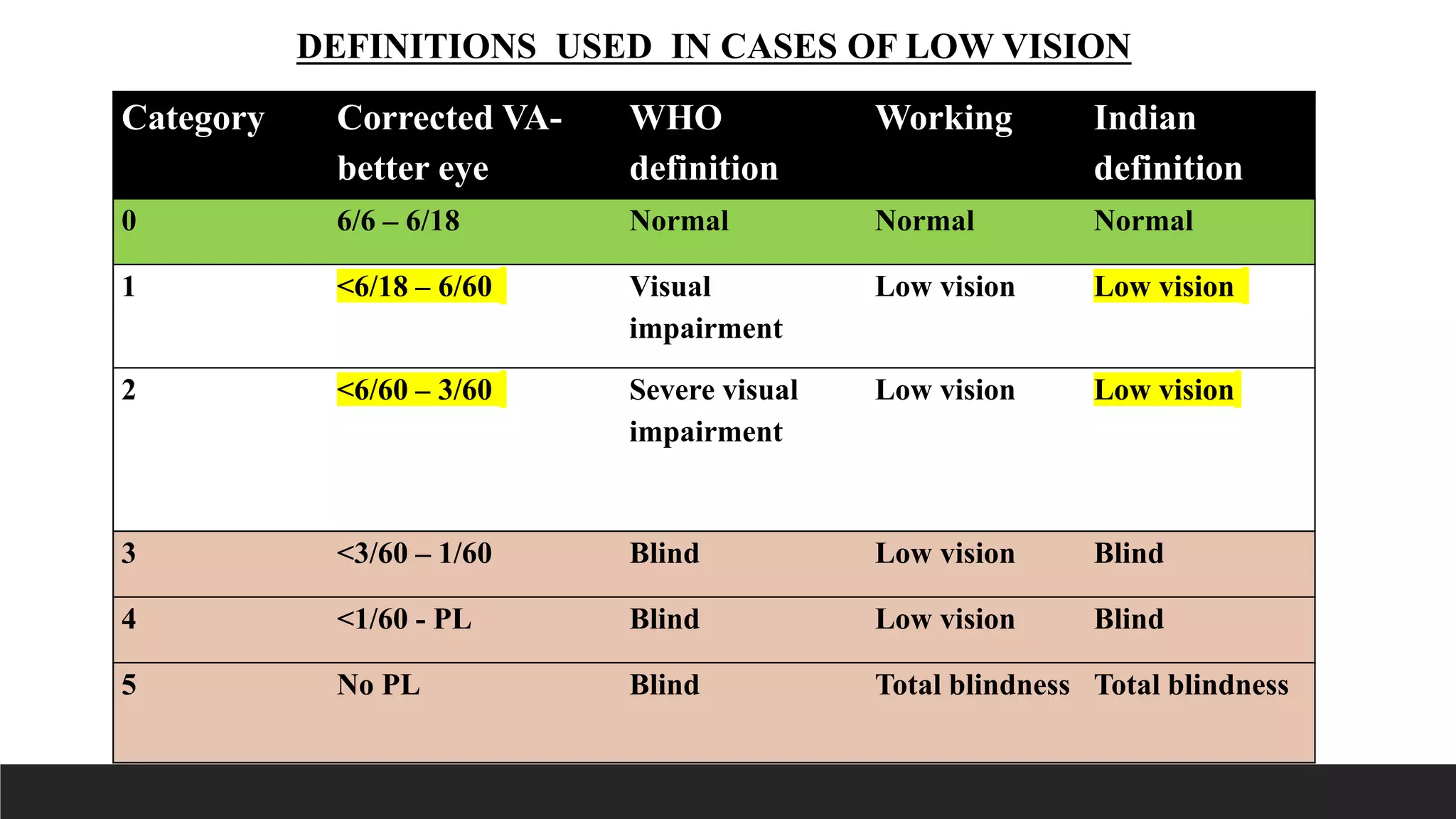
Category Corrected VA-
better eye
WHO
definition
Working Indian
definition
0 6/6 – 6/18 Normal Normal Normal
1 <6/18 – 6/60 Visual
impairment
Low vision Low vision
2 <6/60 – 3/60 Severe visual
impairment
Low vision Low vision
3 <3/60 – 1/60 Blind Low vision Blind
4 <1/60 - PL Blind Low vision Blind
5 No PL Blind Total blindness Total blindness
DEFINITIONS USED IN CASES OF LOW VISION
The most common disorders found
in children with low vision are:
• ROP—Retinopathy of prematurity
• Albinism
• Heredomacular degeneration
• Pathological Myopia
• Retinitis pigmentosa
• Optic atrophy (Primary or secondary)
• Microophthalmos and colobomas
• Bilateral amblyopia
(nystagmus/strabismic)
The most common disorders found in
adults with low vision are:
 ARMD
 Glaucoma
 Diabetic retinopathy
 Myopic retinopathy
 Corneal Opacities
 Retinitis pigmentosa
 Chorioretinitis
 Optic atrophy
Functional Effects of Low Vision
Low vision Assessment
and
Rehabilitation
Assessment
Its ‘LOW’ vision not ‘NO’ vision
Central visual field
◦ Amsler Grid Charting
Location of scotoma may indicate a need for eccentric viewing training before near
device prescription.
Rehabilitation
‘Something is better than nothing’
Types of Assistive Devices
LVDs are basically of four types:
1. Optical Devices,
incorporating
lenses
2. Non optical
Devices,
do not use optical
lenses.
3.Electronic
Devices
4. Complex Devices
Devices using
advanced
technologies.
Advantages
 Only possible device
which enhances distance
vision
 Can be used in a
classroom for blackboard
reading or outdoors such
as street and bus signs
Disadvantages
 Restriction in field of view
 Patients with constricted
fields do not benefit much
by them
 requires coordination of
hands and eye
 Limited focus depth
 Difficulty in locating and
focussing on objects quickly
Instruction for use
Hold material very close & move it out and scan lines one by one
Advantages
1. Cosmetically acceptable
2. Both hands free to hold reading
material
3. Large field of vision
4. Simultaneous vision for near and
distance
5. Less expensive
Disadvantages
1. Spherical aberrations with high plus lens
2. Patient has to hold print close to eye due to
short focal length, thus reducing the
illumination on reading matter.
Uses
Reading from a book ,newspaper, stock market page, bills
Looking at a picture or diagram.
Disadvantages
 The field of view is
reduced
 Too close reading
posture is sometimes
painful for long hours.
Advantages
 fixed focus easy for patient to see through
 It works well for patients with hand
tremors, arthritis and constricted fields
 They may have their inbuilt light source.
Advantages
◦ Eye to lens distance can be varied
◦ Normal reading distance
◦ Patients with eccentric viewing
◦ Some have light source which
further enhances vision
(illuminated)
◦ Easily available, over the counter
Disadvantages:
◦ Patients with tremors,
arthritis etc have
difficulty holding the
magnifier
◦ Maintaining focus is a
problem especially for
elderly
◦ Field of vision is limited
ELECTRO-OPTICAL & OTHER ASSISTIVE
DEVICES
CCTV (Closed Circuit Television) System
 consists of a Monitor, a camera, a table or
platform where the reading text can be placed
 controls for brightness, contrast, color , change of
polarity from white to black letters on white
background and for magnification
 CCTV’s, also called video magnifiers
ADVANTAGES
 Provides a distortion-free, brighter,
magnified image with enhanced contrast
on a larger screen
Can be modified for a variety of uses:
reading ,writing, computers, crafts etc
DISADVANTAGES
Expensive, heavy, difficult to move
around
Difficulty in operating by some
patients
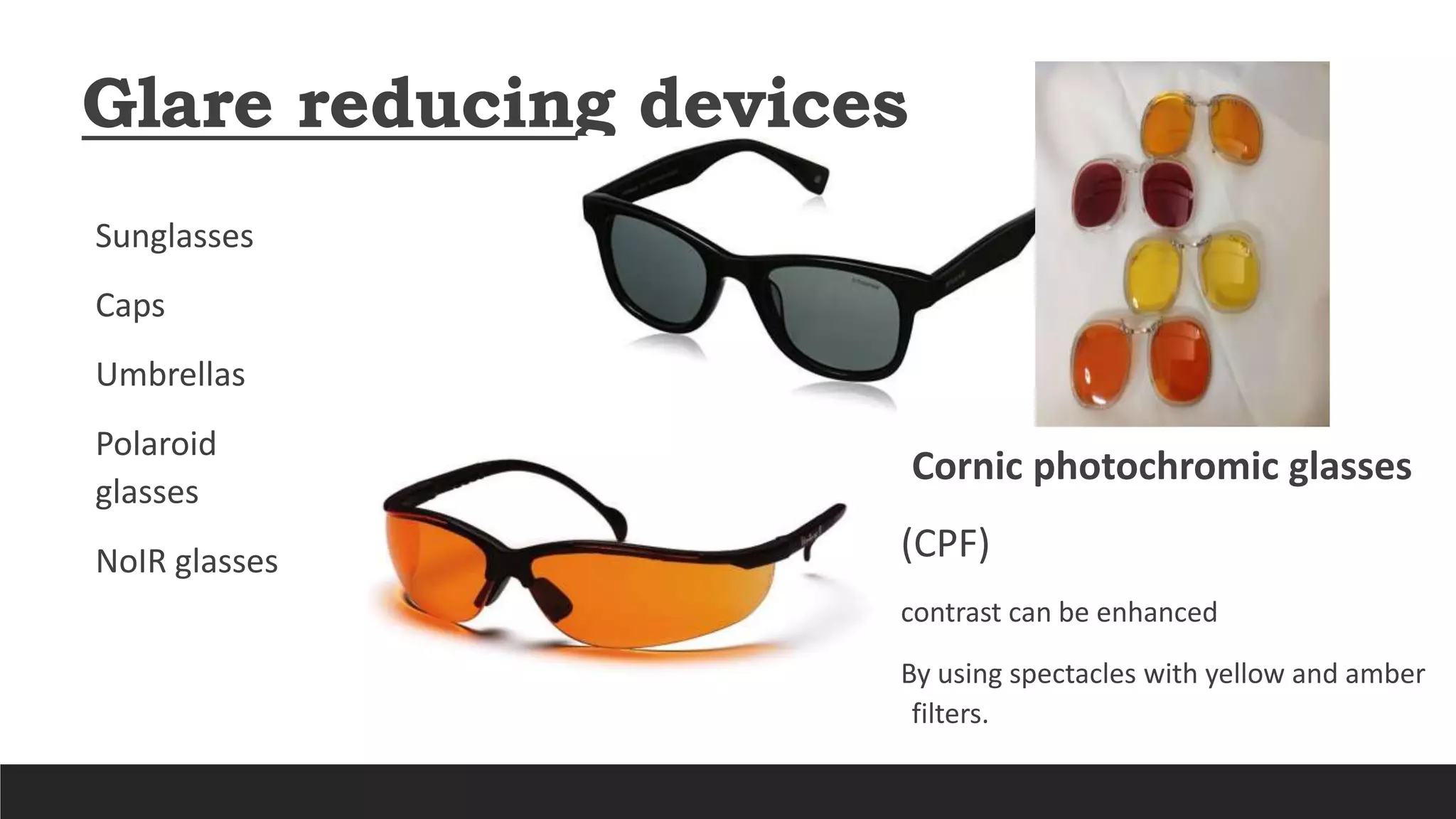
Glare reducing devices
Sunglasses
Caps
Umbrellas
Polaroid
glasses
NoIR glasses
Cornic photochromic glasses
(CPF)
contrast can be enhanced
By using spectacles with yellow and amber
filters.
Mobility assisting
devices
Long canes
Strong portable lights
COMPUTER SOFTWARE
JAWS screen reading software
Connect out loud internet and email software
Magic 8.0 screen magnification software and speech
Visual field enhancement
devices
Visual field enhancement
devices
As the magnification increases ,the field of view decreases.
Methods of increasing the field-
1. Compress the existing image to include most of the available area
2. Provides prisms that relocate the image from a non seeing area to
a seeing area (with the base in the direction of field loss)
3. Use a mirror to reflect a image from a non seeing area
Field expanders
Fresnel prisms
Gottlieb field expanders
Reverse telescopes
Hemianopic mirrors
Reverse telescopes
Newer
technology low
vision aids
.
E-readers (kindle, i-pad)
Portable & affordable
alternative
Allow users to adjust font
sizes contrast settings of the
display
Text to speech functionality
present
Cannot offer same level of
magnification as CCTV
SMART PHONE &
TABLETS
FEATURES:
MAGNIFY: iRead, iLoupe &
magnify use the device’s camera
& light source to magnify and
illuminate the text
SLIGHT BOOK: Digitally
communicates vision changes to
ophthalmologists wirelessly by
measuring visual function
MAP QUEST : provides voice
guided directions
VOICE INTERFACE : Siri –a
voice recognition system on i-
phone
AAO smartsight – SMARTSIGHT is
AAO’s initiative in vision
rehabilitation.
It provides materials for
ophthalmologists to give to patients
to introduce them to the
possibilities of visual rehabilitation.
Latest In Low Vision Devices
Implantable Miniature Telescope (IO-LVA)
Argus Retinal Prosthesis
Microsystem-based Visual Prosthesis
(MIVP)
Harvard/MIT Retinal Implant
INTRAOCULAR LOW VISION AID
1. Recent advance in low vision rehabilitation
2. It comprises of surgical implantation of intraocular telescopic
aids.
3. Provides 3* magnification in the fundus , so resultant retinal
image is perceived through peripheral retina
Match the following
Manifest blindness/ Legal blindness
Social blindness
Economic blindness
Absolute blindness
>6/18
6/18 to 6/60
6/60 to 3/60
3/60 to 1/60
1/60 to PL +ve
PL -ve
Match the following
Manifest blindness/ Legal blindness
Social blindness
Economic blindness
Absolute blindness
>6/18
6/18 to 6/60
6/60 to 3/60
3/60 to 1/60
1/60 to PL +ve
PL -ve
THANK YOU

LOW VISION AIDS

  • 1.
    Low Vision Management Nikhil D.Gotmare @eyeamnikhil
  • 2.
    Normal vision >6/18 Blindness <3/60 VF <10deg (in better eye) Low vision <6/18 to >3/60
  • 3.
    Category Corrected VA- bettereye WHO definition Working Indian definition 0 6/6 – 6/18 Normal Normal Normal 1 <6/18 – 6/60 Visual impairment Low vision Low vision 2 <6/60 – 3/60 Severe visual impairment Low vision Low vision 3 <3/60 – 1/60 Blind Low vision Blind 4 <1/60 - PL Blind Low vision Blind 5 No PL Blind Total blindness Total blindness DEFINITIONS USED IN CASES OF LOW VISION
  • 5.
    The most commondisorders found in children with low vision are: • ROP—Retinopathy of prematurity • Albinism • Heredomacular degeneration • Pathological Myopia • Retinitis pigmentosa • Optic atrophy (Primary or secondary) • Microophthalmos and colobomas • Bilateral amblyopia (nystagmus/strabismic) The most common disorders found in adults with low vision are:  ARMD  Glaucoma  Diabetic retinopathy  Myopic retinopathy  Corneal Opacities  Retinitis pigmentosa  Chorioretinitis  Optic atrophy
  • 6.
  • 8.
  • 9.
  • 11.
    Central visual field ◦Amsler Grid Charting Location of scotoma may indicate a need for eccentric viewing training before near device prescription.
  • 12.
  • 13.
    Types of AssistiveDevices LVDs are basically of four types: 1. Optical Devices, incorporating lenses 2. Non optical Devices, do not use optical lenses. 3.Electronic Devices 4. Complex Devices Devices using advanced technologies.
  • 18.
    Advantages  Only possibledevice which enhances distance vision  Can be used in a classroom for blackboard reading or outdoors such as street and bus signs Disadvantages  Restriction in field of view  Patients with constricted fields do not benefit much by them  requires coordination of hands and eye  Limited focus depth  Difficulty in locating and focussing on objects quickly
  • 21.
    Instruction for use Holdmaterial very close & move it out and scan lines one by one Advantages 1. Cosmetically acceptable 2. Both hands free to hold reading material 3. Large field of vision 4. Simultaneous vision for near and distance 5. Less expensive Disadvantages 1. Spherical aberrations with high plus lens 2. Patient has to hold print close to eye due to short focal length, thus reducing the illumination on reading matter.
  • 23.
    Uses Reading from abook ,newspaper, stock market page, bills Looking at a picture or diagram. Disadvantages  The field of view is reduced  Too close reading posture is sometimes painful for long hours. Advantages  fixed focus easy for patient to see through  It works well for patients with hand tremors, arthritis and constricted fields  They may have their inbuilt light source.
  • 25.
    Advantages ◦ Eye tolens distance can be varied ◦ Normal reading distance ◦ Patients with eccentric viewing ◦ Some have light source which further enhances vision (illuminated) ◦ Easily available, over the counter Disadvantages: ◦ Patients with tremors, arthritis etc have difficulty holding the magnifier ◦ Maintaining focus is a problem especially for elderly ◦ Field of vision is limited
  • 30.
    ELECTRO-OPTICAL & OTHERASSISTIVE DEVICES CCTV (Closed Circuit Television) System  consists of a Monitor, a camera, a table or platform where the reading text can be placed  controls for brightness, contrast, color , change of polarity from white to black letters on white background and for magnification  CCTV’s, also called video magnifiers
  • 33.
    ADVANTAGES  Provides adistortion-free, brighter, magnified image with enhanced contrast on a larger screen Can be modified for a variety of uses: reading ,writing, computers, crafts etc DISADVANTAGES Expensive, heavy, difficult to move around Difficulty in operating by some patients
  • 37.
    Glare reducing devices Sunglasses Caps Umbrellas Polaroid glasses NoIRglasses Cornic photochromic glasses (CPF) contrast can be enhanced By using spectacles with yellow and amber filters.
  • 38.
  • 39.
    COMPUTER SOFTWARE JAWS screenreading software Connect out loud internet and email software Magic 8.0 screen magnification software and speech
  • 40.
  • 41.
    Visual field enhancement devices Asthe magnification increases ,the field of view decreases. Methods of increasing the field- 1. Compress the existing image to include most of the available area 2. Provides prisms that relocate the image from a non seeing area to a seeing area (with the base in the direction of field loss) 3. Use a mirror to reflect a image from a non seeing area
  • 42.
    Field expanders Fresnel prisms Gottliebfield expanders Reverse telescopes Hemianopic mirrors
  • 44.
  • 45.
  • 46.
    E-readers (kindle, i-pad) Portable& affordable alternative Allow users to adjust font sizes contrast settings of the display Text to speech functionality present Cannot offer same level of magnification as CCTV
  • 47.
    SMART PHONE & TABLETS FEATURES: MAGNIFY:iRead, iLoupe & magnify use the device’s camera & light source to magnify and illuminate the text SLIGHT BOOK: Digitally communicates vision changes to ophthalmologists wirelessly by measuring visual function MAP QUEST : provides voice guided directions VOICE INTERFACE : Siri –a voice recognition system on i- phone
  • 48.
    AAO smartsight –SMARTSIGHT is AAO’s initiative in vision rehabilitation. It provides materials for ophthalmologists to give to patients to introduce them to the possibilities of visual rehabilitation.
  • 49.
    Latest In LowVision Devices Implantable Miniature Telescope (IO-LVA) Argus Retinal Prosthesis Microsystem-based Visual Prosthesis (MIVP) Harvard/MIT Retinal Implant
  • 50.
    INTRAOCULAR LOW VISIONAID 1. Recent advance in low vision rehabilitation 2. It comprises of surgical implantation of intraocular telescopic aids. 3. Provides 3* magnification in the fundus , so resultant retinal image is perceived through peripheral retina
  • 55.
    Match the following Manifestblindness/ Legal blindness Social blindness Economic blindness Absolute blindness >6/18 6/18 to 6/60 6/60 to 3/60 3/60 to 1/60 1/60 to PL +ve PL -ve
  • 56.
    Match the following Manifestblindness/ Legal blindness Social blindness Economic blindness Absolute blindness >6/18 6/18 to 6/60 6/60 to 3/60 3/60 to 1/60 1/60 to PL +ve PL -ve
  • 57.

Editor's Notes

  • #5 Prevalance was higher in india with the previous definition used by npcb