Dr. Richa Naik
How to prescribe a spectacle to a
person??
• Step 1:
• Objective refraction
1. Retinoscopy
2. Auto refractometer
3. Photorefraction
4. Electrophysiological method
• Step 2 :
• Subjective refraction.
Myope
Myopia upto 6D :
in children <8 years of age….
1. full correction
2.Constantly wearing of glasses to avoid developing
squinting and to enhance developing accommodation
Always undercorrect myopes.
Always advise the patient to choose the lens that
makes the letter more clear and not the one
which makes the letter smaller and darker.
in case of exophoria minus correction can be given.
in adults <30 years…full correction
in adults >30 years…not able to tolerate full
correction
over 3D
High myopia > 10D
undercorrection is always better to avoid problem of
near vision and that of minification of images.
Pseudomyopia
Cycloplegic refraction(atropine or HA)
• If tendency for accommodative spasm
- Cycloplegic drops
- Plus over correction
Increase accommodative facility by exercise
Hypermetropia
Cycloplegic refraction is must.
• If manifest error is small..i.e. 1D or small, correction is
given only if the patient is symptomatic.
• Children <4 years- accept full cycloplegic correction
once a child reaches school age, reduce the plus lenses
to 1/3 of refractive prescription( but child is not
allowed to accommodate more than 2.5D)
Older children- may not accept full correction
so 1st
undercorrect and gradually increase the spherical
correction at 6 month interval till he accepts manifest
hypermetropia.
If there is associated exophoria undercorrection for
about 1-2 D
In the presence of accommodative convergent squint,
full correction at 1st
sitting
Remember_ hypermetropia may diminish with
growth of child..so refraction should be carried
out every 6 months.
Try to give manifest correction for adults.
Astigmatism
• Adult- 1st
time diagnosed
• Try optimal correction
• Undercorrection is acceptable with maintaining the
spherical equivalent
• Rotate axis towards 90 & 180
• Check binocular vision
• Check one or both axis to be parallel
• adult- already astigmatic
• It can be due to change in power
• - see pts comfort
• -may require undercorrection
• Axis- try to maintain previous one
• -see binocular vision
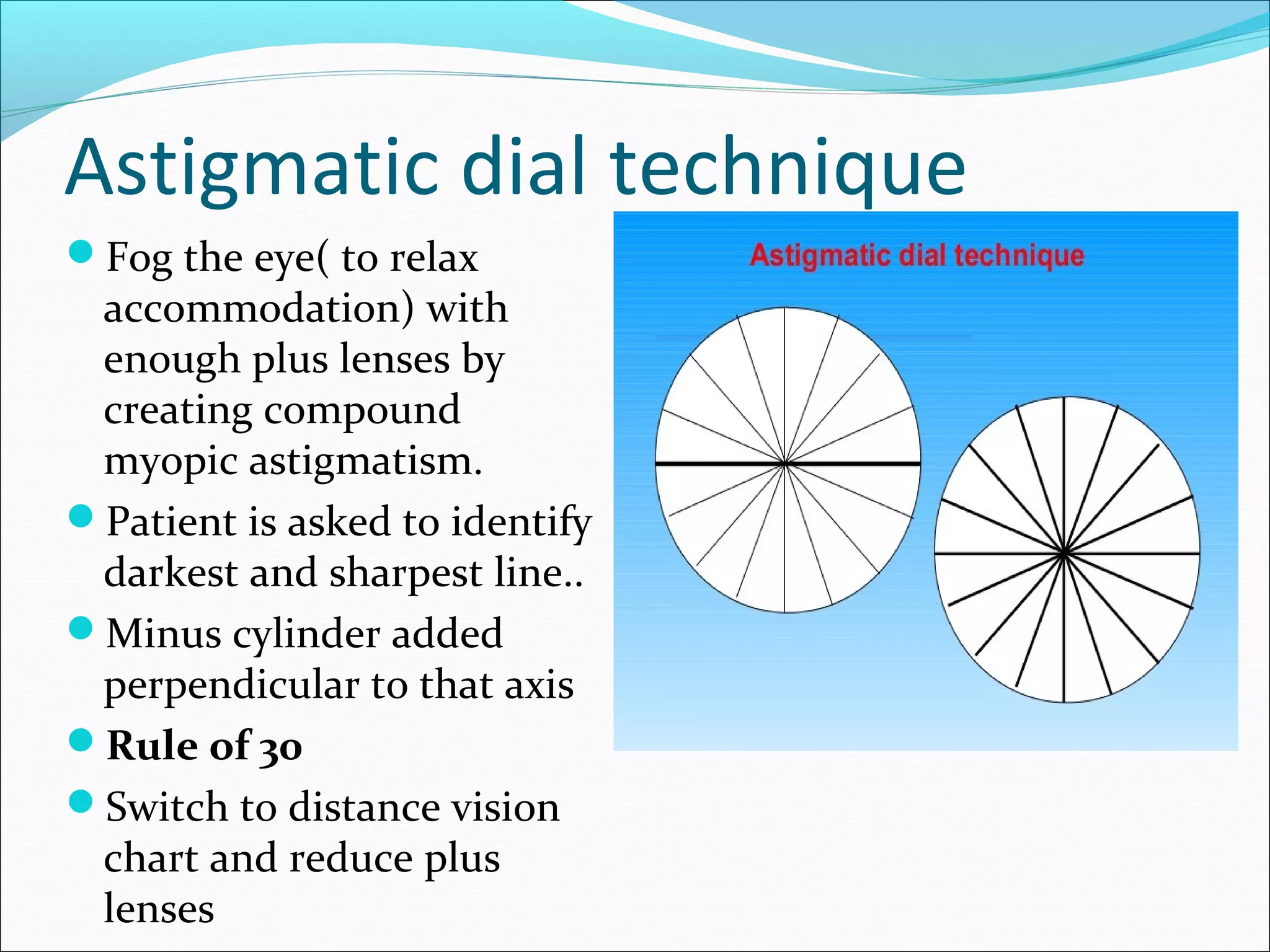
Astigmatic dial technique
Fog the eye( to relax
accommodation) with
enough plus lenses by
creating compound
myopic astigmatism.
Patient is asked to identify
darkest and sharpest line..
Minus cylinder added
perpendicular to that axis
Rule of 30
Switch to distance vision
chart and reduce plus
lenses
Astigmatic fan test
Add plus lens
Refer the patient to the
fan chart and ask which
line or group of lines
appear clearest &
darkest
Directing attention to
the maddox arrow
Directing attention to
the blocks
fogging
 Place enough PLUS lenses to FOG vision to ~6/12 line
 Slowly reduce the plus power until best VA is
obtained
Remember:
“Maximum plus power for best visual acuity”
Duochrome test
Based on chromatic aberration
 Green letters clearer = Add ‘+ 0.25DS’
 Red letters clearer = Add ‘- 0.25DS’
 End-point is obtained when the letters on the
RedGreen chart appears equally dark or when a
reversal occurs.
Pin hole test
Pin hole is put in front
after correction if
patient is improving
than our prescribed lens
is undercorrected.
JCC used to determine the cylindrical axis and the
cylindrical power for the patient.
Binocular Balancing
The technique is also known as "equalising".
 During the monocular refraction, a different state of
relaxation of accommodation may occur because one
eye was under test while the other was not.
 Thus, binocular balancing is performed to balance
between eyes.
1. Fogging and Alternate occlusion method
2.Duochrome test with fogging
3. Prism dissociation method
Presbyopia
The amount of presbyopic correction can be
calculated if the remaining amplitude of
accommodation(for his near point) is determined and
his working distance is specified.
i.e. A emmetropic patient has remaining amplitude
of accommodation 3D(near point 33cm). In order to
achieve comfortable near vision he must keep
one third of this in reserve….so he must use only
2D. If he wishes to see 25 cm clearly he needs 4D of
accommodation n so requires 2D of presbyopic
correction.
Spectacle for presbyopics
Bifocals
1. Franklin split bifocals
2.Franklin cemented bifocals
3. Fused
4.Double segment
5.Solid
Trifocals
Progressive
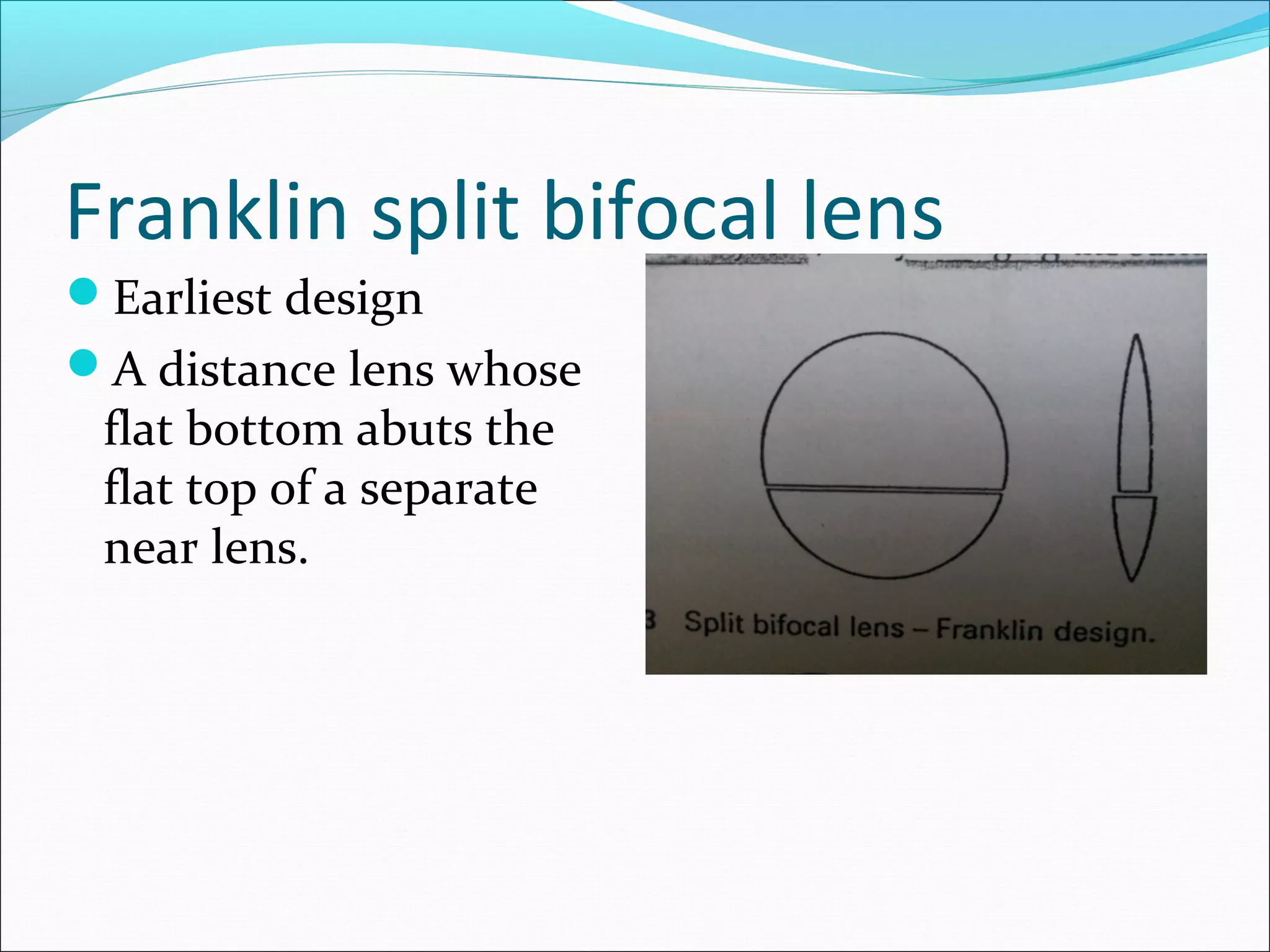
Franklin split bifocal lens
Earliest design
A distance lens whose
flat bottom abuts the
flat top of a separate
near lens.
Franklin cemented bifocals
Near portion is
constructed by attaching
supplementary lens to
the surface of a distance
lens of same RI.
Ulraviolet cured epoxy
resin used as adhesive.
Almost obsolete.
Fused bifocals
2 different material is
used…button is of flint
glass and main lens is of
crown glass.
Advantage-
inconspicuous dividing
line, mechanical stability
and low cost
Disadvantage-
chromatic aberrations
Solid(executive) bifocal
Single piece
construction
Near addition is
produced by a different
curvature of either- back
or front surface
Full width horizontal
junction
i.e.Plastic bifocals
Double segment(trifocal)
Close work above eye
level i.e. librarian,
electrician and painter
Fused as well as 1 piece
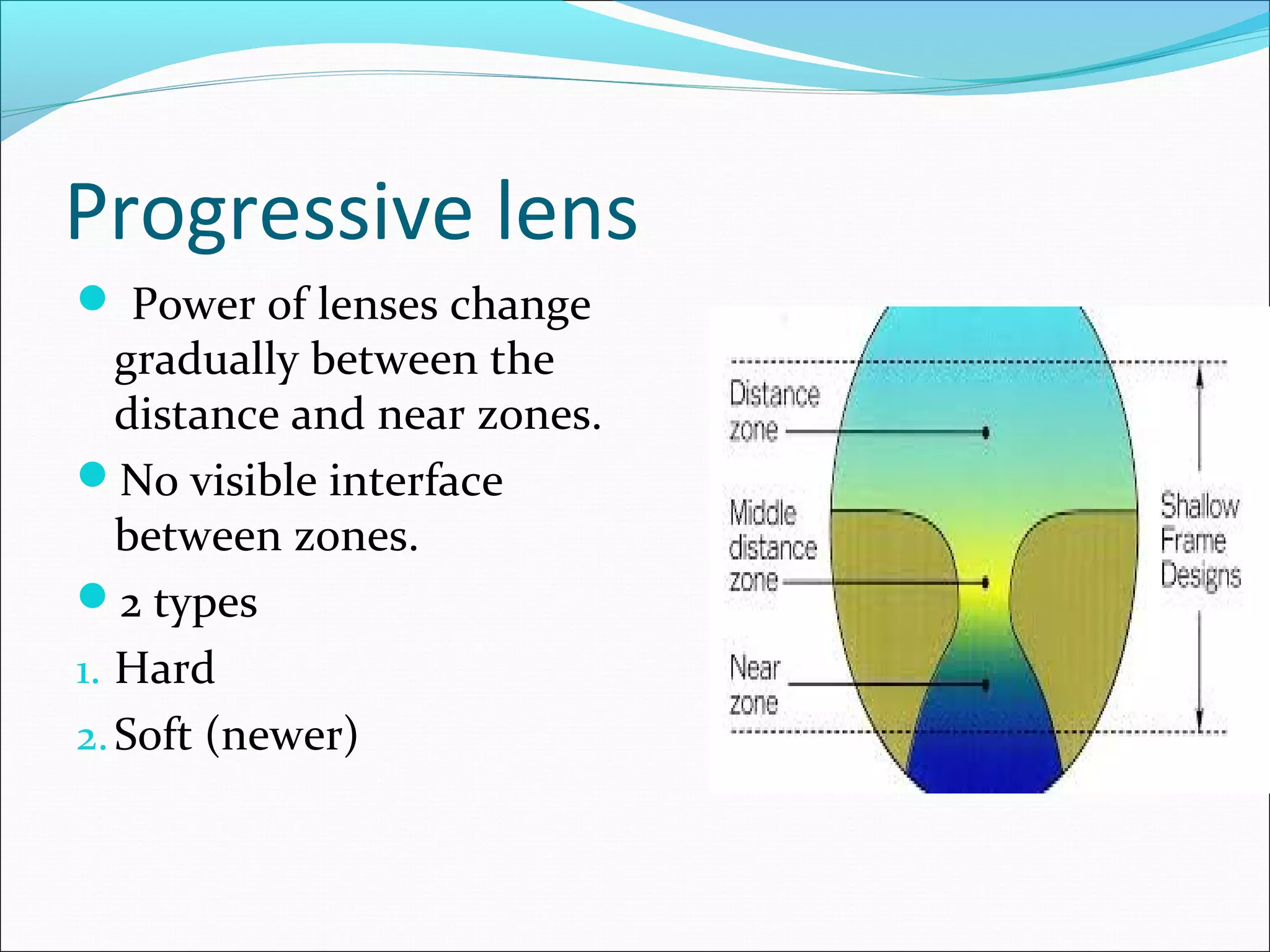
Progressive lens
 Power of lenses change
gradually between the
distance and near zones.
No visible interface
between zones.
2 types
1. Hard
2.Soft (newer)
Types of lenses
Flat lenses
1. Biconcave or biconvex
2.Plano-concave or plano-
convex
Curved lenses
1. Meniscus lens
2.Toric lens
3. Lenticular lens
4.Apheric lens
Meniscus lens
Base curve
-semifinished lens
Base curve is added to
anterior surface and
optician grinds its
other surface to get
required power
deep meniscus lens
Periscopic lens
Lenticular lenses
Used for high power
Central portion – power
– aperture – 30mm
Peripheral portion –
carrier – 1.2-2 mm
thinner than central part
Reduce the weight of
spectacle and
aberrations
Toric lens
Where one surface is spherical and other surface is
toroidal.
What is toroidal surface?
if we visualise a cylinder its one axis is curved while other
is straight which is the axis of cylinder…now straight axis
is also curved then surface will become toroidal.
Spherical lens is ground on anterior surface and
posterior surface is made toroidal
Base curve used 6D
Difference between base curve and curvature of toric
surface equals the cylindrical power
Aspheric lenses
 used to make high plus
aphakic lenses by
modifying the lens
curvature peripherally to
reduce aberration and
provide better
peripheral vision
Base curve for aphakic
lens is relatively flat.
Lens material
Polycarbonate lens
Photochromatic lens
High index lens
Polarised lens
Tinted lens
Trivex lens
Anti reflective coating lens
Yellow filter
Polycarbonate lenses
 These lenses are impact-resistant and are a good
choice for people who regularly participate in sporting
activities, work in a job environment in which their
glasses may be easily scratched or broken
 for children who may easily drop and scratch their
glasses.
 Polycarbonate lenses provide ultraviolet protection.
High index lenses
 Designed for people
who require high power
prescriptions, these
lenses are lighter and
thinner than the
standard thick lenses
that may otherwise be
needed.
Polarised lenses
Light reflected from
water or a flat surface
can cause unwanted
glare. Polarised lenses
reduce glare and are
useful for sport and
driving.
Photochromatic lenses
 Made from either glass or
plastic, these glasses
change from clear to
tinted when exposed to
sunlight. This eliminates
the need for prescription
sunglasses. These lenses
may not darken in a car
because the windscreen
could block the ultraviolet
rays from the sun.
Tinted lens
Decreases transmittance
Done when patient is uncomfortable in bright lights or
exposed to UV radiation
Transmittance level Uses
75-80% Indoor uses
20-25% Mountain climbing , flying
20% sunglasses
Trivex lenses
Made from a newer plastic with similar characteristics
of polycarbonate lenses. It is light weight, thin and
impact-resistant and may result in better vision
correction in some people than polycarbonate lenses.
Anti reflective coating glasses for IR
copper and gold coating reflect approximately 98% of
IR above 750 nm
Yellow filters
Shooter’s glasses
It increases contrast for longer wavelength objects
viewed against shorter wavelength background
THANK YOU

Spectacle prescription

  • 1.
  • 2.
    How to prescribea spectacle to a person?? • Step 1: • Objective refraction 1. Retinoscopy 2. Auto refractometer 3. Photorefraction 4. Electrophysiological method • Step 2 : • Subjective refraction.
  • 3.
  • 4.
    Myopia upto 6D: in children <8 years of age…. 1. full correction 2.Constantly wearing of glasses to avoid developing squinting and to enhance developing accommodation Always undercorrect myopes. Always advise the patient to choose the lens that makes the letter more clear and not the one which makes the letter smaller and darker. in case of exophoria minus correction can be given.
  • 5.
    in adults <30years…full correction in adults >30 years…not able to tolerate full correction over 3D High myopia > 10D undercorrection is always better to avoid problem of near vision and that of minification of images.
  • 6.
  • 7.
    Cycloplegic refraction(atropine orHA) • If tendency for accommodative spasm - Cycloplegic drops - Plus over correction Increase accommodative facility by exercise
  • 9.
  • 10.
    Cycloplegic refraction ismust. • If manifest error is small..i.e. 1D or small, correction is given only if the patient is symptomatic. • Children <4 years- accept full cycloplegic correction once a child reaches school age, reduce the plus lenses to 1/3 of refractive prescription( but child is not allowed to accommodate more than 2.5D) Older children- may not accept full correction so 1st undercorrect and gradually increase the spherical correction at 6 month interval till he accepts manifest hypermetropia.
  • 11.
    If there isassociated exophoria undercorrection for about 1-2 D In the presence of accommodative convergent squint, full correction at 1st sitting Remember_ hypermetropia may diminish with growth of child..so refraction should be carried out every 6 months. Try to give manifest correction for adults.
  • 12.
  • 13.
    • Adult- 1st timediagnosed • Try optimal correction • Undercorrection is acceptable with maintaining the spherical equivalent • Rotate axis towards 90 & 180 • Check binocular vision • Check one or both axis to be parallel • adult- already astigmatic • It can be due to change in power • - see pts comfort • -may require undercorrection • Axis- try to maintain previous one • -see binocular vision
  • 14.
    Astigmatic dial technique Fogthe eye( to relax accommodation) with enough plus lenses by creating compound myopic astigmatism. Patient is asked to identify darkest and sharpest line.. Minus cylinder added perpendicular to that axis Rule of 30 Switch to distance vision chart and reduce plus lenses
  • 15.
    Astigmatic fan test Addplus lens Refer the patient to the fan chart and ask which line or group of lines appear clearest & darkest Directing attention to the maddox arrow Directing attention to the blocks
  • 16.
    fogging  Place enoughPLUS lenses to FOG vision to ~6/12 line  Slowly reduce the plus power until best VA is obtained Remember: “Maximum plus power for best visual acuity”
  • 17.
    Duochrome test Based onchromatic aberration  Green letters clearer = Add ‘+ 0.25DS’  Red letters clearer = Add ‘- 0.25DS’  End-point is obtained when the letters on the RedGreen chart appears equally dark or when a reversal occurs.
  • 18.
    Pin hole test Pinhole is put in front after correction if patient is improving than our prescribed lens is undercorrected.
  • 19.
    JCC used todetermine the cylindrical axis and the cylindrical power for the patient.
  • 20.
    Binocular Balancing The techniqueis also known as "equalising".  During the monocular refraction, a different state of relaxation of accommodation may occur because one eye was under test while the other was not.  Thus, binocular balancing is performed to balance between eyes. 1. Fogging and Alternate occlusion method 2.Duochrome test with fogging 3. Prism dissociation method
  • 21.
  • 22.
    The amount ofpresbyopic correction can be calculated if the remaining amplitude of accommodation(for his near point) is determined and his working distance is specified. i.e. A emmetropic patient has remaining amplitude of accommodation 3D(near point 33cm). In order to achieve comfortable near vision he must keep one third of this in reserve….so he must use only 2D. If he wishes to see 25 cm clearly he needs 4D of accommodation n so requires 2D of presbyopic correction.
  • 24.
    Spectacle for presbyopics Bifocals 1.Franklin split bifocals 2.Franklin cemented bifocals 3. Fused 4.Double segment 5.Solid Trifocals Progressive
  • 25.
    Franklin split bifocallens Earliest design A distance lens whose flat bottom abuts the flat top of a separate near lens.
  • 26.
    Franklin cemented bifocals Nearportion is constructed by attaching supplementary lens to the surface of a distance lens of same RI. Ulraviolet cured epoxy resin used as adhesive. Almost obsolete.
  • 27.
    Fused bifocals 2 differentmaterial is used…button is of flint glass and main lens is of crown glass. Advantage- inconspicuous dividing line, mechanical stability and low cost Disadvantage- chromatic aberrations
  • 28.
    Solid(executive) bifocal Single piece construction Nearaddition is produced by a different curvature of either- back or front surface Full width horizontal junction i.e.Plastic bifocals
  • 29.
    Double segment(trifocal) Close workabove eye level i.e. librarian, electrician and painter Fused as well as 1 piece
  • 30.
    Progressive lens  Powerof lenses change gradually between the distance and near zones. No visible interface between zones. 2 types 1. Hard 2.Soft (newer)
  • 31.
    Types of lenses Flatlenses 1. Biconcave or biconvex 2.Plano-concave or plano- convex Curved lenses 1. Meniscus lens 2.Toric lens 3. Lenticular lens 4.Apheric lens
  • 32.
    Meniscus lens Base curve -semifinishedlens Base curve is added to anterior surface and optician grinds its other surface to get required power deep meniscus lens Periscopic lens
  • 33.
    Lenticular lenses Used forhigh power Central portion – power – aperture – 30mm Peripheral portion – carrier – 1.2-2 mm thinner than central part Reduce the weight of spectacle and aberrations
  • 34.
    Toric lens Where onesurface is spherical and other surface is toroidal. What is toroidal surface? if we visualise a cylinder its one axis is curved while other is straight which is the axis of cylinder…now straight axis is also curved then surface will become toroidal. Spherical lens is ground on anterior surface and posterior surface is made toroidal Base curve used 6D Difference between base curve and curvature of toric surface equals the cylindrical power
  • 35.
    Aspheric lenses  usedto make high plus aphakic lenses by modifying the lens curvature peripherally to reduce aberration and provide better peripheral vision Base curve for aphakic lens is relatively flat.
  • 36.
    Lens material Polycarbonate lens Photochromaticlens High index lens Polarised lens Tinted lens Trivex lens Anti reflective coating lens Yellow filter
  • 37.
    Polycarbonate lenses  Theselenses are impact-resistant and are a good choice for people who regularly participate in sporting activities, work in a job environment in which their glasses may be easily scratched or broken  for children who may easily drop and scratch their glasses.  Polycarbonate lenses provide ultraviolet protection.
  • 38.
    High index lenses Designed for people who require high power prescriptions, these lenses are lighter and thinner than the standard thick lenses that may otherwise be needed.
  • 39.
    Polarised lenses Light reflectedfrom water or a flat surface can cause unwanted glare. Polarised lenses reduce glare and are useful for sport and driving.
  • 40.
    Photochromatic lenses  Madefrom either glass or plastic, these glasses change from clear to tinted when exposed to sunlight. This eliminates the need for prescription sunglasses. These lenses may not darken in a car because the windscreen could block the ultraviolet rays from the sun.
  • 41.
    Tinted lens Decreases transmittance Donewhen patient is uncomfortable in bright lights or exposed to UV radiation Transmittance level Uses 75-80% Indoor uses 20-25% Mountain climbing , flying 20% sunglasses
  • 42.
    Trivex lenses Made froma newer plastic with similar characteristics of polycarbonate lenses. It is light weight, thin and impact-resistant and may result in better vision correction in some people than polycarbonate lenses. Anti reflective coating glasses for IR copper and gold coating reflect approximately 98% of IR above 750 nm Yellow filters Shooter’s glasses It increases contrast for longer wavelength objects viewed against shorter wavelength background
  • 43.