Presenter : Dr. Mahamud Adnan
DO resident, NIO & H.
Basics of Pediatric Refraction
Chairman : Dr. Khair Ahmed Choudhury
Associate Professor & Head of the Department,
Pediatric ophthalmology, NIO & H
Moderator : Dr. Habib Yousuf Rahmatullah
Fellow, NIO & H.
HOW IS IT DIFFERENT FROM NORMAL
REFRACTION ?
Objective Refraction is usually used to determine
refractive status of infants and preverbal children
Meticulously and accurately done
Great expertise is necessary
Cont.
Should understand Emmetropization and
relation between state of BSV and refractive
status of child.
Cycloplegic Refraction is preferable due to
active accomodation in child.
What to expect in the first year:
At birth : adjusting to light and beginning to focus.
 Two to four months old: focusing and tracking of
(persuit) moving objects.
Five to eight months old : Depth perception.
 Nine to twelve months : greeping and grasping .
Milestone of Vision
• At birth-
Eyes move randomly, no central fixation
• At 6 weeks-
Apparent fixation reflex,can follow bright light at
short distance
• At 4-6 months-
Convergence established.Foveal reflex
developed at 4
th
month.Central fixation at 6
months.
• At 6 years-
Foveal development is established completely
with visual acuity 6/6
Change of refraction:
At birth eyes are hypermetropic and visual
acuity is poorly developed.
First 2 – 6 months are associated with rapid
visual development (this is the critical period of
visual development).
Visual acuity improves slowly after this period
and reaches 6/6 by 6 years of age.
Then myopic shift in school age occurs.
Presentation
Blurring of vision.
Inability to read.
Sitting too close to the
television.
Squinting.
Poor performance in
school.
 Intolerance to light .
 Frequent blinking.
 Watering from eyes.
 Headache .
Evaluation of a pediatric patient
Establish a friendly relation with child &
parents.
History:
 Proper history taking :family history.
 Congenital malformation.
 Developmental history.
 H/O trauma.
 Past medical and surgical history.
 Clinical examination :
1. Visual acuity
2. Measurement of deviation.
3. Ocular motility.
4. Fundoscopy.
5. Clinical refraction.
Pediatric refraction
Upto 8 years :
- cycloplegic refraction
Above 8 years :
- subjective refraction
Amblyopic & strabismic child :
-Cycloplegic refraction
Examination under anaesthesia(EUA)
Indication -
1. Usually children 1-5 years of age.
2. Non cooperative patients.
3. Child having nystagmus.
Cycloplegic refraction
Cycloplegic refraction is a procedure to
determine a refractive error by temporarily
paralyzing the ciliary muscles.
WHY CYCLOPLEGIC REFRACTION??
To stop eye’s ability to auto focus or
accommodate in order to determine true
prescription.
When the eye contracts and relaxes the lens
changes its shape
Cont.
Cycloplegic paralysis of ciliary muscles and lens
can no longer change its shape and there is no
chance of accommodation.
In children they have the great ability to vary
their accommodation.
Criteria of an ideal cycloplegic
Rapid onset
Full paralysis of accommodation
Sufficient duration of action to allow accurate
assessment of refraction.
Cont.
Rapid recovery of accommodation.
Dissociation of cycloplegic effect from mydriatic
effect
Absence of local and systemic side effects.
Capacity of safe administration by appropriate
person.
Indication of cycloplegic refraction
All children upto 8 years of age.
squint .
Suspected cases of amblyopia.
Accommodative esotropia.
Uncooperative /non-communicative patient.
If V/A not corrected to predicted level.
Suspected malingering and hysterical patient.
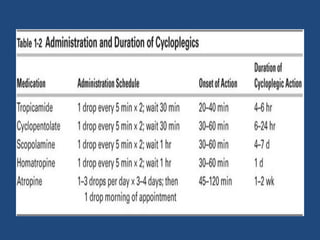
Drugs used for cycloplegia
Antimuscarinic drugs (that block the muscarinic
receptor mediated response of parasympathetic
nervous system) :
 Atropine
 Cyclopentolate
 Homoatropine
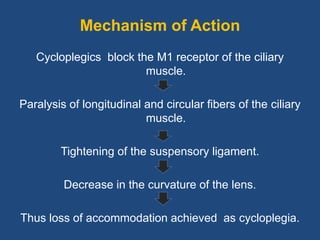
Mechanism of Action
Cycloplegics block the M1 receptor of the ciliary
muscle.
Paralysis of longitudinal and circular fibers of the ciliary
muscle.
Tightening of the suspensory ligament.
Decrease in the curvature of the lens.
Thus loss of accommodation achieved as cycloplegia.
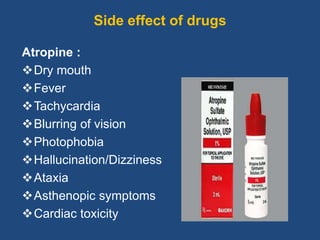
Side effect of drugs
Atropine :
Dry mouth
Fever
Tachycardia
Blurring of vision
Photophobia
Hallucination/Dizziness
Ataxia
Asthenopic symptoms
Cardiac toxicity
cont
Cylopentolae :
Less side effect
Photophobia
Blurring of vision
Burning sensation
Ataxia
Dizziness/Confusion
Tachycardia
Preparing the subject
Counseling the parent of the patient.
Visual acuity assessment prior to cycloplegia.
Cover test to detect latent strabismus.
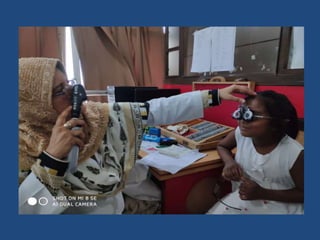
Procedure of cycloplegic refraction
After cycloplegia by appropriate cycloplegic
agent, patient is kept in a room with dim light.
Set up of a distant fixation target.
Then retinoscopy is performed.
Any other option for refraction?
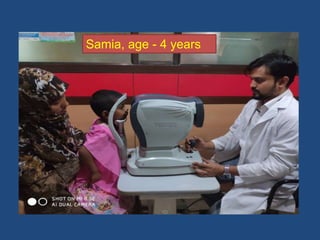
Autorefraction :
- May more accurately detect astigmatism
than retinoscopy.
- Used in cooperative children
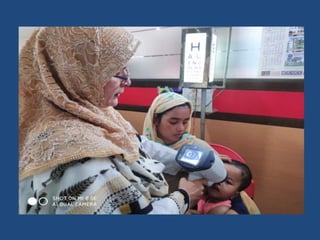
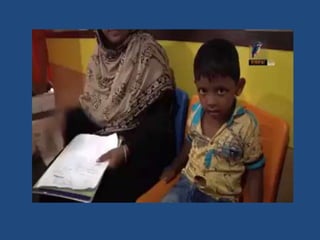
Samia, age - 4 years
Cont.
Post cycloplegic Subjective manifest
refraction :
- Children with high hyperopia who do not
tolerate the full plus correction.
- Who have significant changes in refractive
error over short periods of time.
- Incomplete cycloplegia.
- Children with irregular red reflex.
When to prescribe
Hypermetropia
Usually correction is not given upto +4.0 D in
children in absence of SQUINT.
greater Hypermetropia 2/3 correcrion (usually)
In case of esotropia full cycloplegic correction
should be given even under 2 years.
Myopia
Below 2 years : -5.00D or more should be
corrected
2-4 years : -3.00D should be corrected
> 4 years : Any degree of myopia should be
corrected
Astigmatism
A cylinder of 1.50 D or more should be
prescribed.
(specially with Anisometropia after age of 18
months)
Anisometropia
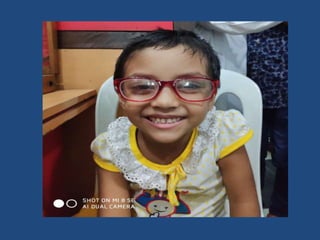
After age of 3yr :
Anisometropia >1D
should be prescribed.
Follow up
Children having strabismus should be examined 6
monthly.
More frequently in children with poor visual acuity.
In aphakic children initially monthly follow up may
be necessary.
6 monthly checkup for teenager myopes.
Counseling :
 Counseling about possible adverse effect of
drugs.
 Counseling about benefit of using spectacles.
 Counseling about demerits of not using
spectacles.
 Counseling for regular follow up.
Take home message
In children having suspected amblyopia, squint ,
hypermetropia – cycloplegic refraction is
mandatory.
 Appropriate , timed intervention in children with
refractive error is essential to prevent
amblyopia.
Thank you

Basics of pediatric refraction by dr.adnan

  • 1.
    Presenter : Dr.Mahamud Adnan DO resident, NIO & H. Basics of Pediatric Refraction
  • 2.
    Chairman : Dr.Khair Ahmed Choudhury Associate Professor & Head of the Department, Pediatric ophthalmology, NIO & H Moderator : Dr. Habib Yousuf Rahmatullah Fellow, NIO & H.
  • 3.
    HOW IS ITDIFFERENT FROM NORMAL REFRACTION ? Objective Refraction is usually used to determine refractive status of infants and preverbal children Meticulously and accurately done Great expertise is necessary
  • 4.
    Cont. Should understand Emmetropizationand relation between state of BSV and refractive status of child. Cycloplegic Refraction is preferable due to active accomodation in child.
  • 5.
    What to expectin the first year: At birth : adjusting to light and beginning to focus.  Two to four months old: focusing and tracking of (persuit) moving objects. Five to eight months old : Depth perception.  Nine to twelve months : greeping and grasping .
  • 6.
    Milestone of Vision •At birth- Eyes move randomly, no central fixation • At 6 weeks- Apparent fixation reflex,can follow bright light at short distance • At 4-6 months- Convergence established.Foveal reflex developed at 4 th month.Central fixation at 6 months. • At 6 years- Foveal development is established completely with visual acuity 6/6
  • 7.
    Change of refraction: Atbirth eyes are hypermetropic and visual acuity is poorly developed. First 2 – 6 months are associated with rapid visual development (this is the critical period of visual development). Visual acuity improves slowly after this period and reaches 6/6 by 6 years of age. Then myopic shift in school age occurs.
  • 8.
    Presentation Blurring of vision. Inabilityto read. Sitting too close to the television. Squinting. Poor performance in school.  Intolerance to light .  Frequent blinking.  Watering from eyes.  Headache .
  • 9.
    Evaluation of apediatric patient Establish a friendly relation with child & parents. History:  Proper history taking :family history.  Congenital malformation.  Developmental history.  H/O trauma.  Past medical and surgical history.
  • 10.
     Clinical examination: 1. Visual acuity 2. Measurement of deviation. 3. Ocular motility. 4. Fundoscopy. 5. Clinical refraction.
  • 11.
    Pediatric refraction Upto 8years : - cycloplegic refraction Above 8 years : - subjective refraction Amblyopic & strabismic child : -Cycloplegic refraction
  • 12.
    Examination under anaesthesia(EUA) Indication- 1. Usually children 1-5 years of age. 2. Non cooperative patients. 3. Child having nystagmus.
  • 13.
    Cycloplegic refraction Cycloplegic refractionis a procedure to determine a refractive error by temporarily paralyzing the ciliary muscles.
  • 14.
    WHY CYCLOPLEGIC REFRACTION?? Tostop eye’s ability to auto focus or accommodate in order to determine true prescription. When the eye contracts and relaxes the lens changes its shape
  • 15.
    Cont. Cycloplegic paralysis ofciliary muscles and lens can no longer change its shape and there is no chance of accommodation. In children they have the great ability to vary their accommodation.
  • 16.
    Criteria of anideal cycloplegic Rapid onset Full paralysis of accommodation Sufficient duration of action to allow accurate assessment of refraction.
  • 17.
    Cont. Rapid recovery ofaccommodation. Dissociation of cycloplegic effect from mydriatic effect Absence of local and systemic side effects. Capacity of safe administration by appropriate person.
  • 18.
    Indication of cycloplegicrefraction All children upto 8 years of age. squint . Suspected cases of amblyopia. Accommodative esotropia. Uncooperative /non-communicative patient. If V/A not corrected to predicted level. Suspected malingering and hysterical patient.
  • 19.
    Drugs used forcycloplegia Antimuscarinic drugs (that block the muscarinic receptor mediated response of parasympathetic nervous system) :  Atropine  Cyclopentolate  Homoatropine
  • 20.
    Mechanism of Action Cycloplegicsblock the M1 receptor of the ciliary muscle. Paralysis of longitudinal and circular fibers of the ciliary muscle. Tightening of the suspensory ligament. Decrease in the curvature of the lens. Thus loss of accommodation achieved as cycloplegia.
  • 22.
    Side effect ofdrugs Atropine : Dry mouth Fever Tachycardia Blurring of vision Photophobia Hallucination/Dizziness Ataxia Asthenopic symptoms Cardiac toxicity
  • 23.
    cont Cylopentolae : Less sideeffect Photophobia Blurring of vision Burning sensation Ataxia Dizziness/Confusion Tachycardia
  • 24.
    Preparing the subject Counselingthe parent of the patient. Visual acuity assessment prior to cycloplegia. Cover test to detect latent strabismus.
  • 25.
    Procedure of cycloplegicrefraction After cycloplegia by appropriate cycloplegic agent, patient is kept in a room with dim light. Set up of a distant fixation target. Then retinoscopy is performed.
  • 27.
    Any other optionfor refraction? Autorefraction : - May more accurately detect astigmatism than retinoscopy. - Used in cooperative children
  • 28.
    Samia, age -4 years
  • 30.
    Cont. Post cycloplegic Subjectivemanifest refraction : - Children with high hyperopia who do not tolerate the full plus correction. - Who have significant changes in refractive error over short periods of time. - Incomplete cycloplegia. - Children with irregular red reflex.
  • 31.
  • 32.
    Hypermetropia Usually correction isnot given upto +4.0 D in children in absence of SQUINT. greater Hypermetropia 2/3 correcrion (usually) In case of esotropia full cycloplegic correction should be given even under 2 years.
  • 33.
    Myopia Below 2 years: -5.00D or more should be corrected 2-4 years : -3.00D should be corrected > 4 years : Any degree of myopia should be corrected
  • 34.
    Astigmatism A cylinder of1.50 D or more should be prescribed. (specially with Anisometropia after age of 18 months)
  • 35.
    Anisometropia After age of3yr : Anisometropia >1D should be prescribed.
  • 36.
    Follow up Children havingstrabismus should be examined 6 monthly. More frequently in children with poor visual acuity. In aphakic children initially monthly follow up may be necessary. 6 monthly checkup for teenager myopes.
  • 37.
    Counseling :  Counselingabout possible adverse effect of drugs.  Counseling about benefit of using spectacles.  Counseling about demerits of not using spectacles.  Counseling for regular follow up.
  • 38.
    Take home message Inchildren having suspected amblyopia, squint , hypermetropia – cycloplegic refraction is mandatory.  Appropriate , timed intervention in children with refractive error is essential to prevent amblyopia.
  • 42.