Low Vision Devices For
Near
Presenter
Aarju Singh
3rd year B.sc optometry
Def of Low Vision
According to WHO :- a person with low vision is one
who
 Has a impairment of visual functioning even after treatment
and /or standard refractive correction
 Has a visual acuity less than 6/18 to light perception
 Or visual field less than 10 degree from the point of fixation
 But who uses , or is potentially able to use, vision for
planning and/or execution of a task.
LOW VISION AIDS
The assistance given to the LV
patient to maximize the
functional level of vision by
optical or non- optical means is
called LV aids .
The optical device can be used
for distance and near .
Near Optical Devices :- are used for
close-up, detail viewing, such as reading,
writing, and sewing.
It includes :-
 Spectacles Magnifier
 Magnifiers :- Hand and Stand magnifier
 Magnifying reading Glasses
 Clip - on loupes
 Telemicroscopic Glasses
 Electrical devices :- CCTV, HMD
Spectacle magnifiers
 High plus reading glasses to magnify the images
 Given as an add to the best distance refraction
 Used for Near work
Contd…
 Amount of add needed depends on the accommodation and
reading distance
 Reading add can be predicted using the kestenbaum rule i.e
the amount of add needed to read 1M print is the inverse of
VA fraction
 However usually greater add is required than predicted as
the patient also has reduced contrast sensitivity
Contd…
 If the patient is monocular ,the poorer eye may be occulded
if it improves the functioning
 When binocular correction are needed :-
base in prism are added to compensate for
convergence angle.
Optical center may be decentered.
 Aspheric lenses may be used to reduce lenticular distortion
Advantages
 Hands are free
 Field of view larger when compared to
telescope
 Greater reading speed
 Can be given in both monocular and
binocular forms
 More portable
 Cosmetically accepatble
Disadvantages
 Higher the power ,closer the reading
distance
 Closer reading distances causes fatigue
and unacceptable posture
 Patient with eccentric fixation are unable
to fix through these glasses
Magnifiers
 Useful for near work
 By keeping at near and distance ,we can
achieve different magnification
Two types :- Hand magnifier
Stand magnifier
Hand magnifiers
 It consist of a convex lens surrounded by
a plastic or metal carrier attached to a
handle .
 For maximum magnification with hand
magnifier place the object at the focal
point.
 The distance from a hand magnifier to
the printed page must be kept constant .
Contd…
 To find this distance start the lens on
the page and slowly pull it away from
the print until optimal focus is reached.
 It should be used with distance glasses
 If the material is brought closer to your
eyes , bring the reading material closer
as well.
 Available from +4.0 to 68.0 D (1x-17x)
 Available designs
- Aspheric – reduces thickness and peripheral distortion
- Aplantic – flat and wide distortion free field and good clarity.
- Bispheric – eliminating aberrations from both surfaces.
 Most patients accept upto 6x magnification
Contd…
Advantages
 The eye to lens distance can be varied.
 Patient can maintain normal reading distance
 Work well with patient with eccentric viewing
 Some have light source which further enhances
vision
 Easily available ,over the counter
Disadvantage
 One hand tied up
 Difficult to held steady in proper position
at all times
 Limited FOV ,depends on eye to lens
distance
 Patient with tremors ,arthritis etc have
difficulty holding the magnifier
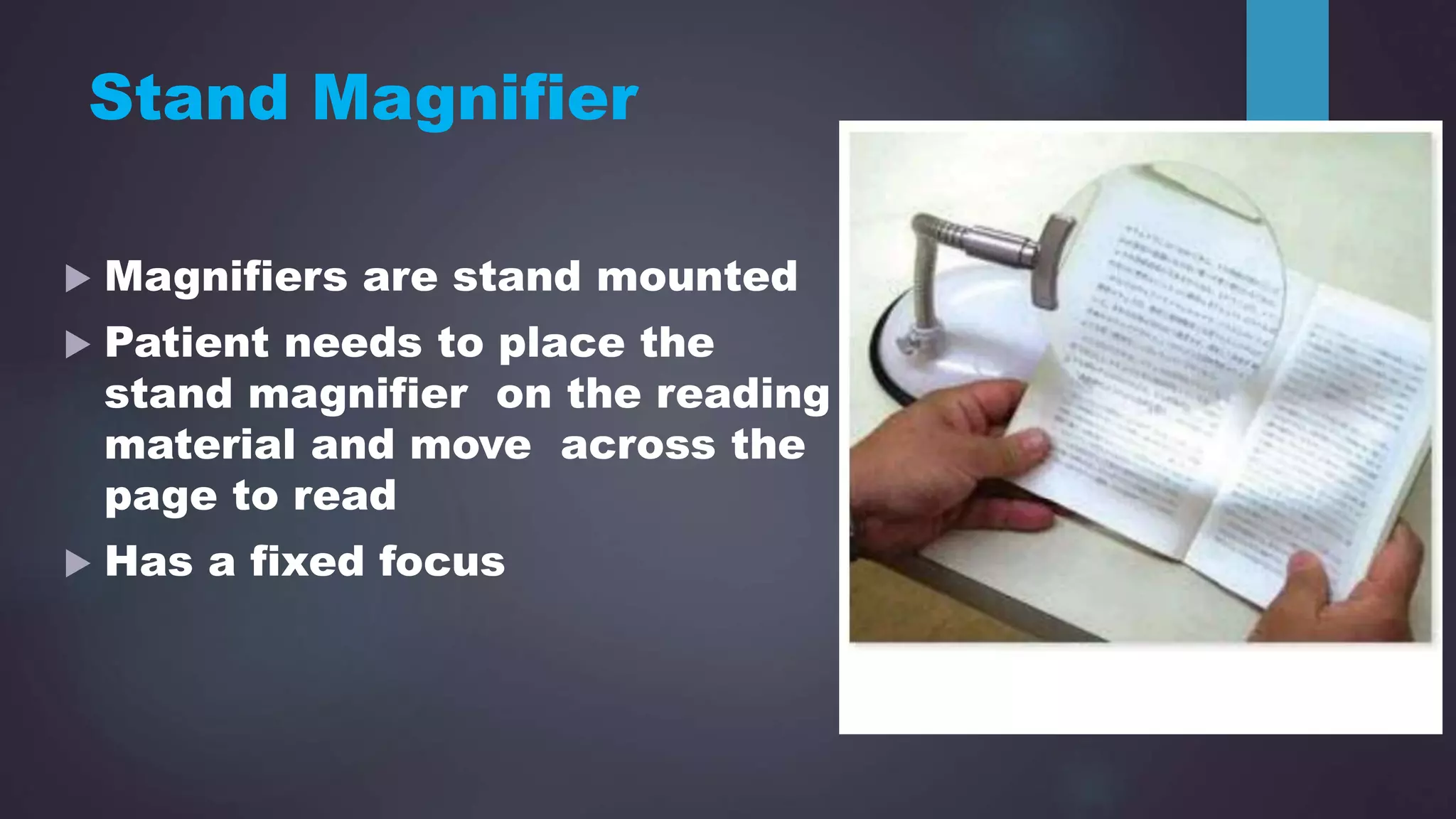
Stand Magnifier
 Magnifiers are stand mounted
 Patient needs to place the
stand magnifier on the reading
material and move across the
page to read
 Has a fixed focus
Types
 Variable focusable stand magnifier :- Have
lenses that can be adjusted closer to or
farther away from the material .
 Fixed focus stand magnifier :- lens at fixed
distance from the base.
Advantages
 Do not have to hold
 Can slide across page
 Constant lens to page distance
 Inexpensive and easily available
Disadvantages
 FOV is reduced or limited
 To close reading posture is uncomfortable for the pt
 Block good lighting unless self illuminated
 Heavy , fatigue problem
Magnifiers Reading glasses
 Allow an individual to read for longer periods of time
 Also called as “microscope”
Advantages
 Wide field of view
 Portable
 Hands are free
Disadvantages
 Holding things very close
Clip-on loupes
 Clip-on loupe attaches to glasses and allow
the person to be hands free while viewing
text , computer screen etc.
Advantage
 Hands are free
 Convenient and easy to use flip
 Inexpensive
Disadvantage
 For larger loupe , they may heavy
 distracting
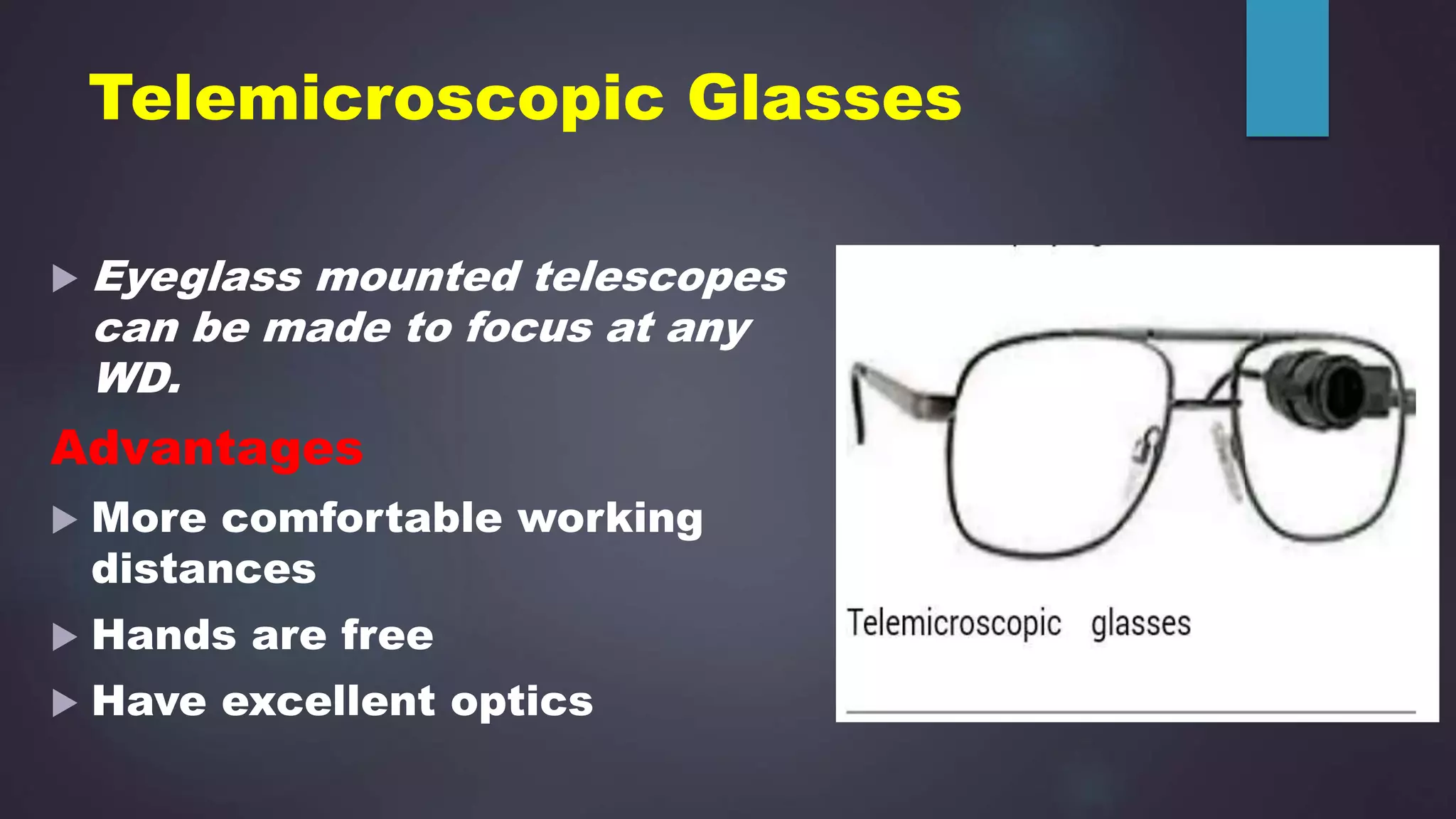
Telemicroscopic Glasses
 Eyeglass mounted telescopes
can be made to focus at any
WD.
Advantages
 More comfortable working
distances
 Hands are free
 Have excellent optics
Disadvantages
 Smaller FOV
 Reading difficulty especially if a book is
heavy ,reading longer period of time
 Image may be some what dark
 Feel heavy on your nose
 Expensive
Electrical devices
CCTV
 An electronic magnification
system for reading and writing
 Consist of 3 major components
camera
monitor
movable reading platform
Contd..
 It provide excellent contrast and magnification ,color .
 Magnification upto 60x .
Advantages
 Provides distortion free ,brighter ,magnified image
with enhanced contrast on a larger screen .
Disadvantages
 Expensive , heavy and difficult move around .
 Difficulty in operation for patient .
Head –mounted Display
 It is display device ,worn
on the head or as a part of
a helmet ,that has a small
display optic in front of
one (monocular HMD) or
each eye(binocular HMD).

Low Vision Devices for Near

  • 1.
    Low Vision DevicesFor Near Presenter Aarju Singh 3rd year B.sc optometry
  • 2.
    Def of LowVision According to WHO :- a person with low vision is one who  Has a impairment of visual functioning even after treatment and /or standard refractive correction  Has a visual acuity less than 6/18 to light perception  Or visual field less than 10 degree from the point of fixation  But who uses , or is potentially able to use, vision for planning and/or execution of a task.
  • 3.
    LOW VISION AIDS Theassistance given to the LV patient to maximize the functional level of vision by optical or non- optical means is called LV aids . The optical device can be used for distance and near .
  • 4.
    Near Optical Devices:- are used for close-up, detail viewing, such as reading, writing, and sewing. It includes :-  Spectacles Magnifier  Magnifiers :- Hand and Stand magnifier  Magnifying reading Glasses  Clip - on loupes  Telemicroscopic Glasses  Electrical devices :- CCTV, HMD
  • 5.
    Spectacle magnifiers  Highplus reading glasses to magnify the images  Given as an add to the best distance refraction  Used for Near work
  • 6.
    Contd…  Amount ofadd needed depends on the accommodation and reading distance  Reading add can be predicted using the kestenbaum rule i.e the amount of add needed to read 1M print is the inverse of VA fraction  However usually greater add is required than predicted as the patient also has reduced contrast sensitivity
  • 7.
    Contd…  If thepatient is monocular ,the poorer eye may be occulded if it improves the functioning  When binocular correction are needed :- base in prism are added to compensate for convergence angle. Optical center may be decentered.  Aspheric lenses may be used to reduce lenticular distortion
  • 8.
    Advantages  Hands arefree  Field of view larger when compared to telescope  Greater reading speed  Can be given in both monocular and binocular forms  More portable  Cosmetically accepatble
  • 9.
    Disadvantages  Higher thepower ,closer the reading distance  Closer reading distances causes fatigue and unacceptable posture  Patient with eccentric fixation are unable to fix through these glasses
  • 10.
    Magnifiers  Useful fornear work  By keeping at near and distance ,we can achieve different magnification Two types :- Hand magnifier Stand magnifier
  • 11.
    Hand magnifiers  Itconsist of a convex lens surrounded by a plastic or metal carrier attached to a handle .  For maximum magnification with hand magnifier place the object at the focal point.  The distance from a hand magnifier to the printed page must be kept constant .
  • 12.
    Contd…  To findthis distance start the lens on the page and slowly pull it away from the print until optimal focus is reached.  It should be used with distance glasses  If the material is brought closer to your eyes , bring the reading material closer as well.  Available from +4.0 to 68.0 D (1x-17x)
  • 13.
     Available designs -Aspheric – reduces thickness and peripheral distortion - Aplantic – flat and wide distortion free field and good clarity. - Bispheric – eliminating aberrations from both surfaces.  Most patients accept upto 6x magnification Contd…
  • 14.
    Advantages  The eyeto lens distance can be varied.  Patient can maintain normal reading distance  Work well with patient with eccentric viewing  Some have light source which further enhances vision  Easily available ,over the counter
  • 15.
    Disadvantage  One handtied up  Difficult to held steady in proper position at all times  Limited FOV ,depends on eye to lens distance  Patient with tremors ,arthritis etc have difficulty holding the magnifier
  • 16.
    Stand Magnifier  Magnifiersare stand mounted  Patient needs to place the stand magnifier on the reading material and move across the page to read  Has a fixed focus
  • 17.
    Types  Variable focusablestand magnifier :- Have lenses that can be adjusted closer to or farther away from the material .  Fixed focus stand magnifier :- lens at fixed distance from the base.
  • 18.
    Advantages  Do nothave to hold  Can slide across page  Constant lens to page distance  Inexpensive and easily available Disadvantages  FOV is reduced or limited  To close reading posture is uncomfortable for the pt  Block good lighting unless self illuminated  Heavy , fatigue problem
  • 19.
    Magnifiers Reading glasses Allow an individual to read for longer periods of time  Also called as “microscope” Advantages  Wide field of view  Portable  Hands are free Disadvantages  Holding things very close
  • 20.
    Clip-on loupes  Clip-onloupe attaches to glasses and allow the person to be hands free while viewing text , computer screen etc. Advantage  Hands are free  Convenient and easy to use flip  Inexpensive Disadvantage  For larger loupe , they may heavy  distracting
  • 22.
    Telemicroscopic Glasses  Eyeglassmounted telescopes can be made to focus at any WD. Advantages  More comfortable working distances  Hands are free  Have excellent optics
  • 23.
    Disadvantages  Smaller FOV Reading difficulty especially if a book is heavy ,reading longer period of time  Image may be some what dark  Feel heavy on your nose  Expensive
  • 24.
    Electrical devices CCTV  Anelectronic magnification system for reading and writing  Consist of 3 major components camera monitor movable reading platform
  • 25.
    Contd..  It provideexcellent contrast and magnification ,color .  Magnification upto 60x . Advantages  Provides distortion free ,brighter ,magnified image with enhanced contrast on a larger screen . Disadvantages  Expensive , heavy and difficult move around .  Difficulty in operation for patient .
  • 26.
    Head –mounted Display It is display device ,worn on the head or as a part of a helmet ,that has a small display optic in front of one (monocular HMD) or each eye(binocular HMD).