MAGNIFICATION
By
RAHUL K.V.
OPTOMETRIST
Magnification is a method of increasing the size of the image
so that enough of the retina is stimulated to send an impulse
through the optic nerve allowing an object to be perceived .
There are a number of different means via which this can be
achieved:
1. Relative Size Magnification
2. Relative distance Magnification
3. Angular Magnification
What is magnification ?
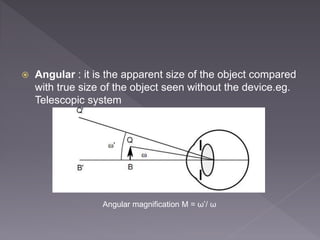
 Angular : it is the apparent size of the object compared
with true size of the object seen without the device.eg.
Telescopic system
Angular magnification M = ω’/ ω
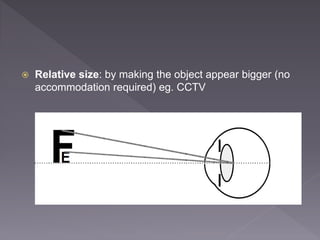
 Relative size: by making the object appear bigger (no
accommodation required) eg. CCTV
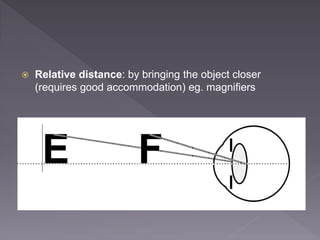
 Relative distance: by bringing the object closer
(requires good accommodation) eg. magnifiers
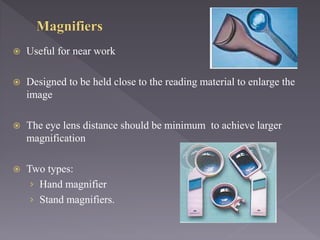
 Useful for near work
 Designed to be held close to the reading material to enlarge the
image
 The eye lens distance should be minimum to achieve larger
magnification
 Two types:
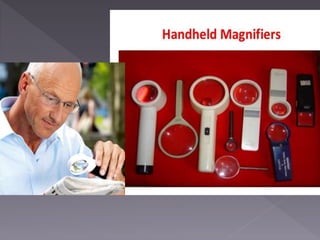
› Hand magnifier
› Stand magnifiers.

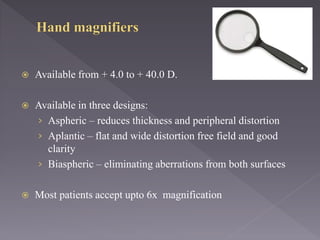
 Available from + 4.0 to + 40.0 D.
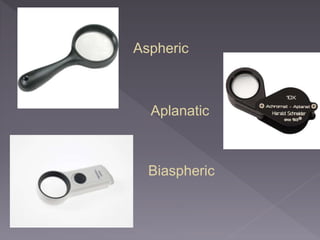
 Available in three designs:
› Aspheric – reduces thickness and peripheral distortion
› Aplantic – flat and wide distortion free field and good
clarity
› Biaspheric – eliminating aberrations from both surfaces
 Most patients accept upto 6x magnification
Aspheric
Biaspheric
Aplanatic
 Advantages
› The eye to lens distance can be varied
› Patient can maintain normal reading distance
› Work well with patients with eccentric viewing
› Some have light source which further enhances vision
› Easily available, over the counter
 Disadvantages:
› It occupies both hands
› Patients with tremors, arthritis etc have difficulty
holding the magnifier
› Maintaining focus is a problem especially for elderly
› Field of vision is limited
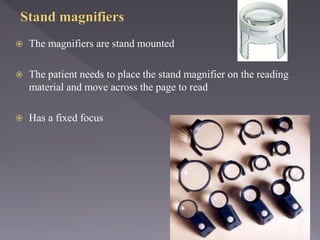
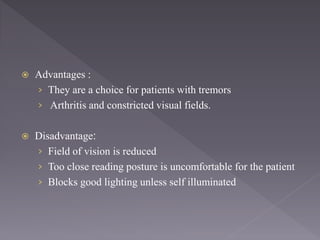
 The magnifiers are stand mounted
 The patient needs to place the stand magnifier on the reading
material and move across the page to read
 Has a fixed focus
 Advantages :
› They are a choice for patients with tremors
› Arthritis and constricted visual fields.
 Disadvantage:
› Field of vision is reduced
› Too close reading posture is uncomfortable for the patient
› Blocks good lighting unless self illuminated
 It is a cylinder reading bar which lies flat on a
page.
 It elongate the letter but does not separate
them
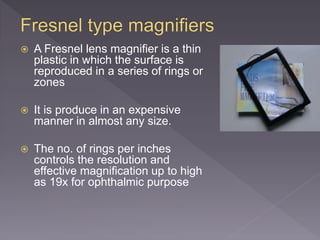
 A Fresnel lens magnifier is a thin
plastic in which the surface is
reproduced in a series of rings or
zones
 It is produce in an expensive
manner in almost any size.
 The no. of rings per inches
controls the resolution and
effective magnification up to high
as 19x for ophthalmic purpose
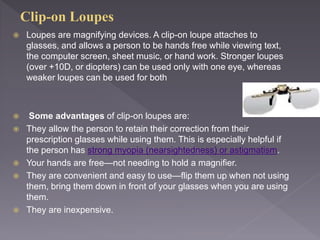
 Loupes are magnifying devices. A clip-on loupe attaches to
glasses, and allows a person to be hands free while viewing text,
the computer screen, sheet music, or hand work. Stronger loupes
(over +10D, or diopters) can be used only with one eye, whereas
weaker loupes can be used for both
 Some advantages of clip-on loupes are:
 They allow the person to retain their correction from their
prescription glasses while using them. This is especially helpful if
the person has strong myopia (nearsightedness) or astigmatism.
 Your hands are free—not needing to hold a magnifier.
 They are convenient and easy to use—flip them up when not using
them, bring them down in front of your glasses when you are using
them.
 They are inexpensive.
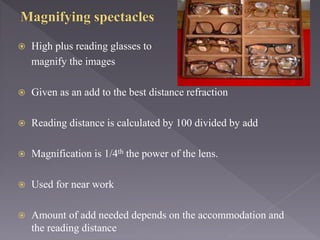
 High plus reading glasses to
magnify the images
 Given as an add to the best distance refraction
 Reading distance is calculated by 100 divided by add
 Magnification is 1/4th the power of the lens.
 Used for near work
 Amount of add needed depends on the accommodation and
the reading distance
 Reading add can be predicted using the Kestenbaum rule
i.e. the amount of add needed to read 1M print is the
inverse of the visual acuity fraction.
 However usually greater add is required than predicted as
the patient also has reduced contrast sensitivity
 If the patient is monocular, the poorer eye may be
occluded if it improves the functioning
 When binocular corrections are needed :
 Base in prisms are added to compensate for convergence angle.
 Optical center may be decent red
 Aspheric lenses may be used to reduce lenticular distortion
 Advantages :
› Hands are free
› Field of view larger when compared to telescope
› Greater reading speed
› Can be given in both monocular and binocular forms
› More portable
› Cosmetically acceptable
 Disadvantages:
› Higher the power, closer the reading distance
› Close reading distance causes fatigue and unacceptable posture
› Patients with eccentric fixation are unable to fix through these glasses
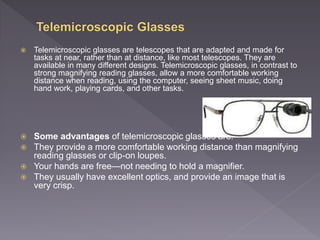
 Telemicroscopic glasses are telescopes that are adapted and made for
tasks at near, rather than at distance, like most telescopes. They are
available in many different designs. Telemicroscopic glasses, in contrast to
strong magnifying reading glasses, allow a more comfortable working
distance when reading, using the computer, seeing sheet music, doing
hand work, playing cards, and other tasks.
 Some advantages of telemicroscopic glasses are:
 They provide a more comfortable working distance than magnifying
reading glasses or clip-on loupes.
 Your hands are free—not needing to hold a magnifier.
 They usually have excellent optics, and provide an image that is
very crisp.
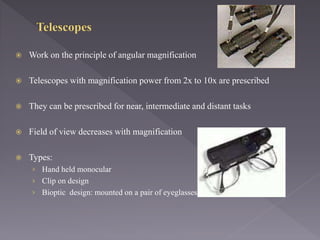
 Work on the principle of angular magnification
 Telescopes with magnification power from 2x to 10x are prescribed
 They can be prescribed for near, intermediate and distant tasks
 Field of view decreases with magnification
 Types:
› Hand held monocular
› Clip on design
› Bioptic design: mounted on a pair of eyeglasses
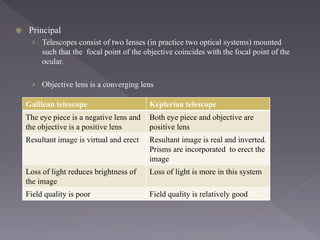
 Principal
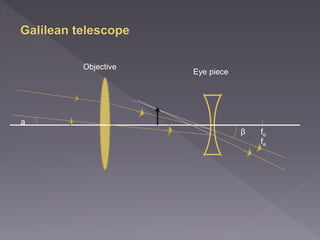
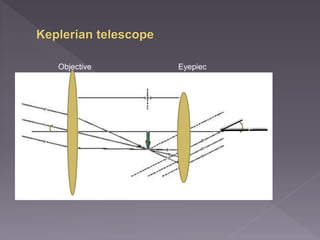
› Telescopes consist of two lenses (in practice two optical systems) mounted
such that the focal point of the objective coincides with the focal point of the
ocular.
› Objective lens is a converging lens
Galilean telescope Keplerian telescope
The eye piece is a negative lens and
the objective is a positive lens
Both eye piece and objective are
positive lens
Resultant image is virtual and erect Resultant image is real and inverted.
Prisms are incorporated to erect the
image
Loss of light reduces brightness of
the image
Loss of light is more in this system
Field quality is poor Field quality is relatively good
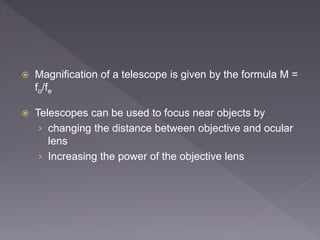
 Magnification of a telescope is given by the formula M =
fo/fe
 Telescopes can be used to focus near objects by
› changing the distance between objective and ocular
lens
› Increasing the power of the objective lens
a
β
Objective
Eye piece
fo
fe
fo fe
α
Objective Eyepiec
e
β
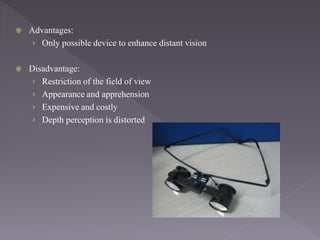
 Advantages:
› Only possible device to enhance distant vision
 Disadvantage:
› Restriction of the field of view
› Appearance and apprehension
› Expensive and costly
› Depth perception is distorted
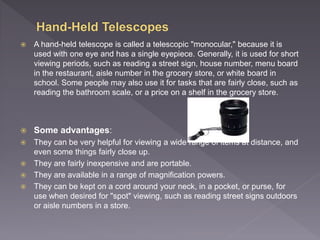
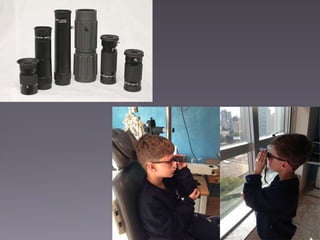
 A hand-held telescope is called a telescopic "monocular," because it is
used with one eye and has a single eyepiece. Generally, it is used for short
viewing periods, such as reading a street sign, house number, menu board
in the restaurant, aisle number in the grocery store, or white board in
school. Some people may also use it for tasks that are fairly close, such as
reading the bathroom scale, or a price on a shelf in the grocery store.
 Some advantages:
 They can be very helpful for viewing a wide range of items at distance, and
even some things fairly close up.
 They are fairly inexpensive and are portable.
 They are available in a range of magnification powers.
 They can be kept on a cord around your neck, in a pocket, or purse, for
use when desired for "spot" viewing, such as reading street signs outdoors
or aisle numbers in a store.
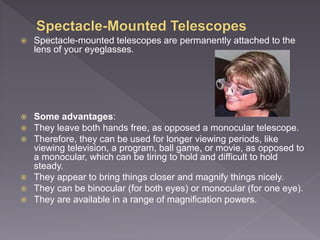
 Spectacle-mounted telescopes are permanently attached to the
lens of your eyeglasses.
 Some advantages:
 They leave both hands free, as opposed a monocular telescope.
 Therefore, they can be used for longer viewing periods, like
viewing television, a program, ball game, or movie, as opposed to
a monocular, which can be tiring to hold and difficult to hold
steady.
 They appear to bring things closer and magnify things nicely.
 They can be binocular (for both eyes) or monocular (for one eye).
 They are available in a range of magnification powers.
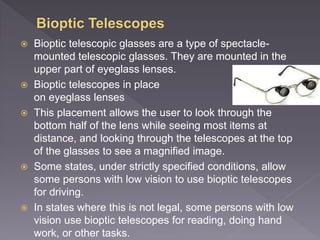
 Bioptic telescopic glasses are a type of spectacle-
mounted telescopic glasses. They are mounted in the
upper part of eyeglass lenses.
 Bioptic telescopes in place
on eyeglass lenses
 This placement allows the user to look through the
bottom half of the lens while seeing most items at
distance, and looking through the telescopes at the top
of the glasses to see a magnified image.
 Some states, under strictly specified conditions, allow
some persons with low vision to use bioptic telescopes
for driving.
 In states where this is not legal, some persons with low
vision use bioptic telescopes for reading, doing hand
work, or other tasks.
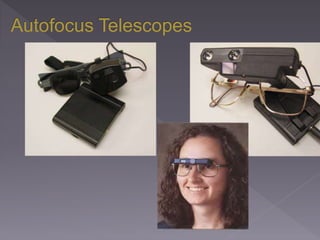
 It allows 3.5X magnification for distance and 4.7X for
reading. It focuses automatically from near to far.
 It is more costly
 It does not constitute the first choice prescription for
children.
 Various forms are available
1. Powers usually available are +4.0, +5.0, +6.0, +10.0 ,
+12.0, +16.0, 20.0 and +24.0
2. Binocular corrections are needed –Base in prisms are
added to compensate for convergence angle.
 Optical quality of the lens should be an aspheric design to
eliminate peripheral aberration and provide reasonable field.
 The reading glass should be prescribed as an addition over
the distance correction.
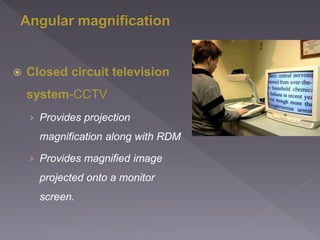
 Closed circuit television
system-CCTV
› Provides projection
magnification along with RDM
› Provides magnified image
projected onto a monitor
screen.
 An electronic magnification system for reading &
writing
 Incorporates both projection & RDM
 consists of three major components:
 camera
monitor
movable reading platform
 Best for pt. Having constricted VF, decreased VA
decreased contrast sensitivity secondary to glaucoma,
RP, ION.
ANY
DOUBT ?
Low vision aids magnification

Low vision aids magnification

  • 1.
  • 3.
    Magnification is amethod of increasing the size of the image so that enough of the retina is stimulated to send an impulse through the optic nerve allowing an object to be perceived . There are a number of different means via which this can be achieved: 1. Relative Size Magnification 2. Relative distance Magnification 3. Angular Magnification What is magnification ?
  • 4.
     Angular :it is the apparent size of the object compared with true size of the object seen without the device.eg. Telescopic system Angular magnification M = ω’/ ω
  • 5.
     Relative size:by making the object appear bigger (no accommodation required) eg. CCTV
  • 6.
     Relative distance:by bringing the object closer (requires good accommodation) eg. magnifiers
  • 8.
     Useful fornear work  Designed to be held close to the reading material to enlarge the image  The eye lens distance should be minimum to achieve larger magnification  Two types: › Hand magnifier › Stand magnifiers.
  • 9.
     Available from+ 4.0 to + 40.0 D.  Available in three designs: › Aspheric – reduces thickness and peripheral distortion › Aplantic – flat and wide distortion free field and good clarity › Biaspheric – eliminating aberrations from both surfaces  Most patients accept upto 6x magnification
  • 10.
  • 12.
     Advantages › Theeye to lens distance can be varied › Patient can maintain normal reading distance › Work well with patients with eccentric viewing › Some have light source which further enhances vision › Easily available, over the counter  Disadvantages: › It occupies both hands › Patients with tremors, arthritis etc have difficulty holding the magnifier › Maintaining focus is a problem especially for elderly › Field of vision is limited
  • 13.
     The magnifiersare stand mounted  The patient needs to place the stand magnifier on the reading material and move across the page to read  Has a fixed focus
  • 14.
     Advantages : ›They are a choice for patients with tremors › Arthritis and constricted visual fields.  Disadvantage: › Field of vision is reduced › Too close reading posture is uncomfortable for the patient › Blocks good lighting unless self illuminated
  • 15.
     It isa cylinder reading bar which lies flat on a page.  It elongate the letter but does not separate them
  • 16.
     A Fresnellens magnifier is a thin plastic in which the surface is reproduced in a series of rings or zones  It is produce in an expensive manner in almost any size.  The no. of rings per inches controls the resolution and effective magnification up to high as 19x for ophthalmic purpose
  • 17.
     Loupes aremagnifying devices. A clip-on loupe attaches to glasses, and allows a person to be hands free while viewing text, the computer screen, sheet music, or hand work. Stronger loupes (over +10D, or diopters) can be used only with one eye, whereas weaker loupes can be used for both  Some advantages of clip-on loupes are:  They allow the person to retain their correction from their prescription glasses while using them. This is especially helpful if the person has strong myopia (nearsightedness) or astigmatism.  Your hands are free—not needing to hold a magnifier.  They are convenient and easy to use—flip them up when not using them, bring them down in front of your glasses when you are using them.  They are inexpensive.
  • 18.
     High plusreading glasses to magnify the images  Given as an add to the best distance refraction  Reading distance is calculated by 100 divided by add  Magnification is 1/4th the power of the lens.  Used for near work  Amount of add needed depends on the accommodation and the reading distance
  • 19.
     Reading addcan be predicted using the Kestenbaum rule i.e. the amount of add needed to read 1M print is the inverse of the visual acuity fraction.  However usually greater add is required than predicted as the patient also has reduced contrast sensitivity  If the patient is monocular, the poorer eye may be occluded if it improves the functioning  When binocular corrections are needed :  Base in prisms are added to compensate for convergence angle.  Optical center may be decent red  Aspheric lenses may be used to reduce lenticular distortion
  • 20.
     Advantages : ›Hands are free › Field of view larger when compared to telescope › Greater reading speed › Can be given in both monocular and binocular forms › More portable › Cosmetically acceptable  Disadvantages: › Higher the power, closer the reading distance › Close reading distance causes fatigue and unacceptable posture › Patients with eccentric fixation are unable to fix through these glasses
  • 21.
     Telemicroscopic glassesare telescopes that are adapted and made for tasks at near, rather than at distance, like most telescopes. They are available in many different designs. Telemicroscopic glasses, in contrast to strong magnifying reading glasses, allow a more comfortable working distance when reading, using the computer, seeing sheet music, doing hand work, playing cards, and other tasks.  Some advantages of telemicroscopic glasses are:  They provide a more comfortable working distance than magnifying reading glasses or clip-on loupes.  Your hands are free—not needing to hold a magnifier.  They usually have excellent optics, and provide an image that is very crisp.
  • 23.
     Work onthe principle of angular magnification  Telescopes with magnification power from 2x to 10x are prescribed  They can be prescribed for near, intermediate and distant tasks  Field of view decreases with magnification  Types: › Hand held monocular › Clip on design › Bioptic design: mounted on a pair of eyeglasses
  • 24.
     Principal › Telescopesconsist of two lenses (in practice two optical systems) mounted such that the focal point of the objective coincides with the focal point of the ocular. › Objective lens is a converging lens Galilean telescope Keplerian telescope The eye piece is a negative lens and the objective is a positive lens Both eye piece and objective are positive lens Resultant image is virtual and erect Resultant image is real and inverted. Prisms are incorporated to erect the image Loss of light reduces brightness of the image Loss of light is more in this system Field quality is poor Field quality is relatively good
  • 25.
     Magnification ofa telescope is given by the formula M = fo/fe  Telescopes can be used to focus near objects by › changing the distance between objective and ocular lens › Increasing the power of the objective lens
  • 26.
  • 27.
  • 28.
     Advantages: › Onlypossible device to enhance distant vision  Disadvantage: › Restriction of the field of view › Appearance and apprehension › Expensive and costly › Depth perception is distorted
  • 29.
     A hand-heldtelescope is called a telescopic "monocular," because it is used with one eye and has a single eyepiece. Generally, it is used for short viewing periods, such as reading a street sign, house number, menu board in the restaurant, aisle number in the grocery store, or white board in school. Some people may also use it for tasks that are fairly close, such as reading the bathroom scale, or a price on a shelf in the grocery store.  Some advantages:  They can be very helpful for viewing a wide range of items at distance, and even some things fairly close up.  They are fairly inexpensive and are portable.  They are available in a range of magnification powers.  They can be kept on a cord around your neck, in a pocket, or purse, for use when desired for "spot" viewing, such as reading street signs outdoors or aisle numbers in a store.
  • 31.
     Spectacle-mounted telescopesare permanently attached to the lens of your eyeglasses.  Some advantages:  They leave both hands free, as opposed a monocular telescope.  Therefore, they can be used for longer viewing periods, like viewing television, a program, ball game, or movie, as opposed to a monocular, which can be tiring to hold and difficult to hold steady.  They appear to bring things closer and magnify things nicely.  They can be binocular (for both eyes) or monocular (for one eye).  They are available in a range of magnification powers.
  • 32.
     Bioptic telescopicglasses are a type of spectacle- mounted telescopic glasses. They are mounted in the upper part of eyeglass lenses.  Bioptic telescopes in place on eyeglass lenses  This placement allows the user to look through the bottom half of the lens while seeing most items at distance, and looking through the telescopes at the top of the glasses to see a magnified image.  Some states, under strictly specified conditions, allow some persons with low vision to use bioptic telescopes for driving.  In states where this is not legal, some persons with low vision use bioptic telescopes for reading, doing hand work, or other tasks.
  • 34.
     It allows3.5X magnification for distance and 4.7X for reading. It focuses automatically from near to far.  It is more costly  It does not constitute the first choice prescription for children.
  • 35.
     Various formsare available 1. Powers usually available are +4.0, +5.0, +6.0, +10.0 , +12.0, +16.0, 20.0 and +24.0 2. Binocular corrections are needed –Base in prisms are added to compensate for convergence angle.  Optical quality of the lens should be an aspheric design to eliminate peripheral aberration and provide reasonable field.  The reading glass should be prescribed as an addition over the distance correction.
  • 36.
     Closed circuittelevision system-CCTV › Provides projection magnification along with RDM › Provides magnified image projected onto a monitor screen.
  • 37.
     An electronicmagnification system for reading & writing  Incorporates both projection & RDM  consists of three major components:  camera monitor movable reading platform  Best for pt. Having constricted VF, decreased VA decreased contrast sensitivity secondary to glaucoma, RP, ION.
  • 38.

Editor's Notes

  • #10 Formula of magnifivcTIION