Visual impairment and low vision
BSEd
Nusrat Zerin
`„wócÖwZeÜxZv
• ‡Pv‡L†`Lvi mgm¨v
• ‡Pv‡Lievwn¨KMVb
• `„wóMZ AvPi‡Y wfbœZvhv ¯^vfvweK weKvkn‡Zwfbœ
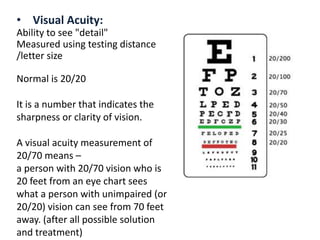
• Visual Acuity:
Ability to see "detail"
Measured using testing distance
/letter size
Normal is 20/20
It is a number that indicates the
sharpness or clarity of vision.
A visual acuity measurement of
20/70 means –
a person with 20/70 vision who is
20 feet from an eye chart sees
what a person with unimpaired (or
20/20) vision can see from 70 feet
away. (after all possible solution
and treatment)
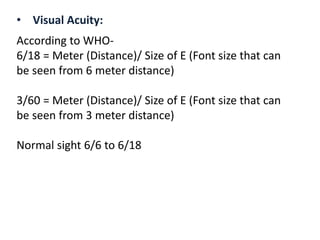
• Visual Acuity:
According to WHO-
6/18 = Meter (Distance)/ Size of E (Font size that can
be seen from 6 meter distance)
3/60 = Meter (Distance)/ Size of E (Font size that can
be seen from 3 meter distance)
Normal sight 6/6 to 6/18
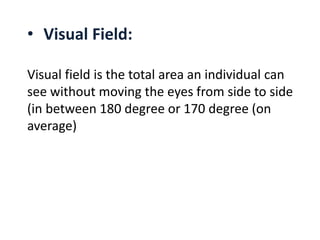
• Visual Field:
Visual field is the total area an individual can
see without moving the eyes from side to side
(in between 180 degree or 170 degree (on
average)
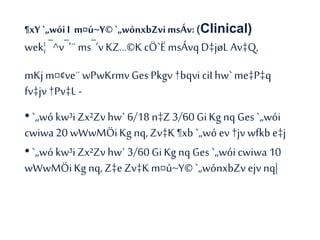
¶xY `„wóiI m¤ú~Y©`„wónxbZvimsÁv:(Clinical)
wek¦ ¯^v¯’¨ ms¯’v KZ…©K cÖ`Ë msÁvqD‡jøL Av‡Q,
mKj m¤¢ve¨wPwKrmvGes Pkgv †bqvi ciI hw`me‡P‡q
fv‡jv†Pv‡L -
• `„wókw³i Zx²Zvhw` 6/18 n‡Z3/60 GiKg nq Ges`„wói
cwiwa20 wWwMÖiKg nq, Zv‡K¶xb `„wó ev†jv wfkb e‡j
• `„wókw³i Zx²Zvhw` 3/60 GiKgnq Ges`„wói cwiwa 10
wWwMÖiKg nq, Z‡e Zv‡Km¤ú~Y© `„wónxbZv ejvnq|
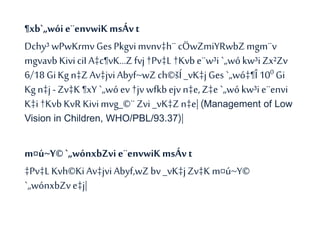
¶xb`„wóie¨envwiK msÁvt
Dchy³ wPwKrmvGes Pkgvimvnv‡h¨ cÖwZmiYRwbZmgm¨v
mgvavbKiviciI A‡c¶vK…Z fvj†Pv‡L †Kvbe¨w³i `„wókw³i Zx²Zv
6/18 GiKgn‡ZAv‡jviAbyf~wZch©šÍ _vK‡jGes`„wó‡¶Î100 Gi
Kg n‡j-Zv‡K ¶xY `„wóev†jv wfkbejv n‡e,Z‡e `„wókw³ie¨envi
K‡i†KvbKvR Kivimvg_©¨Zvi _vK‡Zn‡e| (Management of Low
Vision in Children, WHO/PBL/93.37)|
m¤ú~Y©`„wónxbZvie¨envwiKmsÁvt
‡Pv‡LKvh©KiAv‡jvi Abyf‚wZbv _vK‡jZv‡K m¤ú~Y©
`„wónxbZve‡j|
"Legal blindness" -definition developed by the US govt. to
determine eligibility for vocational training, rehab., schooling,
disability benefits, low vision devices & tax exemption
programs. It's not a functional low vision definition and
doesn't tell us about what a person can and cannot see.
- A visual acuity of 20/200 or less in the better-seeing eye with
best conventional correction
- visual field of 20 degrees or less (also called tunnel vision)
in the better-seeing eye.
Low vision is a condition caused by eye disease, in which
visual acuity is 20/70 or poorer in the better-seeing eye and
cannot be corrected or improved with regular eyeglasses.
দৃষ্টিপ্রষ্টিবষ্টিিা (visual impairment): (cÖwZeÜx e¨w³‡`i AwaKvi I myiÿv AvBb 2013)
ষ্টিম্নবষ্টণিি দফাসমূহে উ‡লjøষ্টিি ববষ্টিিযসমূহের মহযয এক বা একাষ্টযক ববষ্টিহিযর অষ্টযকারী বযষ্টি
,দৃষ্টিপ্রষ্টিবিী বযষ্টি বষ্টলয়া ষ্টবহবষ্টিি েইহবি, যথা:
(ক) সম্পূণি দৃষ্টিেীিিা (blindness):
(অ) উভয় চিাহি এহকবাহরই চদষ্টিহি িা পারা; বা
(আ) যথাযথ চলন্স বযবোহরর পরও দৃষ্টি িীক্ষ্ণিা (visual acuity) ৬/৬০ বা ২০/২০০এর
কম; বা
(ই) দৃষ্টিচেত্র (visual field)২০ষ্টিগ্রী বা উোর িাইহি কম;
(ি) আংষ্টিক দৃষ্টিেীিিা (partial blindness), যথা :− এক চিাহি এহকবাহরই চদষ্টিহি িা পারা;
(গ) ক্ষ্ণীিদৃষ্টি (low vision):
(অ) উভয় চিাহি আংষ্টিক বা কম চদষ্টিহি পারা; বা
(আ) যথাযথ চলন্স বযবোহরর পরও দৃষ্টি িীক্ষ্ণিা (visual acuity) ৬/১৮ বা ২০/৬০এবং
৬/৬০ বা ২০/২০০এর মহযয; বা
(ই) দৃষ্টিচেত্র (visual field)২০ষ্টিগ্রী েইহি ৪০ষ্টিগ্রীর মহযয।
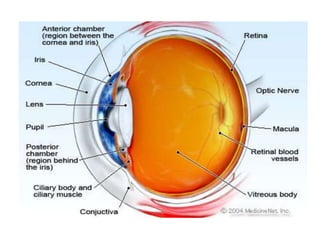
Anatomy of Eye
Outer eye: Eyelid, eyelashes
Inner eye: Eye ball, optic nerve
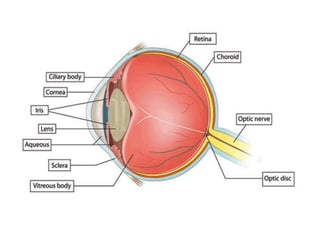
Three different layers of eye:
1. The external layer - Sclera (white
& gives eye it’s shape)
2. The intermediate layer – Choroid
(contains blood vessel)
3. The internal layer - Retina
the sensory part of the eye
The eye has a number of components
1. Sclera
2. choroid
3. Retina
4. Conjunctiva
5. Cornea
6. Iris
7. Pupil
8. Lens
9. Macula
10. optic nerve
11. Vitreous body
12. Aqueous body
13. Optic nerve
Three chambers of fluid:
1. Anterior chamber (between cornea and
iris)
2. Posterior chamber (between iris and
lens)
3. Vitreous chamber (between the lens
and the retina).
The first two chambers are filled with
aqueous humor the vitreous chamber is
filled with a more sticky fluid, the vitreous
humor.
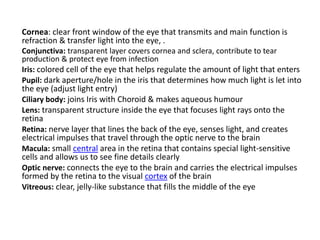
Cornea: clear front window of the eye that transmits and main function is
refraction & transfer light into the eye, .
Conjunctiva: transparent layer covers cornea and sclera, contribute to tear
production & protect eye from infection
Iris: colored cell of the eye that helps regulate the amount of light that enters
Pupil: dark aperture/hole in the iris that determines how much light is let into
the eye (adjust light entry)
Ciliary body: joins Iris with Choroid & makes aqueous humour
Lens: transparent structure inside the eye that focuses light rays onto the
retina
Retina: nerve layer that lines the back of the eye, senses light, and creates
electrical impulses that travel through the optic nerve to the brain
Macula: small central area in the retina that contains special light-sensitive
cells and allows us to see fine details clearly
Optic nerve: connects the eye to the brain and carries the electrical impulses
formed by the retina to the visual cortex of the brain
Vitreous: clear, jelly-like substance that fills the middle of the eye
my¯’¨ †Pv‡Li 6wU wPý ev jÿY
1. †PvLmwVKfv‡e Lyj‡Z I eÜ Ki‡Zcvi‡e;
2. KbRvswUfv ¯^”Q/cwi¯‹vi n‡Zn‡e;
3. KwY©qv ¯^”Q n‡Zn‡e;
4. wcDwcj Kv‡jv, †MvjvKvi Ges `yB †Pv‡LGKB
AvKv‡ii n‡Zn‡e;
5. †Pv‡LibovPov ¯^vfvweK n‡Zn‡e Ges
6. `„wó fvj n‡Zn‡e|
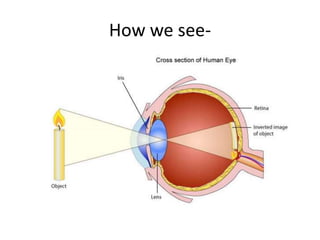
How we see-
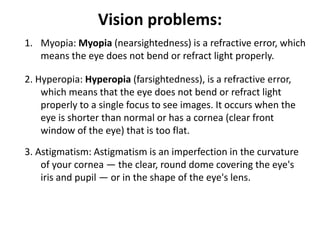
Vision problems:
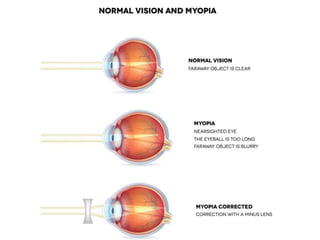
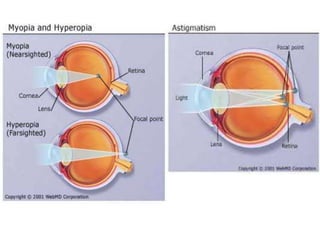
1. Myopia: Myopia (nearsightedness) is a refractive error, which
means the eye does not bend or refract light properly.
2. Hyperopia: Hyperopia (farsightedness), is a refractive error,
which means that the eye does not bend or refract light
properly to a single focus to see images. It occurs when the
eye is shorter than normal or has a cornea (clear front
window of the eye) that is too flat.
3. Astigmatism: Astigmatism is an imperfection in the curvature
of your cornea — the clear, round dome covering the eye's
iris and pupil — or in the shape of the eye's lens.
Causes of vision loss
- Congenital
- Disease (Cataract, vit A deficiency, myopia,
hyperopia, astigmatism, lazy eye, albinism,
Glaucoma, Trachoma, dry eye, diabetic
retinopathy, Retinitis pigmentosa)
- Accidents / trauma
Types of vision loss
• Total blind
• Low vision
Low vision devices:
Tools that help those with vision loss
maximize their remaining vision and these
devices are:
1. Optical
2. Non Optical
3. Electronic devices
Check that each person has been examined to see
if spectacles are needed to correct /improve vision
before recommending low vision devices.
Before selecting a low vision device consider:
• size of objects to be viewed
• possible viewing distance from the object
• length of time needed for activity
• Whether one / both hands are needed for
activity
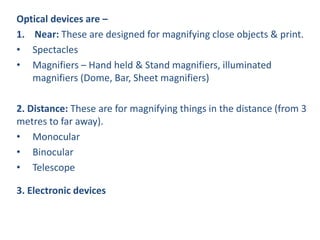
Optical devices are –
1. Near: These are designed for magnifying close
objects & print.
• Spectacles
• Magnifiers – Hand held & Stand magnifiers,
illuminated magnifiers
2. Distance: These are for magnifying things in the
distance (from 3 metres to far away).
• Monocular
• Binocular
• Telescope
3. Electronic devices:
• CCTV or video magnifier
Optical devices are –
1. Near: These are designed for magnifying close objects & print.
• Spectacles
• Magnifiers – Hand held & Stand magnifiers, illuminated
magnifiers (Dome, Bar, Sheet magnifiers)
2. Distance: These are for magnifying things in the distance (from 3
metres to far away).
• Monocular
• Binocular
• Telescope
3. Electronic devices
Optical devices for near tasks
Magnifiers for near tasks can be used for:
• reading a book or a newspaper
• reading labels, signs or prices in shops
• using tools, for example measuring
• threading a needle
• identifying money
• inspecting objects such as plants or insects
For reading, the magnifier has to be moved along each line of
print, sometimes only showing a word or part of a word at a
time. More words will be seen if the eye is held close to the
magnifier. Reading is very slow at first. It is difficult to learn to
use the magnifier properly - a lot of practice is needed.
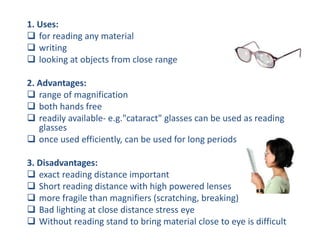
1. Uses:
 for reading any material
 writing
 looking at objects from close range
2. Advantages:
 range of magnification
 both hands free
 readily available- e.g."cataract" glasses can be used as reading
glasses
 once used efficiently, can be used for long periods
3. Disadvantages:
 exact reading distance important
 Short reading distance with high powered lenses
 more fragile than magnifiers (scratching, breaking)
 Bad lighting at close distance stress eye
 Without reading stand to bring material close to eye is difficult
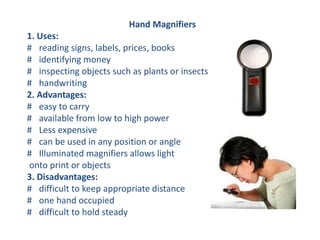
Hand Magnifiers
1. Uses:
# reading signs, labels, prices, books
# identifying money
# inspecting objects such as plants or insects
# handwriting
2. Advantages:
# easy to carry
# available from low to high power
# Less expensive
# can be used in any position or angle
# Illuminated magnifiers allows light
onto print or objects
3. Disadvantages:
# difficult to keep appropriate distance
# one hand occupied
# difficult to hold steady
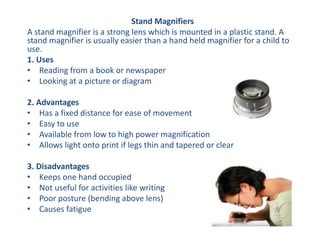
Stand Magnifiers
A stand magnifier is a strong lens which is mounted in a plastic stand. A
stand magnifier is usually easier than a hand held magnifier for a child to
use.
1. Uses
• Reading from a book or newspaper
• Looking at a picture or diagram
2. Advantages
• Has a fixed distance for ease of movement
• Easy to use
• Available from low to high power magnification
• Allows light onto print if legs thin and tapered or clear
3. Disadvantages
• Keeps one hand occupied
• Not useful for activities like writing
• Poor posture (bending above lens)
• Causes fatigue
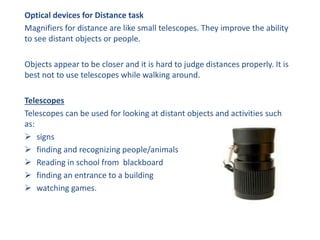
Optical devices for Distance task
Magnifiers for distance are like small telescopes. They improve the ability
to see distant objects or people.
Objects appear to be closer and it is hard to judge distances properly. It is
best not to use telescopes while walking around.
Telescopes
Telescopes can be used for looking at distant objects and activities such
as:
 signs
 finding and recognizing people/animals
 Reading in school from blackboard
 finding an entrance to a building
 watching games.
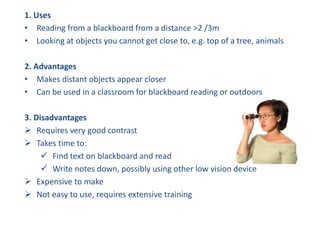
1. Uses
• Reading from a blackboard from a distance >2 /3m
• Looking at objects you cannot get close to, e.g. top of a tree, animals
2. Advantages
• Makes distant objects appear closer
• Can be used in a classroom for blackboard reading or outdoors
3. Disadvantages
 Requires very good contrast
 Takes time to:
 Find text on blackboard and read
 Write notes down, possibly using other low vision device
 Expensive to make
 Not easy to use, requires extensive training
Training to use optical devices
• Encouragement and training are needed for people to use low vision
devices well.
• The field of view or amount through magnifier or telescope is small. It
takes practice to be able to find objects and then follow them or scan
to find other objects.
• For distance tasks it is best to look in the general direction of an object
without the device and then point or place the device in that direction
to locate objects.
• It is easier to scan along horizontal objects such as roads or fences and
up and down vertical objects such as trees or walls.
• Do not just give out magnifying glasses, if there is no one to train the
person in its use. A person will often reject the device, because they
do not know how to see better with it.
Training in the use of all magnifying devices is vital
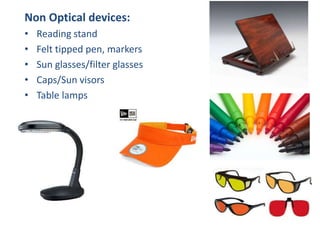
Non Optical devices:
• Reading stand
• Felt tipped pen, markers
• Sun glasses/filter glasses
• Caps/Sun visors
• Table lamps
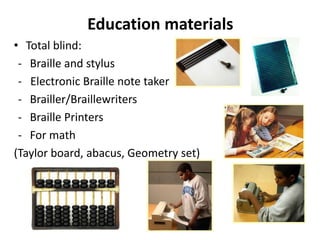
Education materials
• Total blind:
- Braille and stylus
- Electronic Braille note taker
- Brailler/Braillewriters
- Braille Printers
- For math
(Taylor board, abacus, Geometry set)
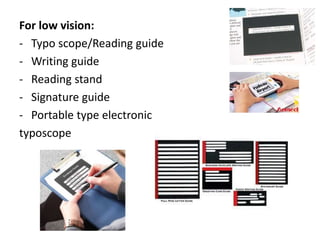
For low vision:
- Typo scope/Reading guide
- Writing guide
- Reading stand
- Signature guide
- Portable type electronic
typoscope
For mobility
• White cane
• Sighted guide technique
• Independent movement technique
• Guide dog
Plus curriculum
• Orientation and mobility
• Sensory training (touch, smell, hear, taste)
• Assistive technology- Computer technology
(screen reader software, magnification
software, JAWS, dolphin, NVDIA etc.)
Visual impairment and low vision

Visual impairment and low vision

  • 1.
    Visual impairment andlow vision BSEd Nusrat Zerin
  • 2.
    `„wócÖwZeÜxZv • ‡Pv‡L†`Lvi mgm¨v •‡Pv‡Lievwn¨KMVb • `„wóMZ AvPi‡Y wfbœZvhv ¯^vfvweK weKvkn‡Zwfbœ
  • 3.
    • Visual Acuity: Abilityto see "detail" Measured using testing distance /letter size Normal is 20/20 It is a number that indicates the sharpness or clarity of vision. A visual acuity measurement of 20/70 means – a person with 20/70 vision who is 20 feet from an eye chart sees what a person with unimpaired (or 20/20) vision can see from 70 feet away. (after all possible solution and treatment)
  • 4.
    • Visual Acuity: Accordingto WHO- 6/18 = Meter (Distance)/ Size of E (Font size that can be seen from 6 meter distance) 3/60 = Meter (Distance)/ Size of E (Font size that can be seen from 3 meter distance) Normal sight 6/6 to 6/18
  • 5.
    • Visual Field: Visualfield is the total area an individual can see without moving the eyes from side to side (in between 180 degree or 170 degree (on average)
  • 6.
    ¶xY `„wóiI m¤ú~Y©`„wónxbZvimsÁv:(Clinical) wek¦¯^v¯’¨ ms¯’v KZ…©K cÖ`Ë msÁvqD‡jøL Av‡Q, mKj m¤¢ve¨wPwKrmvGes Pkgv †bqvi ciI hw`me‡P‡q fv‡jv†Pv‡L - • `„wókw³i Zx²Zvhw` 6/18 n‡Z3/60 GiKg nq Ges`„wói cwiwa20 wWwMÖiKg nq, Zv‡K¶xb `„wó ev†jv wfkb e‡j • `„wókw³i Zx²Zvhw` 3/60 GiKgnq Ges`„wói cwiwa 10 wWwMÖiKg nq, Z‡e Zv‡Km¤ú~Y© `„wónxbZv ejvnq|
  • 7.
    ¶xb`„wóie¨envwiK msÁvt Dchy³ wPwKrmvGesPkgvimvnv‡h¨ cÖwZmiYRwbZmgm¨v mgvavbKiviciI A‡c¶vK…Z fvj†Pv‡L †Kvbe¨w³i `„wókw³i Zx²Zv 6/18 GiKgn‡ZAv‡jviAbyf~wZch©šÍ _vK‡jGes`„wó‡¶Î100 Gi Kg n‡j-Zv‡K ¶xY `„wóev†jv wfkbejv n‡e,Z‡e `„wókw³ie¨envi K‡i†KvbKvR Kivimvg_©¨Zvi _vK‡Zn‡e| (Management of Low Vision in Children, WHO/PBL/93.37)| m¤ú~Y©`„wónxbZvie¨envwiKmsÁvt ‡Pv‡LKvh©KiAv‡jvi Abyf‚wZbv _vK‡jZv‡K m¤ú~Y© `„wónxbZve‡j|
  • 8.
    "Legal blindness" -definitiondeveloped by the US govt. to determine eligibility for vocational training, rehab., schooling, disability benefits, low vision devices & tax exemption programs. It's not a functional low vision definition and doesn't tell us about what a person can and cannot see. - A visual acuity of 20/200 or less in the better-seeing eye with best conventional correction - visual field of 20 degrees or less (also called tunnel vision) in the better-seeing eye. Low vision is a condition caused by eye disease, in which visual acuity is 20/70 or poorer in the better-seeing eye and cannot be corrected or improved with regular eyeglasses.
  • 9.
    দৃষ্টিপ্রষ্টিবষ্টিিা (visual impairment):(cÖwZeÜx e¨w³‡`i AwaKvi I myiÿv AvBb 2013) ষ্টিম্নবষ্টণিি দফাসমূহে উ‡লjøষ্টিি ববষ্টিিযসমূহের মহযয এক বা একাষ্টযক ববষ্টিহিযর অষ্টযকারী বযষ্টি ,দৃষ্টিপ্রষ্টিবিী বযষ্টি বষ্টলয়া ষ্টবহবষ্টিি েইহবি, যথা: (ক) সম্পূণি দৃষ্টিেীিিা (blindness): (অ) উভয় চিাহি এহকবাহরই চদষ্টিহি িা পারা; বা (আ) যথাযথ চলন্স বযবোহরর পরও দৃষ্টি িীক্ষ্ণিা (visual acuity) ৬/৬০ বা ২০/২০০এর কম; বা (ই) দৃষ্টিচেত্র (visual field)২০ষ্টিগ্রী বা উোর িাইহি কম; (ি) আংষ্টিক দৃষ্টিেীিিা (partial blindness), যথা :− এক চিাহি এহকবাহরই চদষ্টিহি িা পারা; (গ) ক্ষ্ণীিদৃষ্টি (low vision): (অ) উভয় চিাহি আংষ্টিক বা কম চদষ্টিহি পারা; বা (আ) যথাযথ চলন্স বযবোহরর পরও দৃষ্টি িীক্ষ্ণিা (visual acuity) ৬/১৮ বা ২০/৬০এবং ৬/৬০ বা ২০/২০০এর মহযয; বা (ই) দৃষ্টিচেত্র (visual field)২০ষ্টিগ্রী েইহি ৪০ষ্টিগ্রীর মহযয।
  • 10.
    Anatomy of Eye Outereye: Eyelid, eyelashes Inner eye: Eye ball, optic nerve
  • 13.
    Three different layersof eye: 1. The external layer - Sclera (white & gives eye it’s shape) 2. The intermediate layer – Choroid (contains blood vessel) 3. The internal layer - Retina the sensory part of the eye
  • 14.
    The eye hasa number of components 1. Sclera 2. choroid 3. Retina 4. Conjunctiva 5. Cornea 6. Iris 7. Pupil 8. Lens 9. Macula 10. optic nerve 11. Vitreous body 12. Aqueous body 13. Optic nerve
  • 15.
    Three chambers offluid: 1. Anterior chamber (between cornea and iris) 2. Posterior chamber (between iris and lens) 3. Vitreous chamber (between the lens and the retina). The first two chambers are filled with aqueous humor the vitreous chamber is filled with a more sticky fluid, the vitreous humor.
  • 17.
    Cornea: clear frontwindow of the eye that transmits and main function is refraction & transfer light into the eye, . Conjunctiva: transparent layer covers cornea and sclera, contribute to tear production & protect eye from infection Iris: colored cell of the eye that helps regulate the amount of light that enters Pupil: dark aperture/hole in the iris that determines how much light is let into the eye (adjust light entry) Ciliary body: joins Iris with Choroid & makes aqueous humour Lens: transparent structure inside the eye that focuses light rays onto the retina Retina: nerve layer that lines the back of the eye, senses light, and creates electrical impulses that travel through the optic nerve to the brain Macula: small central area in the retina that contains special light-sensitive cells and allows us to see fine details clearly Optic nerve: connects the eye to the brain and carries the electrical impulses formed by the retina to the visual cortex of the brain Vitreous: clear, jelly-like substance that fills the middle of the eye
  • 18.
    my¯’¨ †Pv‡Li 6wUwPý ev jÿY 1. †PvLmwVKfv‡e Lyj‡Z I eÜ Ki‡Zcvi‡e; 2. KbRvswUfv ¯^”Q/cwi¯‹vi n‡Zn‡e; 3. KwY©qv ¯^”Q n‡Zn‡e; 4. wcDwcj Kv‡jv, †MvjvKvi Ges `yB †Pv‡LGKB AvKv‡ii n‡Zn‡e; 5. †Pv‡LibovPov ¯^vfvweK n‡Zn‡e Ges 6. `„wó fvj n‡Zn‡e|
  • 19.
  • 20.
    Vision problems: 1. Myopia:Myopia (nearsightedness) is a refractive error, which means the eye does not bend or refract light properly. 2. Hyperopia: Hyperopia (farsightedness), is a refractive error, which means that the eye does not bend or refract light properly to a single focus to see images. It occurs when the eye is shorter than normal or has a cornea (clear front window of the eye) that is too flat. 3. Astigmatism: Astigmatism is an imperfection in the curvature of your cornea — the clear, round dome covering the eye's iris and pupil — or in the shape of the eye's lens.
  • 23.
    Causes of visionloss - Congenital - Disease (Cataract, vit A deficiency, myopia, hyperopia, astigmatism, lazy eye, albinism, Glaucoma, Trachoma, dry eye, diabetic retinopathy, Retinitis pigmentosa) - Accidents / trauma
  • 24.
    Types of visionloss • Total blind • Low vision
  • 25.
    Low vision devices: Toolsthat help those with vision loss maximize their remaining vision and these devices are: 1. Optical 2. Non Optical 3. Electronic devices
  • 26.
    Check that eachperson has been examined to see if spectacles are needed to correct /improve vision before recommending low vision devices. Before selecting a low vision device consider: • size of objects to be viewed • possible viewing distance from the object • length of time needed for activity • Whether one / both hands are needed for activity
  • 27.
    Optical devices are– 1. Near: These are designed for magnifying close objects & print. • Spectacles • Magnifiers – Hand held & Stand magnifiers, illuminated magnifiers 2. Distance: These are for magnifying things in the distance (from 3 metres to far away). • Monocular • Binocular • Telescope 3. Electronic devices: • CCTV or video magnifier
  • 28.
    Optical devices are– 1. Near: These are designed for magnifying close objects & print. • Spectacles • Magnifiers – Hand held & Stand magnifiers, illuminated magnifiers (Dome, Bar, Sheet magnifiers) 2. Distance: These are for magnifying things in the distance (from 3 metres to far away). • Monocular • Binocular • Telescope 3. Electronic devices
  • 29.
    Optical devices fornear tasks Magnifiers for near tasks can be used for: • reading a book or a newspaper • reading labels, signs or prices in shops • using tools, for example measuring • threading a needle • identifying money • inspecting objects such as plants or insects For reading, the magnifier has to be moved along each line of print, sometimes only showing a word or part of a word at a time. More words will be seen if the eye is held close to the magnifier. Reading is very slow at first. It is difficult to learn to use the magnifier properly - a lot of practice is needed.
  • 30.
    1. Uses:  forreading any material  writing  looking at objects from close range 2. Advantages:  range of magnification  both hands free  readily available- e.g."cataract" glasses can be used as reading glasses  once used efficiently, can be used for long periods 3. Disadvantages:  exact reading distance important  Short reading distance with high powered lenses  more fragile than magnifiers (scratching, breaking)  Bad lighting at close distance stress eye  Without reading stand to bring material close to eye is difficult
  • 31.
    Hand Magnifiers 1. Uses: #reading signs, labels, prices, books # identifying money # inspecting objects such as plants or insects # handwriting 2. Advantages: # easy to carry # available from low to high power # Less expensive # can be used in any position or angle # Illuminated magnifiers allows light onto print or objects 3. Disadvantages: # difficult to keep appropriate distance # one hand occupied # difficult to hold steady
  • 32.
    Stand Magnifiers A standmagnifier is a strong lens which is mounted in a plastic stand. A stand magnifier is usually easier than a hand held magnifier for a child to use. 1. Uses • Reading from a book or newspaper • Looking at a picture or diagram 2. Advantages • Has a fixed distance for ease of movement • Easy to use • Available from low to high power magnification • Allows light onto print if legs thin and tapered or clear 3. Disadvantages • Keeps one hand occupied • Not useful for activities like writing • Poor posture (bending above lens) • Causes fatigue
  • 33.
    Optical devices forDistance task Magnifiers for distance are like small telescopes. They improve the ability to see distant objects or people. Objects appear to be closer and it is hard to judge distances properly. It is best not to use telescopes while walking around. Telescopes Telescopes can be used for looking at distant objects and activities such as:  signs  finding and recognizing people/animals  Reading in school from blackboard  finding an entrance to a building  watching games.
  • 34.
    1. Uses • Readingfrom a blackboard from a distance >2 /3m • Looking at objects you cannot get close to, e.g. top of a tree, animals 2. Advantages • Makes distant objects appear closer • Can be used in a classroom for blackboard reading or outdoors 3. Disadvantages  Requires very good contrast  Takes time to:  Find text on blackboard and read  Write notes down, possibly using other low vision device  Expensive to make  Not easy to use, requires extensive training
  • 35.
    Training to useoptical devices • Encouragement and training are needed for people to use low vision devices well. • The field of view or amount through magnifier or telescope is small. It takes practice to be able to find objects and then follow them or scan to find other objects. • For distance tasks it is best to look in the general direction of an object without the device and then point or place the device in that direction to locate objects. • It is easier to scan along horizontal objects such as roads or fences and up and down vertical objects such as trees or walls. • Do not just give out magnifying glasses, if there is no one to train the person in its use. A person will often reject the device, because they do not know how to see better with it. Training in the use of all magnifying devices is vital
  • 36.
    Non Optical devices: •Reading stand • Felt tipped pen, markers • Sun glasses/filter glasses • Caps/Sun visors • Table lamps
  • 37.
    Education materials • Totalblind: - Braille and stylus - Electronic Braille note taker - Brailler/Braillewriters - Braille Printers - For math (Taylor board, abacus, Geometry set)
  • 38.
    For low vision: -Typo scope/Reading guide - Writing guide - Reading stand - Signature guide - Portable type electronic typoscope
  • 39.
    For mobility • Whitecane • Sighted guide technique • Independent movement technique • Guide dog
  • 40.
    Plus curriculum • Orientationand mobility • Sensory training (touch, smell, hear, taste) • Assistive technology- Computer technology (screen reader software, magnification software, JAWS, dolphin, NVDIA etc.)