LONG TERM
               EVOLUTION(LTE)

                                       NIGEL THOMAS
                                                S7-B
                                          ROLL NO: 23
                 COLLEGE OF ENGINEERING CHENGANNUR


SEMINAR-2010
CONTENTS
                     2


 INTRODUCTION
 EVOLUTION   OF LTE
 FEATURES OF LTE
 TECHONOGIES USED IN LTE
 LTE / SAE ARCHITECTURE
 FUTURE SCOPE
 CONCLUSION
 REFERENCES

SEMINAR-2010
INTRODUCTION
                        3


 LTE- LATEST MOBILE BROADBAND TECHNOLOGY
 3RD GENERATION PARTNERSHIP PROJECT (3GPP)
 LTE IS ONLY 3.9G
 NETWORK DEPLOYED IN DECEMBER 2009 BY
  TELIASONERA
 HI-SPEED INTERNET ON THE MOVE!!!


SEMINAR-2010
EVOLUTION OF LTE
                      4


SEMINAR-2010
FEATURES OF LONG TERM EVOLUTION
                               5


 DOWNLINK SPEED : 100 Mbps
 UPLINK SPEED : 50 Mbps
 LATENCY : less than 10 ms
 MOBILITY : upto 360 km/hr
 CELL SIZE (Range) : upto 100 km
 BANDWIDTH : 1.4, 3, 5, 10, 15, 20 MHz
 Co-existent with legacy 3GPP and non-3GPP networks
 Flat , All–IP Architecture
 Low CAPEX and OPEX

SEMINAR-2010
TECHNOLOGIES USED IN LTE
                          6

OFDMA–Orthogonal Frequency Division Multiple Access


SEMINAR-2010
OFDMA contd…
                                  7


Features of OFDMA
 Robust to narrow band co-channel interference
 Helps in QoS and better system spectral efficiency
 Modulation Schemes: QPSK, 16QAM, 64QAM
Advantages of OFDMA
 Multi-user Diversity: allows different users to transmit over
  different portions of the spectrum
 Efficient use of spectrum
 Receiver Simplicity- only FFT processor required
Drawback of OFDMA
High Peak to Average Power Ratio(PAPR)
SEMINAR-2010
SC-FDMA (Single Carrier FDMA)
                                8

 SC-FDMA is DFT-Spread OFDMA scheme.
 It has low Peak to Average Power Ratio (PAPR), hence used as
  up-link access scheme.
 Helps in increasing cell size.
 Modulation Schemes: QPSK, 16QAM


Transmitter and Receiver
Structure of SC-FDMA


SEMINAR-2010
MIMO (Multiple Input Multiple Output) Antenna
                                9

Aims:
• To improve SNR
• To Share SNR
Types of Transmission:
• Spatial Multiplexing
• Transmit Diversity
• Closed Loop- Linear pre-
coding and Rank Adaptation
Benefits: Increased Capacity,
Coverage and Cell throughput

SEMINAR-2010
LTE/SAE Architecture
                                    10

                 MME/UPE           MME/UPE
                                                        EPC
      S1


                             X2
                                                        E-UTRAN
               eNB                       eNB
                     X2
                                  X2

                           eNB
      MME/UPE = Mobility Management Entity/User Plane Entity
      eNB = eNodeB
      EPC = Evolved Packet Core
      E-UTRAN= Evolved Universal Terrestrial Access Network

SEMINAR-2010
11


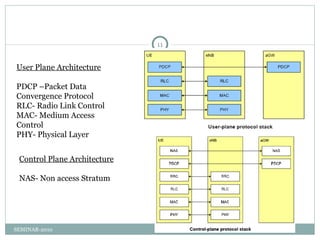
User Plane Architecture

PDCP –Packet Data
Convergence Protocol
RLC- Radio Link Control
MAC- Medium Access
Control
PHY- Physical Layer


 Control Plane Architecture

 NAS- Non access Stratum


SEMINAR-2010
FUTURE SCOPE
                            12


 LTE Advanced = 4G
 Global standard of Communication
 Inter-Appliance communication i.e.
communication between electronic
appliances.
 Voice + Data = 4G


SEMINAR-2010
CONCLUSION
                              13

3GPP Long Term Evolution achieves the lightning speed of
 access, it’s robustness to interference and the high Quality
 of Service meeting its performance targets using the
 following technologies, i.e., OFDMA, SC-FDMA, MIMO
 Antenna, and the simpler E-UTRAN LTE/SAE
 Architecture.
LTE provides a good foundation in achieving the IMT-
 Advanced/4G specifications by evolving into the LTE
 Advanced Technology.


SEMINAR-2010
REFERENCES
                               14

[1.]David Astély, Erik Dahlman, Anders Furuskär, Ylva Jading,
  Magnus Lindström, and Stefan Parkvall, LTE: The Evolution of
  Mobile Broadband, IEEE Communications Magazine, April
  2009, Vol. 47, no. 4, pp. 44 – 51.
[2.] Mamoru Sawahashi, Yoshihisa Kishiyama, Hidekazu Taoka,
  Motohiro Tanno, and Takehiro Nakamura, Broadband Radio
  Access: LTE and LTE-Advanced, International Symposium on
  Intelligent Signal Processing and Communication Systems
  (ISPACS 2009), Dec. 2009, pp. 224-227.
[3.] www.3gpp.org/lte (accessed on 12/08/2010)
[4.] http://en.wikipedia.org/wiki/3GPP_Long_Term_Evolution
  (accessed on 12/08/2010)
SEMINAR-2010
SEMINAR-2010   15

Long term evolution

  • 1.
    LONG TERM EVOLUTION(LTE) NIGEL THOMAS S7-B ROLL NO: 23 COLLEGE OF ENGINEERING CHENGANNUR SEMINAR-2010
  • 2.
    CONTENTS 2  INTRODUCTION  EVOLUTION OF LTE  FEATURES OF LTE  TECHONOGIES USED IN LTE  LTE / SAE ARCHITECTURE  FUTURE SCOPE  CONCLUSION  REFERENCES SEMINAR-2010
  • 3.
    INTRODUCTION 3  LTE- LATEST MOBILE BROADBAND TECHNOLOGY  3RD GENERATION PARTNERSHIP PROJECT (3GPP)  LTE IS ONLY 3.9G  NETWORK DEPLOYED IN DECEMBER 2009 BY TELIASONERA  HI-SPEED INTERNET ON THE MOVE!!! SEMINAR-2010
  • 4.
    EVOLUTION OF LTE 4 SEMINAR-2010
  • 5.
    FEATURES OF LONGTERM EVOLUTION 5  DOWNLINK SPEED : 100 Mbps  UPLINK SPEED : 50 Mbps  LATENCY : less than 10 ms  MOBILITY : upto 360 km/hr  CELL SIZE (Range) : upto 100 km  BANDWIDTH : 1.4, 3, 5, 10, 15, 20 MHz  Co-existent with legacy 3GPP and non-3GPP networks  Flat , All–IP Architecture  Low CAPEX and OPEX SEMINAR-2010
  • 6.
    TECHNOLOGIES USED INLTE 6 OFDMA–Orthogonal Frequency Division Multiple Access SEMINAR-2010
  • 7.
    OFDMA contd… 7 Features of OFDMA  Robust to narrow band co-channel interference  Helps in QoS and better system spectral efficiency  Modulation Schemes: QPSK, 16QAM, 64QAM Advantages of OFDMA  Multi-user Diversity: allows different users to transmit over different portions of the spectrum  Efficient use of spectrum  Receiver Simplicity- only FFT processor required Drawback of OFDMA High Peak to Average Power Ratio(PAPR) SEMINAR-2010
  • 8.
    SC-FDMA (Single CarrierFDMA) 8  SC-FDMA is DFT-Spread OFDMA scheme.  It has low Peak to Average Power Ratio (PAPR), hence used as up-link access scheme.  Helps in increasing cell size.  Modulation Schemes: QPSK, 16QAM Transmitter and Receiver Structure of SC-FDMA SEMINAR-2010
  • 9.
    MIMO (Multiple InputMultiple Output) Antenna 9 Aims: • To improve SNR • To Share SNR Types of Transmission: • Spatial Multiplexing • Transmit Diversity • Closed Loop- Linear pre- coding and Rank Adaptation Benefits: Increased Capacity, Coverage and Cell throughput SEMINAR-2010
  • 10.
    LTE/SAE Architecture 10 MME/UPE MME/UPE EPC S1 X2 E-UTRAN eNB eNB X2 X2 eNB MME/UPE = Mobility Management Entity/User Plane Entity eNB = eNodeB EPC = Evolved Packet Core E-UTRAN= Evolved Universal Terrestrial Access Network SEMINAR-2010
  • 11.
    11 User Plane Architecture PDCP–Packet Data Convergence Protocol RLC- Radio Link Control MAC- Medium Access Control PHY- Physical Layer Control Plane Architecture NAS- Non access Stratum SEMINAR-2010
  • 12.
    FUTURE SCOPE 12  LTE Advanced = 4G  Global standard of Communication  Inter-Appliance communication i.e. communication between electronic appliances.  Voice + Data = 4G SEMINAR-2010
  • 13.
    CONCLUSION 13 3GPP Long Term Evolution achieves the lightning speed of access, it’s robustness to interference and the high Quality of Service meeting its performance targets using the following technologies, i.e., OFDMA, SC-FDMA, MIMO Antenna, and the simpler E-UTRAN LTE/SAE Architecture. LTE provides a good foundation in achieving the IMT- Advanced/4G specifications by evolving into the LTE Advanced Technology. SEMINAR-2010
  • 14.
    REFERENCES 14 [1.]David Astély, Erik Dahlman, Anders Furuskär, Ylva Jading, Magnus Lindström, and Stefan Parkvall, LTE: The Evolution of Mobile Broadband, IEEE Communications Magazine, April 2009, Vol. 47, no. 4, pp. 44 – 51. [2.] Mamoru Sawahashi, Yoshihisa Kishiyama, Hidekazu Taoka, Motohiro Tanno, and Takehiro Nakamura, Broadband Radio Access: LTE and LTE-Advanced, International Symposium on Intelligent Signal Processing and Communication Systems (ISPACS 2009), Dec. 2009, pp. 224-227. [3.] www.3gpp.org/lte (accessed on 12/08/2010) [4.] http://en.wikipedia.org/wiki/3GPP_Long_Term_Evolution (accessed on 12/08/2010) SEMINAR-2010
  • 15.