What is 4G?What is 4G?
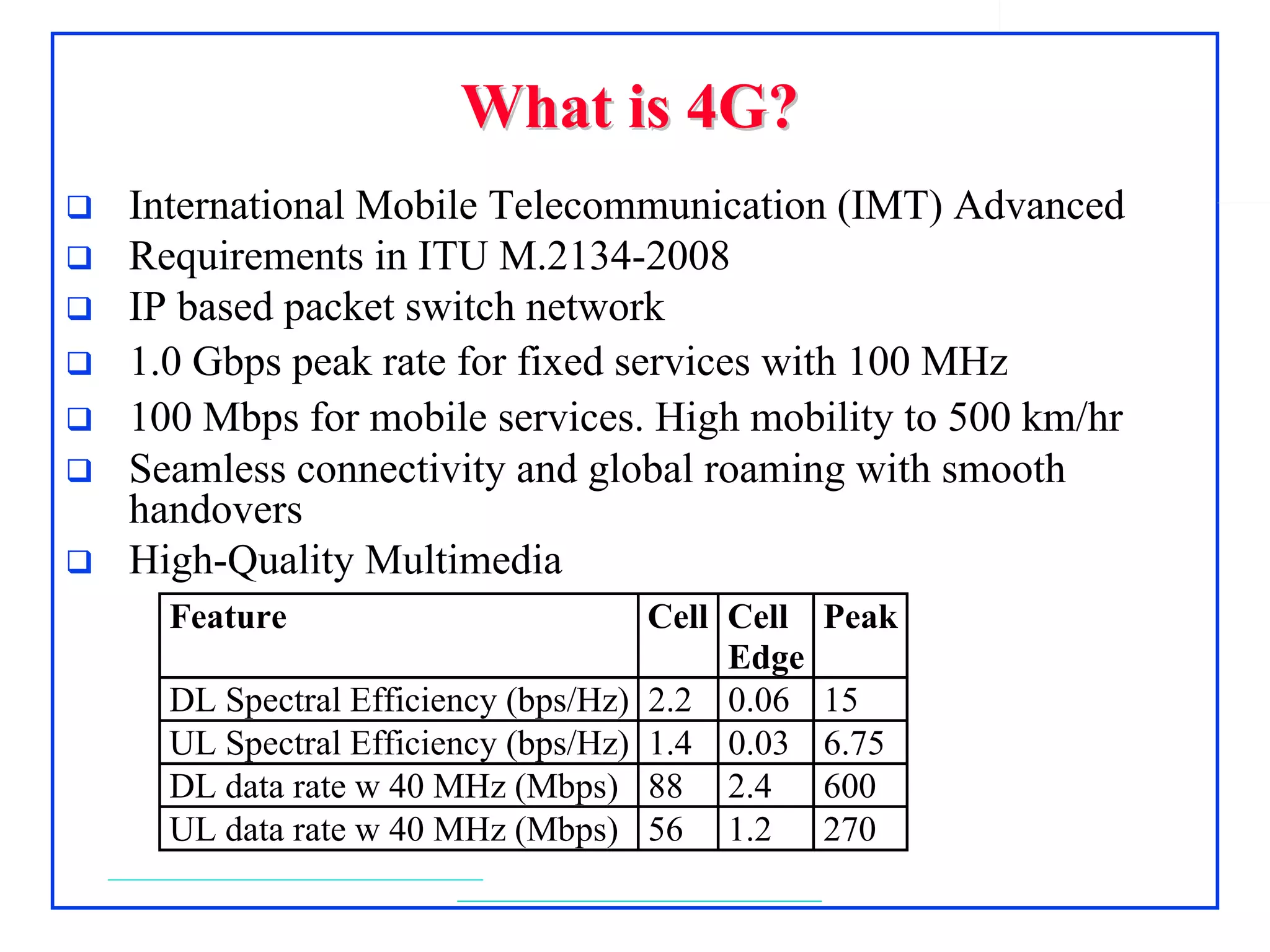
 International Mobile Telecommunication (IMT) Advanced
 Requirements in ITU M.2134-2008
 IP based packet switch network
 1.0 Gbps peak rate for fixed services with 100 MHz
 100 Mbps for mobile services. High mobility to 500 km/hr
 Seamless connectivity and global roaming with smooth
handovers
 High-Quality Multimedia
Feature Cell Cell
Edge
Peak
DL Spectral Efficiency (bps/Hz) 2.2 0.06 15
UL Spectral Efficiency (bps/Hz) 1.4 0.03 6.75
DL data rate w 40 MHz (Mbps) 88 2.4 600
UL data rate w 40 MHz (Mbps) 56 1.2 270
4G Technologies4G Technologies
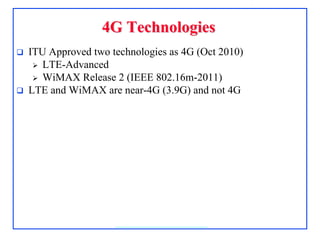
 ITU Approved two technologies as 4G (Oct 2010)
 LTE-Advanced
 WiMAX Release 2 (IEEE 802.16m-2011)
 LTE and WiMAX are near-4G (3.9G) and not 4G
LTE: Key FeaturesLTE: Key Features
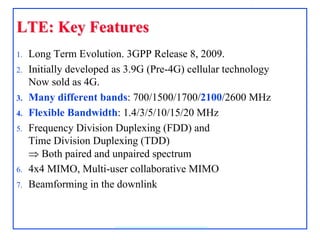
1. Long Term Evolution. 3GPP Release 8, 2009.
2. Initially developed as 3.9G (Pre-4G) cellular technology
Now sold as 4G.
3. Many different bands: 700/1500/1700/2100/2600 MHz
4. Flexible Bandwidth: 1.4/3/5/10/15/20 MHz
5. Frequency Division Duplexing (FDD) and
Time Division Duplexing (TDD)
 Both paired and unpaired spectrum
6. 4x4 MIMO, Multi-user collaborative MIMO
7. Beamforming in the downlink
LTE: Key Features (Cont)LTE: Key Features (Cont)
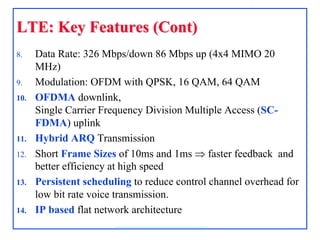
8. Data Rate: 326 Mbps/down 86 Mbps up (4x4 MIMO 20
MHz)
9. Modulation: OFDM with QPSK, 16 QAM, 64 QAM
10. OFDMA downlink,
Single Carrier Frequency Division Multiple Access (SC-
FDMA) uplink
11. Hybrid ARQ Transmission
12. Short Frame Sizes of 10ms and 1ms  faster feedback and
better efficiency at high speed
13. Persistent scheduling to reduce control channel overhead for
low bit rate voice transmission.
14. IP based flat network architecture
CDMA vs. OFDMACDMA vs. OFDMA
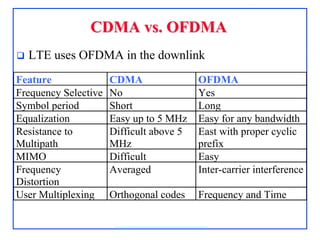
 LTE uses OFDMA in the downlink
Feature CDMA OFDMA
Frequency Selective No Yes
Symbol period Short Long
Equalization Easy up to 5 MHz Easy for any bandwidth
Resistance to
Multipath
Difficult above 5
MHz
East with proper cyclic
prefix
MIMO Difficult Easy
Frequency
Distortion
Averaged Inter-carrier interference
User Multiplexing Orthogonal codes Frequency and Time
SCSC--FDMAFDMA
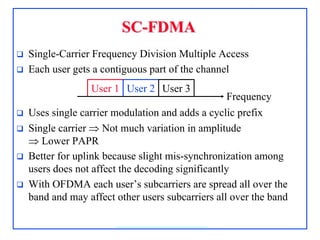
 Single-Carrier Frequency Division Multiple Access
 Each user gets a contiguous part of the channel
 Uses single carrier modulation and adds a cyclic prefix
 Single carrier  Not much variation in amplitude
 Lower PAPR
 Better for uplink because slight mis-synchronization among
users does not affect the decoding significantly
 With OFDMA each user’s subcarriers are spread all over the
band and may affect other users subcarriers all over the band
User 1 User 2 User 3
Frequency
SCSC--FDMAFDMA
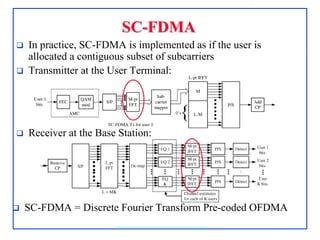
 In practice, SC-FDMA is implemented as if the user is
allocated a contiguous subset of subcarriers
 Transmitter at the User Terminal:
 SC-FDMA = Discrete Fourier Transform Pre-coded OFDMA
 Receiver at the Base Station:
OFDMA UplinkOFDMA Uplink
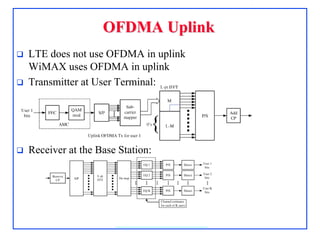
 LTE does not use OFDMA in uplink
WiMAX uses OFDMA in uplink
 Transmitter at User Terminal:
 Receiver at the Base Station:
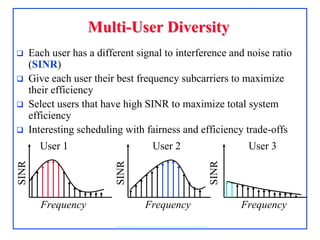
MultiMulti--User DiversityUser Diversity
 Each user has a different signal to interference and noise ratio
(SINR)
 Give each user their best frequency subcarriers to maximize
their efficiency
 Select users that have high SINR to maximize total system
efficiency
 Interesting scheduling with fairness and efficiency trade-offs
Frequency Frequency
User 1 User 2
SINR
SINR
Frequency
User 3
SINR
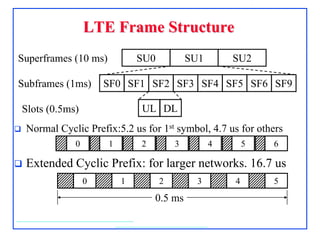
LTE Frame StructureLTE Frame Structure
SU0 SU1 SU2Superframes (10 ms)
SF0 SF1 SF2 SF3 SF4 SF5 SF6 SF9Subframes (1ms)
UL DLSlots (0.5ms)
0 1 2 3 4 5 6
 Normal Cyclic Prefix:5.2 us for 1st symbol, 4.7 us for others
 Extended Cyclic Prefix: for larger networks. 16.7 us
0 1 2 3 4 5
0.5 ms
SummarySummary
1. 4G IMT-Advanced requires 1 Gbps with 100 MHz for fixed
services and 100 Mbps for mobile services.WiMAX and LTE
are pre-4G technologies. Their next generations will be 4G.
2. WiMAX and LTE have numerous common features: Many
bands, flexible bandwidth, FDD/TDD. MIMO/Beamforming
H-ARQ, IP-Based, OFDMA. The key differentiator is SC-
FDMA for uplink in LTE to reduce PAPR.
3. Puncturing allows some ECC bits to be not transmitting.
This is used in H-ARQ to send extra bits only if necessary.
4. STBC requires transmitting redundant symbols from multiple
antenna. SFBC require that these redundant symbols be sent
on different subcarriers.
5. LTE protocol stack consists of RRC, PDCP for header
compression and encryption, RLC for segmentation and
reassembly, and MAC for transmission scheduling.
AcronymsAcronyms
 3GPP 3rd Generation Partnership Project
 ARQ Automatic Repeat Request
 BPSK Binary Phase Shift Keying
 BS Base Station
 BSC Base Station Controller
 BTS Base Transceiver Station
 CDMA Code Division Multiple Access
 CFI Control Format Indicator
 CS Circuit Switched
 DCI Downlink Control Information
 DL Downlink
 DVB-H Digital Video Broadcast handheld
 ECC Error Correcting Code
 eNB Enhanced Node B
 eNode-B Enchanced Node B
 EPC Evolved Packet Core
Acronyms (Cont)Acronyms (Cont)
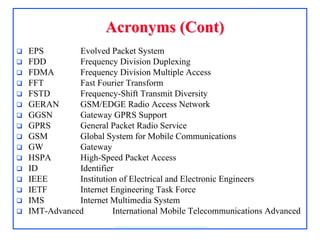
 EPS Evolved Packet System
 FDD Frequency Division Duplexing
 FDMA Frequency Division Multiple Access
 FFT Fast Fourier Transform
 FSTD Frequency-Shift Transmit Diversity
 GERAN GSM/EDGE Radio Access Network
 GGSN Gateway GPRS Support
 GPRS General Packet Radio Service
 GSM Global System for Mobile Communications
 GW Gateway
 HSPA High-Speed Packet Access
 ID Identifier
 IEEE Institution of Electrical and Electronic Engineers
 IETF Internet Engineering Task Force
 IMS Internet Multimedia System
 IMT-Advanced International Mobile Telecommunications Advanced
Acronyms (Cont)Acronyms (Cont)
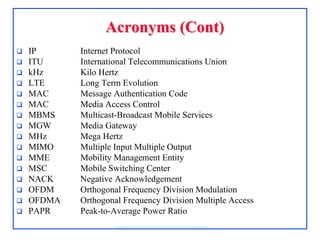
 IP Internet Protocol
 ITU International Telecommunications Union
 kHz Kilo Hertz
 LTE Long Term Evolution
 MAC Message Authentication Code
 MAC Media Access Control
 MBMS Multicast-Broadcast Mobile Services
 MGW Media Gateway
 MHz Mega Hertz
 MIMO Multiple Input Multiple Output
 MME Mobility Management Entity
 MSC Mobile Switching Center
 NACK Negative Acknowledgement
 OFDM Orthogonal Frequency Division Modulation
 OFDMA Orthogonal Frequency Division Multiple Access
 PAPR Peak-to-Average Power Ratio
Acronyms (Cont)Acronyms (Cont)
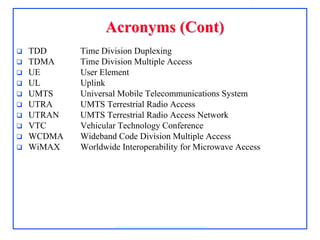
 TDD Time Division Duplexing
 TDMA Time Division Multiple Access
 UE User Element
 UL Uplink
 UMTS Universal Mobile Telecommunications System
 UTRA UMTS Terrestrial Radio Access
 UTRAN UMTS Terrestrial Radio Access Network
 VTC Vehicular Technology Conference
 WCDMA Wideband Code Division Multiple Access
 WiMAX Worldwide Interoperability for Microwave Access

Introduction to lte

  • 1.
    What is 4G?Whatis 4G?  International Mobile Telecommunication (IMT) Advanced  Requirements in ITU M.2134-2008  IP based packet switch network  1.0 Gbps peak rate for fixed services with 100 MHz  100 Mbps for mobile services. High mobility to 500 km/hr  Seamless connectivity and global roaming with smooth handovers  High-Quality Multimedia Feature Cell Cell Edge Peak DL Spectral Efficiency (bps/Hz) 2.2 0.06 15 UL Spectral Efficiency (bps/Hz) 1.4 0.03 6.75 DL data rate w 40 MHz (Mbps) 88 2.4 600 UL data rate w 40 MHz (Mbps) 56 1.2 270
  • 2.
    4G Technologies4G Technologies ITU Approved two technologies as 4G (Oct 2010)  LTE-Advanced  WiMAX Release 2 (IEEE 802.16m-2011)  LTE and WiMAX are near-4G (3.9G) and not 4G
  • 3.
    LTE: Key FeaturesLTE:Key Features 1. Long Term Evolution. 3GPP Release 8, 2009. 2. Initially developed as 3.9G (Pre-4G) cellular technology Now sold as 4G. 3. Many different bands: 700/1500/1700/2100/2600 MHz 4. Flexible Bandwidth: 1.4/3/5/10/15/20 MHz 5. Frequency Division Duplexing (FDD) and Time Division Duplexing (TDD)  Both paired and unpaired spectrum 6. 4x4 MIMO, Multi-user collaborative MIMO 7. Beamforming in the downlink
  • 4.
    LTE: Key Features(Cont)LTE: Key Features (Cont) 8. Data Rate: 326 Mbps/down 86 Mbps up (4x4 MIMO 20 MHz) 9. Modulation: OFDM with QPSK, 16 QAM, 64 QAM 10. OFDMA downlink, Single Carrier Frequency Division Multiple Access (SC- FDMA) uplink 11. Hybrid ARQ Transmission 12. Short Frame Sizes of 10ms and 1ms  faster feedback and better efficiency at high speed 13. Persistent scheduling to reduce control channel overhead for low bit rate voice transmission. 14. IP based flat network architecture
  • 5.
    CDMA vs. OFDMACDMAvs. OFDMA  LTE uses OFDMA in the downlink Feature CDMA OFDMA Frequency Selective No Yes Symbol period Short Long Equalization Easy up to 5 MHz Easy for any bandwidth Resistance to Multipath Difficult above 5 MHz East with proper cyclic prefix MIMO Difficult Easy Frequency Distortion Averaged Inter-carrier interference User Multiplexing Orthogonal codes Frequency and Time
  • 6.
    SCSC--FDMAFDMA  Single-Carrier FrequencyDivision Multiple Access  Each user gets a contiguous part of the channel  Uses single carrier modulation and adds a cyclic prefix  Single carrier  Not much variation in amplitude  Lower PAPR  Better for uplink because slight mis-synchronization among users does not affect the decoding significantly  With OFDMA each user’s subcarriers are spread all over the band and may affect other users subcarriers all over the band User 1 User 2 User 3 Frequency
  • 7.
    SCSC--FDMAFDMA  In practice,SC-FDMA is implemented as if the user is allocated a contiguous subset of subcarriers  Transmitter at the User Terminal:  SC-FDMA = Discrete Fourier Transform Pre-coded OFDMA  Receiver at the Base Station:
  • 8.
    OFDMA UplinkOFDMA Uplink LTE does not use OFDMA in uplink WiMAX uses OFDMA in uplink  Transmitter at User Terminal:  Receiver at the Base Station:
  • 9.
    MultiMulti--User DiversityUser Diversity Each user has a different signal to interference and noise ratio (SINR)  Give each user their best frequency subcarriers to maximize their efficiency  Select users that have high SINR to maximize total system efficiency  Interesting scheduling with fairness and efficiency trade-offs Frequency Frequency User 1 User 2 SINR SINR Frequency User 3 SINR
  • 10.
    LTE Frame StructureLTEFrame Structure SU0 SU1 SU2Superframes (10 ms) SF0 SF1 SF2 SF3 SF4 SF5 SF6 SF9Subframes (1ms) UL DLSlots (0.5ms) 0 1 2 3 4 5 6  Normal Cyclic Prefix:5.2 us for 1st symbol, 4.7 us for others  Extended Cyclic Prefix: for larger networks. 16.7 us 0 1 2 3 4 5 0.5 ms
  • 11.
    SummarySummary 1. 4G IMT-Advancedrequires 1 Gbps with 100 MHz for fixed services and 100 Mbps for mobile services.WiMAX and LTE are pre-4G technologies. Their next generations will be 4G. 2. WiMAX and LTE have numerous common features: Many bands, flexible bandwidth, FDD/TDD. MIMO/Beamforming H-ARQ, IP-Based, OFDMA. The key differentiator is SC- FDMA for uplink in LTE to reduce PAPR. 3. Puncturing allows some ECC bits to be not transmitting. This is used in H-ARQ to send extra bits only if necessary. 4. STBC requires transmitting redundant symbols from multiple antenna. SFBC require that these redundant symbols be sent on different subcarriers. 5. LTE protocol stack consists of RRC, PDCP for header compression and encryption, RLC for segmentation and reassembly, and MAC for transmission scheduling.
  • 12.
    AcronymsAcronyms  3GPP 3rdGeneration Partnership Project  ARQ Automatic Repeat Request  BPSK Binary Phase Shift Keying  BS Base Station  BSC Base Station Controller  BTS Base Transceiver Station  CDMA Code Division Multiple Access  CFI Control Format Indicator  CS Circuit Switched  DCI Downlink Control Information  DL Downlink  DVB-H Digital Video Broadcast handheld  ECC Error Correcting Code  eNB Enhanced Node B  eNode-B Enchanced Node B  EPC Evolved Packet Core
  • 13.
    Acronyms (Cont)Acronyms (Cont) EPS Evolved Packet System  FDD Frequency Division Duplexing  FDMA Frequency Division Multiple Access  FFT Fast Fourier Transform  FSTD Frequency-Shift Transmit Diversity  GERAN GSM/EDGE Radio Access Network  GGSN Gateway GPRS Support  GPRS General Packet Radio Service  GSM Global System for Mobile Communications  GW Gateway  HSPA High-Speed Packet Access  ID Identifier  IEEE Institution of Electrical and Electronic Engineers  IETF Internet Engineering Task Force  IMS Internet Multimedia System  IMT-Advanced International Mobile Telecommunications Advanced
  • 14.
    Acronyms (Cont)Acronyms (Cont) IP Internet Protocol  ITU International Telecommunications Union  kHz Kilo Hertz  LTE Long Term Evolution  MAC Message Authentication Code  MAC Media Access Control  MBMS Multicast-Broadcast Mobile Services  MGW Media Gateway  MHz Mega Hertz  MIMO Multiple Input Multiple Output  MME Mobility Management Entity  MSC Mobile Switching Center  NACK Negative Acknowledgement  OFDM Orthogonal Frequency Division Modulation  OFDMA Orthogonal Frequency Division Multiple Access  PAPR Peak-to-Average Power Ratio
  • 15.
    Acronyms (Cont)Acronyms (Cont) TDD Time Division Duplexing  TDMA Time Division Multiple Access  UE User Element  UL Uplink  UMTS Universal Mobile Telecommunications System  UTRA UMTS Terrestrial Radio Access  UTRAN UMTS Terrestrial Radio Access Network  VTC Vehicular Technology Conference  WCDMA Wideband Code Division Multiple Access  WiMAX Worldwide Interoperability for Microwave Access