Jaipur National University
(Established By Government Of Rajasthan ,Approved By The UGC Act 1956)
                           A venture of
                    SEEDLING GROUP OF INSTITUTIONS


                   Presentation Seminar
                           on
                        4g technology
                                                      Presented by………
                                                       bindia kumari
                                                       B.tech
                                                       (6CS-22)
Generation of wireless communication
    1G
o Refers to the first-generation of wireless telephone technology,
  mobile telecommunications.
o analog signals are used and introduced in the early 1980s.
o Average rate between 4800 to 9600 bps
o Based on FDMA.

 DRAWBACKS

o   1G Poor voice quality
o   Poor battery life
o   Large phone size
o   No security
o   Frequent call drops
o   Limited capacity
o   Poor handoff reliability.
2G Technology
o Was launched in Finland in the year 1991.
o 2g networks use digital signals.
o Enabled services such as text messages, picture
   messages and MMS
o Is based on GSM or in other words global system
    for mobile communication .


 DRAWBACKS:
o Requires strong digital signals to help mobile phones work. If
  there is no network coverage in any specific area, digital signals
  would be weak.
o 2G The GSM is a circuit switched, connection oriented
  technology, where the end systems are dedicated for the entire call
  session. This causes inefficiency in usage of bandwidth and
  resources.
o The GSM-enabled systems do not support high data rates.
o They are unable to handle complex data such as video.
3G Technology
o The 3G technology adds multimedia facilities to 2G phones by allowing
  video, audio, and graphics applications. Over 3G phones, you can watch
  streaming video or have video telephony.
o The idea behind 3G is to have a single network standard .
o 3G promises increased bandwidth, up to 384 kbps when the device
  holder is walking, 128 kbps in a car, and 2 Mbps in fixed applications.

 DRAWBACKS:
o High bandwidth requirement

o High spectrum licensing fees

o Huge capital
Motivation for 4G Research Before 3G Has Not Been
Deployed?
 Needs of future high-performance applications like
  multi-media, full-motion video, wireless
  teleconferencing.

 Need global mobility and service portability.

 Difficulty in continuously increasing bandwidth and
  high data rate to meet multimedia services
  requirements.
 Need wider bandwidth.
 Need all digital packet network that utilizes IP in its
  fullest form with converged voice and data capability.
4G Technology

o Characterised by high-speed data rates.
o In 4G the download speed is up to 100 Mbps for moving
  users and 1 Gbps for stationary users
o Will allow users to download a full-length feature film
  within five minutes
o Will also be able to stream high-definition television and
  radio to hand-held devices
o 4G is adoption of packet switching instead of circuit
  switching in voice and video calls
7
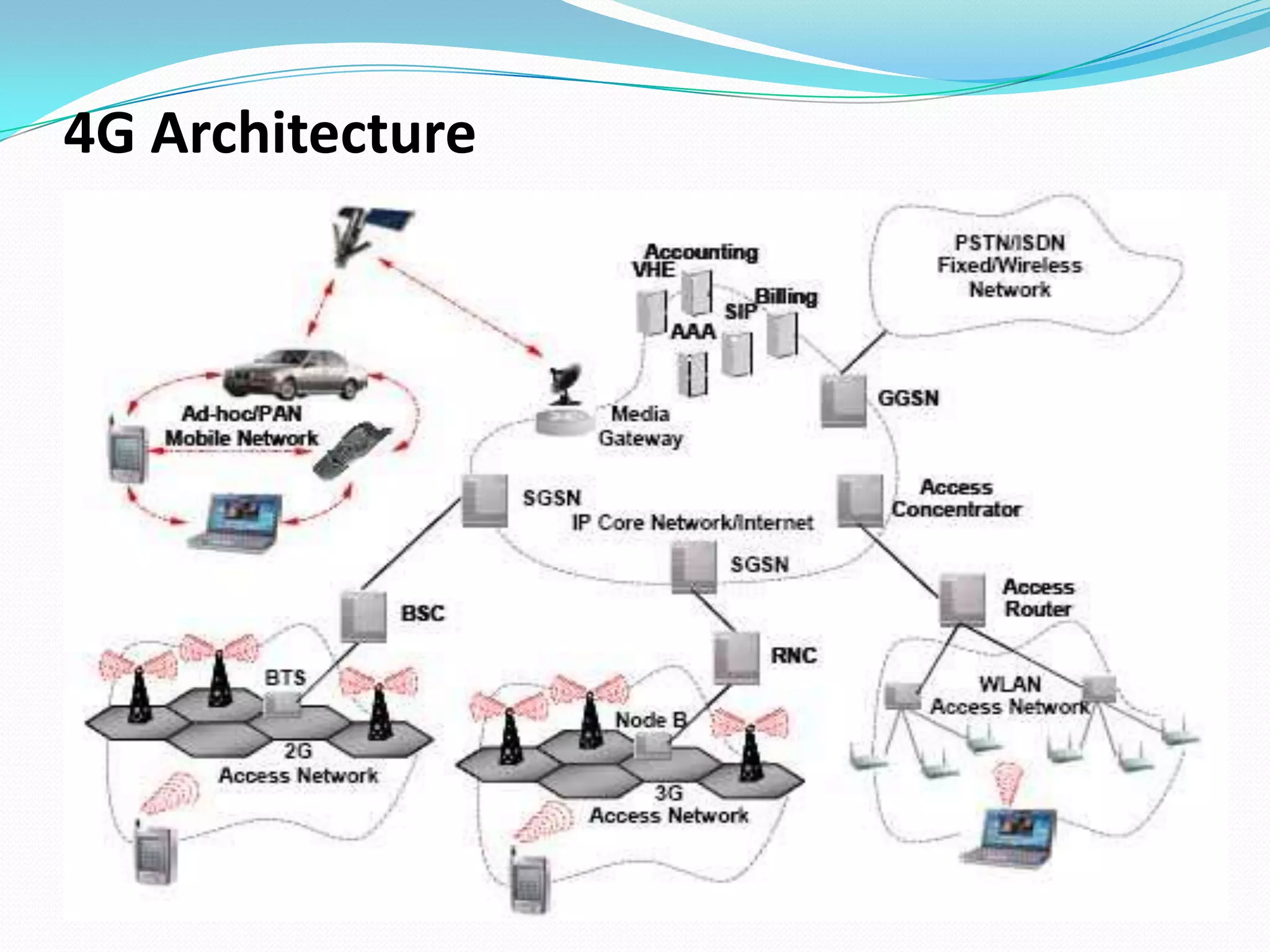
4G Architecture
Technologies Used in 4G

 Smart Antenas for Multiple-input and multiple-
  output (MIMO)
 IPv6
 VoIP
 OFDM
 Software Defined Radio (SDR) System
Smart Antennas
 Transmitting & receiving antennas
 Resolve problem of diminishing spectrum availability
 Doesn’t require increase power or additional frequency

 Fix no. of beams that can be selected to follow devices as it
  moves about

 Advantages:
     Increased capacity
     Increased range
     Less power use for transmission
     Reductions in handoff rate
     New services
     Increase security
IPv6 Technology
 In the context of 4G, IPv6 support is essential in order to
  support a large number of wireless-enabled devices.
 By increasing the number of IP addresses, IPv6 removes the
  need for Network Address Translation (NAT).
 IPv6 also enables a number of applications with better
  multicast, security, and route optimization capabilities.
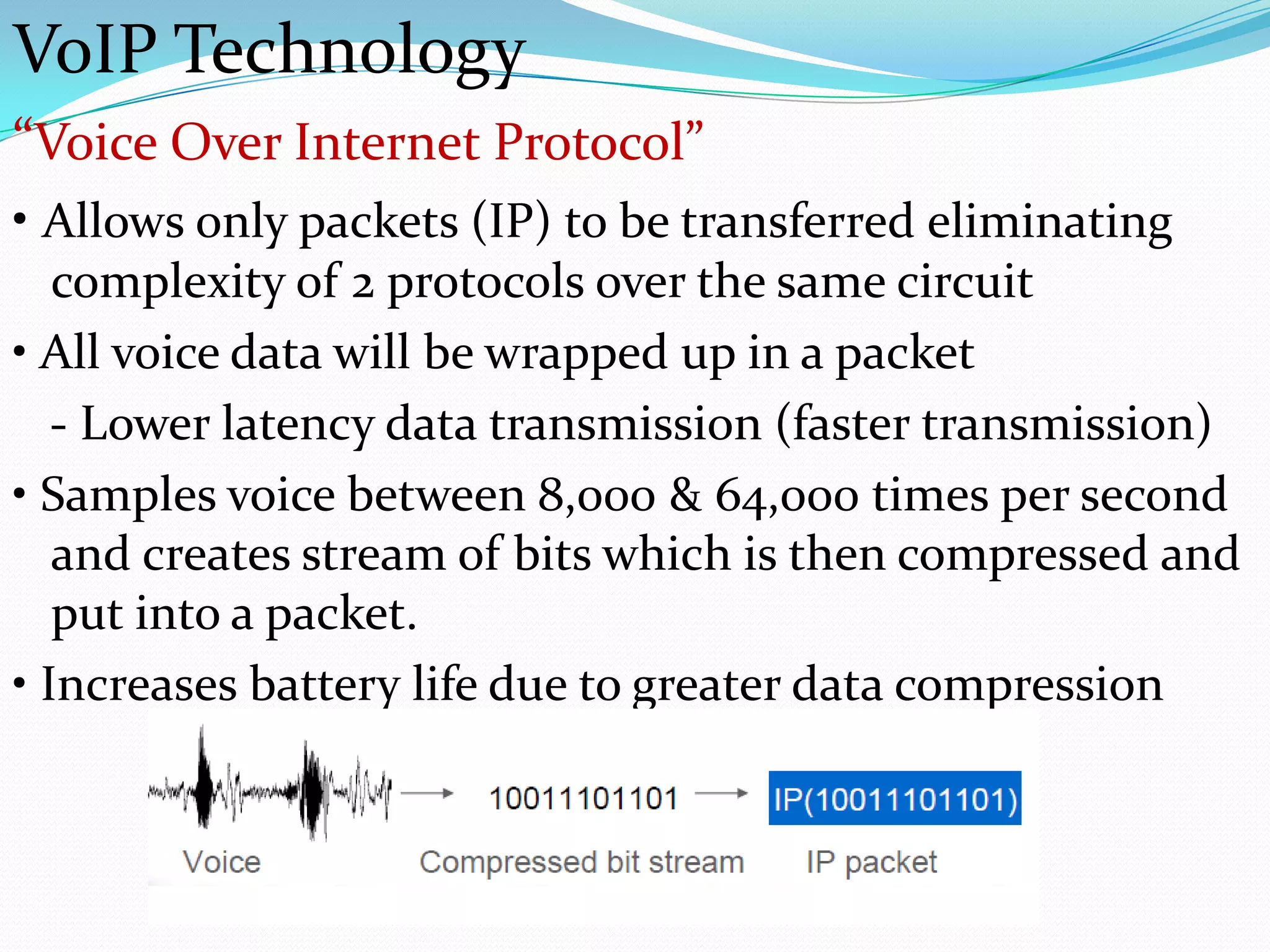
VoIP Technology
“Voice Over Internet Protocol”
• Allows only packets (IP) to be transferred eliminating
   complexity of 2 protocols over the same circuit
• All voice data will be wrapped up in a packet
   - Lower latency data transmission (faster transmission)
• Samples voice between 8,000 & 64,000 times per second
   and creates stream of bits which is then compressed and
   put into a packet.
• Increases battery life due to greater data compression
OFDM Technology
Orthogonal Frequency Division Multiplexing
• Allows for transfer of more data than other forms of
  multiplexing (time, frequency, code, etc)
• Simplifies the design of the transmitter & receiver
• Allows for use of almost the entire frequency band
   -No gaps to prevent interference needed
• Currently used in WiMax(802.16) and WiFi(802.11a/g)
• The frequencies are spaced so that the signals do not
  interfere with each other (no cross talk)
• Parallel Data Transmission
  -Allows for the sending of multiple signals
  simultaneously from the same antenna (or wire) to one
  device
Software-Defined Radio(SDR) Technology
  o SDR is one form of open wireless architecture (OWA).
  o Since 4G is a collection of wireless standards, the final
    form of a 4G device will constitute various standards.
  o This can be efficiently realized using SDR technology,
    which is categorized to the area of the radio
    convergence.
Features of 4G
Support for interactive multimedia, voice, streaming video,
   Internet, and other broadband services
• Fully IP based mobile system
• High speed, high capacity, and low cost‐per‐bit
• Global access, service portability, and scalable mobile services
• Seamless switching, and a variety of Quality of Service
• Better scheduling and call‐admission‐control techniques
• Ad‐hoc and multi‐hop networks
• Better spectral efficiency
• Interoperability with existing wireless standards
• An all IP, packet switched network
Applications of 4G
o Better Usage of Multimedia Applications
o Virtual Presence: 4G system gives mobile users a "virtual
  presence" (for example, always-on connections to keep
  people on event).Video Conferencing
o Virtual navigation: a remote database contains the graphical
  representation of streets, buildings, and physical
  characteristics of a large metropolis. Blocks of this database
  are transmitted in rapid sequence to a vehicle
o Tele- geoprocessing: Queries dependent on location
  information of several users, in addition to temporal aspects
  have many applications.e.g:GIS,GPS
o 4G in normal life .
  i)Traffic control.
  ii)Mobile phones.
  iii)Sensor on public vehicle.
Advantages of 4G-
o Affordable communication services.
o High speed,high capacity and low cost per bit.
o Support for interactive multimedia, voice , streaming video, Internet and
  other broadband services.
o Global access, Service portability and scalable mobile services and
  variety of quality of services provided.
o Better spectral efficiency.
o seamless network of multiple protocol and air interfaces.
 Disadvantages of 4G-
o Battery usage is more
o Hard to implement
o Need complicated hardware
o The equipment required to implement a next generation network
  is still very expensive.
o Carriers and providers have to plan carefully to make sure that
  expenses are kept realistic
Future Prospects of 4G
o 4G is coming quicker.
o Fast internet access to both stationery and mobile
  users.
o 4G can be efficiently combined with cellular
  technologies to make consistent use of smart phones and
  also create video blogs.
o This gives the manufactures the opportunity to produce
  more affordable user friendly 4G compatible
  devices.
o 4G is capable of providing new horizon of opportunity
  for both existing and startup telephone companies.
Challenges

o Integrating all the promised services is a challenge.
   Challenges in migration to 4G.
   High data-rate services and low per bit transmission
    cost.
   Meet the demand of the diverse users.

o Competition with the next forth coming 5G.
   5G technology is providing large broadcasting of data
    in Gigabit which supports almost 65,000 connections.
   5G technology would provide better use of available
    bandwidth.
Conclusion

o 4G can be best described in one word “   MAGIC”, which
    stands for:

   Mobile multimedia
   Anytime Anywhere
   Global mobility support,
   Integrated wireless and personalized services.

o Though 4G is facing challenges and problems we believe
    that future research will overcome these challenges and
    integrate newly developed services to 4G networks making
    them available to everyone, anytime and everywhere.

4g technology

  • 1.
    Jaipur National University (EstablishedBy Government Of Rajasthan ,Approved By The UGC Act 1956) A venture of SEEDLING GROUP OF INSTITUTIONS Presentation Seminar on 4g technology Presented by……… bindia kumari B.tech (6CS-22)
  • 2.
    Generation of wirelesscommunication 1G o Refers to the first-generation of wireless telephone technology, mobile telecommunications. o analog signals are used and introduced in the early 1980s. o Average rate between 4800 to 9600 bps o Based on FDMA. DRAWBACKS o 1G Poor voice quality o Poor battery life o Large phone size o No security o Frequent call drops o Limited capacity o Poor handoff reliability.
  • 3.
    2G Technology o Waslaunched in Finland in the year 1991. o 2g networks use digital signals. o Enabled services such as text messages, picture messages and MMS o Is based on GSM or in other words global system for mobile communication . DRAWBACKS: o Requires strong digital signals to help mobile phones work. If there is no network coverage in any specific area, digital signals would be weak. o 2G The GSM is a circuit switched, connection oriented technology, where the end systems are dedicated for the entire call session. This causes inefficiency in usage of bandwidth and resources. o The GSM-enabled systems do not support high data rates. o They are unable to handle complex data such as video.
  • 4.
    3G Technology o The3G technology adds multimedia facilities to 2G phones by allowing video, audio, and graphics applications. Over 3G phones, you can watch streaming video or have video telephony. o The idea behind 3G is to have a single network standard . o 3G promises increased bandwidth, up to 384 kbps when the device holder is walking, 128 kbps in a car, and 2 Mbps in fixed applications. DRAWBACKS: o High bandwidth requirement o High spectrum licensing fees o Huge capital
  • 5.
    Motivation for 4GResearch Before 3G Has Not Been Deployed?  Needs of future high-performance applications like multi-media, full-motion video, wireless teleconferencing.  Need global mobility and service portability.  Difficulty in continuously increasing bandwidth and high data rate to meet multimedia services requirements.  Need wider bandwidth.  Need all digital packet network that utilizes IP in its fullest form with converged voice and data capability.
  • 6.
    4G Technology o Characterisedby high-speed data rates. o In 4G the download speed is up to 100 Mbps for moving users and 1 Gbps for stationary users o Will allow users to download a full-length feature film within five minutes o Will also be able to stream high-definition television and radio to hand-held devices o 4G is adoption of packet switching instead of circuit switching in voice and video calls
  • 7.
  • 8.
  • 9.
    Technologies Used in4G  Smart Antenas for Multiple-input and multiple- output (MIMO)  IPv6  VoIP  OFDM  Software Defined Radio (SDR) System
  • 10.
    Smart Antennas  Transmitting& receiving antennas  Resolve problem of diminishing spectrum availability  Doesn’t require increase power or additional frequency  Fix no. of beams that can be selected to follow devices as it moves about  Advantages:  Increased capacity  Increased range  Less power use for transmission  Reductions in handoff rate  New services  Increase security
  • 11.
    IPv6 Technology  Inthe context of 4G, IPv6 support is essential in order to support a large number of wireless-enabled devices.  By increasing the number of IP addresses, IPv6 removes the need for Network Address Translation (NAT).  IPv6 also enables a number of applications with better multicast, security, and route optimization capabilities.
  • 12.
    VoIP Technology “Voice OverInternet Protocol” • Allows only packets (IP) to be transferred eliminating complexity of 2 protocols over the same circuit • All voice data will be wrapped up in a packet - Lower latency data transmission (faster transmission) • Samples voice between 8,000 & 64,000 times per second and creates stream of bits which is then compressed and put into a packet. • Increases battery life due to greater data compression
  • 13.
    OFDM Technology Orthogonal FrequencyDivision Multiplexing • Allows for transfer of more data than other forms of multiplexing (time, frequency, code, etc) • Simplifies the design of the transmitter & receiver • Allows for use of almost the entire frequency band -No gaps to prevent interference needed • Currently used in WiMax(802.16) and WiFi(802.11a/g) • The frequencies are spaced so that the signals do not interfere with each other (no cross talk) • Parallel Data Transmission -Allows for the sending of multiple signals simultaneously from the same antenna (or wire) to one device
  • 14.
    Software-Defined Radio(SDR) Technology o SDR is one form of open wireless architecture (OWA). o Since 4G is a collection of wireless standards, the final form of a 4G device will constitute various standards. o This can be efficiently realized using SDR technology, which is categorized to the area of the radio convergence.
  • 15.
    Features of 4G Supportfor interactive multimedia, voice, streaming video, Internet, and other broadband services • Fully IP based mobile system • High speed, high capacity, and low cost‐per‐bit • Global access, service portability, and scalable mobile services • Seamless switching, and a variety of Quality of Service • Better scheduling and call‐admission‐control techniques • Ad‐hoc and multi‐hop networks • Better spectral efficiency • Interoperability with existing wireless standards • An all IP, packet switched network
  • 16.
    Applications of 4G oBetter Usage of Multimedia Applications o Virtual Presence: 4G system gives mobile users a "virtual presence" (for example, always-on connections to keep people on event).Video Conferencing o Virtual navigation: a remote database contains the graphical representation of streets, buildings, and physical characteristics of a large metropolis. Blocks of this database are transmitted in rapid sequence to a vehicle o Tele- geoprocessing: Queries dependent on location information of several users, in addition to temporal aspects have many applications.e.g:GIS,GPS o 4G in normal life . i)Traffic control. ii)Mobile phones. iii)Sensor on public vehicle.
  • 17.
    Advantages of 4G- oAffordable communication services. o High speed,high capacity and low cost per bit. o Support for interactive multimedia, voice , streaming video, Internet and other broadband services. o Global access, Service portability and scalable mobile services and variety of quality of services provided. o Better spectral efficiency. o seamless network of multiple protocol and air interfaces. Disadvantages of 4G- o Battery usage is more o Hard to implement o Need complicated hardware o The equipment required to implement a next generation network is still very expensive. o Carriers and providers have to plan carefully to make sure that expenses are kept realistic
  • 18.
    Future Prospects of4G o 4G is coming quicker. o Fast internet access to both stationery and mobile users. o 4G can be efficiently combined with cellular technologies to make consistent use of smart phones and also create video blogs. o This gives the manufactures the opportunity to produce more affordable user friendly 4G compatible devices. o 4G is capable of providing new horizon of opportunity for both existing and startup telephone companies.
  • 19.
    Challenges o Integrating allthe promised services is a challenge.  Challenges in migration to 4G.  High data-rate services and low per bit transmission cost.  Meet the demand of the diverse users. o Competition with the next forth coming 5G.  5G technology is providing large broadcasting of data in Gigabit which supports almost 65,000 connections.  5G technology would provide better use of available bandwidth.
  • 20.
    Conclusion o 4G canbe best described in one word “ MAGIC”, which stands for:  Mobile multimedia  Anytime Anywhere  Global mobility support,  Integrated wireless and personalized services. o Though 4G is facing challenges and problems we believe that future research will overcome these challenges and integrate newly developed services to 4G networks making them available to everyone, anytime and everywhere.