LTE (LONG TERM EVOLUTION) CONCEPTS
MADE BY:
PROBAL MUKHERJEE (ECE2015/001)
SUBHAJIT DAS (ECE2015/013)
ANIRUDDHA PAUL (ECE2015/017)
SUMAN CHANDRA MODAK (ECE2015/047)
INDEX
➢ 4G IDEAL CONCEPT
➢ WHAT IS LTE AND ITS ADVANTAGES
➢ LTE TECHNICAL ARCHITECTURE
➢ TYPES OF LTE
➢ LTE TECHNOLOGIES
➢ LTE NETWORK ELEMENTS
➢ CALLING PROCEDURES IN LTE
➢ POTENTIAL BUSINESS IMPACT
➢ LTE FUTURE AND USES
➢ LTE ADVANCED
➢ CONCLUSION
➢ BIBLIOGRAPHY
4G IDEAL CONCEPT
➢4 G abbreviated for Fourth generation of
latest Mobile Communication Service.
➢This technology allows the user to have access
over Mobile Web, Gaming Applications, HD Video
conferencing and many more Applications.
➢ ITU described 4G as Network that could provide a
serv ice of 100 Mb/second for t ravel l in g users and
a speed of 1 Gigabits/second while in case of a
stationary users.
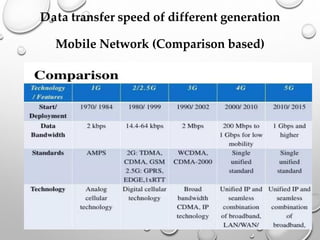
Data transfer speed of different generation
Mobile Network (Comparison based)
2G
WHAT IS LTE
• LTE is the next generation of Mobile broadband
technology
• Data rates of 100 Mbps
• It is the next level after UMTS 3G technology
• Works with IP!
ADVANTAGES
•Provides low latency
•Higher network throughput
•Increased data transfer speed
•More cost effectiveness
•Improvements over 3G network
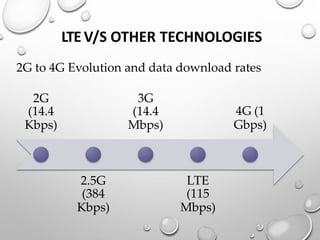
LTEV/S OTHER TECHNOLOGIES
2G
(14.4
Kbps)
2.5G
(384
Kbps)
3G
(14.4
Mbps)
LTE
(115
Mbps)
4G (1
Gbps)
2G to 4G Evolution and data download rates
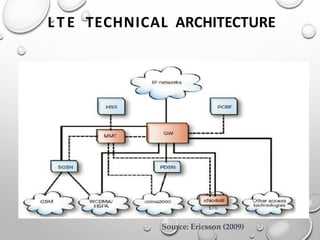
LT E TECHNICAL ARCHITECTURE
Source: Ericsson (2009)
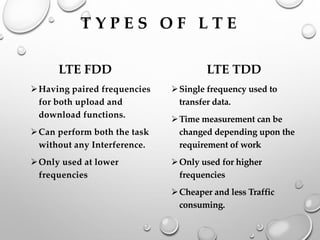
T Y P E S O F L T E
LTE FDD
➢Having paired frequencies
for both upload and
download functions.
➢Can perform both the task
without any Interference.
➢Only used at lower
frequencies
LTE TDD
➢Single frequency used to
transfer data.
➢Time measurement can be
changed depending upon the
requirement of work
➢Only used for higher
frequencies
➢Cheaper and less Traffic
consuming.
LTE TECHNOLOGIES
•OFDM (Orthogonal Frequency Division
Multiplexing) for downlink
•SC-FDMA (Single Carrier – Frequency Division
Multiple Access) for uplink
•MIMO (Multiple Input Multiple Output)
•SAE (System Architecture Evolution)
LTE NETWORK ELEMENTS
•Evolved Node B (eNB)
 Supports air interface
 Provides radio resource management functions
• Serving Gateway (SGW)
 Provides Mobility
 Responsible for Routing and Forwarding
LTE NETWORK ELEMENTS
(CONTD..)
•Packet Data Network Gateway (PDN GW)
 Provides connectivity to Internet
 Provides QoS and mobility between 3G and
non-3G networks
•Mobility Management Entity (MME)
 Manages mobility and provides security
 Operates in control plane and provides
Authentication.
CALLING PROCEDURES IN LTE
➢Volte (Voice Over LTE)
➢C S F B (Circuit Switched Feedback)
➢S VL T E (Simultaneous Voice and LTE)
❖ Of all these techniques Volte is more used in
commercial usage because it allows us to quickly
change the protocols from LTE to HSPA in caseof a
poor signal on LTE
❖ Moreover HDcalling is also enabled on Volte, given
that both the handsets contain this facility.
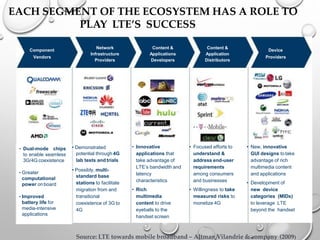
EACH SEGMENT OF THE ECOSYSTEM HAS A ROLE TO
PLAY LTE’S SUCCESS
• Demonstrated
potential through 4G
lab tests and trials
• Possibly, multi-
• Focused efforts to
understand &
address end-user
requirements
among consumers
and businesses
• Willingness to take
measured risks to
monetize 4G
standard base
stations to facilitate
migration from and
transitional
coexistence of 3G to
4G
• Innovative
applications that
take advantage of
LTE’s bandwidth and
latency
characteristics
• Rich
multimedia
content to drive
eyeballs to the
handset screen
• New, innovative
GUI designs totake
advantage of rich
multimedia content
and applications
• Development of
new device
categories (MIDs)
to leverage LTE
beyond the handset
• Dual-mode chips
to enable seamless
3G/4G coexistence
• Greater
computational
power onboard
• Improved
battery life for
media-intensive
applications
Source: LTE towards mobile broadband – Altman Vilandrie & company (2009)
Component
Vendors
Device
Providers
Network
Infrastructure
Providers
Content &
Applications
Developers
Content &
Application
Distributors
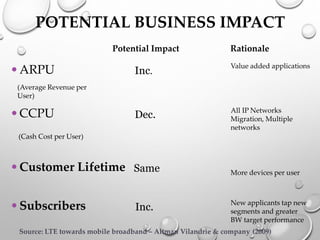
POTENTIAL BUSINESS IMPACT
Potential Impact Rationale
•ARPU Inc.
Value added applications
(Average Revenue per
User)
•CCPU Dec. All IP Networks
Migration, Multiple
networks
(Cash Cost per User)
•Customer Lifetime Same More devices per user
•Subscribers Inc. New applicants tap new
segments and greater
BW target performance
Source: LTE towards mobile broadband – Altman Vilandrie & company (2009)
LTE FUTURE AND USES
•Mass deployment to begin around 2012
•Devices which are covered under LTE are –
Mobile phones, laptops, cameras, camcorders
•Assured interoperability with older
wireless technologies such as GSM,
WCDMA/HSPA, CDMA, TD-SCDMA
LTE ADVANCED
Advantages:
➢ Peak Data Rates of 1GBPS to meet IMT Advanced
➢ standards for 4G
➢ Large Bandwidth upto 100MHZ of Spectrum
Disadvantages:
➢ Costly affair for use.
➢ Moreover the battery consumption is very high
CONCLUSION
Thusthe LTEtechnology hassurpassed its previous
generations and is now ruling over the Mobile
Communication and it is not so far that 5G is going
to come into play in our near future.
BIBLIOGRAPHY
➢HTTPS://WWW.TUTORIALSPOINT.COM/LTE/INDEX.H
TM
➢HTTP://WWW.ARTIZANETWORKS.COM/RESOURCES/
TUTORIALS/WHAT_LTE.HTML

LTE CONCEPTS.pdf

  • 1.
    LTE (LONG TERMEVOLUTION) CONCEPTS MADE BY: PROBAL MUKHERJEE (ECE2015/001) SUBHAJIT DAS (ECE2015/013) ANIRUDDHA PAUL (ECE2015/017) SUMAN CHANDRA MODAK (ECE2015/047)
  • 2.
    INDEX ➢ 4G IDEALCONCEPT ➢ WHAT IS LTE AND ITS ADVANTAGES ➢ LTE TECHNICAL ARCHITECTURE ➢ TYPES OF LTE ➢ LTE TECHNOLOGIES ➢ LTE NETWORK ELEMENTS ➢ CALLING PROCEDURES IN LTE ➢ POTENTIAL BUSINESS IMPACT ➢ LTE FUTURE AND USES ➢ LTE ADVANCED ➢ CONCLUSION ➢ BIBLIOGRAPHY
  • 3.
    4G IDEAL CONCEPT ➢4G abbreviated for Fourth generation of latest Mobile Communication Service. ➢This technology allows the user to have access over Mobile Web, Gaming Applications, HD Video conferencing and many more Applications. ➢ ITU described 4G as Network that could provide a serv ice of 100 Mb/second for t ravel l in g users and a speed of 1 Gigabits/second while in case of a stationary users.
  • 4.
    Data transfer speedof different generation Mobile Network (Comparison based) 2G
  • 5.
    WHAT IS LTE •LTE is the next generation of Mobile broadband technology • Data rates of 100 Mbps • It is the next level after UMTS 3G technology • Works with IP!
  • 6.
    ADVANTAGES •Provides low latency •Highernetwork throughput •Increased data transfer speed •More cost effectiveness •Improvements over 3G network
  • 7.
  • 8.
    LT E TECHNICALARCHITECTURE Source: Ericsson (2009)
  • 9.
    T Y PE S O F L T E LTE FDD ➢Having paired frequencies for both upload and download functions. ➢Can perform both the task without any Interference. ➢Only used at lower frequencies LTE TDD ➢Single frequency used to transfer data. ➢Time measurement can be changed depending upon the requirement of work ➢Only used for higher frequencies ➢Cheaper and less Traffic consuming.
  • 10.
    LTE TECHNOLOGIES •OFDM (OrthogonalFrequency Division Multiplexing) for downlink •SC-FDMA (Single Carrier – Frequency Division Multiple Access) for uplink •MIMO (Multiple Input Multiple Output) •SAE (System Architecture Evolution)
  • 11.
    LTE NETWORK ELEMENTS •EvolvedNode B (eNB)  Supports air interface  Provides radio resource management functions • Serving Gateway (SGW)  Provides Mobility  Responsible for Routing and Forwarding
  • 12.
    LTE NETWORK ELEMENTS (CONTD..) •PacketData Network Gateway (PDN GW)  Provides connectivity to Internet  Provides QoS and mobility between 3G and non-3G networks •Mobility Management Entity (MME)  Manages mobility and provides security  Operates in control plane and provides Authentication.
  • 13.
    CALLING PROCEDURES INLTE ➢Volte (Voice Over LTE) ➢C S F B (Circuit Switched Feedback) ➢S VL T E (Simultaneous Voice and LTE) ❖ Of all these techniques Volte is more used in commercial usage because it allows us to quickly change the protocols from LTE to HSPA in caseof a poor signal on LTE ❖ Moreover HDcalling is also enabled on Volte, given that both the handsets contain this facility.
  • 14.
    EACH SEGMENT OFTHE ECOSYSTEM HAS A ROLE TO PLAY LTE’S SUCCESS • Demonstrated potential through 4G lab tests and trials • Possibly, multi- • Focused efforts to understand & address end-user requirements among consumers and businesses • Willingness to take measured risks to monetize 4G standard base stations to facilitate migration from and transitional coexistence of 3G to 4G • Innovative applications that take advantage of LTE’s bandwidth and latency characteristics • Rich multimedia content to drive eyeballs to the handset screen • New, innovative GUI designs totake advantage of rich multimedia content and applications • Development of new device categories (MIDs) to leverage LTE beyond the handset • Dual-mode chips to enable seamless 3G/4G coexistence • Greater computational power onboard • Improved battery life for media-intensive applications Source: LTE towards mobile broadband – Altman Vilandrie & company (2009) Component Vendors Device Providers Network Infrastructure Providers Content & Applications Developers Content & Application Distributors
  • 15.
    POTENTIAL BUSINESS IMPACT PotentialImpact Rationale •ARPU Inc. Value added applications (Average Revenue per User) •CCPU Dec. All IP Networks Migration, Multiple networks (Cash Cost per User) •Customer Lifetime Same More devices per user •Subscribers Inc. New applicants tap new segments and greater BW target performance Source: LTE towards mobile broadband – Altman Vilandrie & company (2009)
  • 16.
    LTE FUTURE ANDUSES •Mass deployment to begin around 2012 •Devices which are covered under LTE are – Mobile phones, laptops, cameras, camcorders •Assured interoperability with older wireless technologies such as GSM, WCDMA/HSPA, CDMA, TD-SCDMA
  • 17.
    LTE ADVANCED Advantages: ➢ PeakData Rates of 1GBPS to meet IMT Advanced ➢ standards for 4G ➢ Large Bandwidth upto 100MHZ of Spectrum Disadvantages: ➢ Costly affair for use. ➢ Moreover the battery consumption is very high
  • 18.
    CONCLUSION Thusthe LTEtechnology hassurpassedits previous generations and is now ruling over the Mobile Communication and it is not so far that 5G is going to come into play in our near future.
  • 19.