4G LTE


Team 9
4G Standards
 International Mobile
 Telecommunications –
 Advances (IMT-A) set
 by the International
 Telecommunications
 Union – Radio (ITU-R)
   All IP packet switch
    network
   1Gbit/s stationary,
    100Mbit/s moving
   Scalable channel
    bandwidth 5-20 MHz
LTE Technologies / Features
 E-UTRA – LTE’s air interface
  Transfer capabilities
  DL and UL schemes
  Protocol Architecture
  Spectrum Flexibility
  Cell size support
  Network architecture
Data Rate
 Peak download rate of 100 Mbit/s
 Peak upload rate of 50 Mbit/s
 Low handoff and data transfer latencies (sub
 5-ms for small IP packets)


             How is this achieved?
OFDM

                                     OFDM
        Single Carrier


                         • Serial Symbols
             S1          • Wide Frequency
             S2          • Short Symbol Time


                                            S1
                                                 S2
                                                      S3


                                                                S5
                                                           S4
Time         S3                                                      Time
             S4
             S5

                           • Parallel Symbols
          Frequency
                           • Narrow FrequencyFrequency
                           • Long Symbol Time
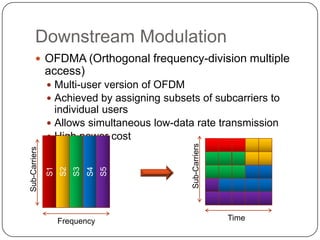
Downstream Modulation
        OFDMA (Orthogonal frequency-division multiple
               access)
                Multi-user version of OFDM
                Achieved by assigning subsets of subcarriers to
                 individual users
                Allows simultaneous low-data rate transmission
                High power cost


                                             Sub-Carriers
Sub-Carriers

               S1
                    S2
                         S3


                                   S5
                              S4


                    Frequency                               Time
Upstream Modulation
 SC-FDMA (Single carrier frequency - division
 multiple access)
   Lower peak-to-average-power (PAPR)
   Acceptable performance loss
MIMO – Multiple Input Multiple
 Output


           S1


DSP   Tx                      Rx   DSP
           S2
E-UTRA Protocol Stack
 MAC: HARQ error correction;
  dynamic scheduling between
  UEs

 RLC: ARQ error correction;
  data formatting

 PDCP: ciphering; error
  correction during handoff

 RRC: handles broadcast
  information, security keying

 NAS: security control;
  authentication
Spectrum Flexibility
 Allows for cell
  bandwidth:
   1.4 MHz
   3 MHz
   5 MHz
   10 MHz
   20 MHz
 Cell sizes can range
  from 1-100 km
E-UTRA Network Architecture

 Network consists of
  only evolved-NodeBs
 eNodeBs consist of
  individual radio
  network controllers,
  simplifying the
  network architecture
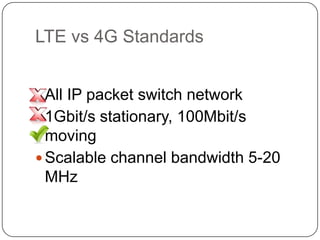
LTE vs 4G Standards


 All IP packet switch network
 1Gbit/s stationary, 100Mbit/s
  moving
 Scalable channel bandwidth 5-20
  MHz
FUTURE: LTE – Advanced


Circuit + Packet    Packet
   Switching       Switching
Questions
?

4G LTE Presentation Group 9

  • 1.
  • 2.
    4G Standards  InternationalMobile Telecommunications – Advances (IMT-A) set by the International Telecommunications Union – Radio (ITU-R)  All IP packet switch network  1Gbit/s stationary, 100Mbit/s moving  Scalable channel bandwidth 5-20 MHz
  • 3.
    LTE Technologies /Features  E-UTRA – LTE’s air interface  Transfer capabilities  DL and UL schemes  Protocol Architecture  Spectrum Flexibility  Cell size support  Network architecture
  • 4.
    Data Rate  Peakdownload rate of 100 Mbit/s  Peak upload rate of 50 Mbit/s  Low handoff and data transfer latencies (sub 5-ms for small IP packets) How is this achieved?
  • 5.
    OFDM OFDM Single Carrier • Serial Symbols S1 • Wide Frequency S2 • Short Symbol Time S1 S2 S3 S5 S4 Time S3 Time S4 S5 • Parallel Symbols Frequency • Narrow FrequencyFrequency • Long Symbol Time
  • 6.
    Downstream Modulation  OFDMA (Orthogonal frequency-division multiple access)  Multi-user version of OFDM  Achieved by assigning subsets of subcarriers to individual users  Allows simultaneous low-data rate transmission  High power cost Sub-Carriers Sub-Carriers S1 S2 S3 S5 S4 Frequency Time
  • 7.
    Upstream Modulation  SC-FDMA(Single carrier frequency - division multiple access)  Lower peak-to-average-power (PAPR)  Acceptable performance loss
  • 8.
    MIMO – MultipleInput Multiple Output S1 DSP Tx Rx DSP S2
  • 9.
    E-UTRA Protocol Stack MAC: HARQ error correction; dynamic scheduling between UEs  RLC: ARQ error correction; data formatting  PDCP: ciphering; error correction during handoff  RRC: handles broadcast information, security keying  NAS: security control; authentication
  • 10.
    Spectrum Flexibility  Allowsfor cell bandwidth:  1.4 MHz  3 MHz  5 MHz  10 MHz  20 MHz  Cell sizes can range from 1-100 km
  • 11.
    E-UTRA Network Architecture Network consists of only evolved-NodeBs  eNodeBs consist of individual radio network controllers, simplifying the network architecture
  • 12.
    LTE vs 4GStandards  All IP packet switch network  1Gbit/s stationary, 100Mbit/s moving  Scalable channel bandwidth 5-20 MHz
  • 13.
    FUTURE: LTE –Advanced Circuit + Packet Packet Switching Switching
  • 14.