By Sherjeel Chughtai(FAST-NU)
(Founder Of Telecom Pak Group)
“Any sufficiently advanced technology is
  indistinguishable from magic.”
Arthur Clarke
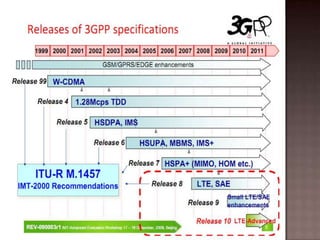
 LTE Advanced is a preliminary mobile
  communication standard, formally submitted
  as a candidate 4G system to ITU-T in late
  2009, was approved into ITU, International
  Telecommunications Union, IMT-Advanced.

 Itis standardized by the 3rd Generation
  Partnership Project (3GPP) as a major
  enhancement of the 3GPP Long Term
  Evolution (LTE) standard.
Spectrum Efficiency
 LTE-Advanced  aims to support downlink (8x8
 antenna configuration) peak spectrum
 efficiency of 30 bps/Hz and uplink (4x4
 antenna configuration) peak spectrum
 efficiency of 15 bps/Hz.
Spectrum flexibility

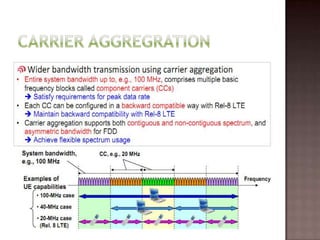
   LTE-Advanced shall operate in spectrum
    allocations of different sizes including
    wider spectrum allocations than those of LTE
    Release 8. The main focus for bandwidth
    solutions wider than 20MHz should be on
    consecutive spectrum. However aggregation of
    the spectrum for LTE-Advanced should take into
    account reasonable user equipment (UE)
    complexity. Frequency division duplex (FDD) and
    time division duplex(TDD) should be supported
    for existing paired and unpaired frequency
    bands, respectively.
Enhanced multiple antenna technologies
 LTE-Advanced extends the MIMO capabilities of
  LTE Release 8 to now supporting eight downlink
  antennas and four uplink antennas.
 In the downlink 8-by-x single user spatial
  multiplexing scenario of LTE-Advanced, up to
  two transport blocks can be transmitted to a
  scheduled UE in one sub frame per downlink
  component carrier. Each transport block is
  assigned its own modulation and coding scheme.
  For HARQ ACK/NACK feedback on uplink, one bit
  is used for each transport block.
Enhanced multiple antenna technologies
   With LTE-Advanced a scheduled UE may transmit up
    to two transport blocks. Each transport block has its
    own modulation and coding scheme (MCS level).
    Depending on the number of transmission layers, the
    modulation symbols associated with each of the
    transport blocks are mapped onto one or two layers
    according to the same principle as for LTE Release 8
    downlink spatial multiplexing. The transmission rank
    can be adapted dynamically. Different codebooks are
    defined depending on the number of layers that are
    used. Further more different pre-coding is used
    depending on whether two or four transmit antennas
    are available. Also the number of bits used for the
    codebook index is different depending on the 2 and 4
    transmit antenna case, respectively.
Enhanced uplink transmission scheme

 The uplink transmission scheme of LTE-Advanced
 has been maintained to a large extent, i.e.
 single carrier – frequency division multiple
 access (SC-FDMA) is used , which is a discrete
 fourier transformed (DFT) pre-coded orthogonal
 frequency division multiple access (OFDMA)
 scheme. The transmission of the physical uplink
 shared channel (PUSCH) uses DFT pre-coding in
 both MIMO and non-MIMO modes.
Control-data decoupling
 In LTE Release 8 a UE only uses physical
  uplink control channel (PUCCH) when it does
  not have any data to transmit on PUSCH. I.e.
  if a UE has data to transmit on PUSCH, it
  would multiplex the control information with
  data on PUSCH. This is not longer valid in
  LTE-Advanced, which means that
  simultaneous PUCCH and PUSCH transmission
  is possible in uplink direction.
Non-contiguous data transmission with single DFT
   The LTE Release 8 uplink scheme SC-FDMA differs
    from the LTE Release 8 downlink schemes, as an
    additional DFT is used in the transmission chain that
    transforms the modulation symbols into the
    frequency domain. In Release 8 localized SC-FDMA is
    allowed only, i.e. in uplink direction only consecutive
    subcarriers are transmitted. This is the essential
    advantage of the scheme, since it reduces the peak
    to average ratio of the transmitted signal and
    consequently allows more efficient power
    amplifier implementation. LTE-Advanced extends the
    uplink transmission scheme by allowing clustered SC-
    FDMA, i.e. the uplink transmission is not anymore
    restricted to the use of consecutive subcarriers, but
    clusters of subcarriers may be allocated . This allows
    uplink frequency selective scheduling and
    consequently will increase the link performance.
    However the peak to average ratio of the
    transmission signal will be increased compared with
    the localized scheme of LTE Release 8
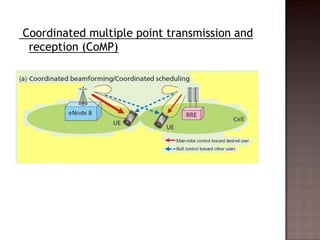
Coordinated multiple point transmission and
 reception (CoMP)
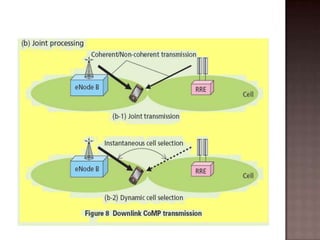
 Coordinated multi-point (CoMP)
 transmission/reception is considered for LTE-
 Advanced as a tool to improve the coverage of high
 data rates, the cell-edge throughput and to increase
 system throughput . In a cellular deployment and
 specifically if frequencies are reused in each
 cell, other-cell interference traditionally degrades
 the system capacity. The target in CoMP is to turn the
 other cell interference into a useful signal
 specifically at the cell border. This requires dynamic
 coordination in the scheduling /
 transmission, including joint transmission, from
 multiple geographically separate points and also
 support for joint processing of received signals at
 multiple geographically separated points.
Coordinated multiple point transmission and
 reception (CoMP)
 Extensionof LTE downlink spatial
 multiplexing to upto eight layers is
 considered. For the uplink spatial multiplying
 to upto four layers is considered.
Relaying

LTE-Advanced extends LTE Release 8 with
  support for relaying in order to enhance
  coverage and capacity.

Further enhanced MBMS
The MBMS has been enhanced in the LTE
  advanced.
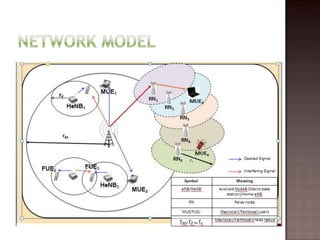
 One solution to improve coverage is the use
 of fixed relays, pieces of
 infrastructure without a wired backhaul
 connection, that relay messages between the
 base station (BS) and mobile stations (MSs)
 through multi-hop communication.
 Analog  repeater :The simplest
  strategy, which uses a combination of
  directional antennas and a power amplifier
  to repeat the transmit signal .
 Amplify-and-forward: relays apply linear
  transformation to the received signal .
 decode-and-forward: relays decode the
  signal then re-encode for transmission
 compress-and-forward
 One-way  relay
 Two-way relay
 Shared relays
ISSUES IN LTE
•   ENERGY
•   SPECTRUM UTILIZATION
•   INTERFERENCE
•   RESOURCE ALLOCATION
•   COVERAGE AND CAPACITY
•   SELF ORGANIZED NETWORKS
•   HIGHER PEAK DATA RATE
•   LARGER BANDWIDTH
   In February 2007 NTT DoCoMo announced the completion
    of a 4G trial where it achieved a
    maximum packet transmission rate of approximately
    5 Gbit/s in the downlink using 100 MHz frequency
    bandwidth to a mobile station moving at 10 km/h.

   In 2009, Rohde & Schwarz launched the CMW500 Wideband
    Communication Tester.

   In February 2011 at Mobile World Congress, Agilent
    Technologies demonstrated the industry's first test
    solutions for LTE-Advanced with both signal
    generation and signal analysis solutions.

   In 2011 May, Dialog Axiata PLC of Sri Lanka successfully
    demonstrated 4G LTE in Colombo and it became the first
    to reach 100mbps in South Asia. Currently, several main
    cities of Colombo are included in 4G testing phase
 Increased peak data rates (Gbit/s).
 Improved cell edge throughput.
 Improved spectrum efficiency.
 Improved network coverage.
 Increased energy efficiency.
 Spectrum flexibility and self-organizing
  network.
 Node B is a term used in UMTS equivalent to the
  BTS (base transceiver station) description used in
  GSM.
 Universal Mobile Telecommunications System
  (UMTS) is a third generation mobile cellular
  technology for networks based on the GSM
  standard.
 High-Speed Downlink Packet Access (HSDPA) is
  an enhanced 3G (third generation) mobile
  telephony communications protocol in the High-
  Speed Packet Access (HSPA) family, also dubbed
  3.5G, 3G+ or turbo 3G, which allows networks
  based on Universal Mobile Telecommunications
  System (UMTS) to have higher data transfer
  speeds and capacity
 Multiple-inputand multiple-
 output, or MIMO is the use of multiple
 antennas at both the transmitter and
 receiver to improve communication
 performance.

 UE:   User equipment

 Femto  Cells: a femto cell is a small
 cellular base station, typically designed for
 use in a home or small business.
 HSPA+, also known as Evolved High-Speed
 Packet Access is
 a wireless broadband standard defined
 in 3GPP release 7 and above.

 System Architecture Evolution (aka SAE) is
 the core network architecture
 of 3GPP's LTE wireless communication
 standard.
 Orthogonal  Frequency-Division Multiple
 Access (OFDMA) is a multi-user version of
 the popular Orthogonal frequency-division
 multiplexing (OFDM) digital modulation
 scheme. Multiple access is achieved in
 OFDMA by assigning subsets of subcarriers to
 individual users.
A macrocell is a cell in a mobile phone
 network that provides radio coverage served
 by a high power cellular base station
 (tower).

 Multimedia Broadcast and Multicast
 Services (MBMS) is
 a broadcasting service offered via
 existing GSM and UMTS cellular networks
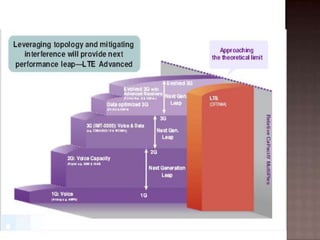
 LTEAdvanced benefits is the ability to take
 advantage of advanced topology networks;
 optimized heterogeneous networks with a
 mix of macros with low power nodes such
 as picocells, femto cells and new relay
 nodes. LTE Advanced further improves the
 capacity and coverage, and ensures user
 fairness. LTE Advanced also introduces
 multicarrier to be able to use ultra wide
 bandwidth.
 http://www.facebook.com/pages/Telecom-
 Pak/167884679914443

 http://www.linkedin.com/groups/Telecom-
 Pak-3672295?mostPopular=&gid=3672295
Lte advanced

Lte advanced

  • 1.
  • 2.
    “Any sufficiently advancedtechnology is indistinguishable from magic.” Arthur Clarke
  • 3.
     LTE Advancedis a preliminary mobile communication standard, formally submitted as a candidate 4G system to ITU-T in late 2009, was approved into ITU, International Telecommunications Union, IMT-Advanced.  Itis standardized by the 3rd Generation Partnership Project (3GPP) as a major enhancement of the 3GPP Long Term Evolution (LTE) standard.
  • 7.
    Spectrum Efficiency  LTE-Advanced aims to support downlink (8x8 antenna configuration) peak spectrum efficiency of 30 bps/Hz and uplink (4x4 antenna configuration) peak spectrum efficiency of 15 bps/Hz.
  • 8.
    Spectrum flexibility  LTE-Advanced shall operate in spectrum allocations of different sizes including wider spectrum allocations than those of LTE Release 8. The main focus for bandwidth solutions wider than 20MHz should be on consecutive spectrum. However aggregation of the spectrum for LTE-Advanced should take into account reasonable user equipment (UE) complexity. Frequency division duplex (FDD) and time division duplex(TDD) should be supported for existing paired and unpaired frequency bands, respectively.
  • 9.
    Enhanced multiple antennatechnologies  LTE-Advanced extends the MIMO capabilities of LTE Release 8 to now supporting eight downlink antennas and four uplink antennas.  In the downlink 8-by-x single user spatial multiplexing scenario of LTE-Advanced, up to two transport blocks can be transmitted to a scheduled UE in one sub frame per downlink component carrier. Each transport block is assigned its own modulation and coding scheme. For HARQ ACK/NACK feedback on uplink, one bit is used for each transport block.
  • 10.
    Enhanced multiple antennatechnologies  With LTE-Advanced a scheduled UE may transmit up to two transport blocks. Each transport block has its own modulation and coding scheme (MCS level). Depending on the number of transmission layers, the modulation symbols associated with each of the transport blocks are mapped onto one or two layers according to the same principle as for LTE Release 8 downlink spatial multiplexing. The transmission rank can be adapted dynamically. Different codebooks are defined depending on the number of layers that are used. Further more different pre-coding is used depending on whether two or four transmit antennas are available. Also the number of bits used for the codebook index is different depending on the 2 and 4 transmit antenna case, respectively.
  • 11.
    Enhanced uplink transmissionscheme The uplink transmission scheme of LTE-Advanced has been maintained to a large extent, i.e. single carrier – frequency division multiple access (SC-FDMA) is used , which is a discrete fourier transformed (DFT) pre-coded orthogonal frequency division multiple access (OFDMA) scheme. The transmission of the physical uplink shared channel (PUSCH) uses DFT pre-coding in both MIMO and non-MIMO modes.
  • 12.
    Control-data decoupling  InLTE Release 8 a UE only uses physical uplink control channel (PUCCH) when it does not have any data to transmit on PUSCH. I.e. if a UE has data to transmit on PUSCH, it would multiplex the control information with data on PUSCH. This is not longer valid in LTE-Advanced, which means that simultaneous PUCCH and PUSCH transmission is possible in uplink direction.
  • 13.
    Non-contiguous data transmissionwith single DFT  The LTE Release 8 uplink scheme SC-FDMA differs from the LTE Release 8 downlink schemes, as an additional DFT is used in the transmission chain that transforms the modulation symbols into the frequency domain. In Release 8 localized SC-FDMA is allowed only, i.e. in uplink direction only consecutive subcarriers are transmitted. This is the essential advantage of the scheme, since it reduces the peak to average ratio of the transmitted signal and consequently allows more efficient power amplifier implementation. LTE-Advanced extends the uplink transmission scheme by allowing clustered SC- FDMA, i.e. the uplink transmission is not anymore restricted to the use of consecutive subcarriers, but clusters of subcarriers may be allocated . This allows uplink frequency selective scheduling and consequently will increase the link performance. However the peak to average ratio of the transmission signal will be increased compared with the localized scheme of LTE Release 8
  • 14.
    Coordinated multiple pointtransmission and reception (CoMP) Coordinated multi-point (CoMP) transmission/reception is considered for LTE- Advanced as a tool to improve the coverage of high data rates, the cell-edge throughput and to increase system throughput . In a cellular deployment and specifically if frequencies are reused in each cell, other-cell interference traditionally degrades the system capacity. The target in CoMP is to turn the other cell interference into a useful signal specifically at the cell border. This requires dynamic coordination in the scheduling / transmission, including joint transmission, from multiple geographically separate points and also support for joint processing of received signals at multiple geographically separated points.
  • 15.
    Coordinated multiple pointtransmission and reception (CoMP)
  • 17.
     Extensionof LTEdownlink spatial multiplexing to upto eight layers is considered. For the uplink spatial multiplying to upto four layers is considered.
  • 19.
    Relaying LTE-Advanced extends LTERelease 8 with support for relaying in order to enhance coverage and capacity. Further enhanced MBMS The MBMS has been enhanced in the LTE advanced.
  • 20.
     One solutionto improve coverage is the use of fixed relays, pieces of infrastructure without a wired backhaul connection, that relay messages between the base station (BS) and mobile stations (MSs) through multi-hop communication.
  • 21.
     Analog repeater :The simplest strategy, which uses a combination of directional antennas and a power amplifier to repeat the transmit signal .  Amplify-and-forward: relays apply linear transformation to the received signal .  decode-and-forward: relays decode the signal then re-encode for transmission  compress-and-forward
  • 22.
     One-way relay  Two-way relay  Shared relays
  • 23.
    ISSUES IN LTE • ENERGY • SPECTRUM UTILIZATION • INTERFERENCE • RESOURCE ALLOCATION • COVERAGE AND CAPACITY • SELF ORGANIZED NETWORKS • HIGHER PEAK DATA RATE • LARGER BANDWIDTH
  • 25.
    In February 2007 NTT DoCoMo announced the completion of a 4G trial where it achieved a maximum packet transmission rate of approximately 5 Gbit/s in the downlink using 100 MHz frequency bandwidth to a mobile station moving at 10 km/h.  In 2009, Rohde & Schwarz launched the CMW500 Wideband Communication Tester.  In February 2011 at Mobile World Congress, Agilent Technologies demonstrated the industry's first test solutions for LTE-Advanced with both signal generation and signal analysis solutions.  In 2011 May, Dialog Axiata PLC of Sri Lanka successfully demonstrated 4G LTE in Colombo and it became the first to reach 100mbps in South Asia. Currently, several main cities of Colombo are included in 4G testing phase
  • 26.
     Increased peakdata rates (Gbit/s).  Improved cell edge throughput.  Improved spectrum efficiency.  Improved network coverage.  Increased energy efficiency.  Spectrum flexibility and self-organizing network.
  • 27.
     Node Bis a term used in UMTS equivalent to the BTS (base transceiver station) description used in GSM.  Universal Mobile Telecommunications System (UMTS) is a third generation mobile cellular technology for networks based on the GSM standard.  High-Speed Downlink Packet Access (HSDPA) is an enhanced 3G (third generation) mobile telephony communications protocol in the High- Speed Packet Access (HSPA) family, also dubbed 3.5G, 3G+ or turbo 3G, which allows networks based on Universal Mobile Telecommunications System (UMTS) to have higher data transfer speeds and capacity
  • 28.
     Multiple-inputand multiple- output, or MIMO is the use of multiple antennas at both the transmitter and receiver to improve communication performance.  UE: User equipment  Femto Cells: a femto cell is a small cellular base station, typically designed for use in a home or small business.
  • 29.
     HSPA+, alsoknown as Evolved High-Speed Packet Access is a wireless broadband standard defined in 3GPP release 7 and above.  System Architecture Evolution (aka SAE) is the core network architecture of 3GPP's LTE wireless communication standard.
  • 30.
     Orthogonal Frequency-Division Multiple Access (OFDMA) is a multi-user version of the popular Orthogonal frequency-division multiplexing (OFDM) digital modulation scheme. Multiple access is achieved in OFDMA by assigning subsets of subcarriers to individual users.
  • 31.
    A macrocell isa cell in a mobile phone network that provides radio coverage served by a high power cellular base station (tower).  Multimedia Broadcast and Multicast Services (MBMS) is a broadcasting service offered via existing GSM and UMTS cellular networks
  • 32.
     LTEAdvanced benefitsis the ability to take advantage of advanced topology networks; optimized heterogeneous networks with a mix of macros with low power nodes such as picocells, femto cells and new relay nodes. LTE Advanced further improves the capacity and coverage, and ensures user fairness. LTE Advanced also introduces multicarrier to be able to use ultra wide bandwidth.
  • 33.
     http://www.facebook.com/pages/Telecom- Pak/167884679914443 http://www.linkedin.com/groups/Telecom- Pak-3672295?mostPopular=&gid=3672295