Long-Term Evolution (LTE) .
Submitted by
Hussein M. Al-Sanabani
Supervisor
Yrd.Doç.Dr. MURAT İSKEFİYELİ
ByHusseinAL-Sanabani
Topics
 IntroductionIntroduction
 LTE Network ArchitectureLTE Network Architecture
 LTETechnologiesLTETechnologies
 Evolution of LTE-AdvancedEvolution of LTE-Advanced
 ResearchesResearches
 ReferencesReferences
By Hussein AL-Sanabani
Introduction
Welcome to the world of LTE!
ByHusseinAL-Sanabani
What is LTE?
 In Nov. 2004, 3GPP began a project to define the long-term
evolution (LTE) of Universal MobileTelecommunications
System (UMTS) cellular technology
 Higher performance (Data rates && Reduced delay/latency )
 Backwards compatible
 Wide application
 Works with IP network
 LTE is the next generation of Mobile broadband technology
By Hussein AL-Sanabani
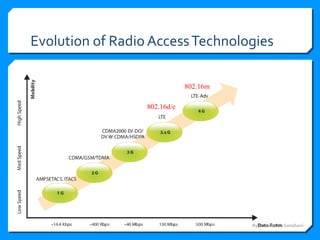
Evolution of Radio AccessTechnologies
 LTE (3.9G) :
3GPP release 8~9
 LTE-Advanced :
3GPP release 10+
802.16d/e
802.16m
By Hussein AL-Sanabani
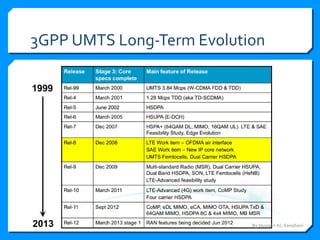
3GPP UMTS Long-Term Evolution
By Hussein AL-Sanabani
LTETARGETs
 Packet-Domain-Services only (e.g.VoIP) TCP/IP- based layers
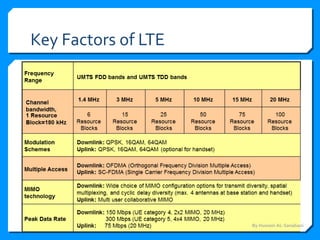
 Higher peak data rate/ user throughput  150 Mbps DL/75 Mbps UL @20MHz bandwidth
 Reduced delay/latency  user-plane latency<10ms
 Improved spectrum efficiency  up to 200 active users in a cell @5MHz bandwidth
 Mobility  optimized for low-mobility (up to 15Km/h), supported with high performance for
medium mobility (up to 120 Km/h), supported for high mobility (up to 500 Km/h)
 Multimedia broadcast & multicast services
 Spectrum flexibility ( Support of scalable bandwidth: 1.4, 3, 5, 10, 15, 20 MHz)
 Support for interworking with legacy networks
 Cost-efficiency:
1. Cost-effective when add new node (upgrade) in LTE network.
2. Cost-effective migration from legacy networks
 Coverage  up to 30 Km By Hussein AL-Sanabani
Key Factors of LTE
By Hussein AL-Sanabani
LTE Network Architecture
What is the Architecture of LTE Network?
ByHusseinAL-Sanabani
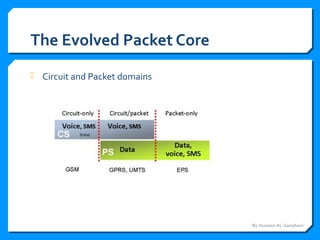
The Evolved Packet Core
 Circuit and Packet domains
By Hussein AL-Sanabani
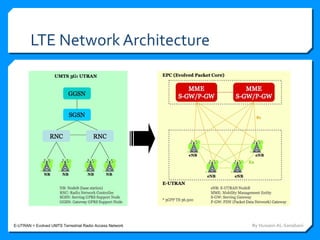
LTE Network Architecture
E-UTRAN = Evolved UMTS Terrestrial Radio Access Network By Hussein AL-Sanabani
Network Architecture – E-UTRAN
 User Equipment
 Evolved Node B (eNB) Functionalities:
1) Provides radio resource management functions, and handover
events
2) Provides admission control and scheduling
By Hussein AL-Sanabani
Network Architecture
Evolved Packet Core
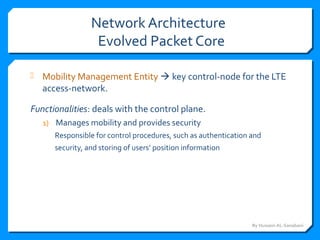
 Mobility Management Entity  key control-node for the LTE
access-network.
Functionalities: deals with the control plane.
1) Manages mobility and provides security
Responsible for control procedures, such as authentication and
security, and storing of users’ position information
By Hussein AL-Sanabani
Network Architecture
Evolved Packet Core (Cont)
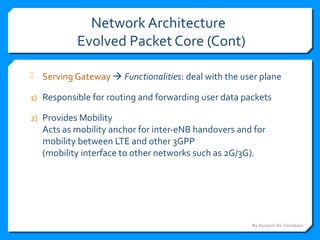
 Serving Gateway  Functionalities: deal with the user plane
1) Responsible for routing and forwarding user data packets
2) Provides Mobility
Acts as mobility anchor for inter-eNB handovers and for
mobility between LTE and other 3GPP
(mobility interface to other networks such as 2G/3G).
By Hussein AL-Sanabani
Network Architecture
Evolved Packet Core (Cont)
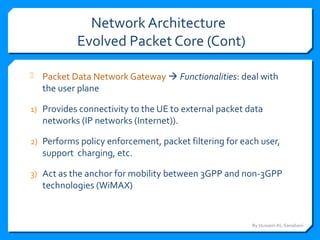
 Packet Data Network Gateway  Functionalities: deal with
the user plane
1) Provides connectivity to the UE to external packet data
networks (IP networks (Internet)).
2) Performs policy enforcement, packet filtering for each user,
support charging, etc.
3) Act as the anchor for mobility between 3GPP and non-3GPP
technologies (WiMAX)
By Hussein AL-Sanabani
LTETechnologies
What is an LTE Network made up of?
ByHusseinAL-Sanabani
LTETechnologies
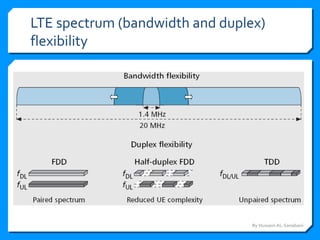
 Spectrum Flexibility
 OFDMA (Orthogonal Frequency Division Multiple
Access) for downlink
 SC-FDMA (Single Carrier – Frequency Division Multiple
Access) for uplink
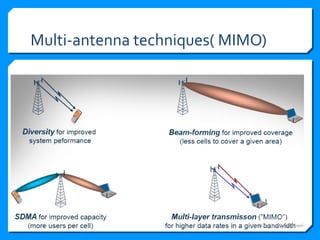
 MIMO (Multiple Input Multiple Output)
By Hussein AL-Sanabani
LTE spectrum (bandwidth and duplex)
flexibility
By Hussein AL-Sanabani
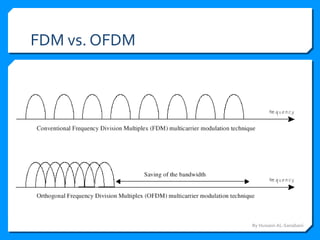
FDM vs. OFDM
By Hussein AL-Sanabani
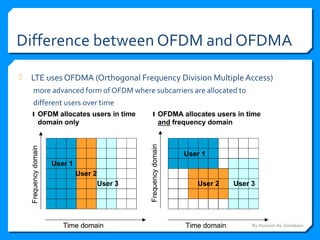
Difference between OFDM and OFDMA
 LTE uses OFDMA (Orthogonal Frequency Division Multiple Access)
more advanced form of OFDM where subcarriers are allocated to
different users over time
By Hussein AL-Sanabani
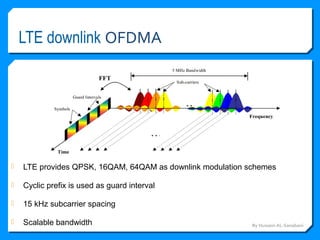
LTE downlink OFDMA
 LTE provides QPSK, 16QAM, 64QAM as downlink modulation schemes

 Cyclic prefix is used as guard interval
 15 kHz subcarrier spacing
 Scalable bandwidth By Hussein AL-Sanabani
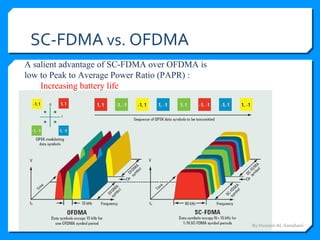
LTE Uplink (SC-FDMA)
 l Similar to OFDM signal, but…
 in OFDM, each sub-carrier only carries information
related to one specific symbol,
 in SC-FDMA, each sub-carrier contains information of
ALL transmitted symbols.
By Hussein AL-Sanabani
SC-FDMA vs. OFDMA
A salient advantage of SC-FDMA over OFDMA is
low to Peak to Average Power Ratio (PAPR) :
Increasing battery life
By Hussein AL-Sanabani
Multi-antenna techniques( MIMO)
By Hussein AL-Sanabani
Advantages of LTE
 Provides low latency
 Increased data transfer speed
 High spectral efficiency
 Support of variable bandwidth
 FDD andTDD within a single radio access technology
 More cost effectiveness
 Compatibility and interworking with earlier 3GPP Releases
 Efficient Multicast/Broadcast
 Improvements over 3G network
By Hussein AL-Sanabani
Evolution of LTE-Advanced
ByHusseinAL-Sanabani
Evolution of LTE-Advanced
 Carrier aggregation
 Enhanced uplink and Downlink multiple access
 Enhanced Multi-antennaTransmissionTechniques
 Downlink 8 antennas
 Uplink 4 antennas
 Support of Larger Bandwidth in LTE-Advanced
 Support heterogeneous network
 Self Optimizing networks (SON)
By Hussein AL-Sanabani
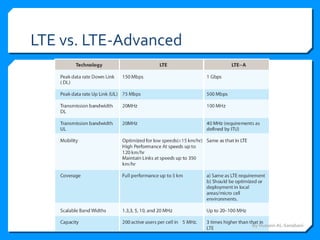
LTE vs. LTE-Advanced
By Hussein AL-Sanabani
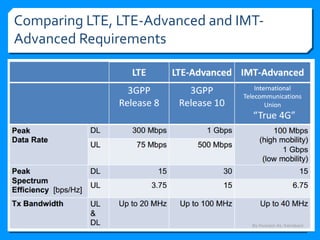
Comparing LTE, LTE-Advanced and IMT-
Advanced Requirements
By Hussein AL-Sanabani
ResearchesResearches
ByHusseinAL-Sanabani
Researches (1)Researches (1)
 Title:
 An efficient power-saving transmission mechanism in LTE
macrocell-femtocell hybrid networks
 Author:
 Yao-Liang Chung
 Institute:
 Department of Communication Engineering, NationalTaipei
University
 Published on:
 2014 Information Networking (ICOIN), International Conference
By Hussein AL-Sanabani
Research: 1 contcont..
 This paper discusses how to improve the energy - saving
performance by using LTE macrocell-femtocell hybrid networks.
 This mechanism is able to greatly improve the energy -saving
performance, while maintaining the required data rate, by
intelligently activating /deactivating each Femto Group (FG).
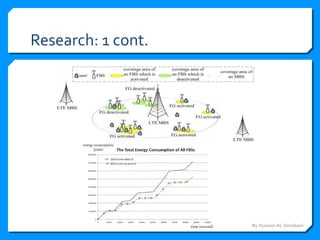
 The results of this paper demonstrate that the proposed
approach is able to achieve a much better energy -saving
performance, when compared it with the existing approaches .
By Hussein AL-Sanabani
Research: 1 cont.
By Hussein AL-Sanabani
Researches (2)Researches (2)
 Title:
 LTE forVehicular Networking: A Survey
 Author:
 Araniti, G. ; Campolo, C. ; Condoluci, M. ; Iera, A.
more authors
 Institute:
 University Mediterranea of Reggio Calabria
 Published on:
 2013 Communications Magazine, IEEE (Volume:51 , Issue: 5 )
By Hussein AL-Sanabani
Research: 2 contcont..
 In this paper discuss the usability of LTE to support vehicular
applications, as they currently do by IEEE 802.11p (e.g., road
safety and traffic efficiency services). And also support the
applications mainly benefit from this promising cellular technology
(e.g., VoIP, file sharing, video streaming, web browsing, social
networking, blog uploading, gaming, cloud access).
 They say how to Take advantage from strengths of LTE (high
capacity, wide coverage, high performance) to face the well-
known drawbacks of IEEE 802.11p (poor scalability, low capacity,
intermittent connectivity).
 LTE has overcome over IEEE 802.11p in terms of coverage (e.g.,In
rural areas where the car density is low.
By Hussein AL-Sanabani
ThankYou!
I’d like to answer any questions that you have…
ByHusseinAL-Sanabani
References
 http://www.3gpp.org/technologies/tutorials-tools
 http://www.rohde-schwarz.com/en/home_48230.html
 http://www.ericsson.com/ericsson/corpinfo/publications/revi
ew/2007_03/files/5_LTE_SAE.pdf
By Hussein AL-Sanabani

Long Term Evolution (LTE)

  • 1.
    Long-Term Evolution (LTE). Submitted by Hussein M. Al-Sanabani Supervisor Yrd.Doç.Dr. MURAT İSKEFİYELİ ByHusseinAL-Sanabani
  • 2.
    Topics  IntroductionIntroduction  LTENetwork ArchitectureLTE Network Architecture  LTETechnologiesLTETechnologies  Evolution of LTE-AdvancedEvolution of LTE-Advanced  ResearchesResearches  ReferencesReferences By Hussein AL-Sanabani
  • 3.
    Introduction Welcome to theworld of LTE! ByHusseinAL-Sanabani
  • 4.
    What is LTE? In Nov. 2004, 3GPP began a project to define the long-term evolution (LTE) of Universal MobileTelecommunications System (UMTS) cellular technology  Higher performance (Data rates && Reduced delay/latency )  Backwards compatible  Wide application  Works with IP network  LTE is the next generation of Mobile broadband technology By Hussein AL-Sanabani
  • 5.
    Evolution of RadioAccessTechnologies  LTE (3.9G) : 3GPP release 8~9  LTE-Advanced : 3GPP release 10+ 802.16d/e 802.16m By Hussein AL-Sanabani
  • 6.
    3GPP UMTS Long-TermEvolution By Hussein AL-Sanabani
  • 7.
    LTETARGETs  Packet-Domain-Services only(e.g.VoIP) TCP/IP- based layers  Higher peak data rate/ user throughput  150 Mbps DL/75 Mbps UL @20MHz bandwidth  Reduced delay/latency  user-plane latency<10ms  Improved spectrum efficiency  up to 200 active users in a cell @5MHz bandwidth  Mobility  optimized for low-mobility (up to 15Km/h), supported with high performance for medium mobility (up to 120 Km/h), supported for high mobility (up to 500 Km/h)  Multimedia broadcast & multicast services  Spectrum flexibility ( Support of scalable bandwidth: 1.4, 3, 5, 10, 15, 20 MHz)  Support for interworking with legacy networks  Cost-efficiency: 1. Cost-effective when add new node (upgrade) in LTE network. 2. Cost-effective migration from legacy networks  Coverage  up to 30 Km By Hussein AL-Sanabani
  • 8.
    Key Factors ofLTE By Hussein AL-Sanabani
  • 9.
    LTE Network Architecture Whatis the Architecture of LTE Network? ByHusseinAL-Sanabani
  • 10.
    The Evolved PacketCore  Circuit and Packet domains By Hussein AL-Sanabani
  • 11.
    LTE Network Architecture E-UTRAN= Evolved UMTS Terrestrial Radio Access Network By Hussein AL-Sanabani
  • 12.
    Network Architecture –E-UTRAN  User Equipment  Evolved Node B (eNB) Functionalities: 1) Provides radio resource management functions, and handover events 2) Provides admission control and scheduling By Hussein AL-Sanabani
  • 13.
    Network Architecture Evolved PacketCore  Mobility Management Entity  key control-node for the LTE access-network. Functionalities: deals with the control plane. 1) Manages mobility and provides security Responsible for control procedures, such as authentication and security, and storing of users’ position information By Hussein AL-Sanabani
  • 14.
    Network Architecture Evolved PacketCore (Cont)  Serving Gateway  Functionalities: deal with the user plane 1) Responsible for routing and forwarding user data packets 2) Provides Mobility Acts as mobility anchor for inter-eNB handovers and for mobility between LTE and other 3GPP (mobility interface to other networks such as 2G/3G). By Hussein AL-Sanabani
  • 15.
    Network Architecture Evolved PacketCore (Cont)  Packet Data Network Gateway  Functionalities: deal with the user plane 1) Provides connectivity to the UE to external packet data networks (IP networks (Internet)). 2) Performs policy enforcement, packet filtering for each user, support charging, etc. 3) Act as the anchor for mobility between 3GPP and non-3GPP technologies (WiMAX) By Hussein AL-Sanabani
  • 16.
    LTETechnologies What is anLTE Network made up of? ByHusseinAL-Sanabani
  • 17.
    LTETechnologies  Spectrum Flexibility OFDMA (Orthogonal Frequency Division Multiple Access) for downlink  SC-FDMA (Single Carrier – Frequency Division Multiple Access) for uplink  MIMO (Multiple Input Multiple Output) By Hussein AL-Sanabani
  • 18.
    LTE spectrum (bandwidthand duplex) flexibility By Hussein AL-Sanabani
  • 19.
    FDM vs. OFDM ByHussein AL-Sanabani
  • 20.
    Difference between OFDMand OFDMA  LTE uses OFDMA (Orthogonal Frequency Division Multiple Access) more advanced form of OFDM where subcarriers are allocated to different users over time By Hussein AL-Sanabani
  • 21.
    LTE downlink OFDMA LTE provides QPSK, 16QAM, 64QAM as downlink modulation schemes  Cyclic prefix is used as guard interval  15 kHz subcarrier spacing  Scalable bandwidth By Hussein AL-Sanabani
  • 22.
    LTE Uplink (SC-FDMA) l Similar to OFDM signal, but…  in OFDM, each sub-carrier only carries information related to one specific symbol,  in SC-FDMA, each sub-carrier contains information of ALL transmitted symbols. By Hussein AL-Sanabani
  • 23.
    SC-FDMA vs. OFDMA Asalient advantage of SC-FDMA over OFDMA is low to Peak to Average Power Ratio (PAPR) : Increasing battery life By Hussein AL-Sanabani
  • 24.
  • 25.
    Advantages of LTE Provides low latency  Increased data transfer speed  High spectral efficiency  Support of variable bandwidth  FDD andTDD within a single radio access technology  More cost effectiveness  Compatibility and interworking with earlier 3GPP Releases  Efficient Multicast/Broadcast  Improvements over 3G network By Hussein AL-Sanabani
  • 26.
  • 27.
    Evolution of LTE-Advanced Carrier aggregation  Enhanced uplink and Downlink multiple access  Enhanced Multi-antennaTransmissionTechniques  Downlink 8 antennas  Uplink 4 antennas  Support of Larger Bandwidth in LTE-Advanced  Support heterogeneous network  Self Optimizing networks (SON) By Hussein AL-Sanabani
  • 28.
    LTE vs. LTE-Advanced ByHussein AL-Sanabani
  • 29.
    Comparing LTE, LTE-Advancedand IMT- Advanced Requirements By Hussein AL-Sanabani
  • 30.
  • 31.
    Researches (1)Researches (1) Title:  An efficient power-saving transmission mechanism in LTE macrocell-femtocell hybrid networks  Author:  Yao-Liang Chung  Institute:  Department of Communication Engineering, NationalTaipei University  Published on:  2014 Information Networking (ICOIN), International Conference By Hussein AL-Sanabani
  • 32.
    Research: 1 contcont.. This paper discusses how to improve the energy - saving performance by using LTE macrocell-femtocell hybrid networks.  This mechanism is able to greatly improve the energy -saving performance, while maintaining the required data rate, by intelligently activating /deactivating each Femto Group (FG).  The results of this paper demonstrate that the proposed approach is able to achieve a much better energy -saving performance, when compared it with the existing approaches . By Hussein AL-Sanabani
  • 33.
    Research: 1 cont. ByHussein AL-Sanabani
  • 34.
    Researches (2)Researches (2) Title:  LTE forVehicular Networking: A Survey  Author:  Araniti, G. ; Campolo, C. ; Condoluci, M. ; Iera, A. more authors  Institute:  University Mediterranea of Reggio Calabria  Published on:  2013 Communications Magazine, IEEE (Volume:51 , Issue: 5 ) By Hussein AL-Sanabani
  • 35.
    Research: 2 contcont.. In this paper discuss the usability of LTE to support vehicular applications, as they currently do by IEEE 802.11p (e.g., road safety and traffic efficiency services). And also support the applications mainly benefit from this promising cellular technology (e.g., VoIP, file sharing, video streaming, web browsing, social networking, blog uploading, gaming, cloud access).  They say how to Take advantage from strengths of LTE (high capacity, wide coverage, high performance) to face the well- known drawbacks of IEEE 802.11p (poor scalability, low capacity, intermittent connectivity).  LTE has overcome over IEEE 802.11p in terms of coverage (e.g.,In rural areas where the car density is low. By Hussein AL-Sanabani
  • 36.
    ThankYou! I’d like toanswer any questions that you have… ByHusseinAL-Sanabani
  • 37.
    References  http://www.3gpp.org/technologies/tutorials-tools  http://www.rohde-schwarz.com/en/home_48230.html http://www.ericsson.com/ericsson/corpinfo/publications/revi ew/2007_03/files/5_LTE_SAE.pdf By Hussein AL-Sanabani

Editor's Notes

  • #5 3GPP: 3rd Generation Partnership Project. A group of standard bodies produce technical specification for telecom industry.
  • #7 system architecture evolution(SAE)
  • #8 Backhaul: A link/system between core network and distributed point.
  • #9 QuadratureAmplitudeModulation(QAM)
  • #14 Operates in control plane and provides authentication(It handles the signalling related to mobility and security for E-UTRAN access.)
  • #23 Discrete Fourier transform (DFT)
  • #25 Multiple-input and multiple-output, or MIMO  is the use of multiple antennas at both the transmitter and receiver to improve communication performance.  Antenna diversity, also known as space diversity, is any one of several wireless diversity schemes that uses two or more antennas to improve the quality and reliability of a wireless link. Diversity plays an important role in combatting fading and co-channel interference and avoiding error bursts. Beamforming or spatial filtering is a signal processing technique used in sensor arrays for directional signal transmission or reception. space-division multiple access (SDMA) to allow multiple transmitters to send separate signals and multiple receivers to receive separate signals simultaneously in the same band. Multi layer transmission:-Different data streams sent simultaneously on different antennas with same frequency
  • #28 Carrier aggregation? Extends the maximum transmission bandwidth, up to 100 MHz, by aggregating up to five LTE carriers – also known as component carriers (CCs) Self Optimizing networks (SON)?The intent is to substantially reduce the effort required to introduce new nodes to the network. •Examples of use cases : • Adding a new eNB • Self configuration • Self Healing • Continuous optimization • Interference control • Capacity and coverage optimization
  • #29 International Telecommunications Union(ITU)
  • #30 International Mobile Telephony (IMT)
  • #33 femtocell is a small, low-power cellular base station.
  • #34 Green Dynamic Configuration Algorithm (GDCA )where the FBS sleeping parameter N was designed to be static. Fig. 7 . The comparison of the total energy consumption of all FBSs between GDCA with static N and GDCA with dynamic N, under the considered violently fluctuating traffic -load pattern. Consumption Consuming
  • #36 IEEE 802.11p is the standard that supports ITS applications in vehicular ad hoc networks (VANETs).