1Marius Pesavento, Willem Mulder, Femto Forum Plenary, June 2010, Reading, UK © mimoOn
LTE Tutorial part 1
LTE Basics
Marius Pesavento - marius.pesavento@mimoOn.de
Willem Mulder - willem.mulder@mimoOn.de
2Marius Pesavento, Willem Mulder, Femto Forum Plenary, June 2010, Reading, UK © mimoOn
Agenda
 Part 1, LTE Basics 9:30 – 10:30
 Introduction to LTE
 FDD/TDD frame structures and reference signals
 Physical channels, logical channels
 PHY signal processing architecture
 H-ARQ processing, H-ARQ timing
 UE categories
 Part 2, Advanced topics in LTE 11:00 – 12:30
 The LTE MIMO modes
 Codebook-based precoding
 Closed loop operation
 CQI reporting modes
 Using antenna port 5 (SDMA) techniques
 Simulation results
 Outlook LTE Advanced
 Q & A 12:30 – 13:00
3Marius Pesavento, Willem Mulder, Femto Forum Plenary, June 2010, Reading, UK © mimoOn
3G Evolution
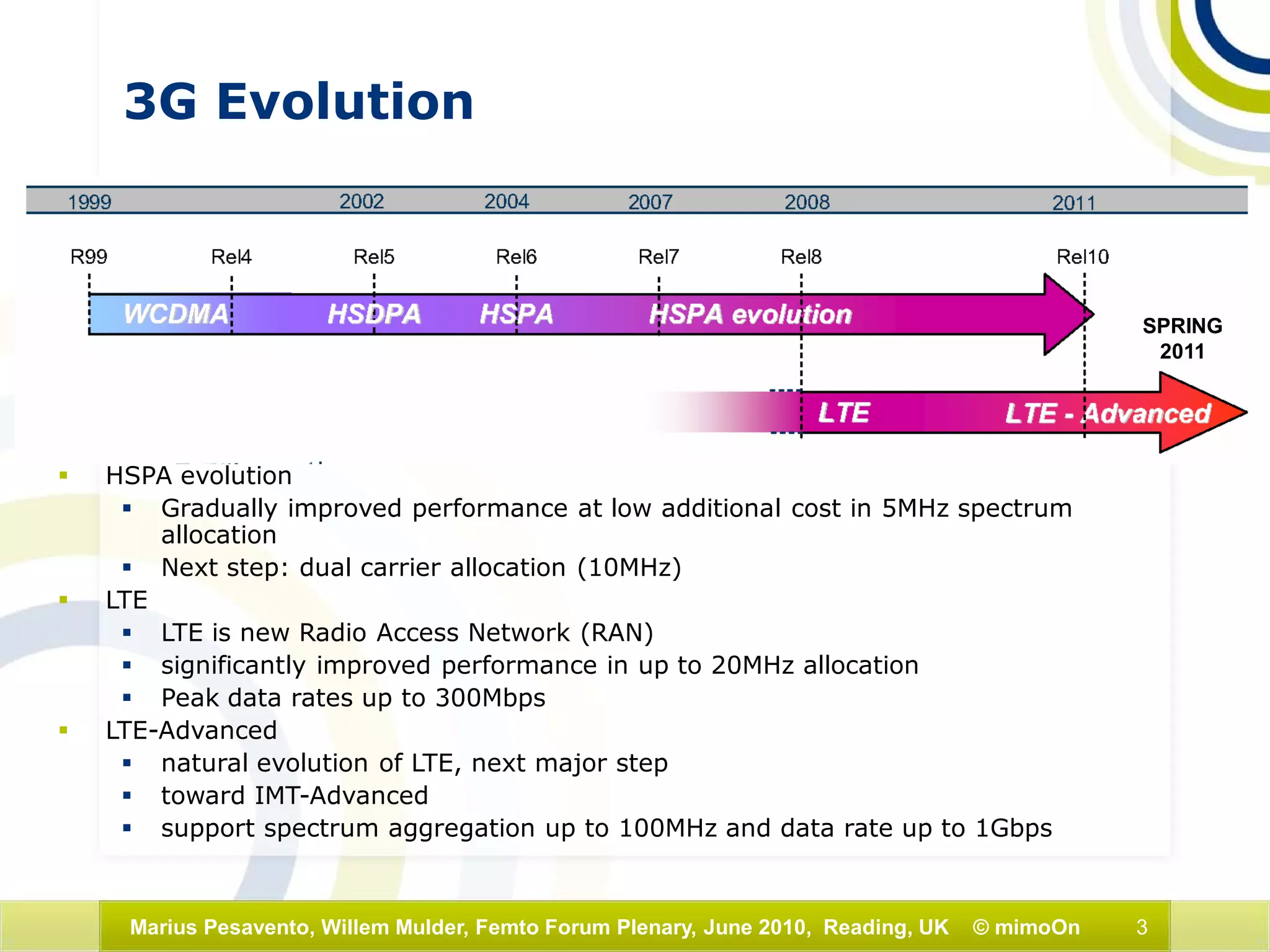
 HSPA evolution
 Gradually improved performance at low additional cost in 5MHz spectrum
allocation
 Next step: dual carrier allocation (10MHz)
 LTE
 LTE is new Radio Access Network (RAN)
 significantly improved performance in up to 20MHz allocation
 Peak data rates up to 300Mbps
 LTE-Advanced
 natural evolution of LTE, next major step
 toward IMT-Advanced
 support spectrum aggregation up to 100MHz and data rate up to 1Gbps
SPRING
2011
4Marius Pesavento, Willem Mulder, Femto Forum Plenary, June 2010, Reading, UK © mimoOn
LTE Targets
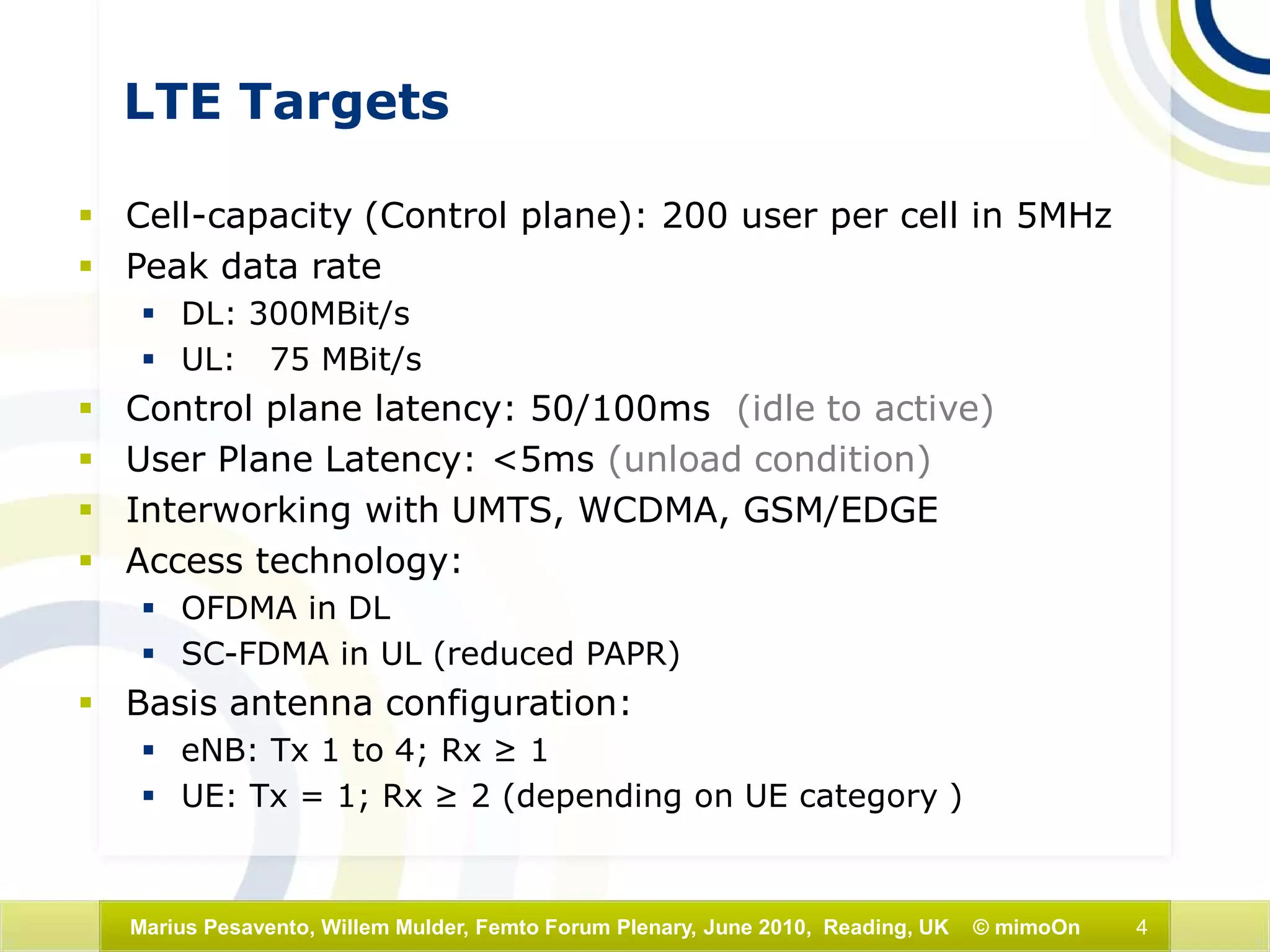
 Cell-capacity (Control plane): 200 user per cell in 5MHz
 Peak data rate
 DL: 300MBit/s
 UL: 75 MBit/s
 Control plane latency: 50/100ms (idle to active)
 User Plane Latency: <5ms (unload condition)
 Interworking with UMTS, WCDMA, GSM/EDGE
 Access technology:
 OFDMA in DL
 SC-FDMA in UL (reduced PAPR)
 Basis antenna configuration:
 eNB: Tx 1 to 4; Rx ≥ 1
 UE: Tx = 1; Rx ≥ 2 (depending on UE category )
5Marius Pesavento, Willem Mulder, Femto Forum Plenary, June 2010, Reading, UK © mimoOn
E-UTRA frequency bands
TDDN/A2400 MHz-2300 MHz2400 MHz-2300 MHz40
TDDN/A1920 MHz-1880 MHz1920 MHz-1880 MHz39
TDDN/A2620 MHz–2570 MHz2620 MHz–2570 MHz38
TDDN/A1930 MHz–1910 MHz1930 MHz–1910 MHz37
TDDN/A1990 MHz–1930 MHz1990 MHz–1930 MHz36
TDDN/A1910 MHz–1850 MHz1910 MHz–1850 MHz35
TDDN/A2025 MHz–2010 MHz2025 MHz–2010 MHz34
TDDN/A1920 MHz–1900 MHz1920 MHz–1900 MHz33
...
FDD20768 MHz–758 MHz798 MHz–788 MHz14
FDD21756 MHz–746 MHz787 MHz–777 MHz13
FDD[TBD][TBD]–[TBD][TBD]–[TBD]12
FDD23 MHz1500.9 MHz–1475.9MHz1452.9 MHz–1427.9MH
z
11
FDD340 MHz2170 MHz–2110 MHz1770 MHz–1710 MHz10
FDD60 MHz1879.9 MHz–1844.9MHz1784.9 MHz–1749.9MHz9
FDD10 MHz960 MHz–925 MHz915 MHz–880 MHz8
FDD50 MHz2690 MHz–2620 MHz2570 MHz–2500 MHz7
FDD35 MHz885 MHz–875 MHz840 MHz–830 MHz6
FDD20 MHz894MHz–869 MHz849 MHz–824 MHz5
FDD355 MHz2155 MHz–2110 MHz1755 MHz–1710 MHz4
FDD20 MHz1880 MHz–1805 MHz1785 MHz–1710 MHz3
FDD20 MHz1990 MHz–1930 MHz1910 MHz–1850 MHz2
FDD130 MHz2170 MHz–2110 MHz1980 MHz–1920 MHz1
FDL_low-FUL_highFDL_low – FDL_highFUL_low – FUL_high
Duplex
Mode
UL-DL Band
separation
Downlink (DL)
eNode B transmit
UE receive
Uplink (UL)
eNode B receive
UE transmit
E-UTRA
Band
UMTS band
extension band
6Marius Pesavento, Willem Mulder, Femto Forum Plenary, June 2010, Reading, UK © mimoOn
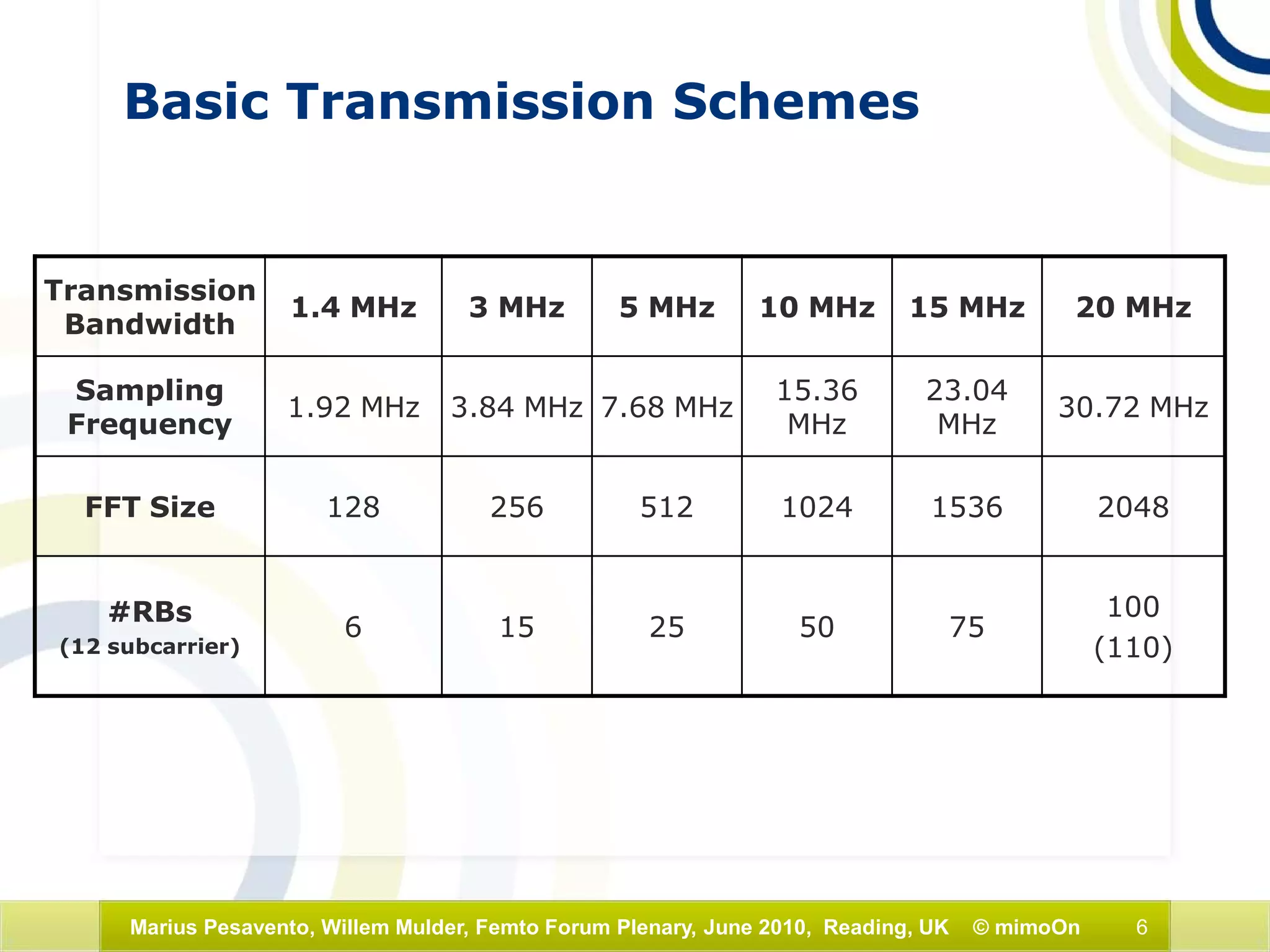
Basic Transmission Schemes
Transmission
Bandwidth
1.4 MHz 3 MHz 5 MHz 10 MHz 15 MHz 20 MHz
Sampling
Frequency
1.92 MHz 3.84 MHz 7.68 MHz
15.36
MHz
23.04
MHz
30.72 MHz
FFT Size 128 256 512 1024 1536 2048
#RBs
(12 subcarrier)
6 15 25 50 75
100
(110)
7Marius Pesavento, Willem Mulder, Femto Forum Plenary, June 2010, Reading, UK © mimoOn
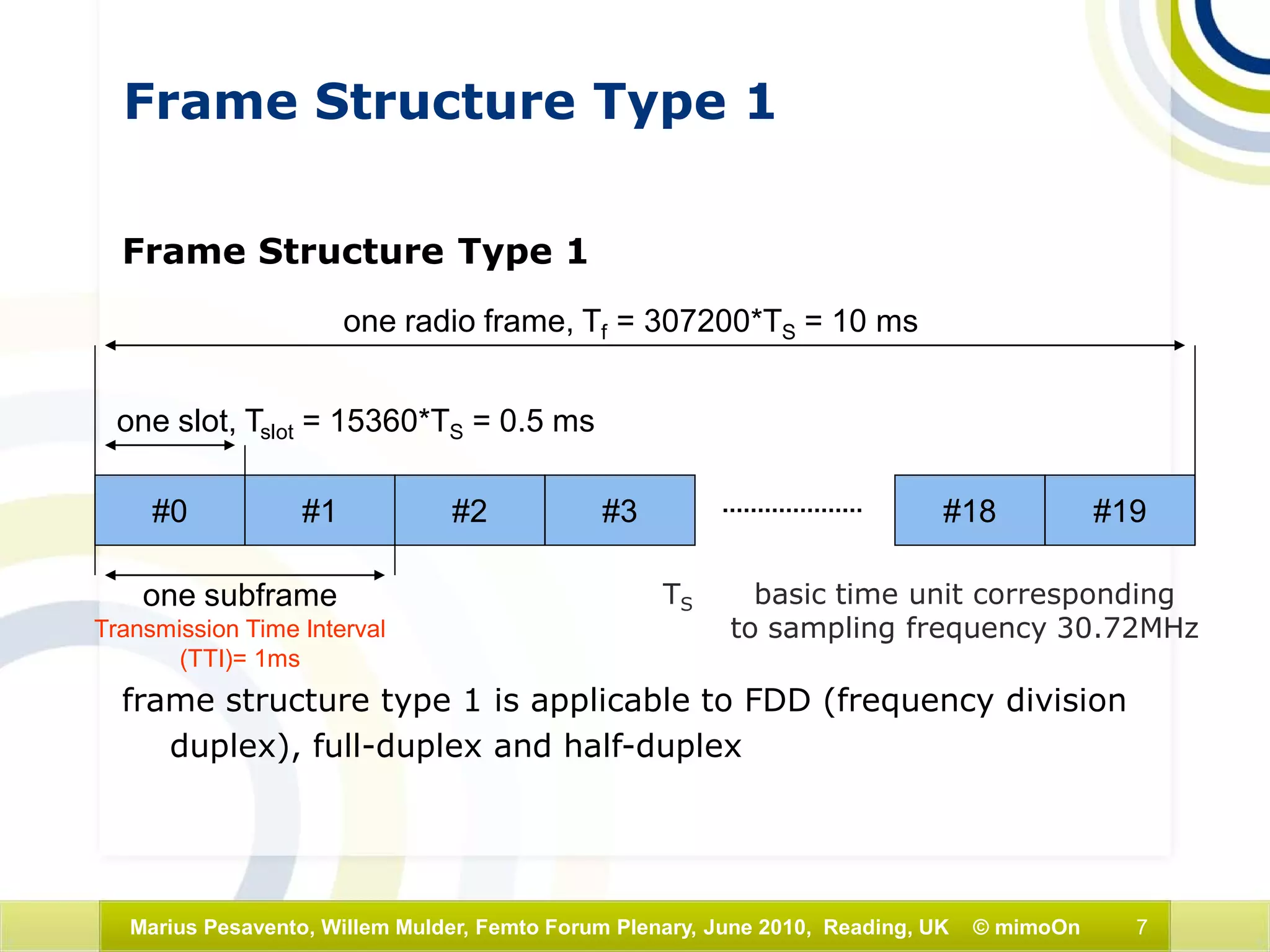
Frame Structure Type 1
frame structure type 1 is applicable to FDD (frequency division
duplex), full-duplex and half-duplex
#0 #1 #2 #3 #18 #19
one slot, Tslot = 15360*TS = 0.5 ms
one radio frame, Tf = 307200*TS = 10 ms
one subframe
Transmission Time Interval
(TTI)= 1ms
TS basic time unit corresponding
to sampling frequency 30.72MHz
8Marius Pesavento, Willem Mulder, Femto Forum Plenary, June 2010, Reading, UK © mimoOn
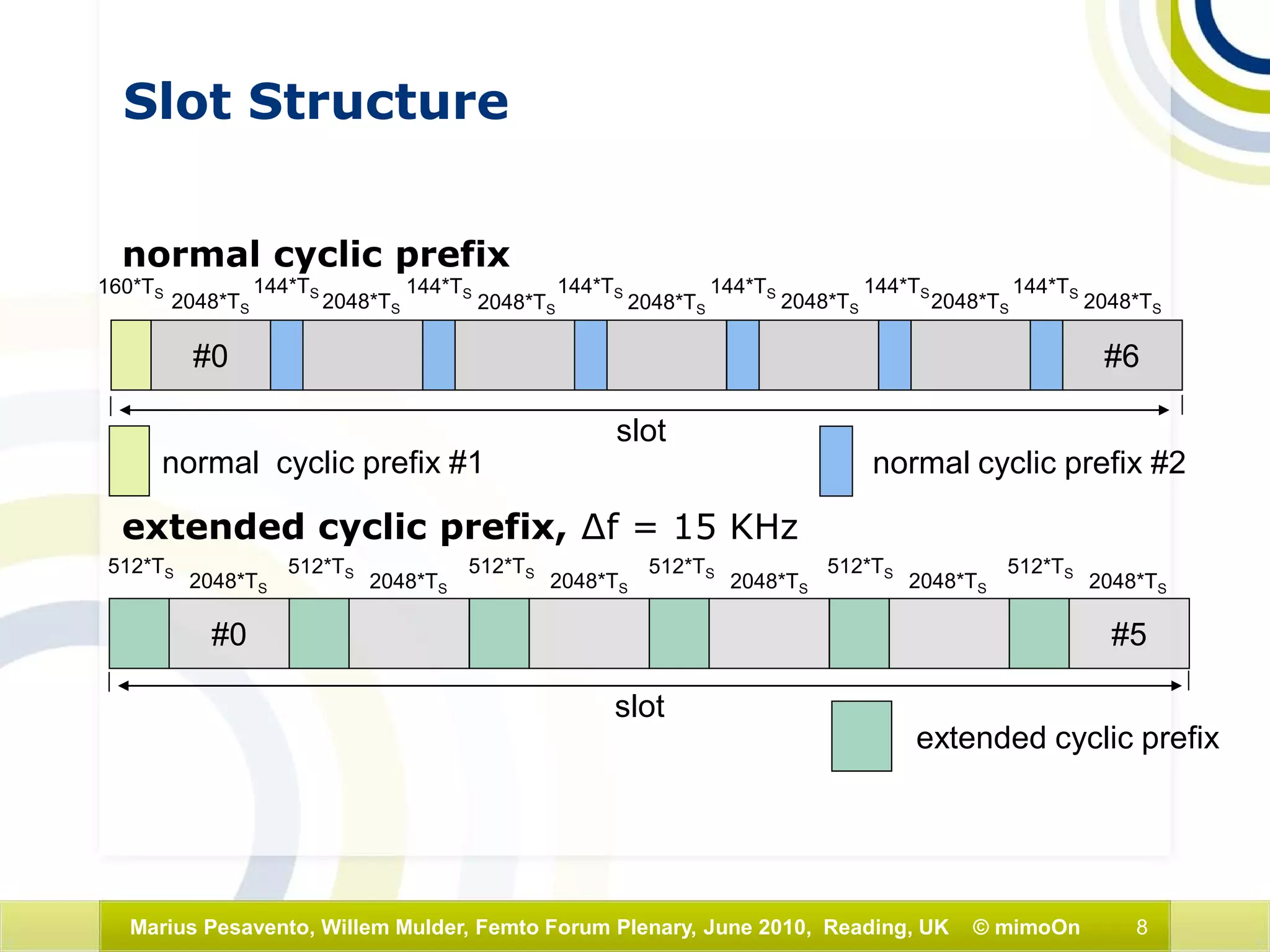
Slot Structure
normal cyclic prefix
extended cyclic prefix, ∆f = 15 KHz
normal cyclic prefix #2normal cyclic prefix #1
2048*TS
144*TS
2048*TS2048*TS2048*TS2048*TS2048*TS2048*TS
160*TS 144*TS144*TS144*TS144*TS144*TS
slot
#0 #6
extended cyclic prefix
#0 #5
2048*TS
512*TS
2048*TS
512*TS
2048*TS
512*TS
2048*TS
512*TS
2048*TS
512*TS
2048*TS
512*TS
slot
9Marius Pesavento, Willem Mulder, Femto Forum Plenary, June 2010, Reading, UK © mimoOn
subframe
1 ms
one radio frame, Tf = 307200*TS = 10 ms
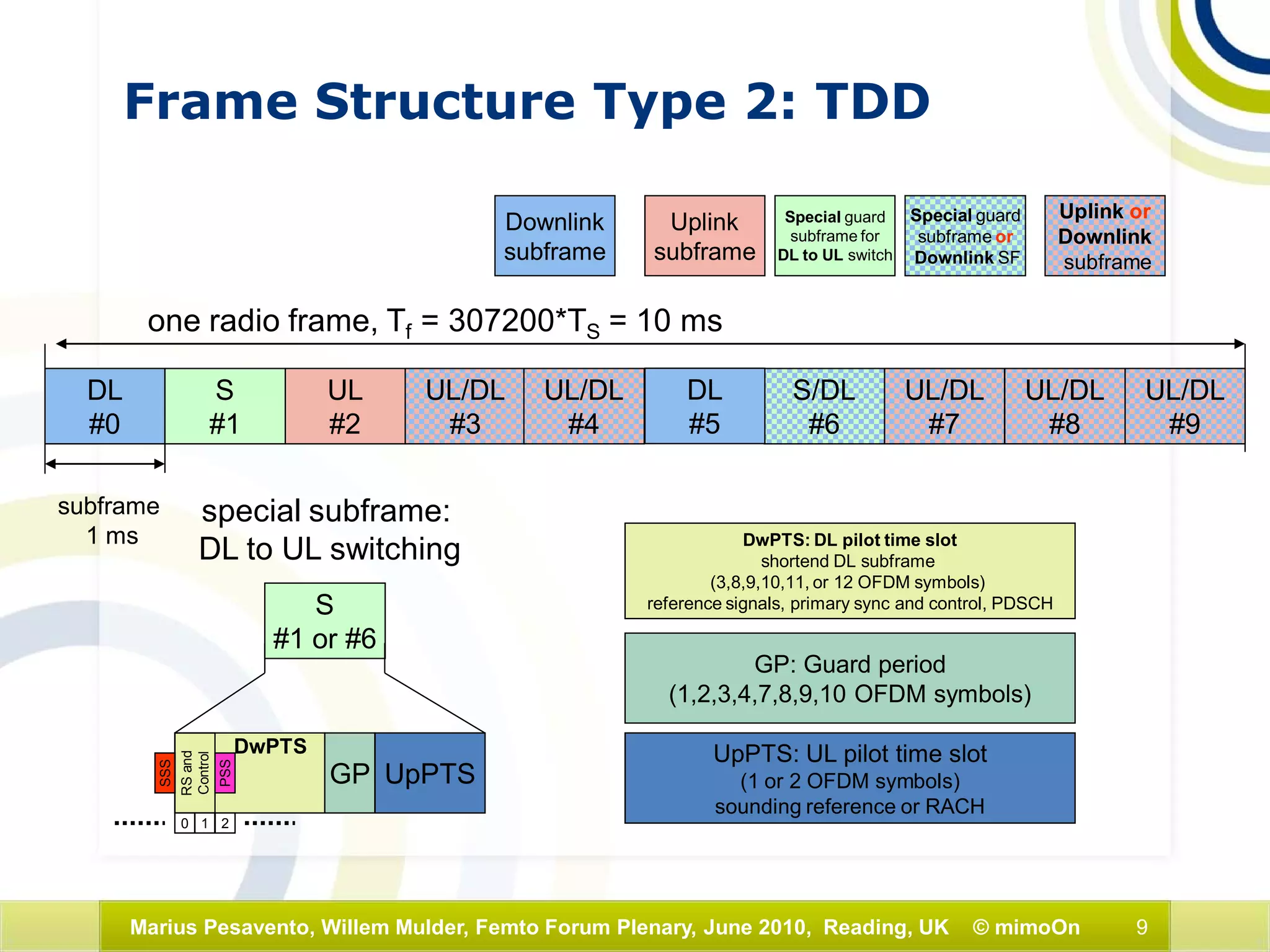
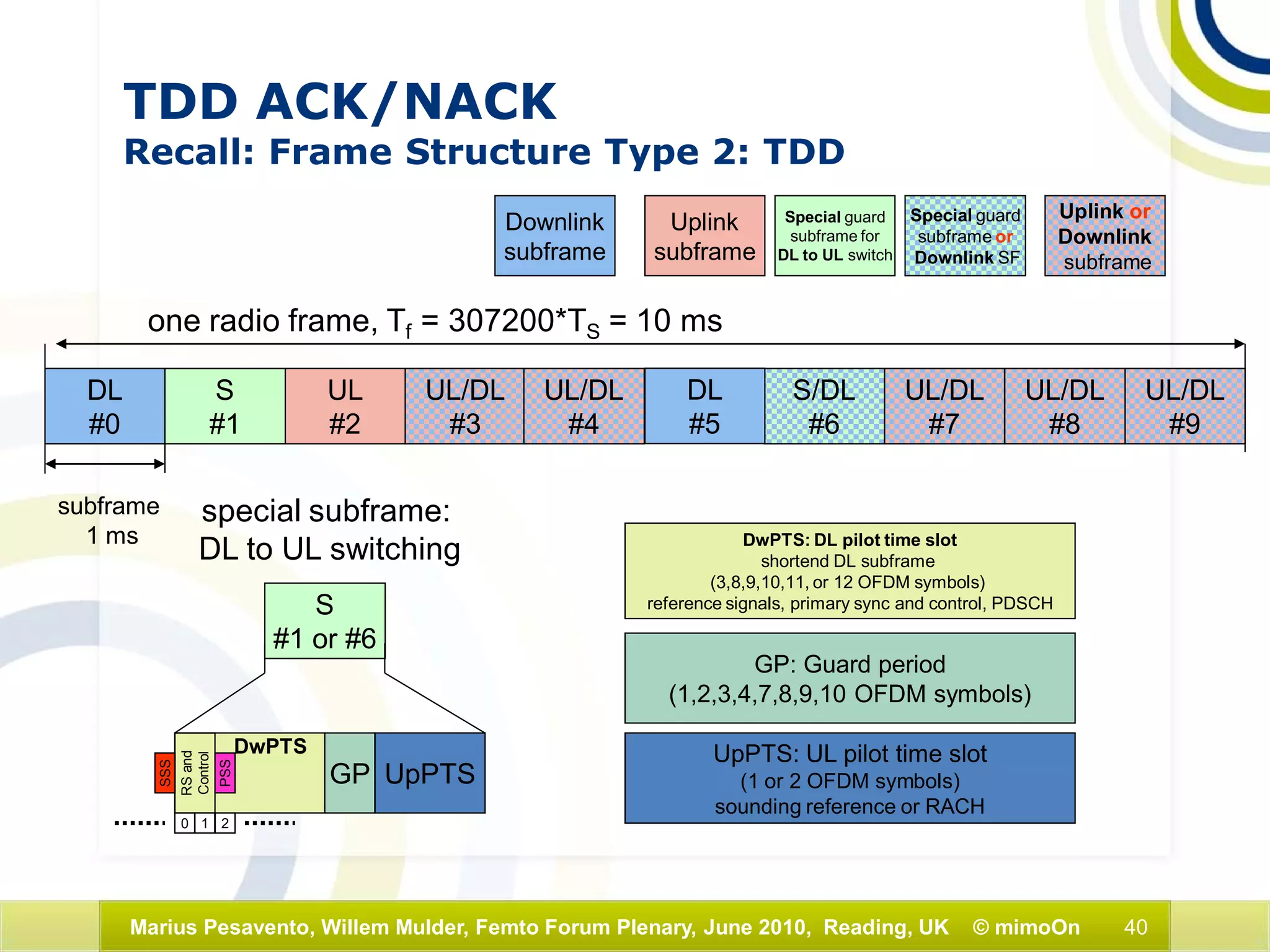
Frame Structure Type 2: TDD
DL
#0
S
#1
UL
#2
UL/DL
#3
UL/DL
#4
S/DL
#6
DL
#5
UL/DL
#7
UL/DL
#8
UL/DL
#9
Downlink
subframe
Uplink
subframe
Special guard
subframe for
DL to UL switch
Special guard
subframe or
Downlink SF
Uplink or
Downlink
subframe
special subframe:
DL to UL switching
S
#1 or #6
DwPTS
GP UpPTS
DwPTS: DL pilot time slot
shortend DL subframe
(3,8,9,10,11, or 12 OFDM symbols)
reference signals, primary sync and control, PDSCH
GP: Guard period
(1,2,3,4,7,8,9,10 OFDM symbols)
UpPTS: UL pilot time slot
(1 or 2 OFDM symbols)
sounding reference or RACH
SSS
RSand
Control
PSS
0 1 2
10Marius Pesavento, Willem Mulder, Femto Forum Plenary, June 2010, Reading, UK © mimoOn
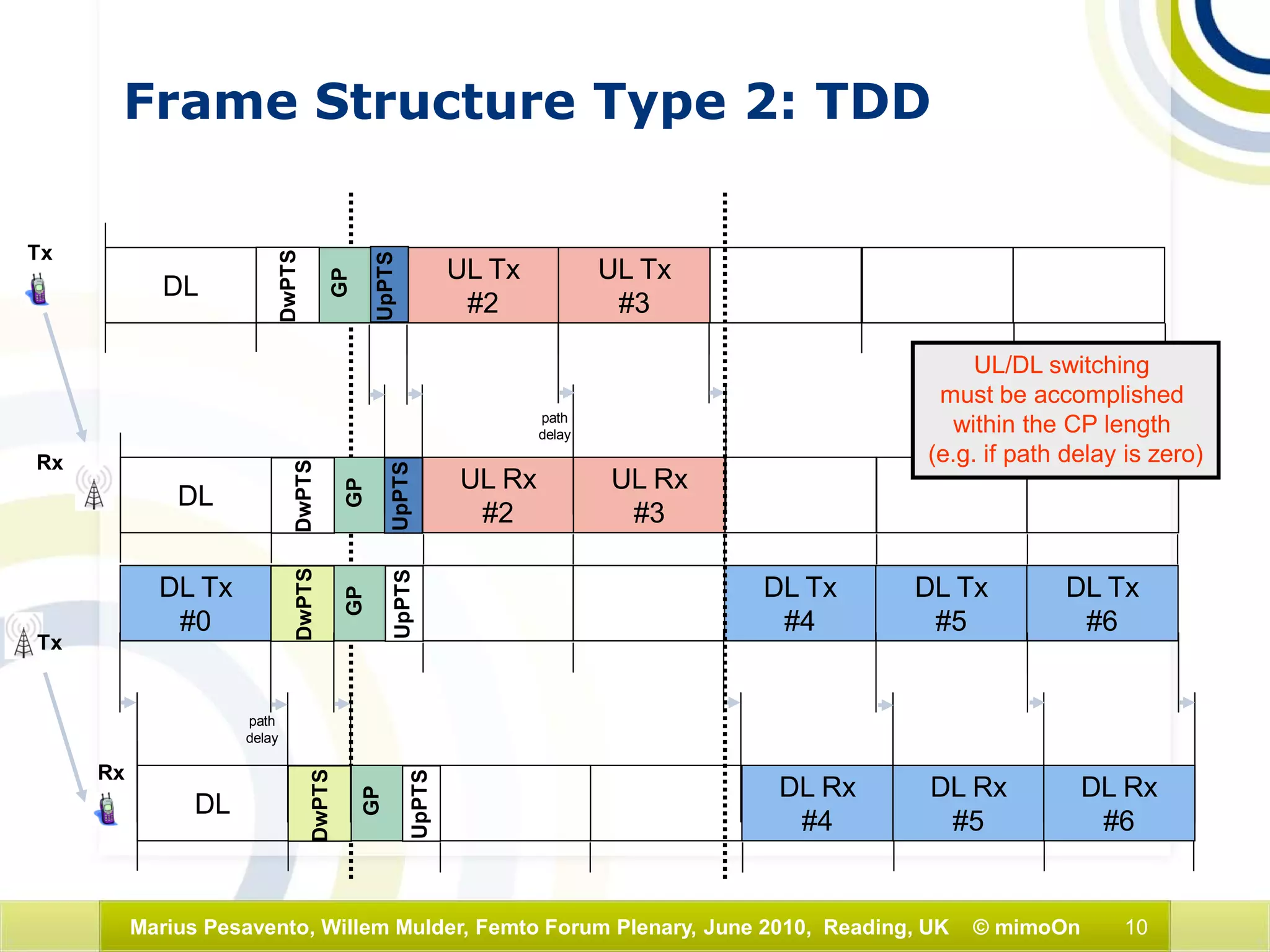
Frame Structure Type 2: TDD
Tx
Rx
Tx
Rx
DL
UL Tx
#2
UL Tx
#3
GP
UpPTS
DwPTS
DL
UL Rx
#2
UL Rx
#3
GP
UpPTS
DwPTS
DL Tx
#0
DL Tx
#4
DL Tx
#6
DL Tx
#5
GP
UpPTS
DwPTS
DL
DL Rx
#4
DL Rx
#6
DL Rx
#5
GP
UpPTS
DwPTS
path
delay
path
delay
UL/DL switching
must be accomplished
within the CP length
(e.g. if path delay is zero)
11Marius Pesavento, Willem Mulder, Femto Forum Plenary, June 2010, Reading, UK © mimoOn
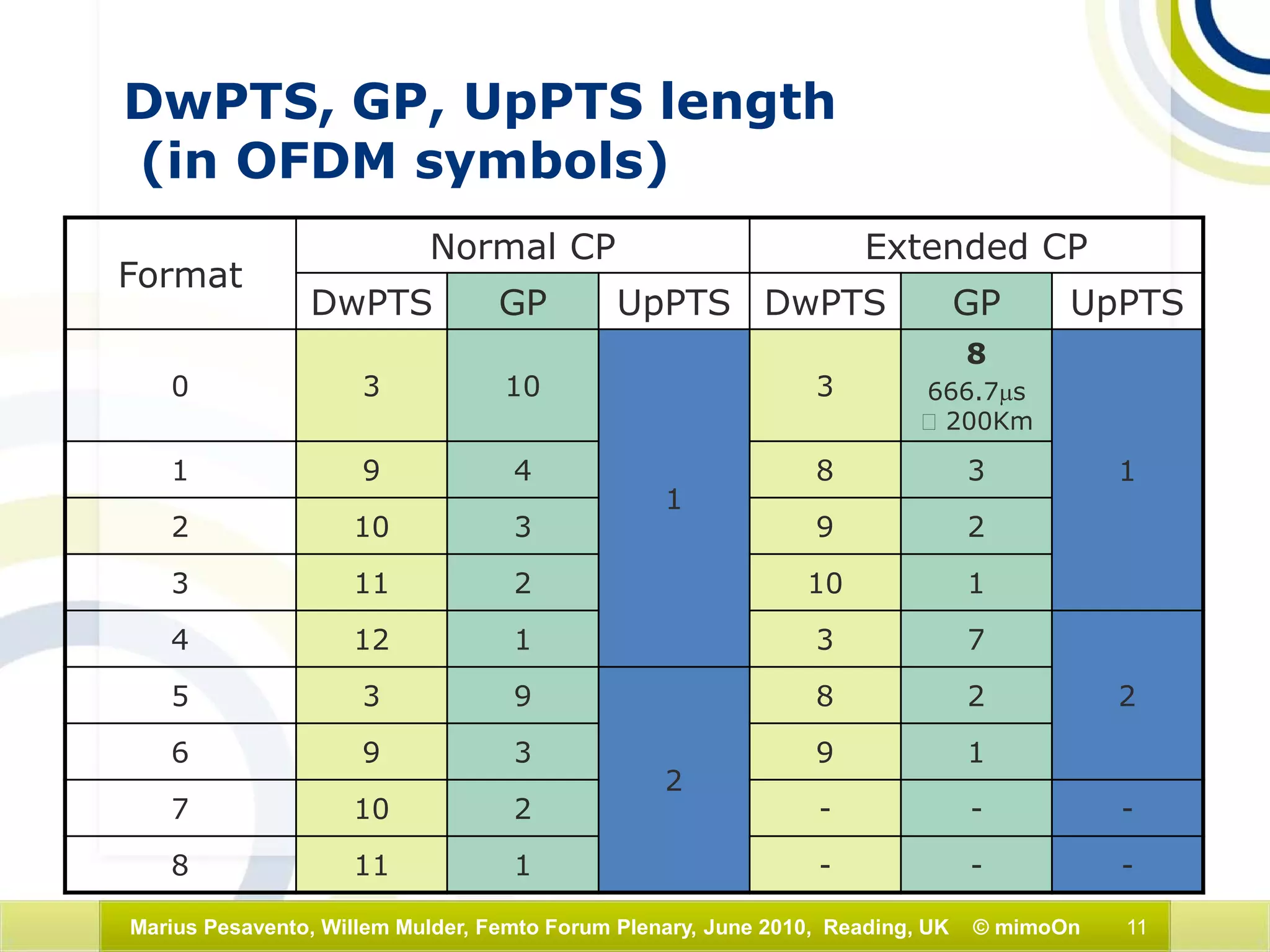
DwPTS, GP, UpPTS length
(in OFDM symbols)
Format
Normal CP Extended CP
DwPTS GP UpPTS DwPTS GP UpPTS
0 3 10
1
3
8
666.7µs
 200Km
11 9 4 8 3
2 10 3 9 2
3 11 2 10 1
4 12 1 3 7
25 3 9
2
8 2
6 9 3 9 1
7 10 2 - - -
8 11 1 - - -
12Marius Pesavento, Willem Mulder, Femto Forum Plenary, June 2010, Reading, UK © mimoOn
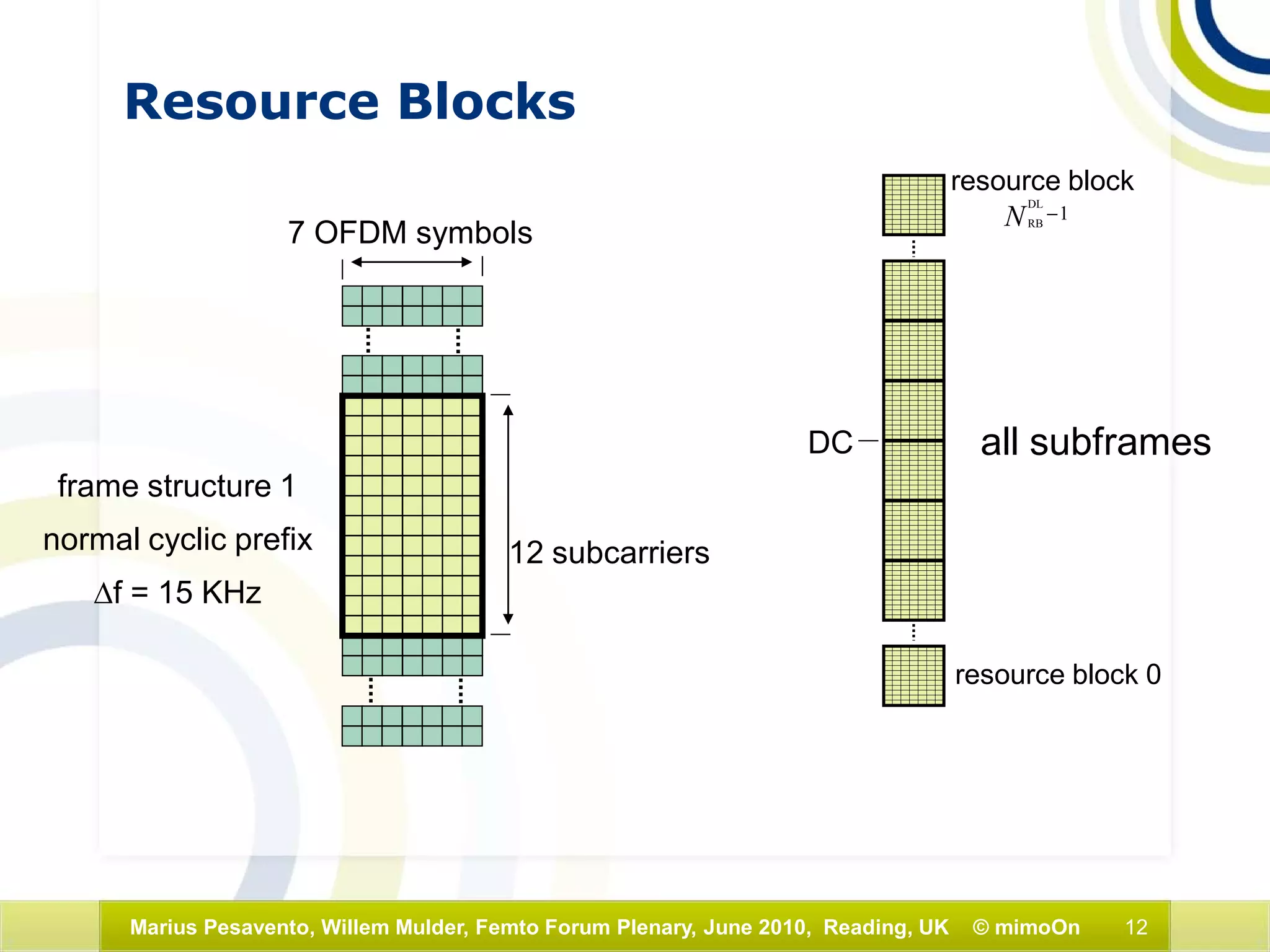
Resource Blocks
7 OFDM symbols
12 subcarriers
frame structure 1
normal cyclic prefix
∆f = 15 KHz
DC
1
DL
RB
−N
resource block
resource block 0
all subframes
13Marius Pesavento, Willem Mulder, Femto Forum Plenary, June 2010, Reading, UK © mimoOn
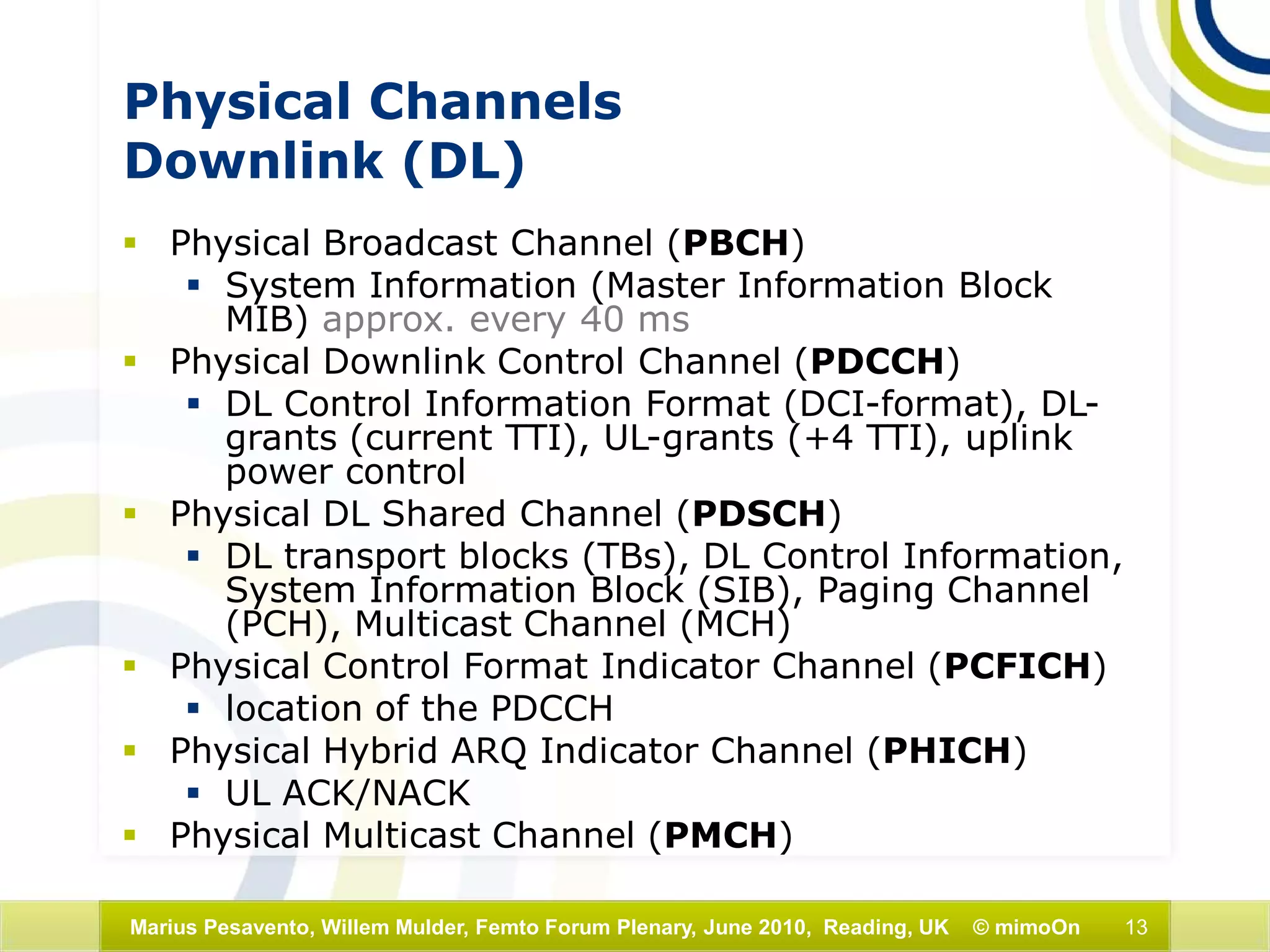
Physical Channels
Downlink (DL)
 Physical Broadcast Channel (PBCH)
 System Information (Master Information Block
MIB) approx. every 40 ms
 Physical Downlink Control Channel (PDCCH)
 DL Control Information Format (DCI-format), DL-
grants (current TTI), UL-grants (+4 TTI), uplink
power control
 Physical DL Shared Channel (PDSCH)
 DL transport blocks (TBs), DL Control Information,
System Information Block (SIB), Paging Channel
(PCH), Multicast Channel (MCH)
 Physical Control Format Indicator Channel (PCFICH)
 location of the PDCCH
 Physical Hybrid ARQ Indicator Channel (PHICH)
 UL ACK/NACK
 Physical Multicast Channel (PMCH)
14Marius Pesavento, Willem Mulder, Femto Forum Plenary, June 2010, Reading, UK © mimoOn
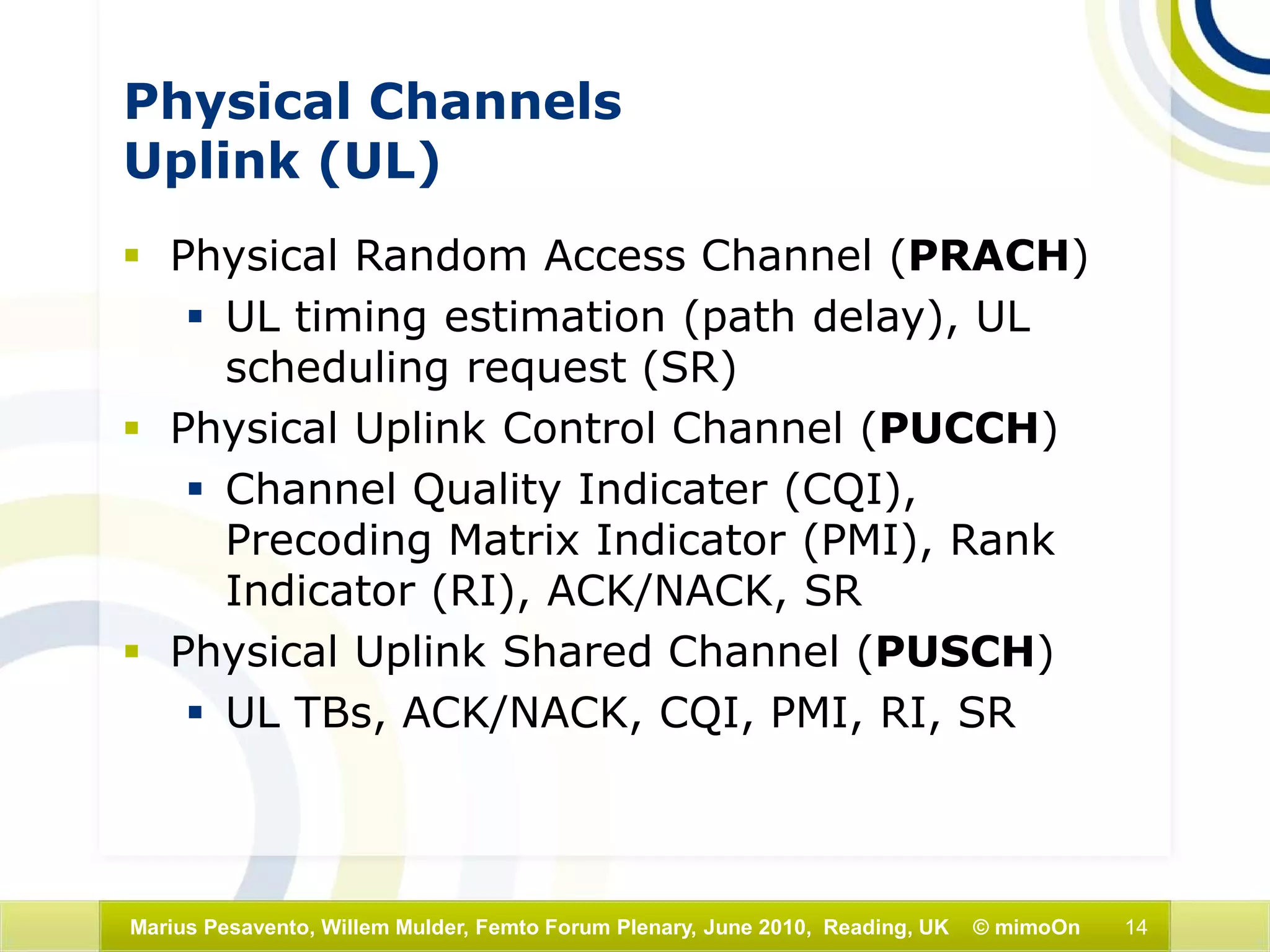
Physical Channels
Uplink (UL)
 Physical Random Access Channel (PRACH)
 UL timing estimation (path delay), UL
scheduling request (SR)
 Physical Uplink Control Channel (PUCCH)
 Channel Quality Indicater (CQI),
Precoding Matrix Indicator (PMI), Rank
Indicator (RI), ACK/NACK, SR
 Physical Uplink Shared Channel (PUSCH)
 UL TBs, ACK/NACK, CQI, PMI, RI, SR
15Marius Pesavento, Willem Mulder, Femto Forum Plenary, June 2010, Reading, UK © mimoOn
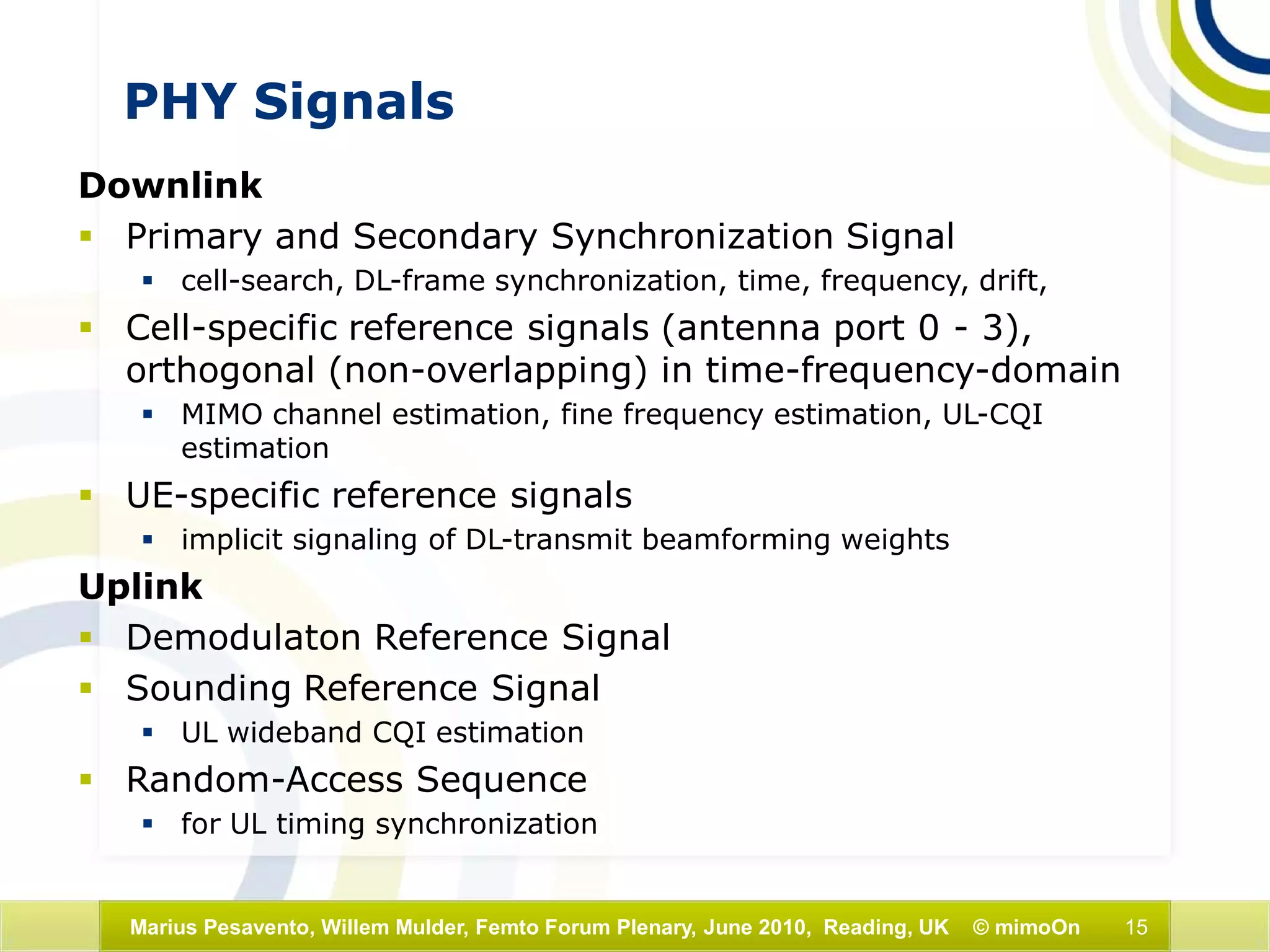
PHY Signals
Downlink
 Primary and Secondary Synchronization Signal
 cell-search, DL-frame synchronization, time, frequency, drift,
 Cell-specific reference signals (antenna port 0 - 3),
orthogonal (non-overlapping) in time-frequency-domain
 MIMO channel estimation, fine frequency estimation, UL-CQI
estimation
 UE-specific reference signals
 implicit signaling of DL-transmit beamforming weights
Uplink
 Demodulaton Reference Signal
 Sounding Reference Signal
 UL wideband CQI estimation
 Random-Access Sequence
 for UL timing synchronization
16Marius Pesavento, Willem Mulder, Femto Forum Plenary, June 2010, Reading, UK © mimoOn
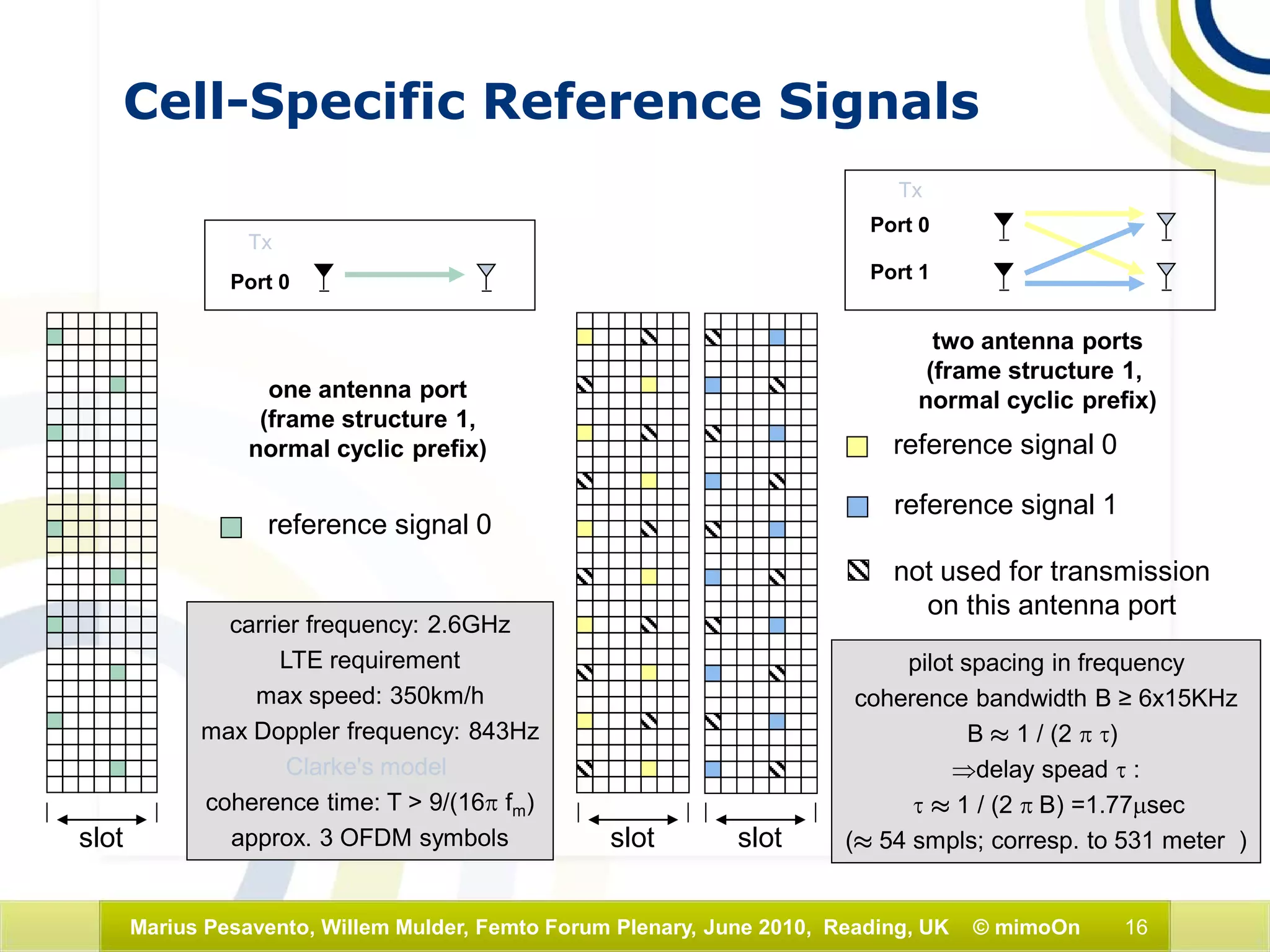
one antenna port
(frame structure 1,
normal cyclic prefix)

reference signal 0
two antenna ports
(frame structure 1,
normal cyclic prefix)
reference signal 0
reference signal 1
not used for transmission
on this antenna port
slot slot slot
Cell-Specific Reference Signals
carrier frequency: 2.6GHz
LTE requirement
max speed: 350km/h
max Doppler frequency: 843Hz
Clarke's model
coherence time: T > 9/(16π fm)
approx. 3 OFDM symbols
pilot spacing in frequency
coherence bandwidth B ≥ 6x15KHz
B ¼ 1 / (2 π τ)
⇒delay spead τ :
τ ¼ 1 / (2 π B) =1.77µsec
(¼ 54 smpls; corresp. to 531 meter )
Port 0 Port 1
Port 0
Tx
Tx
17Marius Pesavento, Willem Mulder, Femto Forum Plenary, June 2010, Reading, UK © mimoOn
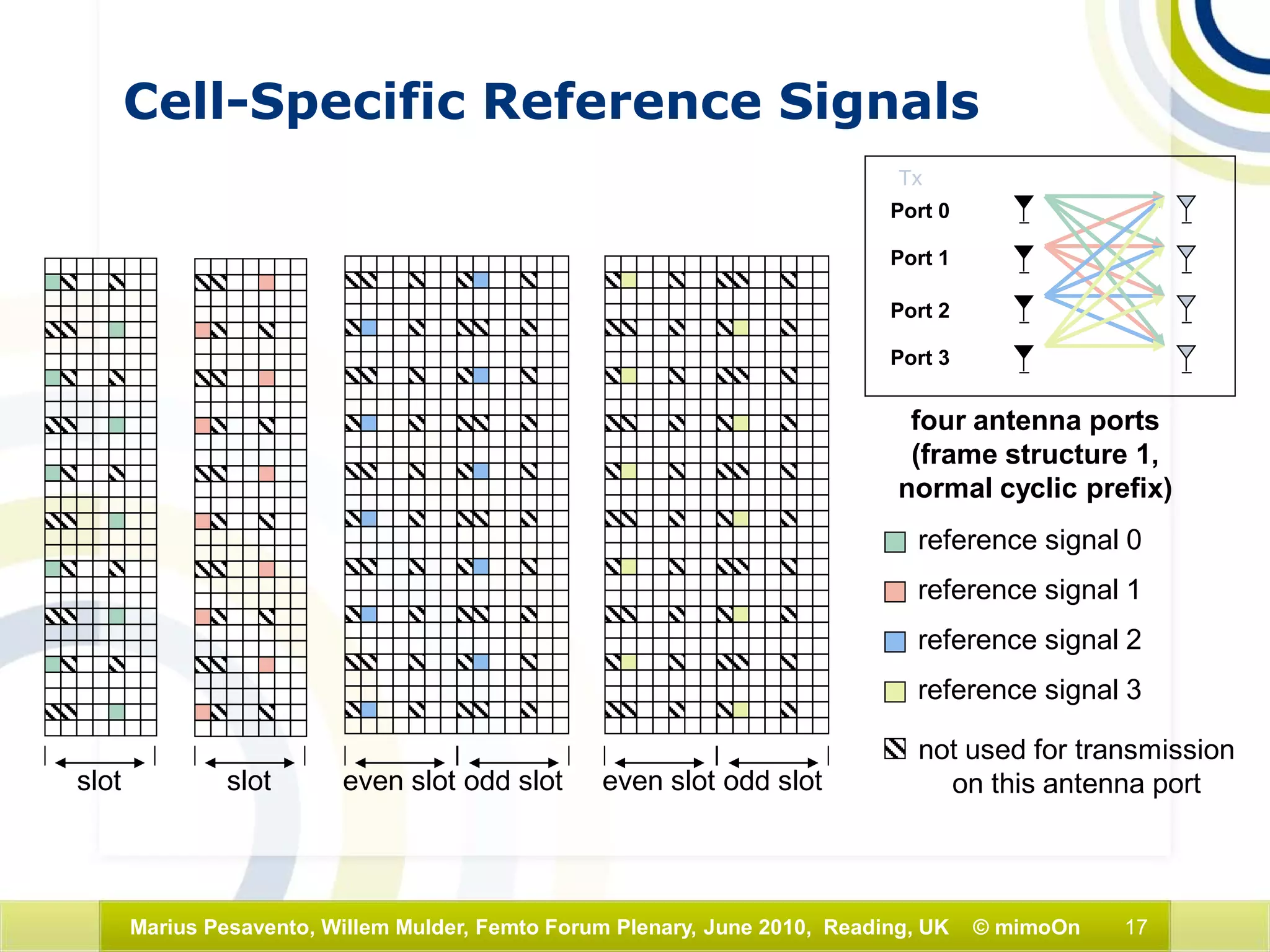
reference signal 0
reference signal 1
not used for transmission
on this antenna port
reference signal 2
reference signal 3
four antenna ports
(frame structure 1,
normal cyclic prefix)
slot slot even slot odd slot even slot odd slot
Cell-Specific Reference Signals
Port 3
Port 2
Port 1
Port 0
Tx
18Marius Pesavento, Willem Mulder, Femto Forum Plenary, June 2010, Reading, UK © mimoOn
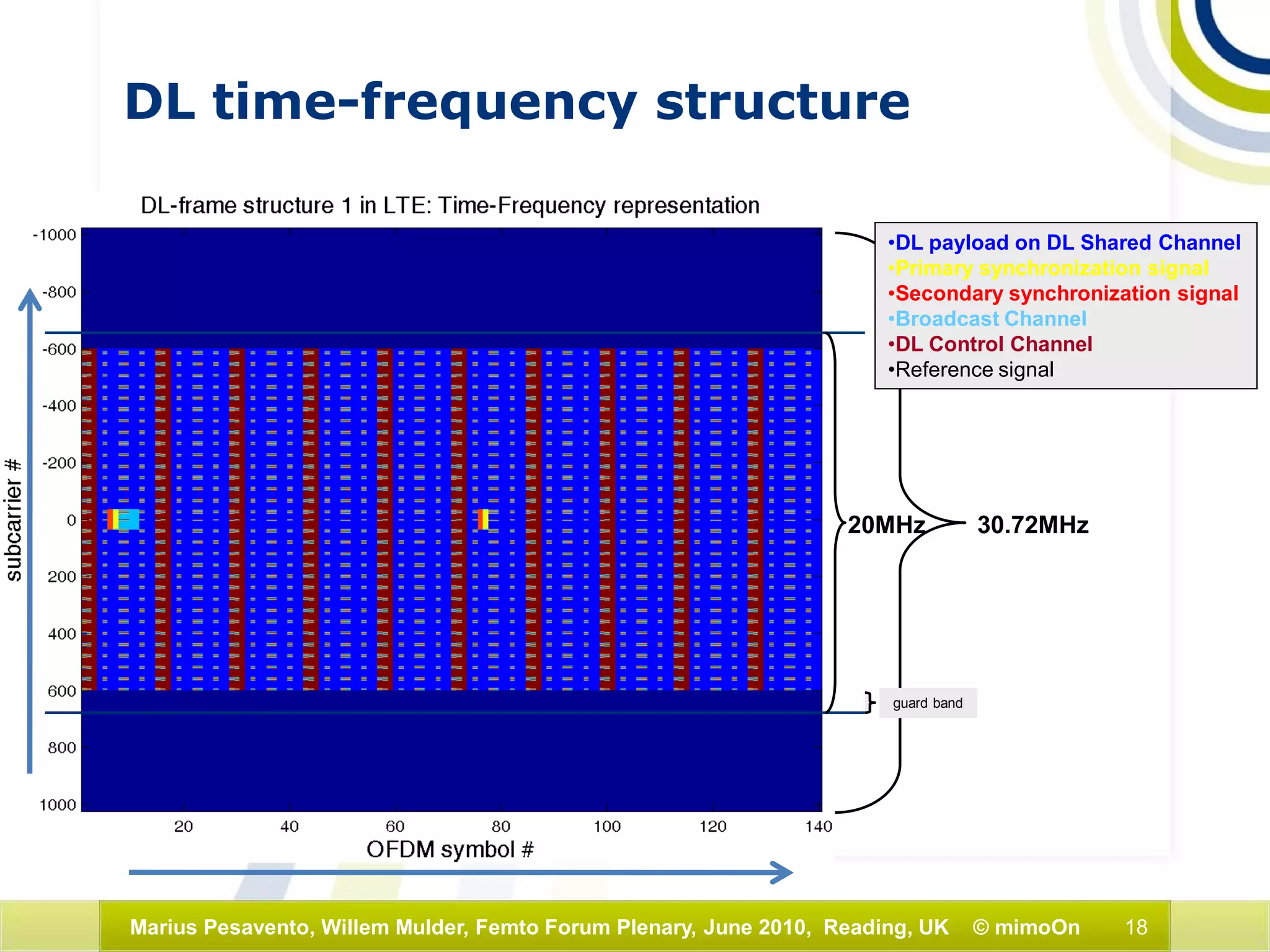
DL time-frequency structure
•DL payload on DL Shared Channel
•Primary synchronization signal
•Secondary synchronization signal
•Broadcast Channel
•DL Control Channel
•Reference signal
20MHz 30.72MHz
guard band
19Marius Pesavento, Willem Mulder, Femto Forum Plenary, June 2010, Reading, UK © mimoOn
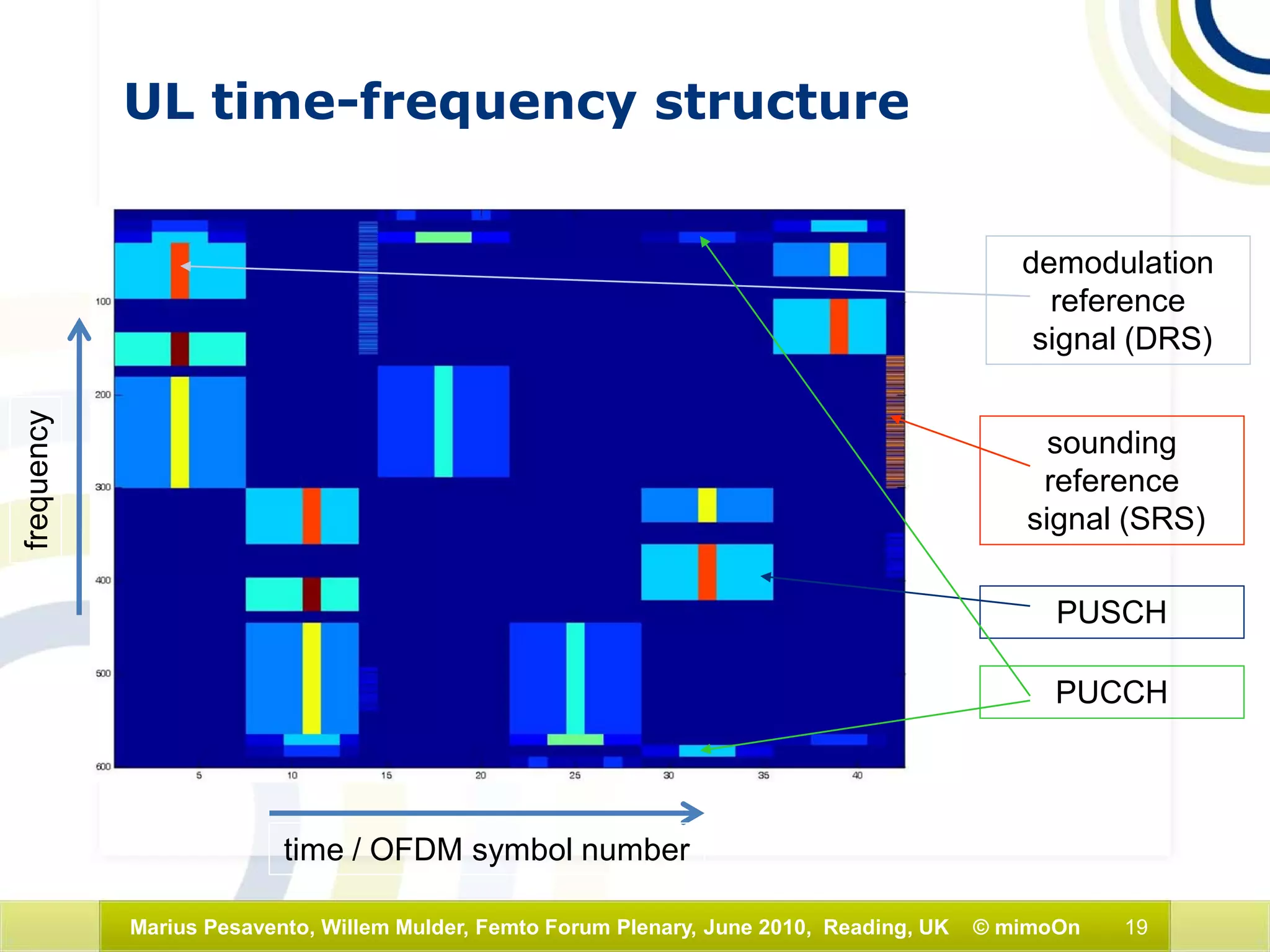
UL time-frequency structure
demodulation
reference
signal (DRS)
sounding
reference
signal (SRS)
PUSCH
PUCCH
time / OFDM symbol number
frequency
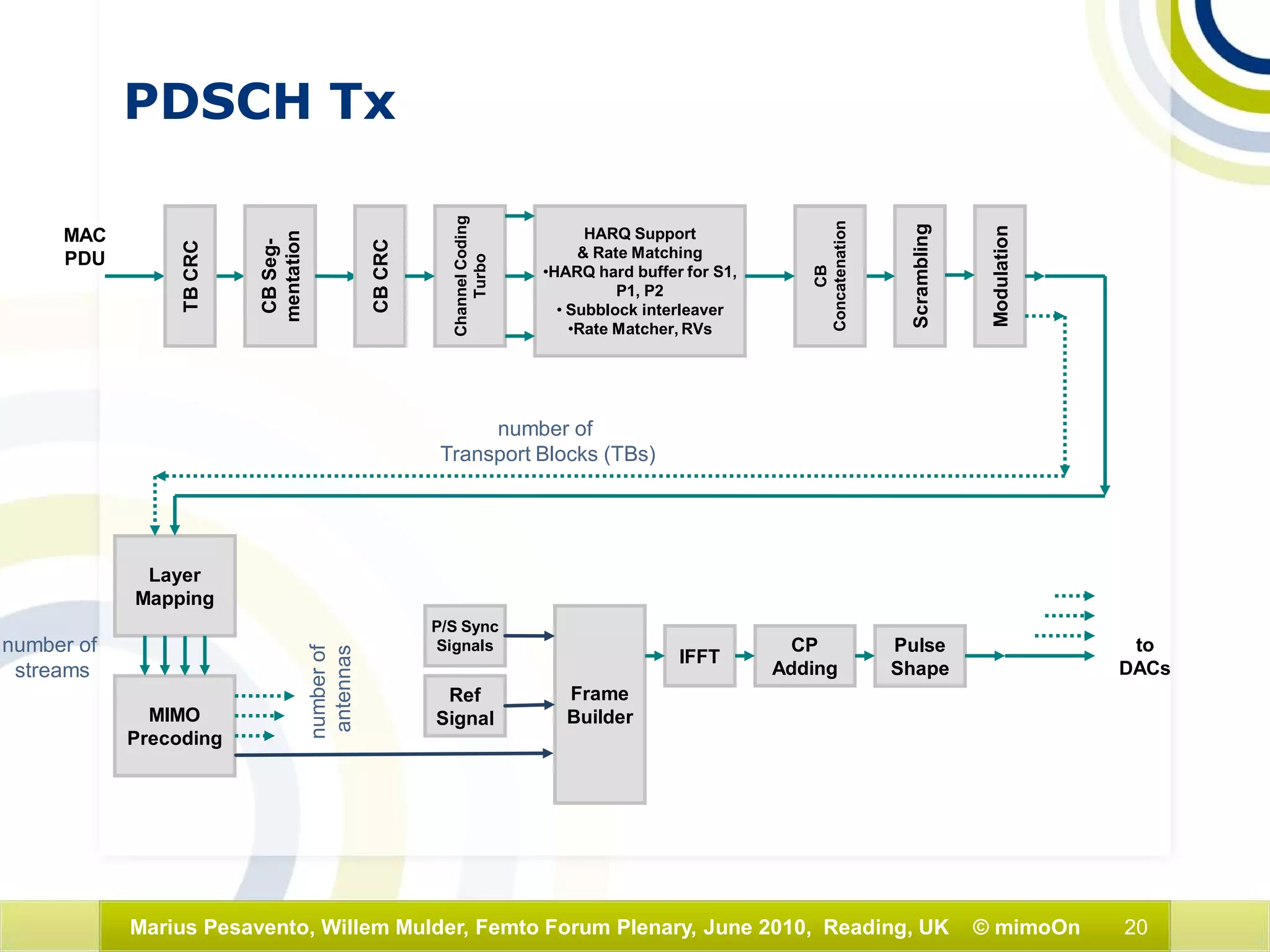
20Marius Pesavento, Willem Mulder, Femto Forum Plenary, June 2010, Reading, UK © mimoOn
MAC
PDU
CBSeg-
mentation
Modulation
Layer
Mapping
MIMO
Precoding
P/S Sync
Signals
Ref
Signal
Frame
Builder
IFFT
CP
Adding
Pulse
Shape
ChannelCoding
Turbo
HARQ Support
& Rate Matching
•HARQ hard buffer for S1,
P1, P2
• Subblock interleaver
•Rate Matcher, RVs
Scrambling
to
DACs
TBCRC
CBCRC
CB
Concatenation
PDSCH Tx
numberof
antennas
number of
Transport Blocks (TBs)
number of
streams
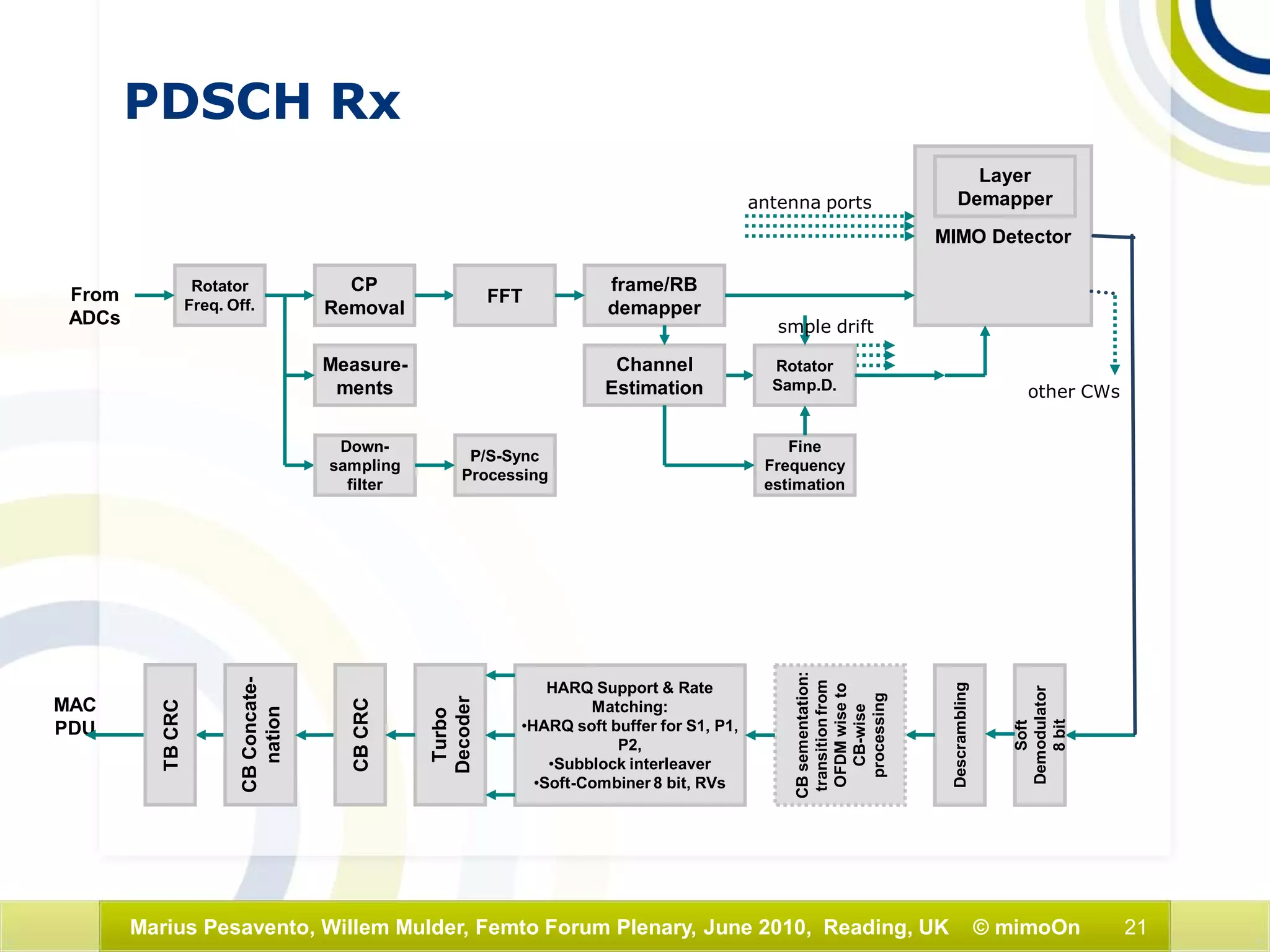
21Marius Pesavento, Willem Mulder, Femto Forum Plenary, June 2010, Reading, UK © mimoOn
MAC
PDU
frame/RB
demapper
Rotator
Freq. Off.
CP
Removal
FFT
Channel
Estimation
Measure-
ments
MIMO Detector
From
ADCs
Layer
Demapper
P/S-Sync
Processing
CBConcate-
nation
Soft
Demodulator
8bit
Turbo
Decoder
HARQ Support & Rate
Matching:
•HARQ soft buffer for S1, P1,
P2,
•Subblock interleaver
•Soft-Combiner 8 bit, RVs
Descrambling
TBCRC
CBCRC
CBsementation:
transitionfrom
OFDMwiseto
CB-wise
processing
antenna ports
Down-
sampling
filter
Fine
Frequency
estimation
Rotator
Samp.D. other CWs
smple drift
PDSCH Rx
22Marius Pesavento, Willem Mulder, Femto Forum Plenary, June 2010, Reading, UK © mimoOn
Transform
Precoding
Mixed-Radix DFT
Demod.
Ref.
Signal
RB
Resource
Mapper
IFFT
CP
Adding
Pulse
Shape DAC
Rotator
Freq.
Cor.
MAC
PDU
CBSeg-
mentation
Modulation
Channel
TurboCoding
Data&Control
Mux
Scrambling
TBCRC
CBCRC
CB
Concatenation
HARQ Support
& Rate Matching
•HARQ hard buffer for S1,
P1, P2
• Subblock interleaver
•Rate Matcher, RVs
Rotator
Samp.
Drift
Sound.
Ref.
Signal
control
TS36.212Figure
5.2.2-1
Channel
Interleaving
ACK RI
Length 32
block code
CQI and/or PMI report
CQI <= 11 bit
CQI and/or
PMI report
CQI > 11 bit
32bit
Channel
Conv.
Coding
CBCRC
Rate Matching
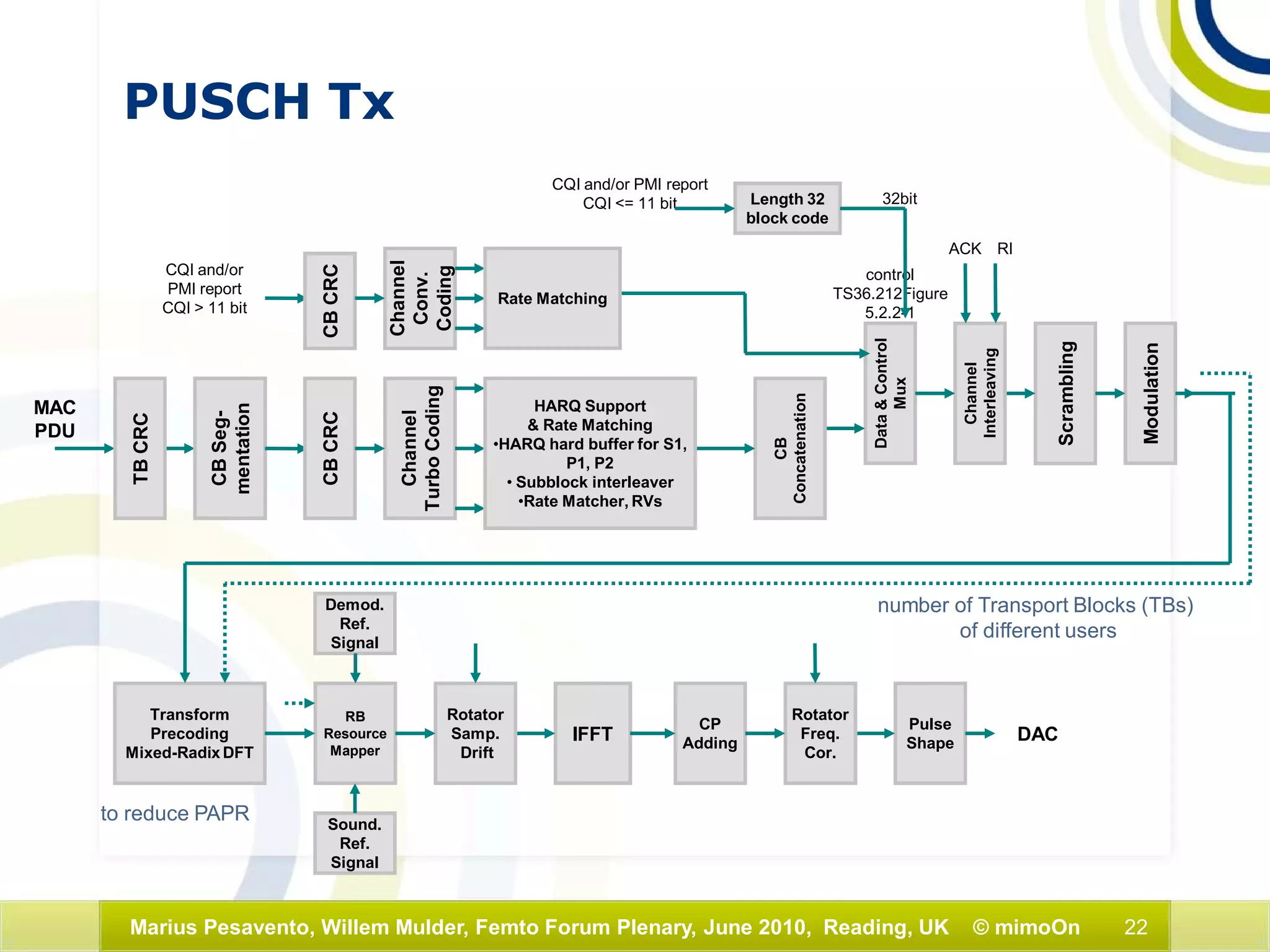
PUSCH Tx
number of Transport Blocks (TBs)
of different users
to reduce PAPR
23Marius Pesavento, Willem Mulder, Femto Forum Plenary, June 2010, Reading, UK © mimoOn
control
TS36.212Figure
5.2.2-1
MAC
PDU
CBConcate-
nation
Soft
demodulator
8.bit
Turbo
Decoder
Descrambling
TBCRC
CBCRC
CBSegmentation:
Transitionfrom
OFDM-toCB-wise
processing
Tranform
(De)Precoding
(mixed-Radix
DFT)
frame/RB
Demapper
CP
Removal
FFT
Demod. Ref.
Channel Estimation
Measure-
ments
Multi-
Antenna
Receiver
Sounding Ref.
Processing
Data&Control
Demux
Frame
timing
HARQ Support & Rate
Matching:
•HARQ soft buffer for S1, P1,
P2,
•Subblock interleaver
•Soft-Combiner 8 bit, RVs
From
ADCs
Channel
deinterleaver
ACK RI
Block decoder
(32,11)
Rate DeMatching:
•Subblock interleaver
•Soft-Combiner 8 bit, RVs
ViterbiCB CRC
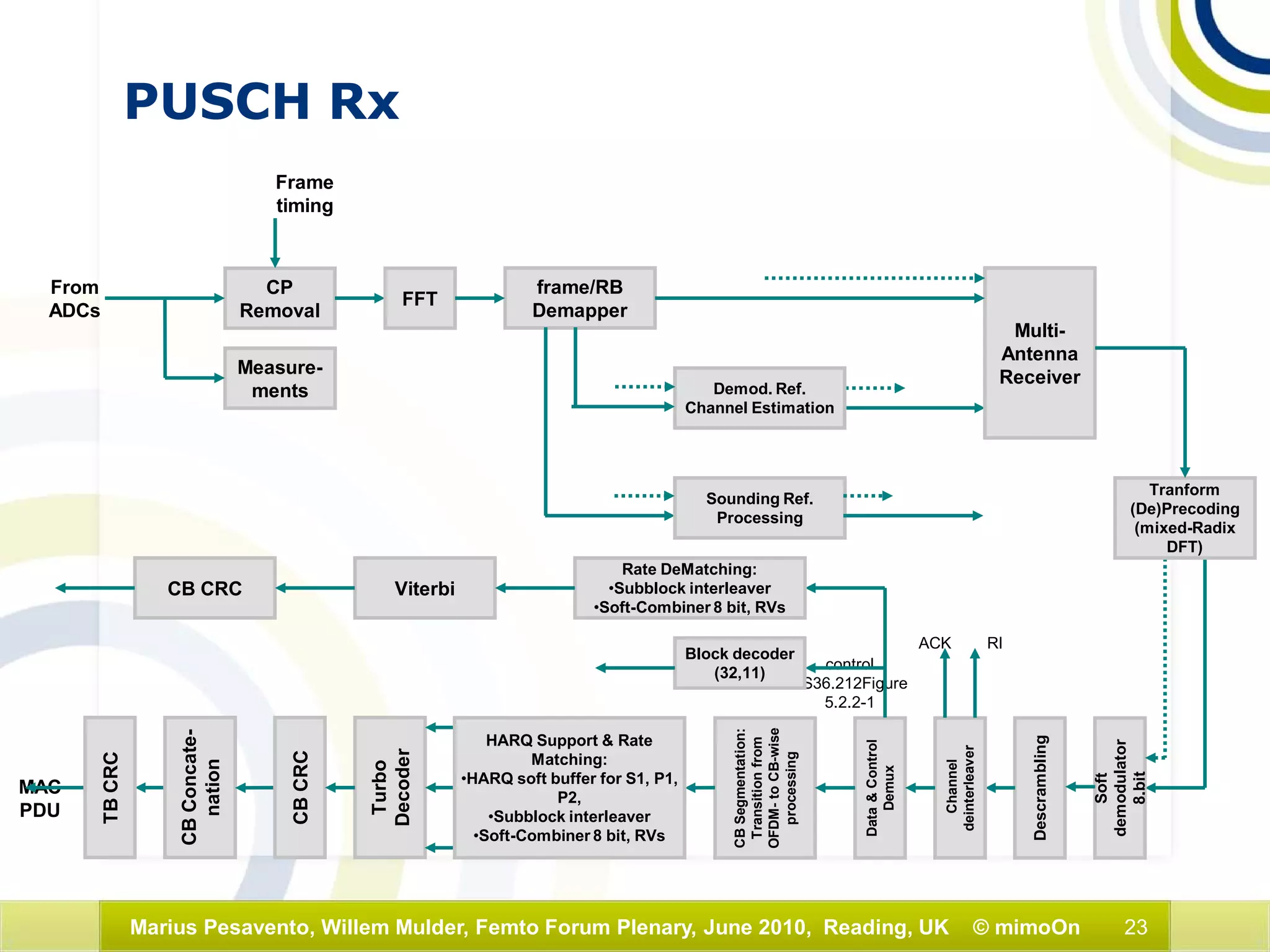
PUSCH Rx
24Marius Pesavento, Willem Mulder, Femto Forum Plenary, June 2010, Reading, UK © mimoOn
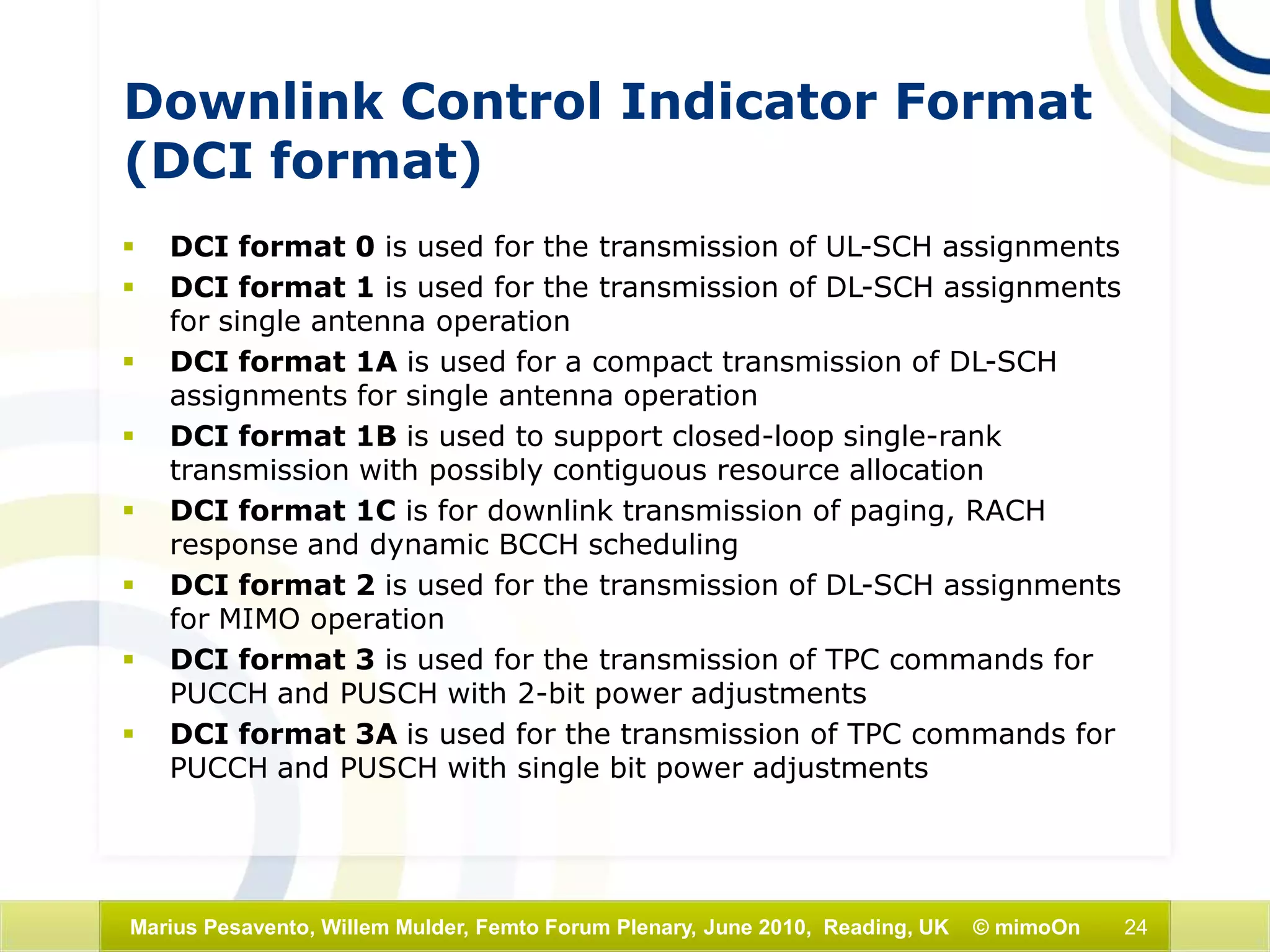
Downlink Control Indicator Format
(DCI format)
 DCI format 0 is used for the transmission of UL-SCH assignments
 DCI format 1 is used for the transmission of DL-SCH assignments
for single antenna operation
 DCI format 1A is used for a compact transmission of DL-SCH
assignments for single antenna operation
 DCI format 1B is used to support closed-loop single-rank
transmission with possibly contiguous resource allocation
 DCI format 1C is for downlink transmission of paging, RACH
response and dynamic BCCH scheduling
 DCI format 2 is used for the transmission of DL-SCH assignments
for MIMO operation
 DCI format 3 is used for the transmission of TPC commands for
PUCCH and PUSCH with 2-bit power adjustments
 DCI format 3A is used for the transmission of TPC commands for
PUCCH and PUSCH with single bit power adjustments
25Marius Pesavento, Willem Mulder, Femto Forum Plenary, June 2010, Reading, UK © mimoOn
CRC scrambling
with RNTI /
(UE Tx port)
specific
CRC
generation
L=16
DCI tail bit
convolutional
encoder, rate 1/3
interleaver,
rate-matching
PDCCH
multiplexing <NIL>element
insertion
cell-specific
scrambling
other DCIs
QPSK
modulation
sub-block interleaver
(on quadruples of modulated
symbols), remove <NULL>
elements
Resource Mapper,
(mapping to RE groups)
time first – then frequency
layer mapping,
pre-coding:
single antenna
port or transmit
diversity
antenna
ports 0,...,3
other DL
channels
IFFT and
CP attachment
MIMO
channel
FFT and
CP removal,
frequency and
timing correction
Resource demapper
(1-3 OFDM symbols,
according to CFI)
sub-block
de-inter-
leaver
equalizer,
MIMO detector,
(requires channel
estimation)
soft-
demodulator
rate-
dematching,
deinterleaving
Viterbi
decoder
cell specific
de-
scrambling
44 blind decoding
attempts (common-
and UE-specific-
search-space),
44 PDCCH
candidates
code bit extraction
CRC calculation
XOR
CRC extraction
RNTI
skip some decodes if RNTI is found
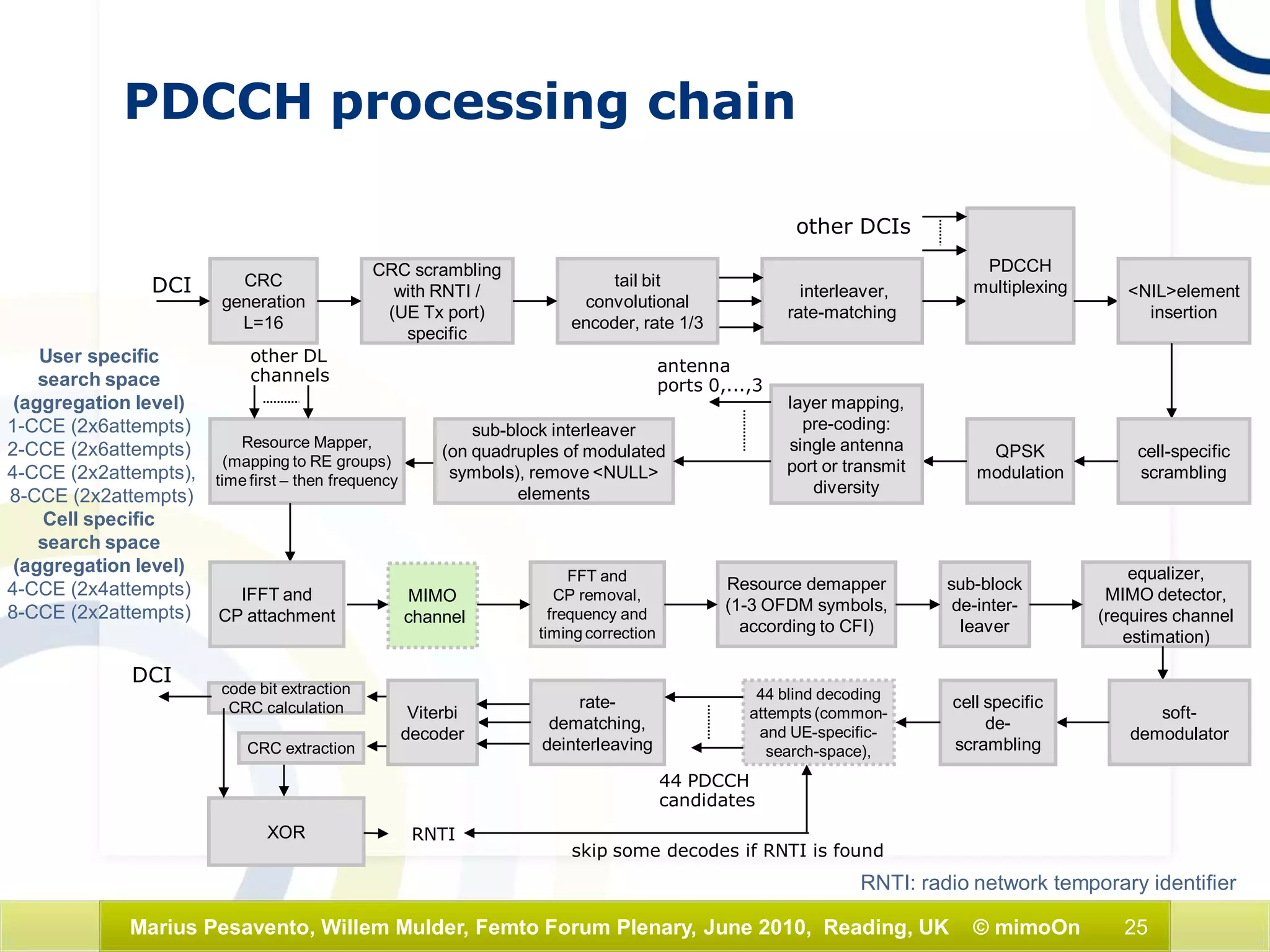
PDCCH processing chain
RNTI: radio network temporary identifier
DCI
User specific
search space
(aggregation level)
1-CCE (2x6attempts)
2-CCE (2x6attempts)
4-CCE (2x2attempts),
8-CCE (2x2attempts)
Cell specific
search space
(aggregation level)
4-CCE (2x4attempts)
8-CCE (2x2attempts)
26Marius Pesavento, Willem Mulder, Femto Forum Plenary, June 2010, Reading, UK © mimoOn
spreading
with
sequence
Scheduling
request (SR)
(presence/absence)
Block code
Length 20
never simultaneously with PUSCH
CQI, PMI,
RI report (2)
<= 4bit
ACK/NACK (1a,1b)
1 or 2 bit
to map on CQI resource
concatenation:
•only CQI (2: 20 bit)
•CQI + ACK/NACK
(2a: 21 bit, 2b: 22bit)
to map on SR resource
•w/o ACK/NACK (1);d(0)=1
•w ACK/NACK
d(0) = 1,-1
d(0) = 1,j,-1,-j
to map on ACK/NACK resource
ACK/NACK w/o CQI or SR,
1a: d(0)= 1,-1
1b: d(0)= 1,j,-1,-j
20bit
for
mapping
to outer
RBs
for
mapping
to in
RBs
Pseudo-Random
sequence generator
cell
IDinit Nc =
(2)
RBN
(1)
csN
),(cell
cs lnn s
)()(
, nr vu
α
12PUCCH
seq =N
spreading
with
orthogonal
sequence
12symbols
)(oc
iwn
4PUCCH
SF =N
UE specific
cell specific
scrambling
spreading
with
sequence
)()(
, nr vu
α
12PUCCH
seq =N
modulation:
d(0),…d(19)
on QPSK
(BPSK)
36.211, 7.1
d(20), d(21)
according to
36.211, Table
5.4.2-1
resource index (2)
PUCCHn
determines cyclic shiftα
Resourcem
apper
(k,l,slot#)
IFFT
CP attach
include demodulation
reference signals for
format 1 (see below)
(1)
PUCCHnresource index
determines cyclic shift
and orthogonal sequence
12symbols
include demodulation
reference signals for
format 2 (see below)
“d”
“z”
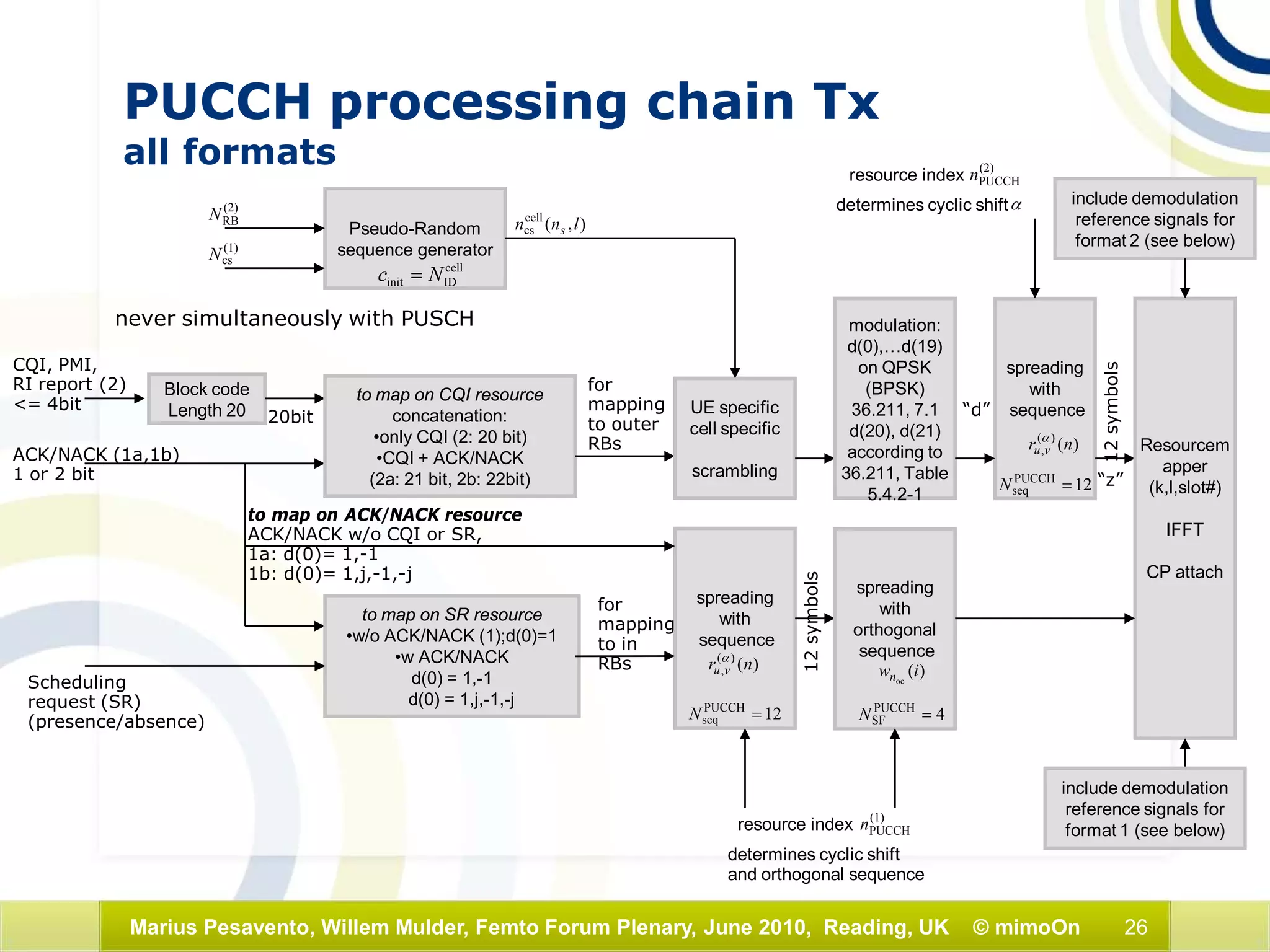
PUCCH processing chain Tx
all formats
27Marius Pesavento, Willem Mulder, Femto Forum Plenary, June 2010, Reading, UK © mimoOn
Resource
de-mapper
(k,l,slot#)
format2,2a,2b
(CQI,PMI,RI)
CP
removal
FFT (2048)
format 1,1a,1b
ACK/NCK w or w/o SR
(see next page)
multiplication
with
conjugate of
)()(
, nr vu
α
12PUCCH
seq =N
resource index (2)
PUCCHn
determines cyclic shiftα
IDFTlength12
separate
users
according
to cyclic
shift in
time-
domain
multiplication
with
conjugate of
)()(
, nr vu
α
12PUCCH
seq =N
resource index (2)
PUCCHn
determines cyclic shiftα
IDFTlength12 channel estimation
separate users according
to cyclic shift in time-
domain
tap M(<12) channel
coefficient vector
M depends on number
of shifts in use
matched
filtering
with
tap M
coef.
vector
user m
user m
harddemodulator
UE specific
cell specific
descrambling
segmentation
SR
•w/o ACK/NACK (1);d(0)=1
•w ACK/NACK
d(0) = 1,-1
d(0) = 1,j,-1,-j
ACK/NACK
(1a,1b)
Block
decoding
(bit-level
matched
filter)
CQI, PMI,
RI report (2)
QPSK
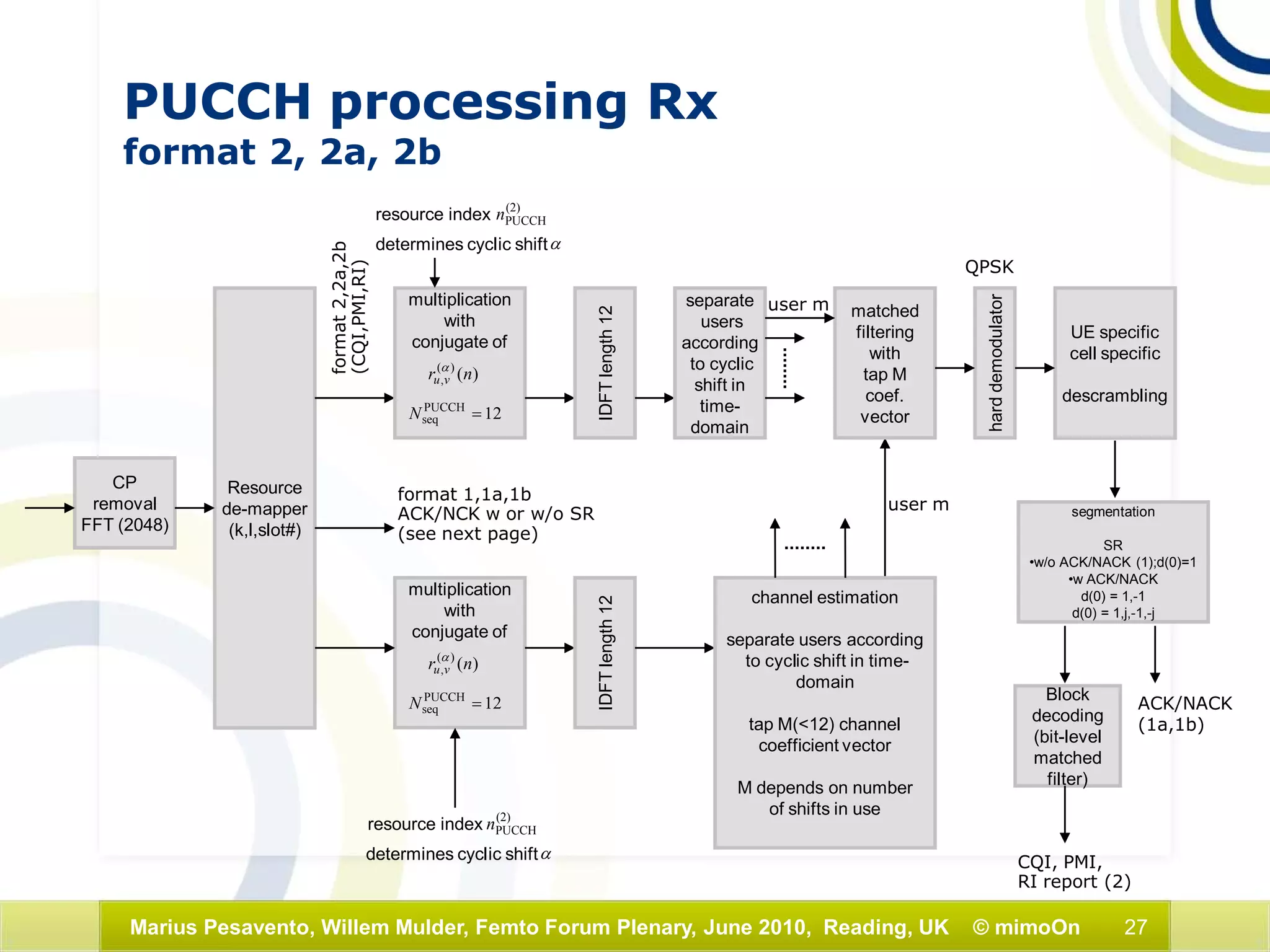
PUCCH processing Rx
format 2, 2a, 2b
28Marius Pesavento, Willem Mulder, Femto Forum Plenary, June 2010, Reading, UK © mimoOn
Resource
de-mapper
(k,l,slot#)
on SR
resource
format1,1a,1b
(SRandACK/NACK)
CP
removal
FFT (2048)
format 2,2a,2b
(CQI,PMI,RI)
multiplication
with
conjugate of
)()(
, nr vu
α
12PUCCH
seq =N
resource index (2)
PUCCHn
determines cyclic shiftα
IDFTlength12
separate
users
according
to cyclic
shift in
time-
domain
multiplication
with
conjugate of
)()(
, nr vu
α
12PUCCH
seq =N
resource index (2)
PUCCHn
determines cyclic shiftα
IDFTlength12
channel
estimation 1
separate users
according to
cyclic shift in
time-domain
tap M(<12)
channel
coefficient vector
M depends on
number of
shifts in use
matched
filtering
with
tap M
coef.
vector
user m
user m
harddemodulator
UE specific
cell specific
descrambling
ACK/NACK
channelestimation2
separateusersaccordingtoorthogonal
coversequence(despreading)
despreading
separateusereaccordingto
orthogonalsequence
SR
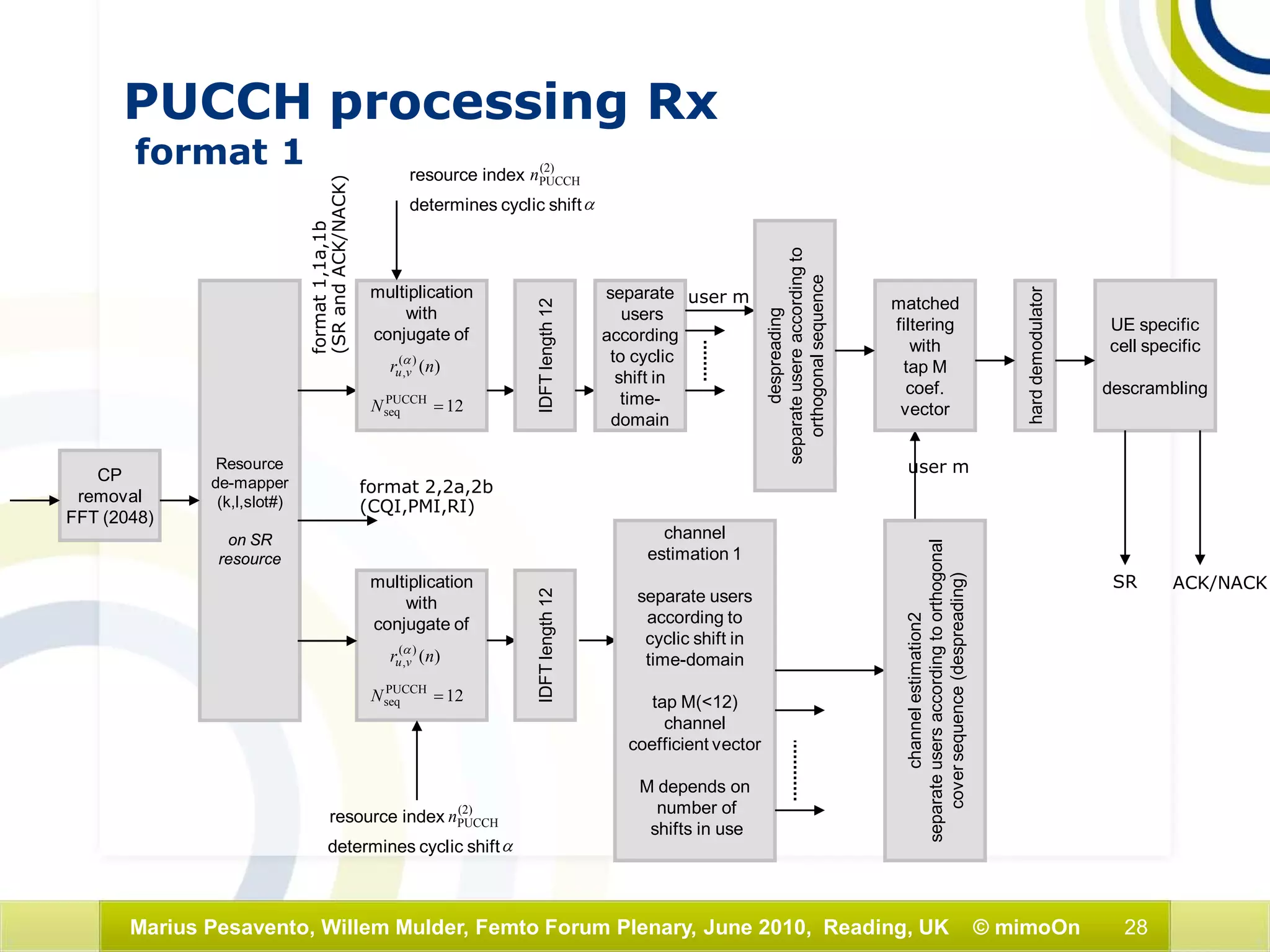
PUCCH processing Rx
format 1
29Marius Pesavento, Willem Mulder, Femto Forum Plenary, June 2010, Reading, UK © mimoOn
Resource
de-mapper
(k,l,slot#)
on
ACK/NACK
resource
format1,1a,1b
(SRandACK/NACK)
CP
removal
FFT (2048)
format 2,2a,2b
(CQI,PMI,RI)
multiplication
with
conjugate of
)()(
, nr vu
α
12PUCCH
seq =N
resource index (2)
PUCCHn
determines cyclic shiftα
IDFTlength12
separate
users
according
to cyclic
shift in
time-
domain
multiplication
with
conjugate of
)()(
, nr vu
α
12PUCCH
seq =N
resource index (2)
PUCCHn
determines cyclic shiftα
IDFTlength12 channel
estimation 1
separate users
according to
cyclic shift in
time-domain
tap M(<12)
channel
coefficient vector
M depends on
number of
shifts in use
matched
filtering
with
tap M
coef.
vector
user m
user m
harddemodulator
UE specific
cell specific
descrambling
ACK/NACK
channelestimation2
separateusersaccordingtoorthogonal
coversequence(despreading)
despreading
separateusereaccordingto
orthogonalsequence
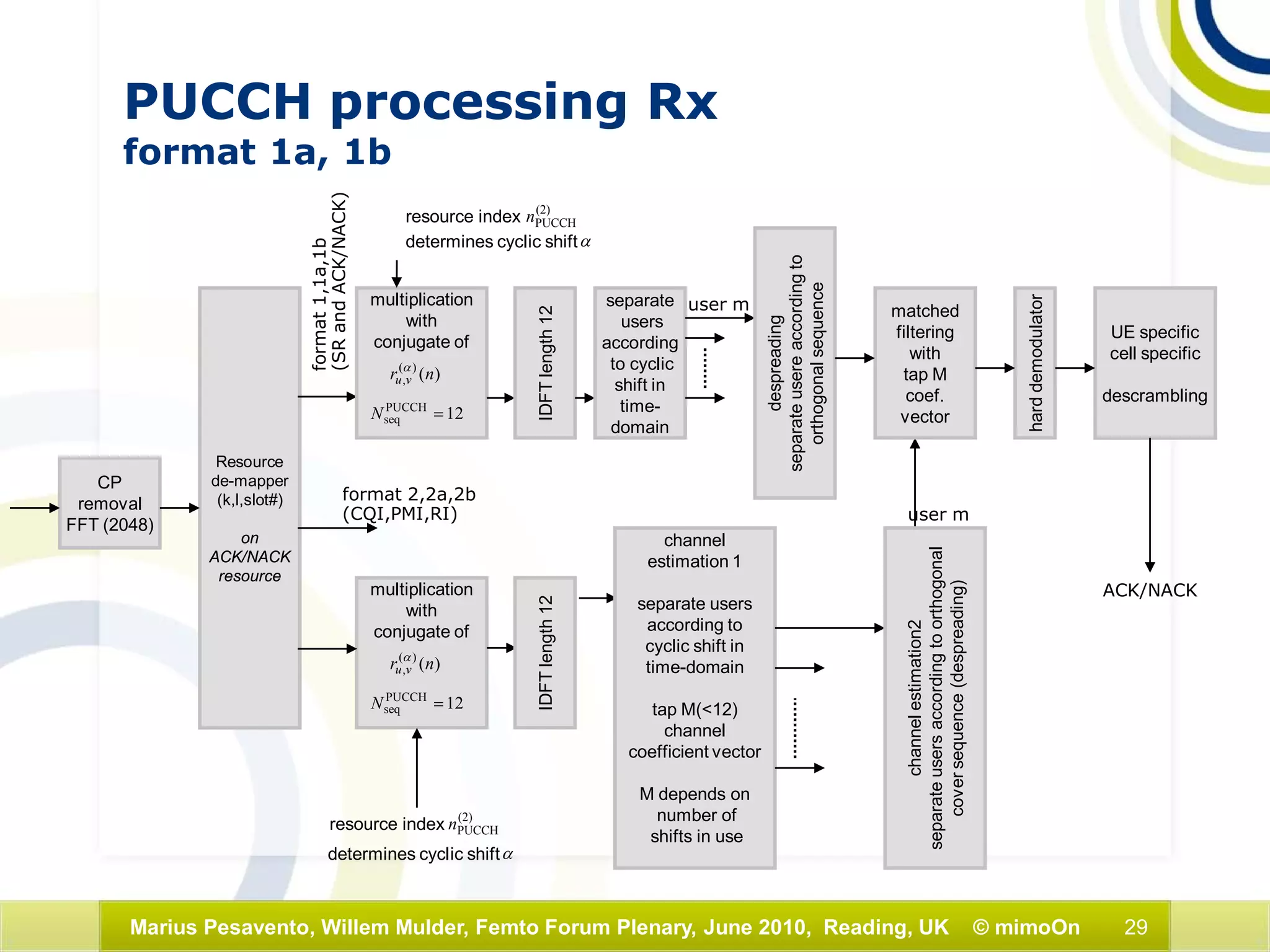
PUCCH processing Rx
format 1a, 1b
30Marius Pesavento, Willem Mulder, Femto Forum Plenary, June 2010, Reading, UK © mimoOn
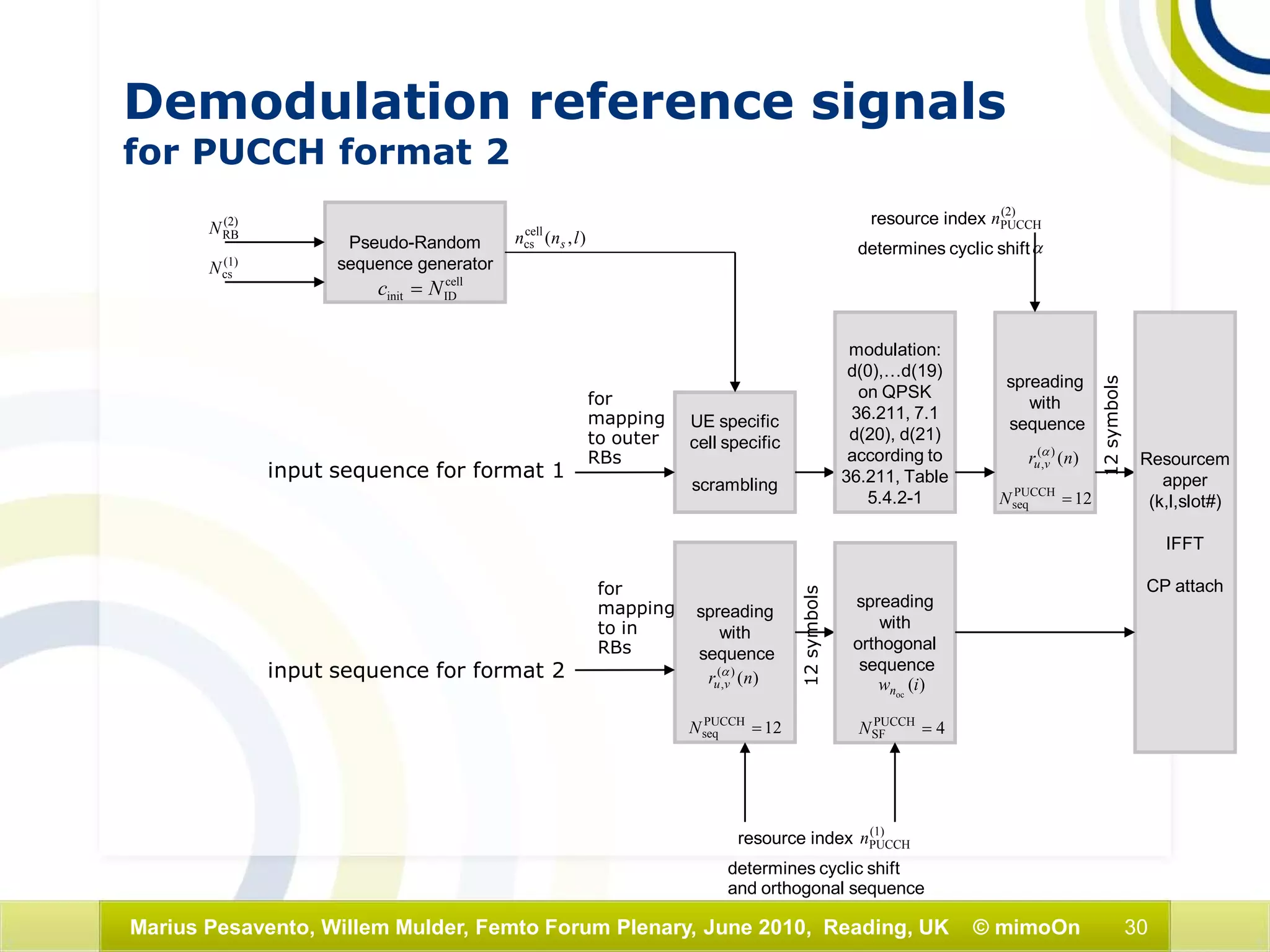
spreading
with
sequence
for
mapping
to outer
RBs
for
mapping
to in
RBs
Pseudo-Random
sequence generator
cell
IDinit Nc =
(2)
RBN
(1)
csN
),(cell
cs lnn s
)()(
, nr vu
α
12PUCCH
seq =N
spreading
with
orthogonal
sequence
12symbols
)(oc
iwn
4PUCCH
SF =N
UE specific
cell specific
scrambling
spreading
with
sequence
)()(
, nr vu
α
12PUCCH
seq =N
modulation:
d(0),…d(19)
on QPSK
36.211, 7.1
d(20), d(21)
according to
36.211, Table
5.4.2-1
resource index (2)
PUCCHn
determines cyclic shiftα
Resourcem
apper
(k,l,slot#)
IFFT
CP attach
(1)
PUCCHnresource index
determines cyclic shift
and orthogonal sequence
12symbols
input sequence for format 1
input sequence for format 2
Demodulation reference signals
for PUCCH format 2
31Marius Pesavento, Willem Mulder, Femto Forum Plenary, June 2010, Reading, UK © mimoOn
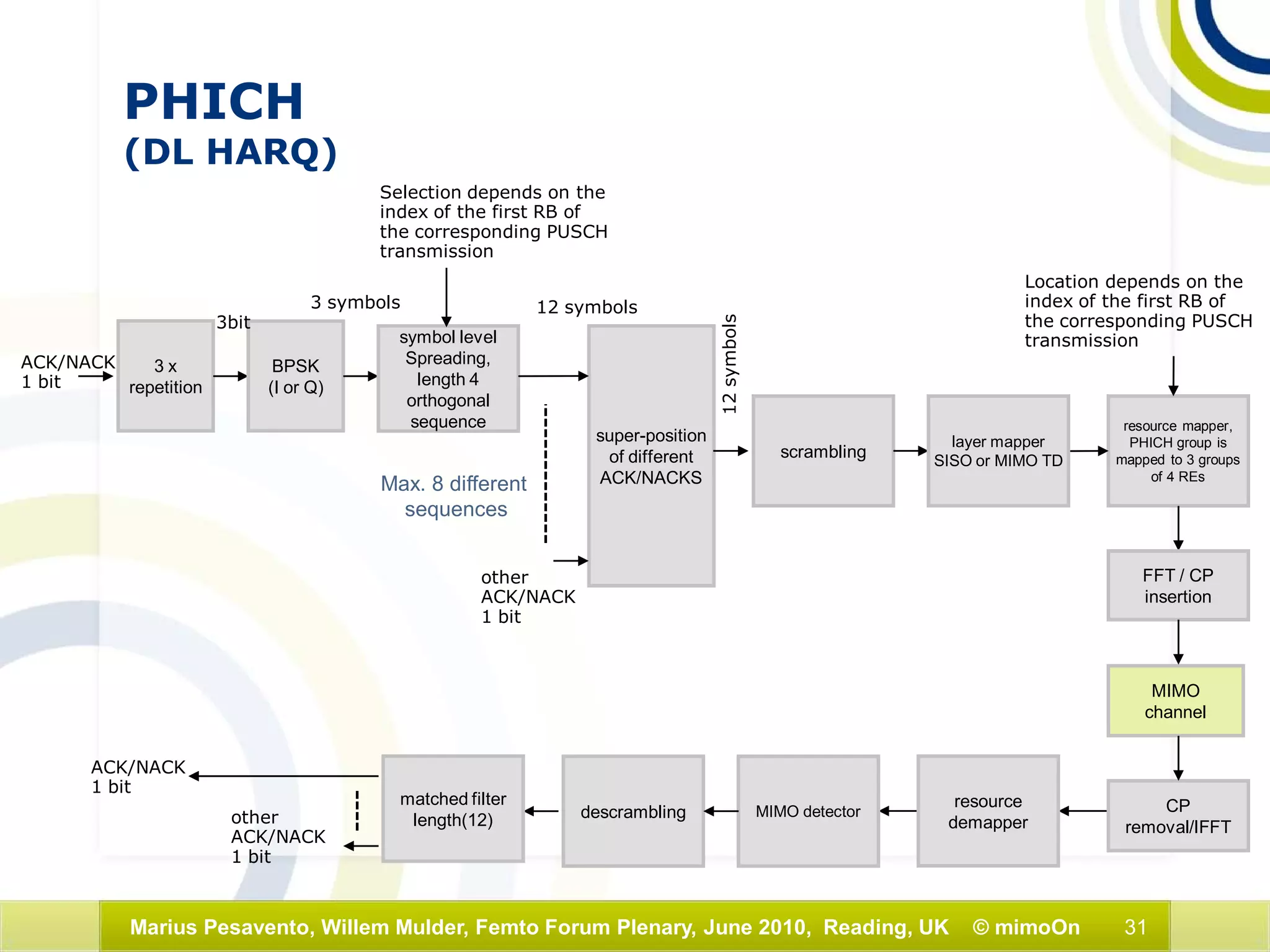
3 x
repetition
ACK/NACK
1 bit
BPSK
(I or Q)
symbol level
Spreading,
length 4
orthogonal
sequence
3bit
super-position
of different
ACK/NACKS
3 symbols 12 symbols
resource mapper,
PHICH group is
mapped to 3 groups
of 4 REs
scrambling
12symbols
layer mapper
SISO or MIMO TD
FFT / CP
insertion
MIMO
channel
CP
removal/IFFT
resource
demapper
MIMO detectordescrambling
matched filter
length(12)
ACK/NACK
1 bit
other
ACK/NACK
1 bit
other
ACK/NACK
1 bit
Location depends on the
index of the first RB of
the corresponding PUSCH
transmission
PHICH
(DL HARQ)
Max. 8 different
sequences
Selection depends on the
index of the first RB of
the corresponding PUSCH
transmission
32Marius Pesavento, Willem Mulder, Femto Forum Plenary, June 2010, Reading, UK © mimoOn
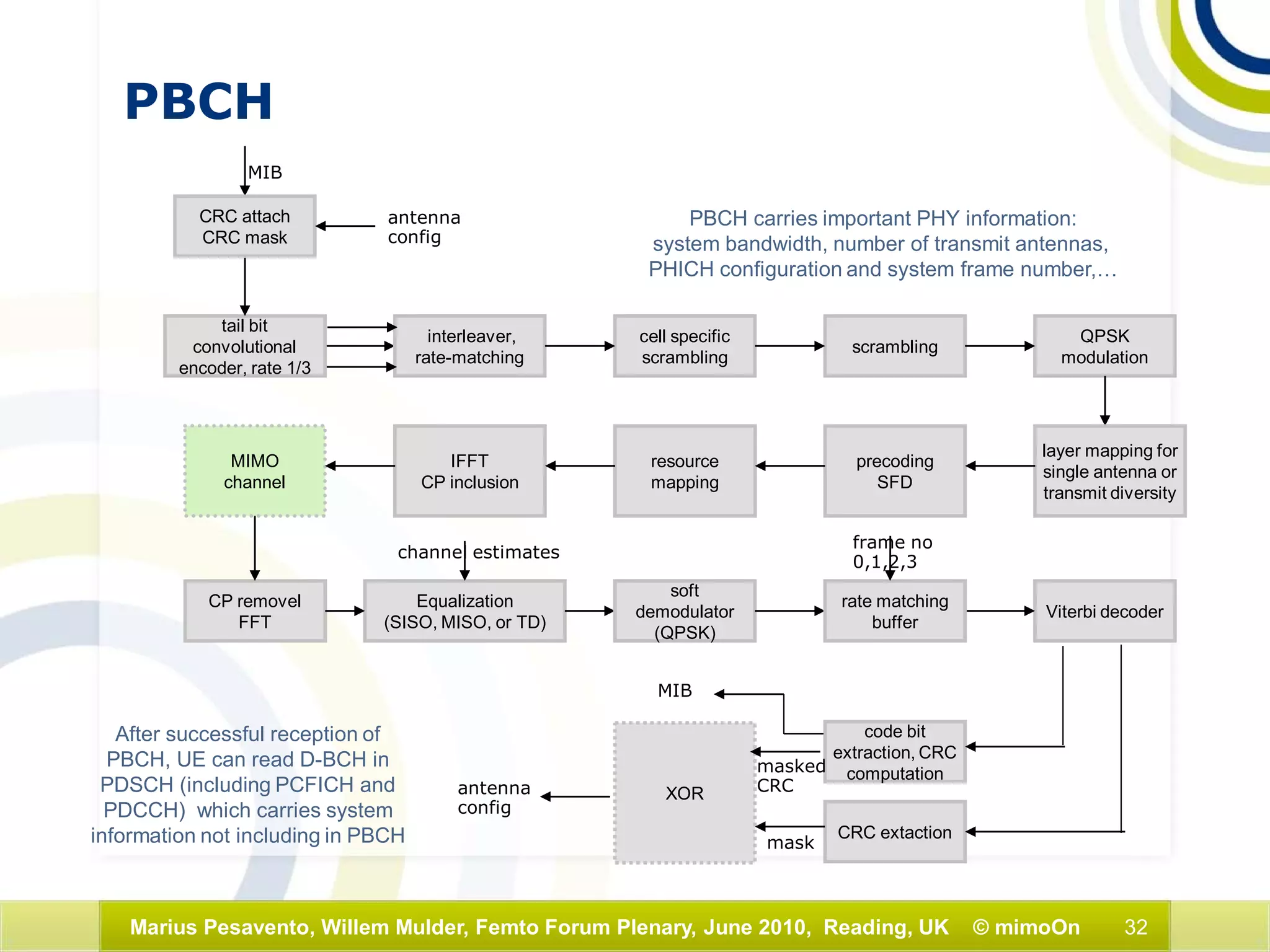
MIB
cell specific
scrambling
scrambling
tail bit
convolutional
encoder, rate 1/3
QPSK
modulation
layer mapping for
single antenna or
transmit diversity
precoding
SFD
resource
mapping
IFFT
CP inclusion
MIMO
channel
CP removel
FFT
Equalization
(SISO, MISO, or TD)
soft
demodulator
(QPSK)
channel estimates
Viterbi decoder
interleaver,
rate-matching
rate matching
buffer
CRC attach
CRC mask
code bit
extraction, CRC
computation
antenna
config
CRC extaction
XOR
antenna
config
frame no
0,1,2,3
PBCH
PBCH carries important PHY information:
system bandwidth, number of transmit antennas,
PHICH configuration and system frame number,…
masked
CRC
mask
MIB
After successful reception of
PBCH, UE can read D-BCH in
PDSCH (including PCFICH and
PDCCH) which carries system
information not including in PBCH
33Marius Pesavento, Willem Mulder, Femto Forum Plenary, June 2010, Reading, UK © mimoOn
possible cell specific
root-sequences,(conjugate)
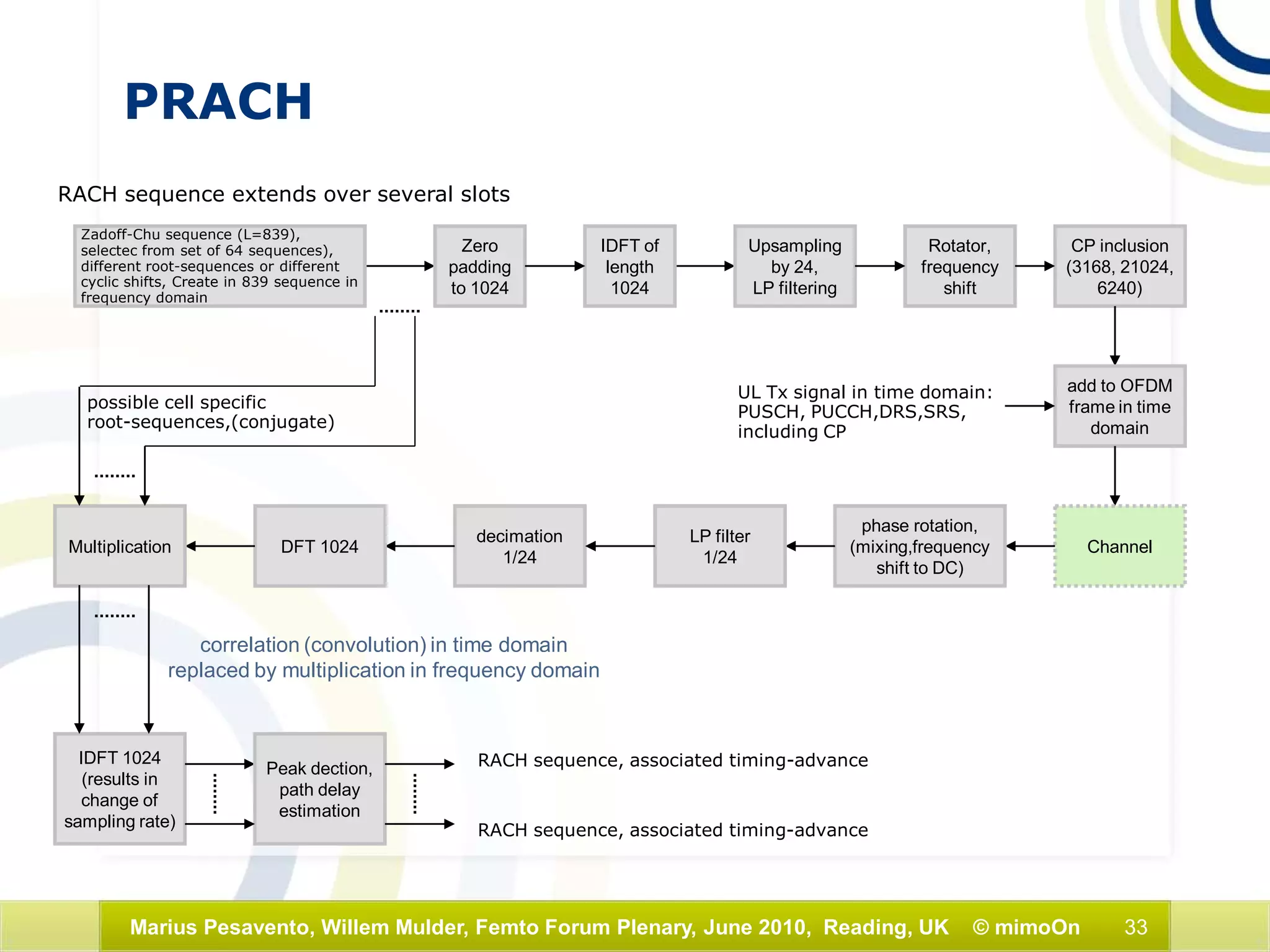
RACH sequence extends over several slots
CP inclusion
(3168, 21024,
6240)
add to OFDM
frame in time
domain
UL Tx signal in time domain:
PUSCH, PUCCH,DRS,SRS,
including CP
Channel
phase rotation,
(mixing,frequency
shift to DC)
decimation
1/24
LP filter
1/24
DFT 1024Multiplication
IDFT 1024
(results in
change of
sampling rate)
Peak dection,
path delay
estimation
RACH sequence, associated timing-advance
Zadoff-Chu sequence (L=839),
selectec from set of 64 sequences),
different root-sequences or different
cyclic shifts, Create in 839 sequence in
frequency domain
Zero
padding
to 1024
IDFT of
length
1024
Upsampling
by 24,
LP filtering
Rotator,
frequency
shift
PRACH
correlation (convolution) in time domain
replaced by multiplication in frequency domain
34Marius Pesavento, Willem Mulder, Femto Forum Plenary, June 2010, Reading, UK © mimoOn
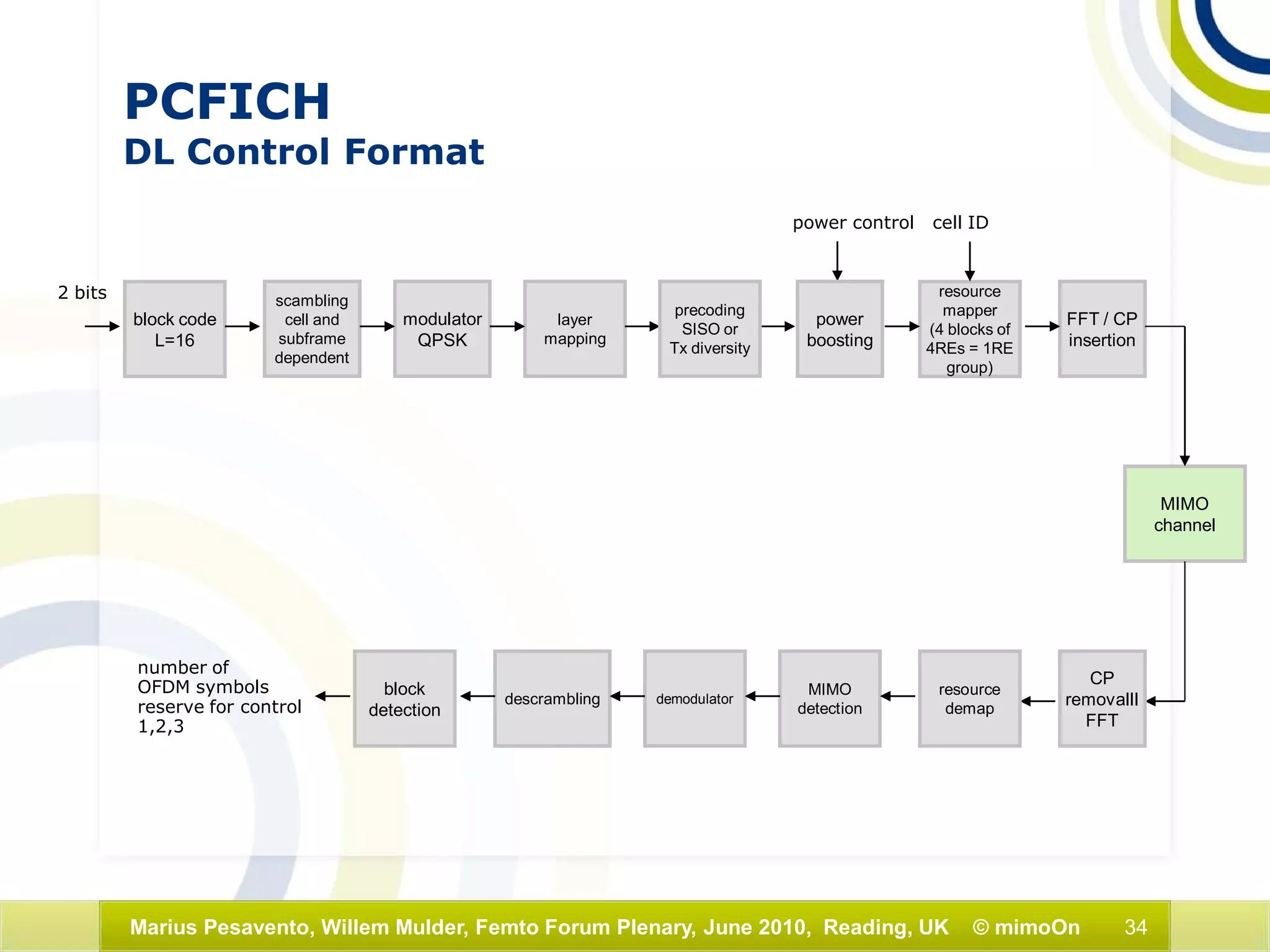
PCFICH
DL Control Format
block code
L=16
2 bits scambling
cell and
subframe
dependent
modulator
QPSK
layer
mapping
FFT / CP
insertion
power
boosting
power control
MIMO
channel
resource
mapper
(4 blocks of
4REs = 1RE
group)
cell ID
precoding
SISO or
Tx diversity
CP
removalII
FFT
resource
demap
MIMO
detection
demodulatordescrambling
block
detection
number of
OFDM symbols
reserve for control
1,2,3
35Marius Pesavento, Willem Mulder, Femto Forum Plenary, June 2010, Reading, UK © mimoOn
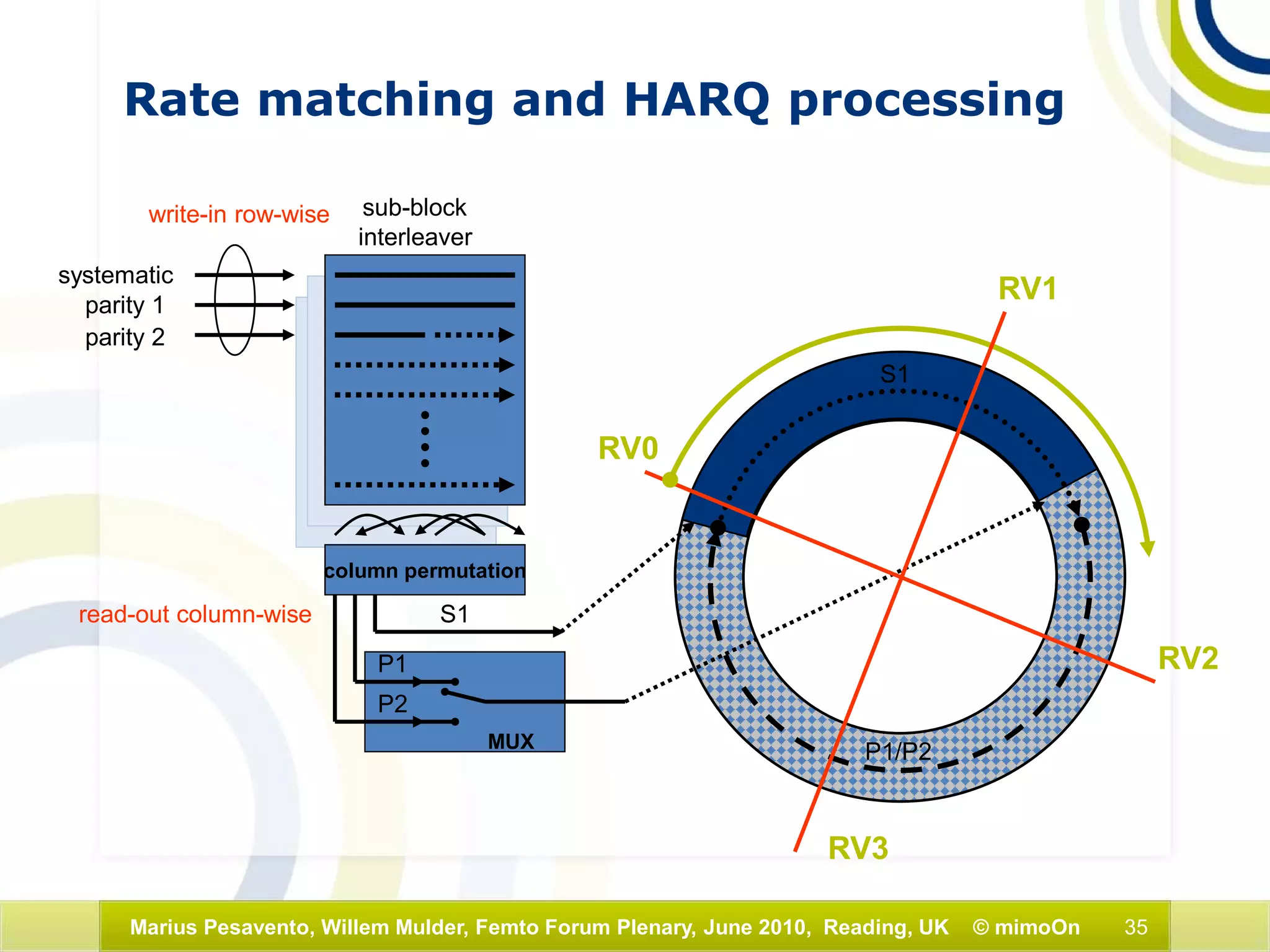
Rate matching and HARQ processing
systematic
parity 1
parity 2
sub-block
interleaver
column permutation
write-in row-wise
read-out column-wise S1
P1
P2
MUX
S1
P1/P2
RV0
RV2
RV3
RV1
36Marius Pesavento, Willem Mulder, Femto Forum Plenary, June 2010, Reading, UK © mimoOn
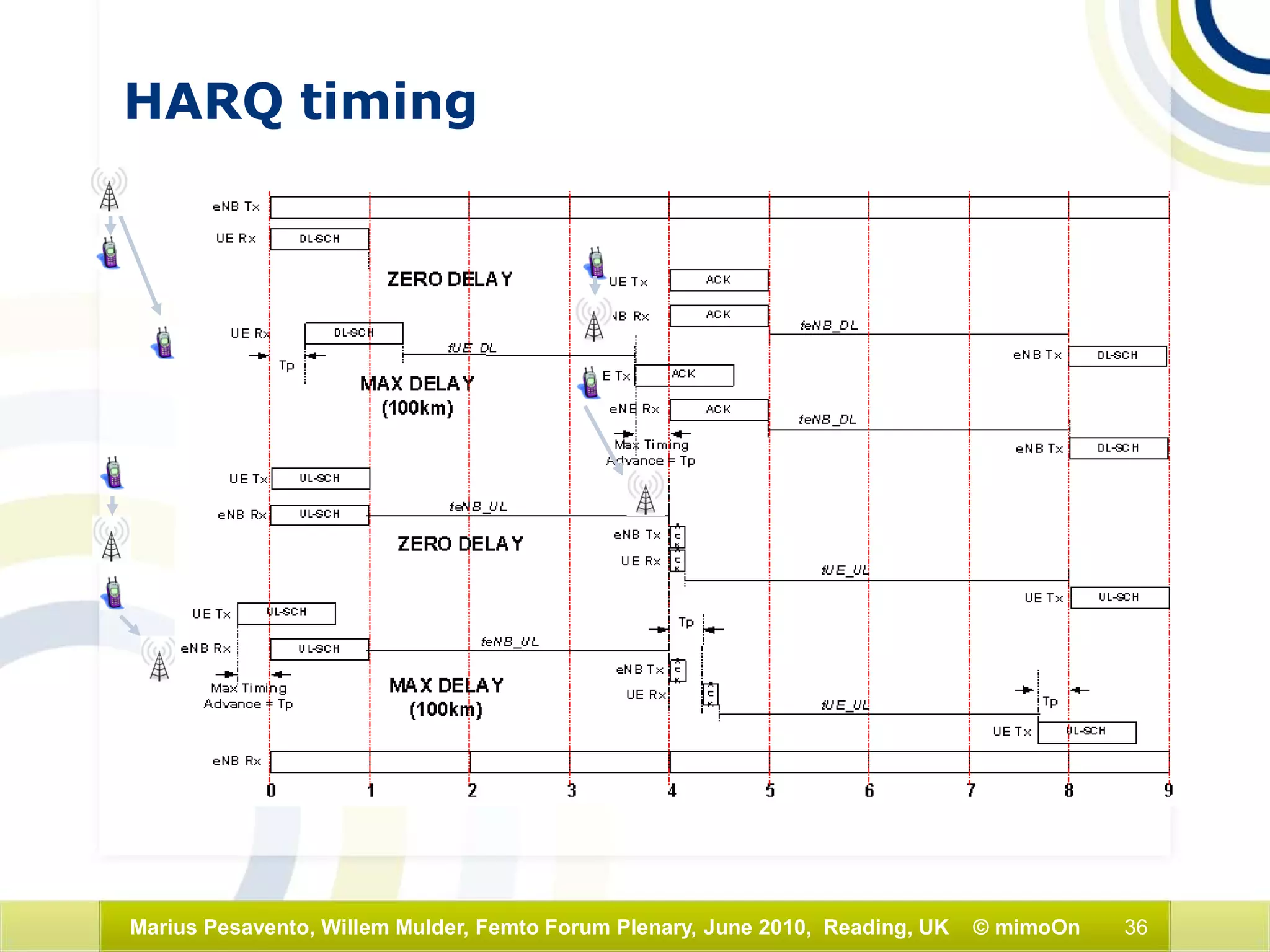
HARQ timing
37Marius Pesavento, Willem Mulder, Femto Forum Plenary, June 2010, Reading, UK © mimoOn
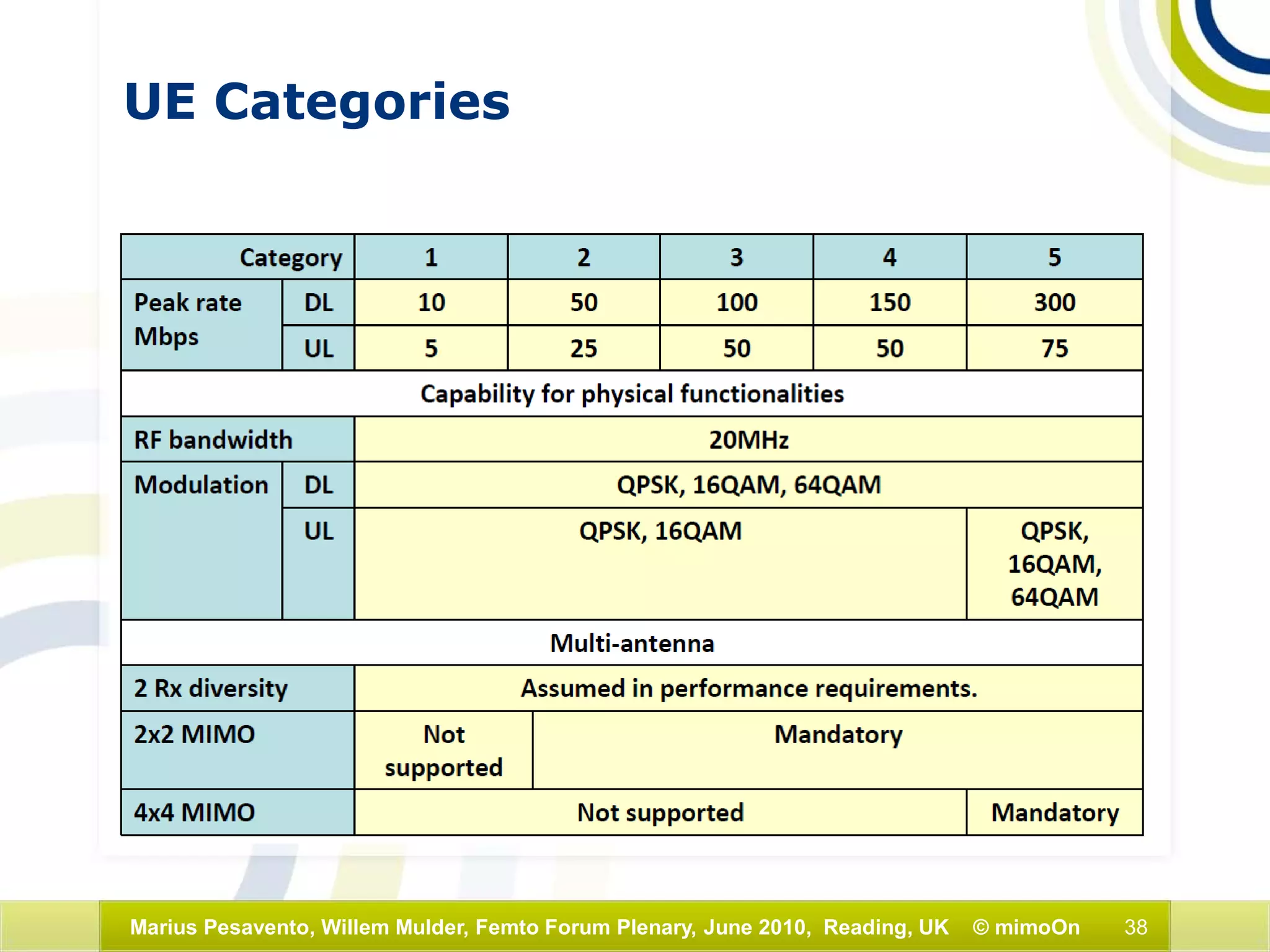
UE Categories
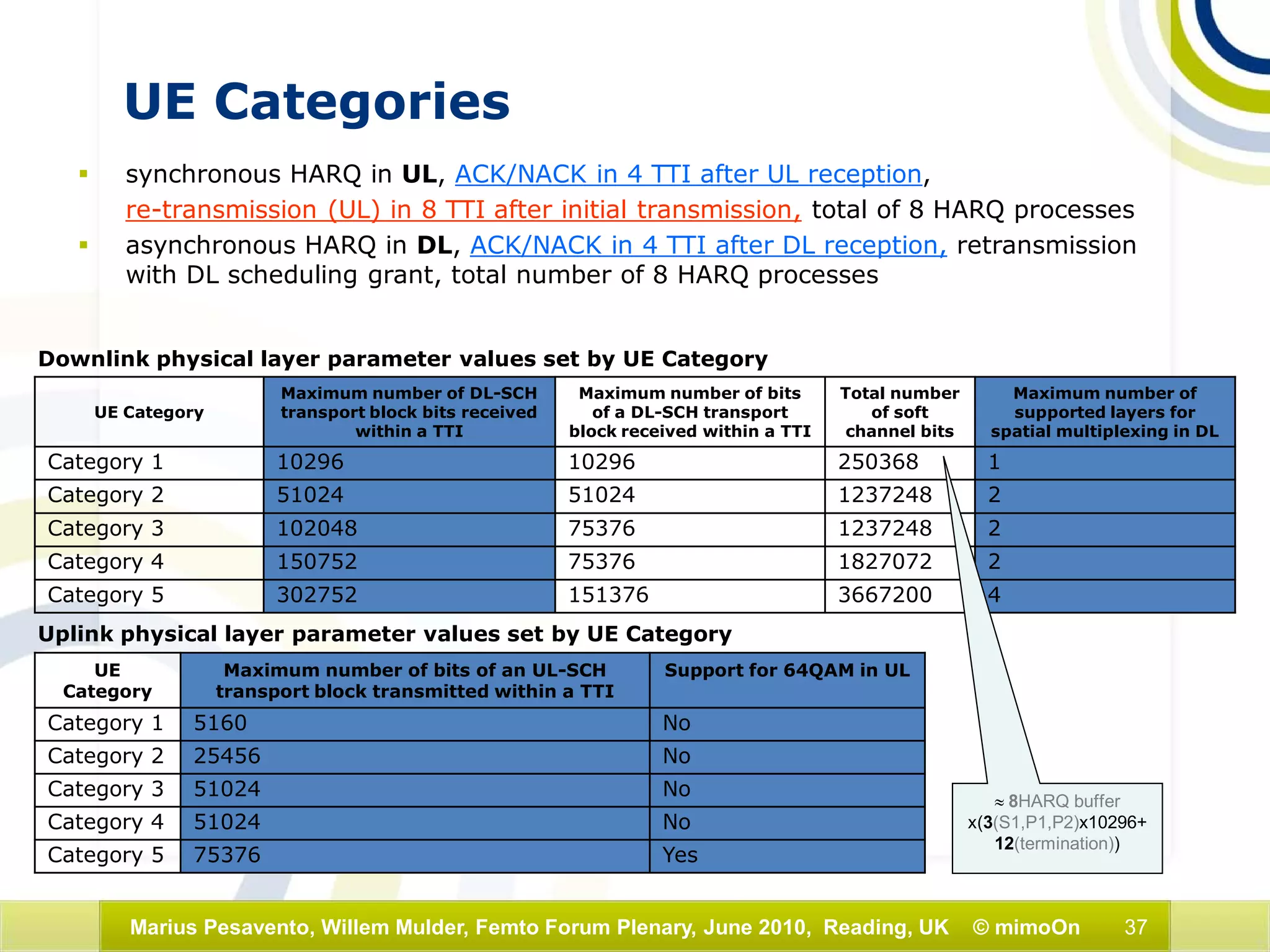
 synchronous HARQ in UL, ACK/NACK in 4 TTI after UL reception,
re-transmission (UL) in 8 TTI after initial transmission, total of 8 HARQ processes
 asynchronous HARQ in DL, ACK/NACK in 4 TTI after DL reception, retransmission
with DL scheduling grant, total number of 8 HARQ processes
Downlink physical layer parameter values set by UE Category
UE Category
Maximum number of DL-SCH
transport block bits received
within a TTI
Maximum number of bits
of a DL-SCH transport
block received within a TTI
Total number
of soft
channel bits
Maximum number of
supported layers for
spatial multiplexing in DL
Category 1 10296 10296 250368 1
Category 2 51024 51024 1237248 2
Category 3 102048 75376 1237248 2
Category 4 150752 75376 1827072 2
Category 5 302752 151376 3667200 4
Uplink physical layer parameter values set by UE Category
UE
Category
Maximum number of bits of an UL-SCH
transport block transmitted within a TTI
Support for 64QAM in UL
Category 1 5160 No
Category 2 25456 No
Category 3 51024 No
Category 4 51024 No
Category 5 75376 Yes
≈ 8HARQ buffer
x(3(S1,P1,P2)x10296+
12(termination))
38Marius Pesavento, Willem Mulder, Femto Forum Plenary, June 2010, Reading, UK © mimoOn
UE Categories
39Marius Pesavento, Willem Mulder, Femto Forum Plenary, June 2010, Reading, UK © mimoOn
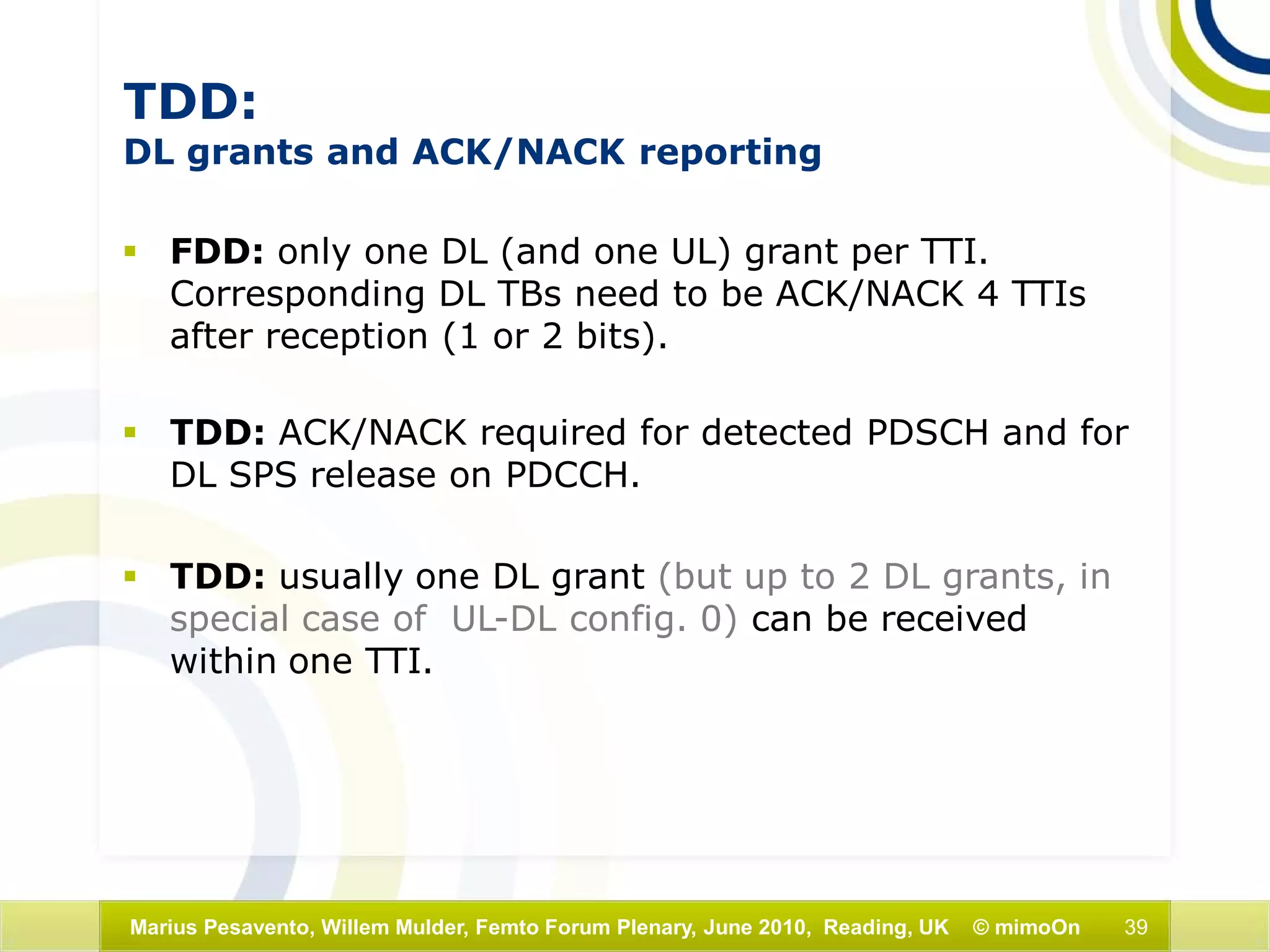
TDD:
DL grants and ACK/NACK reporting
 FDD: only one DL (and one UL) grant per TTI.
Corresponding DL TBs need to be ACK/NACK 4 TTIs
after reception (1 or 2 bits).
 TDD: ACK/NACK required for detected PDSCH and for
DL SPS release on PDCCH.
 TDD: usually one DL grant (but up to 2 DL grants, in
special case of UL-DL config. 0) can be received
within one TTI.
40Marius Pesavento, Willem Mulder, Femto Forum Plenary, June 2010, Reading, UK © mimoOn
subframe
1 ms
one radio frame, Tf = 307200*TS = 10 ms
TDD ACK/NACK
Recall: Frame Structure Type 2: TDD
DL
#0
S
#1
UL
#2
UL/DL
#3
UL/DL
#4
S/DL
#6
DL
#5
UL/DL
#7
UL/DL
#8
UL/DL
#9
Downlink
subframe
Uplink
subframe
Special guard
subframe for
DL to UL switch
Special guard
subframe or
Downlink SF
Uplink or
Downlink
subframe
special subframe:
DL to UL switching
S
#1 or #6
DwPTS
GP UpPTS
DwPTS: DL pilot time slot
shortend DL subframe
(3,8,9,10,11, or 12 OFDM symbols)
reference signals, primary sync and control, PDSCH
GP: Guard period
(1,2,3,4,7,8,9,10 OFDM symbols)
UpPTS: UL pilot time slot
(1 or 2 OFDM symbols)
sounding reference or RACH
SSS
RSand
Control
PSS
0 1 2
41Marius Pesavento, Willem Mulder, Femto Forum Plenary, June 2010, Reading, UK © mimoOn
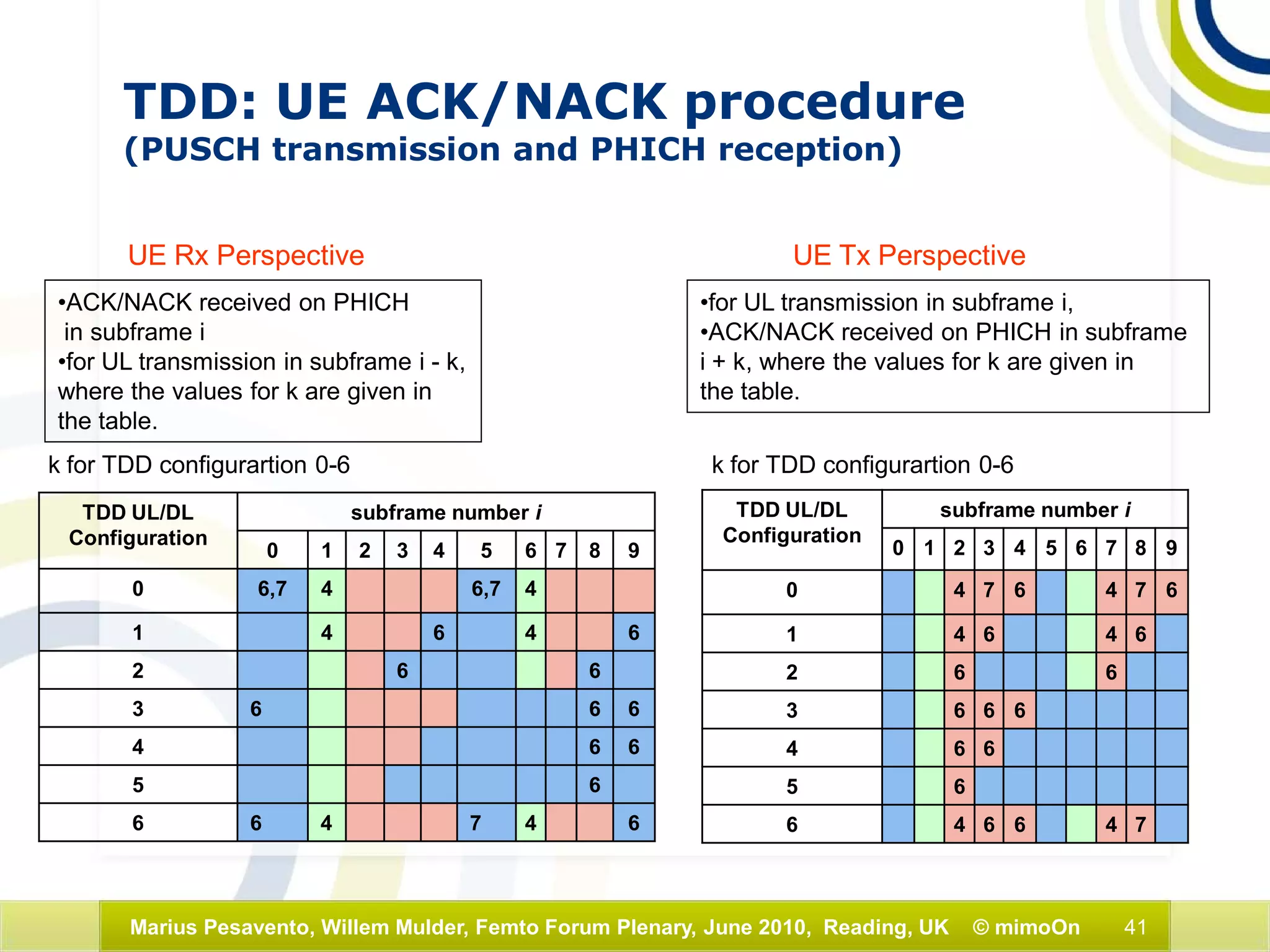
TDD: UE ACK/NACK procedure
(PUSCH transmission and PHICH reception)
TDD UL/DL
Configuration
subframe number i
0 1 2 3 4 5 6 7 8 9
0 6,7 4 6,7 4
1 4 6 4 6
2 6 6
3 6 6 6
4 6 6
5 6
6 6 4 7 4 6
•ACK/NACK received on PHICH
in subframe i
•for UL transmission in subframe i - k,
where the values for k are given in
the table.
k for TDD configurartion 0-6
TDD UL/DL
Configuration
subframe number i
0 1 2 3 4 5 6 7 8 9
0 4 7 6 4 7 6
1 4 6 4 6
2 6 6
3 6 6 6
4 6 6
5 6
6 4 6 6 4 7
UE Rx Perspective
•for UL transmission in subframe i,
•ACK/NACK received on PHICH in subframe
i + k, where the values for k are given in
the table.
k for TDD configurartion 0-6
UE Tx Perspective
42Marius Pesavento, Willem Mulder, Femto Forum Plenary, June 2010, Reading, UK © mimoOn
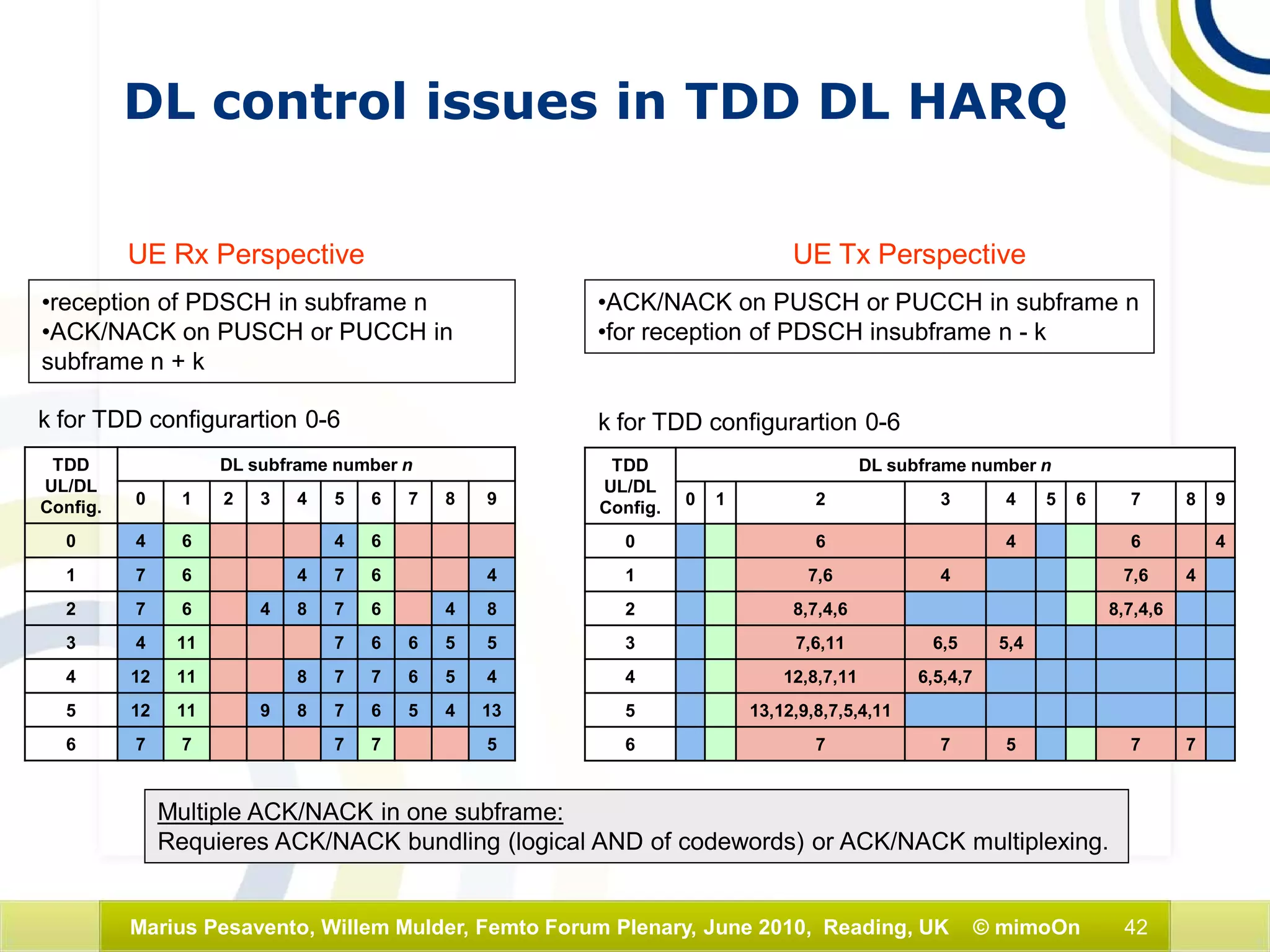
DL control issues in TDD DL HARQ
TDD
UL/DL
Config.
DL subframe number n
0 1 2 3 4 5 6 7 8 9
0 4 6 4 6
1 7 6 4 7 6 4
2 7 6 4 8 7 6 4 8
3 4 11 7 6 6 5 5
4 12 11 8 7 7 6 5 4
5 12 11 9 8 7 6 5 4 13
6 7 7 7 7 5
•reception of PDSCH in subframe n
•ACK/NACK on PUSCH or PUCCH in
subframe n + k
k for TDD configurartion 0-6
TDD
UL/DL
Config.
DL subframe number n
0 1 2 3 4 5 6 7 8 9
0 6 4 6 4
1 7,6 4 7,6 4
2 8,7,4,6 8,7,4,6
3 7,6,11 6,5 5,4
4 12,8,7,11 6,5,4,7
5 13,12,9,8,7,5,4,11
6 7 7 5 7 7
•ACK/NACK on PUSCH or PUCCH in subframe n
•for reception of PDSCH insubframe n - k
k for TDD configurartion 0-6
UE Rx Perspective UE Tx Perspective
Multiple ACK/NACK in one subframe:
Requieres ACK/NACK bundling (logical AND of codewords) or ACK/NACK multiplexing.
43Marius Pesavento, Willem Mulder, Femto Forum Plenary, June 2010, Reading, UK © mimoOn
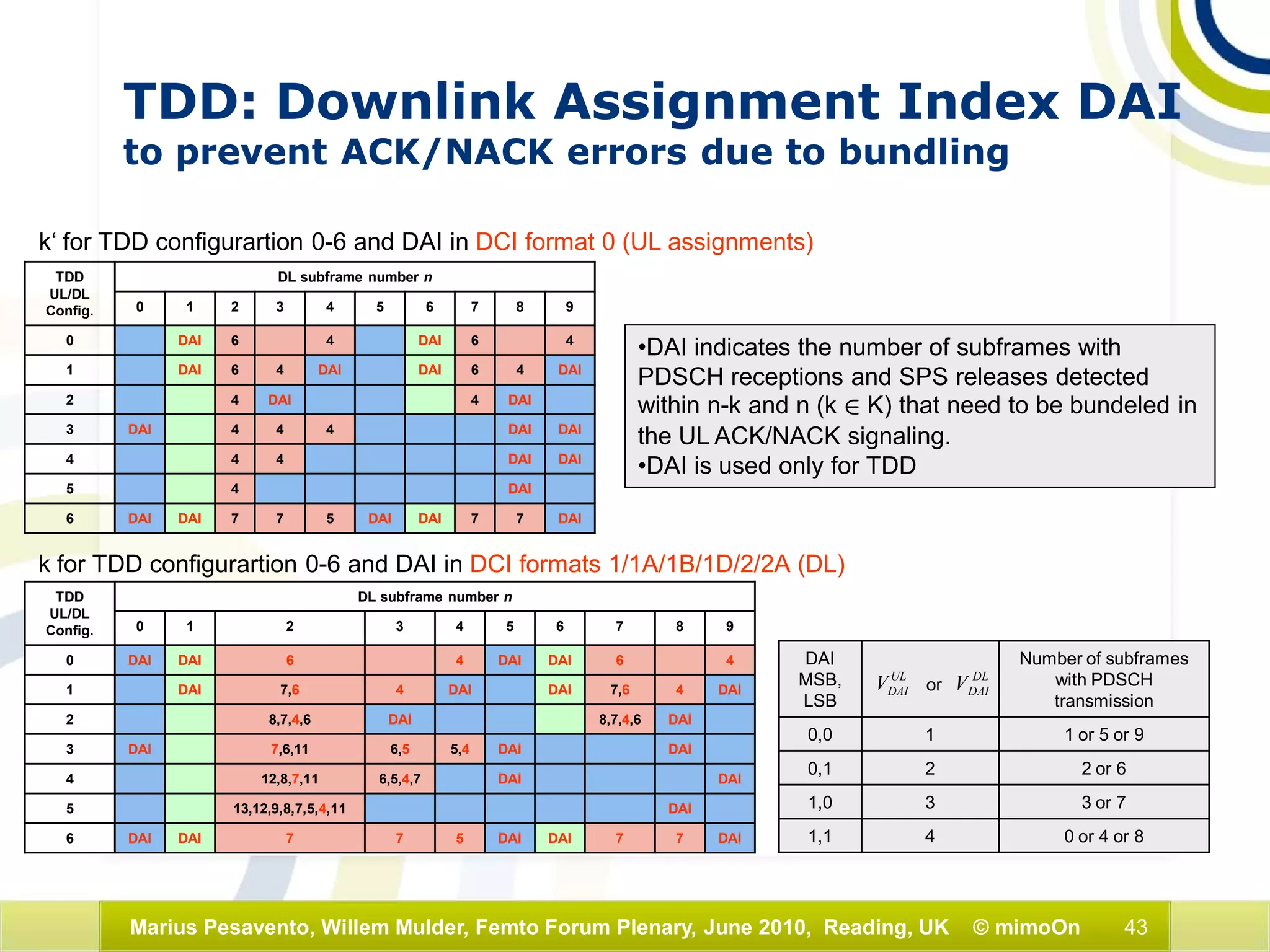
TDD: Downlink Assignment Index DAI
to prevent ACK/NACK errors due to bundling
k‘ for TDD configurartion 0-6 and DAI in DCI format 0 (UL assignments)
•DAI indicates the number of subframes with
PDSCH receptions and SPS releases detected
within n-k and n (k 2 K) that need to be bundeled in
the UL ACK/NACK signaling.
•DAI is used only for TDD
TDD
UL/DL
Config.
DL subframe number n
0 1 2 3 4 5 6 7 8 9
0 DAI 6 4 DAI 6 4
1 DAI 6 4 DAI DAI 6 4 DAI
2 4 DAI 4 DAI
3 DAI 4 4 4 DAI DAI
4 4 4 DAI DAI
5 4 DAI
6 DAI DAI 7 7 5 DAI DAI 7 7 DAI
TDD
UL/DL
Config.
DL subframe number n
0 1 2 3 4 5 6 7 8 9
0 DAI DAI 6 4 DAI DAI 6 4
1 DAI 7,6 4 DAI DAI 7,6 4 DAI
2 8,7,4,6 DAI 8,7,4,6 DAI
3 DAI 7,6,11 6,5 5,4 DAI DAI
4 12,8,7,11 6,5,4,7 DAI DAI
5 13,12,9,8,7,5,4,11 DAI
6 DAI DAI 7 7 5 DAI DAI 7 7 DAI
k for TDD configurartion 0-6 and DAI in DCI formats 1/1A/1B/1D/2/2A (DL)
0 or 4 or 841,1
3 or 731,0
2 or 620,1
1 or 5 or 910,0
Number of subframes
with PDSCH
transmission
DAI
MSB,
LSB
UL
DAIV DL
DAIVor
44Marius Pesavento, Willem Mulder, Femto Forum Plenary, June 2010, Reading, UK © mimoOn
End of Part 1
Thank you!!!
45Marius Pesavento, Willem Mulder, Femto Forum Plenary, June 2010, Reading, UK © mimoOn
Backup slides
46Marius Pesavento, Willem Mulder, Femto Forum Plenary, June 2010, Reading, UK © mimoOn
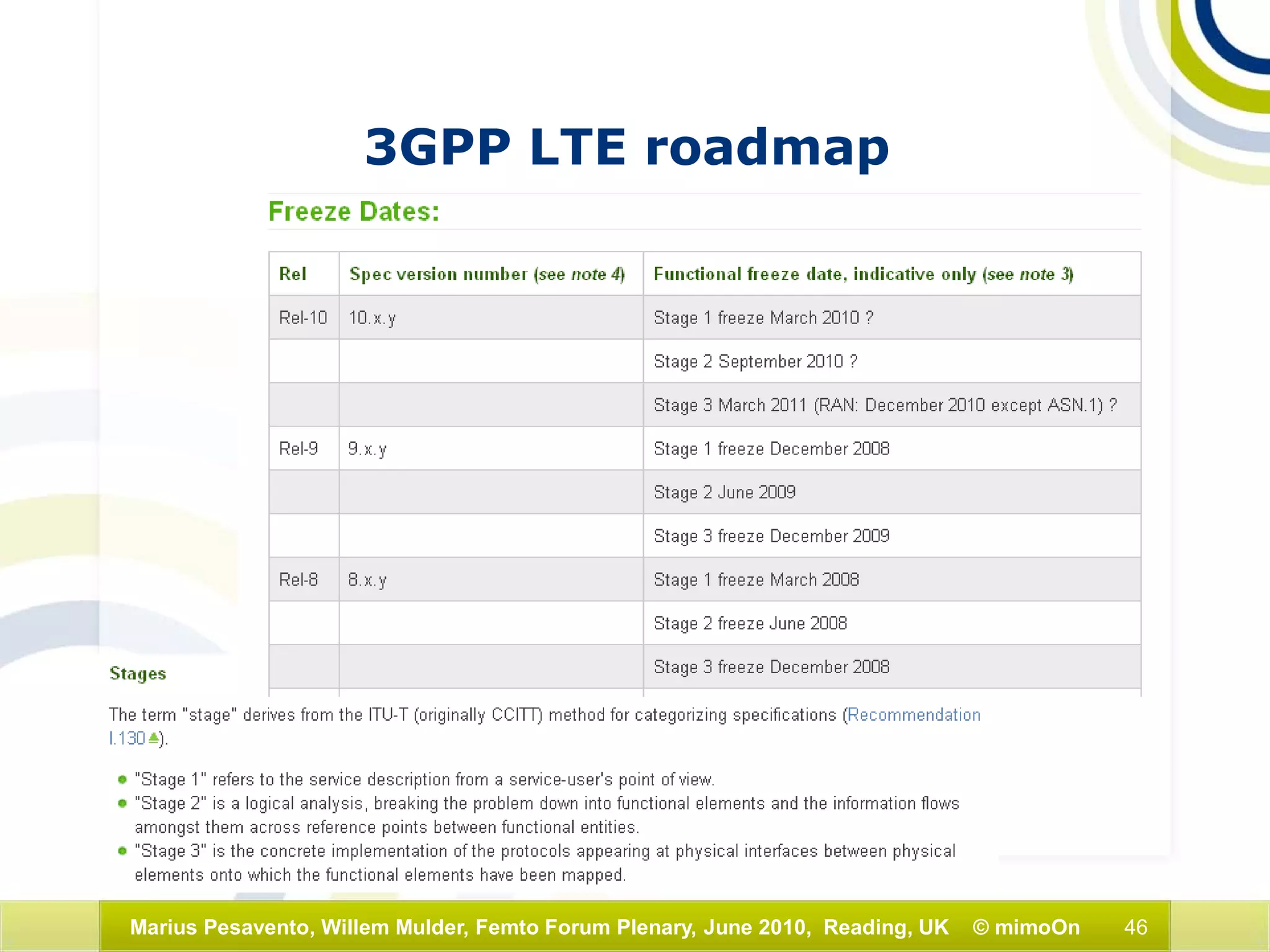
3GPP LTE roadmap

LTE Basics

  • 1.
    1Marius Pesavento, WillemMulder, Femto Forum Plenary, June 2010, Reading, UK © mimoOn LTE Tutorial part 1 LTE Basics Marius Pesavento - marius.pesavento@mimoOn.de Willem Mulder - willem.mulder@mimoOn.de
  • 2.
    2Marius Pesavento, WillemMulder, Femto Forum Plenary, June 2010, Reading, UK © mimoOn Agenda  Part 1, LTE Basics 9:30 – 10:30  Introduction to LTE  FDD/TDD frame structures and reference signals  Physical channels, logical channels  PHY signal processing architecture  H-ARQ processing, H-ARQ timing  UE categories  Part 2, Advanced topics in LTE 11:00 – 12:30  The LTE MIMO modes  Codebook-based precoding  Closed loop operation  CQI reporting modes  Using antenna port 5 (SDMA) techniques  Simulation results  Outlook LTE Advanced  Q & A 12:30 – 13:00
  • 3.
    3Marius Pesavento, WillemMulder, Femto Forum Plenary, June 2010, Reading, UK © mimoOn 3G Evolution  HSPA evolution  Gradually improved performance at low additional cost in 5MHz spectrum allocation  Next step: dual carrier allocation (10MHz)  LTE  LTE is new Radio Access Network (RAN)  significantly improved performance in up to 20MHz allocation  Peak data rates up to 300Mbps  LTE-Advanced  natural evolution of LTE, next major step  toward IMT-Advanced  support spectrum aggregation up to 100MHz and data rate up to 1Gbps SPRING 2011
  • 4.
    4Marius Pesavento, WillemMulder, Femto Forum Plenary, June 2010, Reading, UK © mimoOn LTE Targets  Cell-capacity (Control plane): 200 user per cell in 5MHz  Peak data rate  DL: 300MBit/s  UL: 75 MBit/s  Control plane latency: 50/100ms (idle to active)  User Plane Latency: <5ms (unload condition)  Interworking with UMTS, WCDMA, GSM/EDGE  Access technology:  OFDMA in DL  SC-FDMA in UL (reduced PAPR)  Basis antenna configuration:  eNB: Tx 1 to 4; Rx ≥ 1  UE: Tx = 1; Rx ≥ 2 (depending on UE category )
  • 5.
    5Marius Pesavento, WillemMulder, Femto Forum Plenary, June 2010, Reading, UK © mimoOn E-UTRA frequency bands TDDN/A2400 MHz-2300 MHz2400 MHz-2300 MHz40 TDDN/A1920 MHz-1880 MHz1920 MHz-1880 MHz39 TDDN/A2620 MHz–2570 MHz2620 MHz–2570 MHz38 TDDN/A1930 MHz–1910 MHz1930 MHz–1910 MHz37 TDDN/A1990 MHz–1930 MHz1990 MHz–1930 MHz36 TDDN/A1910 MHz–1850 MHz1910 MHz–1850 MHz35 TDDN/A2025 MHz–2010 MHz2025 MHz–2010 MHz34 TDDN/A1920 MHz–1900 MHz1920 MHz–1900 MHz33 ... FDD20768 MHz–758 MHz798 MHz–788 MHz14 FDD21756 MHz–746 MHz787 MHz–777 MHz13 FDD[TBD][TBD]–[TBD][TBD]–[TBD]12 FDD23 MHz1500.9 MHz–1475.9MHz1452.9 MHz–1427.9MH z 11 FDD340 MHz2170 MHz–2110 MHz1770 MHz–1710 MHz10 FDD60 MHz1879.9 MHz–1844.9MHz1784.9 MHz–1749.9MHz9 FDD10 MHz960 MHz–925 MHz915 MHz–880 MHz8 FDD50 MHz2690 MHz–2620 MHz2570 MHz–2500 MHz7 FDD35 MHz885 MHz–875 MHz840 MHz–830 MHz6 FDD20 MHz894MHz–869 MHz849 MHz–824 MHz5 FDD355 MHz2155 MHz–2110 MHz1755 MHz–1710 MHz4 FDD20 MHz1880 MHz–1805 MHz1785 MHz–1710 MHz3 FDD20 MHz1990 MHz–1930 MHz1910 MHz–1850 MHz2 FDD130 MHz2170 MHz–2110 MHz1980 MHz–1920 MHz1 FDL_low-FUL_highFDL_low – FDL_highFUL_low – FUL_high Duplex Mode UL-DL Band separation Downlink (DL) eNode B transmit UE receive Uplink (UL) eNode B receive UE transmit E-UTRA Band UMTS band extension band
  • 6.
    6Marius Pesavento, WillemMulder, Femto Forum Plenary, June 2010, Reading, UK © mimoOn Basic Transmission Schemes Transmission Bandwidth 1.4 MHz 3 MHz 5 MHz 10 MHz 15 MHz 20 MHz Sampling Frequency 1.92 MHz 3.84 MHz 7.68 MHz 15.36 MHz 23.04 MHz 30.72 MHz FFT Size 128 256 512 1024 1536 2048 #RBs (12 subcarrier) 6 15 25 50 75 100 (110)
  • 7.
    7Marius Pesavento, WillemMulder, Femto Forum Plenary, June 2010, Reading, UK © mimoOn Frame Structure Type 1 Frame Structure Type 1 frame structure type 1 is applicable to FDD (frequency division duplex), full-duplex and half-duplex #0 #1 #2 #3 #18 #19 one slot, Tslot = 15360*TS = 0.5 ms one radio frame, Tf = 307200*TS = 10 ms one subframe Transmission Time Interval (TTI)= 1ms TS basic time unit corresponding to sampling frequency 30.72MHz
  • 8.
    8Marius Pesavento, WillemMulder, Femto Forum Plenary, June 2010, Reading, UK © mimoOn Slot Structure normal cyclic prefix extended cyclic prefix, ∆f = 15 KHz normal cyclic prefix #2normal cyclic prefix #1 2048*TS 144*TS 2048*TS2048*TS2048*TS2048*TS2048*TS2048*TS 160*TS 144*TS144*TS144*TS144*TS144*TS slot #0 #6 extended cyclic prefix #0 #5 2048*TS 512*TS 2048*TS 512*TS 2048*TS 512*TS 2048*TS 512*TS 2048*TS 512*TS 2048*TS 512*TS slot
  • 9.
    9Marius Pesavento, WillemMulder, Femto Forum Plenary, June 2010, Reading, UK © mimoOn subframe 1 ms one radio frame, Tf = 307200*TS = 10 ms Frame Structure Type 2: TDD DL #0 S #1 UL #2 UL/DL #3 UL/DL #4 S/DL #6 DL #5 UL/DL #7 UL/DL #8 UL/DL #9 Downlink subframe Uplink subframe Special guard subframe for DL to UL switch Special guard subframe or Downlink SF Uplink or Downlink subframe special subframe: DL to UL switching S #1 or #6 DwPTS GP UpPTS DwPTS: DL pilot time slot shortend DL subframe (3,8,9,10,11, or 12 OFDM symbols) reference signals, primary sync and control, PDSCH GP: Guard period (1,2,3,4,7,8,9,10 OFDM symbols) UpPTS: UL pilot time slot (1 or 2 OFDM symbols) sounding reference or RACH SSS RSand Control PSS 0 1 2
  • 10.
    10Marius Pesavento, WillemMulder, Femto Forum Plenary, June 2010, Reading, UK © mimoOn Frame Structure Type 2: TDD Tx Rx Tx Rx DL UL Tx #2 UL Tx #3 GP UpPTS DwPTS DL UL Rx #2 UL Rx #3 GP UpPTS DwPTS DL Tx #0 DL Tx #4 DL Tx #6 DL Tx #5 GP UpPTS DwPTS DL DL Rx #4 DL Rx #6 DL Rx #5 GP UpPTS DwPTS path delay path delay UL/DL switching must be accomplished within the CP length (e.g. if path delay is zero)
  • 11.
    11Marius Pesavento, WillemMulder, Femto Forum Plenary, June 2010, Reading, UK © mimoOn DwPTS, GP, UpPTS length (in OFDM symbols) Format Normal CP Extended CP DwPTS GP UpPTS DwPTS GP UpPTS 0 3 10 1 3 8 666.7µs  200Km 11 9 4 8 3 2 10 3 9 2 3 11 2 10 1 4 12 1 3 7 25 3 9 2 8 2 6 9 3 9 1 7 10 2 - - - 8 11 1 - - -
  • 12.
    12Marius Pesavento, WillemMulder, Femto Forum Plenary, June 2010, Reading, UK © mimoOn Resource Blocks 7 OFDM symbols 12 subcarriers frame structure 1 normal cyclic prefix ∆f = 15 KHz DC 1 DL RB −N resource block resource block 0 all subframes
  • 13.
    13Marius Pesavento, WillemMulder, Femto Forum Plenary, June 2010, Reading, UK © mimoOn Physical Channels Downlink (DL)  Physical Broadcast Channel (PBCH)  System Information (Master Information Block MIB) approx. every 40 ms  Physical Downlink Control Channel (PDCCH)  DL Control Information Format (DCI-format), DL- grants (current TTI), UL-grants (+4 TTI), uplink power control  Physical DL Shared Channel (PDSCH)  DL transport blocks (TBs), DL Control Information, System Information Block (SIB), Paging Channel (PCH), Multicast Channel (MCH)  Physical Control Format Indicator Channel (PCFICH)  location of the PDCCH  Physical Hybrid ARQ Indicator Channel (PHICH)  UL ACK/NACK  Physical Multicast Channel (PMCH)
  • 14.
    14Marius Pesavento, WillemMulder, Femto Forum Plenary, June 2010, Reading, UK © mimoOn Physical Channels Uplink (UL)  Physical Random Access Channel (PRACH)  UL timing estimation (path delay), UL scheduling request (SR)  Physical Uplink Control Channel (PUCCH)  Channel Quality Indicater (CQI), Precoding Matrix Indicator (PMI), Rank Indicator (RI), ACK/NACK, SR  Physical Uplink Shared Channel (PUSCH)  UL TBs, ACK/NACK, CQI, PMI, RI, SR
  • 15.
    15Marius Pesavento, WillemMulder, Femto Forum Plenary, June 2010, Reading, UK © mimoOn PHY Signals Downlink  Primary and Secondary Synchronization Signal  cell-search, DL-frame synchronization, time, frequency, drift,  Cell-specific reference signals (antenna port 0 - 3), orthogonal (non-overlapping) in time-frequency-domain  MIMO channel estimation, fine frequency estimation, UL-CQI estimation  UE-specific reference signals  implicit signaling of DL-transmit beamforming weights Uplink  Demodulaton Reference Signal  Sounding Reference Signal  UL wideband CQI estimation  Random-Access Sequence  for UL timing synchronization
  • 16.
    16Marius Pesavento, WillemMulder, Femto Forum Plenary, June 2010, Reading, UK © mimoOn one antenna port (frame structure 1, normal cyclic prefix) reference signal 0 two antenna ports (frame structure 1, normal cyclic prefix) reference signal 0 reference signal 1 not used for transmission on this antenna port slot slot slot Cell-Specific Reference Signals carrier frequency: 2.6GHz LTE requirement max speed: 350km/h max Doppler frequency: 843Hz Clarke's model coherence time: T > 9/(16π fm) approx. 3 OFDM symbols pilot spacing in frequency coherence bandwidth B ≥ 6x15KHz B ¼ 1 / (2 π τ) ⇒delay spead τ : τ ¼ 1 / (2 π B) =1.77µsec (¼ 54 smpls; corresp. to 531 meter ) Port 0 Port 1 Port 0 Tx Tx
  • 17.
    17Marius Pesavento, WillemMulder, Femto Forum Plenary, June 2010, Reading, UK © mimoOn reference signal 0 reference signal 1 not used for transmission on this antenna port reference signal 2 reference signal 3 four antenna ports (frame structure 1, normal cyclic prefix) slot slot even slot odd slot even slot odd slot Cell-Specific Reference Signals Port 3 Port 2 Port 1 Port 0 Tx
  • 18.
    18Marius Pesavento, WillemMulder, Femto Forum Plenary, June 2010, Reading, UK © mimoOn DL time-frequency structure •DL payload on DL Shared Channel •Primary synchronization signal •Secondary synchronization signal •Broadcast Channel •DL Control Channel •Reference signal 20MHz 30.72MHz guard band
  • 19.
    19Marius Pesavento, WillemMulder, Femto Forum Plenary, June 2010, Reading, UK © mimoOn UL time-frequency structure demodulation reference signal (DRS) sounding reference signal (SRS) PUSCH PUCCH time / OFDM symbol number frequency
  • 20.
    20Marius Pesavento, WillemMulder, Femto Forum Plenary, June 2010, Reading, UK © mimoOn MAC PDU CBSeg- mentation Modulation Layer Mapping MIMO Precoding P/S Sync Signals Ref Signal Frame Builder IFFT CP Adding Pulse Shape ChannelCoding Turbo HARQ Support & Rate Matching •HARQ hard buffer for S1, P1, P2 • Subblock interleaver •Rate Matcher, RVs Scrambling to DACs TBCRC CBCRC CB Concatenation PDSCH Tx numberof antennas number of Transport Blocks (TBs) number of streams
  • 21.
    21Marius Pesavento, WillemMulder, Femto Forum Plenary, June 2010, Reading, UK © mimoOn MAC PDU frame/RB demapper Rotator Freq. Off. CP Removal FFT Channel Estimation Measure- ments MIMO Detector From ADCs Layer Demapper P/S-Sync Processing CBConcate- nation Soft Demodulator 8bit Turbo Decoder HARQ Support & Rate Matching: •HARQ soft buffer for S1, P1, P2, •Subblock interleaver •Soft-Combiner 8 bit, RVs Descrambling TBCRC CBCRC CBsementation: transitionfrom OFDMwiseto CB-wise processing antenna ports Down- sampling filter Fine Frequency estimation Rotator Samp.D. other CWs smple drift PDSCH Rx
  • 22.
    22Marius Pesavento, WillemMulder, Femto Forum Plenary, June 2010, Reading, UK © mimoOn Transform Precoding Mixed-Radix DFT Demod. Ref. Signal RB Resource Mapper IFFT CP Adding Pulse Shape DAC Rotator Freq. Cor. MAC PDU CBSeg- mentation Modulation Channel TurboCoding Data&Control Mux Scrambling TBCRC CBCRC CB Concatenation HARQ Support & Rate Matching •HARQ hard buffer for S1, P1, P2 • Subblock interleaver •Rate Matcher, RVs Rotator Samp. Drift Sound. Ref. Signal control TS36.212Figure 5.2.2-1 Channel Interleaving ACK RI Length 32 block code CQI and/or PMI report CQI <= 11 bit CQI and/or PMI report CQI > 11 bit 32bit Channel Conv. Coding CBCRC Rate Matching PUSCH Tx number of Transport Blocks (TBs) of different users to reduce PAPR
  • 23.
    23Marius Pesavento, WillemMulder, Femto Forum Plenary, June 2010, Reading, UK © mimoOn control TS36.212Figure 5.2.2-1 MAC PDU CBConcate- nation Soft demodulator 8.bit Turbo Decoder Descrambling TBCRC CBCRC CBSegmentation: Transitionfrom OFDM-toCB-wise processing Tranform (De)Precoding (mixed-Radix DFT) frame/RB Demapper CP Removal FFT Demod. Ref. Channel Estimation Measure- ments Multi- Antenna Receiver Sounding Ref. Processing Data&Control Demux Frame timing HARQ Support & Rate Matching: •HARQ soft buffer for S1, P1, P2, •Subblock interleaver •Soft-Combiner 8 bit, RVs From ADCs Channel deinterleaver ACK RI Block decoder (32,11) Rate DeMatching: •Subblock interleaver •Soft-Combiner 8 bit, RVs ViterbiCB CRC PUSCH Rx
  • 24.
    24Marius Pesavento, WillemMulder, Femto Forum Plenary, June 2010, Reading, UK © mimoOn Downlink Control Indicator Format (DCI format)  DCI format 0 is used for the transmission of UL-SCH assignments  DCI format 1 is used for the transmission of DL-SCH assignments for single antenna operation  DCI format 1A is used for a compact transmission of DL-SCH assignments for single antenna operation  DCI format 1B is used to support closed-loop single-rank transmission with possibly contiguous resource allocation  DCI format 1C is for downlink transmission of paging, RACH response and dynamic BCCH scheduling  DCI format 2 is used for the transmission of DL-SCH assignments for MIMO operation  DCI format 3 is used for the transmission of TPC commands for PUCCH and PUSCH with 2-bit power adjustments  DCI format 3A is used for the transmission of TPC commands for PUCCH and PUSCH with single bit power adjustments
  • 25.
    25Marius Pesavento, WillemMulder, Femto Forum Plenary, June 2010, Reading, UK © mimoOn CRC scrambling with RNTI / (UE Tx port) specific CRC generation L=16 DCI tail bit convolutional encoder, rate 1/3 interleaver, rate-matching PDCCH multiplexing <NIL>element insertion cell-specific scrambling other DCIs QPSK modulation sub-block interleaver (on quadruples of modulated symbols), remove <NULL> elements Resource Mapper, (mapping to RE groups) time first – then frequency layer mapping, pre-coding: single antenna port or transmit diversity antenna ports 0,...,3 other DL channels IFFT and CP attachment MIMO channel FFT and CP removal, frequency and timing correction Resource demapper (1-3 OFDM symbols, according to CFI) sub-block de-inter- leaver equalizer, MIMO detector, (requires channel estimation) soft- demodulator rate- dematching, deinterleaving Viterbi decoder cell specific de- scrambling 44 blind decoding attempts (common- and UE-specific- search-space), 44 PDCCH candidates code bit extraction CRC calculation XOR CRC extraction RNTI skip some decodes if RNTI is found PDCCH processing chain RNTI: radio network temporary identifier DCI User specific search space (aggregation level) 1-CCE (2x6attempts) 2-CCE (2x6attempts) 4-CCE (2x2attempts), 8-CCE (2x2attempts) Cell specific search space (aggregation level) 4-CCE (2x4attempts) 8-CCE (2x2attempts)
  • 26.
    26Marius Pesavento, WillemMulder, Femto Forum Plenary, June 2010, Reading, UK © mimoOn spreading with sequence Scheduling request (SR) (presence/absence) Block code Length 20 never simultaneously with PUSCH CQI, PMI, RI report (2) <= 4bit ACK/NACK (1a,1b) 1 or 2 bit to map on CQI resource concatenation: •only CQI (2: 20 bit) •CQI + ACK/NACK (2a: 21 bit, 2b: 22bit) to map on SR resource •w/o ACK/NACK (1);d(0)=1 •w ACK/NACK d(0) = 1,-1 d(0) = 1,j,-1,-j to map on ACK/NACK resource ACK/NACK w/o CQI or SR, 1a: d(0)= 1,-1 1b: d(0)= 1,j,-1,-j 20bit for mapping to outer RBs for mapping to in RBs Pseudo-Random sequence generator cell IDinit Nc = (2) RBN (1) csN ),(cell cs lnn s )()( , nr vu α 12PUCCH seq =N spreading with orthogonal sequence 12symbols )(oc iwn 4PUCCH SF =N UE specific cell specific scrambling spreading with sequence )()( , nr vu α 12PUCCH seq =N modulation: d(0),…d(19) on QPSK (BPSK) 36.211, 7.1 d(20), d(21) according to 36.211, Table 5.4.2-1 resource index (2) PUCCHn determines cyclic shiftα Resourcem apper (k,l,slot#) IFFT CP attach include demodulation reference signals for format 1 (see below) (1) PUCCHnresource index determines cyclic shift and orthogonal sequence 12symbols include demodulation reference signals for format 2 (see below) “d” “z” PUCCH processing chain Tx all formats
  • 27.
    27Marius Pesavento, WillemMulder, Femto Forum Plenary, June 2010, Reading, UK © mimoOn Resource de-mapper (k,l,slot#) format2,2a,2b (CQI,PMI,RI) CP removal FFT (2048) format 1,1a,1b ACK/NCK w or w/o SR (see next page) multiplication with conjugate of )()( , nr vu α 12PUCCH seq =N resource index (2) PUCCHn determines cyclic shiftα IDFTlength12 separate users according to cyclic shift in time- domain multiplication with conjugate of )()( , nr vu α 12PUCCH seq =N resource index (2) PUCCHn determines cyclic shiftα IDFTlength12 channel estimation separate users according to cyclic shift in time- domain tap M(<12) channel coefficient vector M depends on number of shifts in use matched filtering with tap M coef. vector user m user m harddemodulator UE specific cell specific descrambling segmentation SR •w/o ACK/NACK (1);d(0)=1 •w ACK/NACK d(0) = 1,-1 d(0) = 1,j,-1,-j ACK/NACK (1a,1b) Block decoding (bit-level matched filter) CQI, PMI, RI report (2) QPSK PUCCH processing Rx format 2, 2a, 2b
  • 28.
    28Marius Pesavento, WillemMulder, Femto Forum Plenary, June 2010, Reading, UK © mimoOn Resource de-mapper (k,l,slot#) on SR resource format1,1a,1b (SRandACK/NACK) CP removal FFT (2048) format 2,2a,2b (CQI,PMI,RI) multiplication with conjugate of )()( , nr vu α 12PUCCH seq =N resource index (2) PUCCHn determines cyclic shiftα IDFTlength12 separate users according to cyclic shift in time- domain multiplication with conjugate of )()( , nr vu α 12PUCCH seq =N resource index (2) PUCCHn determines cyclic shiftα IDFTlength12 channel estimation 1 separate users according to cyclic shift in time-domain tap M(<12) channel coefficient vector M depends on number of shifts in use matched filtering with tap M coef. vector user m user m harddemodulator UE specific cell specific descrambling ACK/NACK channelestimation2 separateusersaccordingtoorthogonal coversequence(despreading) despreading separateusereaccordingto orthogonalsequence SR PUCCH processing Rx format 1
  • 29.
    29Marius Pesavento, WillemMulder, Femto Forum Plenary, June 2010, Reading, UK © mimoOn Resource de-mapper (k,l,slot#) on ACK/NACK resource format1,1a,1b (SRandACK/NACK) CP removal FFT (2048) format 2,2a,2b (CQI,PMI,RI) multiplication with conjugate of )()( , nr vu α 12PUCCH seq =N resource index (2) PUCCHn determines cyclic shiftα IDFTlength12 separate users according to cyclic shift in time- domain multiplication with conjugate of )()( , nr vu α 12PUCCH seq =N resource index (2) PUCCHn determines cyclic shiftα IDFTlength12 channel estimation 1 separate users according to cyclic shift in time-domain tap M(<12) channel coefficient vector M depends on number of shifts in use matched filtering with tap M coef. vector user m user m harddemodulator UE specific cell specific descrambling ACK/NACK channelestimation2 separateusersaccordingtoorthogonal coversequence(despreading) despreading separateusereaccordingto orthogonalsequence PUCCH processing Rx format 1a, 1b
  • 30.
    30Marius Pesavento, WillemMulder, Femto Forum Plenary, June 2010, Reading, UK © mimoOn spreading with sequence for mapping to outer RBs for mapping to in RBs Pseudo-Random sequence generator cell IDinit Nc = (2) RBN (1) csN ),(cell cs lnn s )()( , nr vu α 12PUCCH seq =N spreading with orthogonal sequence 12symbols )(oc iwn 4PUCCH SF =N UE specific cell specific scrambling spreading with sequence )()( , nr vu α 12PUCCH seq =N modulation: d(0),…d(19) on QPSK 36.211, 7.1 d(20), d(21) according to 36.211, Table 5.4.2-1 resource index (2) PUCCHn determines cyclic shiftα Resourcem apper (k,l,slot#) IFFT CP attach (1) PUCCHnresource index determines cyclic shift and orthogonal sequence 12symbols input sequence for format 1 input sequence for format 2 Demodulation reference signals for PUCCH format 2
  • 31.
    31Marius Pesavento, WillemMulder, Femto Forum Plenary, June 2010, Reading, UK © mimoOn 3 x repetition ACK/NACK 1 bit BPSK (I or Q) symbol level Spreading, length 4 orthogonal sequence 3bit super-position of different ACK/NACKS 3 symbols 12 symbols resource mapper, PHICH group is mapped to 3 groups of 4 REs scrambling 12symbols layer mapper SISO or MIMO TD FFT / CP insertion MIMO channel CP removal/IFFT resource demapper MIMO detectordescrambling matched filter length(12) ACK/NACK 1 bit other ACK/NACK 1 bit other ACK/NACK 1 bit Location depends on the index of the first RB of the corresponding PUSCH transmission PHICH (DL HARQ) Max. 8 different sequences Selection depends on the index of the first RB of the corresponding PUSCH transmission
  • 32.
    32Marius Pesavento, WillemMulder, Femto Forum Plenary, June 2010, Reading, UK © mimoOn MIB cell specific scrambling scrambling tail bit convolutional encoder, rate 1/3 QPSK modulation layer mapping for single antenna or transmit diversity precoding SFD resource mapping IFFT CP inclusion MIMO channel CP removel FFT Equalization (SISO, MISO, or TD) soft demodulator (QPSK) channel estimates Viterbi decoder interleaver, rate-matching rate matching buffer CRC attach CRC mask code bit extraction, CRC computation antenna config CRC extaction XOR antenna config frame no 0,1,2,3 PBCH PBCH carries important PHY information: system bandwidth, number of transmit antennas, PHICH configuration and system frame number,… masked CRC mask MIB After successful reception of PBCH, UE can read D-BCH in PDSCH (including PCFICH and PDCCH) which carries system information not including in PBCH
  • 33.
    33Marius Pesavento, WillemMulder, Femto Forum Plenary, June 2010, Reading, UK © mimoOn possible cell specific root-sequences,(conjugate) RACH sequence extends over several slots CP inclusion (3168, 21024, 6240) add to OFDM frame in time domain UL Tx signal in time domain: PUSCH, PUCCH,DRS,SRS, including CP Channel phase rotation, (mixing,frequency shift to DC) decimation 1/24 LP filter 1/24 DFT 1024Multiplication IDFT 1024 (results in change of sampling rate) Peak dection, path delay estimation RACH sequence, associated timing-advance RACH sequence, associated timing-advance Zadoff-Chu sequence (L=839), selectec from set of 64 sequences), different root-sequences or different cyclic shifts, Create in 839 sequence in frequency domain Zero padding to 1024 IDFT of length 1024 Upsampling by 24, LP filtering Rotator, frequency shift PRACH correlation (convolution) in time domain replaced by multiplication in frequency domain
  • 34.
    34Marius Pesavento, WillemMulder, Femto Forum Plenary, June 2010, Reading, UK © mimoOn PCFICH DL Control Format block code L=16 2 bits scambling cell and subframe dependent modulator QPSK layer mapping FFT / CP insertion power boosting power control MIMO channel resource mapper (4 blocks of 4REs = 1RE group) cell ID precoding SISO or Tx diversity CP removalII FFT resource demap MIMO detection demodulatordescrambling block detection number of OFDM symbols reserve for control 1,2,3
  • 35.
    35Marius Pesavento, WillemMulder, Femto Forum Plenary, June 2010, Reading, UK © mimoOn Rate matching and HARQ processing systematic parity 1 parity 2 sub-block interleaver column permutation write-in row-wise read-out column-wise S1 P1 P2 MUX S1 P1/P2 RV0 RV2 RV3 RV1
  • 36.
    36Marius Pesavento, WillemMulder, Femto Forum Plenary, June 2010, Reading, UK © mimoOn HARQ timing
  • 37.
    37Marius Pesavento, WillemMulder, Femto Forum Plenary, June 2010, Reading, UK © mimoOn UE Categories  synchronous HARQ in UL, ACK/NACK in 4 TTI after UL reception, re-transmission (UL) in 8 TTI after initial transmission, total of 8 HARQ processes  asynchronous HARQ in DL, ACK/NACK in 4 TTI after DL reception, retransmission with DL scheduling grant, total number of 8 HARQ processes Downlink physical layer parameter values set by UE Category UE Category Maximum number of DL-SCH transport block bits received within a TTI Maximum number of bits of a DL-SCH transport block received within a TTI Total number of soft channel bits Maximum number of supported layers for spatial multiplexing in DL Category 1 10296 10296 250368 1 Category 2 51024 51024 1237248 2 Category 3 102048 75376 1237248 2 Category 4 150752 75376 1827072 2 Category 5 302752 151376 3667200 4 Uplink physical layer parameter values set by UE Category UE Category Maximum number of bits of an UL-SCH transport block transmitted within a TTI Support for 64QAM in UL Category 1 5160 No Category 2 25456 No Category 3 51024 No Category 4 51024 No Category 5 75376 Yes ≈ 8HARQ buffer x(3(S1,P1,P2)x10296+ 12(termination))
  • 38.
    38Marius Pesavento, WillemMulder, Femto Forum Plenary, June 2010, Reading, UK © mimoOn UE Categories
  • 39.
    39Marius Pesavento, WillemMulder, Femto Forum Plenary, June 2010, Reading, UK © mimoOn TDD: DL grants and ACK/NACK reporting  FDD: only one DL (and one UL) grant per TTI. Corresponding DL TBs need to be ACK/NACK 4 TTIs after reception (1 or 2 bits).  TDD: ACK/NACK required for detected PDSCH and for DL SPS release on PDCCH.  TDD: usually one DL grant (but up to 2 DL grants, in special case of UL-DL config. 0) can be received within one TTI.
  • 40.
    40Marius Pesavento, WillemMulder, Femto Forum Plenary, June 2010, Reading, UK © mimoOn subframe 1 ms one radio frame, Tf = 307200*TS = 10 ms TDD ACK/NACK Recall: Frame Structure Type 2: TDD DL #0 S #1 UL #2 UL/DL #3 UL/DL #4 S/DL #6 DL #5 UL/DL #7 UL/DL #8 UL/DL #9 Downlink subframe Uplink subframe Special guard subframe for DL to UL switch Special guard subframe or Downlink SF Uplink or Downlink subframe special subframe: DL to UL switching S #1 or #6 DwPTS GP UpPTS DwPTS: DL pilot time slot shortend DL subframe (3,8,9,10,11, or 12 OFDM symbols) reference signals, primary sync and control, PDSCH GP: Guard period (1,2,3,4,7,8,9,10 OFDM symbols) UpPTS: UL pilot time slot (1 or 2 OFDM symbols) sounding reference or RACH SSS RSand Control PSS 0 1 2
  • 41.
    41Marius Pesavento, WillemMulder, Femto Forum Plenary, June 2010, Reading, UK © mimoOn TDD: UE ACK/NACK procedure (PUSCH transmission and PHICH reception) TDD UL/DL Configuration subframe number i 0 1 2 3 4 5 6 7 8 9 0 6,7 4 6,7 4 1 4 6 4 6 2 6 6 3 6 6 6 4 6 6 5 6 6 6 4 7 4 6 •ACK/NACK received on PHICH in subframe i •for UL transmission in subframe i - k, where the values for k are given in the table. k for TDD configurartion 0-6 TDD UL/DL Configuration subframe number i 0 1 2 3 4 5 6 7 8 9 0 4 7 6 4 7 6 1 4 6 4 6 2 6 6 3 6 6 6 4 6 6 5 6 6 4 6 6 4 7 UE Rx Perspective •for UL transmission in subframe i, •ACK/NACK received on PHICH in subframe i + k, where the values for k are given in the table. k for TDD configurartion 0-6 UE Tx Perspective
  • 42.
    42Marius Pesavento, WillemMulder, Femto Forum Plenary, June 2010, Reading, UK © mimoOn DL control issues in TDD DL HARQ TDD UL/DL Config. DL subframe number n 0 1 2 3 4 5 6 7 8 9 0 4 6 4 6 1 7 6 4 7 6 4 2 7 6 4 8 7 6 4 8 3 4 11 7 6 6 5 5 4 12 11 8 7 7 6 5 4 5 12 11 9 8 7 6 5 4 13 6 7 7 7 7 5 •reception of PDSCH in subframe n •ACK/NACK on PUSCH or PUCCH in subframe n + k k for TDD configurartion 0-6 TDD UL/DL Config. DL subframe number n 0 1 2 3 4 5 6 7 8 9 0 6 4 6 4 1 7,6 4 7,6 4 2 8,7,4,6 8,7,4,6 3 7,6,11 6,5 5,4 4 12,8,7,11 6,5,4,7 5 13,12,9,8,7,5,4,11 6 7 7 5 7 7 •ACK/NACK on PUSCH or PUCCH in subframe n •for reception of PDSCH insubframe n - k k for TDD configurartion 0-6 UE Rx Perspective UE Tx Perspective Multiple ACK/NACK in one subframe: Requieres ACK/NACK bundling (logical AND of codewords) or ACK/NACK multiplexing.
  • 43.
    43Marius Pesavento, WillemMulder, Femto Forum Plenary, June 2010, Reading, UK © mimoOn TDD: Downlink Assignment Index DAI to prevent ACK/NACK errors due to bundling k‘ for TDD configurartion 0-6 and DAI in DCI format 0 (UL assignments) •DAI indicates the number of subframes with PDSCH receptions and SPS releases detected within n-k and n (k 2 K) that need to be bundeled in the UL ACK/NACK signaling. •DAI is used only for TDD TDD UL/DL Config. DL subframe number n 0 1 2 3 4 5 6 7 8 9 0 DAI 6 4 DAI 6 4 1 DAI 6 4 DAI DAI 6 4 DAI 2 4 DAI 4 DAI 3 DAI 4 4 4 DAI DAI 4 4 4 DAI DAI 5 4 DAI 6 DAI DAI 7 7 5 DAI DAI 7 7 DAI TDD UL/DL Config. DL subframe number n 0 1 2 3 4 5 6 7 8 9 0 DAI DAI 6 4 DAI DAI 6 4 1 DAI 7,6 4 DAI DAI 7,6 4 DAI 2 8,7,4,6 DAI 8,7,4,6 DAI 3 DAI 7,6,11 6,5 5,4 DAI DAI 4 12,8,7,11 6,5,4,7 DAI DAI 5 13,12,9,8,7,5,4,11 DAI 6 DAI DAI 7 7 5 DAI DAI 7 7 DAI k for TDD configurartion 0-6 and DAI in DCI formats 1/1A/1B/1D/2/2A (DL) 0 or 4 or 841,1 3 or 731,0 2 or 620,1 1 or 5 or 910,0 Number of subframes with PDSCH transmission DAI MSB, LSB UL DAIV DL DAIVor
  • 44.
    44Marius Pesavento, WillemMulder, Femto Forum Plenary, June 2010, Reading, UK © mimoOn End of Part 1 Thank you!!!
  • 45.
    45Marius Pesavento, WillemMulder, Femto Forum Plenary, June 2010, Reading, UK © mimoOn Backup slides
  • 46.
    46Marius Pesavento, WillemMulder, Femto Forum Plenary, June 2010, Reading, UK © mimoOn 3GPP LTE roadmap