CHAITANYA
    chaitanya.singh87@gmail.com

    ABV-IIITM
    Gwalior

The Global 4G
Solution
chaitanya.singh87@gmail.com
                              INTRODUCTION
   • LTE Advanced is a mobile communication 4G standard
     approved by International Telecommunications Union
     (ITU) in Jan 2012 [1].
   • Standardized by the 3rd Generation Partnership Project
     (3GPP) as a major enhancement of the Long Term
     Evolution (LTE) standard.
   • It incorporates many enhancements including the
     aggregation of multiple radio channels, advanced
     antenna techniques, advanced network topology
     and others.
chaitanya.singh87@gmail.com
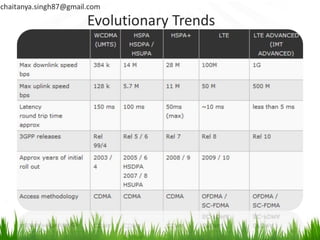
                         Evolutionary Trends


                              Source of Figure : [2]
chaitanya.singh87@gmail.com


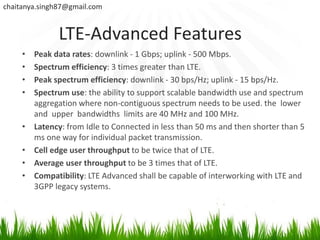
               LTE-Advanced Features
     •   Peak data rates: downlink - 1 Gbps; uplink - 500 Mbps.
     •   Spectrum efficiency: 3 times greater than LTE.
     •   Peak spectrum efficiency: downlink - 30 bps/Hz; uplink - 15 bps/Hz.
     •   Spectrum use: the ability to support scalable bandwidth use and spectrum
         aggregation where non-contiguous spectrum needs to be used. the lower
         and upper bandwidths limits are 40 MHz and 100 MHz.
     •   Latency: from Idle to Connected in less than 50 ms and then shorter than 5
         ms one way for individual packet transmission.
     •   Cell edge user throughput to be twice that of LTE.
     •   Average user throughput to be 3 times that of LTE.
     •   Compatibility: LTE Advanced shall be capable of interworking with LTE and
         3GPP legacy systems.
chaitanya.singh87@gmail.com

                   Principal technologies
   • SON ( Self-Optimizing Networks).
   • Carrier aggregation of contiguous and non-contiguous
     spectrum allocations.
   • Range expansion with Interference management and
     suppression
   • CoMP (Coordinated Multipoint transmission & reception).
   • Relaying.
   • Higher order MIMO.
   • Heterogeneous network support.
   • all-IP Flat Architecture.
chaitanya.singh87@gmail.com
    • Self-Optimizing Networks
    Self configuration Self optimization Self healing


                              Source of Figure: [4]
chaitanya.singh87@gmail.com
    • Carrier aggregation


                              Source of Figure: [3]
chaitanya.singh87@gmail.com
    • Range expansion


                              Source of Figure: [5]
chaitanya.singh87@gmail.com
    • Coordinated Multipoint transmission & reception

   • Joint processing:
   • Coordinated scheduling or beamforming:


                              Source of Figure: [3]
chaitanya.singh87@gmail.com
    • Relaying


                              Source of Figure: [2]
chaitanya.singh87@gmail.com
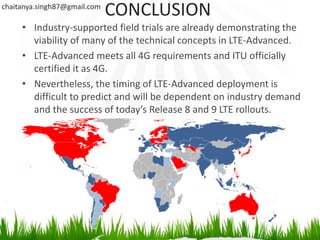
                              CONCLUSION
     • Industry-supported field trials are already demonstrating the
       viability of many of the technical concepts in LTE-Advanced.
     • LTE-Advanced meets all 4G requirements and ITU officially
       certified it as 4G.
     • Nevertheless, the timing of LTE-Advanced deployment is
       difficult to predict and will be dependent on industry demand
       and the success of today’s Release 8 and 9 LTE rollouts.
chaitanya.singh87@gmail.com
    REFERENCES

1. "IMT-Advanced standards for mobile broadband communications,"
   ITU NEWS, www.itunews.itu.in , Jan 2012.
2. "Introducing LTE-advanced,“ Agilent Technologies,
   www.agilent.com/finnd/LTE, Application Note, Nov 2010.
3. "4G Mobile Broadband Evolution: 3GPP Release 10 and Beyond," 4G
   Americas, www.4gamericas.org, White Paper, Feb 2011.
4. "Self-Optimizing Network: The benefits of SON in LTE," 4G Americas,
   www.4gamericas.org, White Paper, July 2011.
5. "LTE Advanced: Heterogeneous Networks,“ Qualcomm,
   http://www.qualcomm.com/solutions/wireless-
   networks/technologies/lte-advanced, White Paper, Jan 2011.
Thank You
chaitanya.singh87@gmail.com


Additional Slides
chaitanya.singh87@gmail.com
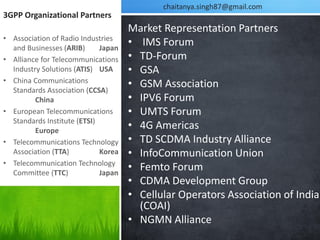
3GPP Organizational Partners
                                     Market Representation Partners
• Association of Radio Industries
  and Businesses (ARIB)      Japan
                                     • IMS Forum
• Alliance for Telecommunications    • TD-Forum
  Industry Solutions (ATIS) USA      • GSA
• China Communications
  Standards Association (CCSA)
                                     • GSM Association
         China                       • IPV6 Forum
• European Telecommunications        • UMTS Forum
  Standards Institute (ETSI)
         Europe
                                     • 4G Americas
• Telecommunications Technology      • TD SCDMA Industry Alliance
  Association (TTA)          Korea   • InfoCommunication Union
• Telecommunication Technology
  Committee (TTC)            Japan
                                     • Femto Forum
                                     • CDMA Development Group
                                     • Cellular Operators Association of India
                                       (COAI)
                                     • NGMN Alliance
chaitanya.singh87@gmail.com

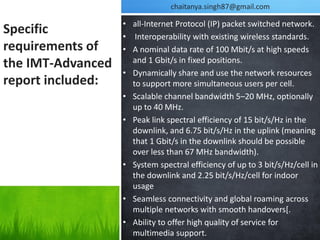
                   • all-Internet Protocol (IP) packet switched network.
Specific           • Interoperability with existing wireless standards.
requirements of    • A nominal data rate of 100 Mbit/s at high speeds
                     and 1 Gbit/s in fixed positions.
the IMT-Advanced
                   • Dynamically share and use the network resources
report included:     to support more simultaneous users per cell.
                   • Scalable channel bandwidth 5–20 MHz, optionally
                     up to 40 MHz.
                   • Peak link spectral efficiency of 15 bit/s/Hz in the
                     downlink, and 6.75 bit/s/Hz in the uplink (meaning
                     that 1 Gbit/s in the downlink should be possible
                     over less than 67 MHz bandwidth).
                   • System spectral efficiency of up to 3 bit/s/Hz/cell in
                     the downlink and 2.25 bit/s/Hz/cell for indoor
                     usage
                   • Seamless connectivity and global roaming across
                     multiple networks with smooth handovers[.
                   • Ability to offer high quality of service for
                     multimedia support.
chaitanya.singh87@gmail.com
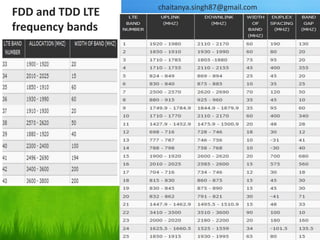
FDD and TDD LTE
frequency bands
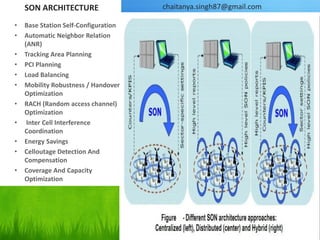
SON ARCHITECTURE                  chaitanya.singh87@gmail.com

•   Base Station Self-Configuration
•   Automatic Neighbor Relation
    (ANR)
•   Tracking Area Planning
•   PCI Planning
•   Load Balancing
•   Mobility Robustness / Handover
    Optimization
•   RACH (Random access channel)
    Optimization
•    Inter Cell Interference
    Coordination
•   Energy Savings
•   Celloutage Detection And
    Compensation
•   Coverage And Capacity
    Optimization
chaitanya.singh87@gmail.com
Common LTE FDD & TDD
Chipset Platform

• MODEMS & DATA CARDS
• SMARTPHONES & TABLETS

LTE Advanced - The Global 4G Standard

  • 1.
    CHAITANYA chaitanya.singh87@gmail.com ABV-IIITM Gwalior The Global 4G Solution
  • 2.
    chaitanya.singh87@gmail.com INTRODUCTION • LTE Advanced is a mobile communication 4G standard approved by International Telecommunications Union (ITU) in Jan 2012 [1]. • Standardized by the 3rd Generation Partnership Project (3GPP) as a major enhancement of the Long Term Evolution (LTE) standard. • It incorporates many enhancements including the aggregation of multiple radio channels, advanced antenna techniques, advanced network topology and others.
  • 3.
    chaitanya.singh87@gmail.com Evolutionary Trends Source of Figure : [2]
  • 5.
    chaitanya.singh87@gmail.com LTE-Advanced Features • Peak data rates: downlink - 1 Gbps; uplink - 500 Mbps. • Spectrum efficiency: 3 times greater than LTE. • Peak spectrum efficiency: downlink - 30 bps/Hz; uplink - 15 bps/Hz. • Spectrum use: the ability to support scalable bandwidth use and spectrum aggregation where non-contiguous spectrum needs to be used. the lower and upper bandwidths limits are 40 MHz and 100 MHz. • Latency: from Idle to Connected in less than 50 ms and then shorter than 5 ms one way for individual packet transmission. • Cell edge user throughput to be twice that of LTE. • Average user throughput to be 3 times that of LTE. • Compatibility: LTE Advanced shall be capable of interworking with LTE and 3GPP legacy systems.
  • 6.
    chaitanya.singh87@gmail.com Principal technologies • SON ( Self-Optimizing Networks). • Carrier aggregation of contiguous and non-contiguous spectrum allocations. • Range expansion with Interference management and suppression • CoMP (Coordinated Multipoint transmission & reception). • Relaying. • Higher order MIMO. • Heterogeneous network support. • all-IP Flat Architecture.
  • 7.
    chaitanya.singh87@gmail.com • Self-Optimizing Networks Self configuration Self optimization Self healing Source of Figure: [4]
  • 8.
    chaitanya.singh87@gmail.com • Carrier aggregation Source of Figure: [3]
  • 9.
    chaitanya.singh87@gmail.com • Range expansion Source of Figure: [5]
  • 10.
    chaitanya.singh87@gmail.com • Coordinated Multipoint transmission & reception • Joint processing: • Coordinated scheduling or beamforming: Source of Figure: [3]
  • 11.
    chaitanya.singh87@gmail.com • Relaying Source of Figure: [2]
  • 12.
    chaitanya.singh87@gmail.com CONCLUSION • Industry-supported field trials are already demonstrating the viability of many of the technical concepts in LTE-Advanced. • LTE-Advanced meets all 4G requirements and ITU officially certified it as 4G. • Nevertheless, the timing of LTE-Advanced deployment is difficult to predict and will be dependent on industry demand and the success of today’s Release 8 and 9 LTE rollouts.
  • 13.
    chaitanya.singh87@gmail.com REFERENCES 1. "IMT-Advanced standards for mobile broadband communications," ITU NEWS, www.itunews.itu.in , Jan 2012. 2. "Introducing LTE-advanced,“ Agilent Technologies, www.agilent.com/finnd/LTE, Application Note, Nov 2010. 3. "4G Mobile Broadband Evolution: 3GPP Release 10 and Beyond," 4G Americas, www.4gamericas.org, White Paper, Feb 2011. 4. "Self-Optimizing Network: The benefits of SON in LTE," 4G Americas, www.4gamericas.org, White Paper, July 2011. 5. "LTE Advanced: Heterogeneous Networks,“ Qualcomm, http://www.qualcomm.com/solutions/wireless- networks/technologies/lte-advanced, White Paper, Jan 2011.
  • 14.
  • 15.
    chaitanya.singh87@gmail.com 3GPP Organizational Partners Market Representation Partners • Association of Radio Industries and Businesses (ARIB) Japan • IMS Forum • Alliance for Telecommunications • TD-Forum Industry Solutions (ATIS) USA • GSA • China Communications Standards Association (CCSA) • GSM Association China • IPV6 Forum • European Telecommunications • UMTS Forum Standards Institute (ETSI) Europe • 4G Americas • Telecommunications Technology • TD SCDMA Industry Alliance Association (TTA) Korea • InfoCommunication Union • Telecommunication Technology Committee (TTC) Japan • Femto Forum • CDMA Development Group • Cellular Operators Association of India (COAI) • NGMN Alliance
  • 16.
    chaitanya.singh87@gmail.com • all-Internet Protocol (IP) packet switched network. Specific • Interoperability with existing wireless standards. requirements of • A nominal data rate of 100 Mbit/s at high speeds and 1 Gbit/s in fixed positions. the IMT-Advanced • Dynamically share and use the network resources report included: to support more simultaneous users per cell. • Scalable channel bandwidth 5–20 MHz, optionally up to 40 MHz. • Peak link spectral efficiency of 15 bit/s/Hz in the downlink, and 6.75 bit/s/Hz in the uplink (meaning that 1 Gbit/s in the downlink should be possible over less than 67 MHz bandwidth). • System spectral efficiency of up to 3 bit/s/Hz/cell in the downlink and 2.25 bit/s/Hz/cell for indoor usage • Seamless connectivity and global roaming across multiple networks with smooth handovers[. • Ability to offer high quality of service for multimedia support.
  • 17.
  • 18.
    SON ARCHITECTURE chaitanya.singh87@gmail.com • Base Station Self-Configuration • Automatic Neighbor Relation (ANR) • Tracking Area Planning • PCI Planning • Load Balancing • Mobility Robustness / Handover Optimization • RACH (Random access channel) Optimization • Inter Cell Interference Coordination • Energy Savings • Celloutage Detection And Compensation • Coverage And Capacity Optimization
  • 19.
    chaitanya.singh87@gmail.com Common LTE FDD& TDD Chipset Platform • MODEMS & DATA CARDS • SMARTPHONES & TABLETS