Technology Briefing
11 November 2010
Global Trends
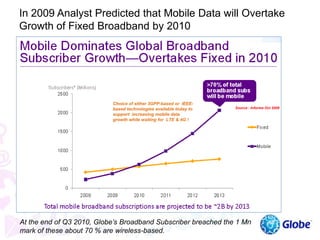
In 2009 Analyst Predicted that Mobile Data will Overtake
Growth of Fixed Broadband by 2010
Source : Informa Oct 2009
Choice of either 3GPP-based or IEEE-
based technologies available today to
support increasing mobile data
growth while waiting for LTE & 4G !
At the end of Q3 2010, Globe’s Broadband Subscriber breached the 1 Mn
mark of these about 70 % are wireless-based.
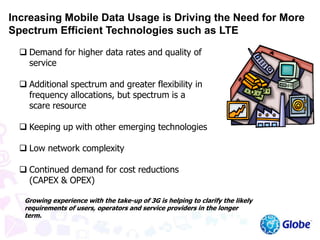
 Demand for higher data rates and quality of
service
 Additional spectrum and greater flexibility in
frequency allocations, but spectrum is a
scare resource
 Keeping up with other emerging technologies
 Low network complexity
 Continued demand for cost reductions
(CAPEX & OPEX)
Growing experience with the take-up of 3G is helping to clarify the likely
requirements of users, operators and service providers in the longer
term.
Increasing Mobile Data Usage is Driving the Need for More
Spectrum Efficient Technologies such as LTE
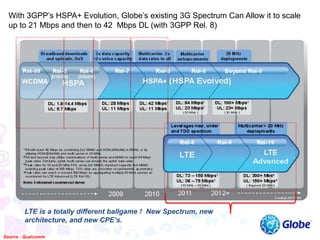
With 3GPP’s HSPA+ Evolution, Globe’s existing 3G Spectrum Can Allow it to scale
up to 21 Mbps and then to 42 Mbps DL (with 3GPP Rel. 8)
Source : Qualcomm
LTE is a totally different ballgame ! New Spectrum, new
architecture, and new CPE’s.
LTE Technology Overview
Part 1 - LTE Overview
▐ LTE standardization
▐ System Architecture base on 3GPP
▐ LTE key technology
▐ LTE Applications
© NEC
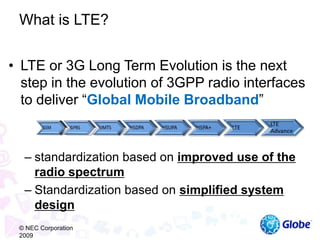
• LTE or 3G Long Term Evolution is the next
step in the evolution of 3GPP radio interfaces
to deliver “Global Mobile Broadband”
– standardization based on improved use of the
radio spectrum
– Standardization based on simplified system
design
What is LTE?
© NEC Corporation
2009
© NEC Corporation 2009
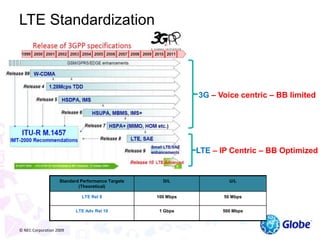
LTE Standardization
LTE – IP Centric – BB Optimized
Standard Performance Targets
(Theoretical)
D/L U/L
LTE Rel 8 100 Mbps 50 Mbps
LTE Adv Rel 10 1 Gbps 500 Mbps
3G – Voice centric – BB limited
Part 1 - LTE Overview
▐ LTE standardization
▐ System Architecture base on 3GPP
▐ LTE key technology
▐ LTE Applications
© NEC Corporation 2009
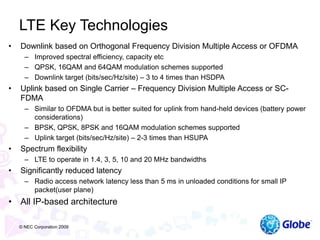
LTE Key Technologies
• Downlink based on Orthogonal Frequency Division Multiple Access or OFDMA
– Improved spectral efficiency, capacity etc
– QPSK, 16QAM and 64QAM modulation schemes supported
– Downlink target (bits/sec/Hz/site) – 3 to 4 times than HSDPA
• Uplink based on Single Carrier – Frequency Division Multiple Access or SC-
FDMA
– Similar to OFDMA but is better suited for uplink from hand-held devices (battery power
considerations)
– BPSK, QPSK, 8PSK and 16QAM modulation schemes supported
– Uplink target (bits/sec/Hz/site) – 2-3 times than HSUPA
• Spectrum flexibility
– LTE to operate in 1.4, 3, 5, 10 and 20 MHz bandwidths
• Significantly reduced latency
– Radio access network latency less than 5 ms in unloaded conditions for small IP
packet(user plane)
• All IP-based architecture
© NEC Corporation 2009
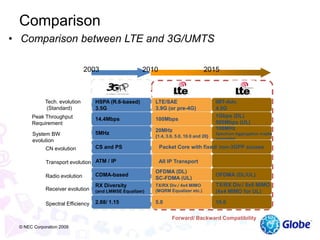
Comparison
• Comparison between LTE and 3G/UMTS
© NEC Corporation 2009
CN evolution
Tech. evolution
(Standard)
System BW
evolution
Radio evolution
Receiver evolution
HSPA (R.6-based)
3.5G
LTE/SAE
3.9G (or pre-4G)
IMT-Adv.
4.0G
5MHz
20MHz
{1.4, 3.0, 5.0, 10.0 and 20}
100MHz
Spectrum Aggregation maybe
supported
CS and PS
CDMA-based
OFDMA (DL)
SC-FDMA (UL)
OFDMA (DL/UL)
Packet Core with fixed/ non-3GPP access
RX Diversity
(and LMMSE Equalizer)
TX/RX Div./ 4x4 MIMO
(MQRM Equalizer etc.)
TX/RX Div./ 8x8 MIMO
(4x4 MIMO for UL)
2.88/ 1.15 5.0 10.0Spectral Efficiency
2003 2010 2015
Peak Throughput
Requirement
14.4Mbps 100Mbps
1Gbps (DL)
500Mbps (UL)
Transport evolution ATM / IP All IP Transport
Forward/ Backward Compatibility
Part 1 - LTE Overview
▐ LTE standardization
▐ System Architecture based on 3GPP
▐ LTE key technology
▐ LTE Applications
© NEC Corporation 2009
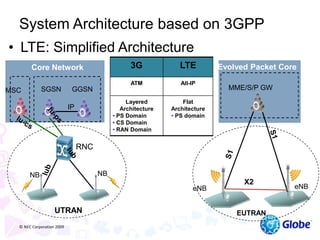
GGSNSGSN
IP
RNC
eNB
NB
MME/S/P GW
eNB
UTRAN EUTRAN
Core Network
NB
Evolved Packet Core
X2
System Architecture based on 3GPP
• LTE: Simplified Architecture
3G LTE
ATM All-IP
Layered
Architecture
• PS Domain
• CS Domain
• RAN Domain
Flat
Architecture
• PS domain
MSC
Part 1 - LTE Overview
▐ LTE standardization
▐ System Architecture base on 3GPP
▐ LTE key technology
▐ LTE Applications
© NEC Corporation 2009
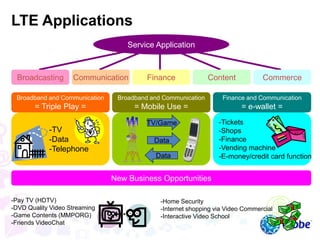
-Pay TV (HDTV)
-DVD Quality Video Streaming
-Game Contents (MMPORG)
-Friends VideoChat
Broadband and Communication
= Triple Play =
Broadband and Communication
= Mobile Use =
Finance and Communication
= e-wallet =
-TV
-Data
-Telephone
New Business Opportunities
-Tickets
-Shops
-Finance
-Vending machine
-E-money/credit card function
TV/Game
Data
Data
Service Application
Broadcasting Communication Finance Content Commerce
-Home Security
-Internet shopping via Video Commercial
-Interactive Video School
LTE Applications
Part 2 - Global Status
▐Spectrum
▐Deployment Status
© NEC Corporation
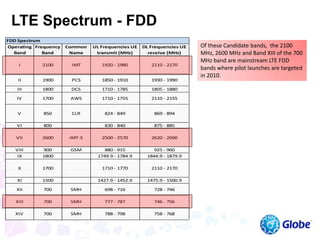
LTE Spectrum - FDD
Operating
Band
Frequency
Band
Common
Name
UL Frequencies UE
transmit (MHz)
DL Frequencies UE
receive (MHz)
I 2100 IMT 1920 - 1980 2110 - 2170
II 1900 PCS 1850 - 1910 1930 - 1990
III 1800 DCS 1710 - 1785 1805 - 1880
IV 1700 AWS 1710 - 1755 2110 - 2155
V 850 CLR 824 - 849 869 - 894
VI 800 830 - 840 875 - 885
VII 2600 IMT-E 2500 - 2570 2620 - 2690
VIII 900 GSM 880 - 915 925 - 960
IX 1800 1749.9 - 1784.9 1844.9 - 1879.9
X 1700 1710 - 1770 2110 - 2170
XI 1500 1427.9 - 1452.9 1475.9 - 1500.9
XII 700 SMH 698 - 716 728 - 746
XIII 700 SMH 777 - 787 746 - 756
XIV 700 SMH 788 - 798 758 - 768
FDD Spectrum
Of these Candidate bands, the 2100
MHz, 2600 MHz and Band XIII of the 700
MHz band are mainstream LTE FDD
bands where pilot launches are targeted
in 2010.
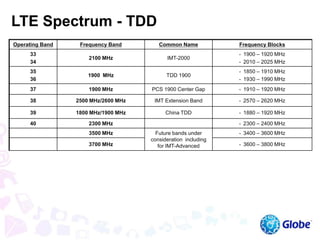
LTE Spectrum - TDD
Operating Band Frequency Band Common Name Frequency Blocks
33
34
2100 MHz IMT-2000
• 1900 – 1920 MHz
• 2010 – 2025 MHz
35
36
1900 MHz TDD 1900
• 1850 – 1910 MHz
• 1930 – 1990 MHz
37 1900 MHz PCS 1900 Center Gap • 1910 – 1920 MHz
38 2500 MHz/2600 MHz IMT Extension Band • 2570 – 2620 MHz
39 1800 MHz/1900 MHz China TDD • 1880 – 1920 MHz
40 2300 MHz • 2300 – 2400 MHz
3500 MHz Future bands under
consideration including
for IMT-Advanced
• 3400 – 3600 MHz
3700 MHz • 3600 – 3800 MHz
© NEC Corporation Page 20
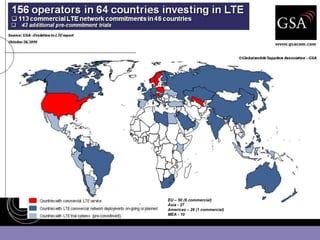
EU – 50 (6 commercial)
Asia - 27
Americas – 26 (1 commercial)
MEA - 10
End of Presentation
Globe Technology Scan
31 May 2010

Technology briefing 11 nov2010_media_kit (1)

  • 1.
  • 2.
  • 3.
    In 2009 AnalystPredicted that Mobile Data will Overtake Growth of Fixed Broadband by 2010 Source : Informa Oct 2009 Choice of either 3GPP-based or IEEE- based technologies available today to support increasing mobile data growth while waiting for LTE & 4G ! At the end of Q3 2010, Globe’s Broadband Subscriber breached the 1 Mn mark of these about 70 % are wireless-based.
  • 4.
     Demand forhigher data rates and quality of service  Additional spectrum and greater flexibility in frequency allocations, but spectrum is a scare resource  Keeping up with other emerging technologies  Low network complexity  Continued demand for cost reductions (CAPEX & OPEX) Growing experience with the take-up of 3G is helping to clarify the likely requirements of users, operators and service providers in the longer term. Increasing Mobile Data Usage is Driving the Need for More Spectrum Efficient Technologies such as LTE
  • 5.
    With 3GPP’s HSPA+Evolution, Globe’s existing 3G Spectrum Can Allow it to scale up to 21 Mbps and then to 42 Mbps DL (with 3GPP Rel. 8) Source : Qualcomm LTE is a totally different ballgame ! New Spectrum, new architecture, and new CPE’s.
  • 6.
  • 7.
    Part 1 -LTE Overview ▐ LTE standardization ▐ System Architecture base on 3GPP ▐ LTE key technology ▐ LTE Applications © NEC
  • 8.
    • LTE or3G Long Term Evolution is the next step in the evolution of 3GPP radio interfaces to deliver “Global Mobile Broadband” – standardization based on improved use of the radio spectrum – Standardization based on simplified system design What is LTE? © NEC Corporation 2009
  • 9.
    © NEC Corporation2009 LTE Standardization LTE – IP Centric – BB Optimized Standard Performance Targets (Theoretical) D/L U/L LTE Rel 8 100 Mbps 50 Mbps LTE Adv Rel 10 1 Gbps 500 Mbps 3G – Voice centric – BB limited
  • 10.
    Part 1 -LTE Overview ▐ LTE standardization ▐ System Architecture base on 3GPP ▐ LTE key technology ▐ LTE Applications © NEC Corporation 2009
  • 11.
    LTE Key Technologies •Downlink based on Orthogonal Frequency Division Multiple Access or OFDMA – Improved spectral efficiency, capacity etc – QPSK, 16QAM and 64QAM modulation schemes supported – Downlink target (bits/sec/Hz/site) – 3 to 4 times than HSDPA • Uplink based on Single Carrier – Frequency Division Multiple Access or SC- FDMA – Similar to OFDMA but is better suited for uplink from hand-held devices (battery power considerations) – BPSK, QPSK, 8PSK and 16QAM modulation schemes supported – Uplink target (bits/sec/Hz/site) – 2-3 times than HSUPA • Spectrum flexibility – LTE to operate in 1.4, 3, 5, 10 and 20 MHz bandwidths • Significantly reduced latency – Radio access network latency less than 5 ms in unloaded conditions for small IP packet(user plane) • All IP-based architecture © NEC Corporation 2009
  • 12.
    Comparison • Comparison betweenLTE and 3G/UMTS © NEC Corporation 2009 CN evolution Tech. evolution (Standard) System BW evolution Radio evolution Receiver evolution HSPA (R.6-based) 3.5G LTE/SAE 3.9G (or pre-4G) IMT-Adv. 4.0G 5MHz 20MHz {1.4, 3.0, 5.0, 10.0 and 20} 100MHz Spectrum Aggregation maybe supported CS and PS CDMA-based OFDMA (DL) SC-FDMA (UL) OFDMA (DL/UL) Packet Core with fixed/ non-3GPP access RX Diversity (and LMMSE Equalizer) TX/RX Div./ 4x4 MIMO (MQRM Equalizer etc.) TX/RX Div./ 8x8 MIMO (4x4 MIMO for UL) 2.88/ 1.15 5.0 10.0Spectral Efficiency 2003 2010 2015 Peak Throughput Requirement 14.4Mbps 100Mbps 1Gbps (DL) 500Mbps (UL) Transport evolution ATM / IP All IP Transport Forward/ Backward Compatibility
  • 13.
    Part 1 -LTE Overview ▐ LTE standardization ▐ System Architecture based on 3GPP ▐ LTE key technology ▐ LTE Applications © NEC Corporation 2009
  • 14.
    © NEC Corporation2009 GGSNSGSN IP RNC eNB NB MME/S/P GW eNB UTRAN EUTRAN Core Network NB Evolved Packet Core X2 System Architecture based on 3GPP • LTE: Simplified Architecture 3G LTE ATM All-IP Layered Architecture • PS Domain • CS Domain • RAN Domain Flat Architecture • PS domain MSC
  • 15.
    Part 1 -LTE Overview ▐ LTE standardization ▐ System Architecture base on 3GPP ▐ LTE key technology ▐ LTE Applications © NEC Corporation 2009
  • 16.
    -Pay TV (HDTV) -DVDQuality Video Streaming -Game Contents (MMPORG) -Friends VideoChat Broadband and Communication = Triple Play = Broadband and Communication = Mobile Use = Finance and Communication = e-wallet = -TV -Data -Telephone New Business Opportunities -Tickets -Shops -Finance -Vending machine -E-money/credit card function TV/Game Data Data Service Application Broadcasting Communication Finance Content Commerce -Home Security -Internet shopping via Video Commercial -Interactive Video School LTE Applications
  • 17.
    Part 2 -Global Status ▐Spectrum ▐Deployment Status © NEC Corporation
  • 18.
    LTE Spectrum -FDD Operating Band Frequency Band Common Name UL Frequencies UE transmit (MHz) DL Frequencies UE receive (MHz) I 2100 IMT 1920 - 1980 2110 - 2170 II 1900 PCS 1850 - 1910 1930 - 1990 III 1800 DCS 1710 - 1785 1805 - 1880 IV 1700 AWS 1710 - 1755 2110 - 2155 V 850 CLR 824 - 849 869 - 894 VI 800 830 - 840 875 - 885 VII 2600 IMT-E 2500 - 2570 2620 - 2690 VIII 900 GSM 880 - 915 925 - 960 IX 1800 1749.9 - 1784.9 1844.9 - 1879.9 X 1700 1710 - 1770 2110 - 2170 XI 1500 1427.9 - 1452.9 1475.9 - 1500.9 XII 700 SMH 698 - 716 728 - 746 XIII 700 SMH 777 - 787 746 - 756 XIV 700 SMH 788 - 798 758 - 768 FDD Spectrum Of these Candidate bands, the 2100 MHz, 2600 MHz and Band XIII of the 700 MHz band are mainstream LTE FDD bands where pilot launches are targeted in 2010.
  • 19.
    LTE Spectrum -TDD Operating Band Frequency Band Common Name Frequency Blocks 33 34 2100 MHz IMT-2000 • 1900 – 1920 MHz • 2010 – 2025 MHz 35 36 1900 MHz TDD 1900 • 1850 – 1910 MHz • 1930 – 1990 MHz 37 1900 MHz PCS 1900 Center Gap • 1910 – 1920 MHz 38 2500 MHz/2600 MHz IMT Extension Band • 2570 – 2620 MHz 39 1800 MHz/1900 MHz China TDD • 1880 – 1920 MHz 40 2300 MHz • 2300 – 2400 MHz 3500 MHz Future bands under consideration including for IMT-Advanced • 3400 – 3600 MHz 3700 MHz • 3600 – 3800 MHz
  • 20.
    © NEC CorporationPage 20 EU – 50 (6 commercial) Asia - 27 Americas – 26 (1 commercial) MEA - 10
  • 21.
    End of Presentation GlobeTechnology Scan 31 May 2010