LTE
Simplify the Migration to 4G Networks

by:
Amirali Baha
Outline
• 3G-LTE Introduction
• LTE Architecture
• LTE air-interface
• LTE core

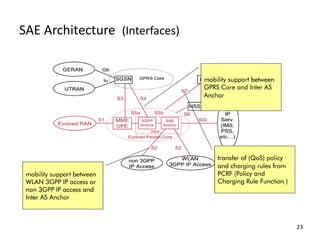
• SAE Architecture

1
3GPP Evolution
•
•
•
•

2G: Started years ago with GSM: Mainly voice
2.5G: Adding Packet Services: GPRS,EDGE
3G: Adding 3G Air Interference: UMTS
3G Architecture:
• Support of 2G/2.5G and 3G Access
• Handover between GSM and UMTS technologies

• 3G Extensions:
• HSDPA/HSPUA
• IP Multi Media Subsystem (IMS)
• Inter-working with WLAN (I-WLAN)

• Beyond 3G:
• Long Term Evolution(LTE)
• Introduced in Release 8 of 3GPP in 2004

2
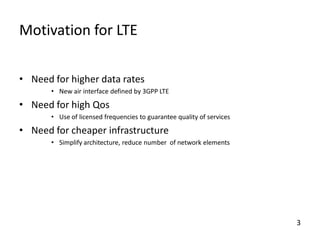
Motivation for LTE
• Need for higher data rates
• New air interface defined by 3GPP LTE

• Need for high Qos
• Use of licensed frequencies to guarantee quality of services

• Need for cheaper infrastructure
• Simplify architecture, reduce number of network elements

3
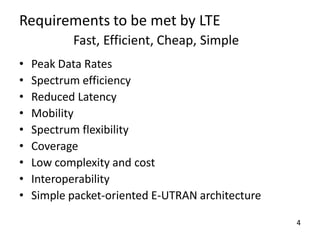
Requirements to be met by LTE
Fast, Efficient, Cheap, Simple
•
•
•
•
•
•
•
•
•

Peak Data Rates
Spectrum efficiency
Reduced Latency
Mobility
Spectrum flexibility
Coverage
Low complexity and cost
Interoperability
Simple packet-oriented E-UTRAN architecture
4
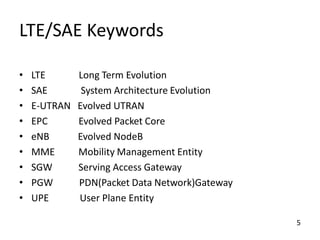
LTE/SAE Keywords
•
•
•
•
•
•
•
•
•

LTE
SAE
E-UTRAN
EPC
eNB
MME
SGW
PGW
UPE

Long Term Evolution
System Architecture Evolution
Evolved UTRAN
Evolved Packet Core
Evolved NodeB
Mobility Management Entity
Serving Access Gateway
PDN(Packet Data Network)Gateway
User Plane Entity
5
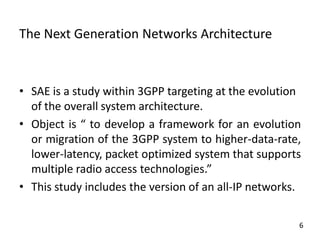
The Next Generation Networks Architecture

• SAE is a study within 3GPP targeting at the evolution
of the overall system architecture.
• Object is “ to develop a framework for an evolution
or migration of the 3GPP system to higher-data-rate,
lower-latency, packet optimized system that supports
multiple radio access technologies.”
• This study includes the version of an all-IP networks.
6
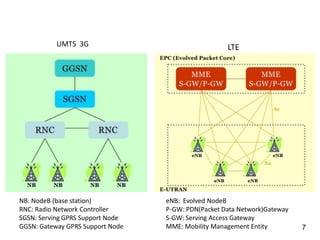
UMTS 3G

NB: NodeB (base station)
RNC: Radio Network Controller
SGSN: Serving GPRS Support Node
GGSN: Gateway GPRS Support Node

LTE

eNB: Evolved NodeB
P-GW: PDN(Packet Data Network)Gateway
S-GW: Serving Access Gateway
MME: Mobility Management Entity

7
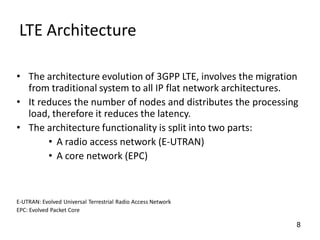
LTE Architecture
• The architecture evolution of 3GPP LTE, involves the migration
from traditional system to all IP flat network architectures.
• It reduces the number of nodes and distributes the processing
load, therefore it reduces the latency.
• The architecture functionality is split into two parts:
• A radio access network (E-UTRAN)
• A core network (EPC)

E-UTRAN: Evolved Universal Terrestrial Radio Access Network
EPC: Evolved Packet Core

8
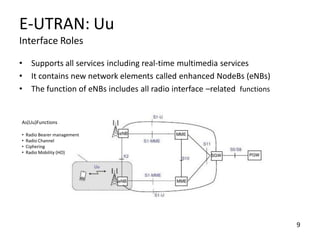
E-UTRAN: Uu
Interface Roles
•
•
•

Supports all services including real-time multimedia services
It contains new network elements called enhanced NodeBs (eNBs)
The function of eNBs includes all radio interface –related functions

As(Uu)Functions
•
•
•
•

Radio Bearer management
Radio Channel
Ciphering
Radio Mobility (HO)

9
Air Interface
Enabling Technologies

• LTE aims at better spectral flexibility, higher data
rates, low latency and improved coverage.
• To achieve the targets, LTE employs the enabling
technologies:
• OFDMA
• SC-FDMA
• MIMO

• LTE employs OFDMA for downlink and SC-FDMA for
uplink transmission.
10
Orthogonal Multiple Access Schemes
• Downlink: OFDMA
• The available spectrum is divided into multiple carriers, called sub-carriers,
which are orthogonal to each other.
• sub-carriers are allocated dynamically among the different users.
• Each of these subcarriers is independently modulated by low rate data
stream.

• OFDM has several benefits:
•
•
•
•
•

High spectral efficiency
Robust against frequency- selective and multi- path fading
Supports flexible bandwidth deployment
Facilitates frequency- domain scheduling
Well suited to advanced MIMO techniques
11
Orthogonal Multiple Access Schemes
• Uplink: SC-FDMA
• SC-FDMA is chosen because it combines the low Peak-to-average Power
Ratio (PAPR) techniques of single-carrier transmission systems, such as
CDMA, with the multipath resistance and flexible frequency allocation of
OFDMA.

SC-FDMA has several benefits:
• Based on OFDMA with DFT precoding
• Common structure of transmission resources compared to downlink

12
Single-Carrier Frequency Division Multiple Access
(SC-FDMA)

• The incoming bit stream is first converted to single-carrier
symbols.
• Then, data symbols in the time domain are converted to the
frequency domain(Discrete Fourier Transform).
• Then, data symbols mapped to the desired band in the
overall channel bandwidth.
• Now, they back to the time domain using Inverse Fourier
Transform.
• Finally, the Cyclic Prefix is inserted. It’s used for effectively
eliminate Inter Symbol Interference
13
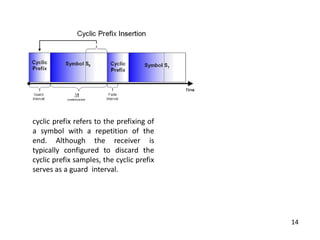
cyclic prefix refers to the prefixing of
a symbol with a repetition of the
end. Although the receiver is
typically configured to discard the
cyclic prefix samples, the cyclic prefix
serves as a guard interval.

14
Multiple Antenna Schemes in LTE
• In DL: Tx diversity, Rx diversity, spatial multiplexing supported
(2×2,4×2 configurations).

• In UL: Only 1 Transmitter (antenna selection Tx diversity), Rx
diversity with 2 or 4 antennas at eNB supported.

15
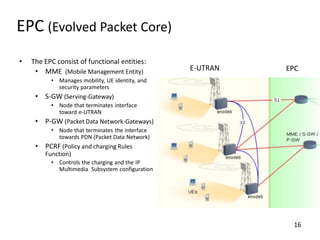
EPC (Evolved Packet Core)
•

The EPC consist of functional entities:
• MME (Mobile Management Entity)

E-UTRAN

EPC

• Manages mobility, UE identity, and
security parameters

• S-GW (Serving-Gateway)
• Node that terminates interface
toward e-UTRAN

• P-GW (Packet Data Network-Gateways)
• Node that terminates the interface
towards PDN (Packet Data Network)

• PCRF (Policy and charging Rules
Function)
• Controls the charging and the IP
Multimedia Subsystem configuration

16
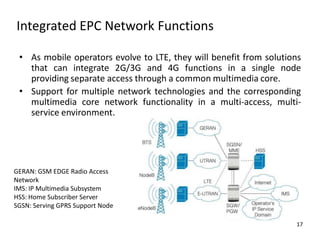
Integrated EPC Network Functions
• As mobile operators evolve to LTE, they will benefit from solutions
that can integrate 2G/3G and 4G functions in a single node
providing separate access through a common multimedia core.
• Support for multiple network technologies and the corresponding
multimedia core network functionality in a multi-access, multiservice environment.

GERAN: GSM EDGE Radio Access
Network
IMS: IP Multimedia Subsystem
HSS: Home Subscriber Server
SGSN: Serving GPRS Support Node
17
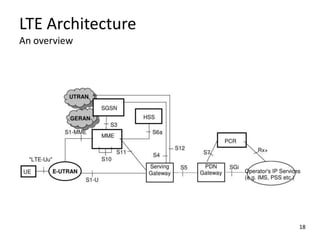
LTE Architecture
An overview

18
SAE (System Architecture Evolution)
Objectives
• New network architecture to support the high- throughput
and low-latency LTE access system
• Simplified network architecture

• All IP network
• Support mobility between multiple heterogeneous access
system
• 2G/3G, LTE, non 3GPP access system such as WLAN, WiMAX
• Inter-3GPP handover
• Inter-3GPP and non-3GPP mobility

19
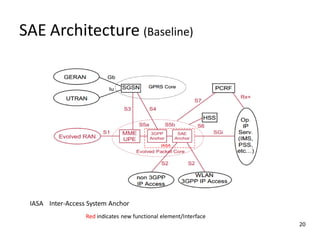
SAE Architecture (Baseline)

IASA Inter-Access System Anchor
Red indicates new functional element/Interface
20
SAE Architecture

(Functions per Element)

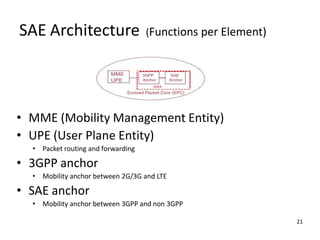
• MME (Mobility Management Entity)
• UPE (User Plane Entity)
• Packet routing and forwarding

• 3GPP anchor
• Mobility anchor between 2G/3G and LTE

• SAE anchor
• Mobility anchor between 3GPP and non 3GPP
21
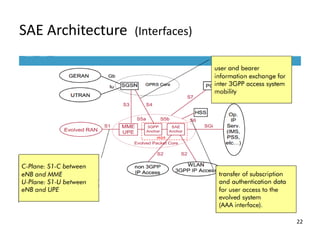
SAE Architecture

(Interfaces)

22
SAE Architecture (Interfaces)

23
Conclusion
• The 3GPP LTE/SAE is a future-oriented radio access
system designed to support huge traffic of future
end user requirements like high speed internet, DVBH
• The 3GPP LTE provides a framework for
standardization in the evolution towards 4G.

24
Lte(1)

Lte(1)

  • 1.
    LTE Simplify the Migrationto 4G Networks by: Amirali Baha
  • 2.
    Outline • 3G-LTE Introduction •LTE Architecture • LTE air-interface • LTE core • SAE Architecture 1
  • 3.
    3GPP Evolution • • • • 2G: Startedyears ago with GSM: Mainly voice 2.5G: Adding Packet Services: GPRS,EDGE 3G: Adding 3G Air Interference: UMTS 3G Architecture: • Support of 2G/2.5G and 3G Access • Handover between GSM and UMTS technologies • 3G Extensions: • HSDPA/HSPUA • IP Multi Media Subsystem (IMS) • Inter-working with WLAN (I-WLAN) • Beyond 3G: • Long Term Evolution(LTE) • Introduced in Release 8 of 3GPP in 2004 2
  • 4.
    Motivation for LTE •Need for higher data rates • New air interface defined by 3GPP LTE • Need for high Qos • Use of licensed frequencies to guarantee quality of services • Need for cheaper infrastructure • Simplify architecture, reduce number of network elements 3
  • 5.
    Requirements to bemet by LTE Fast, Efficient, Cheap, Simple • • • • • • • • • Peak Data Rates Spectrum efficiency Reduced Latency Mobility Spectrum flexibility Coverage Low complexity and cost Interoperability Simple packet-oriented E-UTRAN architecture 4
  • 6.
    LTE/SAE Keywords • • • • • • • • • LTE SAE E-UTRAN EPC eNB MME SGW PGW UPE Long TermEvolution System Architecture Evolution Evolved UTRAN Evolved Packet Core Evolved NodeB Mobility Management Entity Serving Access Gateway PDN(Packet Data Network)Gateway User Plane Entity 5
  • 7.
    The Next GenerationNetworks Architecture • SAE is a study within 3GPP targeting at the evolution of the overall system architecture. • Object is “ to develop a framework for an evolution or migration of the 3GPP system to higher-data-rate, lower-latency, packet optimized system that supports multiple radio access technologies.” • This study includes the version of an all-IP networks. 6
  • 8.
    UMTS 3G NB: NodeB(base station) RNC: Radio Network Controller SGSN: Serving GPRS Support Node GGSN: Gateway GPRS Support Node LTE eNB: Evolved NodeB P-GW: PDN(Packet Data Network)Gateway S-GW: Serving Access Gateway MME: Mobility Management Entity 7
  • 9.
    LTE Architecture • Thearchitecture evolution of 3GPP LTE, involves the migration from traditional system to all IP flat network architectures. • It reduces the number of nodes and distributes the processing load, therefore it reduces the latency. • The architecture functionality is split into two parts: • A radio access network (E-UTRAN) • A core network (EPC) E-UTRAN: Evolved Universal Terrestrial Radio Access Network EPC: Evolved Packet Core 8
  • 10.
    E-UTRAN: Uu Interface Roles • • • Supportsall services including real-time multimedia services It contains new network elements called enhanced NodeBs (eNBs) The function of eNBs includes all radio interface –related functions As(Uu)Functions • • • • Radio Bearer management Radio Channel Ciphering Radio Mobility (HO) 9
  • 11.
    Air Interface Enabling Technologies •LTE aims at better spectral flexibility, higher data rates, low latency and improved coverage. • To achieve the targets, LTE employs the enabling technologies: • OFDMA • SC-FDMA • MIMO • LTE employs OFDMA for downlink and SC-FDMA for uplink transmission. 10
  • 12.
    Orthogonal Multiple AccessSchemes • Downlink: OFDMA • The available spectrum is divided into multiple carriers, called sub-carriers, which are orthogonal to each other. • sub-carriers are allocated dynamically among the different users. • Each of these subcarriers is independently modulated by low rate data stream. • OFDM has several benefits: • • • • • High spectral efficiency Robust against frequency- selective and multi- path fading Supports flexible bandwidth deployment Facilitates frequency- domain scheduling Well suited to advanced MIMO techniques 11
  • 13.
    Orthogonal Multiple AccessSchemes • Uplink: SC-FDMA • SC-FDMA is chosen because it combines the low Peak-to-average Power Ratio (PAPR) techniques of single-carrier transmission systems, such as CDMA, with the multipath resistance and flexible frequency allocation of OFDMA. SC-FDMA has several benefits: • Based on OFDMA with DFT precoding • Common structure of transmission resources compared to downlink 12
  • 14.
    Single-Carrier Frequency DivisionMultiple Access (SC-FDMA) • The incoming bit stream is first converted to single-carrier symbols. • Then, data symbols in the time domain are converted to the frequency domain(Discrete Fourier Transform). • Then, data symbols mapped to the desired band in the overall channel bandwidth. • Now, they back to the time domain using Inverse Fourier Transform. • Finally, the Cyclic Prefix is inserted. It’s used for effectively eliminate Inter Symbol Interference 13
  • 15.
    cyclic prefix refersto the prefixing of a symbol with a repetition of the end. Although the receiver is typically configured to discard the cyclic prefix samples, the cyclic prefix serves as a guard interval. 14
  • 16.
    Multiple Antenna Schemesin LTE • In DL: Tx diversity, Rx diversity, spatial multiplexing supported (2×2,4×2 configurations). • In UL: Only 1 Transmitter (antenna selection Tx diversity), Rx diversity with 2 or 4 antennas at eNB supported. 15
  • 17.
    EPC (Evolved PacketCore) • The EPC consist of functional entities: • MME (Mobile Management Entity) E-UTRAN EPC • Manages mobility, UE identity, and security parameters • S-GW (Serving-Gateway) • Node that terminates interface toward e-UTRAN • P-GW (Packet Data Network-Gateways) • Node that terminates the interface towards PDN (Packet Data Network) • PCRF (Policy and charging Rules Function) • Controls the charging and the IP Multimedia Subsystem configuration 16
  • 18.
    Integrated EPC NetworkFunctions • As mobile operators evolve to LTE, they will benefit from solutions that can integrate 2G/3G and 4G functions in a single node providing separate access through a common multimedia core. • Support for multiple network technologies and the corresponding multimedia core network functionality in a multi-access, multiservice environment. GERAN: GSM EDGE Radio Access Network IMS: IP Multimedia Subsystem HSS: Home Subscriber Server SGSN: Serving GPRS Support Node 17
  • 19.
  • 20.
    SAE (System ArchitectureEvolution) Objectives • New network architecture to support the high- throughput and low-latency LTE access system • Simplified network architecture • All IP network • Support mobility between multiple heterogeneous access system • 2G/3G, LTE, non 3GPP access system such as WLAN, WiMAX • Inter-3GPP handover • Inter-3GPP and non-3GPP mobility 19
  • 21.
    SAE Architecture (Baseline) IASAInter-Access System Anchor Red indicates new functional element/Interface 20
  • 22.
    SAE Architecture (Functions perElement) • MME (Mobility Management Entity) • UPE (User Plane Entity) • Packet routing and forwarding • 3GPP anchor • Mobility anchor between 2G/3G and LTE • SAE anchor • Mobility anchor between 3GPP and non 3GPP 21
  • 23.
  • 24.
  • 25.
    Conclusion • The 3GPPLTE/SAE is a future-oriented radio access system designed to support huge traffic of future end user requirements like high speed internet, DVBH • The 3GPP LTE provides a framework for standardization in the evolution towards 4G. 24