Long Term Evolution (LTE) 
Sachidananda Sahu
Table of Contents 
 Introduction to LTE 
 Introduction to Mobile Communication 
 Generations In Mobile Technology 
 Key Technology of LTE 
 LTE Targets 
 Architecture of LTE 
 Protocol Stack 
 LTE- Advantages 
 Major Applications 
 Current market scenario 
 Beyond LTE 
 Conclusion 
 References
Introduction to LTE 
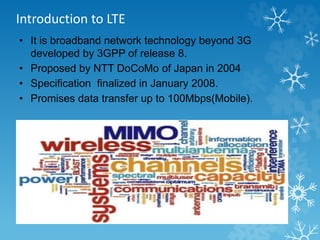
• It is broadband network technology beyond 3G 
developed by 3GPP of release 8. 
• Proposed by NTT DoCoMo of Japan in 2004 
• Specification finalized in January 2008. 
• Promises data transfer up to 100Mbps(Mobile).
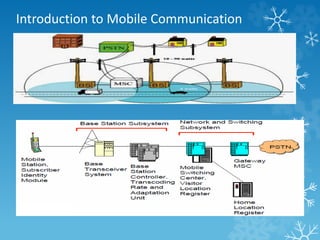
Introduction to Mobile Communication
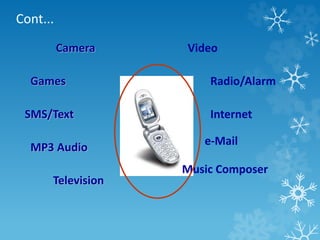
Video 
Radio/Alarm 
Internet 
e-Mail 
Music Composer 
Camera 
Cont... 
Games 
SMS/Text 
MP3 Audio 
Television
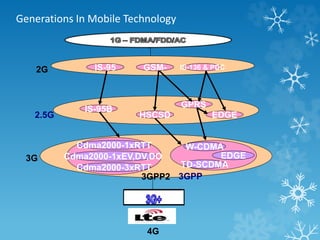
Generations In Mobile Technology 
IS-95 GSM- IS-136 & PDC 
EDGE 
GPRS 
HSCSD 
IS-95B 
Cdma2000-1xRTT 
Cdma2000-1xEV,DV,DO 
Cdma2000-3xRTT 
W-CDMA 
EDGE 
TD-SCDMA 
2G 
2.5G 
3G 
3GPP2 3GPP 
4G
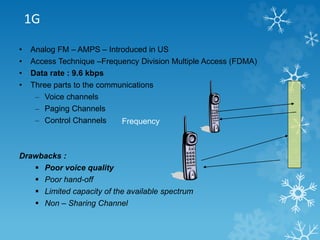
1G 
• Analog FM – AMPS – Introduced in US 
• Access Technique –Frequency Division Multiple Access (FDMA) 
• Data rate : 9.6 kbps 
• Three parts to the communications 
– Voice channels 
– Paging Channels 
– Control Channels 
Drawbacks : 
Frequency 
 Poor voice quality 
 Poor hand-off 
 Limited capacity of the available spectrum 
 Non – Sharing Channel
2G 
• GSM, IS-136, IS-95 (CDMA one) standard introduced 
• Digital modulation 
• Due to digital error checking, sound quality increased 
• Circuit Switched communication 
• Data rate : 19.3 kbps 
• SMS & E-mail feature introduced 
• Drawbacks: 
• Very Low data rate 
• Limited internet browsing 
• Weaker digital signal will not reach a cell tower in less populous 
area
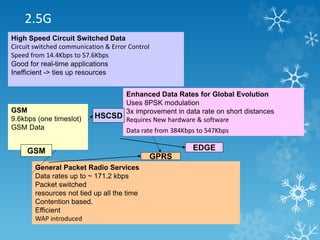
2.5G 
High Speed Circuit Switched Data 
Circuit switched communication & Error Control 
Speed from 14.4Kbps to 57.6Kbps 
Good for real-time applications 
Inefficient -> ties up resources 
Enhanced Data Rates for Global Evolution 
Uses 8PSK modulation 
3x improvement in data rate on short distances 
Requires New hardware & software 
Data rate from 384Kbps to 547Kbps 
General Packet Radio Services 
Data rates up to ~ 171.2 kbps 
Packet switched 
resources not tied up all the time 
Contention based. 
Efficient 
WAP introduced 
GPRS 
EDGE 
HSCSD 
GSM 
9.6kbps (one timeslot) 
GSM Data 
GSM
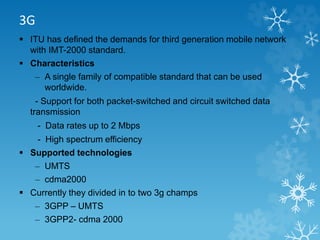
3G 
 ITU has defined the demands for third generation mobile network 
with IMT-2000 standard. 
 Characteristics 
– A single family of compatible standard that can be used 
worldwide. 
- Support for both packet-switched and circuit switched data 
transmission 
- Data rates up to 2 Mbps 
- High spectrum efficiency 
 Supported technologies 
– UMTS 
– cdma2000 
 Currently they divided in to two 3g champs 
– 3GPP – UMTS 
– 3GPP2- cdma 2000
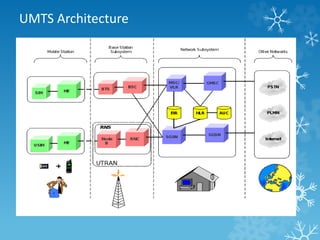
UMTS Architecture
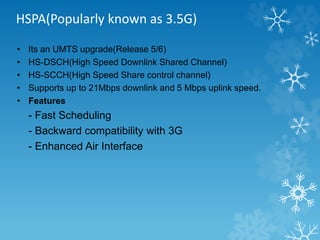
HSPA(Popularly known as 3.5G) 
• Its an UMTS upgrade(Release 5/6) 
• HS-DSCH(High Speed Downlink Shared Channel) 
• HS-SCCH(High Speed Share control channel) 
• Supports up to 21Mbps downlink and 5 Mbps uplink speed. 
• Features 
- Fast Scheduling 
- Backward compatibility with 3G 
- Enhanced Air Interface
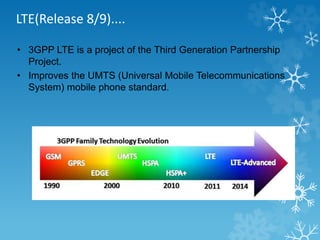
LTE(Release 8/9).... 
• 3GPP LTE is a project of the Third Generation Partnership 
Project. 
• Improves the UMTS (Universal Mobile Telecommunications 
System) mobile phone standard.
Key technology of LTE 
These two are the key technologies which enable LTE to have spectral 
efficiency and High Speed communication 
-OFDMA/SC-FDMA 
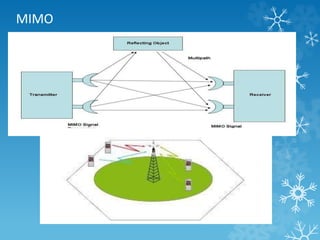
-MIMO 
Features : 
• Reduced power consumption 
• Higher RF power amplifier efficiency (less battery power used by 
handsets) 
• Fully packet switched domain 
– No more circuit switched network 
• Scalable bandwidth 1.4,3,5,10,15,20 MHz
LTE Targets 
• Peak data rate 
– 100 Mbps 
• Up to 200 active users in a cell (5 MHz) 
• Mobility 
– Optimized for 0 ~ 15 km/h. 
– 15 ~ 120 km/h supported with high performance. 
• Enhanced multimedia broadcast service 
• Spectrum flexibility: 1.25 ~ 20 MHz 
• Duplexing supports FDD & TDD 
• Spectral Efficiency – SC - FDMA & OFDMA 
• Modulation type : QPSK,QAM
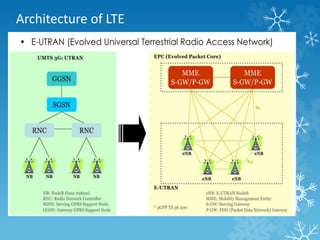
Architecture of LTE 
SAE/EPC
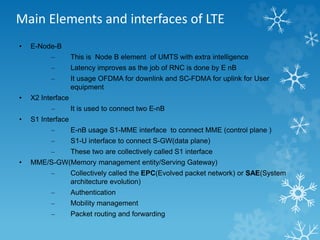
Main Elements and interfaces of LTE 
• E-Node-B 
– This is Node B element of UMTS with extra intelligence 
– Latency improves as the job of RNC is done by E nB 
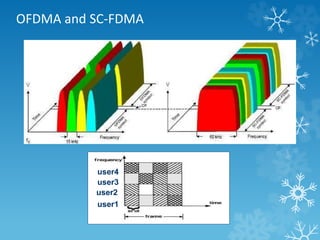
– It usage OFDMA for downlink and SC-FDMA for uplink for User 
equipment 
• X2 Interface 
– It is used to connect two E-nB 
• S1 Interface 
– E-nB usage S1-MME interface to connect MME (control plane ) 
– S1-U interface to connect S-GW(data plane) 
– These two are collectively called S1 interface 
• MME/S-GW(Memory management entity/Serving Gateway) 
– Collectively called the EPC(Evolved packet network) or SAE(System 
architecture evolution) 
– Authentication 
– Mobility management 
– Packet routing and forwarding
OFDMA and SC-FDMA 
user4 
user3 
user2 
user1
MIMO
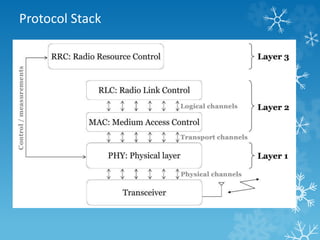
Protocol Stack
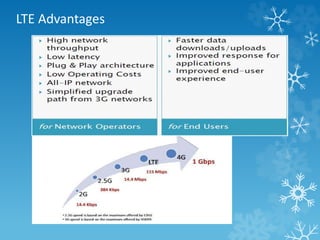
LTE Advantages
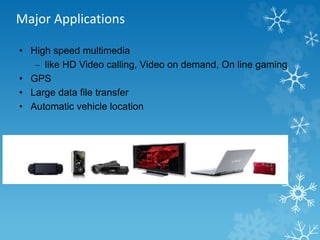
Major Applications 
• High speed multimedia 
– like HD Video calling, Video on demand, On line gaming 
• GPS 
• Large data file transfer 
• Automatic vehicle location
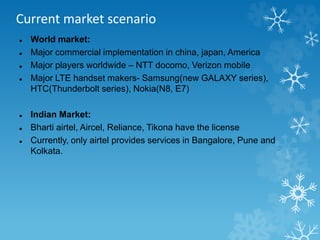
Current market scenario 
 World market: 
 Major commercial implementation in china, japan, America 
 Major players worldwide – NTT docomo, Verizon mobile 
 Major LTE handset makers- Samsung(new GALAXY series), 
HTC(Thunderbolt series), Nokia(N8, E7) 
 Indian Market: 
 Bharti airtel, Aircel, Reliance, Tikona have the license 
 Currently, only airtel provides services in Bangalore, Pune and 
Kolkata.
Beyond LTE... 
• LTE-Advanced(considered as True 4G) 
• Data rate : 100Mbps(High mobility) up to 3 Gbps 
• Higher spectral efficiency 
• Increased number of simultaneous active subscribers 
• Backward compatible with LTEs
Conclusion 
LTE is well positioned to meet the requirements of next-generation 
mobile networks with existing 3GPP/3GPP2 
operators. 
It enables operators to offer high performance, mass-market 
mobile broadband services. 
LTE will be available not only in next-generation mobile phones 
but also in notebooks, cameras.
References 
1. T.S.Rappaport, Wireless communication 
2. www.4gltemall.com 
3. www.3gpplte.com 
4. www.3gpp.org
LTE Introduction - Hello World to LTE

LTE Introduction - Hello World to LTE

  • 1.
    Long Term Evolution(LTE) Sachidananda Sahu
  • 2.
    Table of Contents  Introduction to LTE  Introduction to Mobile Communication  Generations In Mobile Technology  Key Technology of LTE  LTE Targets  Architecture of LTE  Protocol Stack  LTE- Advantages  Major Applications  Current market scenario  Beyond LTE  Conclusion  References
  • 3.
    Introduction to LTE • It is broadband network technology beyond 3G developed by 3GPP of release 8. • Proposed by NTT DoCoMo of Japan in 2004 • Specification finalized in January 2008. • Promises data transfer up to 100Mbps(Mobile).
  • 4.
  • 5.
    Video Radio/Alarm Internet e-Mail Music Composer Camera Cont... Games SMS/Text MP3 Audio Television
  • 6.
    Generations In MobileTechnology IS-95 GSM- IS-136 & PDC EDGE GPRS HSCSD IS-95B Cdma2000-1xRTT Cdma2000-1xEV,DV,DO Cdma2000-3xRTT W-CDMA EDGE TD-SCDMA 2G 2.5G 3G 3GPP2 3GPP 4G
  • 7.
    1G • AnalogFM – AMPS – Introduced in US • Access Technique –Frequency Division Multiple Access (FDMA) • Data rate : 9.6 kbps • Three parts to the communications – Voice channels – Paging Channels – Control Channels Drawbacks : Frequency  Poor voice quality  Poor hand-off  Limited capacity of the available spectrum  Non – Sharing Channel
  • 8.
    2G • GSM,IS-136, IS-95 (CDMA one) standard introduced • Digital modulation • Due to digital error checking, sound quality increased • Circuit Switched communication • Data rate : 19.3 kbps • SMS & E-mail feature introduced • Drawbacks: • Very Low data rate • Limited internet browsing • Weaker digital signal will not reach a cell tower in less populous area
  • 9.
    2.5G High SpeedCircuit Switched Data Circuit switched communication & Error Control Speed from 14.4Kbps to 57.6Kbps Good for real-time applications Inefficient -> ties up resources Enhanced Data Rates for Global Evolution Uses 8PSK modulation 3x improvement in data rate on short distances Requires New hardware & software Data rate from 384Kbps to 547Kbps General Packet Radio Services Data rates up to ~ 171.2 kbps Packet switched resources not tied up all the time Contention based. Efficient WAP introduced GPRS EDGE HSCSD GSM 9.6kbps (one timeslot) GSM Data GSM
  • 10.
    3G  ITUhas defined the demands for third generation mobile network with IMT-2000 standard.  Characteristics – A single family of compatible standard that can be used worldwide. - Support for both packet-switched and circuit switched data transmission - Data rates up to 2 Mbps - High spectrum efficiency  Supported technologies – UMTS – cdma2000  Currently they divided in to two 3g champs – 3GPP – UMTS – 3GPP2- cdma 2000
  • 11.
  • 12.
    HSPA(Popularly known as3.5G) • Its an UMTS upgrade(Release 5/6) • HS-DSCH(High Speed Downlink Shared Channel) • HS-SCCH(High Speed Share control channel) • Supports up to 21Mbps downlink and 5 Mbps uplink speed. • Features - Fast Scheduling - Backward compatibility with 3G - Enhanced Air Interface
  • 13.
    LTE(Release 8/9).... •3GPP LTE is a project of the Third Generation Partnership Project. • Improves the UMTS (Universal Mobile Telecommunications System) mobile phone standard.
  • 14.
    Key technology ofLTE These two are the key technologies which enable LTE to have spectral efficiency and High Speed communication -OFDMA/SC-FDMA -MIMO Features : • Reduced power consumption • Higher RF power amplifier efficiency (less battery power used by handsets) • Fully packet switched domain – No more circuit switched network • Scalable bandwidth 1.4,3,5,10,15,20 MHz
  • 15.
    LTE Targets •Peak data rate – 100 Mbps • Up to 200 active users in a cell (5 MHz) • Mobility – Optimized for 0 ~ 15 km/h. – 15 ~ 120 km/h supported with high performance. • Enhanced multimedia broadcast service • Spectrum flexibility: 1.25 ~ 20 MHz • Duplexing supports FDD & TDD • Spectral Efficiency – SC - FDMA & OFDMA • Modulation type : QPSK,QAM
  • 16.
  • 17.
    Main Elements andinterfaces of LTE • E-Node-B – This is Node B element of UMTS with extra intelligence – Latency improves as the job of RNC is done by E nB – It usage OFDMA for downlink and SC-FDMA for uplink for User equipment • X2 Interface – It is used to connect two E-nB • S1 Interface – E-nB usage S1-MME interface to connect MME (control plane ) – S1-U interface to connect S-GW(data plane) – These two are collectively called S1 interface • MME/S-GW(Memory management entity/Serving Gateway) – Collectively called the EPC(Evolved packet network) or SAE(System architecture evolution) – Authentication – Mobility management – Packet routing and forwarding
  • 18.
    OFDMA and SC-FDMA user4 user3 user2 user1
  • 19.
  • 20.
  • 21.
  • 22.
    Major Applications •High speed multimedia – like HD Video calling, Video on demand, On line gaming • GPS • Large data file transfer • Automatic vehicle location
  • 23.
    Current market scenario  World market:  Major commercial implementation in china, japan, America  Major players worldwide – NTT docomo, Verizon mobile  Major LTE handset makers- Samsung(new GALAXY series), HTC(Thunderbolt series), Nokia(N8, E7)  Indian Market:  Bharti airtel, Aircel, Reliance, Tikona have the license  Currently, only airtel provides services in Bangalore, Pune and Kolkata.
  • 24.
    Beyond LTE... •LTE-Advanced(considered as True 4G) • Data rate : 100Mbps(High mobility) up to 3 Gbps • Higher spectral efficiency • Increased number of simultaneous active subscribers • Backward compatible with LTEs
  • 25.
    Conclusion LTE iswell positioned to meet the requirements of next-generation mobile networks with existing 3GPP/3GPP2 operators. It enables operators to offer high performance, mass-market mobile broadband services. LTE will be available not only in next-generation mobile phones but also in notebooks, cameras.
  • 26.
    References 1. T.S.Rappaport,Wireless communication 2. www.4gltemall.com 3. www.3gpplte.com 4. www.3gpp.org