2
Proprietary & Confidential
• Internet History
• Dial up followed by Wireless Technology
• Evolution Stages
• Wimax Vs LTEA
• Wireless Vs Wired Broadband
• LTEA Supporting CPE
3
Proprietary & Confidential
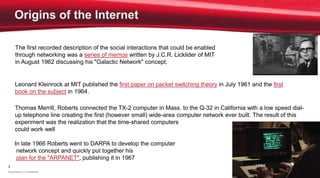
The first recorded description of the social interactions that could be enabled
through networking was a series of memos written by J.C.R. Licklider of MIT
in August 1962 discussing his "Galactic Network" concept.
Thomas Merrill, Roberts connected the TX-2 computer in Mass. to the Q-32 in California with a low speed dial-
up telephone line creating the first (however small) wide-area computer network ever built. The result of this
experiment was the realization that the time-shared computers
could work well together
Leonard Kleinrock at MIT published the first paper on packet switching theory in July 1961 and the first
book on the subject in 1964.
In late 1966 Roberts went to DARPA to develop the computer
network concept and quickly put together his
plan for the "ARPANET", publishing it in 1967
4
Proprietary & Confidential
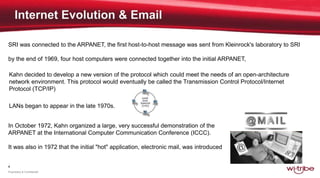
SRI was connected to the ARPANET, the first host-to-host message was sent from Kleinrock's laboratory to SRI
by the end of 1969, four host computers were connected together into the initial ARPANET,
In October 1972, Kahn organized a large, very successful demonstration of the
ARPANET at the International Computer Communication Conference (ICCC).
It was also in 1972 that the initial "hot" application, electronic mail, was introduced
Kahn decided to develop a new version of the protocol which could meet the needs of an open-architecture
network environment. This protocol would eventually be called the Transmission Control Protocol/Internet
Protocol (TCP/IP)
LANs began to appear in the late 1970s.
5
Proprietary & Confidential
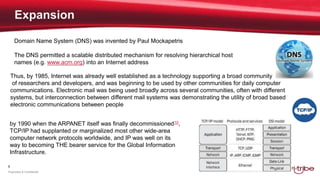
Domain Name System (DNS) was invented by Paul Mockapetris
The DNS permitted a scalable distributed mechanism for resolving hierarchical host
names (e.g. www.acm.org) into an Internet address
Thus, by 1985, Internet was already well established as a technology supporting a broad community
of researchers and developers, and was beginning to be used by other communities for daily computer
communications. Electronic mail was being used broadly across several communities, often with different
systems, but interconnection between different mail systems was demonstrating the utility of broad based
electronic communications between people
by 1990 when the ARPANET itself was finally decommissioned10,
TCP/IP had supplanted or marginalized most other wide-area
computer network protocols worldwide, and IP was well on its
way to becoming THE bearer service for the Global Information
Infrastructure.
6
Proprietary & Confidential
Dial-up Internet access is a form of Internet access that uses the
facilities of the public switched telephone network (PSTN) to establish
a connection to an Internet service provider (ISP) by dialing
a telephone number on a conventional telephone line. The user's
computer or router uses an attached modem to encode and decode
information into and from audio frequency signals, respectively.
In 1979, Tom Truscott and Steve Bellovin, graduate students for Duke
University, would create an early predecessor to dial-up Internet
access – called the USENET. The USENET was a UNIX based
system that used a dial-up connection to transfer data through
telephone modems.[1]
Dial-up Internet has been around since the 1980s via public providers
such as NSFNET-linked universities and was first offered
commercially in July 1992 by Sprint.[2] Despite losing ground
to broadband since the late-1990s, dial-up may still be used where
other forms are not available or the cost is too high, such as in some
rural or remote areas.
7
Proprietary & Confidential
8
Proprietary & Confidential
9
Proprietary & Confidential
10
Proprietary & Confidential
11
Proprietary & Confidential
12
Proprietary & Confidential
13
Proprietary & Confidential
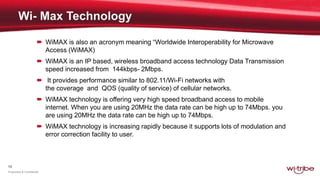
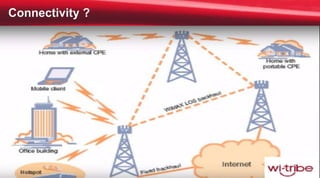
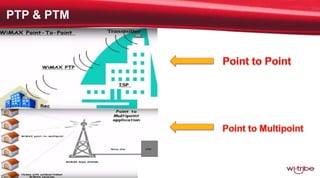
 WiMAX is also an acronym meaning “Worldwide Interoperability for Microwave
Access (WiMAX)
 WiMAX is an IP based, wireless broadband access technology Data Transmission
speed increased from 144kbps- 2Mbps.
 It provides performance similar to 802.11/Wi-Fi networks with
the coverage and QOS (quality of service) of cellular networks.
 WiMAX technology is offering very high speed broadband access to mobile
internet. When you are using 20MHz the data rate can be high up to 74Mbps. you
are using 20MHz the data rate can be high up to 74Mbps.
 WiMAX technology is increasing rapidly because it supports lots of modulation and
error correction facility to user.
14
Proprietary & Confidential
15
Proprietary & Confidential
16
Proprietary & Confidential
17
Proprietary & Confidential
18
Proprietary & Confidential
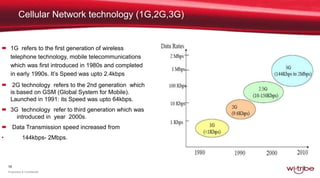
Cellular Network technology (1G,2G,3G)
 1G refers to the first generation of wireless
telephone technology, mobile telecommunications
which was first introduced in 1980s and completed
in early 1990s. It’s Speed was upto 2.4kbps
 2G technology refers to the 2nd generation which
is based on GSM (Global System for Mobile).
Launched in 1991: its Speed was upto 64kbps.
 3G technology refer to third generation which was
introduced in year 2000s.
 Data Transmission speed increased from
• 144kbps- 2Mbps.
19
Proprietary & Confidential
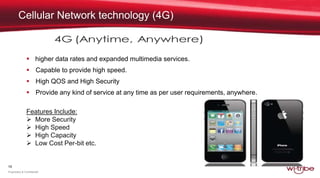
Cellular Network technology (4G)
 higher data rates and expanded multimedia services.
 Capable to provide high speed.
 High QOS and High Security
 Provide any kind of service at any time as per user requirements, anywhere.
Features Include:
 More Security
 High Speed
 High Capacity
 Low Cost Per-bit etc.
20
Proprietary & Confidential
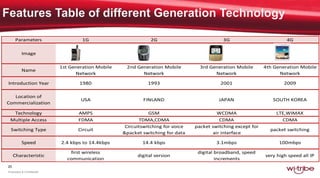
Parameters 1G 2G 3G 4G
Image
Name
1st Generation Mobile
Network
2nd Generation Mobile
Network
3rd Generation Mobile
Network
4th Generation Mobile
Network
Introduction Year 1980 1993 2001 2009
Location of
Commercialization
USA FINLAND JAPAN SOUTH KOREA
Technology AMPS GSM WCDMA LTE,WIMAX
Multiple Access FDMA TDMA,CDMA CDMA CDMA
Switching Type Circuit
Circuitswitching for voice
&packet switching for data
packet switching except for
air interface
packet switching
Speed 2.4 kbps to 14.4kbps 14.4 kbps 3.1mbps 100mbps
Characteristic
first wireless
communication
digital version
digital broadband, speed
increments
very high speed all IP
21
Proprietary & Confidential
22
Proprietary & Confidential
23
Proprietary & Confidential
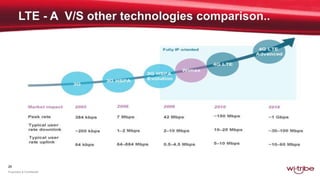
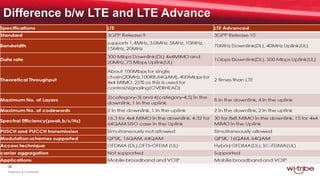
What is LTE - Advanced?
 LTE (Long term evolution) Advanced is the next major step in the evolution of our LTE
networks and generation of Mobile broadband technology
 Better coverage, greater stability, and faster performance
 Data rates of up to 1Gbps
 It is the next level after LTE technology
24
Proprietary & Confidential
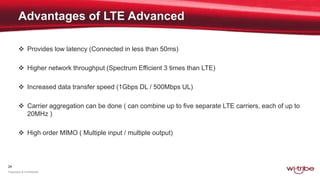
 Provides low latency (Connected in less than 50ms)
 Higher network throughput (Spectrum Efficient 3 times than LTE)
 Increased data transfer speed (1Gbps DL / 500Mbps UL)
 Carrier aggregation can be done ( can combine up to five separate LTE carriers, each of up to
20MHz )
 High order MIMO ( Multiple input / multiple output)
25
Proprietary & Confidential
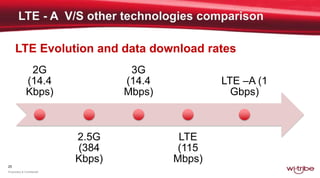
LTE Evolution and data download rates
2G
(14.4
Kbps)
2.5G
(384
Kbps)
3G
(14.4
Mbps)
LTE
(115
Mbps)
LTE –A (1
Gbps)
26
Proprietary & Confidential
27
Proprietary & Confidential
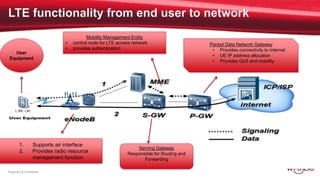
User
Equipment
1. Supports air interface
2. Provides radio resource
management function
Mobility Management Entity
• control node for LTE access network
• provides authentication
Serving Gateway
Responsible for Routing and
Forwarding
Packet Data Network Gateway
• Provides connectivity to Internet
• UE IP address allocation
• Provides QoS and mobility
28
Proprietary & Confidential
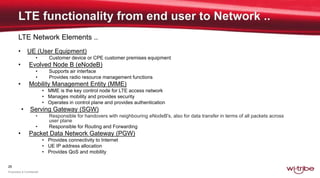
LTE Network Elements ..
• UE (User Equipment)
• Customer device or CPE customer premises equipment
• Evolved Node B (eNodeB)
• Supports air interface
• Provides radio resource management functions
• Mobility Management Entity (MME)
• MME is the key control node for LTE access network
• Manages mobility and provides security
• Operates in control plane and provides authentication
• Serving Gateway (SGW)
• Responsible for handovers with neighbouring eNodeB's, also for data transfer in terms of all packets across
user plane
• Responsible for Routing and Forwarding
• Packet Data Network Gateway (PGW)
• Provides connectivity to Internet
• UE IP address allocation
• Provides QoS and mobility
29
Proprietary & Confidential
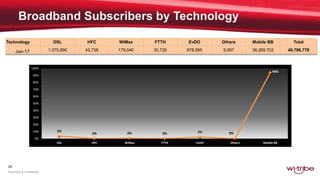
Technology DSL HFC WiMax FTTH EvDO Others Mobile BB Total
Jan-17 1,375,890 43,738 179,040 30,726 878,585 9,097 38,269,702 40,786,778
3%
0% 0% 0% 2% 0%
94%
0%
10%
20%
30%
40%
50%
60%
70%
80%
90%
100%
DSL HFC WiMax FTTH EvDO Others Mobile BB
30
Proprietary & Confidential
31
Proprietary & Confidential
32
Proprietary & Confidential
33
Proprietary & Confidential
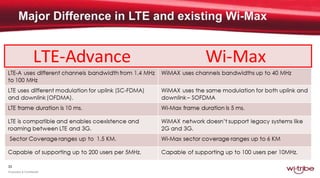
LTE-Advance Wi-Max
34
Proprietary & Confidential
35
Proprietary & Confidential
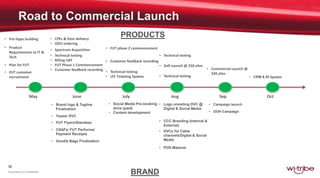
May June July Aug Sep Oct
• Pre Hype building
• Product
Requirements to IT &
Tech
• Plan for FUT
• FUT customer
recruitment
• CPEs & Sims delivery
• ODU ordering
• Spectrum Acquisition
• Technical testing
• Billing UAT
• FUT Phase 1 Commencement
• Customer feedback recording
• FUT phase 2 commencement
• Customer feedback recording
• Technical testing
• LTE Ticketing System
• Technical testing
• Soft Launch @ 250 sites
• Technical testing
• Commercial Launch @
320 sites
• CRM & BI System
• Brand logo & Tagline
Finalization
• Teaser DVC
• FUT Flyers/Standees
• CSAFs/ FUT Performa/
Payment Receipts
• Goodie Bags Finalization
• Logo unveiling DVC @
Digital & Social Media
• CCC Branding (Internal &
External)
• DVCs for Cable
channels/Digital & Social
Media
• POS Material
• Social Media Pre-booking
drive (paid)
• Content development
• Campaign launch
• OOH Campaign
PRODUCTS
BRAND
36
Proprietary & Confidential
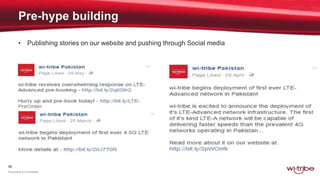
• Publishing stories on our website and pushing through Social media
37
Proprietary & Confidential
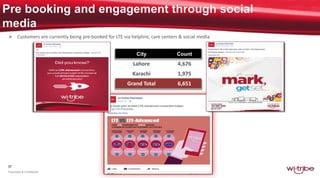
 Customers are currently being pre-booked for LTE via helpline, care centers & social media
City Count
Lahore 4,676
Karachi 1,975
Grand Total 6,651
38
Proprietary & Confidential
39
Proprietary & Confidential
 To benchmark/test our network delivery, billing, and front-end (Sales & Customer Care) capability &
readiness on the new LTE-A service
 Identifying SOPs related to the new technology, products, business rules, customer queries,
troubleshooting etc.
 Testing profiles with various combinations of speed & volume to set user experience benchmarks
 Billing system ruggedness for Prepaid & Postpaid services
 Recording & analyzing end user experience to determine the best practices for delivery of LTE-A
service
40
Proprietary & Confidential
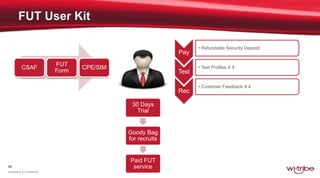
 Existing base & pre-booking leads will be contacted for FUT in the selected areas
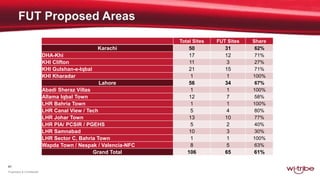
 Total 65 sites from Karachi and Lahore may be considered for FUT
 Customers will be recruited for this trial - a sample size of 300 – 500 customers is suggested
 They will be offered to test wi-tribe LTE-A by paying Rs. 4,000 (refundable device Security) and using
the service FREE for at least 30 days (may be extended) – SD may be adjusted against their conversion
to paid service
 They will be required to provide feedback regarding service experience on regular intervals (4 surveys
in 30 days)
 Customer care will call the recruited customer and their feedback will be recorded in the form of
surveys
41
Proprietary & Confidential
Total Sites FUT Sites Share
Karachi 50 31 62%
DHA-Khi 17 12 71%
KHI Clifton 11 3 27%
KHI Gulshan-e-Iqbal 21 15 71%
KHI Kharadar 1 1 100%
Lahore 56 34 67%
Abadi Sheraz Villas 1 1 100%
Allama Iqbal Town 12 7 58%
LHR Bahria Town 1 1 100%
LHR Canal View / Tech 5 4 80%
LHR Johar Town 13 10 77%
LHR PIA/ PCSIR / PGEHS 5 2 40%
LHR Samnabad 10 3 30%
LHR Sector C, Bahria Town 1 1 100%
Wapda Town / Nespak / Valencia-NFC 8 5 63%
Grand Total 106 65 61%
42
Proprietary & Confidential
CSAF
FUT
Form
CPE/SIM
Pay
• Refundable Security Deposit
Test
• Test Profiles X 4
Rec
• Customer Feedback X 4
30 Days
Trial
Goody Bag
for recruits
Paid FUT
service
43
Proprietary & Confidential
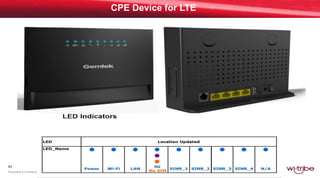
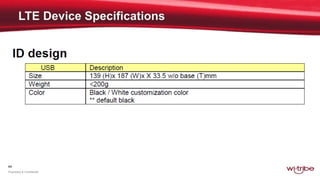
CPE Device for LTE
44
Proprietary & Confidential
45
Proprietary & Confidential
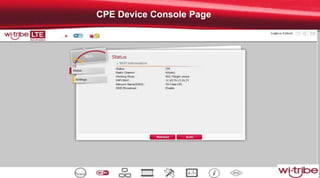
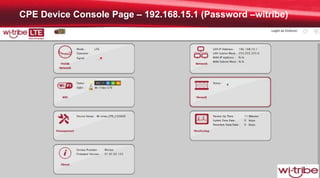
CPE Device Console Page – 192.168.15.1 (Password –witribe)
46
Proprietary & Confidential
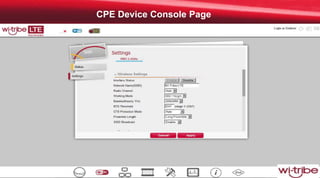
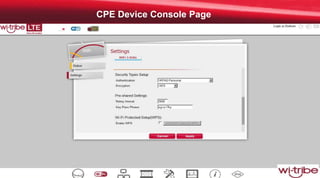
CPE Device Console Page
47
Proprietary & Confidential
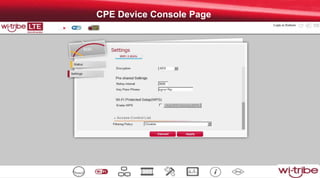
CPE Device Console Page
48
Proprietary & Confidential
CPE Device Console Page
49
Proprietary & Confidential
CPE Device Console Page
50
Proprietary & Confidential
Thank You

LTE Advanced Overview

  • 2.
    2 Proprietary & Confidential •Internet History • Dial up followed by Wireless Technology • Evolution Stages • Wimax Vs LTEA • Wireless Vs Wired Broadband • LTEA Supporting CPE
  • 3.
    3 Proprietary & Confidential Thefirst recorded description of the social interactions that could be enabled through networking was a series of memos written by J.C.R. Licklider of MIT in August 1962 discussing his "Galactic Network" concept. Thomas Merrill, Roberts connected the TX-2 computer in Mass. to the Q-32 in California with a low speed dial- up telephone line creating the first (however small) wide-area computer network ever built. The result of this experiment was the realization that the time-shared computers could work well together Leonard Kleinrock at MIT published the first paper on packet switching theory in July 1961 and the first book on the subject in 1964. In late 1966 Roberts went to DARPA to develop the computer network concept and quickly put together his plan for the "ARPANET", publishing it in 1967
  • 4.
    4 Proprietary & Confidential SRIwas connected to the ARPANET, the first host-to-host message was sent from Kleinrock's laboratory to SRI by the end of 1969, four host computers were connected together into the initial ARPANET, In October 1972, Kahn organized a large, very successful demonstration of the ARPANET at the International Computer Communication Conference (ICCC). It was also in 1972 that the initial "hot" application, electronic mail, was introduced Kahn decided to develop a new version of the protocol which could meet the needs of an open-architecture network environment. This protocol would eventually be called the Transmission Control Protocol/Internet Protocol (TCP/IP) LANs began to appear in the late 1970s.
  • 5.
    5 Proprietary & Confidential DomainName System (DNS) was invented by Paul Mockapetris The DNS permitted a scalable distributed mechanism for resolving hierarchical host names (e.g. www.acm.org) into an Internet address Thus, by 1985, Internet was already well established as a technology supporting a broad community of researchers and developers, and was beginning to be used by other communities for daily computer communications. Electronic mail was being used broadly across several communities, often with different systems, but interconnection between different mail systems was demonstrating the utility of broad based electronic communications between people by 1990 when the ARPANET itself was finally decommissioned10, TCP/IP had supplanted or marginalized most other wide-area computer network protocols worldwide, and IP was well on its way to becoming THE bearer service for the Global Information Infrastructure.
  • 6.
    6 Proprietary & Confidential Dial-upInternet access is a form of Internet access that uses the facilities of the public switched telephone network (PSTN) to establish a connection to an Internet service provider (ISP) by dialing a telephone number on a conventional telephone line. The user's computer or router uses an attached modem to encode and decode information into and from audio frequency signals, respectively. In 1979, Tom Truscott and Steve Bellovin, graduate students for Duke University, would create an early predecessor to dial-up Internet access – called the USENET. The USENET was a UNIX based system that used a dial-up connection to transfer data through telephone modems.[1] Dial-up Internet has been around since the 1980s via public providers such as NSFNET-linked universities and was first offered commercially in July 1992 by Sprint.[2] Despite losing ground to broadband since the late-1990s, dial-up may still be used where other forms are not available or the cost is too high, such as in some rural or remote areas.
  • 7.
  • 8.
  • 9.
  • 10.
  • 11.
  • 12.
  • 13.
    13 Proprietary & Confidential WiMAX is also an acronym meaning “Worldwide Interoperability for Microwave Access (WiMAX)  WiMAX is an IP based, wireless broadband access technology Data Transmission speed increased from 144kbps- 2Mbps.  It provides performance similar to 802.11/Wi-Fi networks with the coverage and QOS (quality of service) of cellular networks.  WiMAX technology is offering very high speed broadband access to mobile internet. When you are using 20MHz the data rate can be high up to 74Mbps. you are using 20MHz the data rate can be high up to 74Mbps.  WiMAX technology is increasing rapidly because it supports lots of modulation and error correction facility to user.
  • 14.
  • 15.
  • 16.
  • 17.
  • 18.
    18 Proprietary & Confidential CellularNetwork technology (1G,2G,3G)  1G refers to the first generation of wireless telephone technology, mobile telecommunications which was first introduced in 1980s and completed in early 1990s. It’s Speed was upto 2.4kbps  2G technology refers to the 2nd generation which is based on GSM (Global System for Mobile). Launched in 1991: its Speed was upto 64kbps.  3G technology refer to third generation which was introduced in year 2000s.  Data Transmission speed increased from • 144kbps- 2Mbps.
  • 19.
    19 Proprietary & Confidential CellularNetwork technology (4G)  higher data rates and expanded multimedia services.  Capable to provide high speed.  High QOS and High Security  Provide any kind of service at any time as per user requirements, anywhere. Features Include:  More Security  High Speed  High Capacity  Low Cost Per-bit etc.
  • 20.
    20 Proprietary & Confidential Parameters1G 2G 3G 4G Image Name 1st Generation Mobile Network 2nd Generation Mobile Network 3rd Generation Mobile Network 4th Generation Mobile Network Introduction Year 1980 1993 2001 2009 Location of Commercialization USA FINLAND JAPAN SOUTH KOREA Technology AMPS GSM WCDMA LTE,WIMAX Multiple Access FDMA TDMA,CDMA CDMA CDMA Switching Type Circuit Circuitswitching for voice &packet switching for data packet switching except for air interface packet switching Speed 2.4 kbps to 14.4kbps 14.4 kbps 3.1mbps 100mbps Characteristic first wireless communication digital version digital broadband, speed increments very high speed all IP
  • 21.
  • 22.
  • 23.
    23 Proprietary & Confidential Whatis LTE - Advanced?  LTE (Long term evolution) Advanced is the next major step in the evolution of our LTE networks and generation of Mobile broadband technology  Better coverage, greater stability, and faster performance  Data rates of up to 1Gbps  It is the next level after LTE technology
  • 24.
    24 Proprietary & Confidential Provides low latency (Connected in less than 50ms)  Higher network throughput (Spectrum Efficient 3 times than LTE)  Increased data transfer speed (1Gbps DL / 500Mbps UL)  Carrier aggregation can be done ( can combine up to five separate LTE carriers, each of up to 20MHz )  High order MIMO ( Multiple input / multiple output)
  • 25.
    25 Proprietary & Confidential LTEEvolution and data download rates 2G (14.4 Kbps) 2.5G (384 Kbps) 3G (14.4 Mbps) LTE (115 Mbps) LTE –A (1 Gbps)
  • 26.
  • 27.
    27 Proprietary & Confidential User Equipment 1.Supports air interface 2. Provides radio resource management function Mobility Management Entity • control node for LTE access network • provides authentication Serving Gateway Responsible for Routing and Forwarding Packet Data Network Gateway • Provides connectivity to Internet • UE IP address allocation • Provides QoS and mobility
  • 28.
    28 Proprietary & Confidential LTENetwork Elements .. • UE (User Equipment) • Customer device or CPE customer premises equipment • Evolved Node B (eNodeB) • Supports air interface • Provides radio resource management functions • Mobility Management Entity (MME) • MME is the key control node for LTE access network • Manages mobility and provides security • Operates in control plane and provides authentication • Serving Gateway (SGW) • Responsible for handovers with neighbouring eNodeB's, also for data transfer in terms of all packets across user plane • Responsible for Routing and Forwarding • Packet Data Network Gateway (PGW) • Provides connectivity to Internet • UE IP address allocation • Provides QoS and mobility
  • 29.
    29 Proprietary & Confidential TechnologyDSL HFC WiMax FTTH EvDO Others Mobile BB Total Jan-17 1,375,890 43,738 179,040 30,726 878,585 9,097 38,269,702 40,786,778 3% 0% 0% 0% 2% 0% 94% 0% 10% 20% 30% 40% 50% 60% 70% 80% 90% 100% DSL HFC WiMax FTTH EvDO Others Mobile BB
  • 30.
  • 31.
  • 32.
  • 33.
  • 34.
  • 35.
    35 Proprietary & Confidential MayJune July Aug Sep Oct • Pre Hype building • Product Requirements to IT & Tech • Plan for FUT • FUT customer recruitment • CPEs & Sims delivery • ODU ordering • Spectrum Acquisition • Technical testing • Billing UAT • FUT Phase 1 Commencement • Customer feedback recording • FUT phase 2 commencement • Customer feedback recording • Technical testing • LTE Ticketing System • Technical testing • Soft Launch @ 250 sites • Technical testing • Commercial Launch @ 320 sites • CRM & BI System • Brand logo & Tagline Finalization • Teaser DVC • FUT Flyers/Standees • CSAFs/ FUT Performa/ Payment Receipts • Goodie Bags Finalization • Logo unveiling DVC @ Digital & Social Media • CCC Branding (Internal & External) • DVCs for Cable channels/Digital & Social Media • POS Material • Social Media Pre-booking drive (paid) • Content development • Campaign launch • OOH Campaign PRODUCTS BRAND
  • 36.
    36 Proprietary & Confidential •Publishing stories on our website and pushing through Social media
  • 37.
    37 Proprietary & Confidential Customers are currently being pre-booked for LTE via helpline, care centers & social media City Count Lahore 4,676 Karachi 1,975 Grand Total 6,651
  • 38.
  • 39.
    39 Proprietary & Confidential To benchmark/test our network delivery, billing, and front-end (Sales & Customer Care) capability & readiness on the new LTE-A service  Identifying SOPs related to the new technology, products, business rules, customer queries, troubleshooting etc.  Testing profiles with various combinations of speed & volume to set user experience benchmarks  Billing system ruggedness for Prepaid & Postpaid services  Recording & analyzing end user experience to determine the best practices for delivery of LTE-A service
  • 40.
    40 Proprietary & Confidential Existing base & pre-booking leads will be contacted for FUT in the selected areas  Total 65 sites from Karachi and Lahore may be considered for FUT  Customers will be recruited for this trial - a sample size of 300 – 500 customers is suggested  They will be offered to test wi-tribe LTE-A by paying Rs. 4,000 (refundable device Security) and using the service FREE for at least 30 days (may be extended) – SD may be adjusted against their conversion to paid service  They will be required to provide feedback regarding service experience on regular intervals (4 surveys in 30 days)  Customer care will call the recruited customer and their feedback will be recorded in the form of surveys
  • 41.
    41 Proprietary & Confidential TotalSites FUT Sites Share Karachi 50 31 62% DHA-Khi 17 12 71% KHI Clifton 11 3 27% KHI Gulshan-e-Iqbal 21 15 71% KHI Kharadar 1 1 100% Lahore 56 34 67% Abadi Sheraz Villas 1 1 100% Allama Iqbal Town 12 7 58% LHR Bahria Town 1 1 100% LHR Canal View / Tech 5 4 80% LHR Johar Town 13 10 77% LHR PIA/ PCSIR / PGEHS 5 2 40% LHR Samnabad 10 3 30% LHR Sector C, Bahria Town 1 1 100% Wapda Town / Nespak / Valencia-NFC 8 5 63% Grand Total 106 65 61%
  • 42.
    42 Proprietary & Confidential CSAF FUT Form CPE/SIM Pay •Refundable Security Deposit Test • Test Profiles X 4 Rec • Customer Feedback X 4 30 Days Trial Goody Bag for recruits Paid FUT service
  • 43.
  • 44.
  • 45.
    45 Proprietary & Confidential CPEDevice Console Page – 192.168.15.1 (Password –witribe)
  • 46.
  • 47.
  • 48.
  • 49.
  • 50.