3GPP – Long Term Evolution – A Technical
Study
1
Mr. Vishal Pawar
MITSOT
Main Topics
• Introduction to LTE
• LTE Network Architecture
• LTE Physical Layer
• SC-FDMA
• Channel Dependent Scheduling
• Cognitive Radio for LTE RRM
• Multiple antenna schemes in LTE
• LTE-Advanced
• Conclusion
2
Introduction to LTE
• 3GPP Long Term Evolution - the next generation of wireless cellular
technology beyond 3G
• Initiative taken by the 3rd Generation Partnership Project in 2004
• Introduced in Release 8 of 3GPP
• Mobile systems likely to be deployed by 2010
3
Requirements to be met by LTE
Fast, Efficient, Cheap, Simple
• Peak Data Rates
• Spectrum efficiency
• Reduced Latency
• Mobility
• Spectrum flexibility
• Coverage
• Low complexity and cost
• Interoperability
• Simple packet-oriented E-UTRAN architecture
4
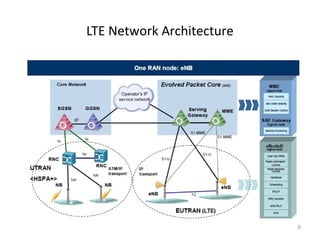
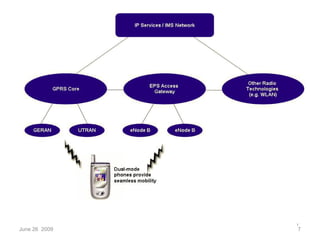
LTE Network Architecture
5
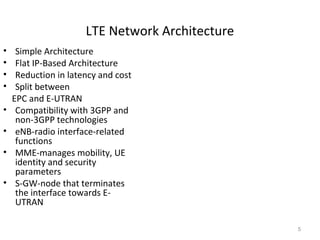
• Simple Architecture
• Flat IP-Based Architecture
• Reduction in latency and cost
• Split between
EPC and E-UTRAN
• Compatibility with 3GPP and
non-3GPP technologies
• eNB-radio interface-related
functions
• MME-manages mobility, UE
identity and security
parameters
• S-GW-node that terminates
the interface towards E-
UTRAN
LTE Network Architecture
6
June 26 2009 7
8
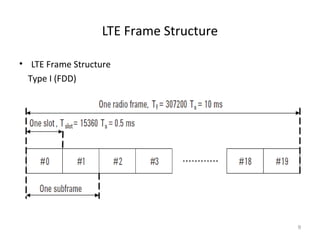
LTE Frame Structure
• LTE Frame Structure
Type I (FDD)
9
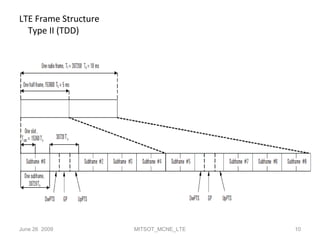
LTE Frame Structure
Type II (TDD)
June 26 2009 MITSOT_MCNE_LTE 10
Single-Carrier Frequency Division Multiple
Access (SC-FDMA)
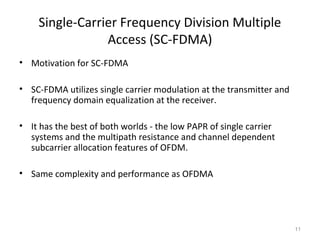
• Motivation for SC-FDMA
• SC-FDMA utilizes single carrier modulation at the transmitter and
frequency domain equalization at the receiver.
• It has the best of both worlds - the low PAPR of single carrier
systems and the multipath resistance and channel dependent
subcarrier allocation features of OFDM.
• Same complexity and performance as OFDMA
11
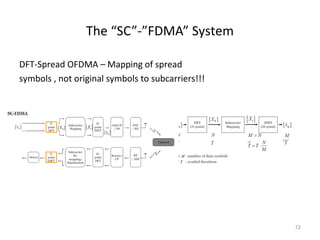
The “SC”-”FDMA” System
DFT-Spread OFDMA – Mapping of spread
symbols , not original symbols to subcarriers!!!
12
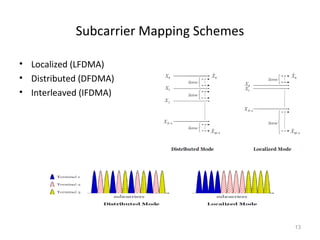
Subcarrier Mapping Schemes
• Localized (LFDMA)
• Distributed (DFDMA)
• Interleaved (IFDMA)
13
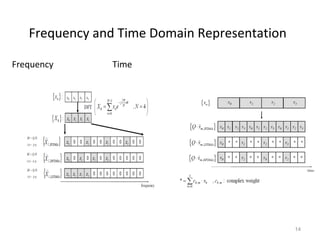
Frequency and Time Domain Representation
14
Frequency Time
Time domain signals of LFDMA, DFDMA and
IFDMA[20]
15
PAPR characteristics of an SC-FDMA signal [20]
Comparison of the CCDF of PAPR for LFDMA, DFDMA, IFDMA and
OFDMA
16
Effect of roll-off factor, alpha on the PAPR[20]
17
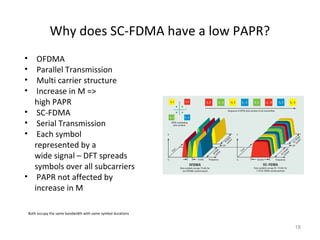
Why does SC-FDMA have a low PAPR?
• OFDMA
• Parallel Transmission
• Multi carrier structure
• Increase in M =>
high PAPR
• SC-FDMA
• Serial Transmission
• Each symbol
represented by a
wide signal – DFT spreads
symbols over all subcarriers
• PAPR not affected by
increase in M
Both occupy the same bandwidth with same symbol durations
18
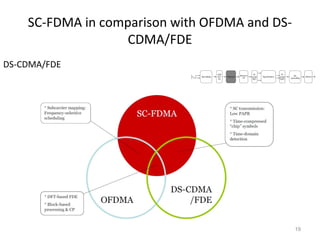
SC-FDMA in comparison with OFDMA and DS-
CDMA/FDE
19
DS-CDMA/FDE
Channel Dependent Scheduling
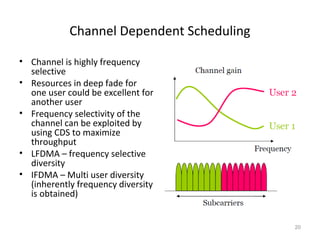
• Channel is highly frequency
selective
• Resources in deep fade for
one user could be excellent for
another user
• Frequency selectivity of the
channel can be exploited by
using CDS to maximize
throughput
• LFDMA – frequency selective
diversity
• IFDMA – Multi user diversity
(inherently frequency diversity
is obtained)
20
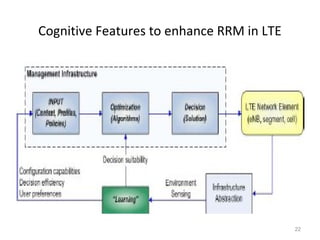
Cognitive RRM in LTE
• Link adaptation possible as network segments in LTE adapt to the
environmental changes
• System can learn from solutions that were provided in the past
• Faster response, improved performance, intelligent system
• Decisions reg. apt BW,DSA,APA and AM
21
Cognitive Features to enhance RRM in LTE
22
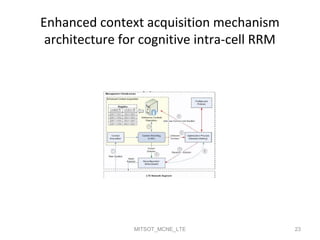
Enhanced context acquisition mechanism
architecture for cognitive intra-cell RRM
MITSOT_MCNE_LTE 23
Multiple Antenna Schemes in LTE
• In DL : Tx diversity, Rx diversity, Spatial multiplexing (2x2,4x2
configurations – SU-MIMO and MU-MIMO) supported
• In UL : Only 1 Transmitter (antenna selection Tx diversity ), MU-
MIMO possible, Rx diversity with 2 or 4 antennas at eNB supported
24
LTE Advanced
• LTE doesn’t fulfill the requirements of IMT-Advanced
• 3GPP has also started work on LTE-Advanced, an evolution of LTE,
as a proposal to ITU-R for the development of IMT Advanced.
• LTE Advanced is envisioned to be the “first true 4G technology”.
25
Requirements of LTE Advanced
• Peak data rates – 1Gbps in DL and 500 Mbps in UL
• Cell edge user data rates twice as high and average user throughput
thrice as high as in LTE
• Peak spectrum efficiency DL: 30 bps/Hz, UL: 15 bps/Hz
• Operate in flexible spectrum allocations up to 100 MHz and support
spectrum aggregation (as BW in DL >>20 MHz)
• An LTE-Advanced capable network must appear as a LTE network
for the LTE UEs
26
Technological proposals for LTE Advanced
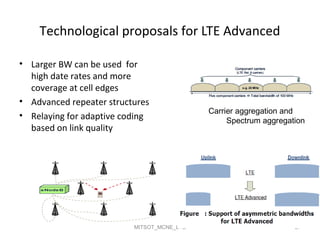
• Larger BW can be used for
high date rates and more
coverage at cell edges
• Advanced repeater structures
• Relaying for adaptive coding
based on link quality
MITSOT_MCNE_LTE 27
Carrier aggregation and
Spectrum aggregation
Thank You !
28

3GPP – Long Term Evolution

  • 1.
    3GPP – LongTerm Evolution – A Technical Study 1 Mr. Vishal Pawar MITSOT
  • 2.
    Main Topics • Introductionto LTE • LTE Network Architecture • LTE Physical Layer • SC-FDMA • Channel Dependent Scheduling • Cognitive Radio for LTE RRM • Multiple antenna schemes in LTE • LTE-Advanced • Conclusion 2
  • 3.
    Introduction to LTE •3GPP Long Term Evolution - the next generation of wireless cellular technology beyond 3G • Initiative taken by the 3rd Generation Partnership Project in 2004 • Introduced in Release 8 of 3GPP • Mobile systems likely to be deployed by 2010 3
  • 4.
    Requirements to bemet by LTE Fast, Efficient, Cheap, Simple • Peak Data Rates • Spectrum efficiency • Reduced Latency • Mobility • Spectrum flexibility • Coverage • Low complexity and cost • Interoperability • Simple packet-oriented E-UTRAN architecture 4
  • 5.
    LTE Network Architecture 5 •Simple Architecture • Flat IP-Based Architecture • Reduction in latency and cost • Split between EPC and E-UTRAN • Compatibility with 3GPP and non-3GPP technologies • eNB-radio interface-related functions • MME-manages mobility, UE identity and security parameters • S-GW-node that terminates the interface towards E- UTRAN
  • 6.
  • 7.
  • 8.
  • 9.
    LTE Frame Structure •LTE Frame Structure Type I (FDD) 9
  • 10.
    LTE Frame Structure TypeII (TDD) June 26 2009 MITSOT_MCNE_LTE 10
  • 11.
    Single-Carrier Frequency DivisionMultiple Access (SC-FDMA) • Motivation for SC-FDMA • SC-FDMA utilizes single carrier modulation at the transmitter and frequency domain equalization at the receiver. • It has the best of both worlds - the low PAPR of single carrier systems and the multipath resistance and channel dependent subcarrier allocation features of OFDM. • Same complexity and performance as OFDMA 11
  • 12.
    The “SC”-”FDMA” System DFT-SpreadOFDMA – Mapping of spread symbols , not original symbols to subcarriers!!! 12
  • 13.
    Subcarrier Mapping Schemes •Localized (LFDMA) • Distributed (DFDMA) • Interleaved (IFDMA) 13
  • 14.
    Frequency and TimeDomain Representation 14 Frequency Time
  • 15.
    Time domain signalsof LFDMA, DFDMA and IFDMA[20] 15
  • 16.
    PAPR characteristics ofan SC-FDMA signal [20] Comparison of the CCDF of PAPR for LFDMA, DFDMA, IFDMA and OFDMA 16
  • 17.
    Effect of roll-offfactor, alpha on the PAPR[20] 17
  • 18.
    Why does SC-FDMAhave a low PAPR? • OFDMA • Parallel Transmission • Multi carrier structure • Increase in M => high PAPR • SC-FDMA • Serial Transmission • Each symbol represented by a wide signal – DFT spreads symbols over all subcarriers • PAPR not affected by increase in M Both occupy the same bandwidth with same symbol durations 18
  • 19.
    SC-FDMA in comparisonwith OFDMA and DS- CDMA/FDE 19 DS-CDMA/FDE
  • 20.
    Channel Dependent Scheduling •Channel is highly frequency selective • Resources in deep fade for one user could be excellent for another user • Frequency selectivity of the channel can be exploited by using CDS to maximize throughput • LFDMA – frequency selective diversity • IFDMA – Multi user diversity (inherently frequency diversity is obtained) 20
  • 21.
    Cognitive RRM inLTE • Link adaptation possible as network segments in LTE adapt to the environmental changes • System can learn from solutions that were provided in the past • Faster response, improved performance, intelligent system • Decisions reg. apt BW,DSA,APA and AM 21
  • 22.
    Cognitive Features toenhance RRM in LTE 22
  • 23.
    Enhanced context acquisitionmechanism architecture for cognitive intra-cell RRM MITSOT_MCNE_LTE 23
  • 24.
    Multiple Antenna Schemesin LTE • In DL : Tx diversity, Rx diversity, Spatial multiplexing (2x2,4x2 configurations – SU-MIMO and MU-MIMO) supported • In UL : Only 1 Transmitter (antenna selection Tx diversity ), MU- MIMO possible, Rx diversity with 2 or 4 antennas at eNB supported 24
  • 25.
    LTE Advanced • LTEdoesn’t fulfill the requirements of IMT-Advanced • 3GPP has also started work on LTE-Advanced, an evolution of LTE, as a proposal to ITU-R for the development of IMT Advanced. • LTE Advanced is envisioned to be the “first true 4G technology”. 25
  • 26.
    Requirements of LTEAdvanced • Peak data rates – 1Gbps in DL and 500 Mbps in UL • Cell edge user data rates twice as high and average user throughput thrice as high as in LTE • Peak spectrum efficiency DL: 30 bps/Hz, UL: 15 bps/Hz • Operate in flexible spectrum allocations up to 100 MHz and support spectrum aggregation (as BW in DL >>20 MHz) • An LTE-Advanced capable network must appear as a LTE network for the LTE UEs 26
  • 27.
    Technological proposals forLTE Advanced • Larger BW can be used for high date rates and more coverage at cell edges • Advanced repeater structures • Relaying for adaptive coding based on link quality MITSOT_MCNE_LTE 27 Carrier aggregation and Spectrum aggregation
  • 28.