PRESENTATION
 BEGINNING
                   GOALS


INTRODUCTION
                WHAT IS 4G
    TO 4G
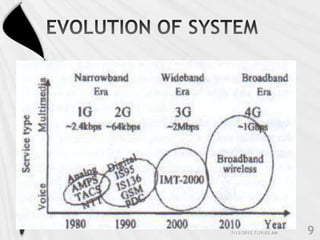
EVOLUTION OF
  EVOLUTION
                     SYSTEM


    WHICH
                 INFRASTRUCTURE
COUNTRIES HAVE
                      FOR 4G
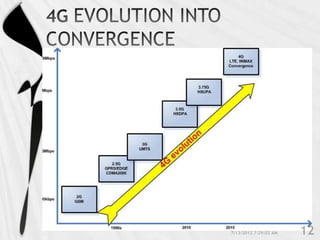
     4G
4G EVOLUTION
     INTO         WiMax
CONVERGENCE


 4G IN INDIA   APPLICATION
DIFFERENCE
BETWEEN 3G   REFERENCES
    & 4G


CONCLUSION   QUESTIONS
In telecommunications,            The     The aim is
      4G is the fourth         technology to achieve
 generation of cell phone      is currently    “ultra
  mobile communications        available in broadband
standards. It is a successor       some      speed” –
  of the third generation       countries      to be
 (3G) standards, will soon       but it is  counted in
 become the standard for        still being  gigabytes
      cellular wireless.        perfected.      per
                                              second.
Will allow users to
  ITU designed 4G in                  download a full-length
  2002 with the official              feature film within five
 name “3G Long-Term                   minutes.
  Evolutions” or 3.9G.


    4G is adoption of packet
   switching instead of circuit         Will also be able to
switching in voice and video calls.   stream high-definition
 With packet switching, resources
   are only used when there is        television and radio to
information to be sent across 4G        hand-held devices.
     uses spiral multiplexing.
The first commercial deployment was
          by Telia Sonera and
               NetCom.


  Telia Sonera branded the network
                “4G”.


  The modem devices on offer were
manufactured by Samsung (dongle GT-
              B3710).

   The network infrastructure were
   created by Huawei (in Oslo) and
       Ericsson (in Stockholm).
Except for the Scandinavian countries, a few
countries have started the 4G commercially.


In the US, Sprint Nextel initiated the service
                  last year.


  Countries expected to launch 4G by this
 year are Germany, Spain, China, Japan and
                 England.
There are three primary technologies that support 4G – WiMax,
                       LTE, and UMB.


   The main doubt is whether to implement WiMax or LTE.


                 The advantages of LTE are:


(i) Faster speed with 100 Mbps for download and 50 Mbps
                         for upload.

         (ii) It makes CDMA and GSM database.


      (iii) It offers both FDD and TDD duplexing.
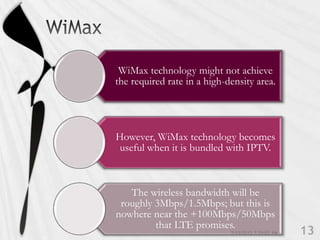
WiMax technology might not achieve
the required rate in a high-density area.


However, WiMax technology becomes
 useful when it is bundled with IPTV.


   The wireless bandwidth will be
 roughly 3Mbps/1.5Mbps; but this is
nowhere near the +100Mbps/50Mbps
         that LTE promises.
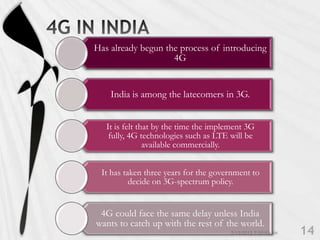
Has already begun the process of introducing
                    4G


    India is among the latecomers in 3G.


   It is felt that by the time the implement 3G
    fully, 4G technologies such as LTE will be
                available commercially.


 It has taken three years for the government to
          decide on 3G-spectrum policy.


 4G could face the same delay unless India
wants to catch up with the rest of the world.
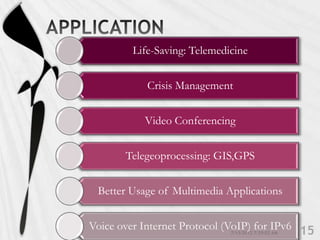
Life-Saving: Telemedicine


            Crisis Management


            Video Conferencing


       Telegeoprocessing: GIS,GPS


 Better Usage of Multimedia Applications


Voice over Internet Protocol (VoIP) for IPv6
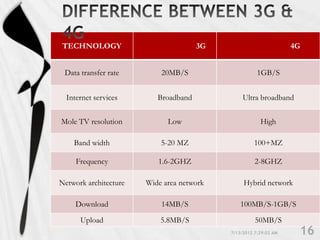
TECHNOLOGY                            3G                4G


 Data transfer rate        20MB/S              1GB/S


  Internet services       Broadband        Ultra broadband


Mole TV resolution           Low                High

    Band width             5-20 MZ            100+MZ

     Frequency            1.6-2GHZ            2-8GHZ

Network architecture   Wide area network   Hybrid network

     Download              14MB/S          100MB/S-1GB/S
      Upload               5.8MB/S            50MB/S
www.3g.co.uk/All%20Abou
      t%203G.htm
www.en.wikipedia.org/wiki
           /4G
      www.4g.co.uk

www.uscwc.com/4GReport

     www.four-g.net/
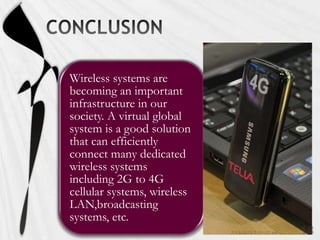
Wireless systems are
becoming an important
infrastructure in our
society. A virtual global
system is a good solution
that can efficiently
connect many dedicated
wireless systems
including 2G to 4G
cellular systems, wireless
LAN,broadcasting
systems, etc.
4G

4G

  • 2.
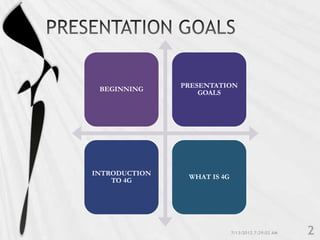
    PRESENTATION BEGINNING GOALS INTRODUCTION WHAT IS 4G TO 4G
  • 3.
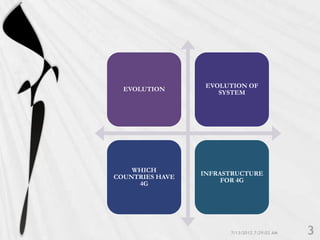
    EVOLUTION OF EVOLUTION SYSTEM WHICH INFRASTRUCTURE COUNTRIES HAVE FOR 4G 4G
  • 4.
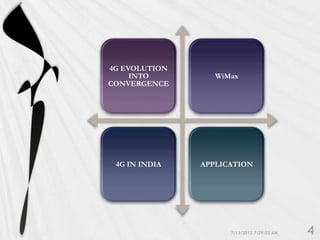
    4G EVOLUTION INTO WiMax CONVERGENCE 4G IN INDIA APPLICATION
  • 5.
    DIFFERENCE BETWEEN 3G REFERENCES & 4G CONCLUSION QUESTIONS
  • 6.
    In telecommunications, The The aim is 4G is the fourth technology to achieve generation of cell phone is currently “ultra mobile communications available in broadband standards. It is a successor some speed” – of the third generation countries to be (3G) standards, will soon but it is counted in become the standard for still being gigabytes cellular wireless. perfected. per second.
  • 7.
    Will allow usersto ITU designed 4G in download a full-length 2002 with the official feature film within five name “3G Long-Term minutes. Evolutions” or 3.9G. 4G is adoption of packet switching instead of circuit Will also be able to switching in voice and video calls. stream high-definition With packet switching, resources are only used when there is television and radio to information to be sent across 4G hand-held devices. uses spiral multiplexing.
  • 8.
    The first commercialdeployment was by Telia Sonera and NetCom. Telia Sonera branded the network “4G”. The modem devices on offer were manufactured by Samsung (dongle GT- B3710). The network infrastructure were created by Huawei (in Oslo) and Ericsson (in Stockholm).
  • 10.
    Except for theScandinavian countries, a few countries have started the 4G commercially. In the US, Sprint Nextel initiated the service last year. Countries expected to launch 4G by this year are Germany, Spain, China, Japan and England.
  • 11.
    There are threeprimary technologies that support 4G – WiMax, LTE, and UMB. The main doubt is whether to implement WiMax or LTE. The advantages of LTE are: (i) Faster speed with 100 Mbps for download and 50 Mbps for upload. (ii) It makes CDMA and GSM database. (iii) It offers both FDD and TDD duplexing.
  • 13.
    WiMax technology mightnot achieve the required rate in a high-density area. However, WiMax technology becomes useful when it is bundled with IPTV. The wireless bandwidth will be roughly 3Mbps/1.5Mbps; but this is nowhere near the +100Mbps/50Mbps that LTE promises.
  • 14.
    Has already begunthe process of introducing 4G India is among the latecomers in 3G. It is felt that by the time the implement 3G fully, 4G technologies such as LTE will be available commercially. It has taken three years for the government to decide on 3G-spectrum policy. 4G could face the same delay unless India wants to catch up with the rest of the world.
  • 15.
    Life-Saving: Telemedicine Crisis Management Video Conferencing Telegeoprocessing: GIS,GPS Better Usage of Multimedia Applications Voice over Internet Protocol (VoIP) for IPv6
  • 16.
    TECHNOLOGY 3G 4G Data transfer rate 20MB/S 1GB/S Internet services Broadband Ultra broadband Mole TV resolution Low High Band width 5-20 MZ 100+MZ Frequency 1.6-2GHZ 2-8GHZ Network architecture Wide area network Hybrid network Download 14MB/S 100MB/S-1GB/S Upload 5.8MB/S 50MB/S
  • 17.
    www.3g.co.uk/All%20Abou t%203G.htm www.en.wikipedia.org/wiki /4G www.4g.co.uk www.uscwc.com/4GReport www.four-g.net/
  • 18.
    Wireless systems are becomingan important infrastructure in our society. A virtual global system is a good solution that can efficiently connect many dedicated wireless systems including 2G to 4G cellular systems, wireless LAN,broadcasting systems, etc.