www.huawei.com
LTE System Overview
Page1
Contents
1. LTE Industry Briefing
2. LTE Network Architecture
3. LTE Air Interface Principles
4. eNodeB Product Overview
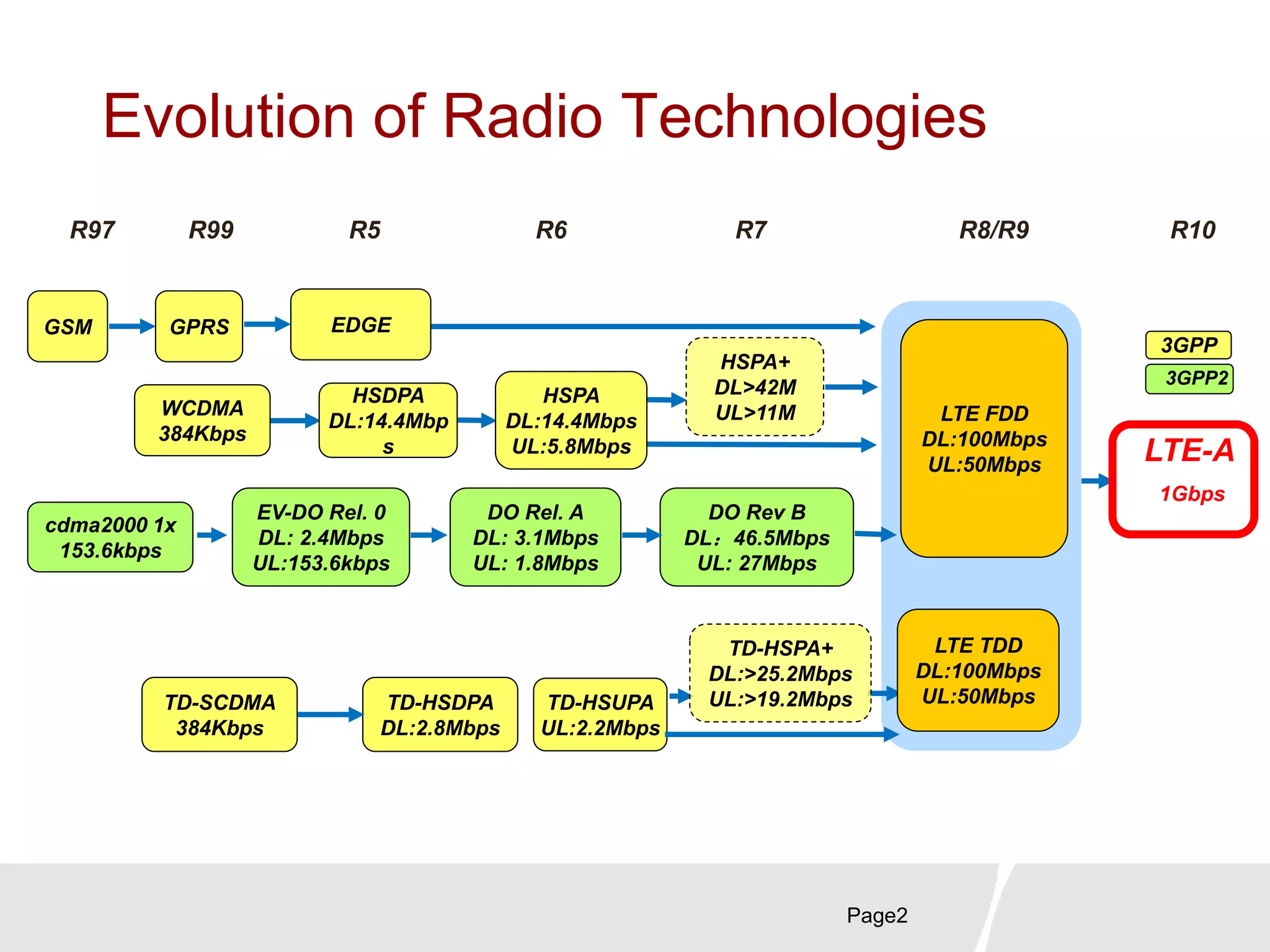
Evolution of Radio Technologies
Page2
1Gbps
LTE-A
EV-DO Rel. 0
DL: 2.4Mbps
UL:153.6kbps
cdma2000 1x
153.6kbps
DO Rel. A
DL: 3.1Mbps
UL: 1.8Mbps
DO Rev B
DL:46.5Mbps
UL: 27Mbps
HSPA+
DL>42M
UL>11MWCDMA
384Kbps
HSDPA
DL:14.4Mbp
s
HSPA
DL:14.4Mbps
UL:5.8Mbps
LTE FDD
DL:100Mbps
UL:50Mbps
GSM EDGE
TD-HSDPA
DL:2.8Mbps
TD-HSUPA
UL:2.2Mbps
LTE TDD
DL:100Mbps
UL:50Mbps
TD-HSPA+
DL:>25.2Mbps
UL:>19.2MbpsTD-SCDMA
384Kbps
GPRS
3GPP
3GPP2
R97 R99 R5 R6 R7 R8/R9 R10
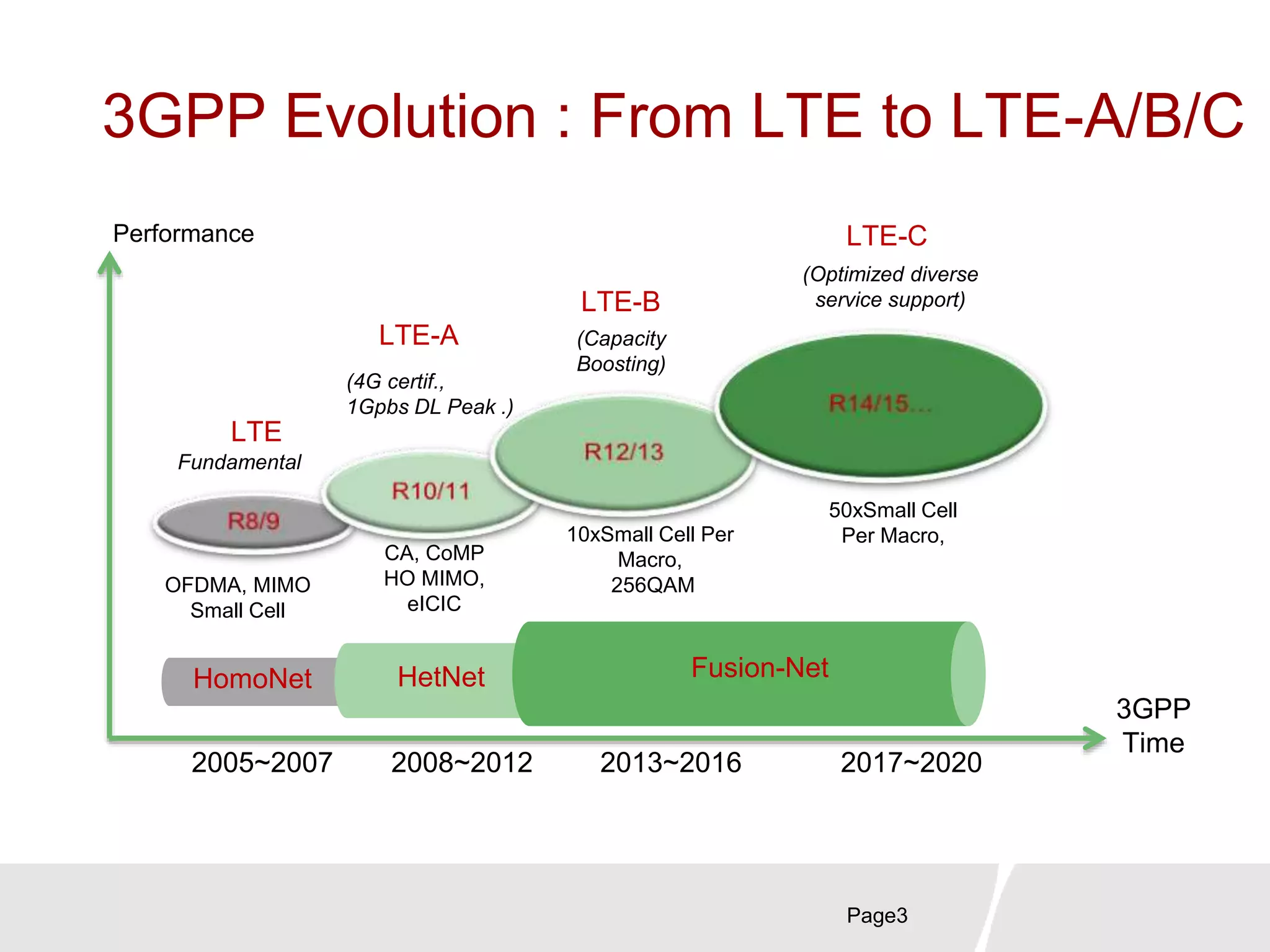
3GPP Evolution : From LTE to LTE-A/B/C
Page3
HomoNet
LTE-A
LTE-B
LTE-C
OFDMA, MIMO
Small Cell
CA, CoMP
HO MIMO,
eICIC
50xSmall Cell
Per Macro,
(4G certif.,
1Gpbs DL Peak .)
Fundamental
(Capacity
Boosting)
(Optimized diverse
service support)
Performance
3GPP
Time
2005~2007 2008~2012 2013~2016 2017~2020
10xSmall Cell Per
Macro,
256QAM
LTE
HetNet Fusion-Net
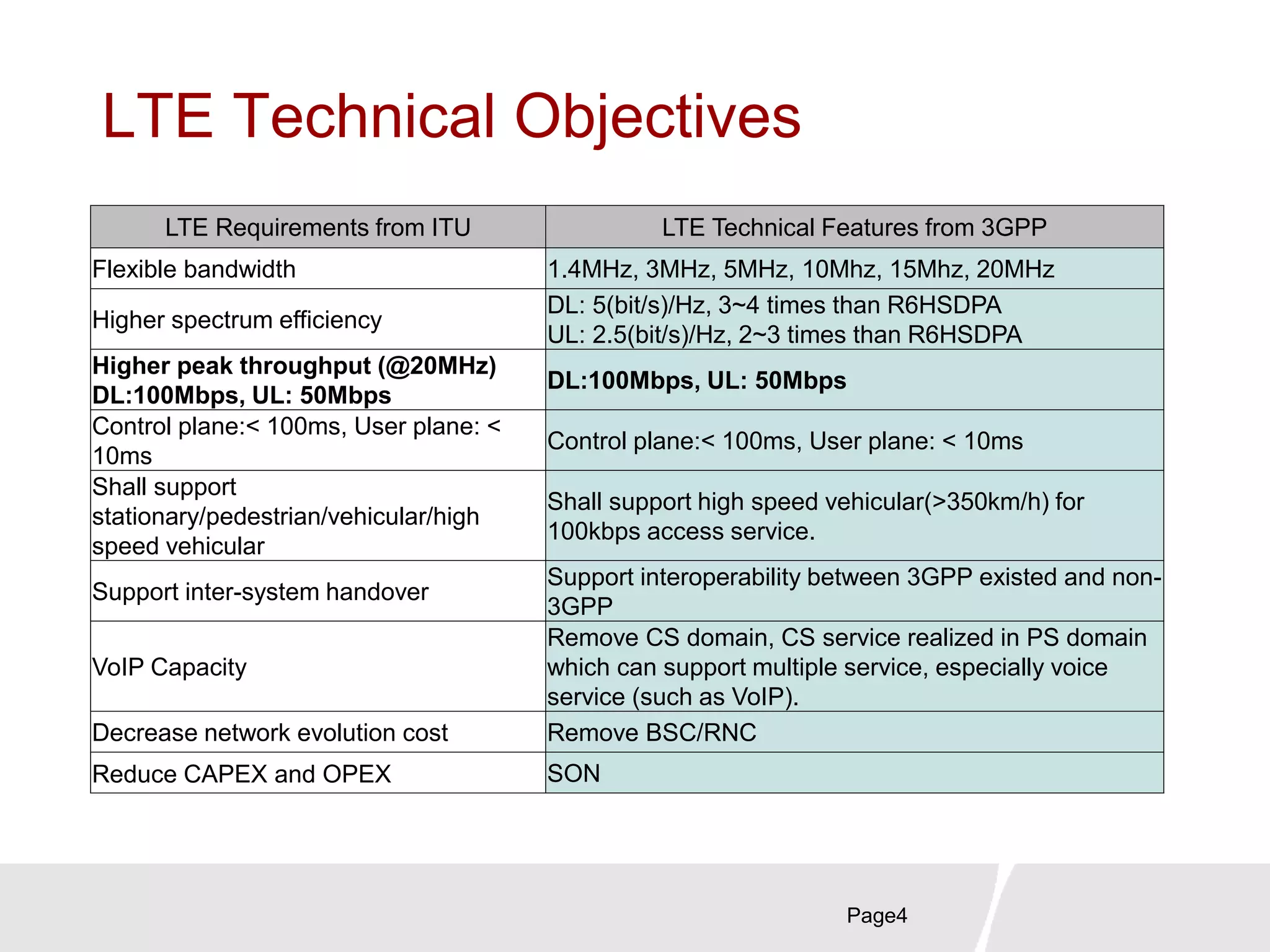
LTE Technical Objectives
Page4
LTE Requirements from ITU LTE Technical Features from 3GPP
Flexible bandwidth 1.4MHz, 3MHz, 5MHz, 10Mhz, 15Mhz, 20MHz
Higher spectrum efficiency
DL: 5(bit/s)/Hz, 3~4 times than R6HSDPA
UL: 2.5(bit/s)/Hz, 2~3 times than R6HSDPA
Higher peak throughput (@20MHz)
DL:100Mbps, UL: 50Mbps
Control plane:< 100ms, User plane: <
10ms
Control plane:< 100ms, User plane: < 10ms
Shall support
stationary/pedestrian/vehicular/high
speed vehicular
Shall support high speed vehicular(>350km/h) for
100kbps access service.
Support inter-system handover
Support interoperability between 3GPP existed and non-
3GPP
VoIP Capacity
Remove CS domain, CS service realized in PS domain
which can support multiple service, especially voice
service (such as VoIP).
Decrease network evolution cost Remove BSC/RNC
Reduce CAPEX and OPEX SON
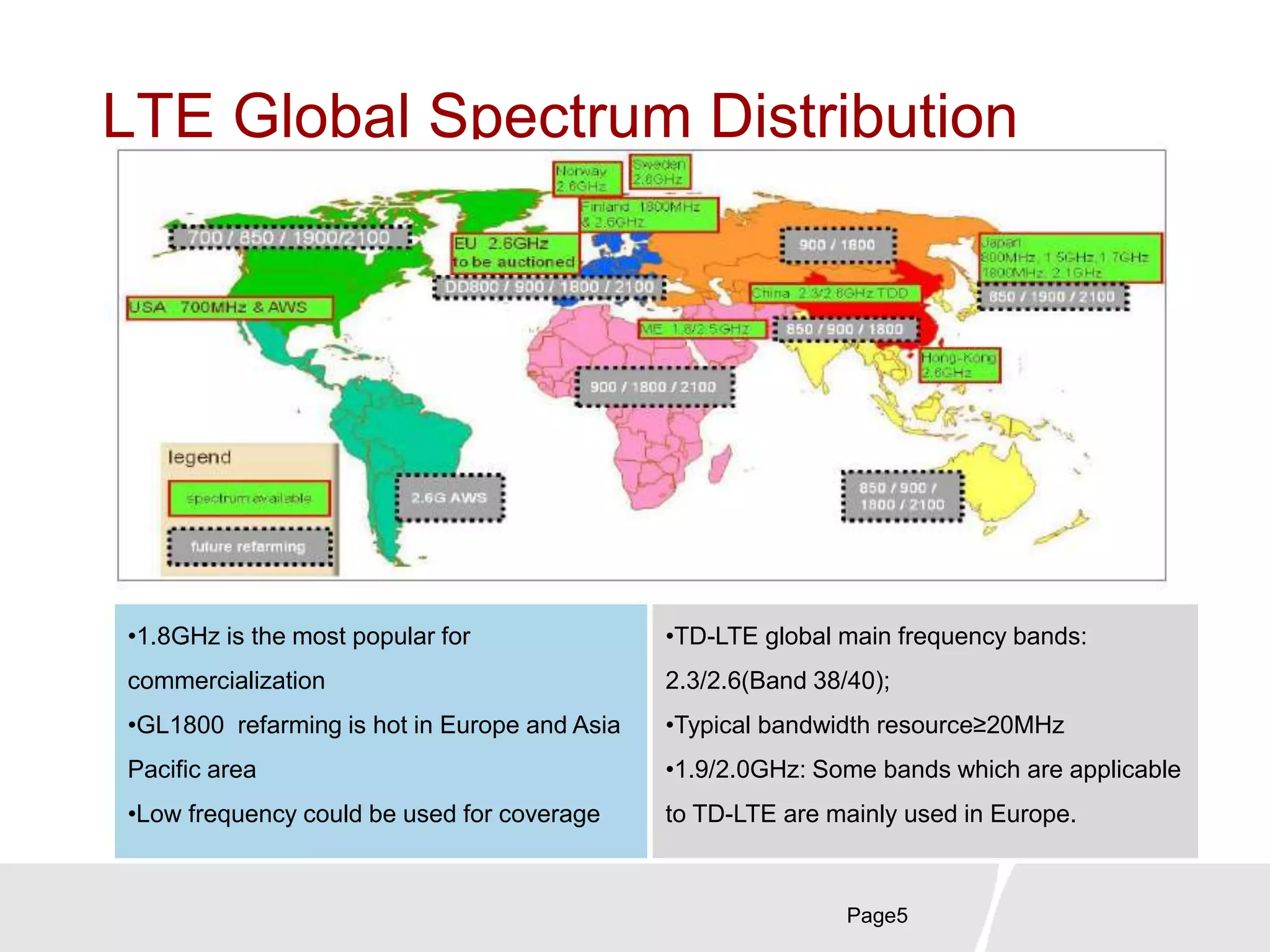
LTE Global Spectrum Distribution
Page5
•1.8GHz is the most popular for
commercialization
•GL1800 refarming is hot in Europe and Asia
Pacific area
•Low frequency could be used for coverage
•TD-LTE global main frequency bands:
2.3/2.6(Band 38/40);
•Typical bandwidth resource≥20MHz
•1.9/2.0GHz: Some bands which are applicable
to TD-LTE are mainly used in Europe.
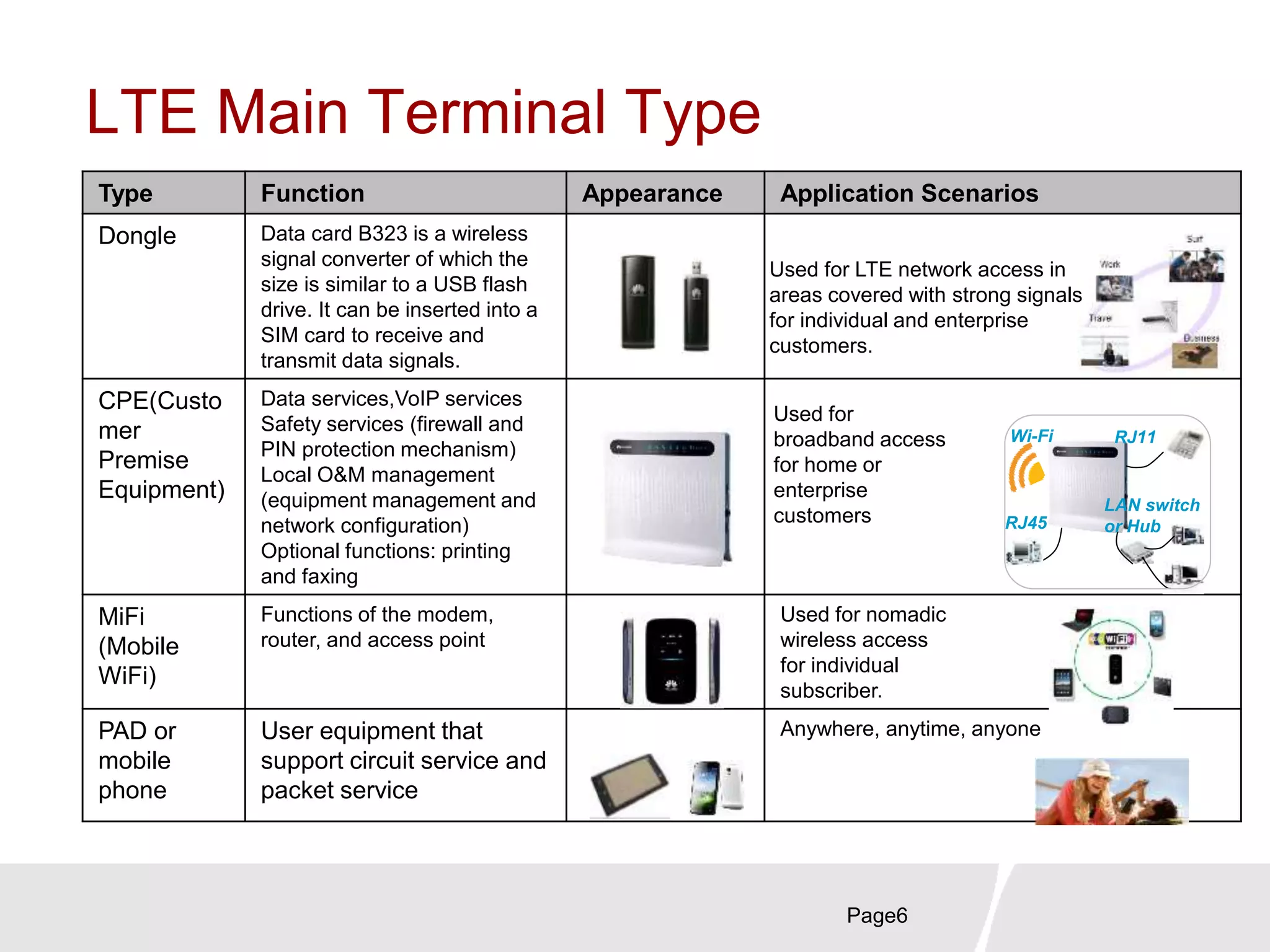
Type Function Appearance Application Scenarios
Dongle Data card B323 is a wireless
signal converter of which the
size is similar to a USB flash
drive. It can be inserted into a
SIM card to receive and
transmit data signals.
CPE(Custo
mer
Premise
Equipment)
Data services,VoIP services
Safety services (firewall and
PIN protection mechanism)
Local O&M management
(equipment management and
network configuration)
Optional functions: printing
and faxing
MiFi
(Mobile
WiFi)
Functions of the modem,
router, and access point
Used for nomadic
wireless access
for individual
subscriber.
PAD or
mobile
phone
User equipment that
support circuit service and
packet service
Anywhere, anytime, anyone
LTE Main Terminal Type
Page6
Wi-Fi
RJ45
RJ11
LAN switch
or Hub
Used for LTE network access in
areas covered with strong signals
for individual and enterprise
customers.
Used for
broadband access
for home or
enterprise
customers
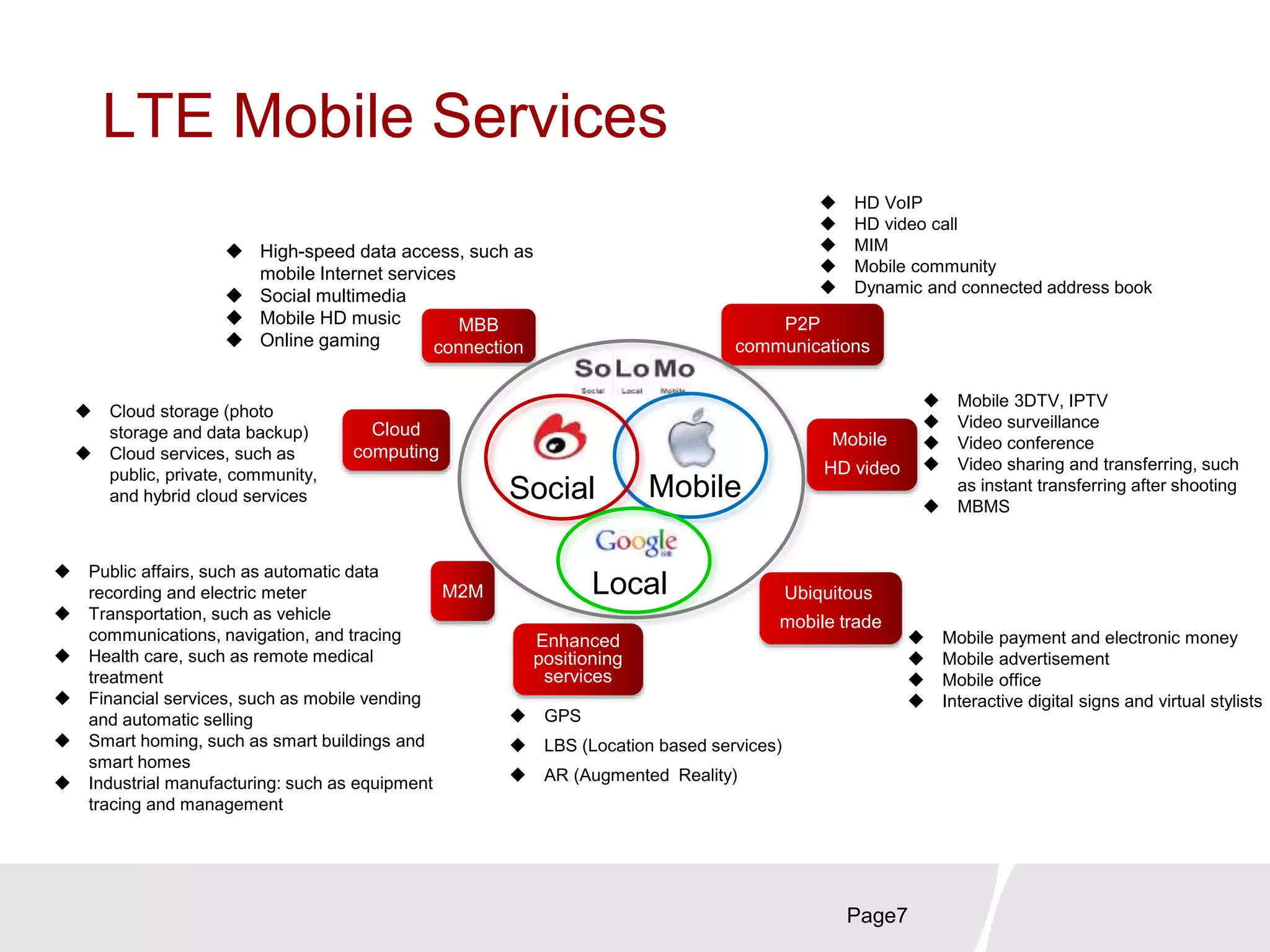
LTE Mobile Services
Page7
P2P
communications
 HD VoIP
 HD video call
 MIM
 Mobile community
 Dynamic and connected address book
 High-speed data access, such as
mobile Internet services
 Social multimedia
 Mobile HD music
 Online gaming
MBB
connection
Mobile
HD video
 Mobile 3DTV, IPTV
 Video surveillance
 Video conference
 Video sharing and transferring, such
as instant transferring after shooting
 MBMS
M2M
 Public affairs, such as automatic data
recording and electric meter
 Transportation, such as vehicle
communications, navigation, and tracing
 Health care, such as remote medical
treatment
 Financial services, such as mobile vending
and automatic selling
 Smart homing, such as smart buildings and
smart homes
 Industrial manufacturing: such as equipment
tracing and management
Enhanced
positioning
services
Ubiquitous
mobile trade
 Mobile payment and electronic money
 Mobile advertisement
 Mobile office
 Interactive digital signs and virtual stylists
Cloud
computing
 Cloud storage (photo
storage and data backup)
 Cloud services, such as
public, private, community,
and hybrid cloud services
Local
MobileSocial
 GPS
 LBS (Location based services)
 AR (Augmented Reality)
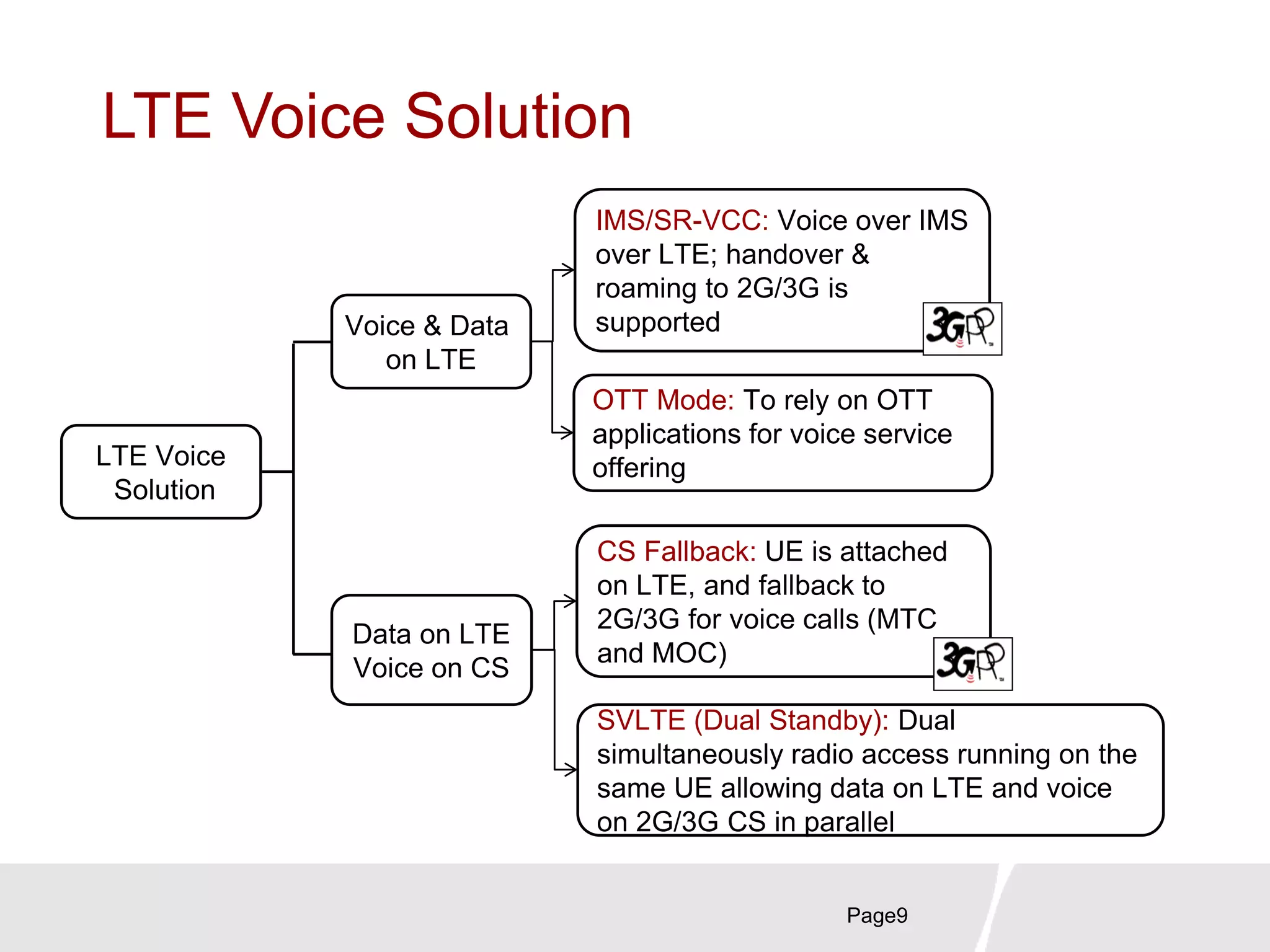
LTE Voice Solution
Page9
IMS/SR-VCC: Voice over IMS
over LTE; handover &
roaming to 2G/3G is
supported
Data on LTE
Voice on CS
Voice & Data
on LTE
CS Fallback: UE is attached
on LTE, and fallback to
2G/3G for voice calls (MTC
and MOC)
OTT Mode: To rely on OTT
applications for voice service
offering
SVLTE (Dual Standby): Dual
simultaneously radio access running on the
same UE allowing data on LTE and voice
on 2G/3G CS in parallel
LTE Voice
Solution
Page10
Contents
1. LTE Industry Briefing
2. LTE Network Architecture
3. LTE Air Interface Principles
4. eNodeB Product Overview
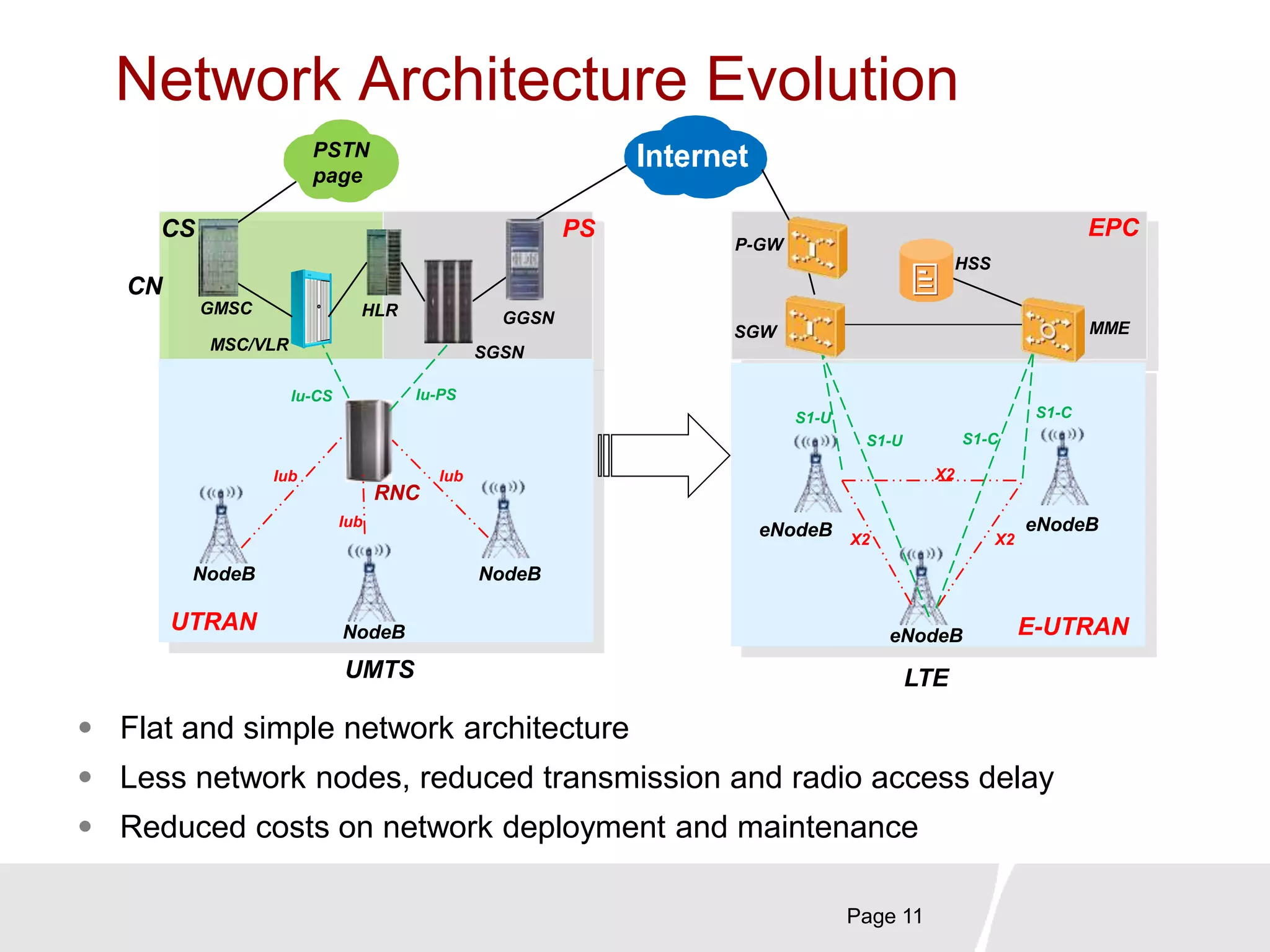
Network Architecture Evolution
 Flat and simple network architecture
 Less network nodes, reduced transmission and radio access delay
 Reduced costs on network deployment and maintenance
Page 11
UTRAN
RNC
NodeB
NodeB
NodeB
SGSN
eNodeB
MMESGW
X2
X2X2
S1-U
S1-C
S1-C
S1-U
E-UTRAN
Iub
Iub
Iub
Iu-CS Iu-PS
eNodeB
eNodeB
CS PS EPC
UMTS LTE
GGSN
MSC/VLR
GMSC
PSTN
page
CN
HLR
P-GW
HSS
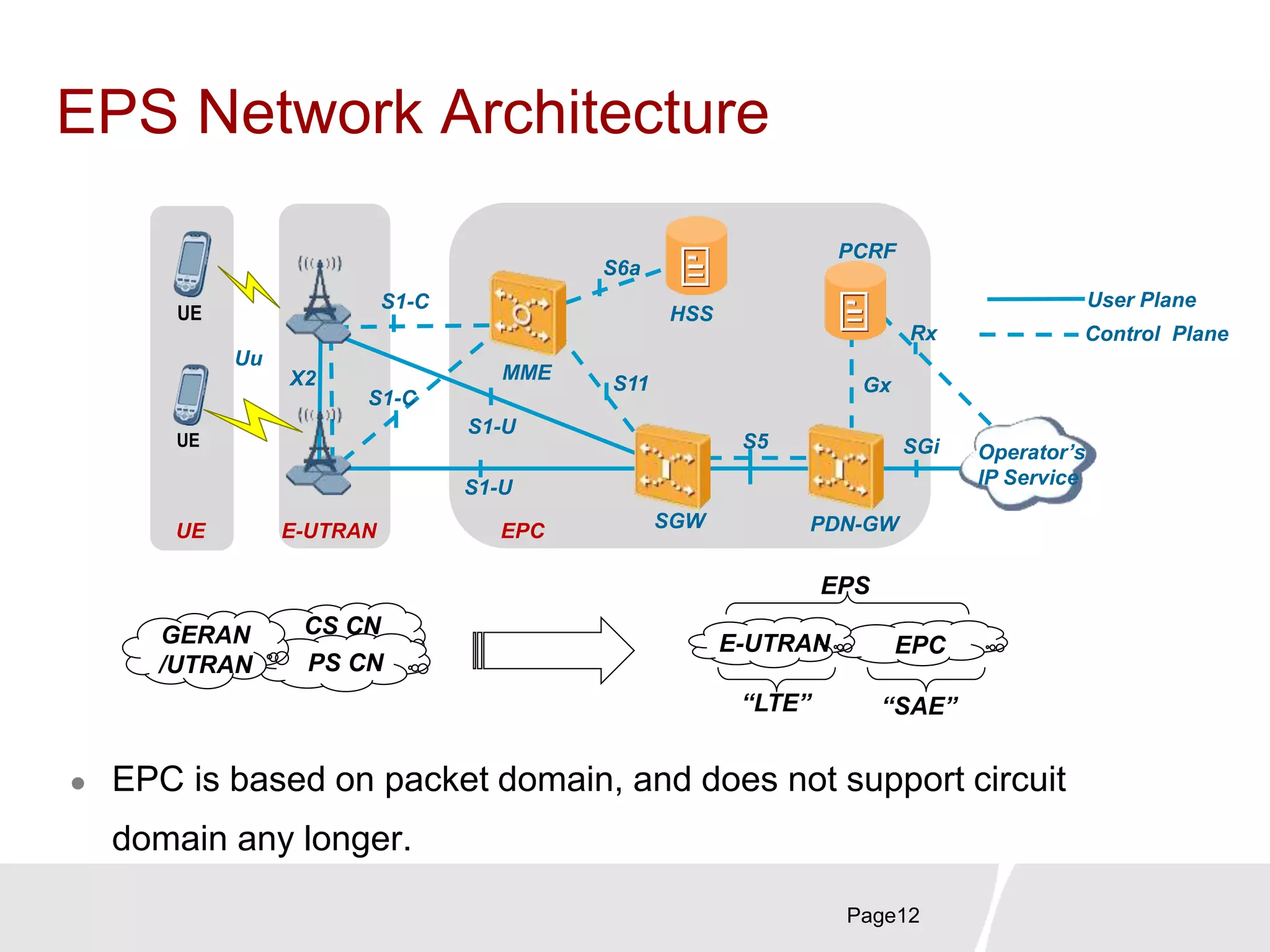
EPS Network Architecture
 EPC is based on packet domain, and does not support circuit
domain any longer.
Page12
S1-U
MME
SGi
E-UTRAN
S1-C
S11
Operator’s
IP Service
S6a
HSS
SGW
S5
PDN-GW
Rx
Gx
PCRF
UE
Uu
S1-C
S1-U
X2
UE
EPCUE
Control Plane
User Plane
GERAN
/UTRAN
CS CN
PS CN
E-UTRAN EPC
“LTE” “SAE”
EPS
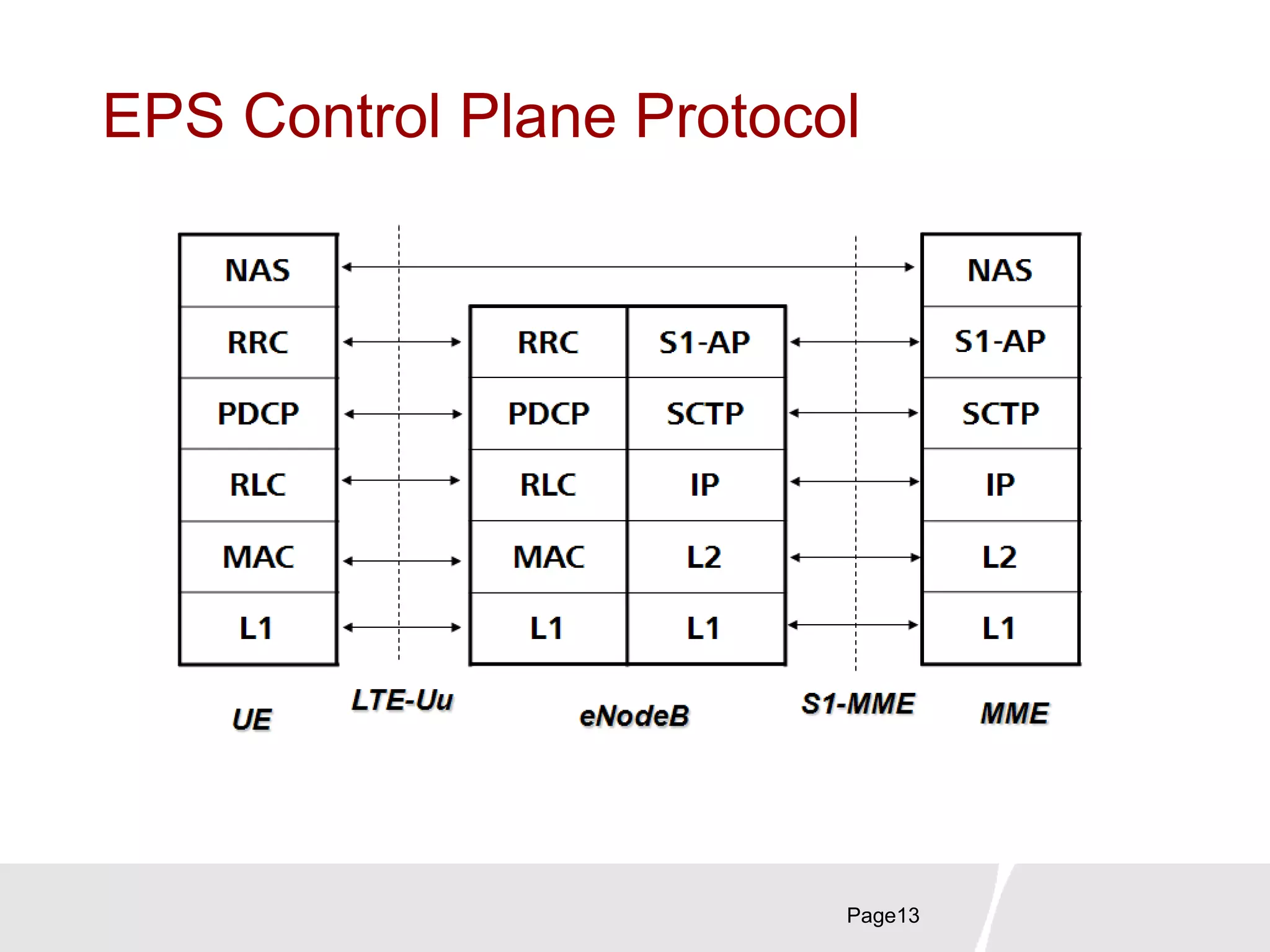
EPS Control Plane Protocol
Page13
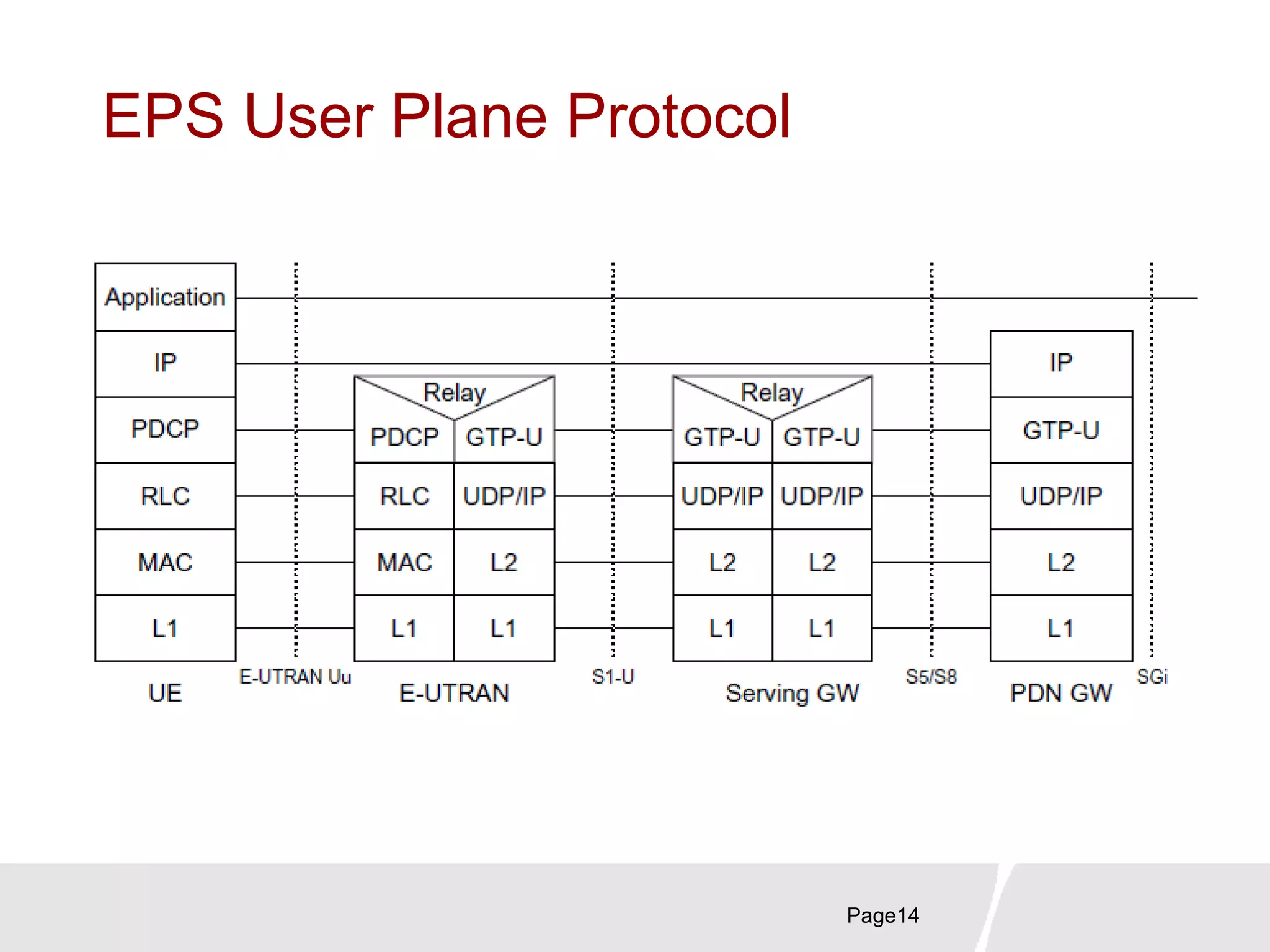
EPS User Plane Protocol
Page14
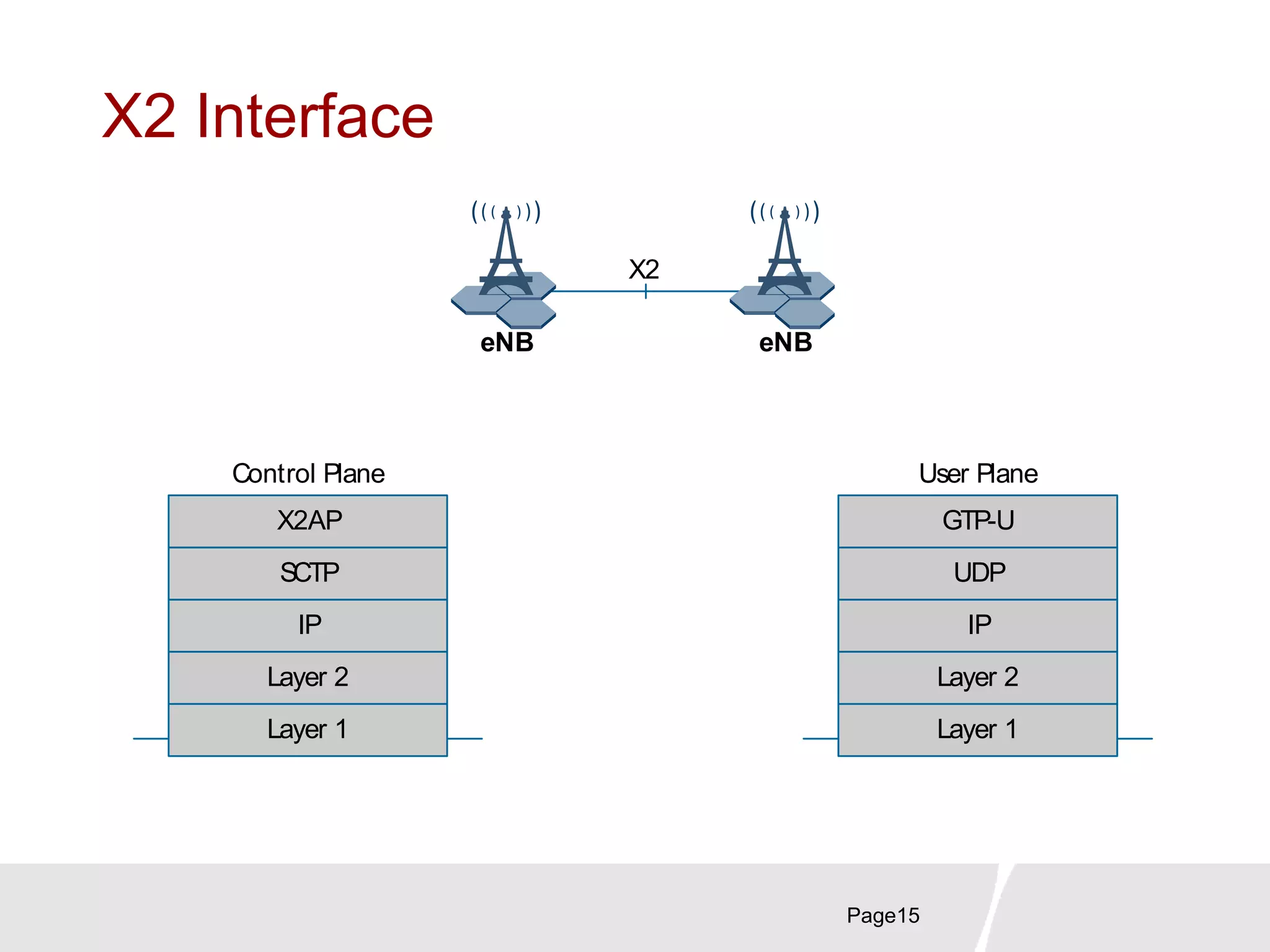
X2 Interface
Page15
eNB eNB
X2
IP
Layer 2
Layer 1
SCTP
X2AP
Control Plane
IP
Layer 2
Layer 1
UDP
GTP-U
User Plane
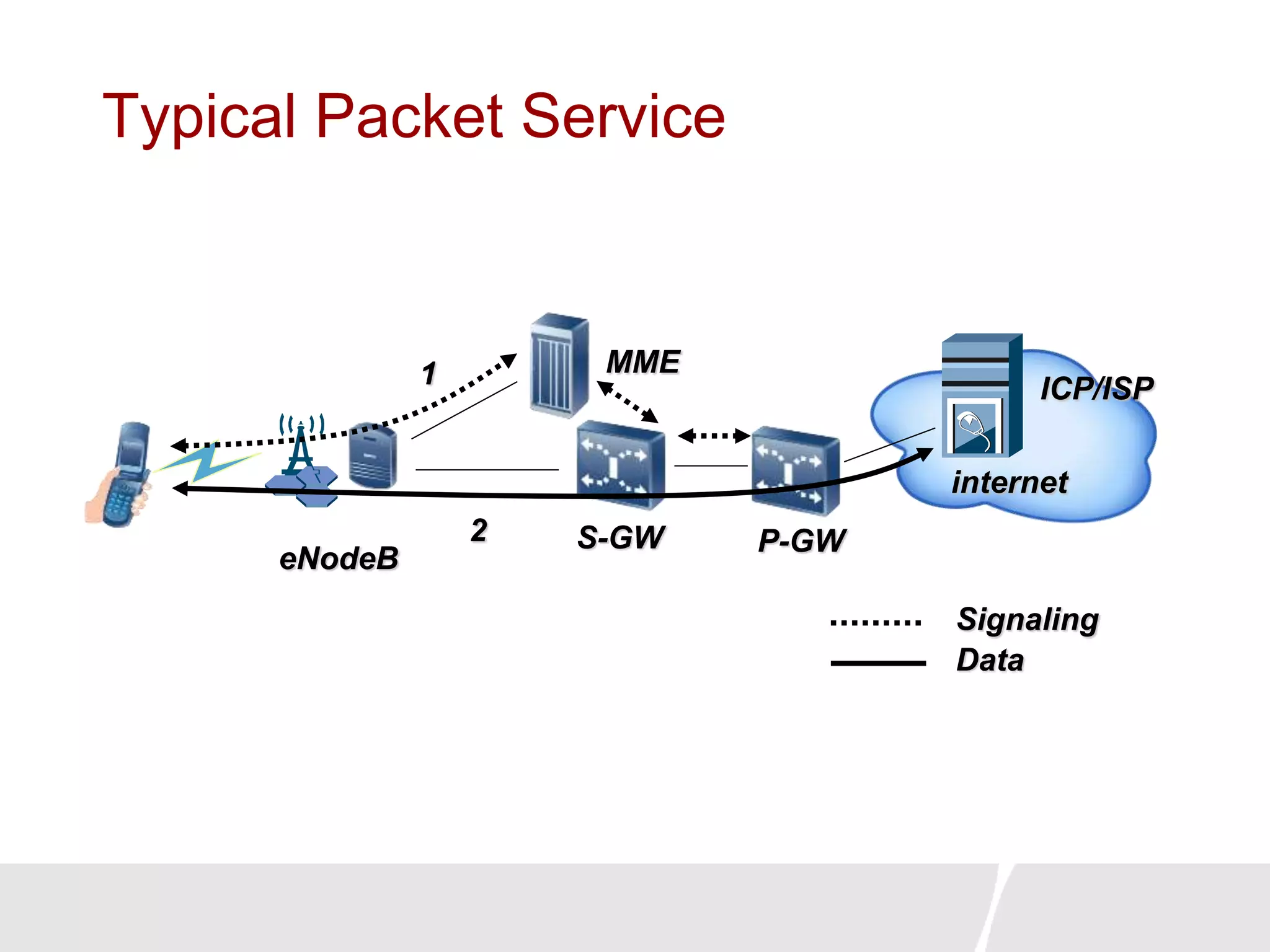
Typical Packet Service
eNodeB
MME
S-GW P-GW
ICP/ISP
internet
Data
Signaling
1
2
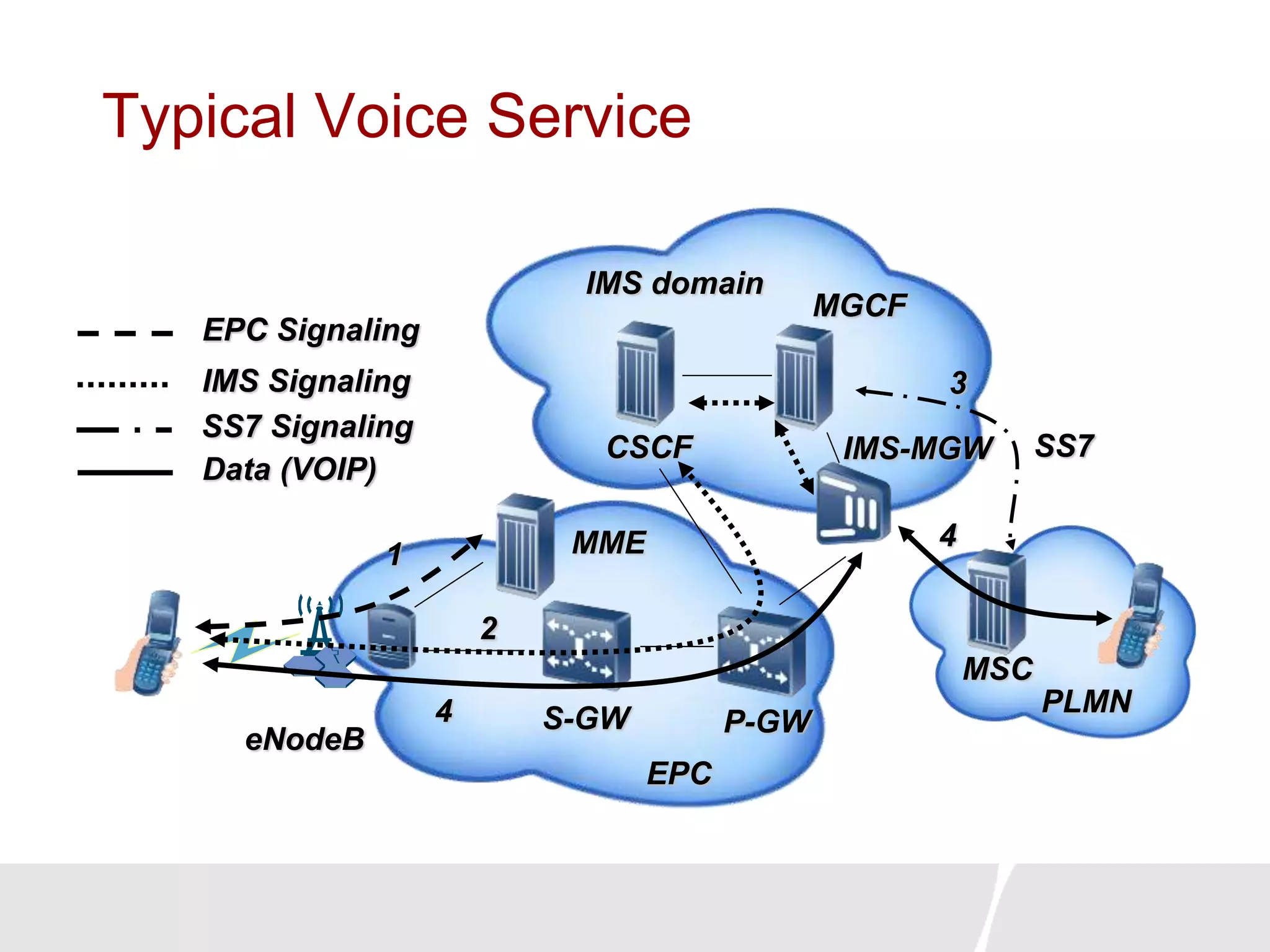
Typical Voice Service
eNodeB
MME
S-GW P-GW
EPC
Data (VOIP)
EPC Signaling
1
4
CSCF
IMS domain
MGCF
IMS-MGW
MSC
2
4
IMS Signaling
PLMN
SS7
SS7 Signaling
3
Page18
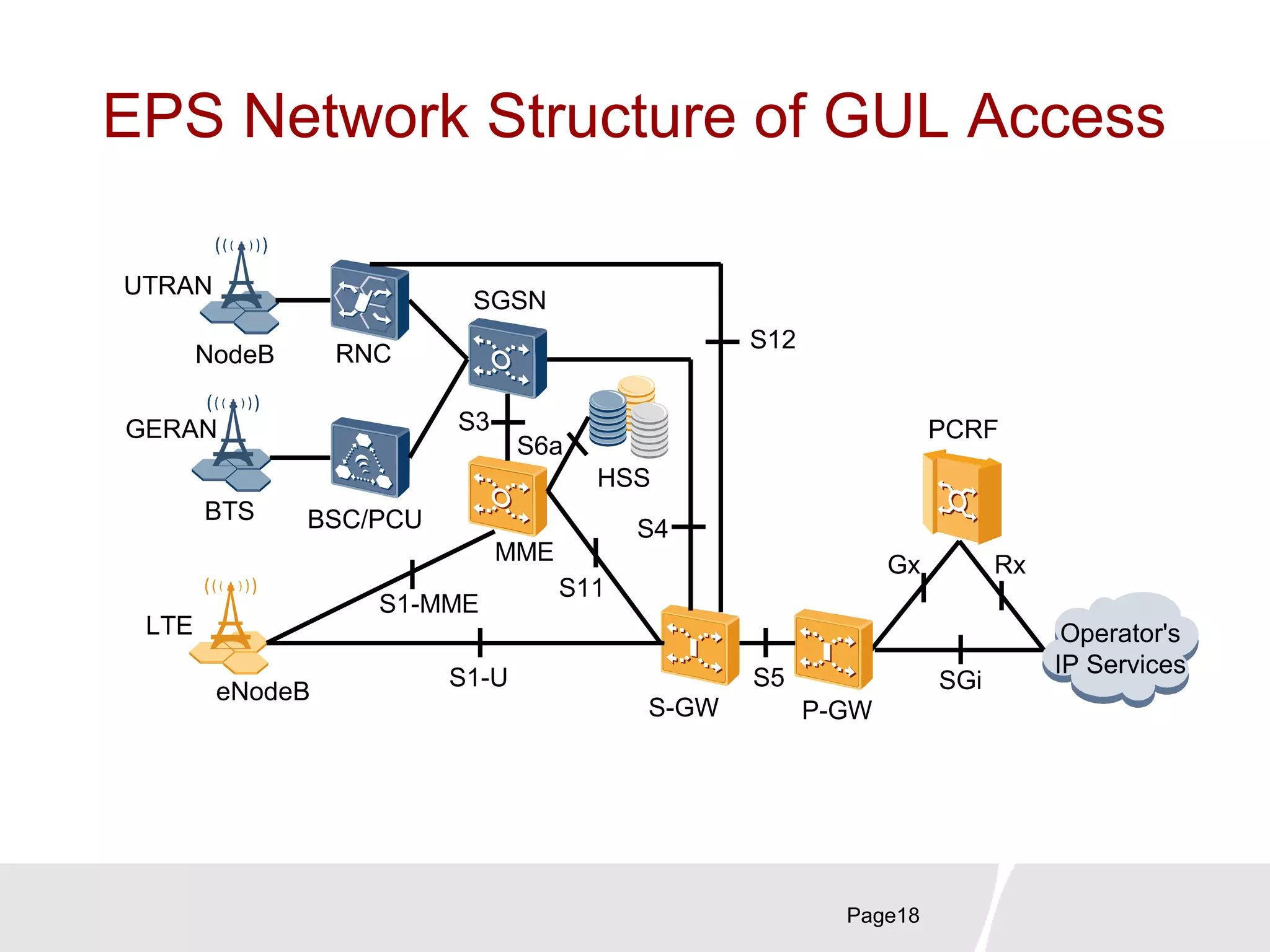
EPS Network Structure of GUL Access
S-GW
eNodeB
MME
SGSN
HSS
LTE
NodeB RNC
UTRAN
BSC/PCUBTS
GERAN
Gx
S1-U
S1-MME
S12
S4
S6a
S3
S11
Operator's
IP Services
PCRF
Rx
SGi
P-GW
S5
Page19
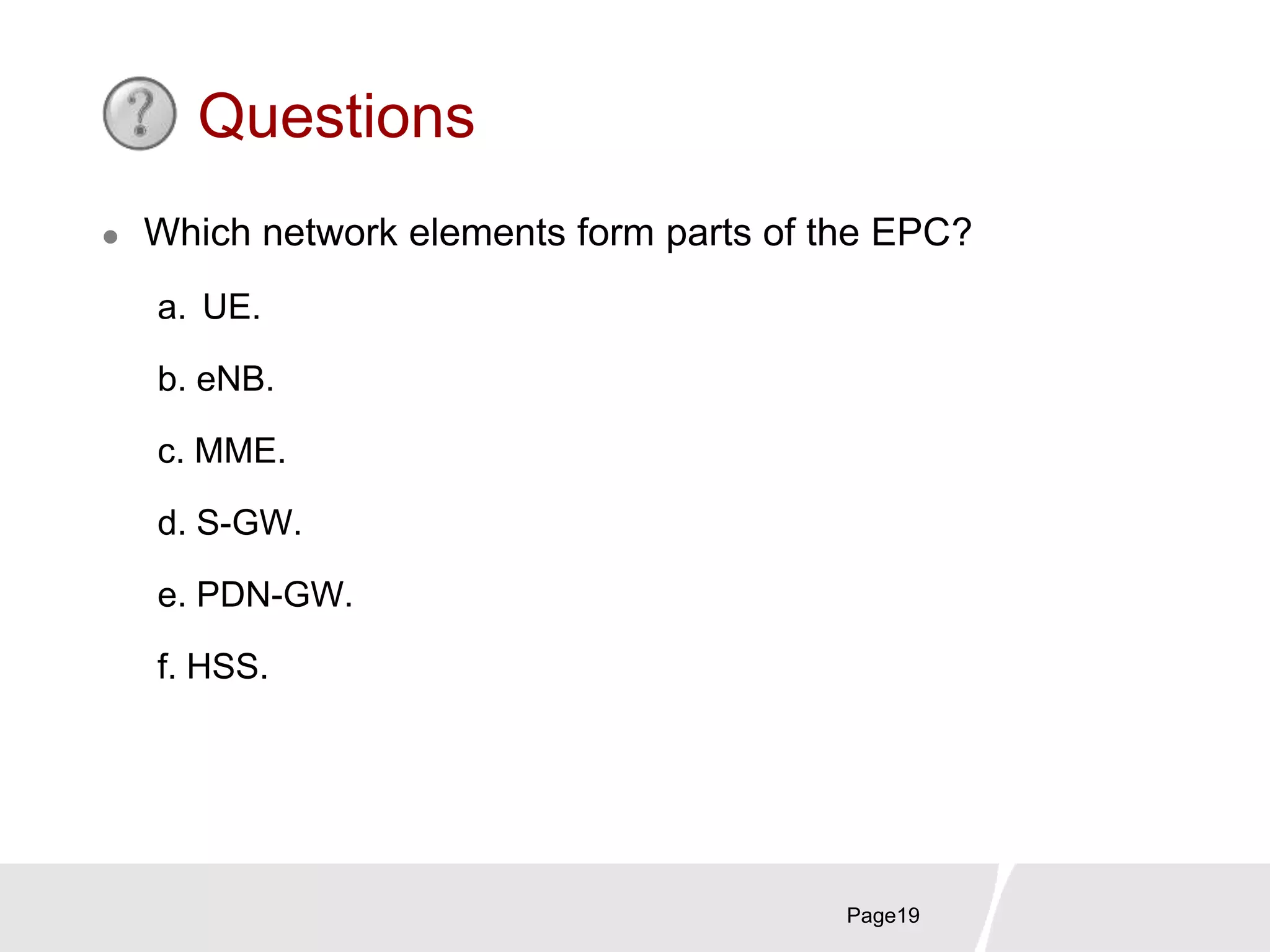
Questions
 Which network elements form parts of the EPC?
a. UE.
b. eNB.
c. MME.
d. S-GW.
e. PDN-GW.
f. HSS.
Page20
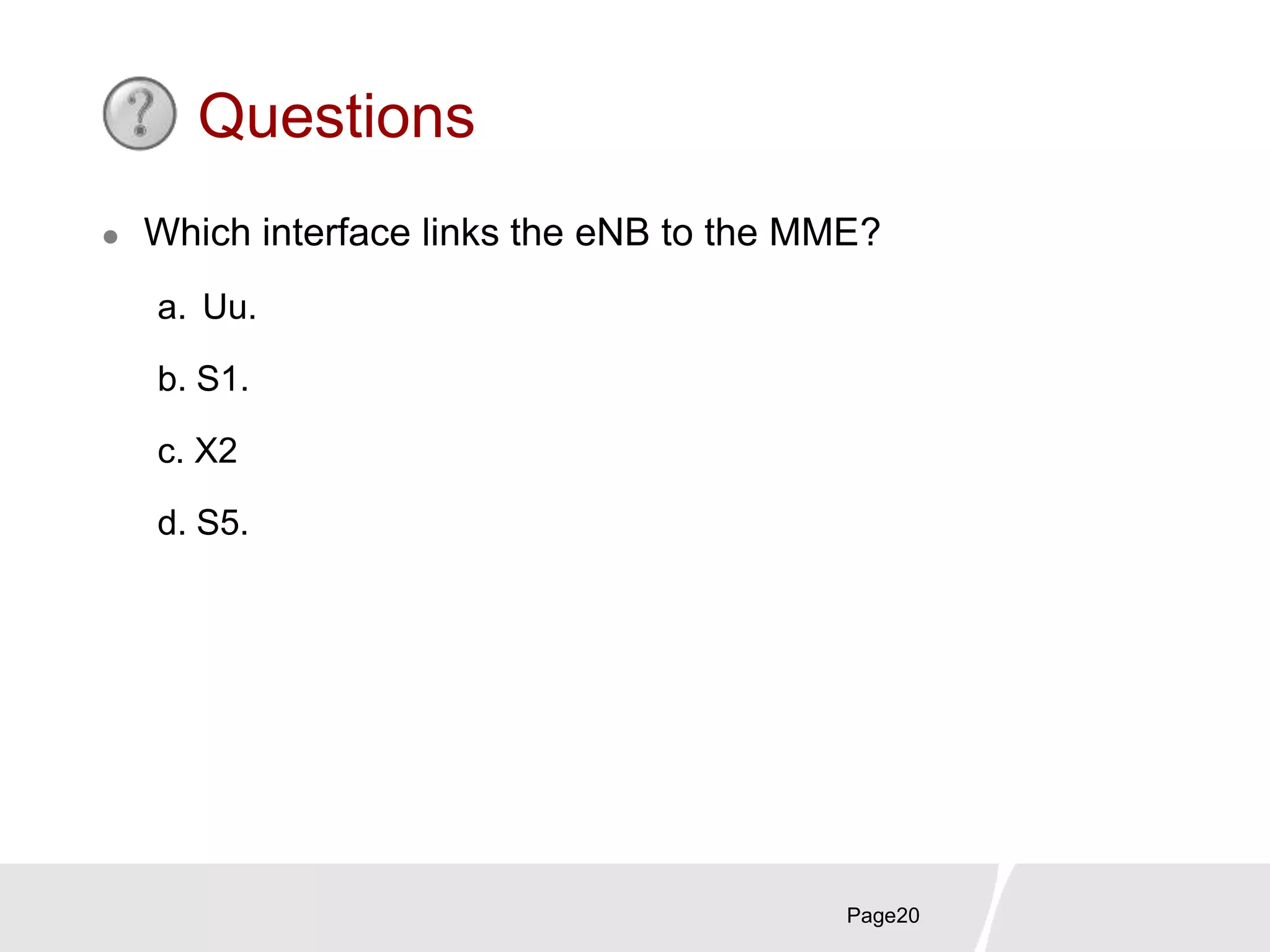
Questions
 Which interface links the eNB to the MME?
a. Uu.
b. S1.
c. X2
d. S5.
Page21
Contents
1. LTE Industry Briefing
2. LTE Network Architecture
3. LTE Air Interface Principles
4. eNodeB Product Overview
Page22
Contents
3 LTE Air Interface Principles
3.1 Principles of OFDM
3.2 Multiple Access and Duplex Technologies
3.3 LTE Frame Structure
3.4 LTE Physical Channel
3.5 Physical Procedures
3.6 Key Technologies
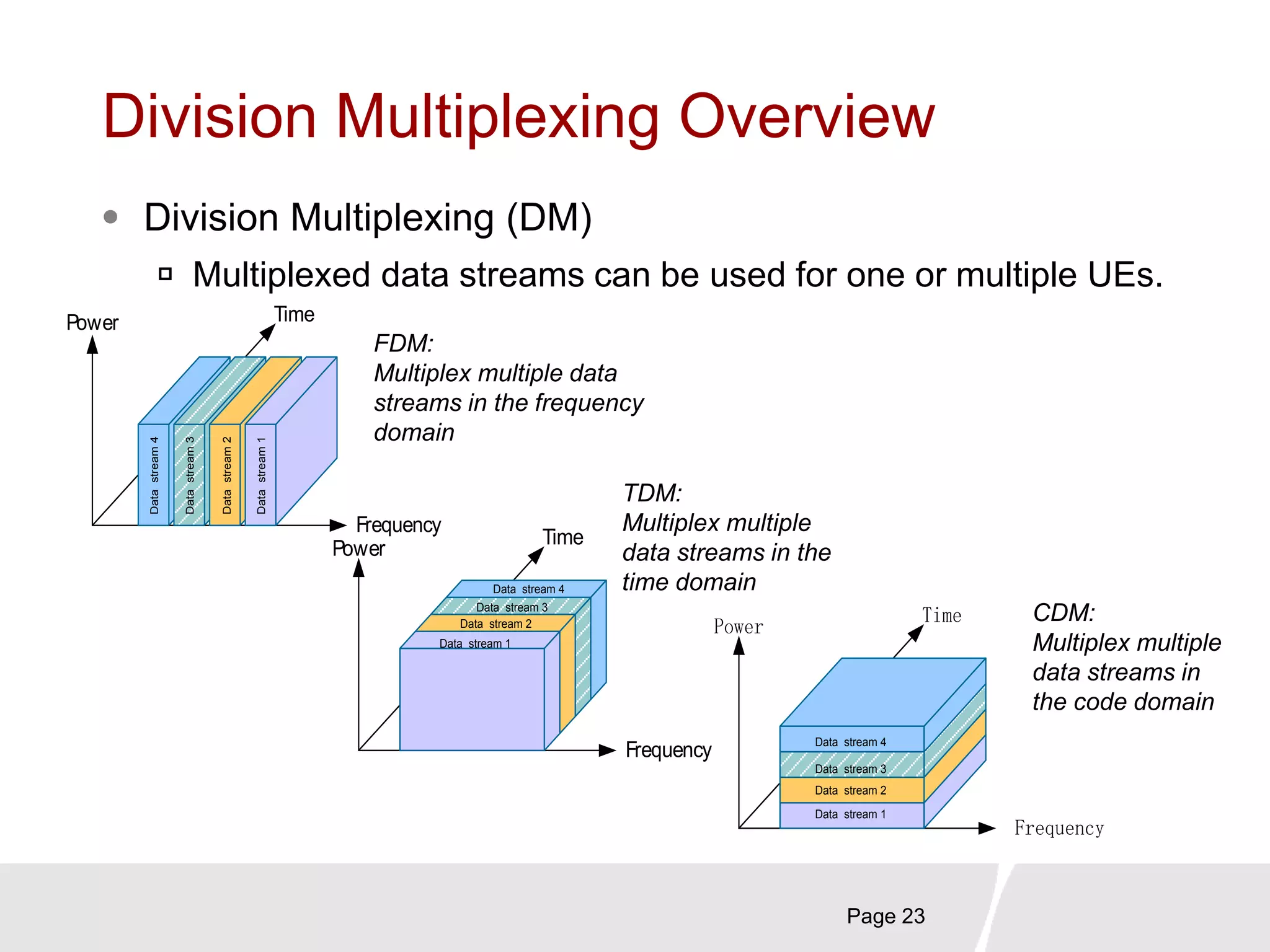
Division Multiplexing Overview
 Division Multiplexing (DM)
 Multiplexed data streams can be used for one or multiple UEs.
Page 23
Frequency
Power Time
Datastream1
Datastream2
Datastream3
Datastream4
Frequency
Power
Time
Data stream 1
Data stream 2
Data stream 3
Data stream 4
Frequency
Power
Time
Data stream 3
Data stream 4
Data stream 2
Data stream 1
FDM:
Multiplex multiple data
streams in the frequency
domain
TDM:
Multiplex multiple
data streams in the
time domain
CDM:
Multiplex multiple
data streams in
the code domain
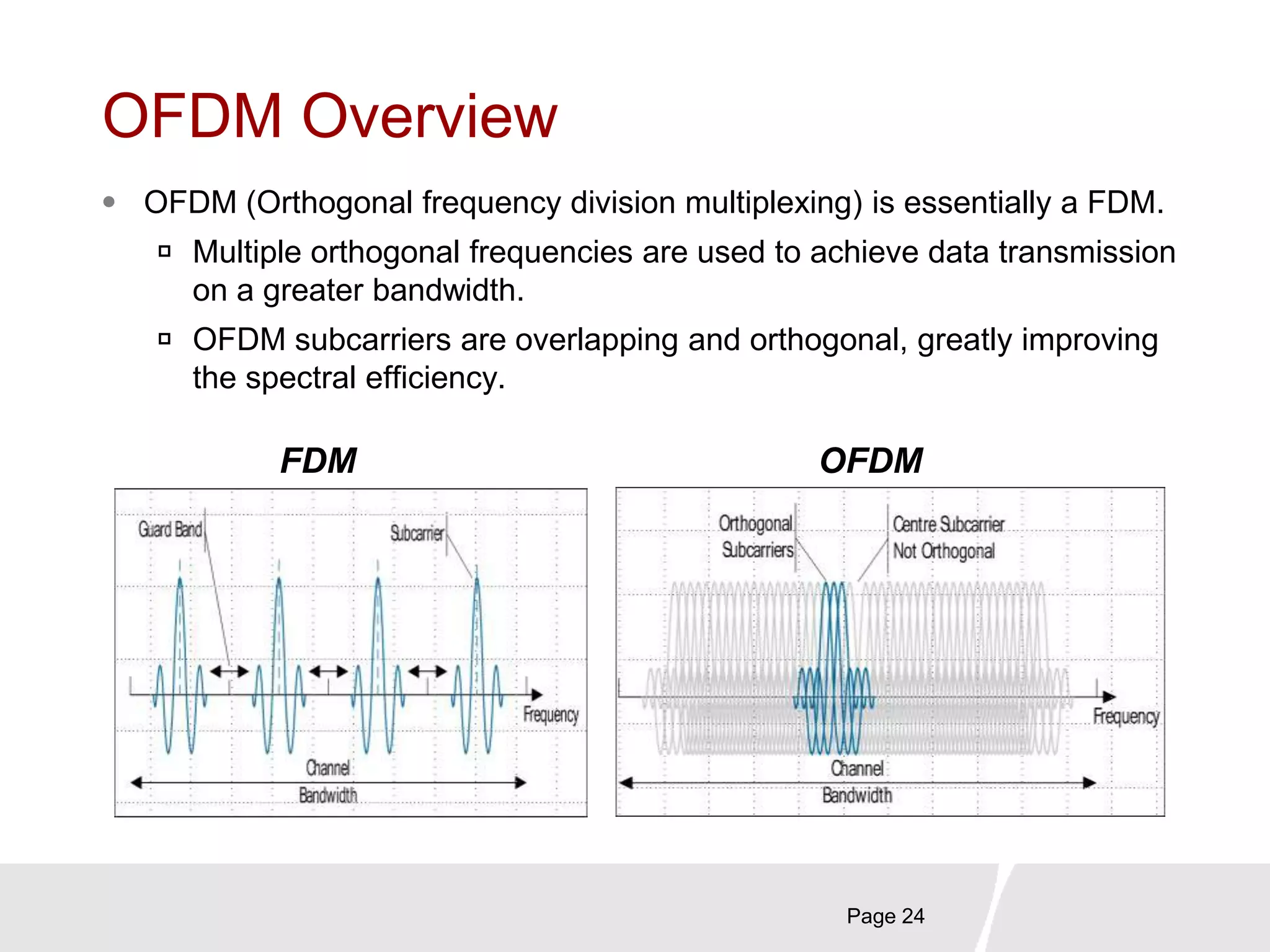
OFDM Overview
 OFDM (Orthogonal frequency division multiplexing) is essentially a FDM.
 Multiple orthogonal frequencies are used to achieve data transmission
on a greater bandwidth.
 OFDM subcarriers are overlapping and orthogonal, greatly improving
the spectral efficiency.
Page 24
FDM OFDM
eNB
UE
Page25
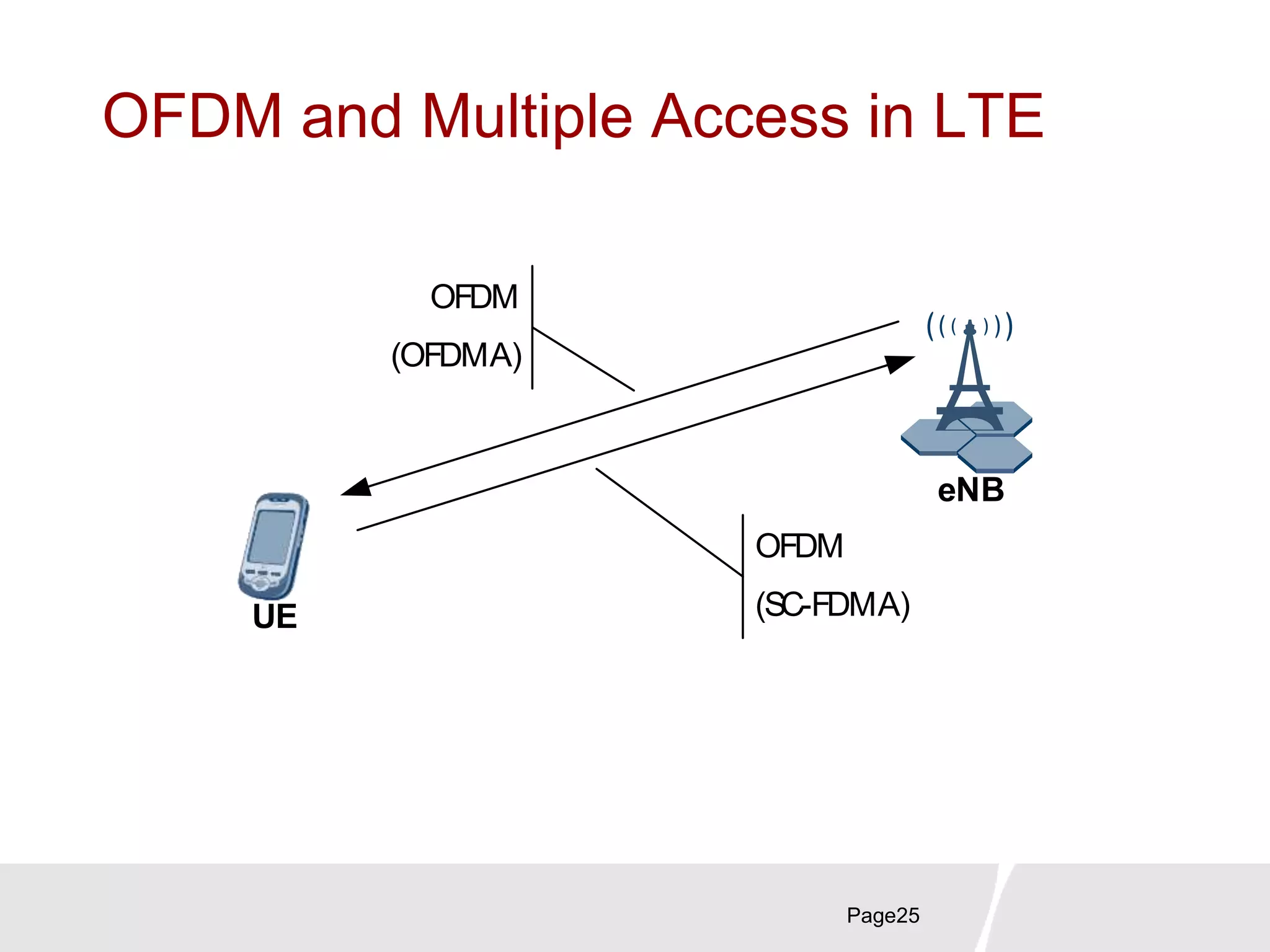
OFDM and Multiple Access in LTE
OFDM
(OFDMA)
OFDM
(SC-FDMA)
Page26
Contents
3 LTE Air Interface Principles
3.1 Principles of OFDM
3.2 Multiple Access and Duplex Technologies
3.3 LTE Frame Structure
3.4 LTE Physical Channel
3.5 Physical Procedures
3.6 Key Technologies
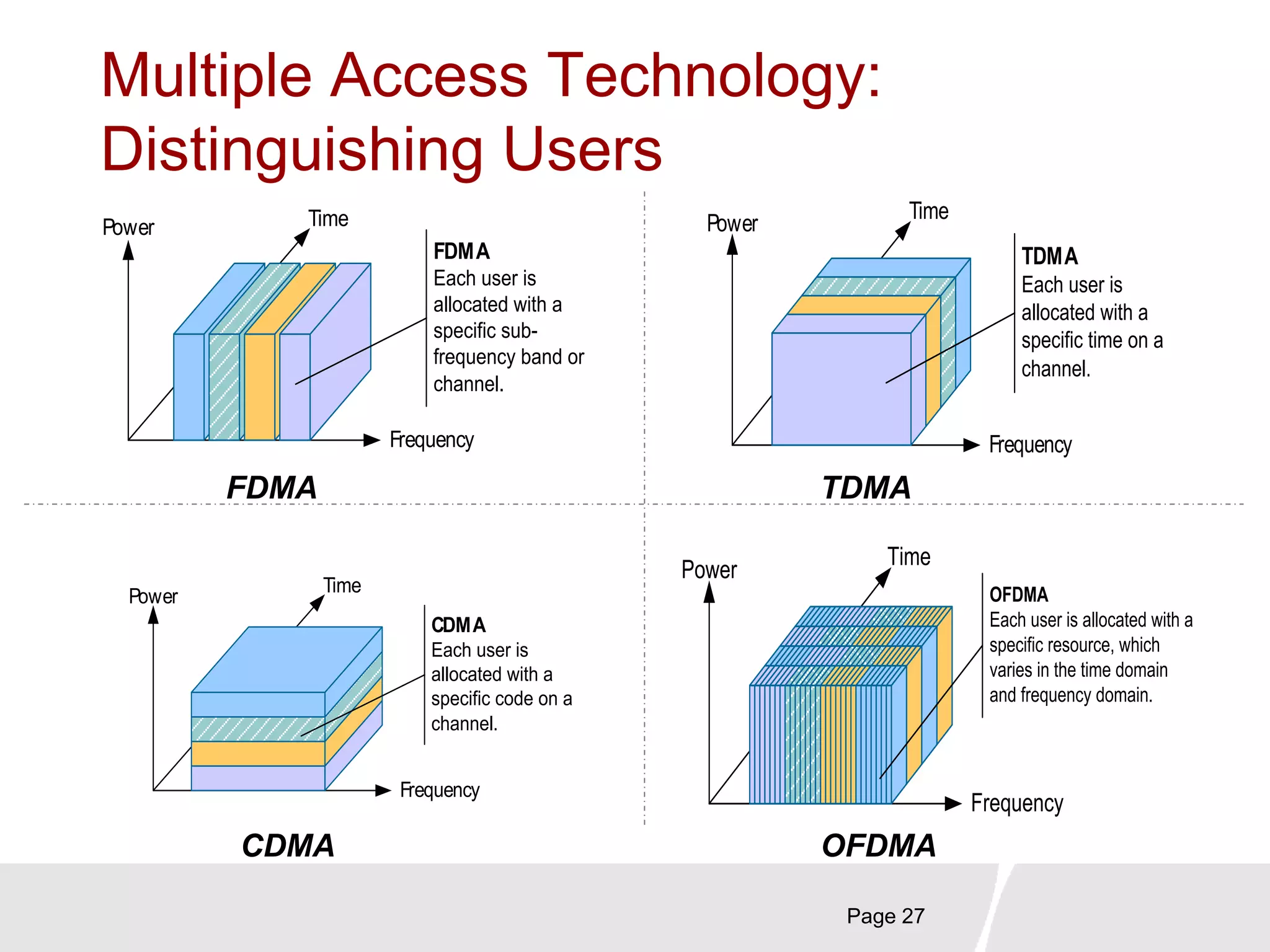
Multiple Access Technology:
Distinguishing Users
Page 27
OFDMA
FDMA TDMA
CDMA
Frequency
Power Time
FDMA
Each user is
allocated with a
specific sub-
frequency band or
channel.
Frequency
Power
Time
TDMA
Each user is
allocated with a
specific time on a
channel.
Frequency
Power
Time
CDMA
Each user is
allocated with a
specific code on a
channel.
Frequency
Power
Time
OFDMA
Each user is allocated with a
specific resource, which
varies in the time domain
and frequency domain.
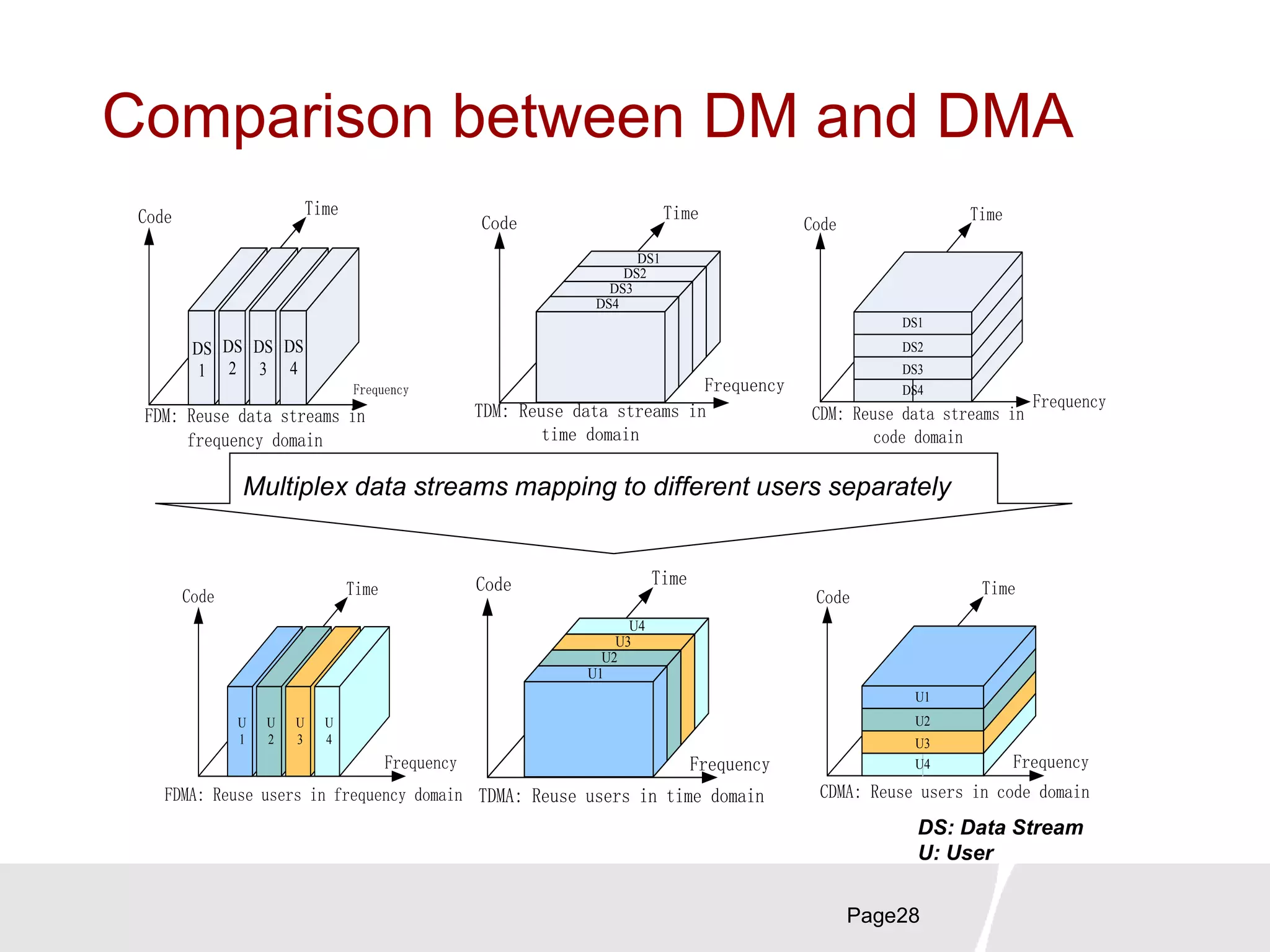
Comparison between DM and DMA
Page28
Frequency
Code
Time
DS1
DS2
DS4
DS3
CDM: Reuse data streams in
code domain
Frequency
Time
TDMA: Reuse users in time domain
U1
U2
U3
U4
Code
Frequency
Time
U1
U2
U4
U3
CDMA: Reuse users in code domain
Code
Frequency
Code Time
U
1
U
2
U
3
U
4
FDMA: Reuse users in frequency domain
Multiplex data streams mapping to different users separately
Frequency
Time
DS
1
DS
2
DS
3
DS
4
FDM: Reuse data streams in
frequency domain
Code
Frequency
Code
Time
TDM: Reuse data streams in
time domain
DS4
DS3
DS2
DS1
DS: Data Stream
U: User
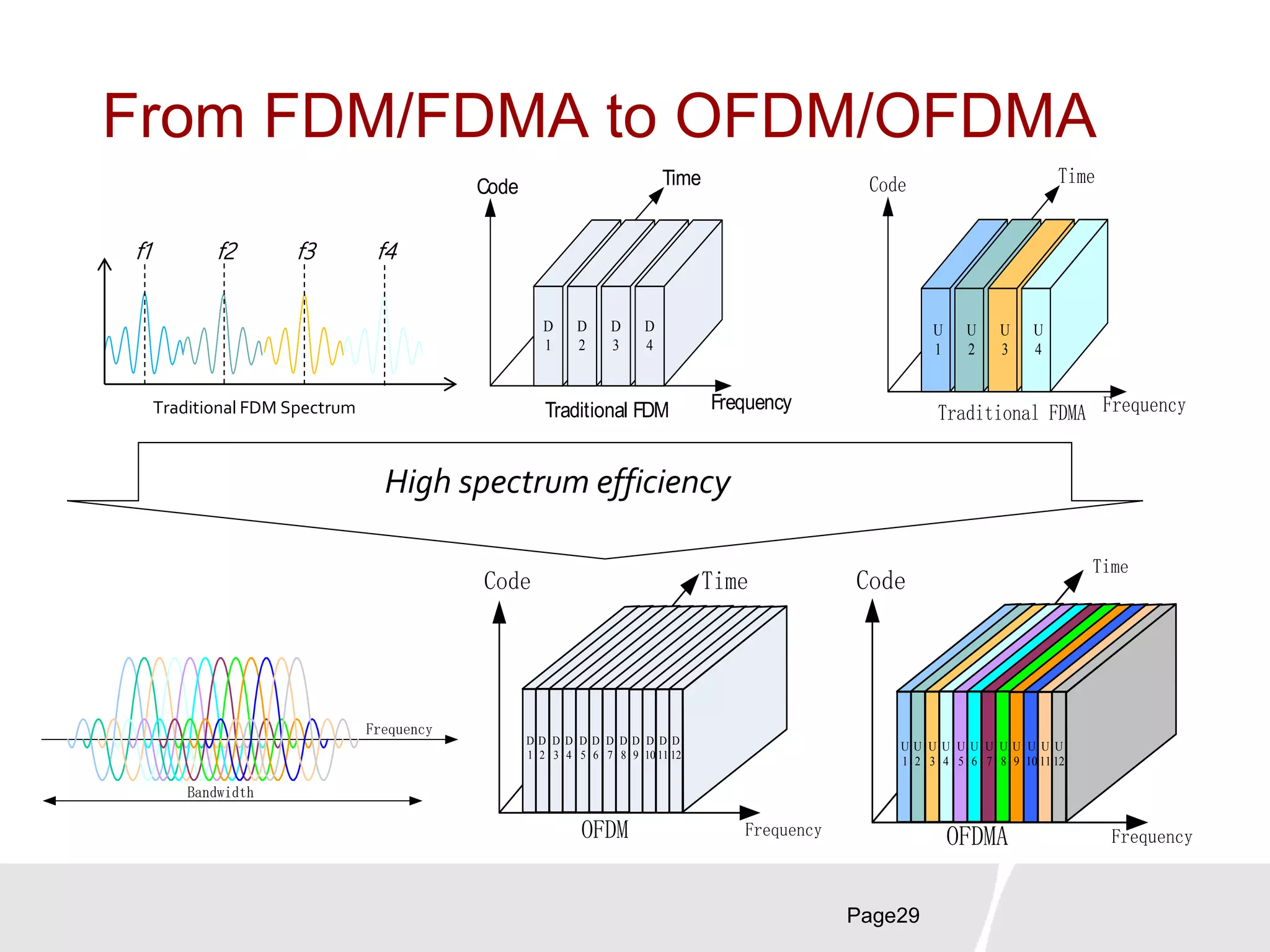
From FDM/FDMA to OFDM/OFDMA
Page29
f1 f2
Traditional FDM Spectrum
f3 f4
Frequency
Time
D
1
D
2
D
3
D
4
Traditional FDM
Code
Frequency
Code Time
U
1
U
2
U
3
U
4
Traditional FDMA
Time
Frequency
D
1
D
2
D
3
D
4
D
5
D
6
D
7
D
8
D
9
D
10
D
11
D
12
OFDM
Code
Time
Frequency
U
1
U
2
U
3
U
4
U
5
U
6
U
7
U
8
U
9
U
10
U
11
U
12
OFDMA
Code
Frequency
Bandwidth
High spectrum efficiency
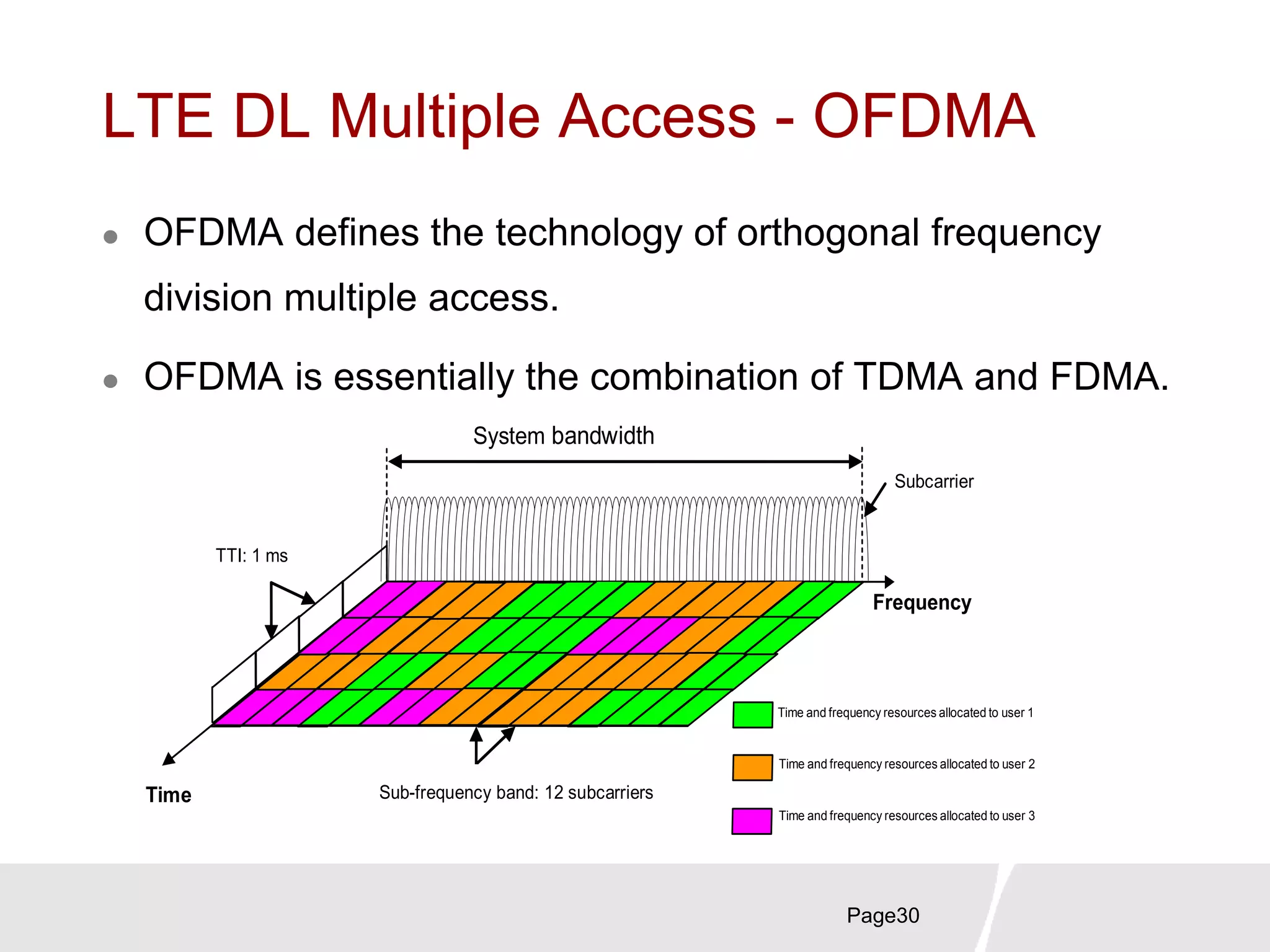
LTE DL Multiple Access - OFDMA
 OFDMA defines the technology of orthogonal frequency
division multiple access.
 OFDMA is essentially the combination of TDMA and FDMA.
Page30
Subcarrier
TTI: 1 ms
Frequency
Time
Time and frequency resources allocated to user 1
System bandwidth
Sub-frequency band: 12 subcarriers
Time and frequency resources allocated to user 2
Time and frequency resources allocated to user 3
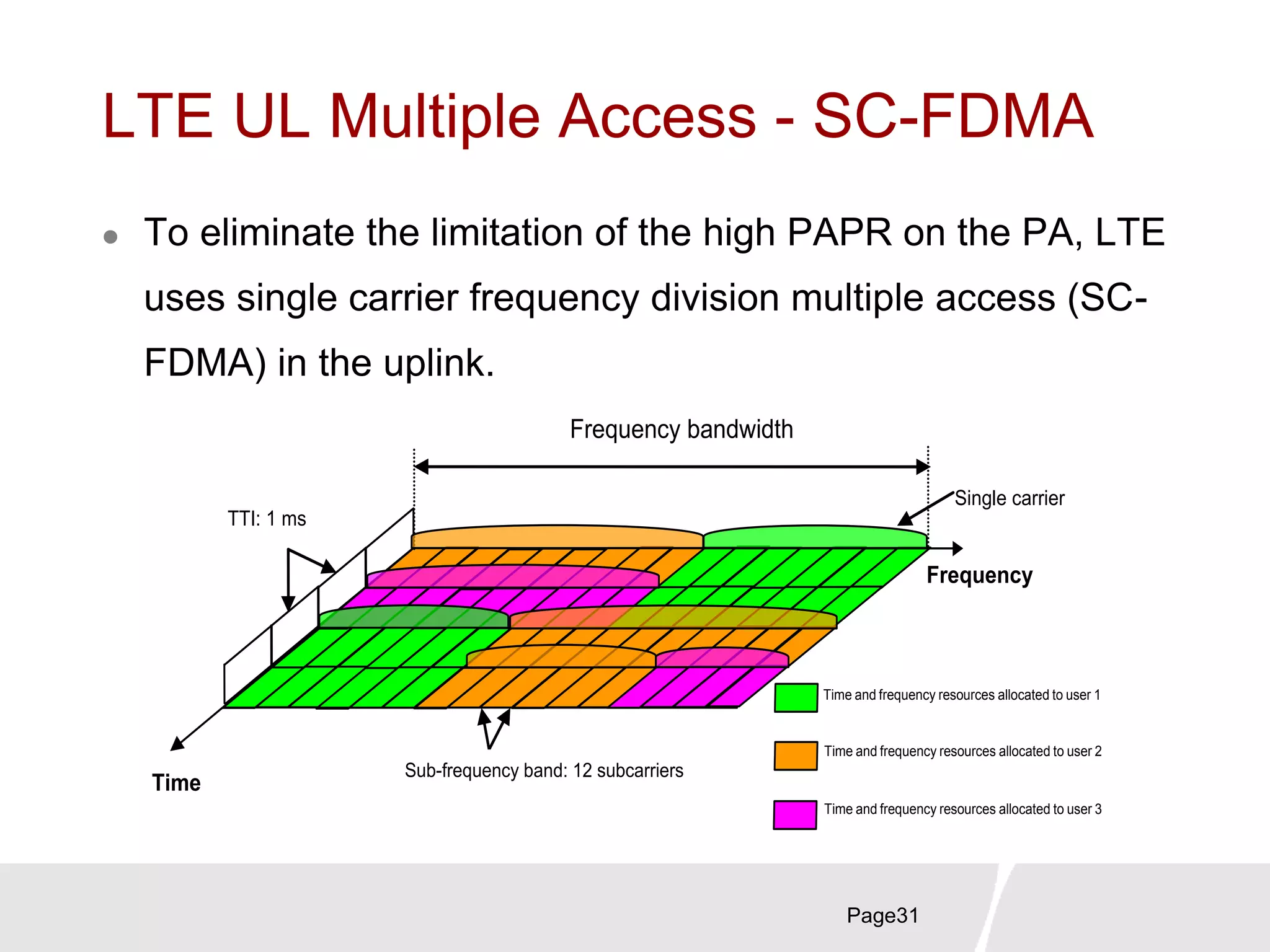
LTE UL Multiple Access - SC-FDMA
 To eliminate the limitation of the high PAPR on the PA, LTE
uses single carrier frequency division multiple access (SC-
FDMA) in the uplink.
Page310
Single carrier
TTI: 1 ms
Frequency
Time
Frequency bandwidth
Sub-frequency band: 12 subcarriers
Time and frequency resources allocated to user 1
Time and frequency resources allocated to user 2
Time and frequency resources allocated to user 3
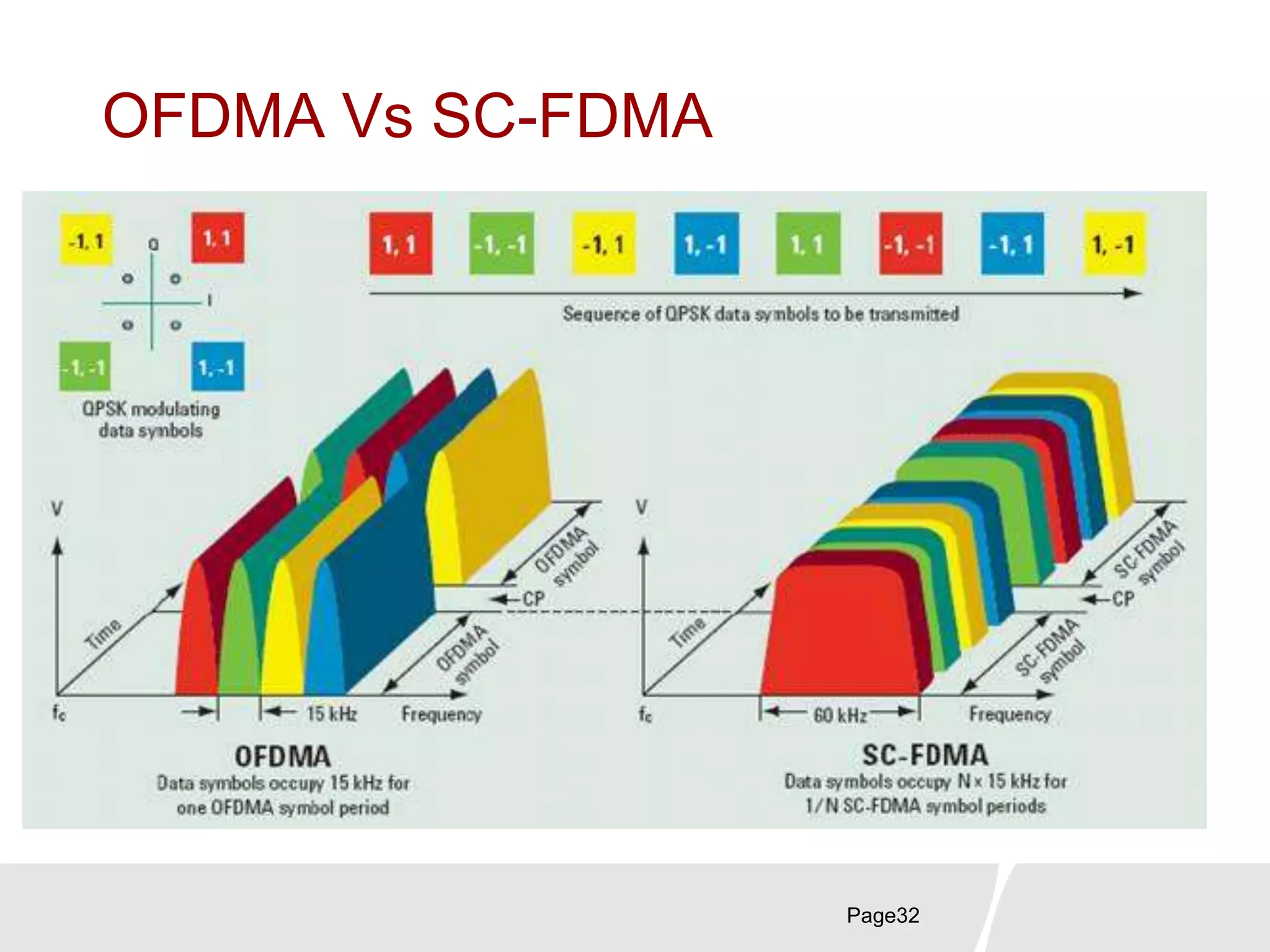
OFDMA Vs SC-FDMA
Page32
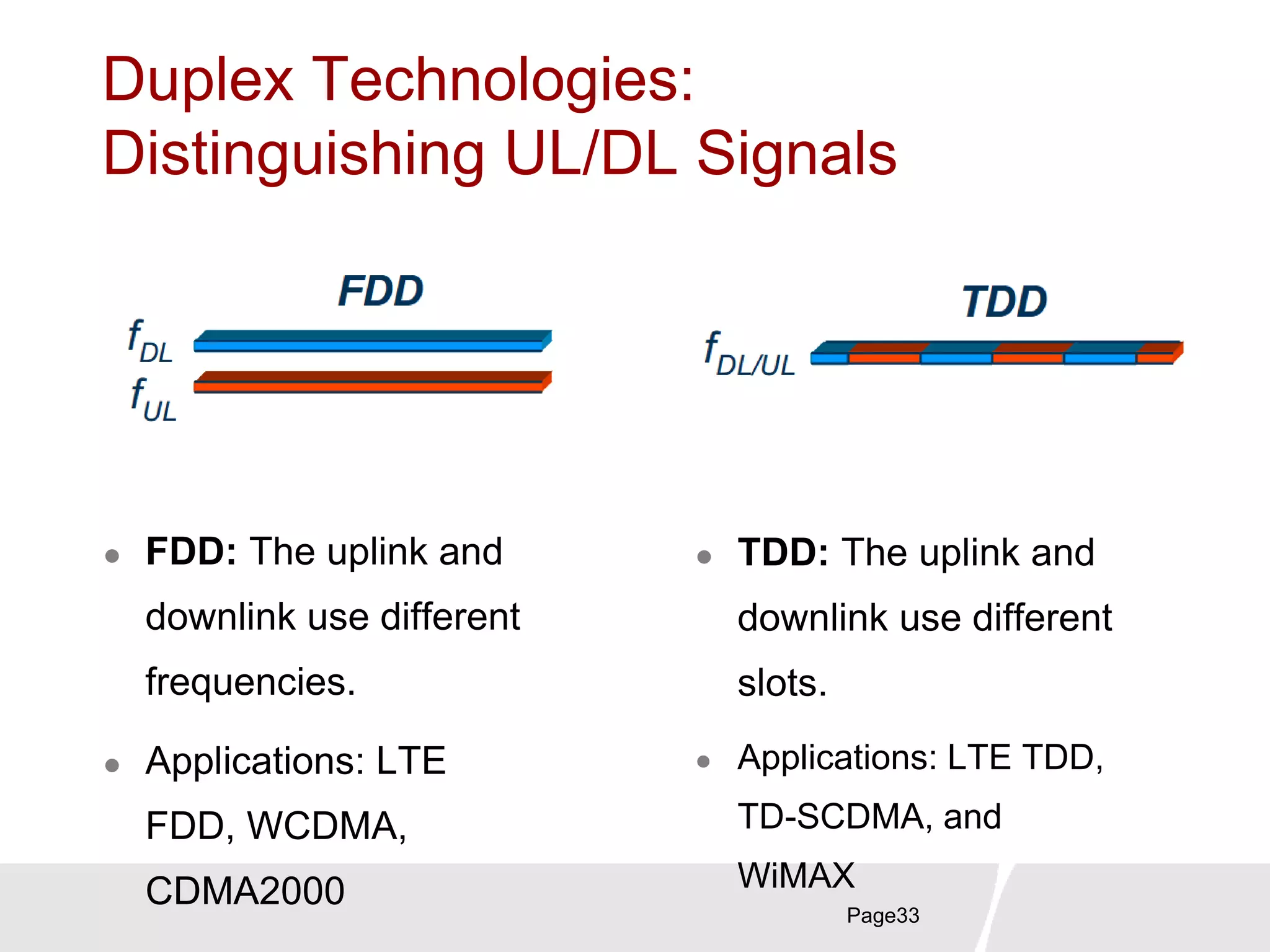
Duplex Technologies:
Distinguishing UL/DL Signals
 TDD: The uplink and
downlink use different
slots.
 Applications: LTE TDD,
TD-SCDMA, and
WiMAX
Page33
 FDD: The uplink and
downlink use different
frequencies.
 Applications: LTE
FDD, WCDMA,
CDMA2000
Page34
Contents
3 LTE Air Interface Principles
3.1 Principles of OFDM
3.2 Multiple Access and Duplex Technologies
3.3 LTE Frame Structure
3.4 LTE Physical Channel
3.5 Physical Procedures
3.6 Key Technologies
Page35
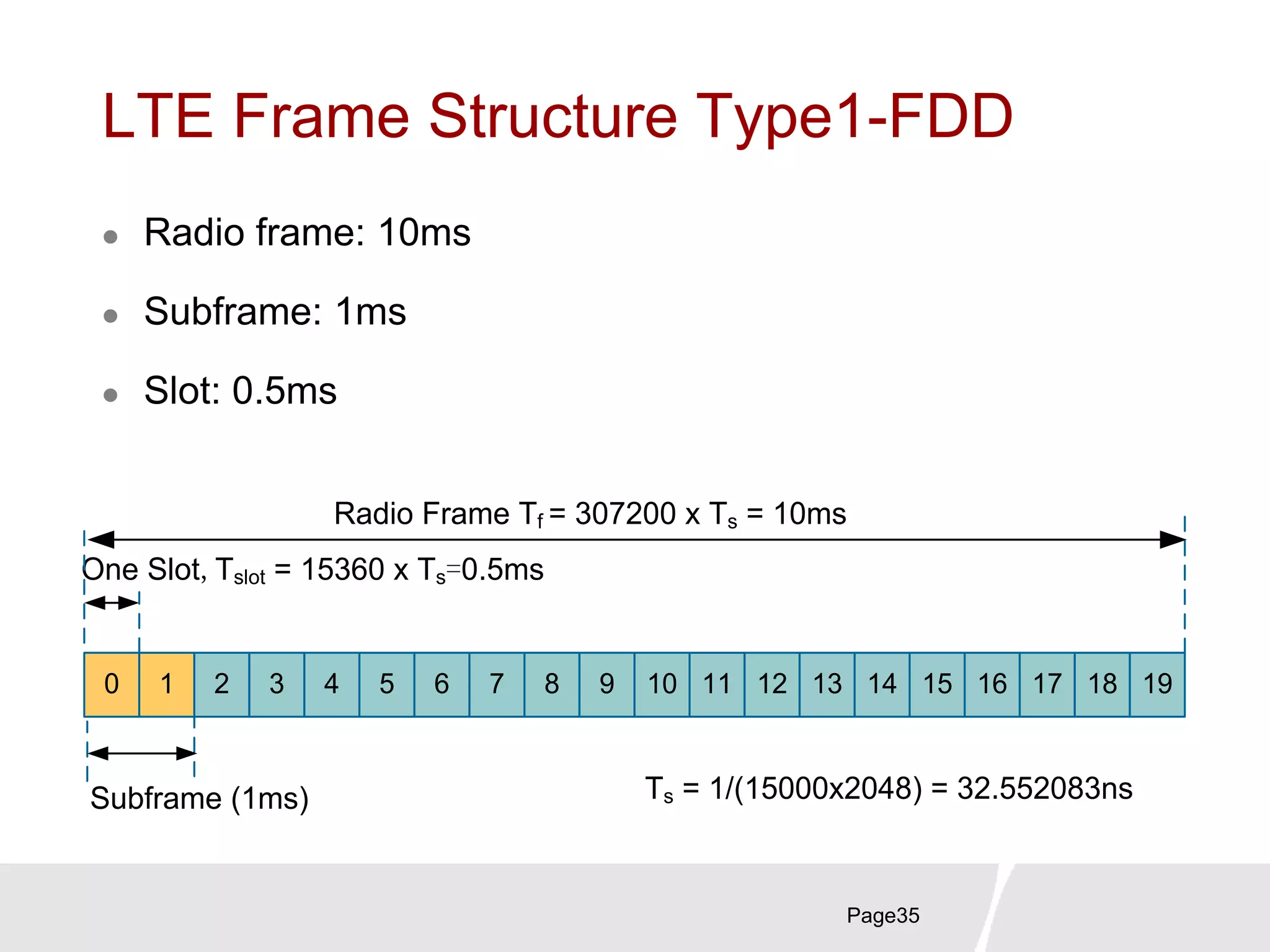
LTE Frame Structure Type1-FDD
One Slot,Tslot = 15360 x Ts=0.5ms
Radio Frame Tf = 307200 x Ts = 10ms
Subframe (1ms)
0 1 2 3 4 5 6 7 8 9 10 11 12 13 14 15 16 17 18 19
Ts = 1/(15000x2048) = 32.552083ns
 Radio frame: 10ms
 Subframe: 1ms
 Slot: 0.5ms
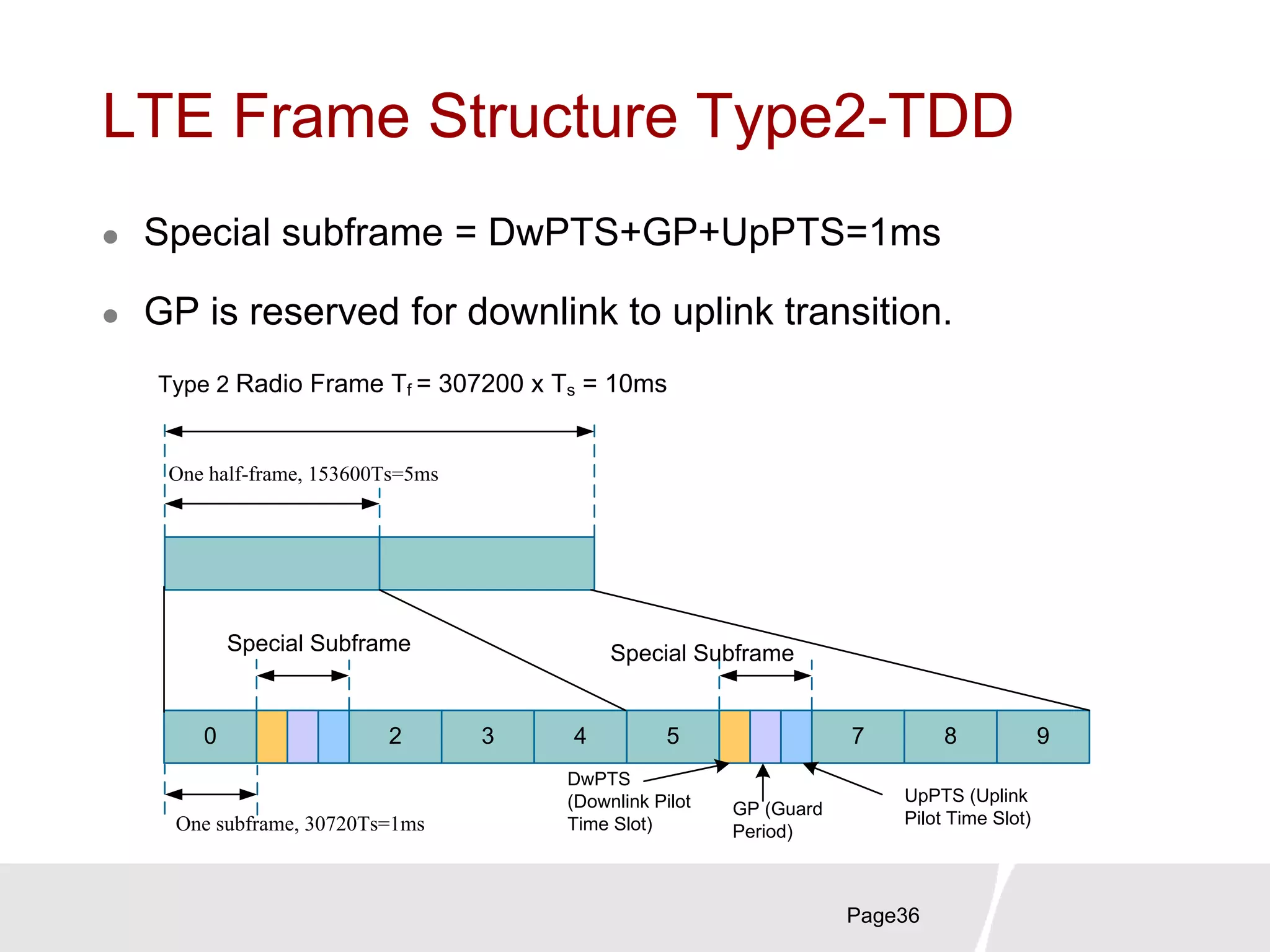
LTE Frame Structure Type2-TDD
 Special subframe = DwPTS+GP+UpPTS=1ms
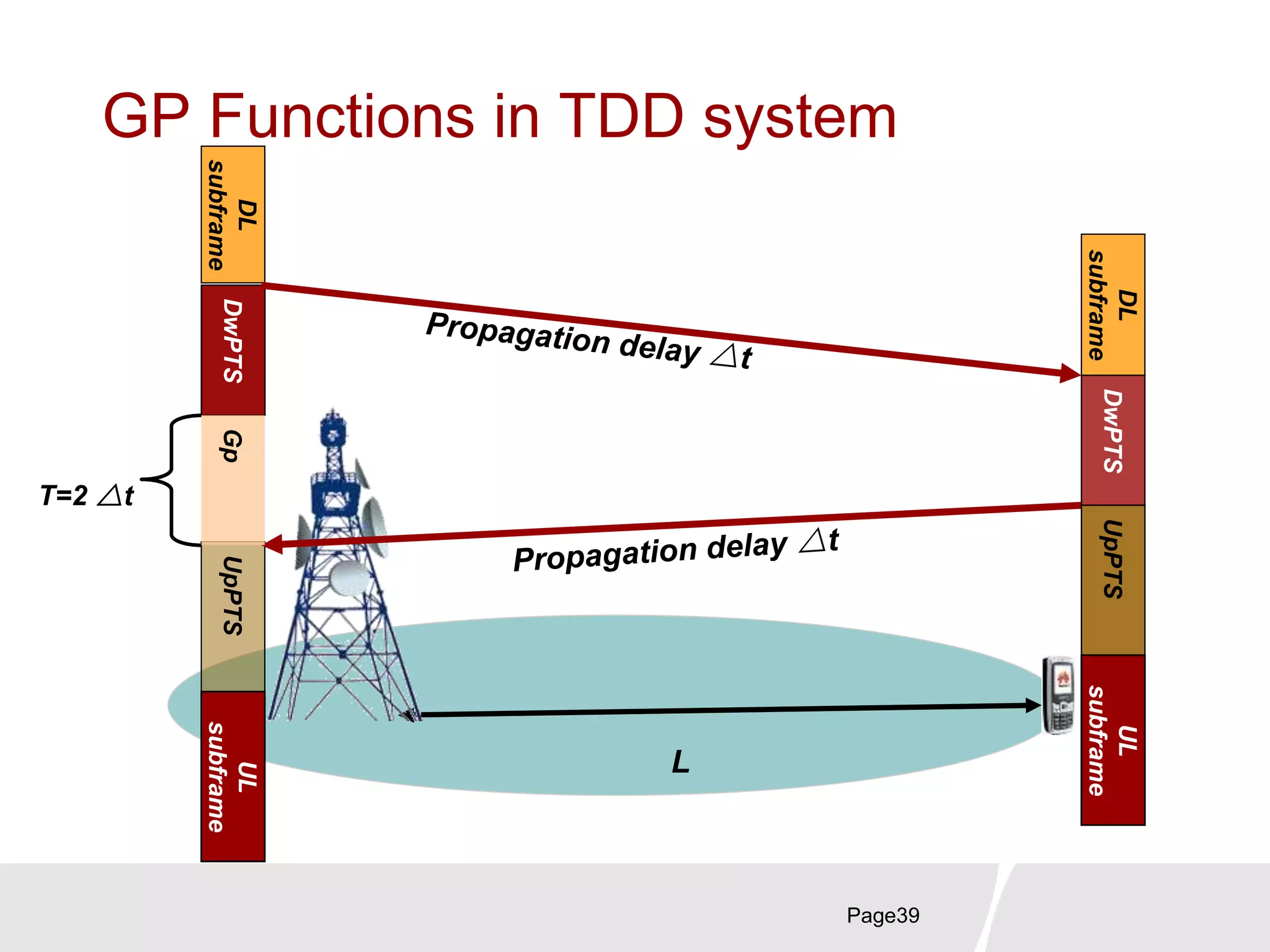
 GP is reserved for downlink to uplink transition.
Page36
Type 2 Radio Frame Tf = 307200 x Ts = 10ms
0 2 3 4 5 7 8 9
One half-frame, 153600Ts=5ms
One subframe, 30720Ts=1ms
DwPTS
(Downlink Pilot
Time Slot)
GP (Guard
Period)
UpPTS (Uplink
Pilot Time Slot)
Special Subframe Special Subframe
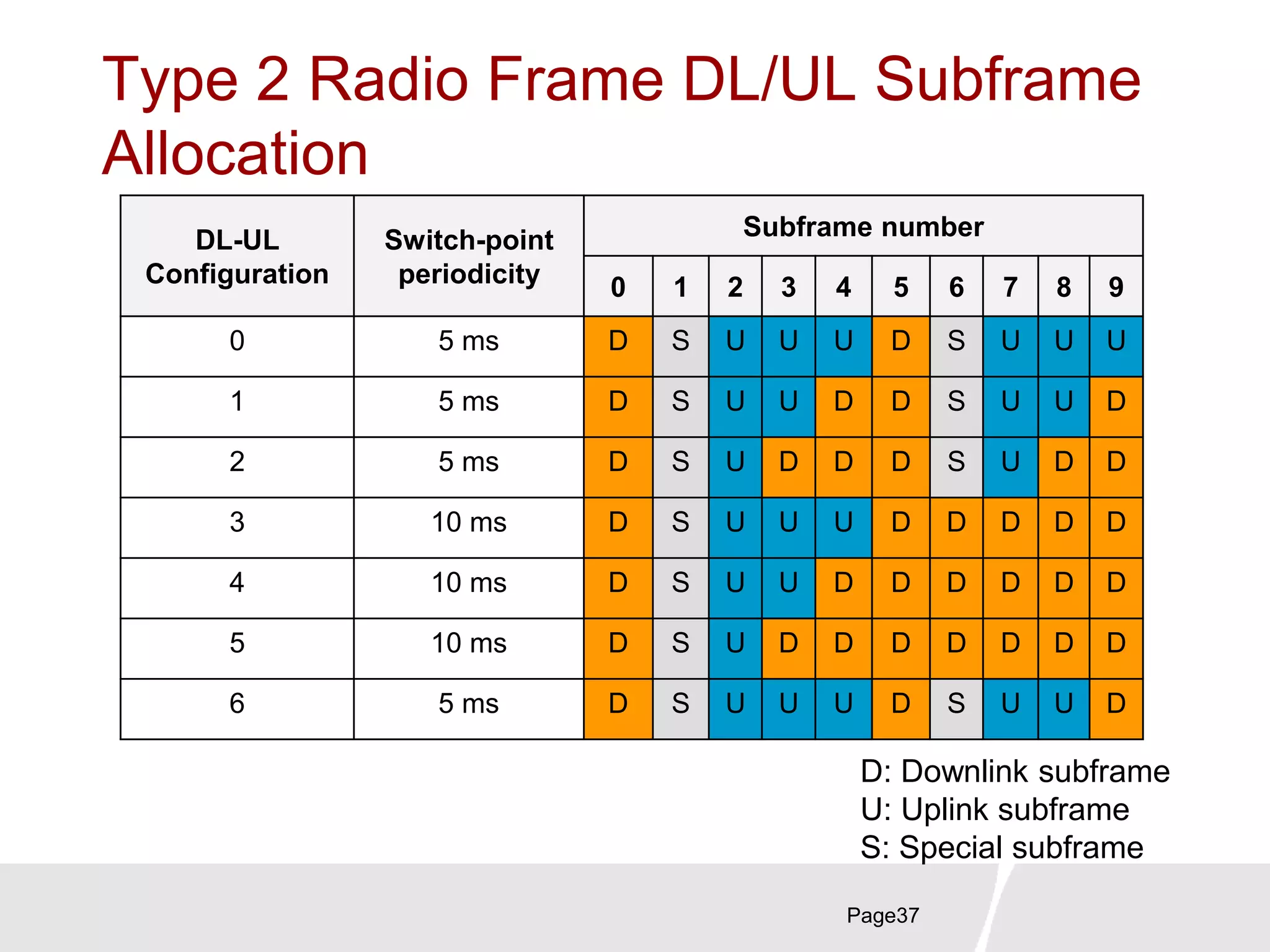
Type 2 Radio Frame DL/UL Subframe
Allocation
Page37
DL-UL
Configuration
Switch-point
periodicity
Subframe number
0 1 2 3 4 5 6 7 8 9
0 5 ms D S U U U D S U U U
1 5 ms D S U U D D S U U D
2 5 ms D S U D D D S U D D
3 10 ms D S U U U D D D D D
4 10 ms D S U U D D D D D D
5 10 ms D S U D D D D D D D
6 5 ms D S U U U D S U U D
D: Downlink subframe
U: Uplink subframe
S: Special subframe
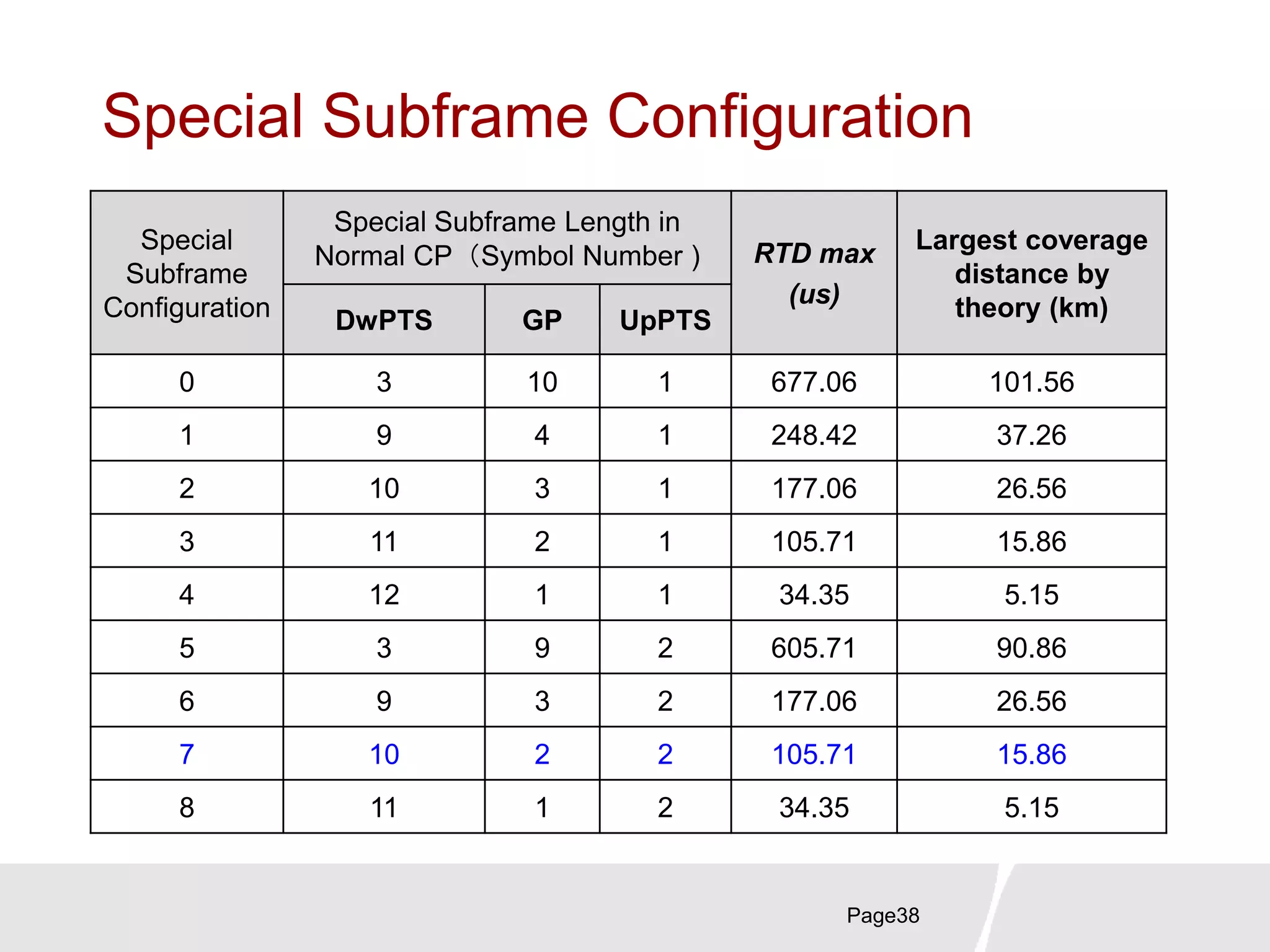
Special Subframe Configuration
Page38
Special
Subframe
Configuration
Special Subframe Length in
Normal CP(Symbol Number ) RTD max
(us)
Largest coverage
distance by
theory (km)DwPTS GP UpPTS
0 3 10 1 677.06 101.56
1 9 4 1 248.42 37.26
2 10 3 1 177.06 26.56
3 11 2 1 105.71 15.86
4 12 1 1 34.35 5.15
5 3 9 2 605.71 90.86
6 9 3 2 177.06 26.56
7 10 2 2 105.71 15.86
8 11 1 2 34.35 5.15
GP Functions in TDD system
Page39
DwPTSDwPTS
UpPTS
L
UpPTS
DL
subframe
Gp
UL
subframe
UL
subframe
DL
subframe
DwPTS
T=2 △t
UpPTS
Page40
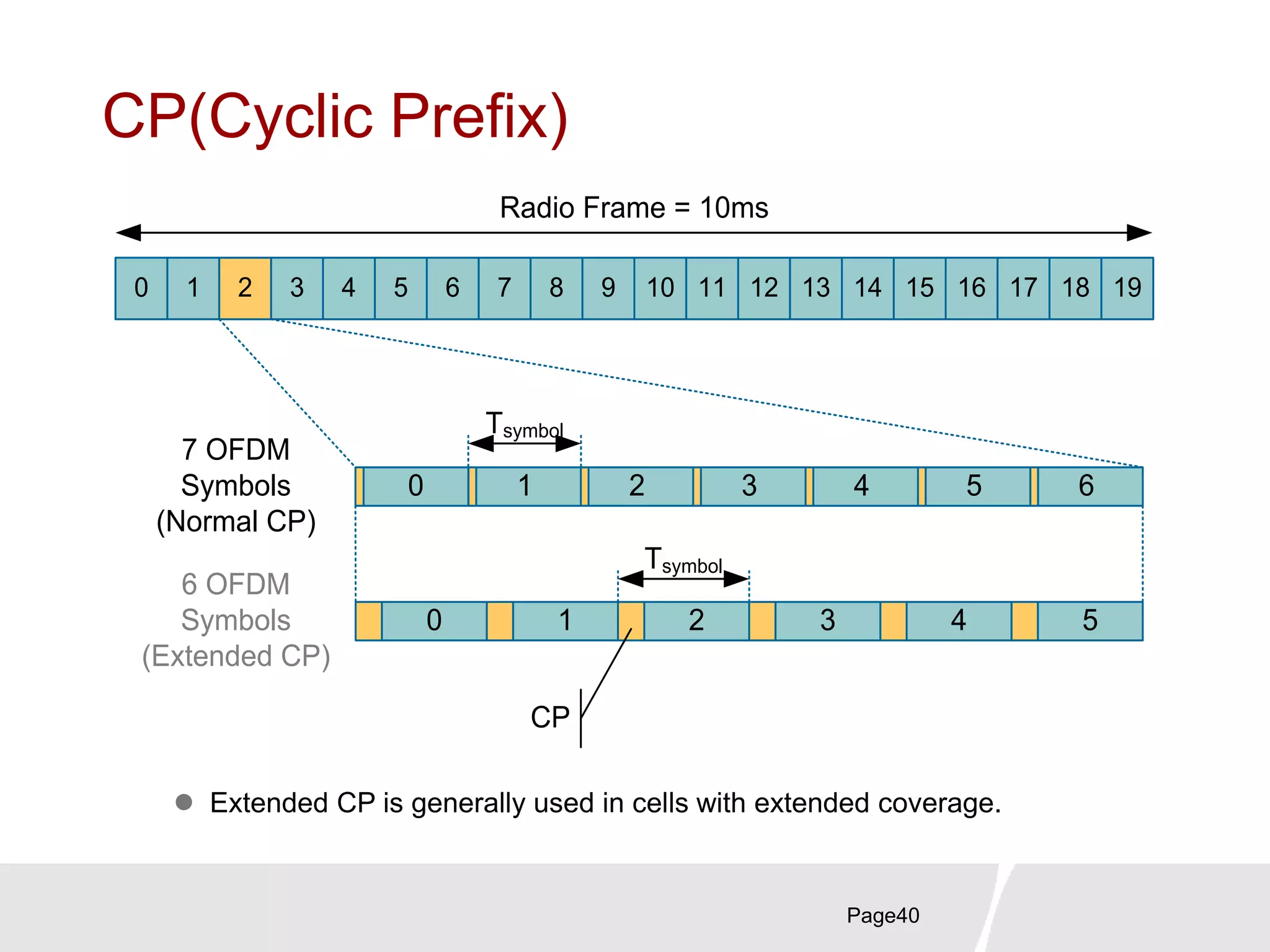
CP(Cyclic Prefix)
Radio Frame = 10ms
0 1 2 3 4 5 6 7 8 9 10 11 12 13 14 15 16 17 18 19
7 OFDM
Symbols
(Normal CP)
6 OFDM
Symbols
(Extended CP)
0 1 2 3 4 5 6
0 1 2 3 4 5
CP
Tsymbol
Tsymbol
 Extended CP is generally used in cells with extended coverage.
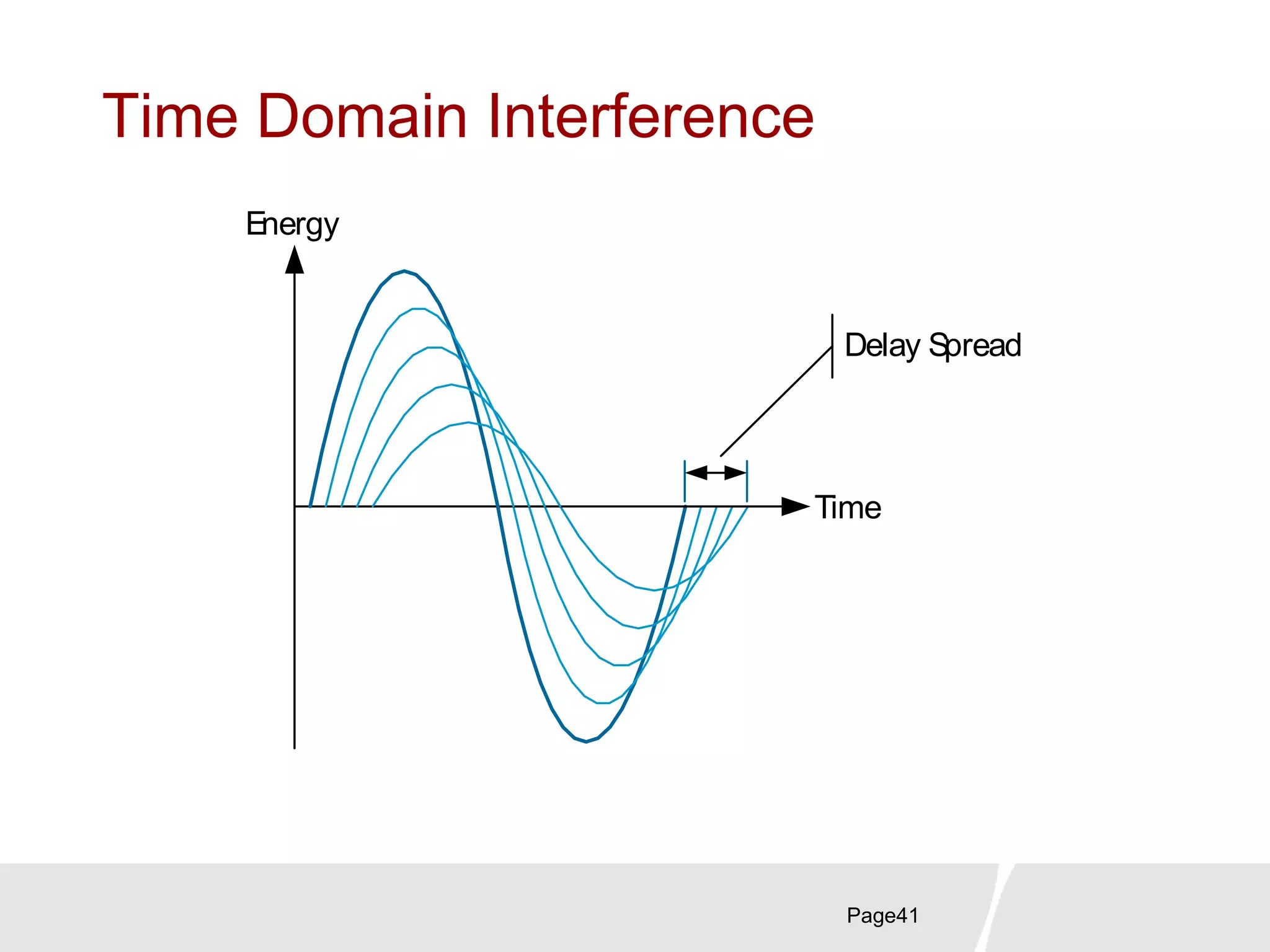
Time Domain Interference
Energy
Time
Delay Spread
Page41
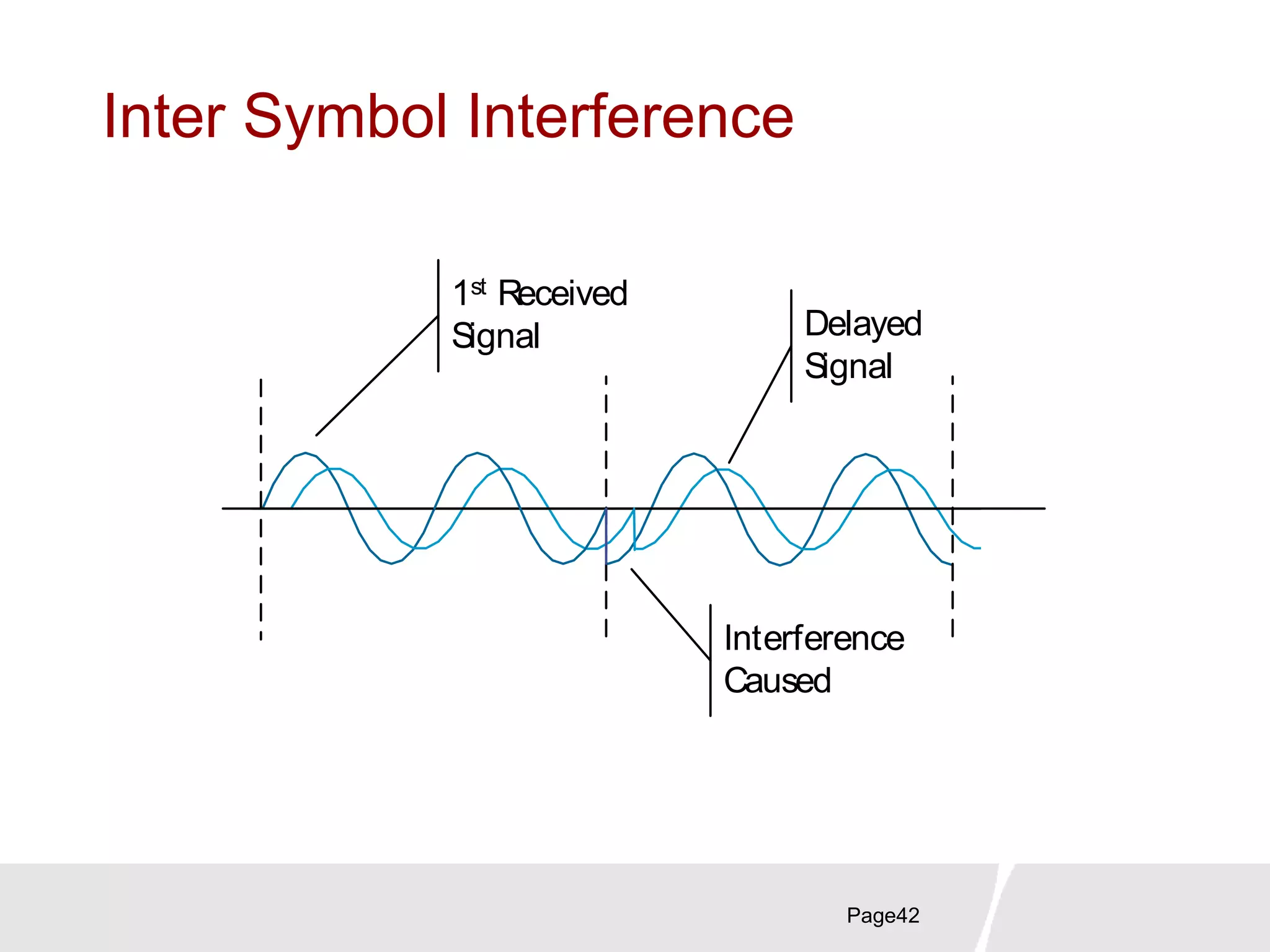
Inter Symbol Interference
1st Received
Signal Delayed
Signal
Interference
Caused
Page42
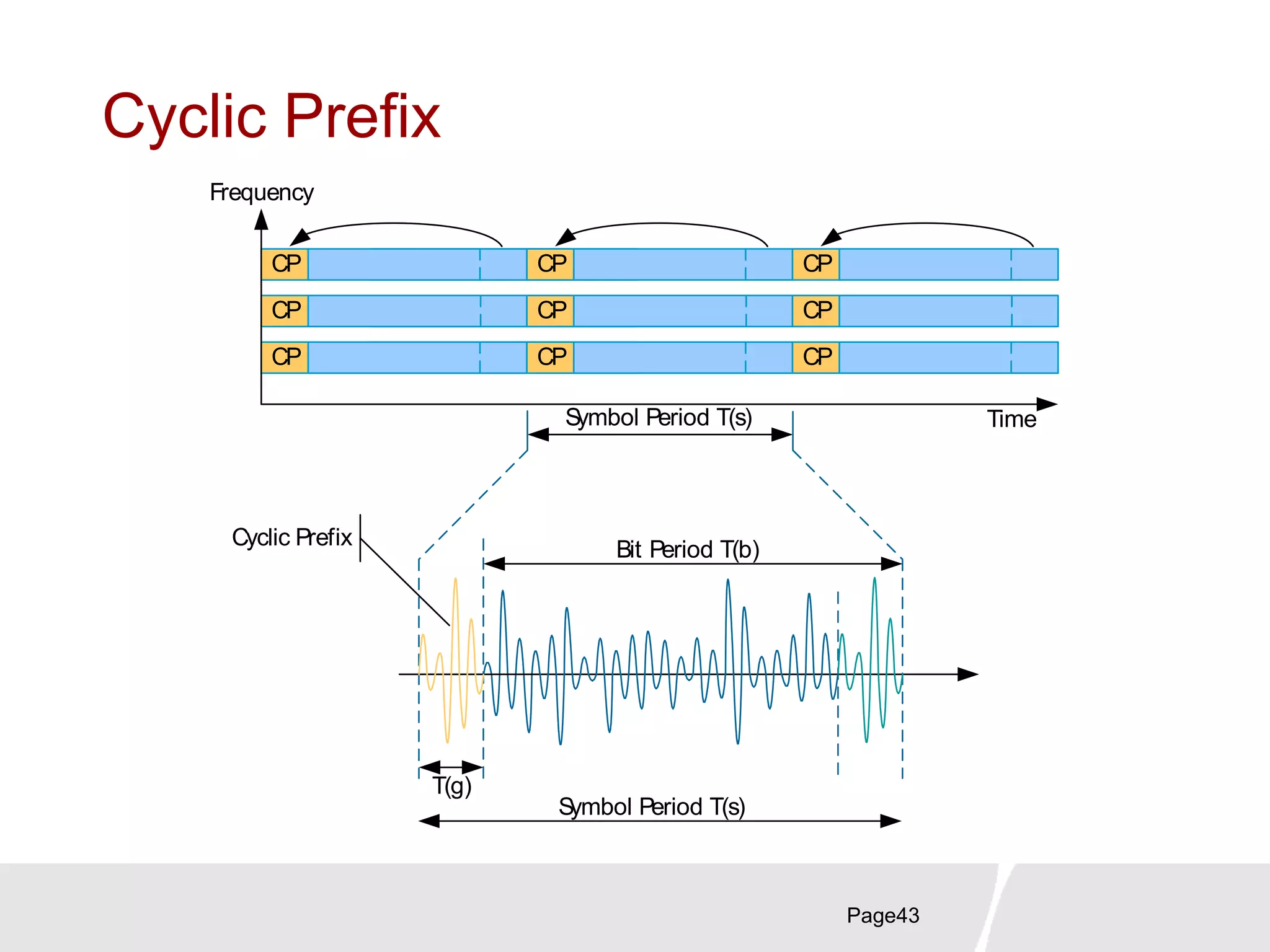
Cyclic Prefix
CP
CP
CP
CP
CP
CP
CP
CP
CP
CP
CP
CP
Frequency
Time
Symbol Period T(s)
T(g)
Symbol Period T(s)
Bit Period T(b)
Cyclic Prefix
Page43
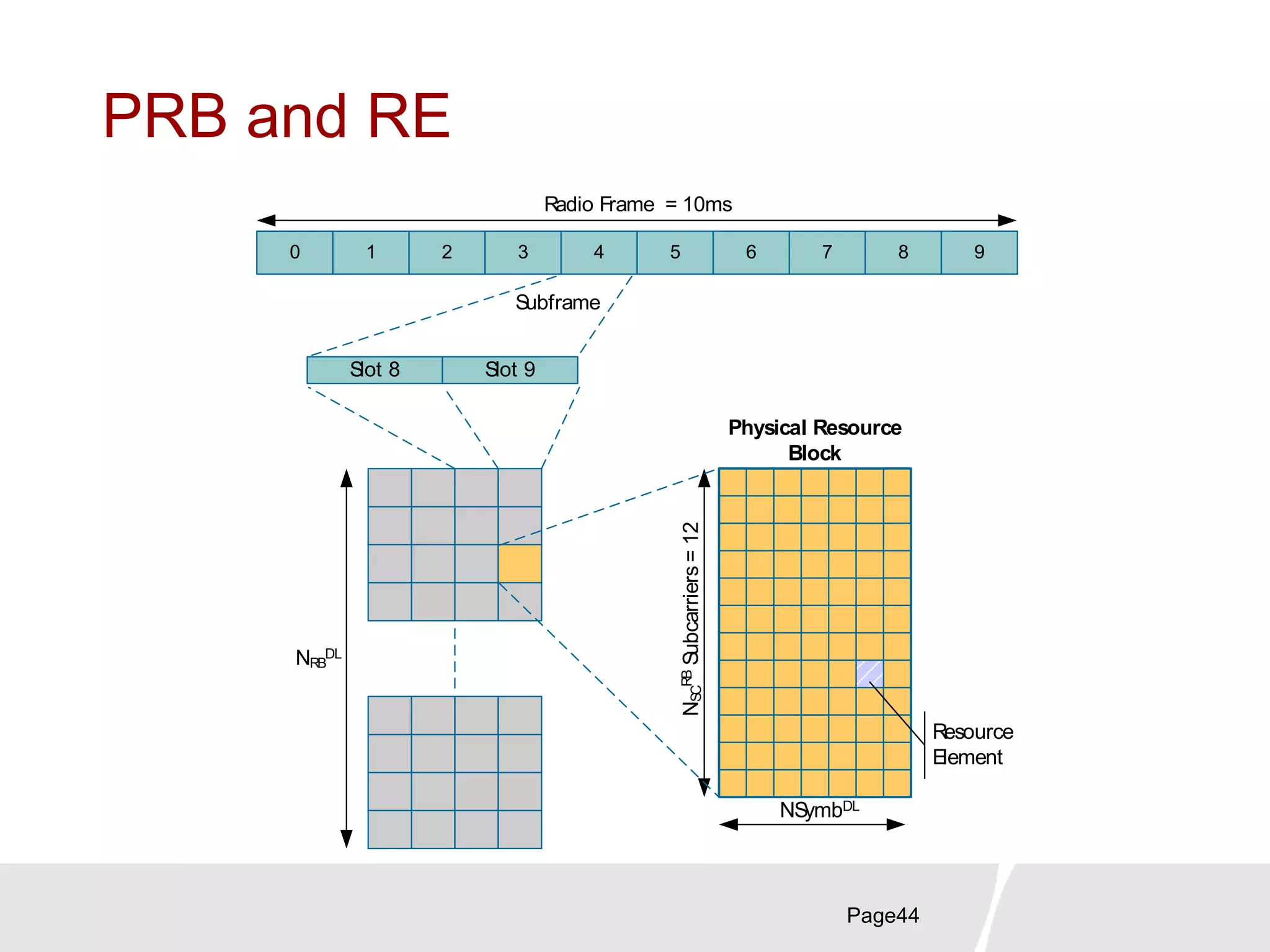
PRB and RE
Radio Frame = 10ms
0 2 3 4 5 7 8 961
Slot 8 Slot 9
Subframe
NRB
DL
NSC
RBSubcarriers=12
Physical Resource
Block
Resource
Element
NSymbDL
Page44
Page45
Channel BW and RB
Channel bandwidth BWChannel [MHz] 1.4 3 5 10 15 20
Transmission bandwidth
configuration NRB
6 15 25 50 75 100
Transmission
Bandwidth [RB]
Transmission Bandwidth Configuration [RB]
Channel Bandwidth [MHz]
Resourceblock
Channeledge
Channeledge
DC carrier (downlink only)Active Resource Blocks
 For details, please refer to protocol 36.101
Page46
Contents
3 LTE Air Interface Principles
3.1 Principles of OFDM
3.2 Multiple Access and Duplex Technologies
3.3 LTE Frame Structure
3.4 LTE Physical Channel
3.5 Physical Procedures
3.6 Key Technologies
Page47
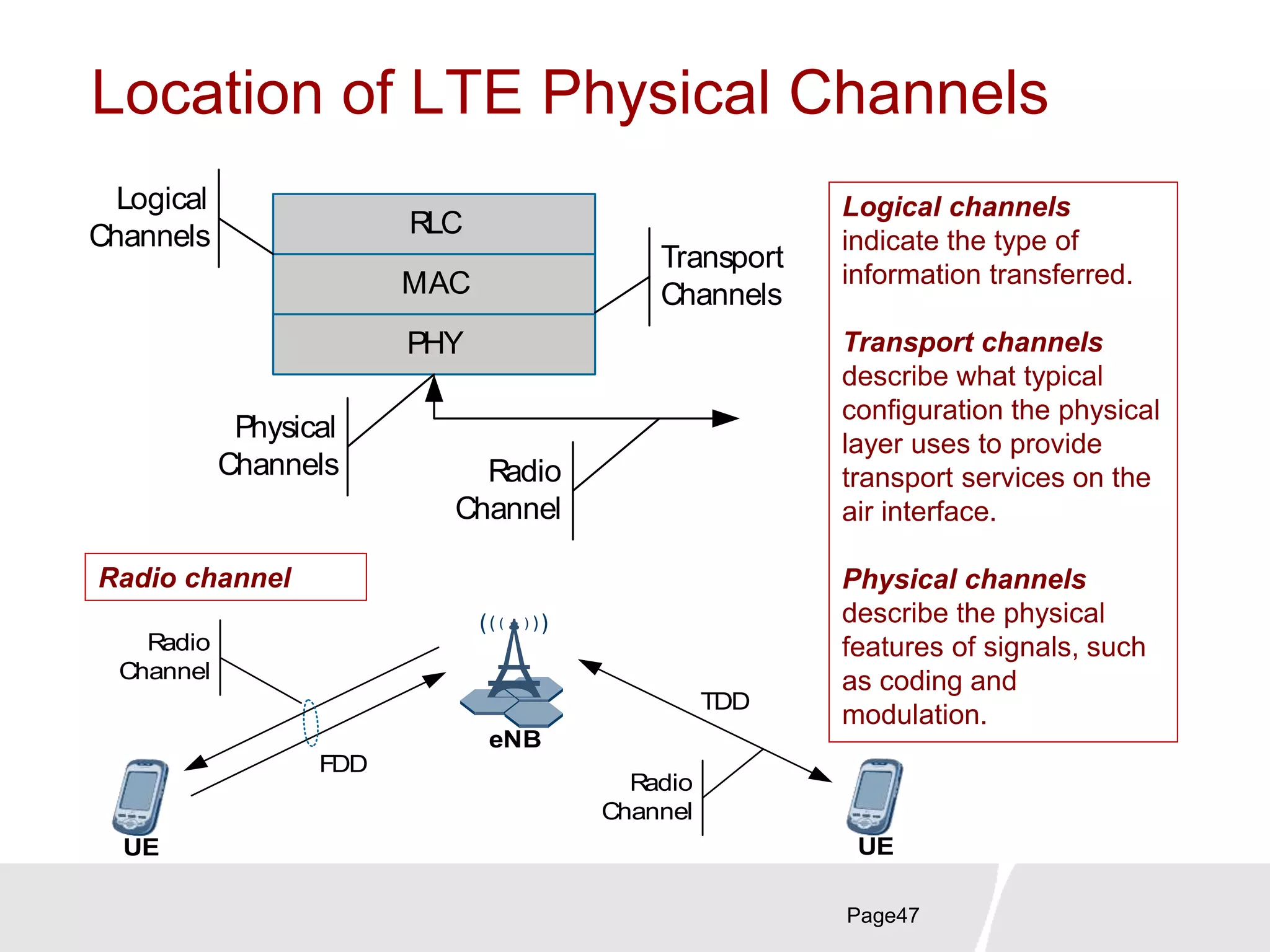
Location of LTE Physical Channels
RLC
MAC
PHY
Logical
Channels
Transport
Channels
Physical
Channels Radio
Channel
Logical channels
indicate the type of
information transferred.
Transport channels
describe what typical
configuration the physical
layer uses to provide
transport services on the
air interface.
Physical channels
describe the physical
features of signals, such
as coding and
modulation.
eNB
UE
Radio
Channel
FDD
Radio
Channel
UE
TDD
Radio channel
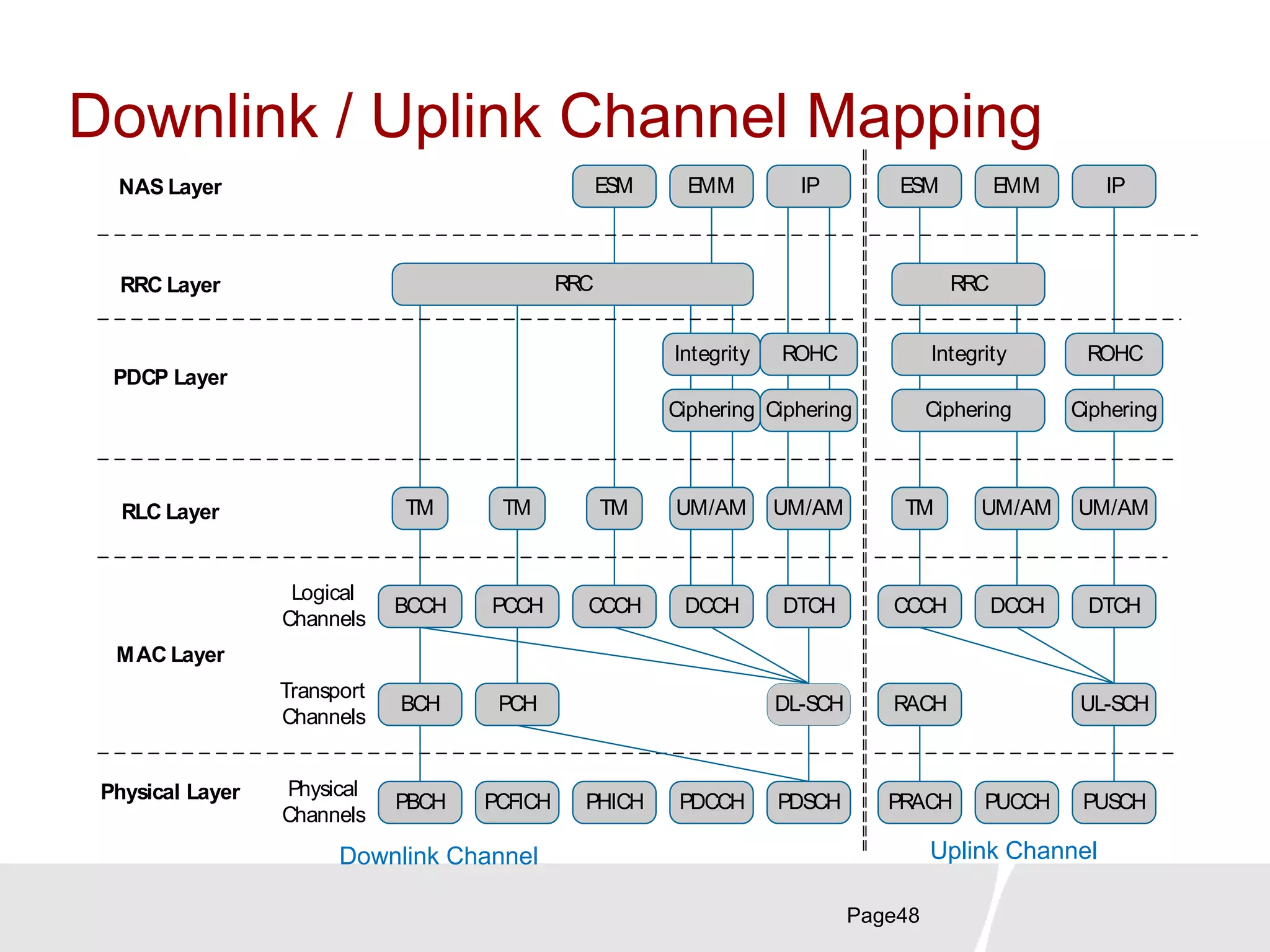
Downlink / Uplink Channel Mapping
Page48
DL-SCH
Physical Layer
MAC Layer
RLC Layer
PDCP Layer
RRC Layer
Physical
Channels
Transport
Channels
Logical
Channels
PDSCHPDCCHPHICHPCFICHPBCH
BCH PCH
BCCH PCCH CCCH DCCH DTCH
TM TM TM UM/AM UM/AM
Ciphering
Integrity
Ciphering
ROHC
RRC
ESM EMM IPNAS Layer
PUSCHPUCCHPRACH
RACH
CCCH
TM UM/AM UM/AM
Ciphering
Integrity
Ciphering
ROHC
RRC
ESM EMM IP
UL-SCH
DCCH DTCH
Downlink Channel Uplink Channel
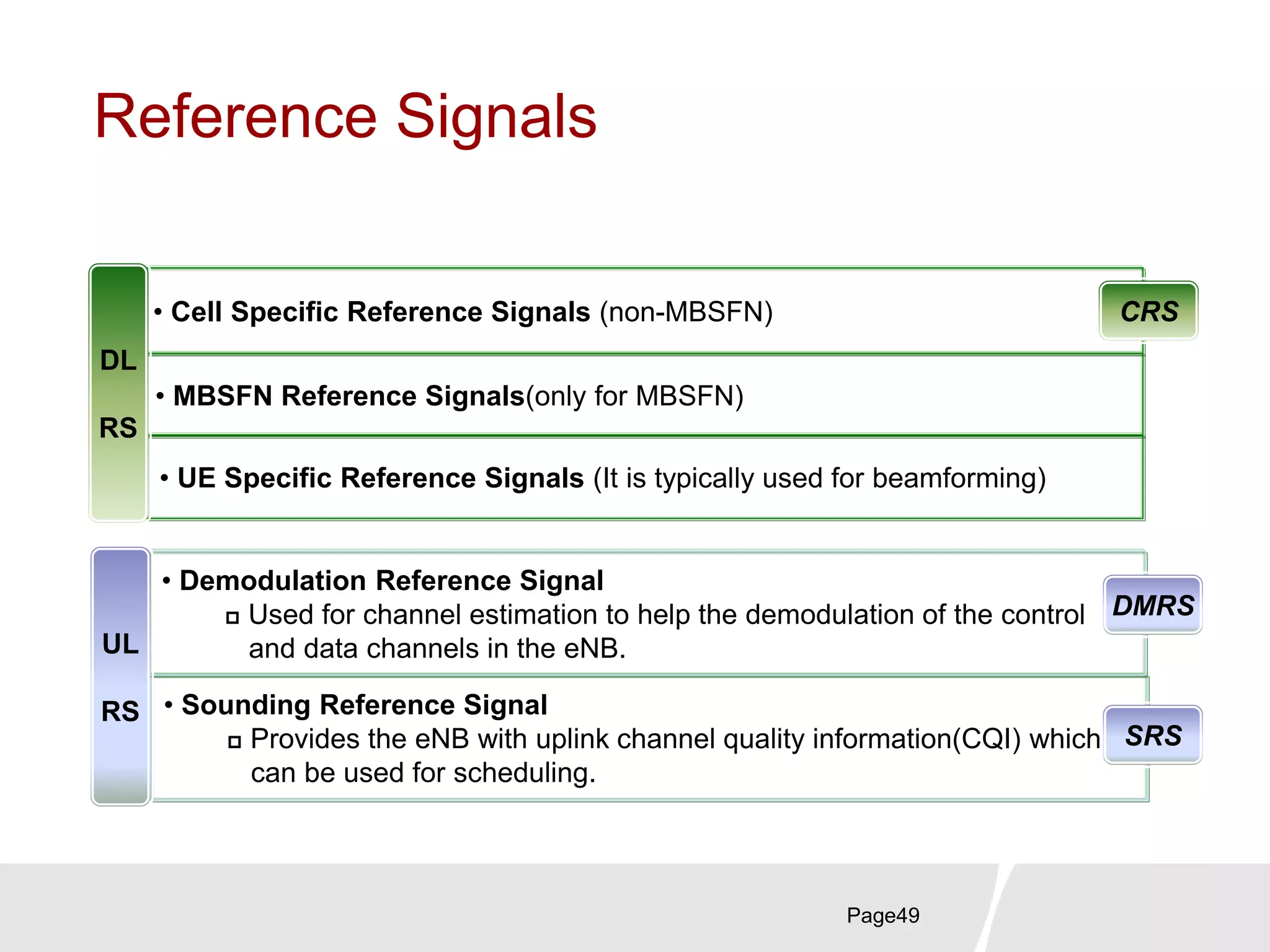
• Sounding Reference Signal
 Provides the eNB with uplink channel quality information(CQI) which
can be used for scheduling.
Reference Signals
Page49
• Cell Specific Reference Signals (non-MBSFN)
• MBSFN Reference Signals(only for MBSFN)
• UE Specific Reference Signals (It is typically used for beamforming)
• Demodulation Reference Signal
 Used for channel estimation to help the demodulation of the control
and data channels in the eNB.
CRS
DMRS
SRS
UL
RS
DL
RS
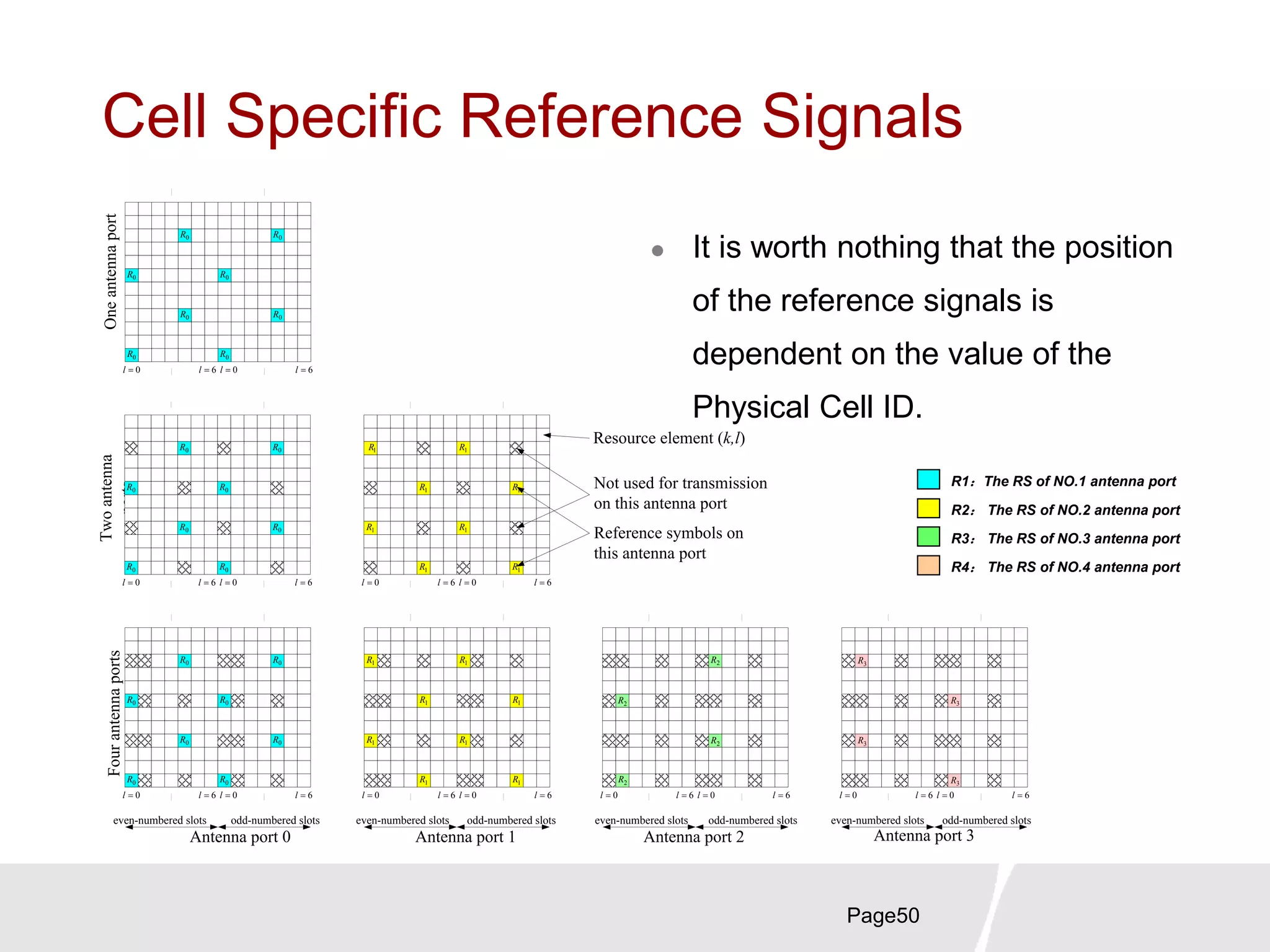
Cell Specific Reference Signals
Page50
 It is worth nothing that the position
of the reference signals is
dependent on the value of the
Physical Cell ID.
0l
0R
0R
0R
0R
6l 0l
0R
0R
0R
0R
6l
OneantennaportTwoantenna
ports
Resource element (k,l)
Not used for transmission
on this antenna port
Reference symbols on
this antenna port
0l
0R
0R
0R
0R
6l 0l
0R
0R
0R
0R
6l 0l
1R
1R
1R
1R
6l 0l
1R
1R
1R
1R
6l
0l
0R
0R
0R
0R
6l 0l
0R
0R
0R
0R
6l 0l
1R
1R
1R
1R
6l 0l
1R
1R
1R
1R
6l
Fourantennaports
0l 6l 0l
2R
6l 0l 6l 0l 6l
2R
2R
2R
3R
3R
3R
3R
even-numbered slots odd-numbered slots
Antenna port 0
even-numbered slots odd-numbered slots
Antenna port 1
even-numbered slots odd-numbered slots
Antenna port 2
even-numbered slots odd-numbered slots
Antenna port 3
R1:The RS of NO.1 antenna port
R2: The RS of NO.2 antenna port
R3: The RS of NO.3 antenna port
R4: The RS of NO.4 antenna port
RS Measurement
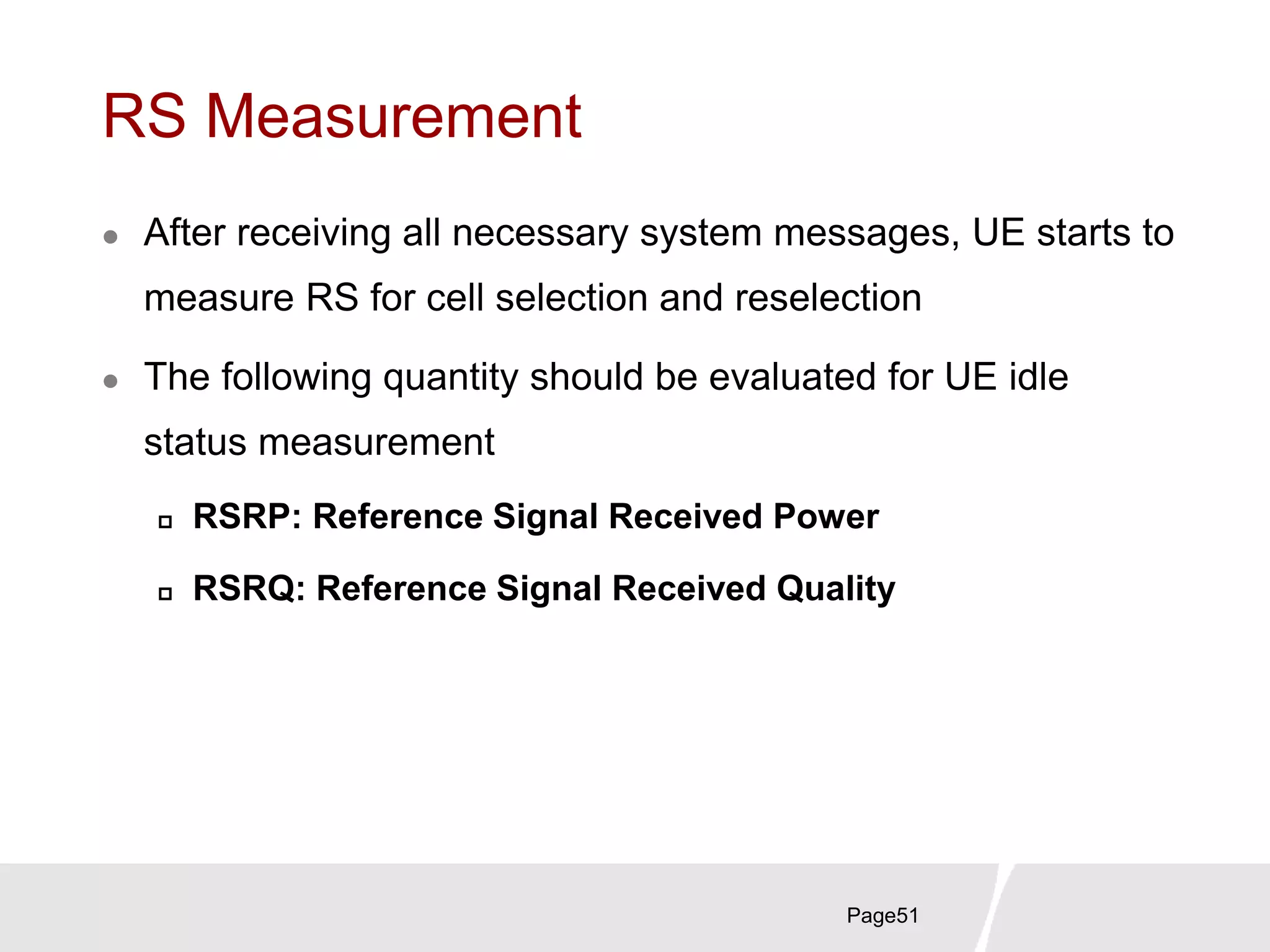
 After receiving all necessary system messages, UE starts to
measure RS for cell selection and reselection
 The following quantity should be evaluated for UE idle
status measurement
 RSRP: Reference Signal Received Power
 RSRQ: Reference Signal Received Quality
Page51
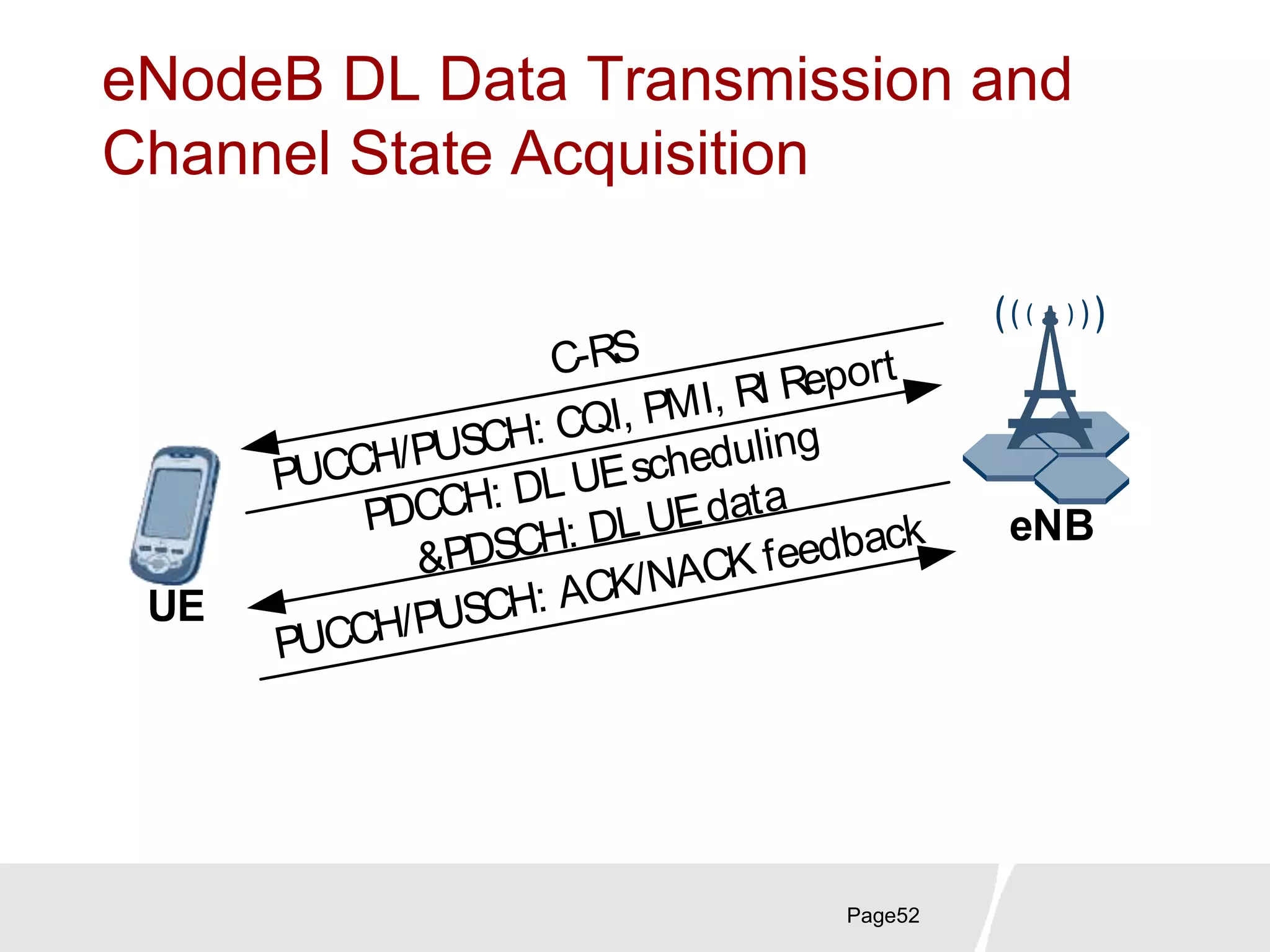
eNodeB DL Data Transmission and
Channel State Acquisition
Page52
PDCCH: DL UEscheduling
&PDSCH: DL UEdata
eNB
UE
PUCCH/PUSCH: CQI, PMI, RI ReportC-RS
PUCCH/PUSCH: ACK/NACK feedback
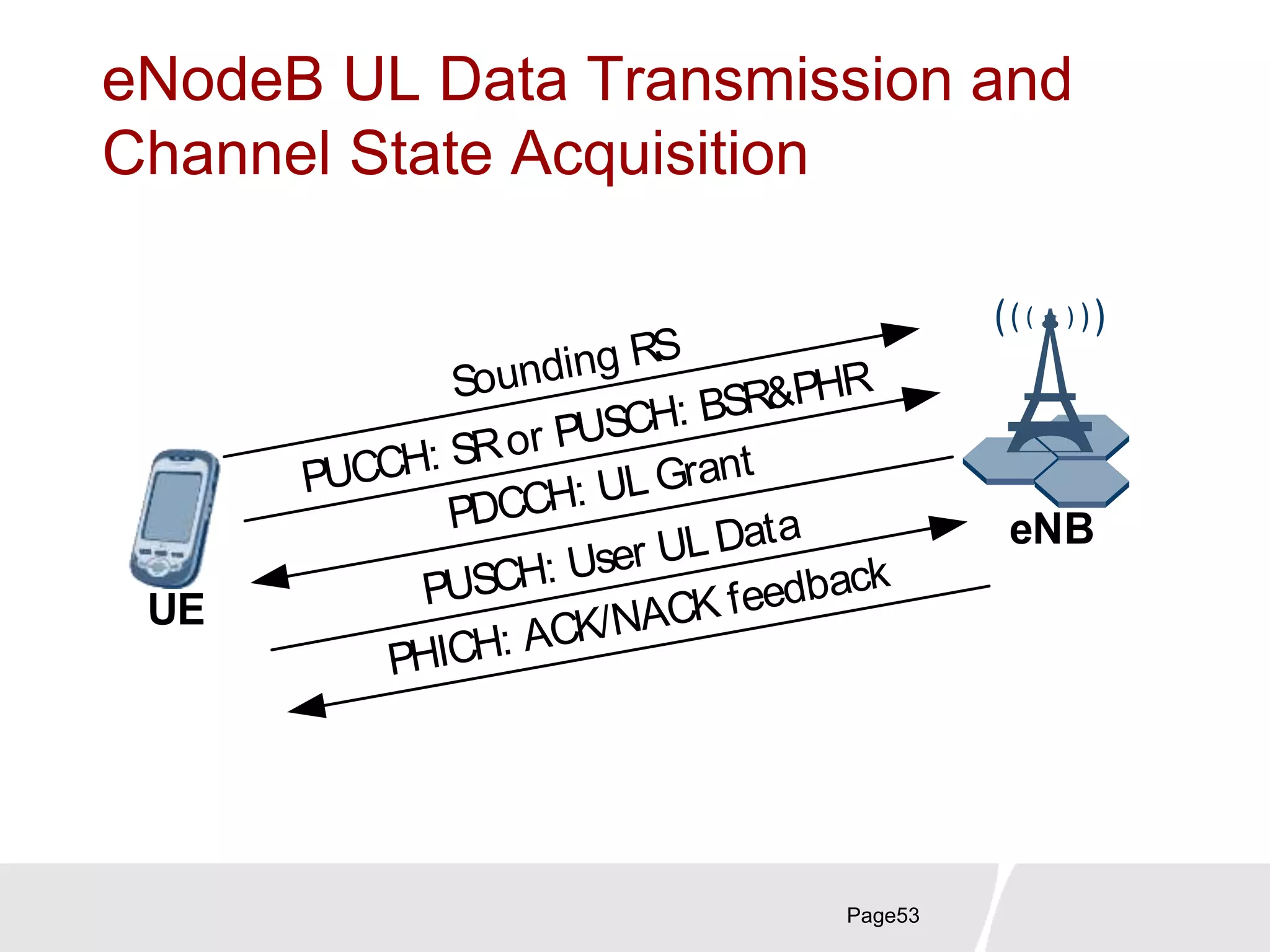
eNodeB UL Data Transmission and
Channel State Acquisition
Page53
PDCCH: UL Grant
eNB
UE
Sounding RS
PHICH: ACK/NACK feedbackPUSCH: User UL Data
PUCCH: SRor PUSCH: BSR&PHR
Page54
Questions
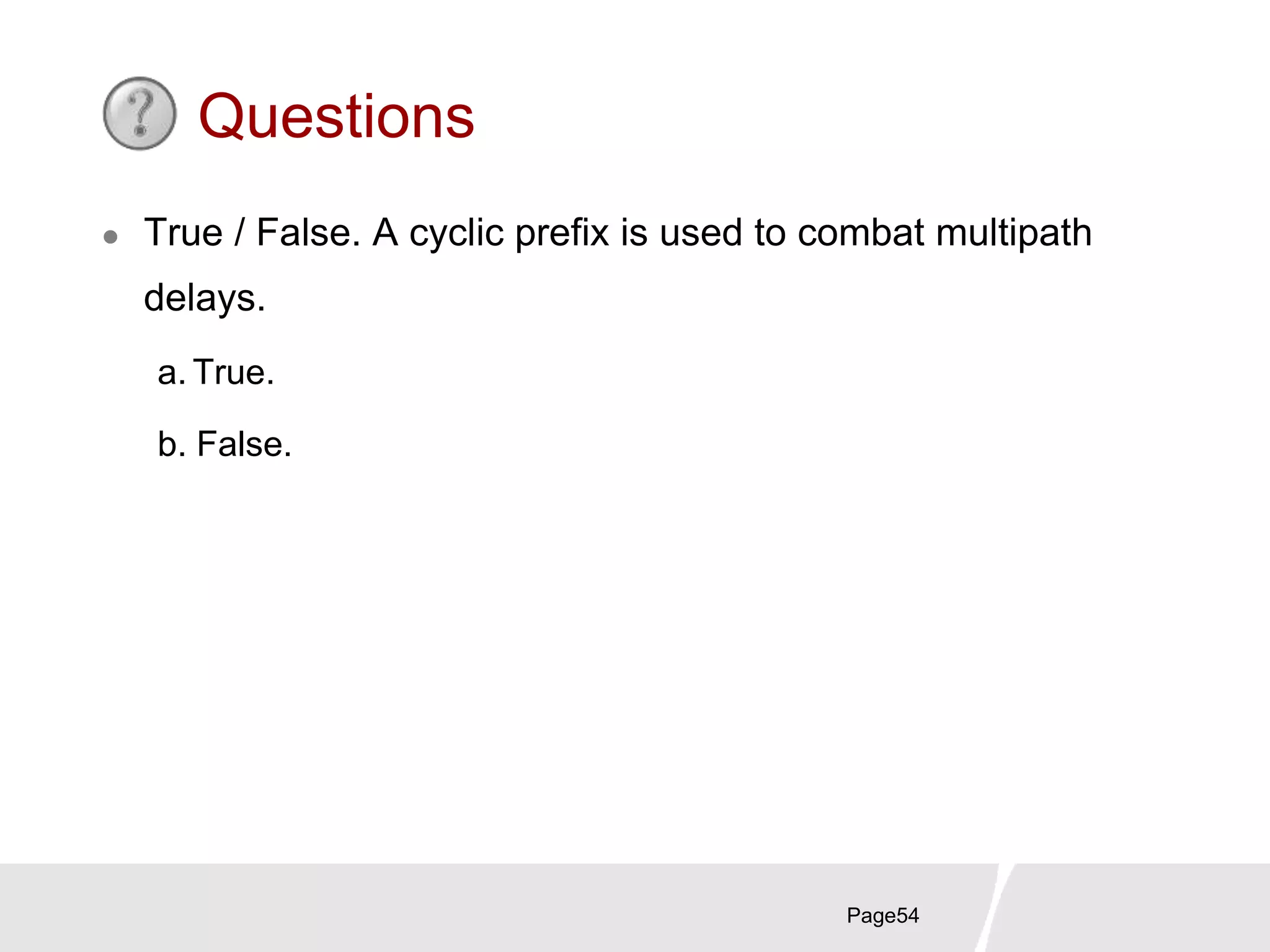
 True / False. A cyclic prefix is used to combat multipath
delays.
a. True.
b. False.
Page55
Questions
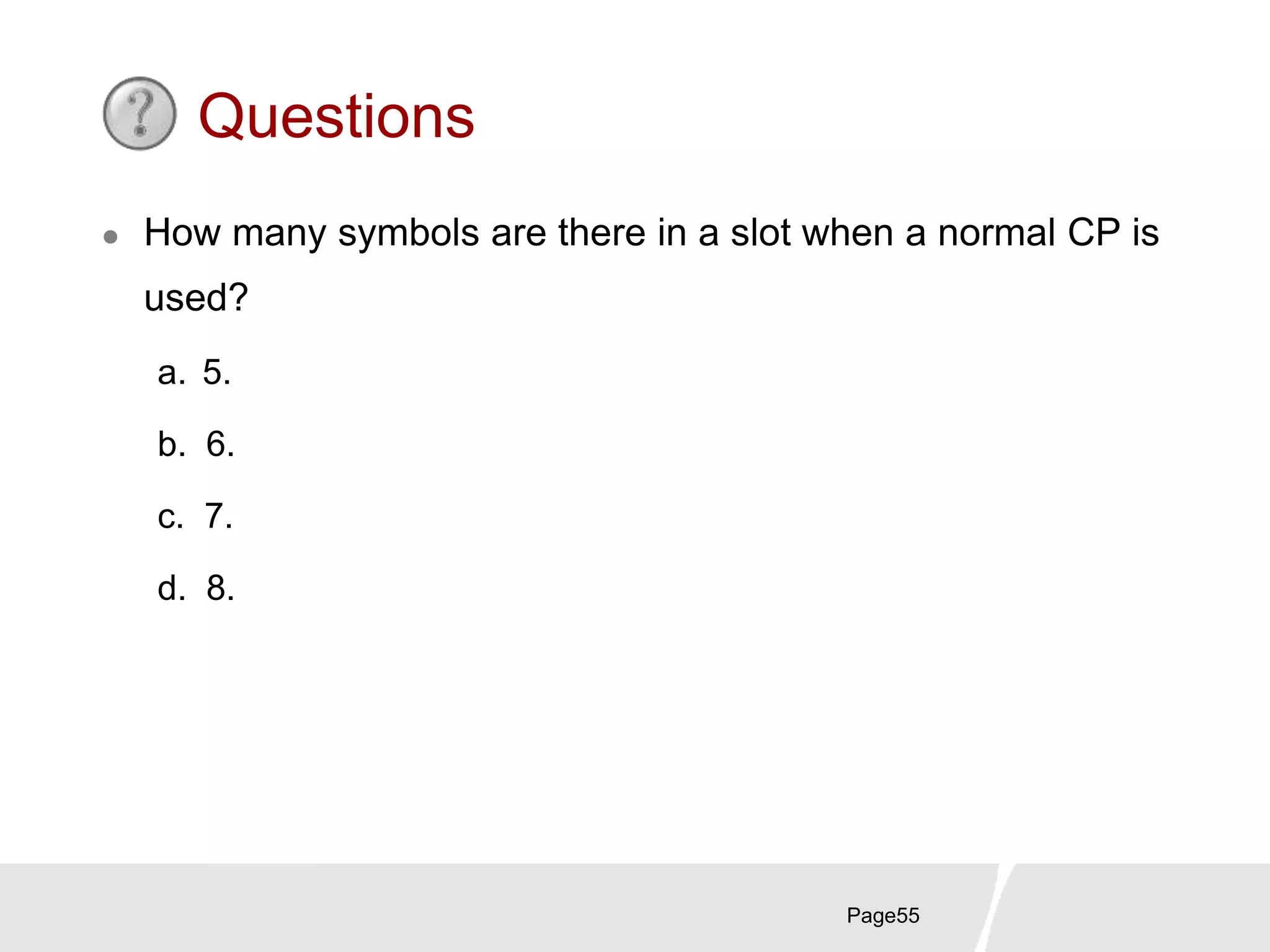
 How many symbols are there in a slot when a normal CP is
used?
a. 5.
b. 6.
c. 7.
d. 8.
Page56
Questions
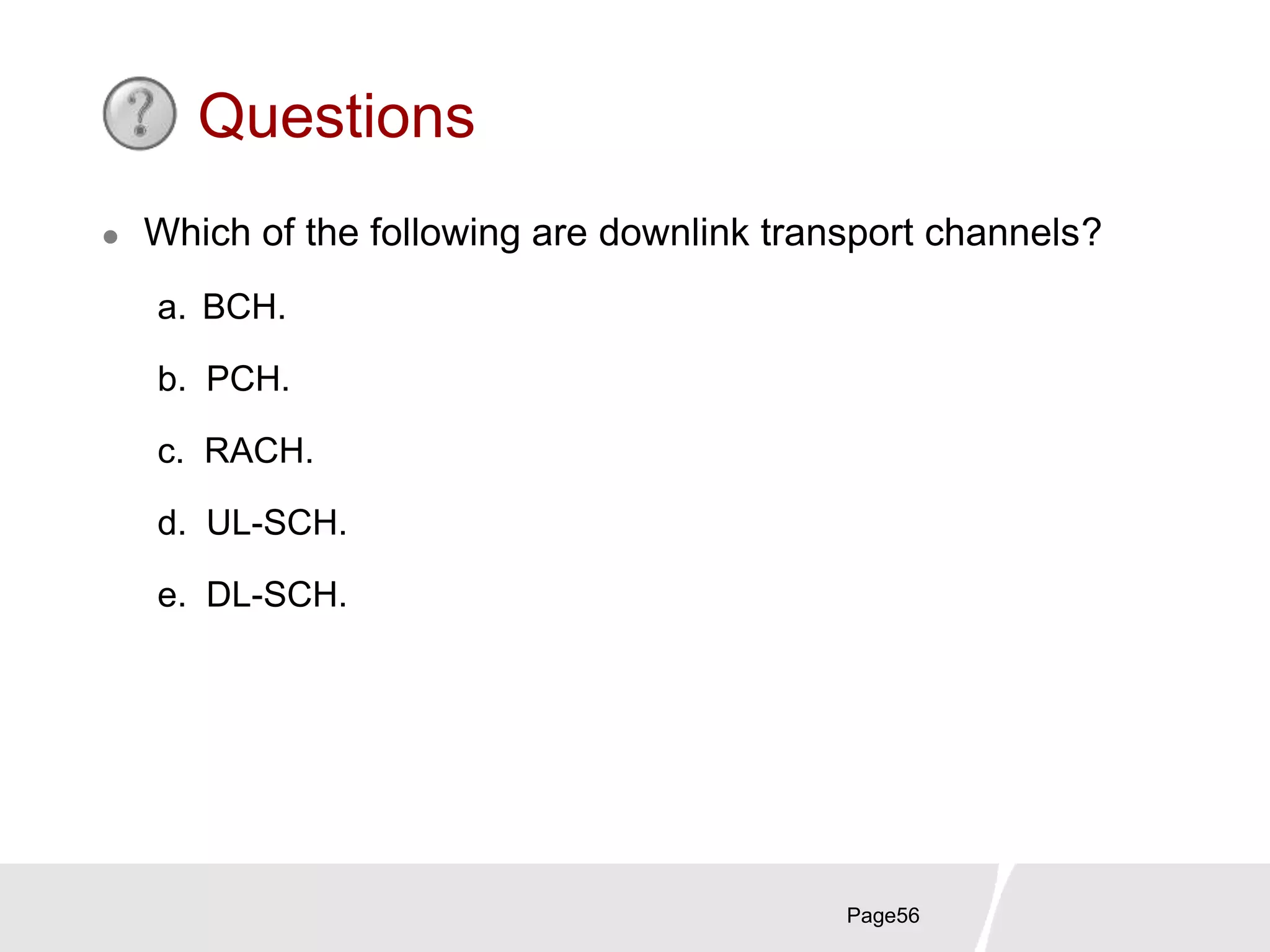
 Which of the following are downlink transport channels?
a. BCH.
b. PCH.
c. RACH.
d. UL-SCH.
e. DL-SCH.
Page57
Contents
3 LTE Air Interface Principles
3.1 Principles of OFDM
3.2 Multiple Access and Duplex Technologies
3.3 LTE Frame Structure
3.4 LTE Physical Channel
3.5 Physical Procedures
3.6 Key Technologies
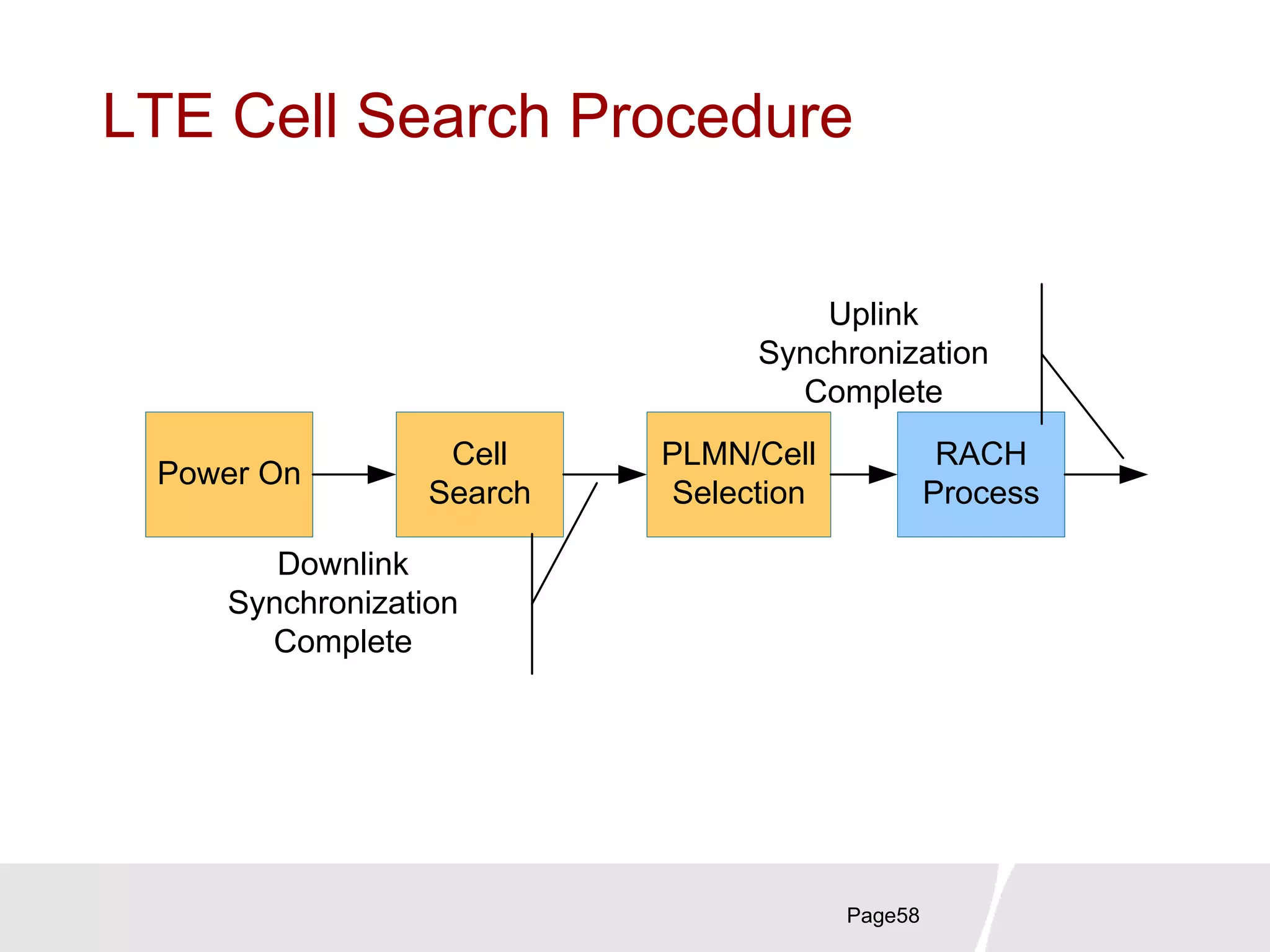
LTE Cell Search Procedure
Page58
Power On
Cell
Search
PLMN/Cell
Selection
RACH
Process
Downlink
Synchronization
Complete
Uplink
Synchronization
Complete
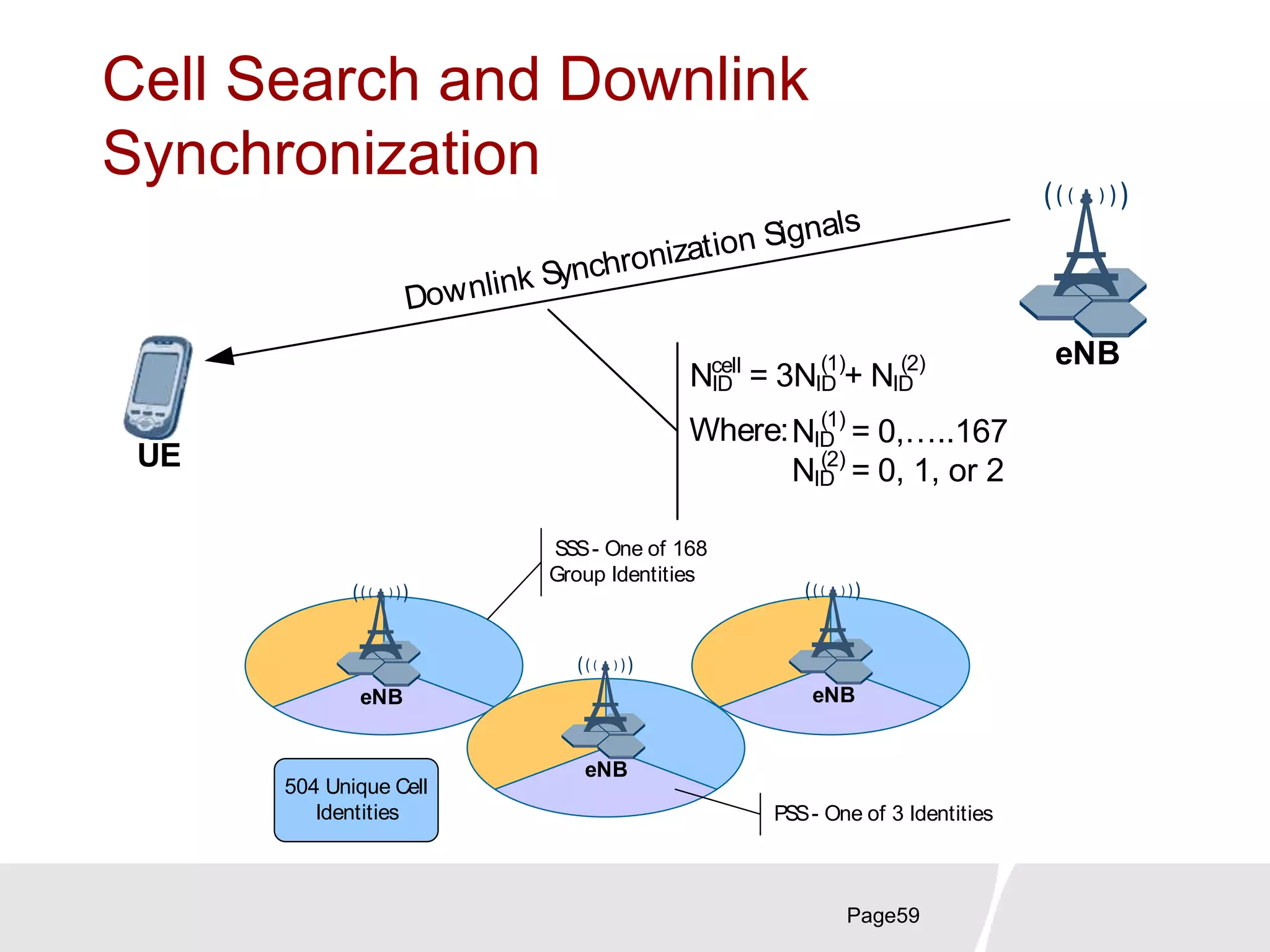
Downlink Synchronization Signals
eNB
UE
Page59
Cell Search and Downlink
Synchronization
cell (1) (2)
(1)
(2)
Where:
NID = 3NID + NID
NID = 0,…..167
NID = 0, 1, or 2
eNB
eNB
eNB
PSS- One of 3 Identities
SSS- One of 168
Group Identities
504 Unique Cell
Identities
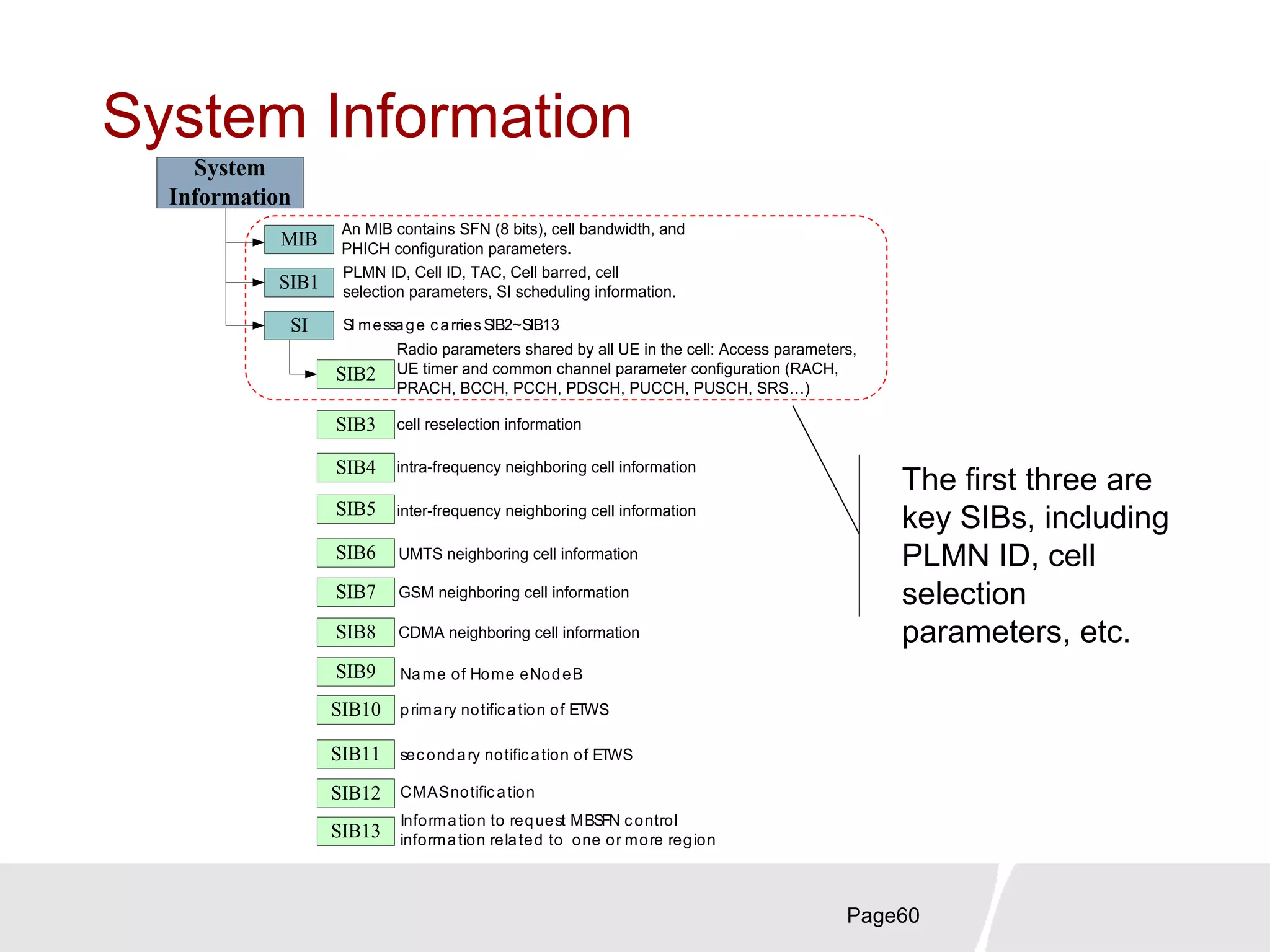
System Information
Page60
System
Information
MIB
SIB1
SI
An MIB contains SFN (8 bits), cell bandwidth, and
PHICH configuration parameters.
PLMN ID, Cell ID, TAC, Cell barred, cell
selection parameters, SI scheduling information.
SI message carriesSIB2~SIB13
SIB2
SIB10
SIB11
SIB12
SIB13
SIB3
SIB4
SIB5
SIB6
SIB7
SIB8
SIB9
Radio parameters shared by all UE in the cell: Access parameters,
UE timer and common channel parameter configuration (RACH,
PRACH, BCCH, PCCH, PDSCH, PUCCH, PUSCH, SRS…)
cell reselection information
intra-frequency neighboring cell information
inter-frequency neighboring cell information
UMTS neighboring cell information
GSM neighboring cell information
CDMA neighboring cell information
Name of Home eNodeB
primary notification of ETWS
secondary notification of ETWS
CMASnotification
Information to request MBSFN control
information related to one or more region
The first three are
key SIBs, including
PLMN ID, cell
selection
parameters, etc.
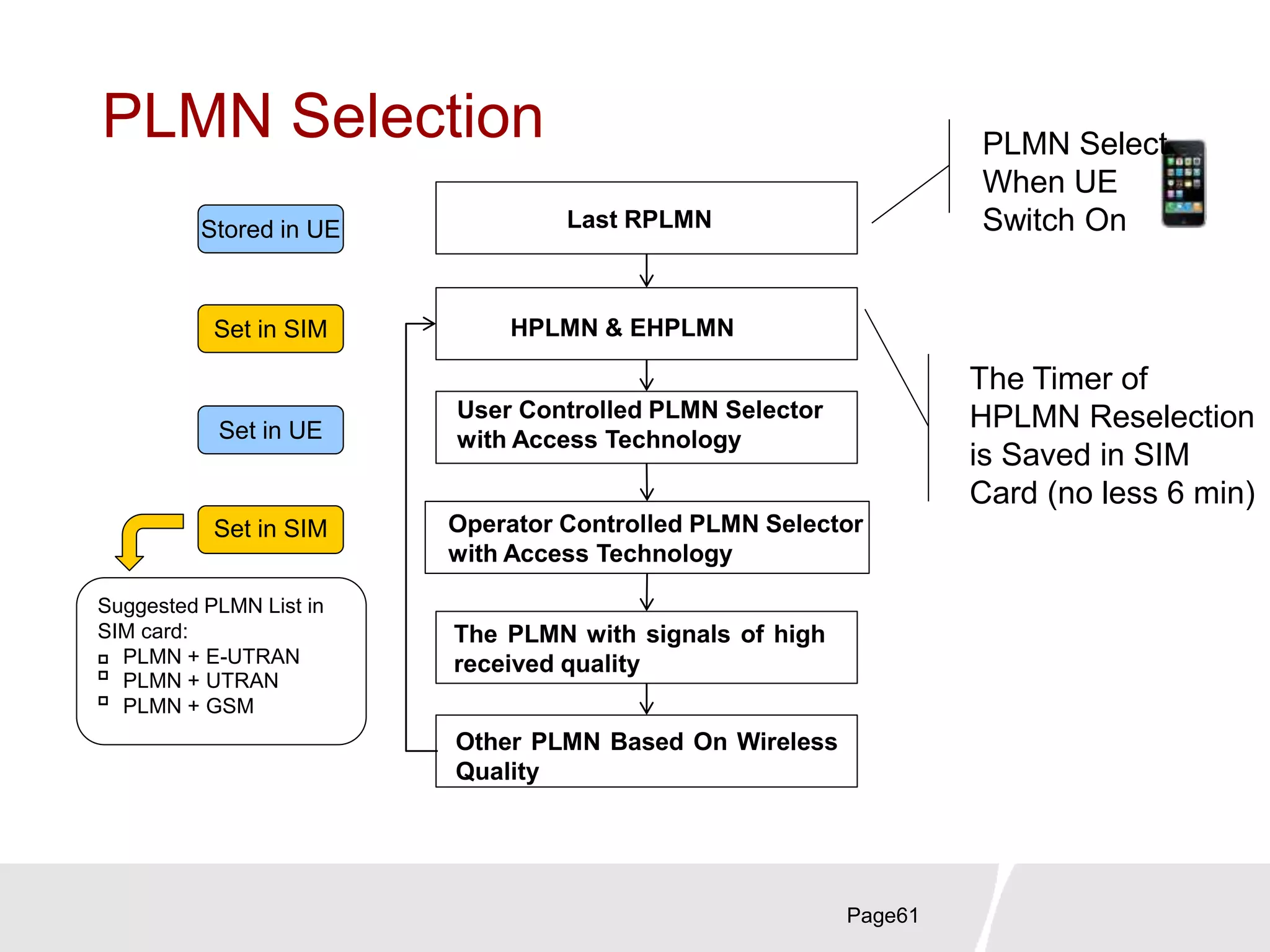
PLMN Selection
Page61
Last RPLMN
HPLMN & EHPLMN
User Controlled PLMN Selector
with Access Technology
Operator Controlled PLMN Selector
with Access Technology
The PLMN with signals of high
received quality
Other PLMN Based On Wireless
Quality
Stored in UE
Set in SIM
Set in SIM
Set in UE
Suggested PLMN List in
SIM card:
 PLMN + E-UTRAN

PLMN + UTRAN

PLMN + GSM
PLMN Select
When UE
Switch On
The Timer of
HPLMN Reselection
is Saved in SIM
Card (no less 6 min)
Page62
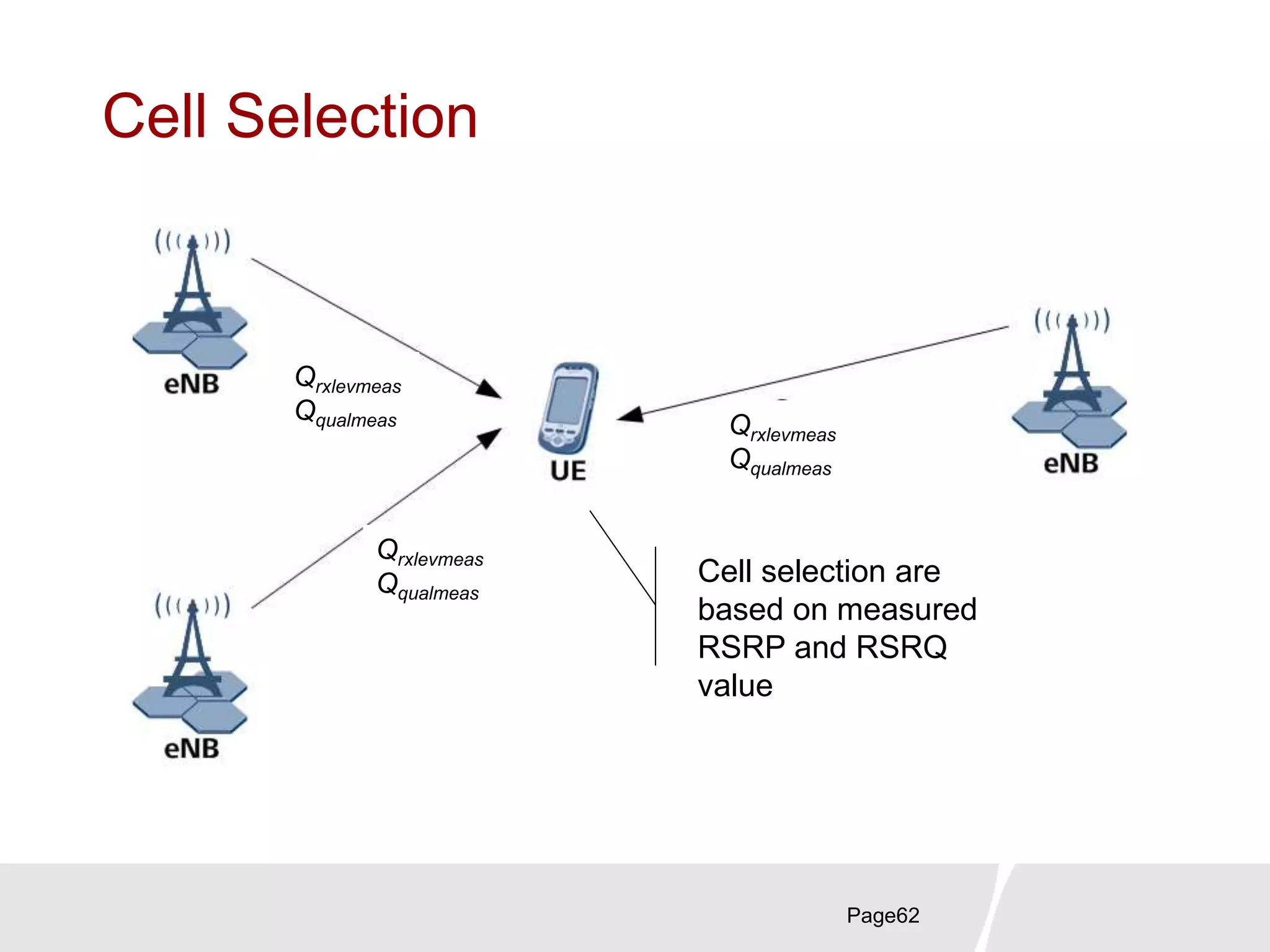
Cell Selection
Qrxlevmeas
Qqualmeas
Qrxlevmeas
Qqualmeas Qrxlevmeas
Qqualmeas
Cell selection are
based on measured
RSRP and RSRQ
value
Page63
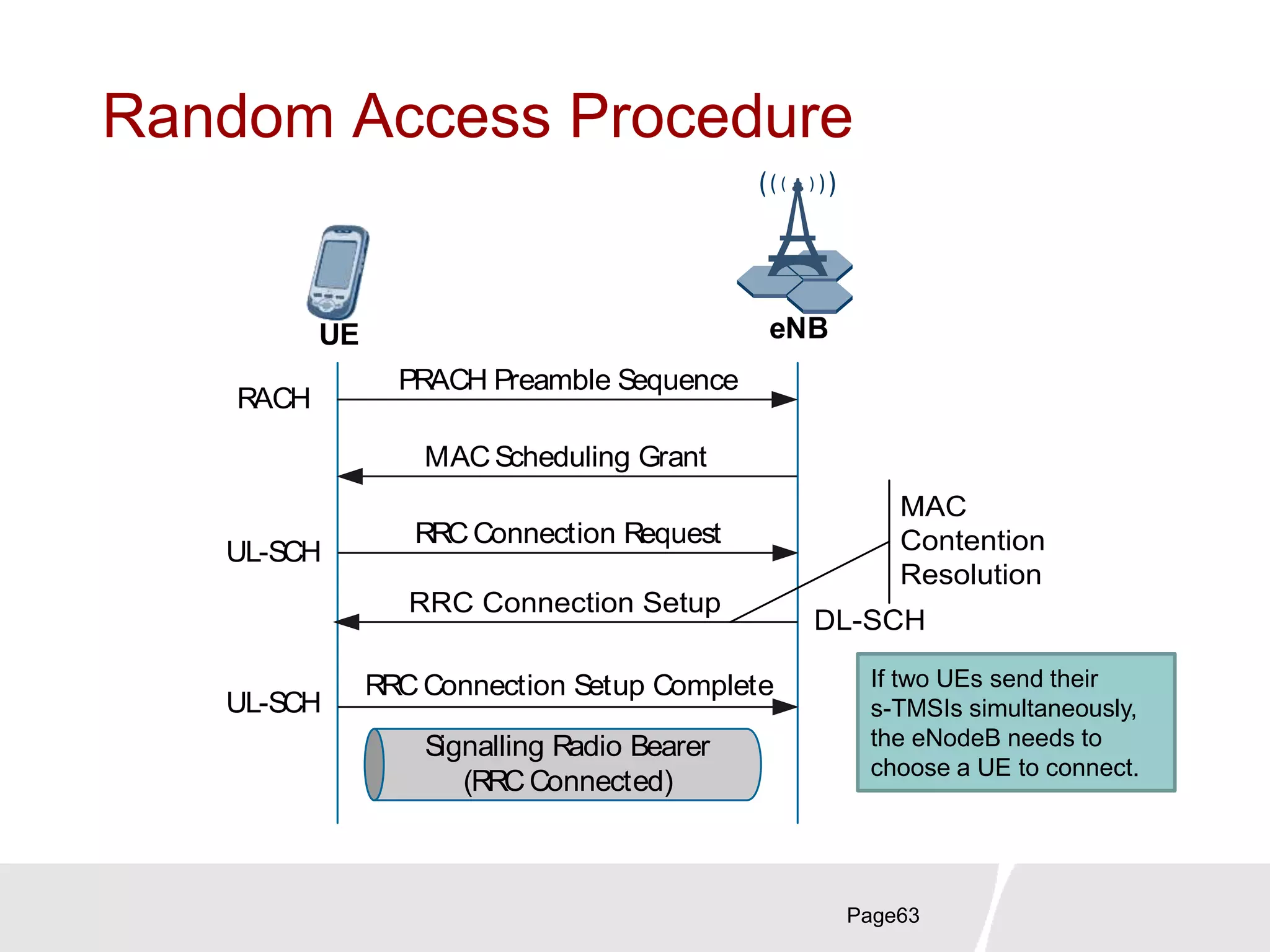
Random Access Procedure
UE eNB
PRACH Preamble Sequence
RACH
MACScheduling Grant
RRCConnection Request
UL-SCH
RRCConnection Setup Complete
UL-SCH
Signalling Radio Bearer
(RRCConnected)
RRC Connection Setup
DL-SCH
MAC
Contention
Resolution
If two UEs send their
s-TMSIs simultaneously,
the eNodeB needs to
choose a UE to connect.
Page64
Contents
3 LTE Air Interface Principles
3.1 Principles of OFDM
3.2 Multiple Access and Duplex Technologies
3.3 LTE Frame Structure
3.4 LTE Physical Channel
3.5 Physical Procedures
3.6 Key Technologies
Page65
Contents
3.6 Key Technologies
3.6.1 MIMO
3.6.2 SON
3.6.3 CA
3.6.4 CoMP
3.6.5 HetNet
3.6.6 eMBMS
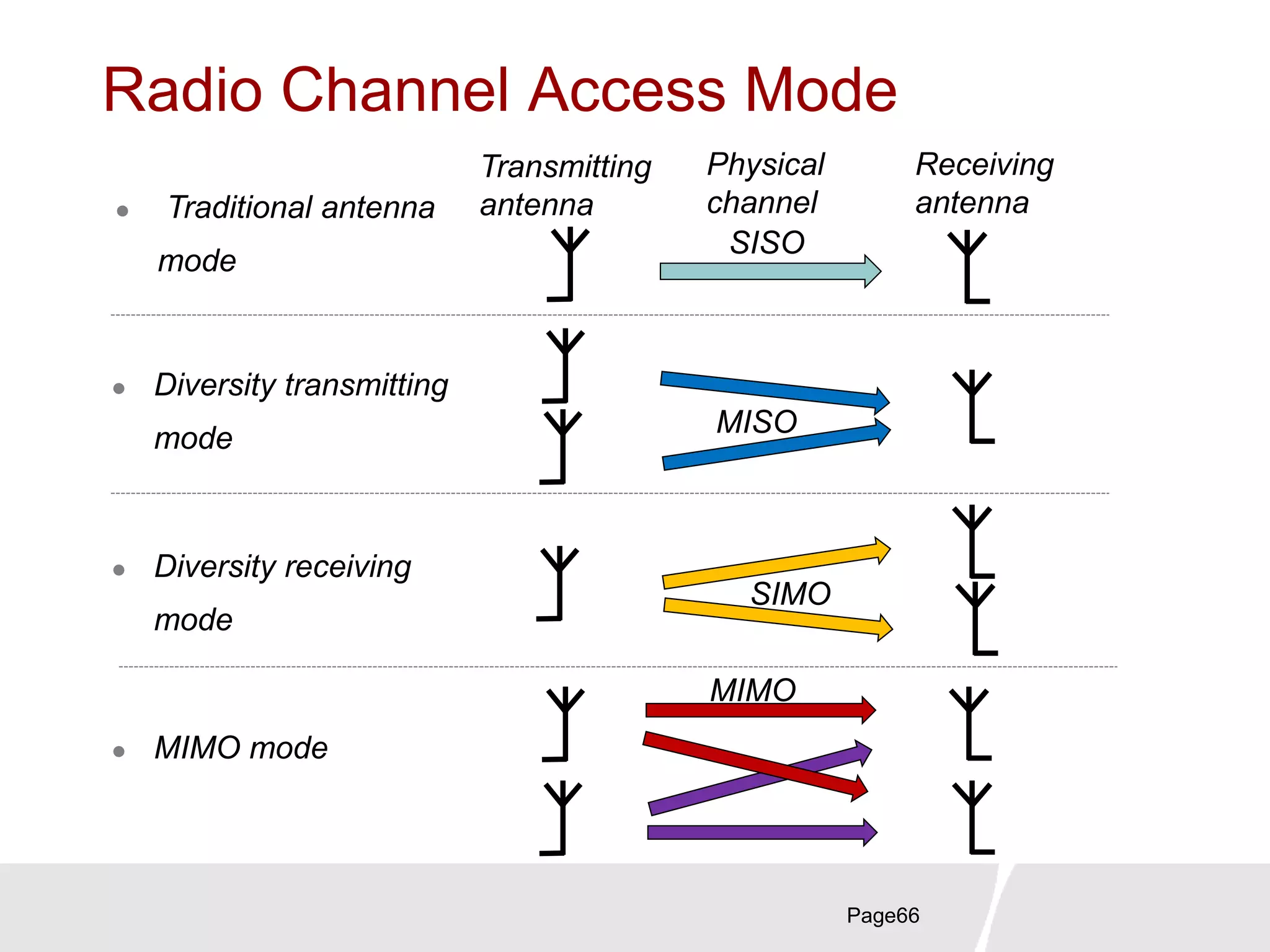
Radio Channel Access Mode
Page66
 Diversity receiving
mode
 Diversity transmitting
mode
 MIMO mode
Transmitting
antenna
Receiving
antenna
Physical
channel
SISO
MISO
SIMO
MIMO
 Traditional antenna
mode
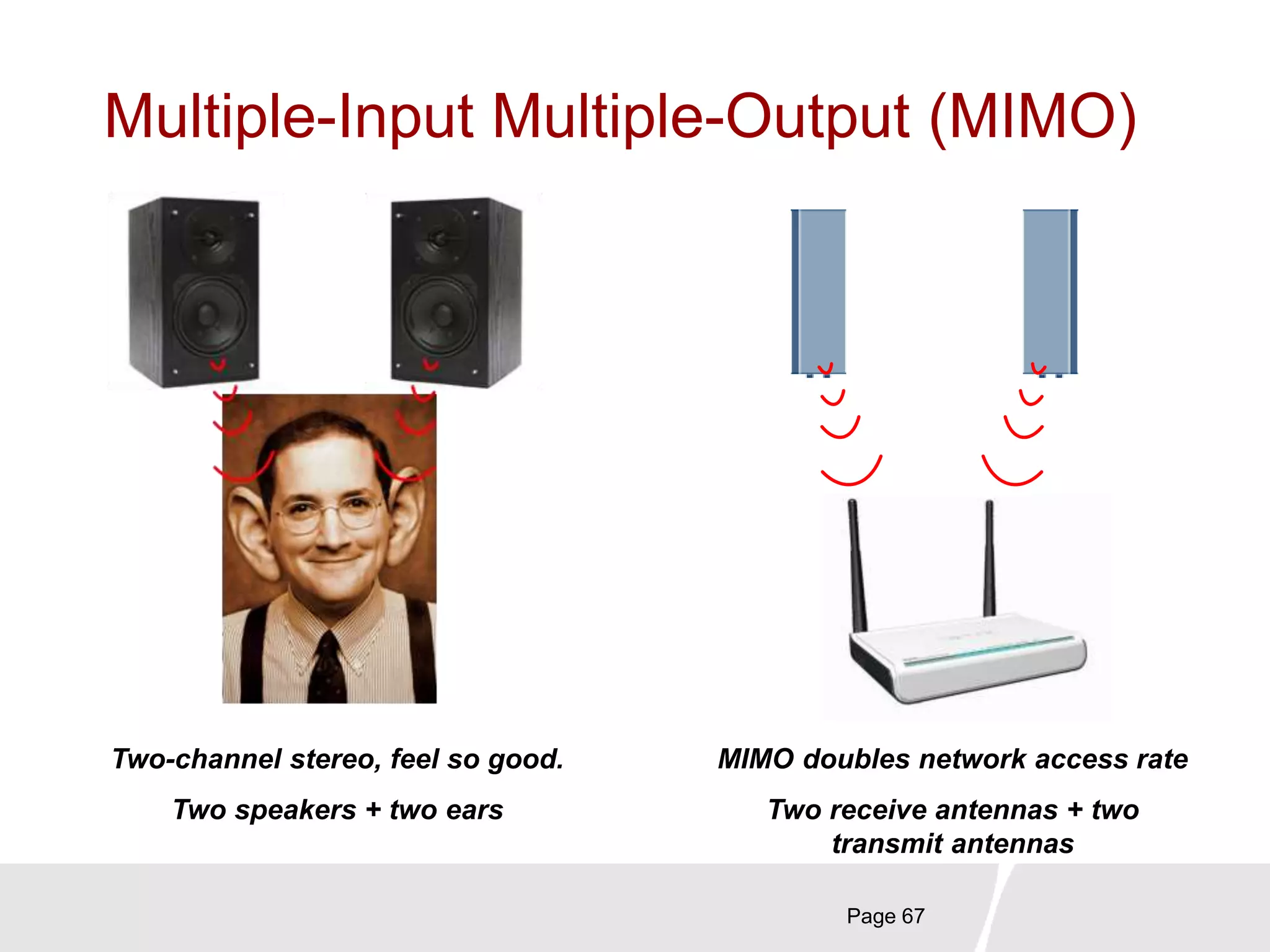
Multiple-Input Multiple-Output (MIMO)
Page 67
Two-channel stereo, feel so good.
Two speakers + two ears
MIMO doubles network access rate
Two receive antennas + two
transmit antennas
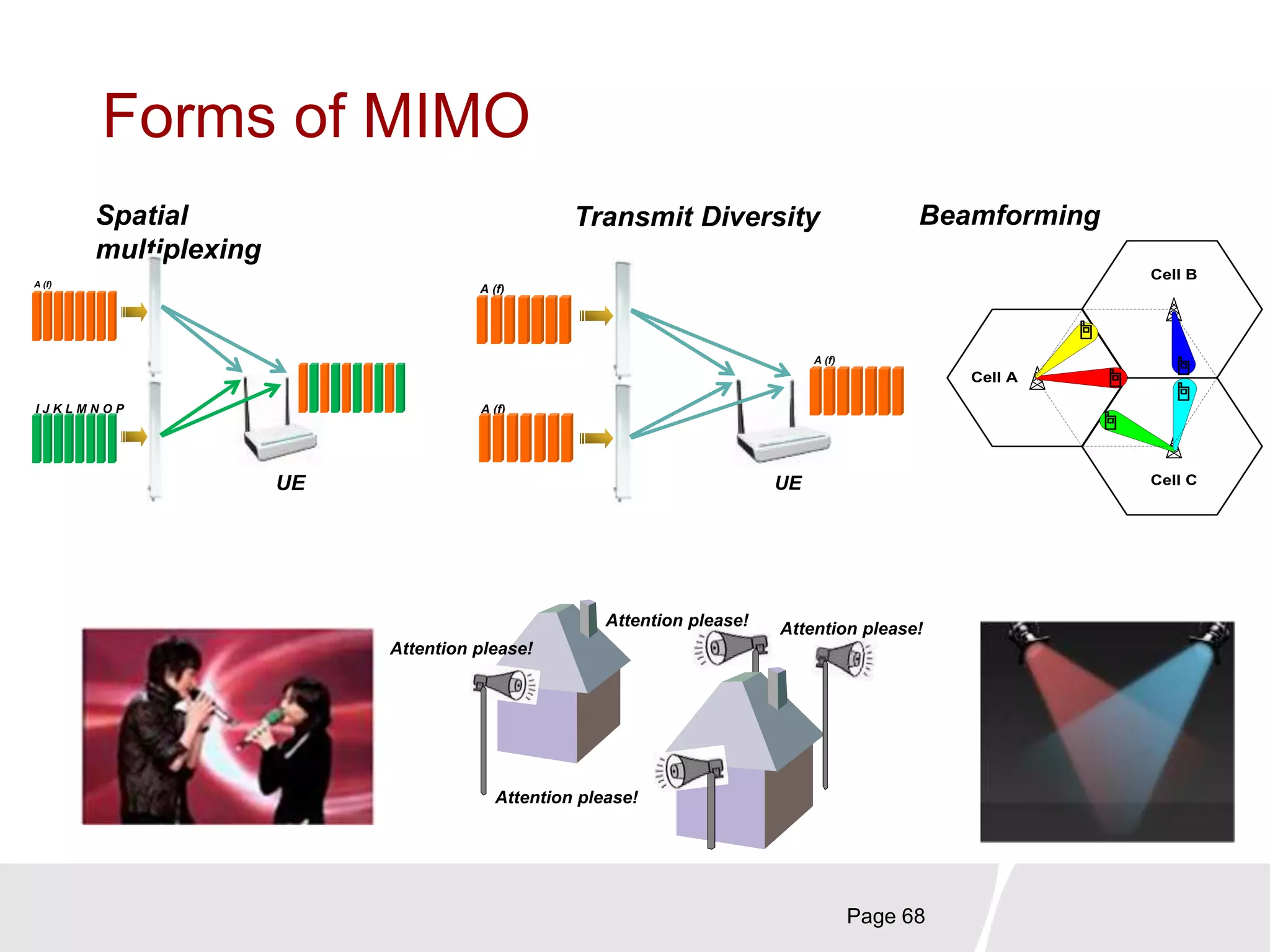
Forms of MIMO
Page 68
Spatial
multiplexing
UE
A (f)
I J K L M N O P
Transmit Diversity
A (f)
A (f)
A (f)
UE
Cell A
Cell B
Cell C
Beamforming
Attention please!
Attention please!
Attention please! Attention please!
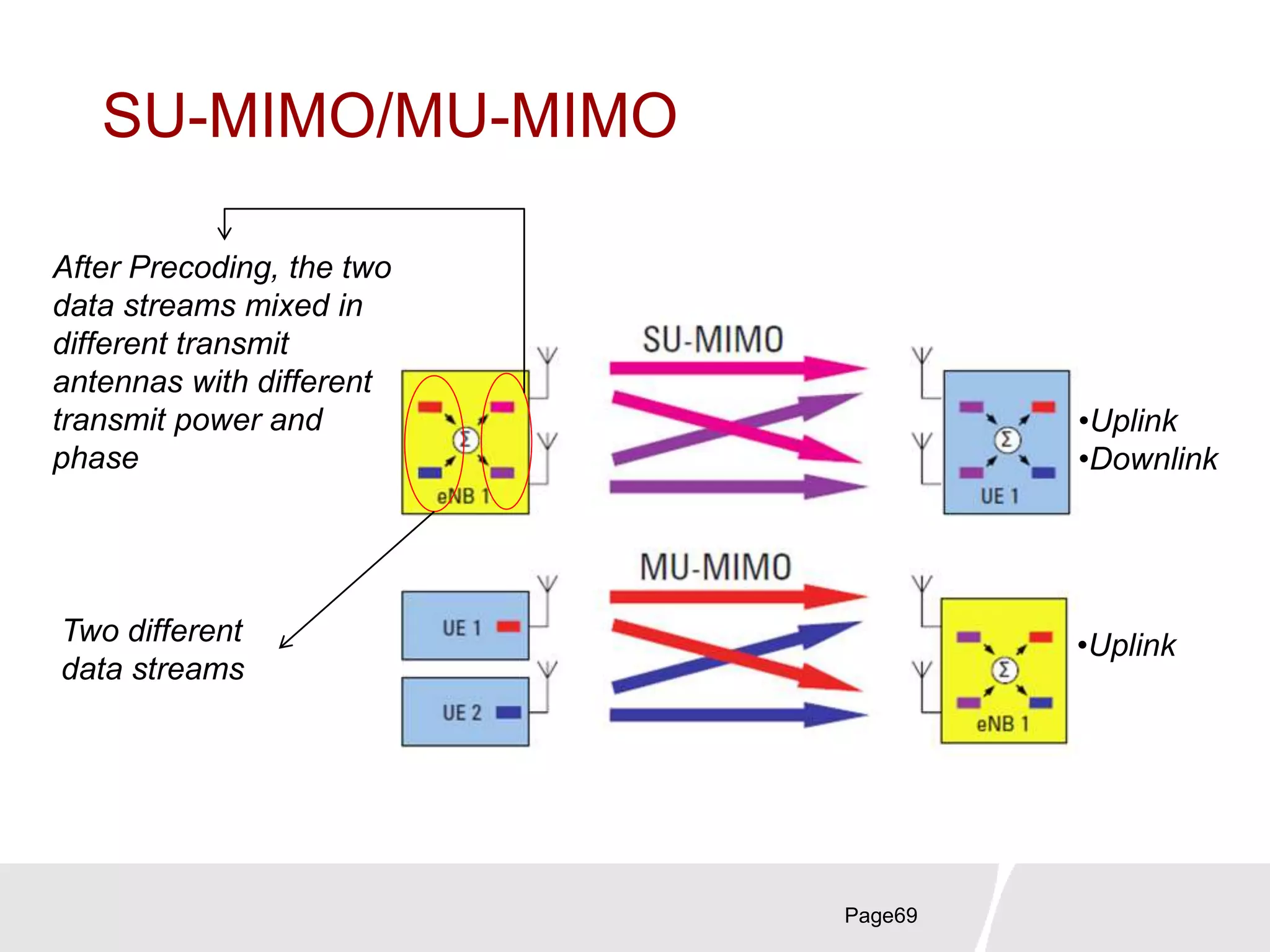
SU-MIMO/MU-MIMO
Page69
Two different
data streams
After Precoding, the two
data streams mixed in
different transmit
antennas with different
transmit power and
phase
•Uplink
•Downlink
•Uplink
Benefits of MIMO
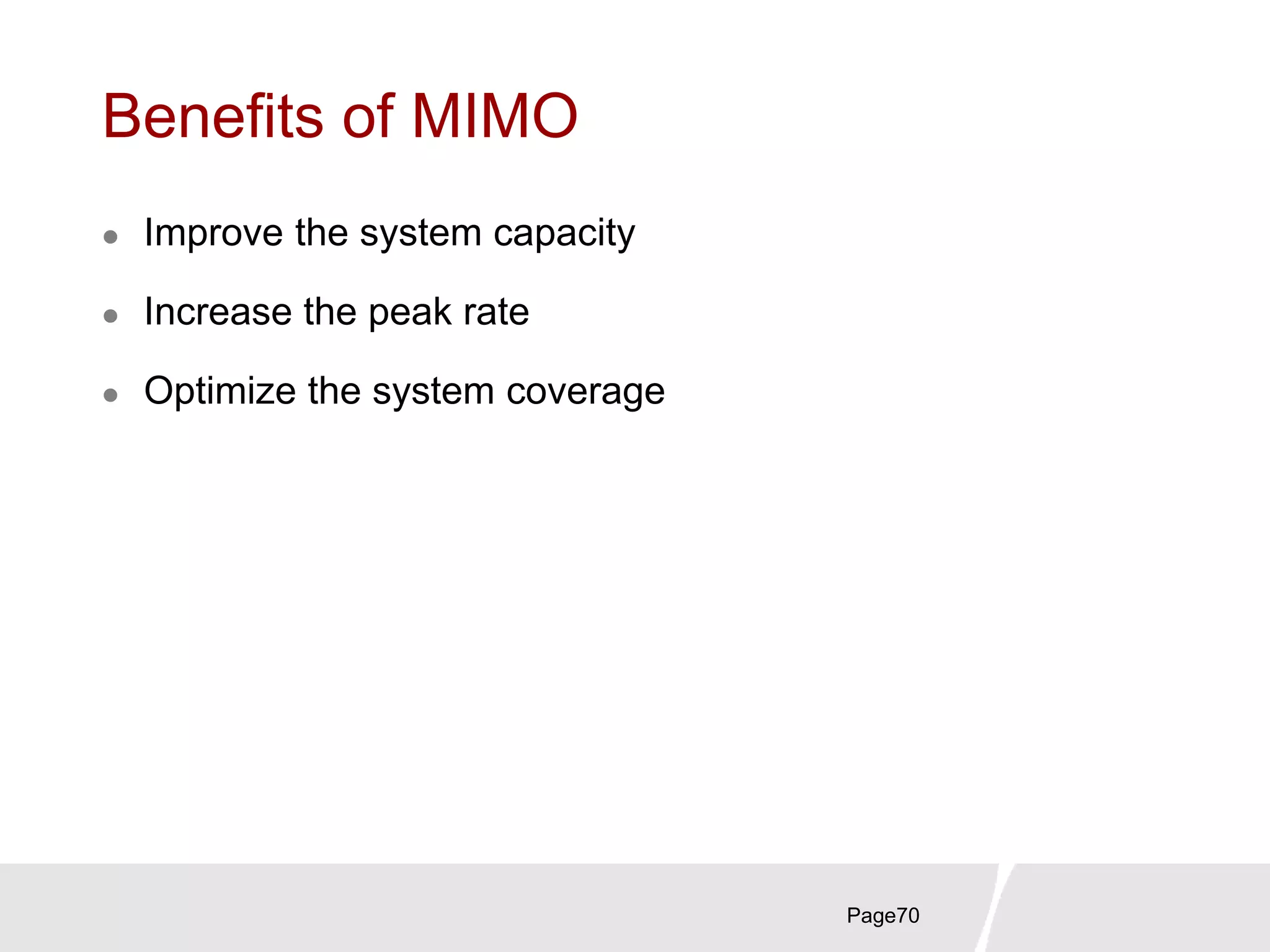
 Improve the system capacity
 Increase the peak rate
 Optimize the system coverage
Page70
High Order MIMO
Page71
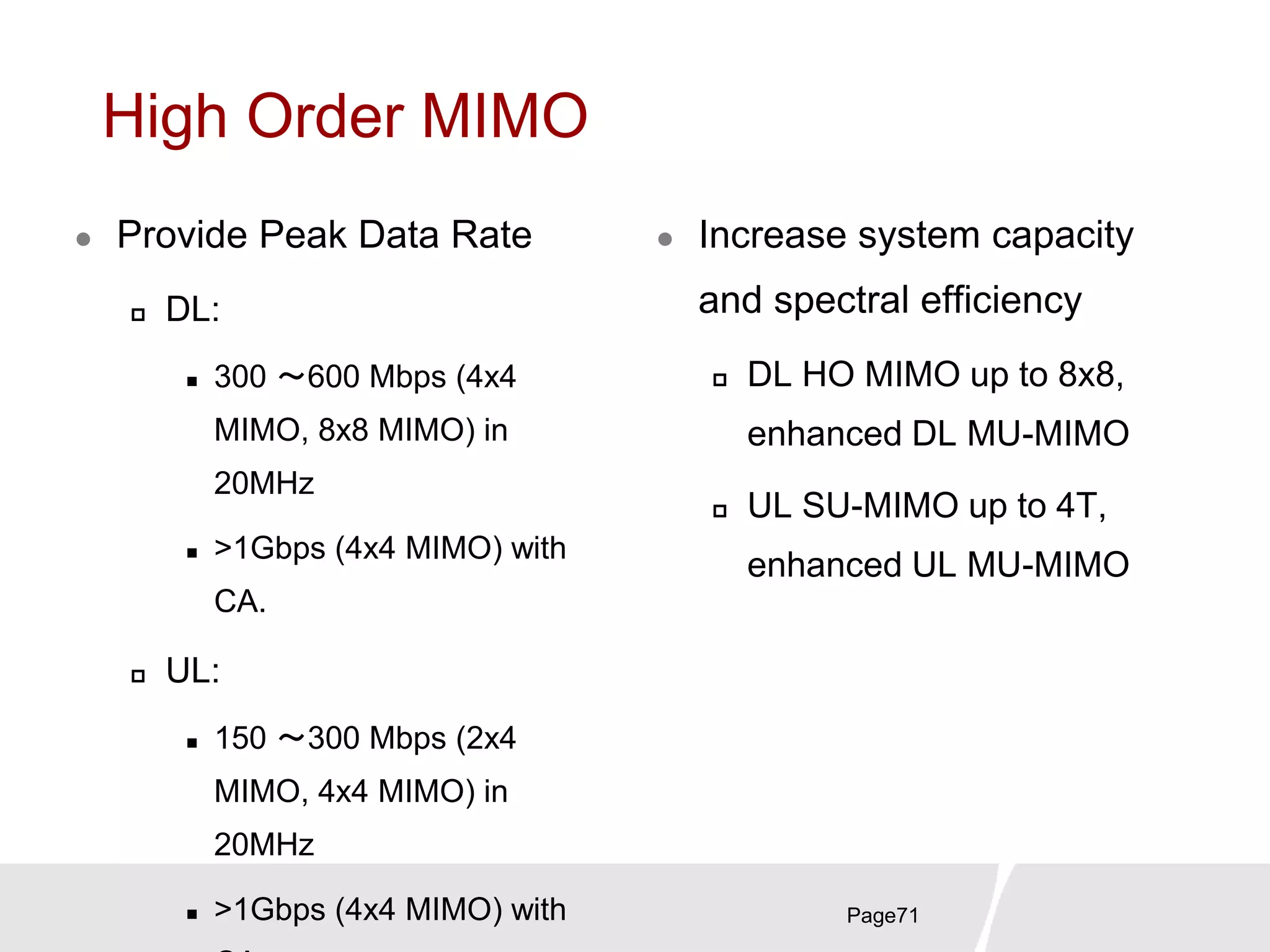
 Provide Peak Data Rate
 DL:
 300 ~600 Mbps (4x4
MIMO, 8x8 MIMO) in
20MHz
 >1Gbps (4x4 MIMO) with
CA.
 UL:
 150 ~300 Mbps (2x4
MIMO, 4x4 MIMO) in
20MHz
 >1Gbps (4x4 MIMO) with
 Increase system capacity
and spectral efficiency
 DL HO MIMO up to 8x8,
enhanced DL MU-MIMO
 UL SU-MIMO up to 4T,
enhanced UL MU-MIMO
Page72
Contents
3.6 Key Technologies
3.6.1 MIMO
3.6.2 SON
3.6.3 CA
3.6.4 CoMP
3.6.5 HetNet
3.6.6 eMBMS
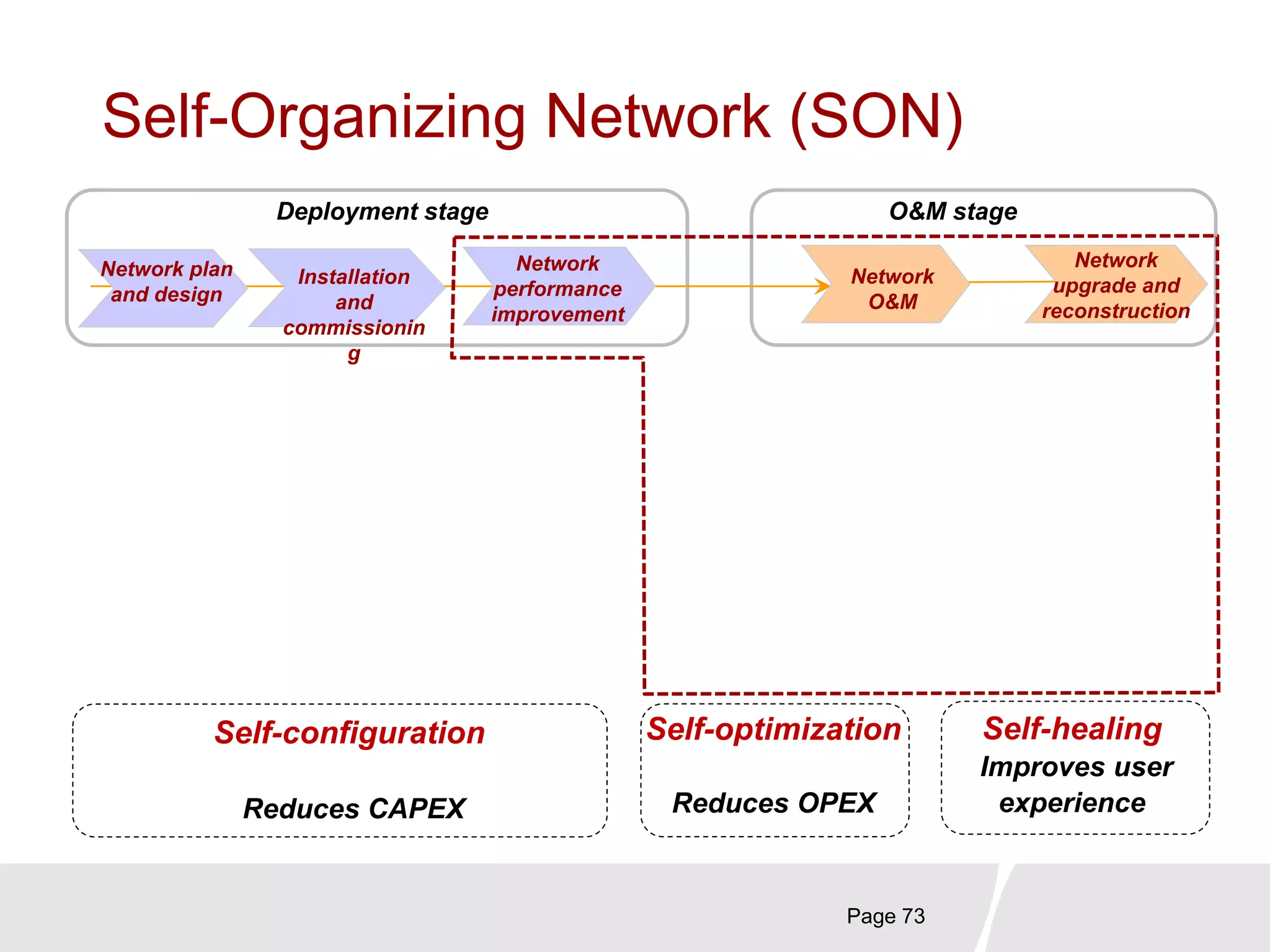
Deployment stage O&M stage
Network plan
and design
Installation
and
commissionin
g
Network
performance
improvement
Network
O&M
Network
upgrade and
reconstruction
Self-Organizing Network (SON)
Page 73
Self-configuration
Reduces CAPEX
Self-optimization
Reduces OPEX
Self-healing
Improves user
experience
Page75
Contents
3.6 Key Technologies
3.6.1 MIMO
3.6.2 SON
3.6.3 CA
3.6.4 CoMP
3.6.5 HetNet
3.6.6 eMBMS
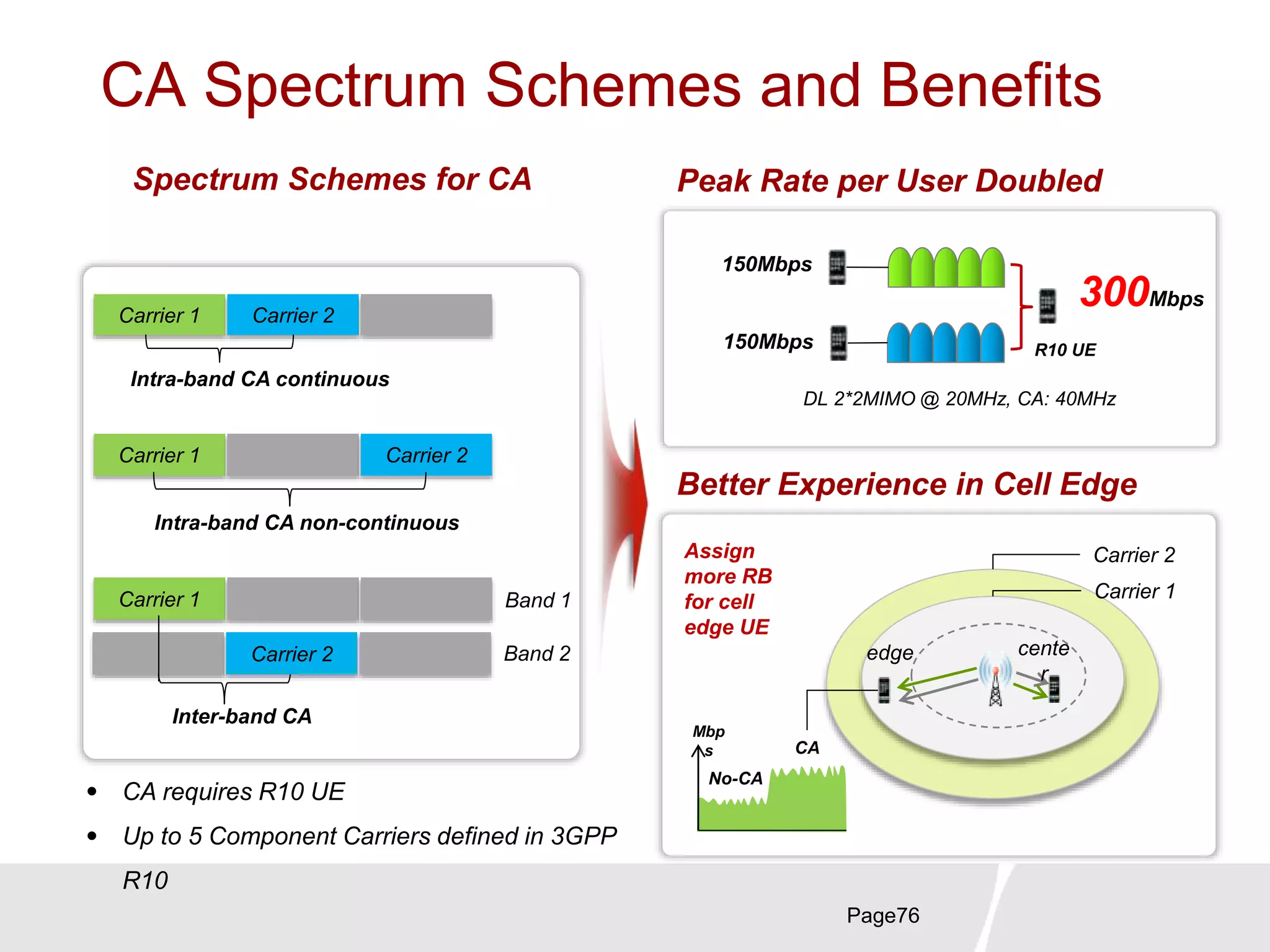
CA Spectrum Schemes and Benefits
Page76
Carrier 1 Carrier 2
Intra-band CA non-continuous
Carrier 1 Carrier 2
Intra-band CA continuous
Carrier 1
Inter-band CA
Carrier 2
Band 1
Band 2
Spectrum Schemes for CA Peak Rate per User Doubled
150Mbps
150Mbps
300Mbps
R10 UE
Better Experience in Cell Edge
DL 2*2MIMO @ 20MHz, CA: 40MHz
Assign
more RB
for cell
edge UE
cente
r
edge
Carrier 2
Carrier 1
No-CA
CA
Mbp
s
 CA requires R10 UE
 Up to 5 Component Carriers defined in 3GPP
R10
Page77
Contents
3.6 Key Technologies
3.6.1 MIMO
3.6.2 SON
3.6.3 CA
3.6.4 CoMP
3.6.5 HetNet
3.6.6 eMBMS
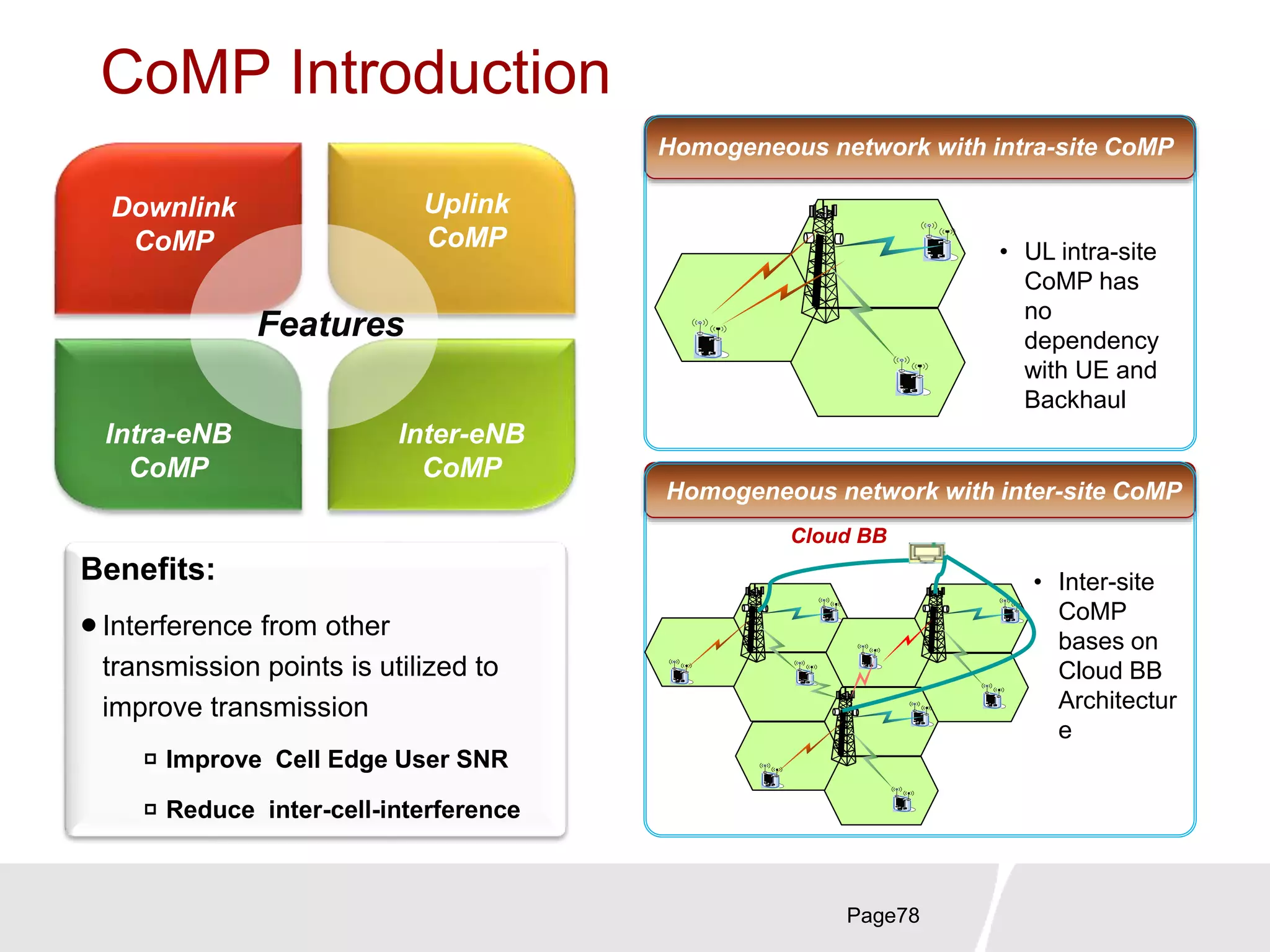
CoMP Introduction
Page78
Benefits:
 Interference from other
transmission points is utilized to
improve transmission
 Improve Cell Edge User SNR
 Reduce inter-cell-interference
Downlink
CoMP
Intra-eNB
CoMP
Inter-eNB
CoMP
Features
Uplink
CoMP
Homogeneous network with intra-site CoMP
Homogeneous network with inter-site CoMP
Cloud BB
• UL intra-site
CoMP has
no
dependency
with UE and
Backhaul
• Inter-site
CoMP
bases on
Cloud BB
Architectur
e
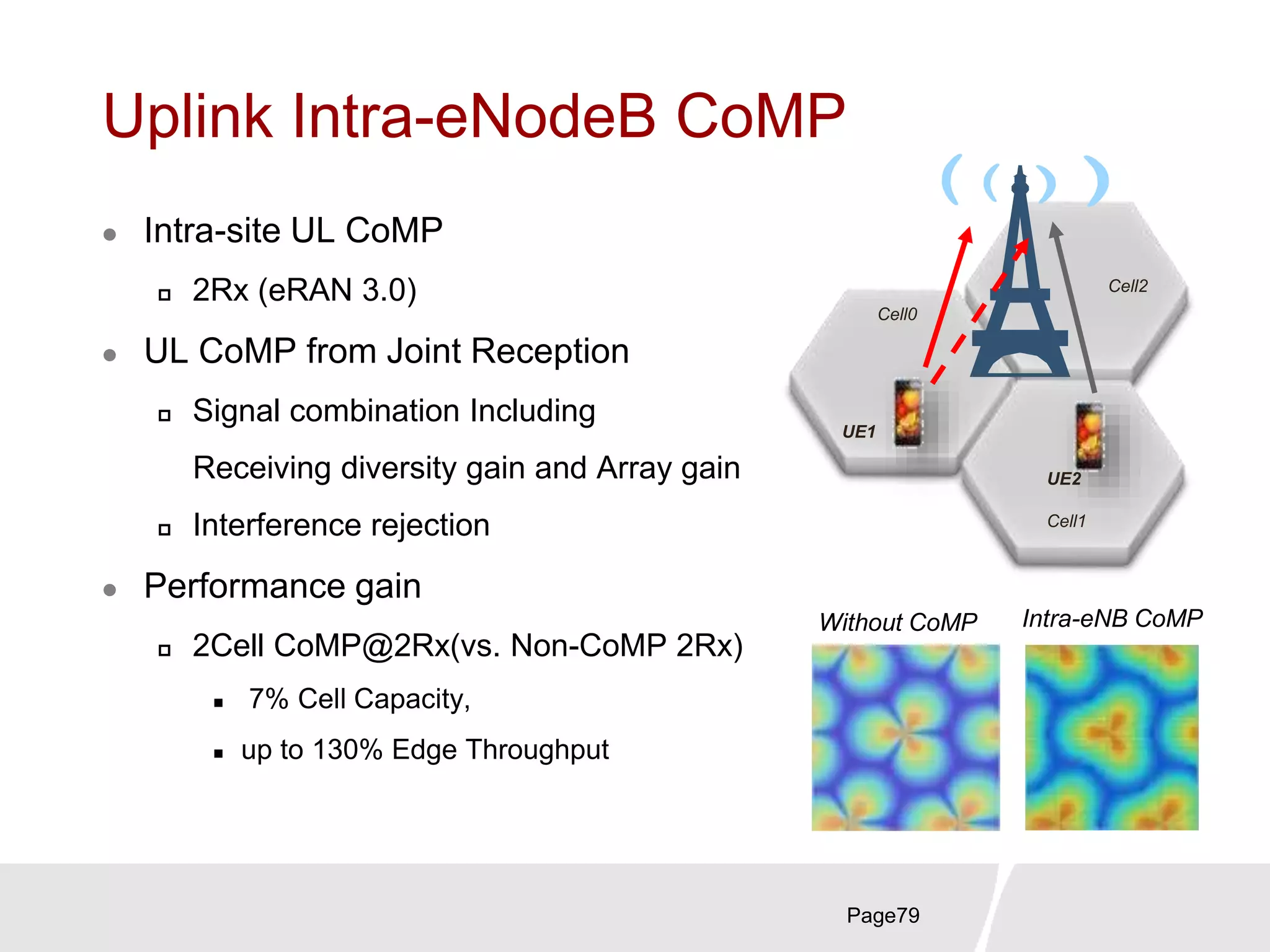
Without CoMP Intra-eNB CoMP
Cell0
Cell1
Cell2
UE1
UE2
Uplink Intra-eNodeB CoMP
 Intra-site UL CoMP
 2Rx (eRAN 3.0)
 UL CoMP from Joint Reception
 Signal combination Including
Receiving diversity gain and Array gain
 Interference rejection
 Performance gain
 2Cell CoMP@2Rx(vs. Non-CoMP 2Rx)
 7% Cell Capacity,
 up to 130% Edge Throughput
Page79
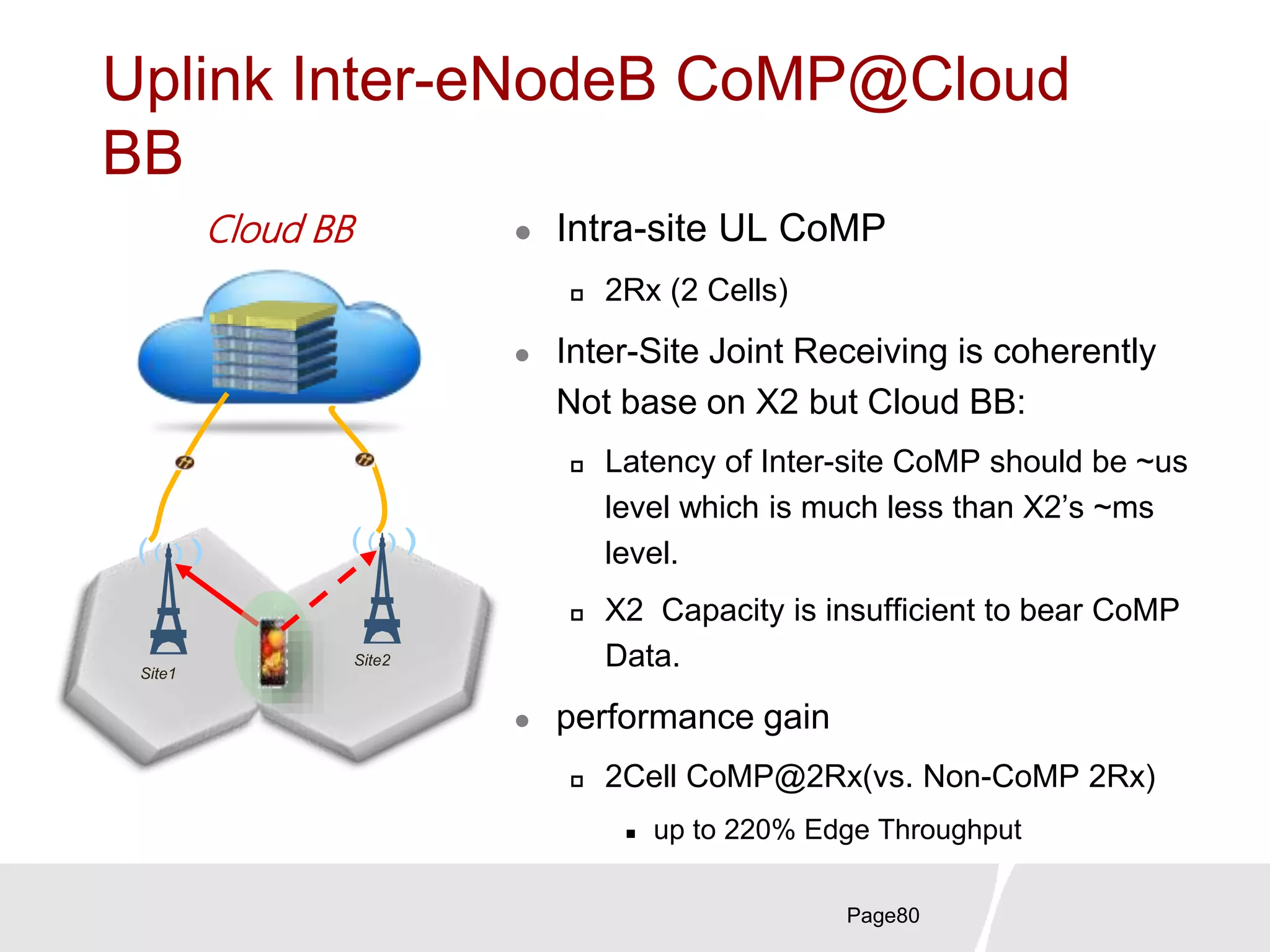
Site1
Site2
Cloud BB
Uplink Inter-eNodeB CoMP@Cloud
BB
 Intra-site UL CoMP
 2Rx (2 Cells)
 Inter-Site Joint Receiving is coherently
Not base on X2 but Cloud BB:
 Latency of Inter-site CoMP should be ~us
level which is much less than X2’s ~ms
level.
 X2 Capacity is insufficient to bear CoMP
Data.
 performance gain
 2Cell CoMP@2Rx(vs. Non-CoMP 2Rx)
 up to 220% Edge Throughput
Page80
Page81
Contents
3.6 Key Technologies
3.6.1 MIMO
3.6.2 SON
3.6.3 CA
3.6.4 CoMP
3.6.5 HetNet
3.6.6 eMBMS
HetNet Overview
Page82
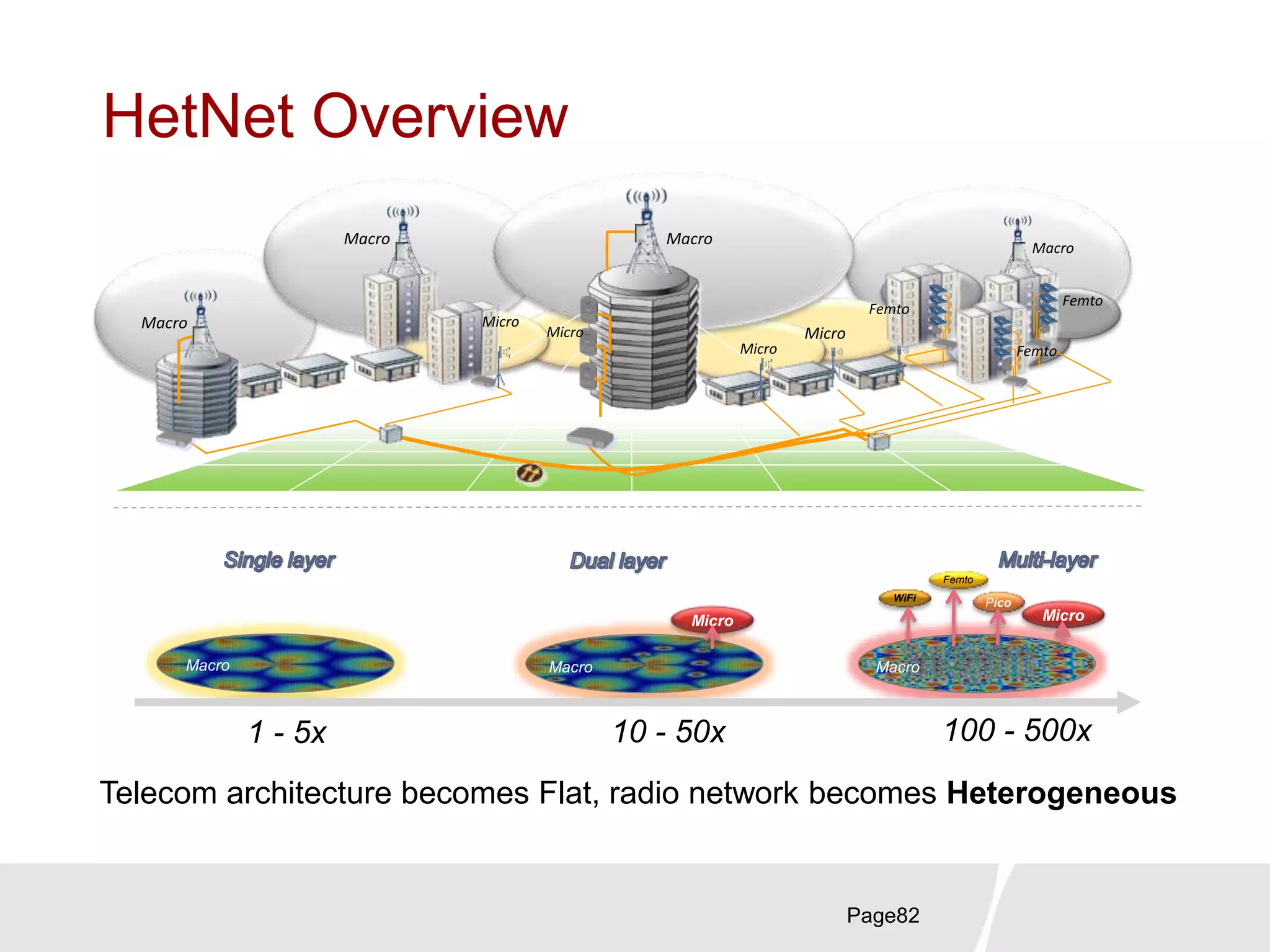
Macro
Macro
Micro Micro
Macro
Macro
Micro
Femto
Femto
Femto
Micro
1 - 5x 10 - 50x 100 - 500x
Micro Micro
Pico
Femto
Macro Macro Macro
WiFi
Telecom architecture becomes Flat, radio network becomes Heterogeneous
Page83
Contents
3.6 Key Technologies
3.6.1 MIMO
3.6.2 SON
3.6.3 CA
3.6.4 CoMP
3.6.5 HetNet
3.6.6 eMBMS
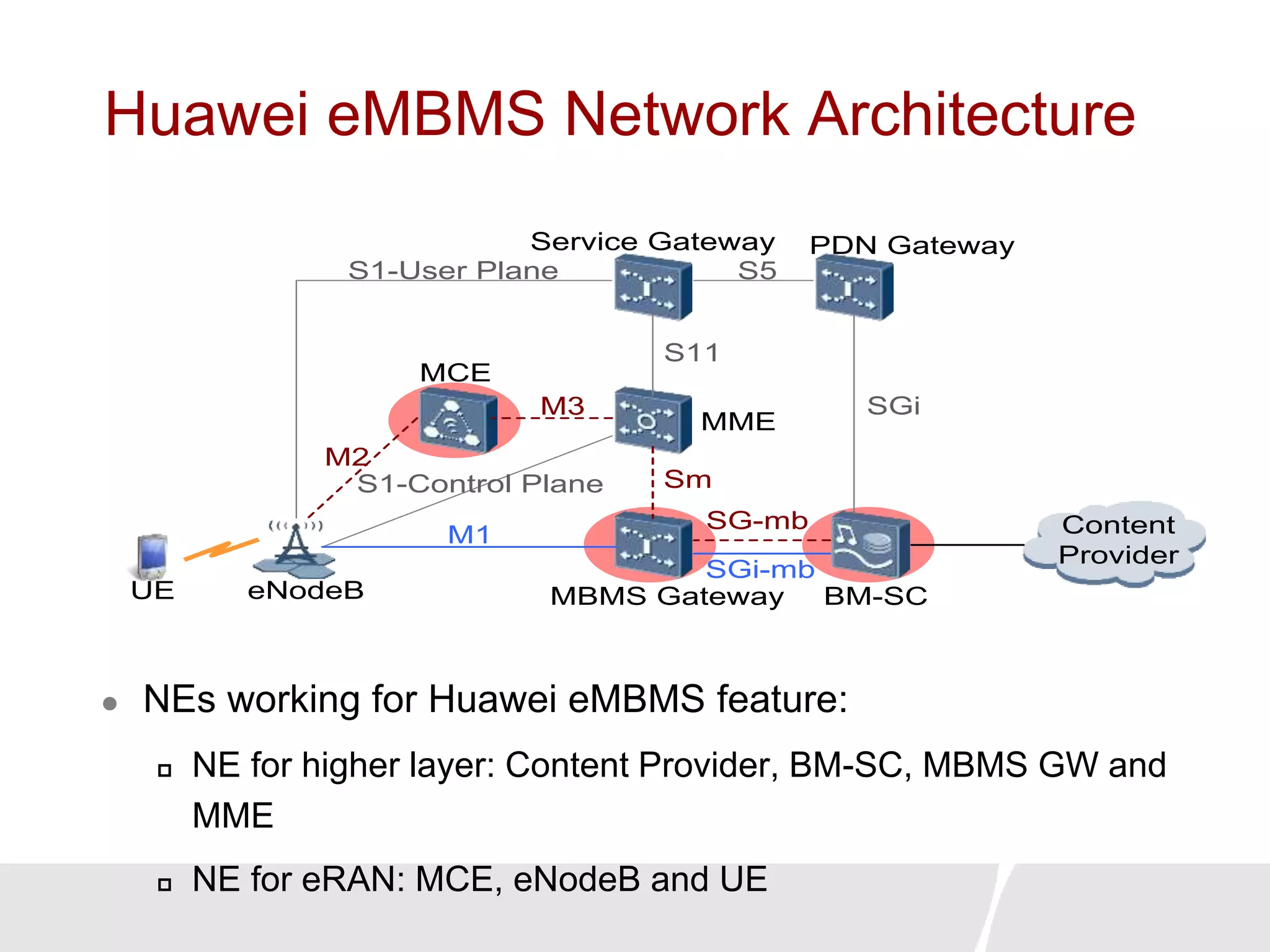
Huawei eMBMS Network Architecture
 NEs working for Huawei eMBMS feature:
 NE for higher layer: Content Provider, BM-SC, MBMS GW and
MME
 NE for eRAN: MCE, eNodeB and UE
Content
Provider
M3
M2
Sm
S11
S1-User Plane
S1-Control Plane
SG-mb
SGi-mb
M1
S5
SGi
Service Gateway PDN Gateway
MBMS Gateway BM-SCeNodeBUE
MME
MCE
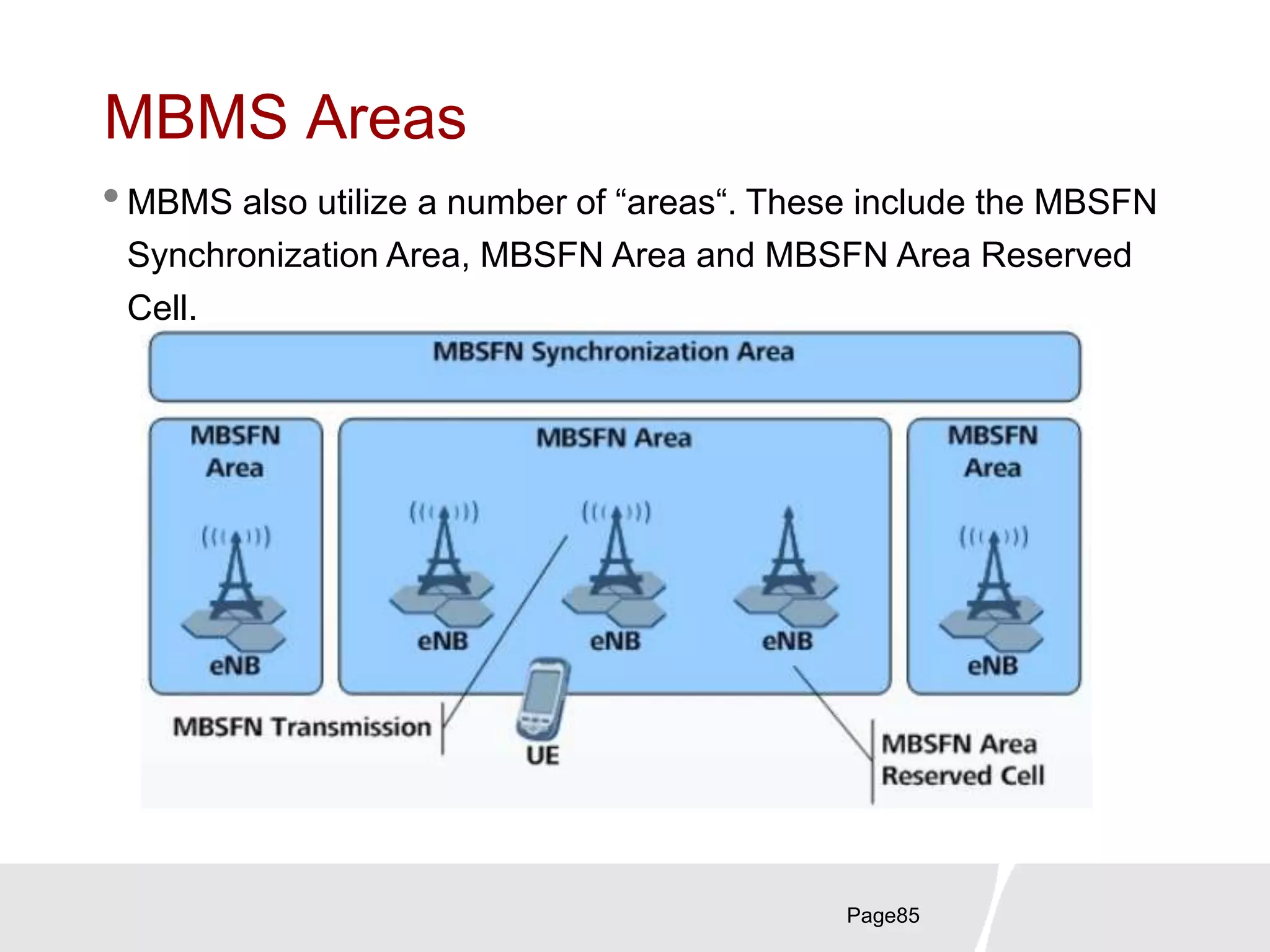
MBMS Areas
Page85
•MBMS also utilize a number of “areas“. These include the MBSFN
Synchronization Area, MBSFN Area and MBSFN Area Reserved
Cell.
Page 86
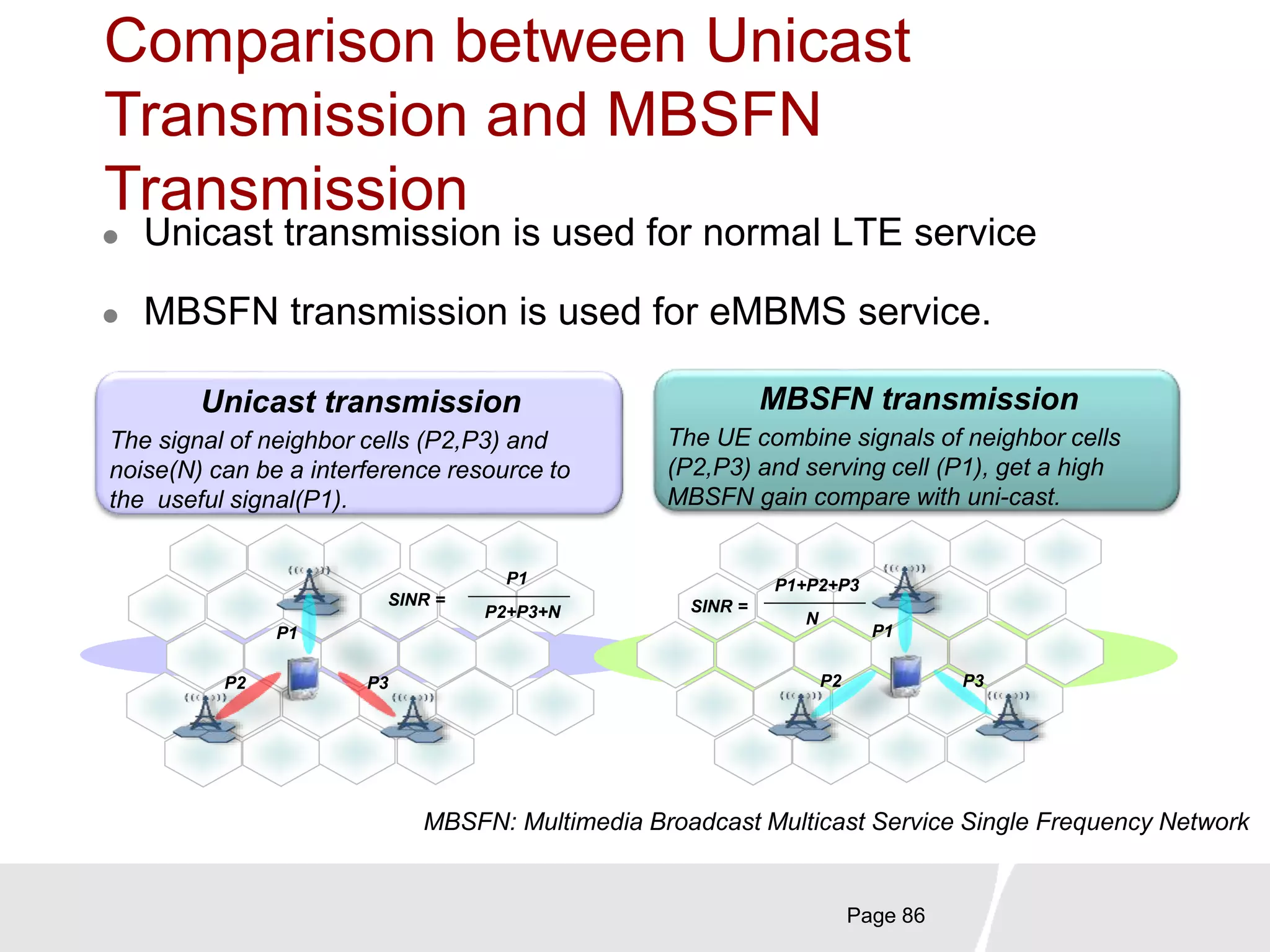
Comparison between Unicast
Transmission and MBSFN
Transmission
MBSFN: Multimedia Broadcast Multicast Service Single Frequency Network
SINR =
P1
P1+P2+P3
N
P2 P3
SINR =
P1
P1
P2+P3+N
P2 P3
Unicast transmission
The signal of neighbor cells (P2,P3) and
noise(N) can be a interference resource to
the useful signal(P1).
MBSFN transmission
The UE combine signals of neighbor cells
(P2,P3) and serving cell (P1), get a high
MBSFN gain compare with uni-cast.
 Unicast transmission is used for normal LTE service
 MBSFN transmission is used for eMBMS service.
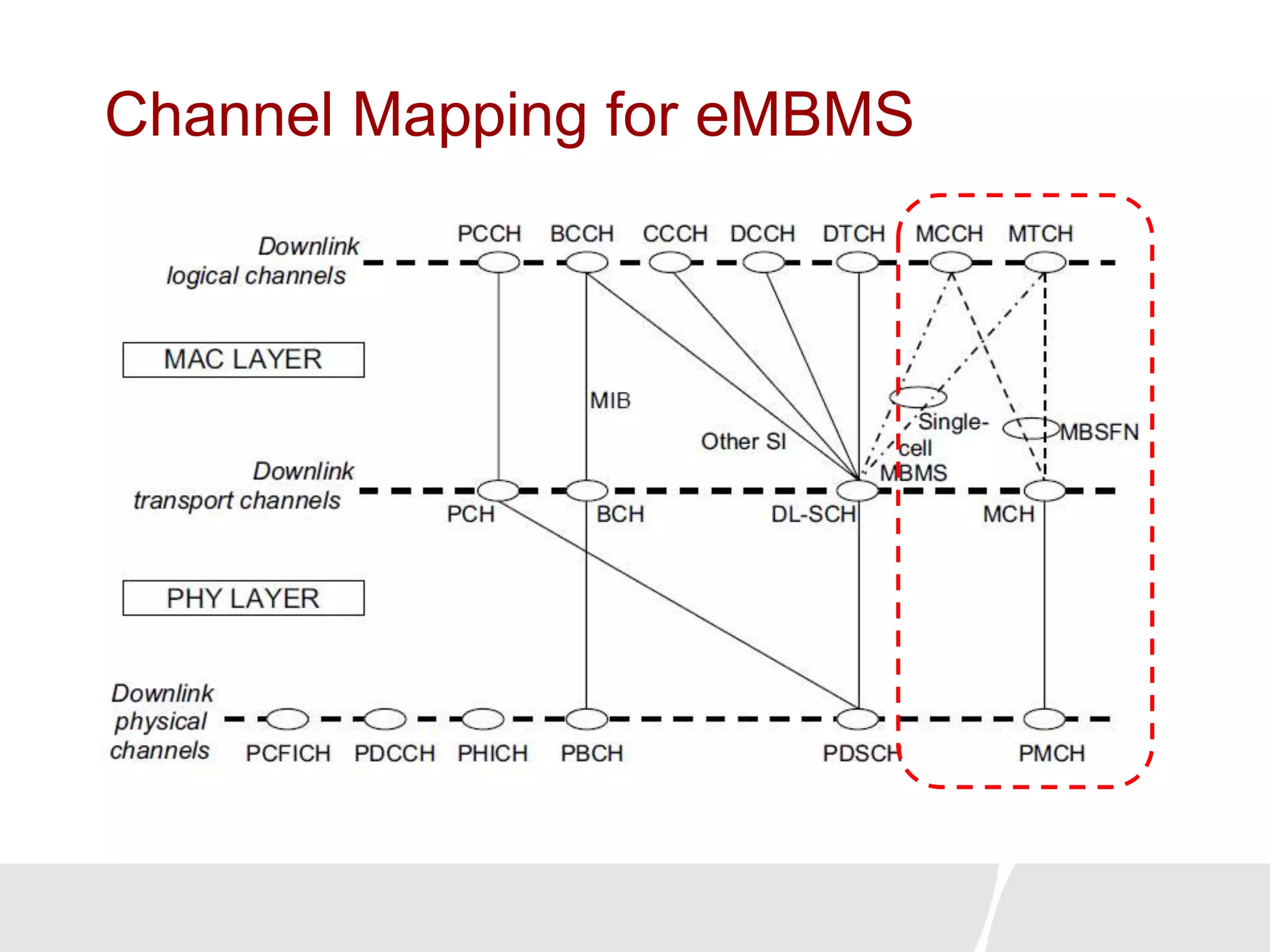
Channel Mapping for eMBMS
LTE-A Key Technogies
Page88
Carrier
Aggregation
HetNet
High Order
MIMO
[06-
2012]
Av. DL
3.7bps/Hz
Av. UL
2.0bps/Hz
Coordinate
d Multi-
Point
1. To boost LTE radio capacity
and spectrum efficiency
2. To fulfill ITU-R “IMT-
Advanced” recommendation
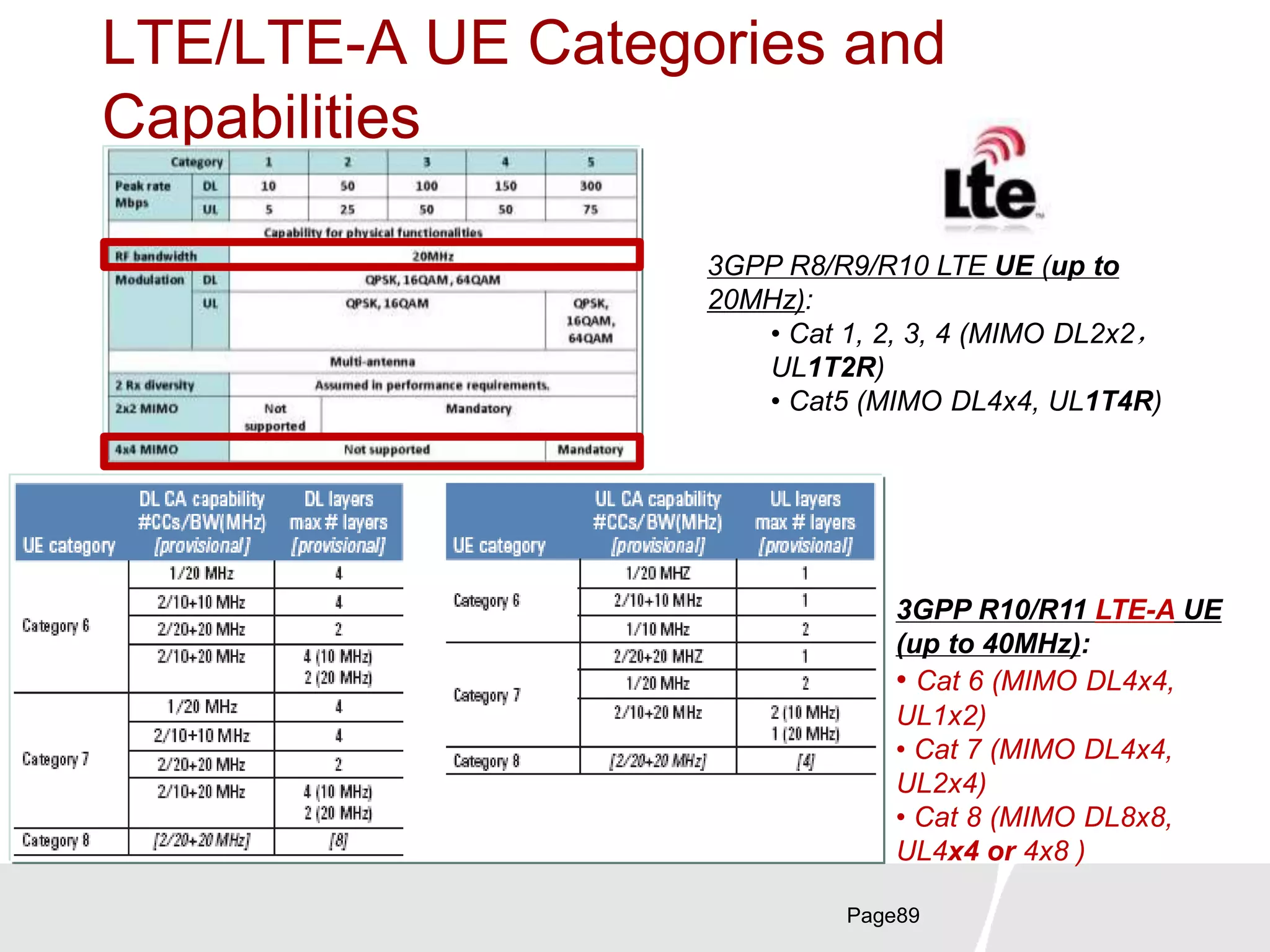
LTE/LTE-A UE Categories and
Capabilities
Page89
3GPP R8/R9/R10 LTE UE (up to
20MHz):
• Cat 1, 2, 3, 4 (MIMO DL2x2,
UL1T2R)
• Cat5 (MIMO DL4x4, UL1T4R)
3GPP R10/R11 LTE-A UE
(up to 40MHz):
• Cat 6 (MIMO DL4x4,
UL1x2)
• Cat 7 (MIMO DL4x4,
UL2x4)
• Cat 8 (MIMO DL8x8,
UL4x4 or 4x8 )
Page90
Contents
1. LTE Industry Briefing
2. LTE Network Architecture
3. LTE Air Interface Principles
4. eNodeB Product Overview
Page91
Contents
4 eNodeB Product Overview
4.1 The Huawei eNB Family Overview
4.2 Operations and Maintenance
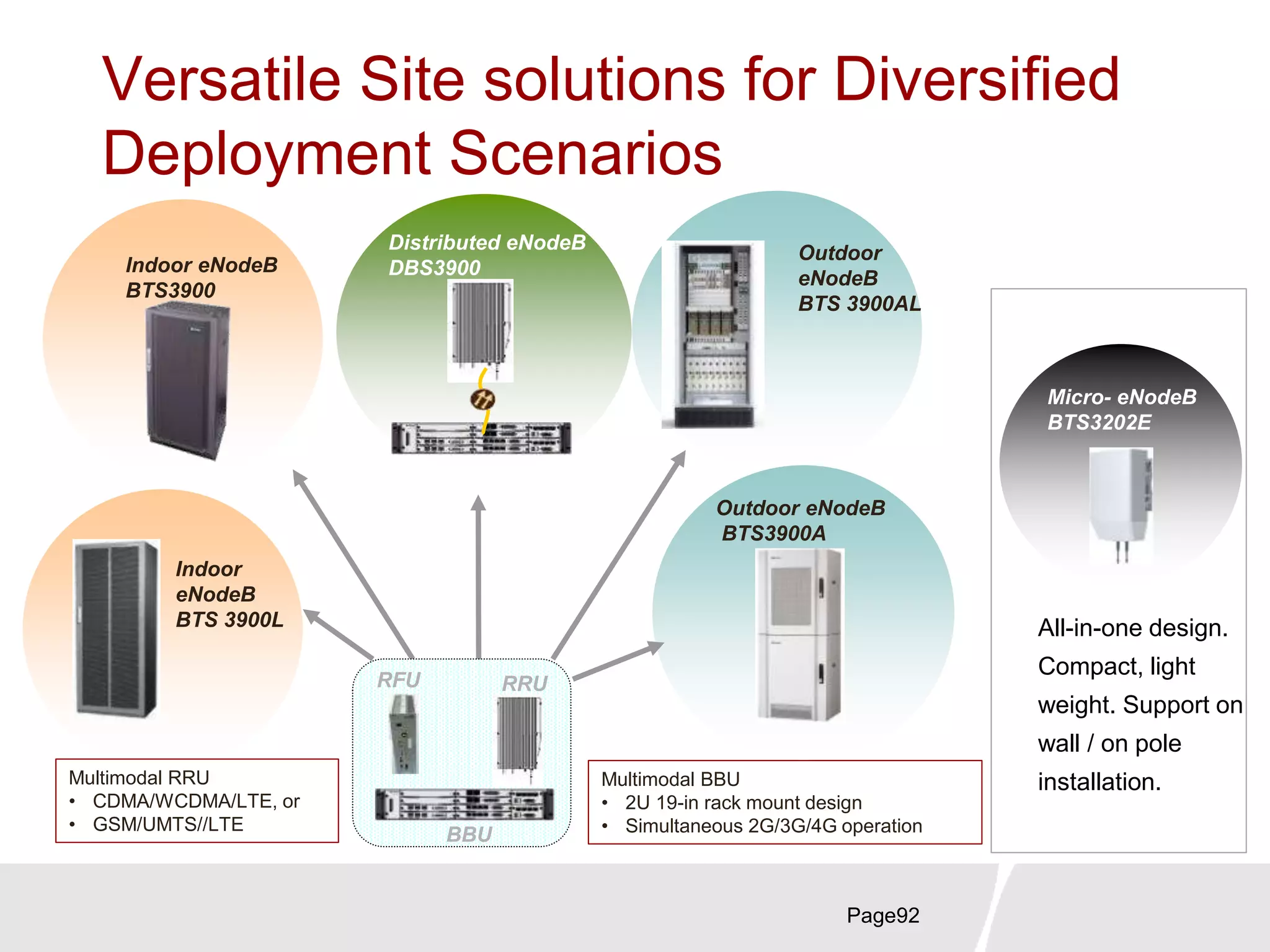
Versatile Site solutions for Diversified
Deployment Scenarios
Page92
Outdoor
eNodeB
BTS 3900AL
Indoor eNodeB
BTS3900
Multimodal RRU
• CDMA/WCDMA/LTE, or
• GSM/UMTS//LTE
Multimodal BBU
• 2U 19-in rack mount design
• Simultaneous 2G/3G/4G operation
Distributed eNodeB
DBS3900
BBU
RFU RRU
Outdoor eNodeB
BTS3900A
Micro- eNodeB
BTS3202E
All-in-one design.
Compact, light
weight. Support on
wall / on pole
installation.
Indoor
eNodeB
BTS 3900L
Page93
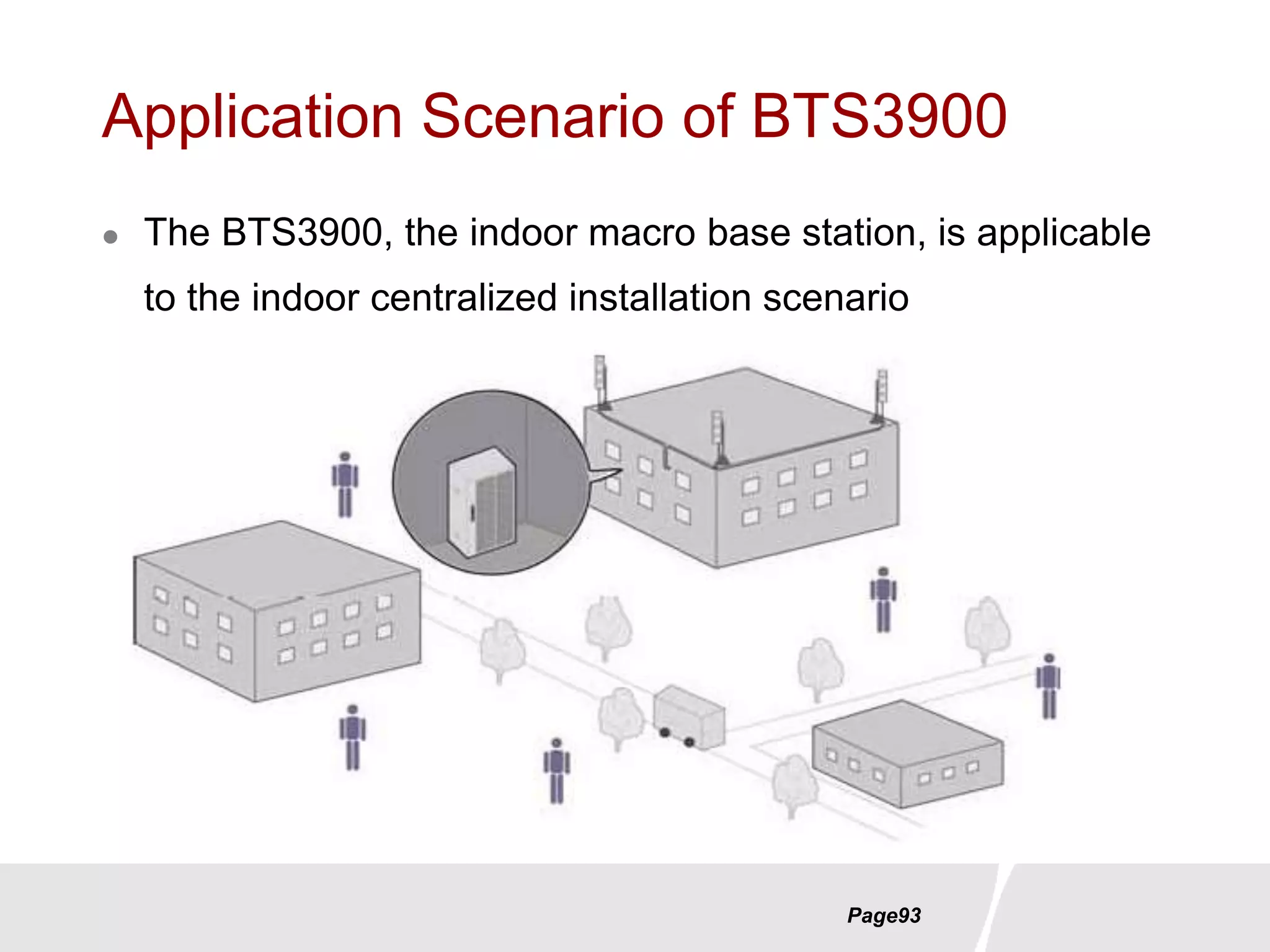
Application Scenario of BTS3900
 The BTS3900, the indoor macro base station, is applicable
to the indoor centralized installation scenario
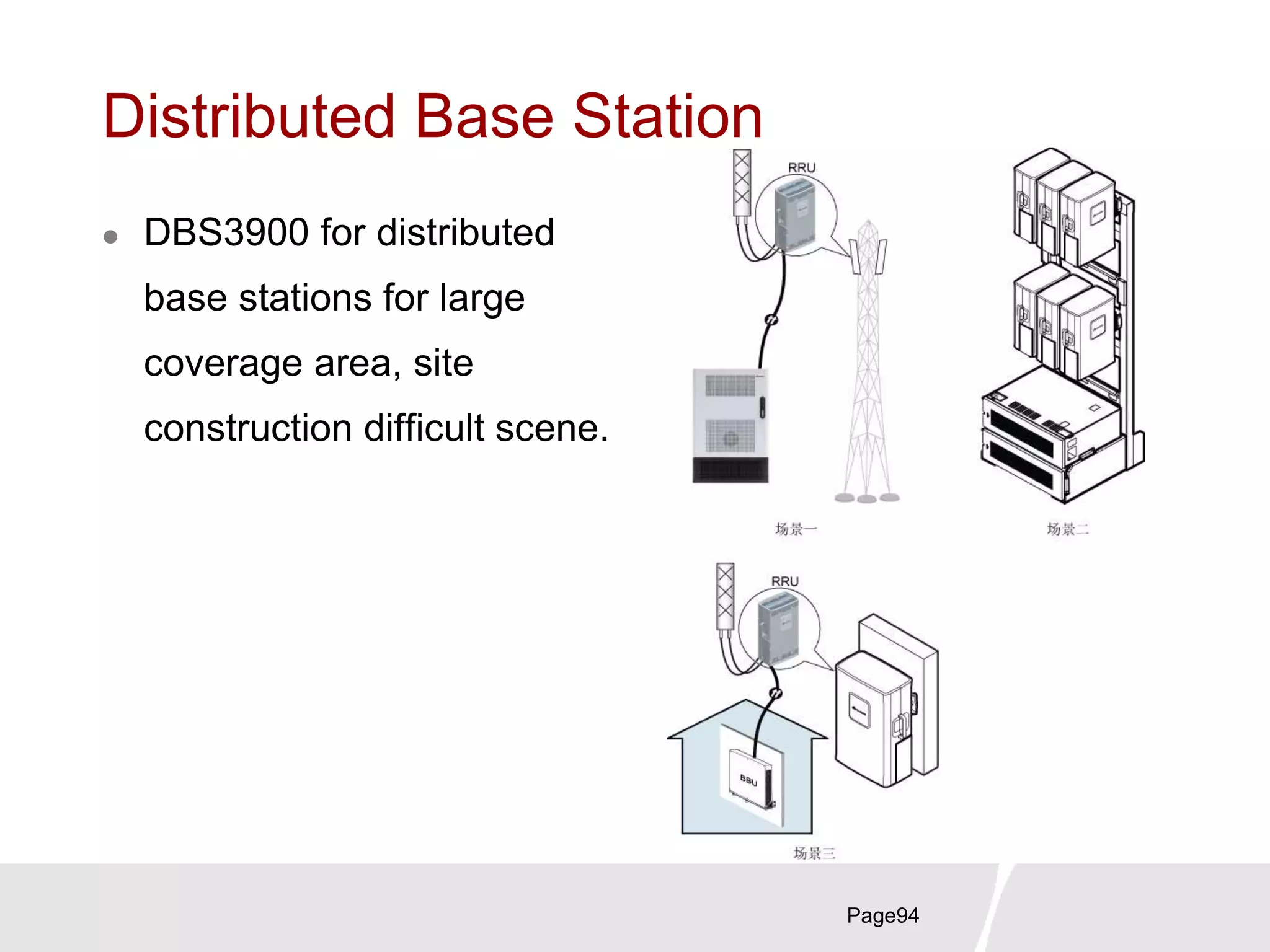
Distributed Base Station
 DBS3900 for distributed
base stations for large
coverage area, site
construction difficult scene.
Page94
Page95
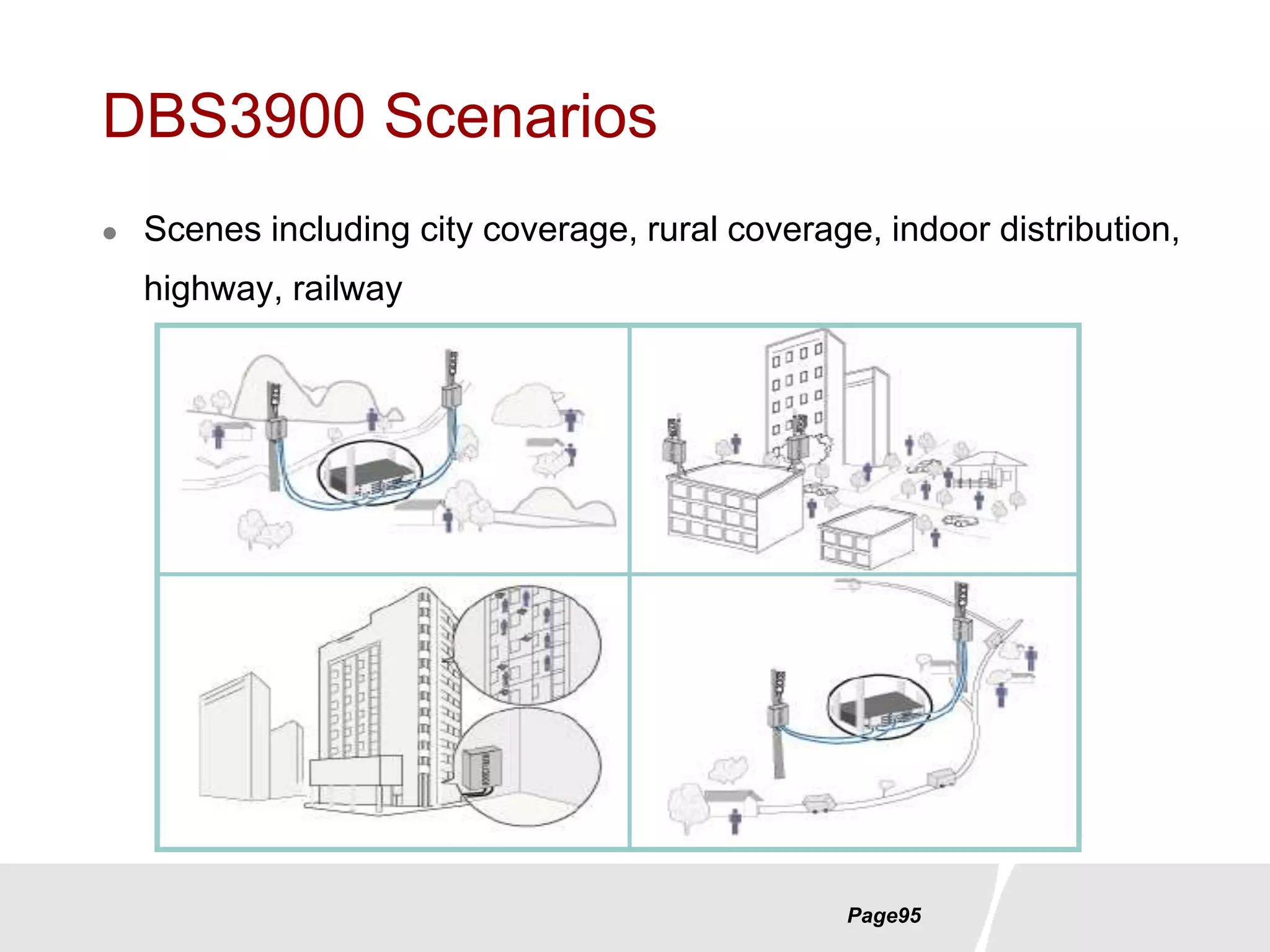
DBS3900 Scenarios
 Scenes including city coverage, rural coverage, indoor distribution,
highway, railway
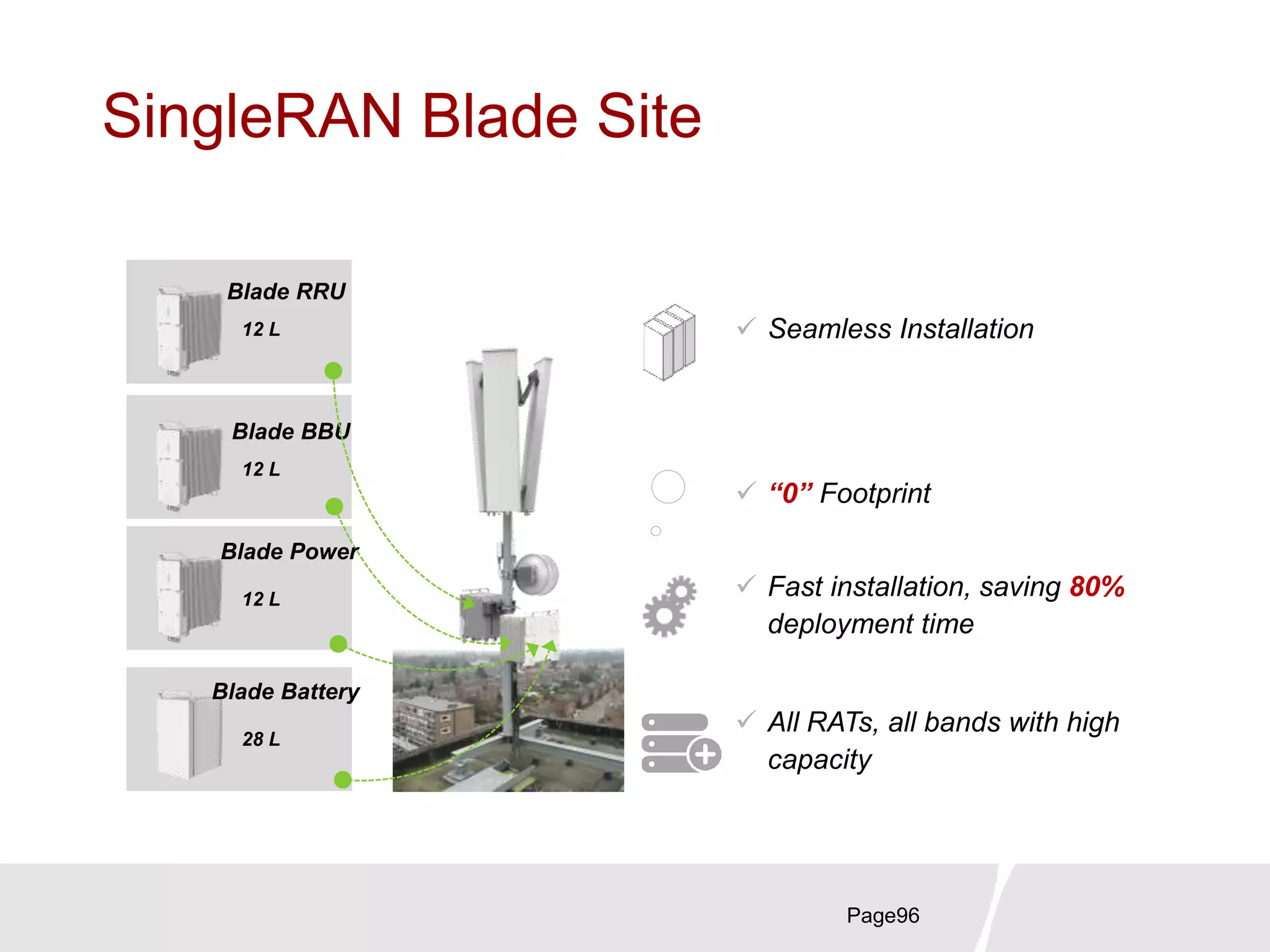
SingleRAN Blade Site
Page96
Blade RRU
Blade BBU
 Seamless Installation
 “0” Footprint
 All RATs, all bands with high
capacity
 Fast installation, saving 80%
deployment time
Blade Battery
Blade Power
12 L
12 L
12 L
28 L
Page97
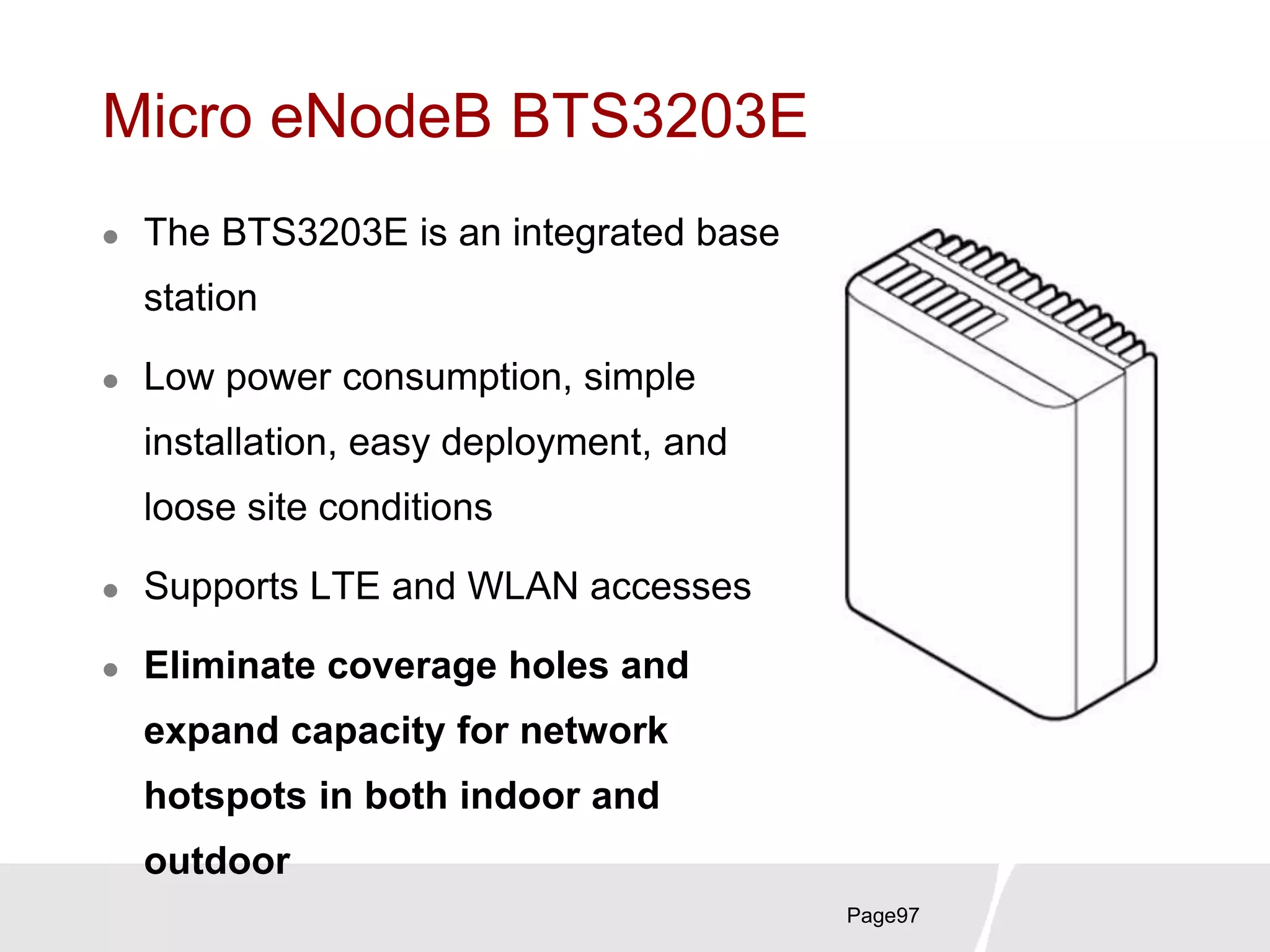
Micro eNodeB BTS3203E
 The BTS3203E is an integrated base
station
 Low power consumption, simple
installation, easy deployment, and
loose site conditions
 Supports LTE and WLAN accesses
 Eliminate coverage holes and
expand capacity for network
hotspots in both indoor and
outdoor
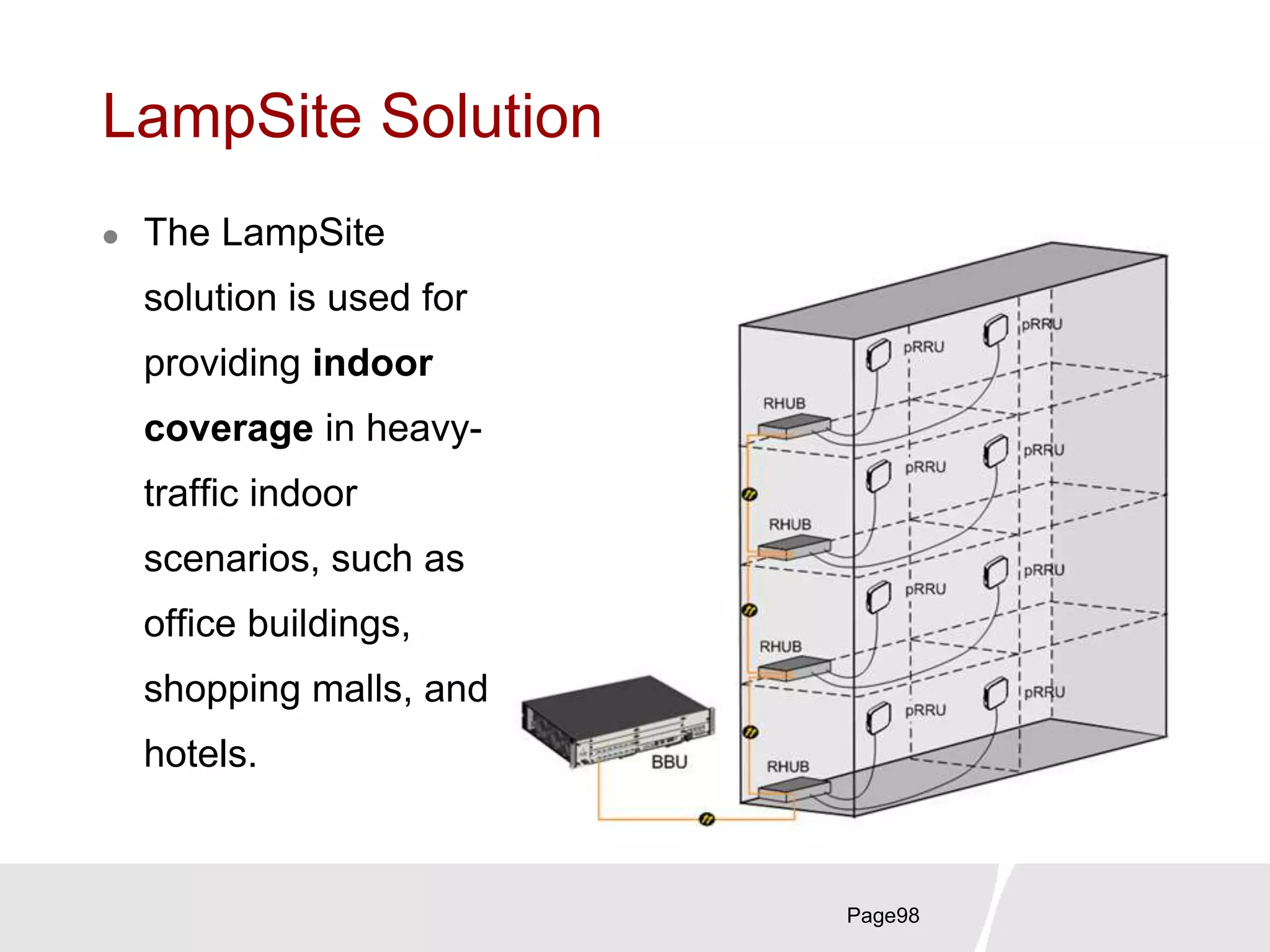
LampSite Solution
 The LampSite
solution is used for
providing indoor
coverage in heavy-
traffic indoor
scenarios, such as
office buildings,
shopping malls, and
hotels.
Page98
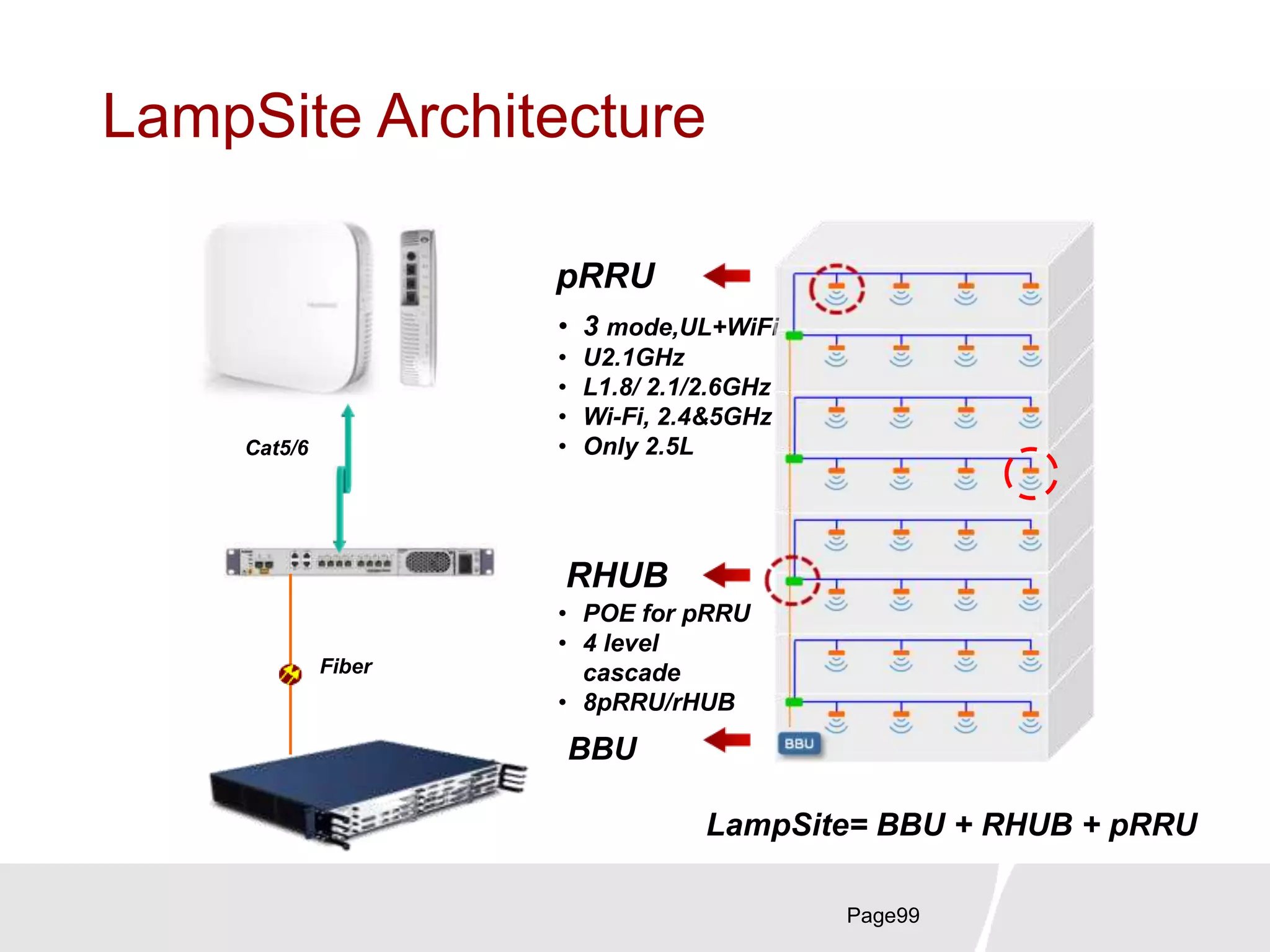
LampSite Architecture
Page99
RHUB
pRRU
BBU
Cat5/6
Fiber
• 3 mode,UL+WiFi
• U2.1GHz
• L1.8/ 2.1/2.6GHz
• Wi-Fi, 2.4&5GHz
• Only 2.5L
• POE for pRRU
• 4 level
cascade
• 8pRRU/rHUB
LampSite= BBU + RHUB + pRRU
Page100
Contents
4 eNB Product Overview
4.1 The Huawei eNB Family Overview
4.2 Operations and Maintenance
Page101
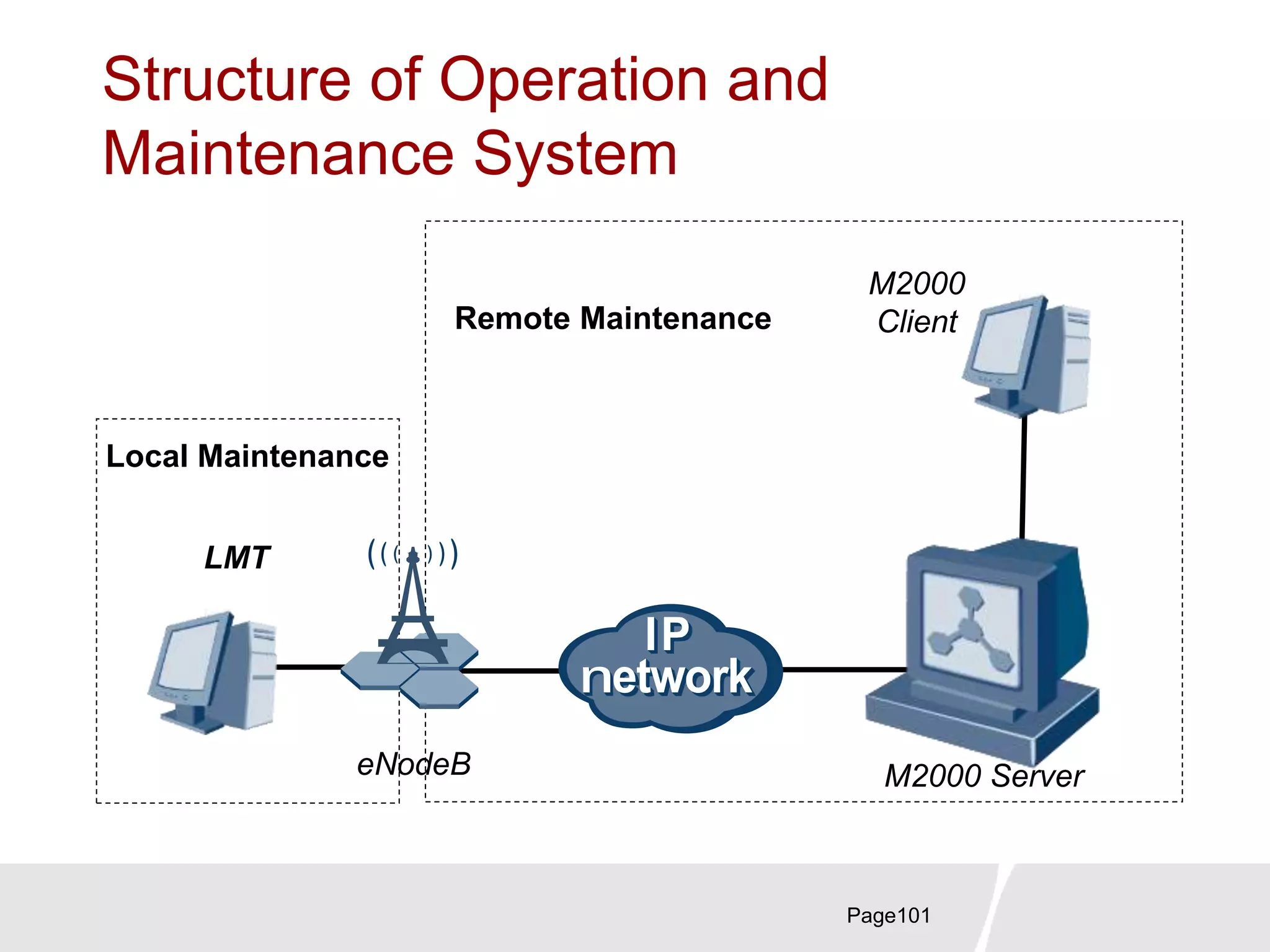
Structure of Operation and
Maintenance System
M2000 ServereNodeB
LMT
M2000
Client
Local Maintenance
Remote Maintenance
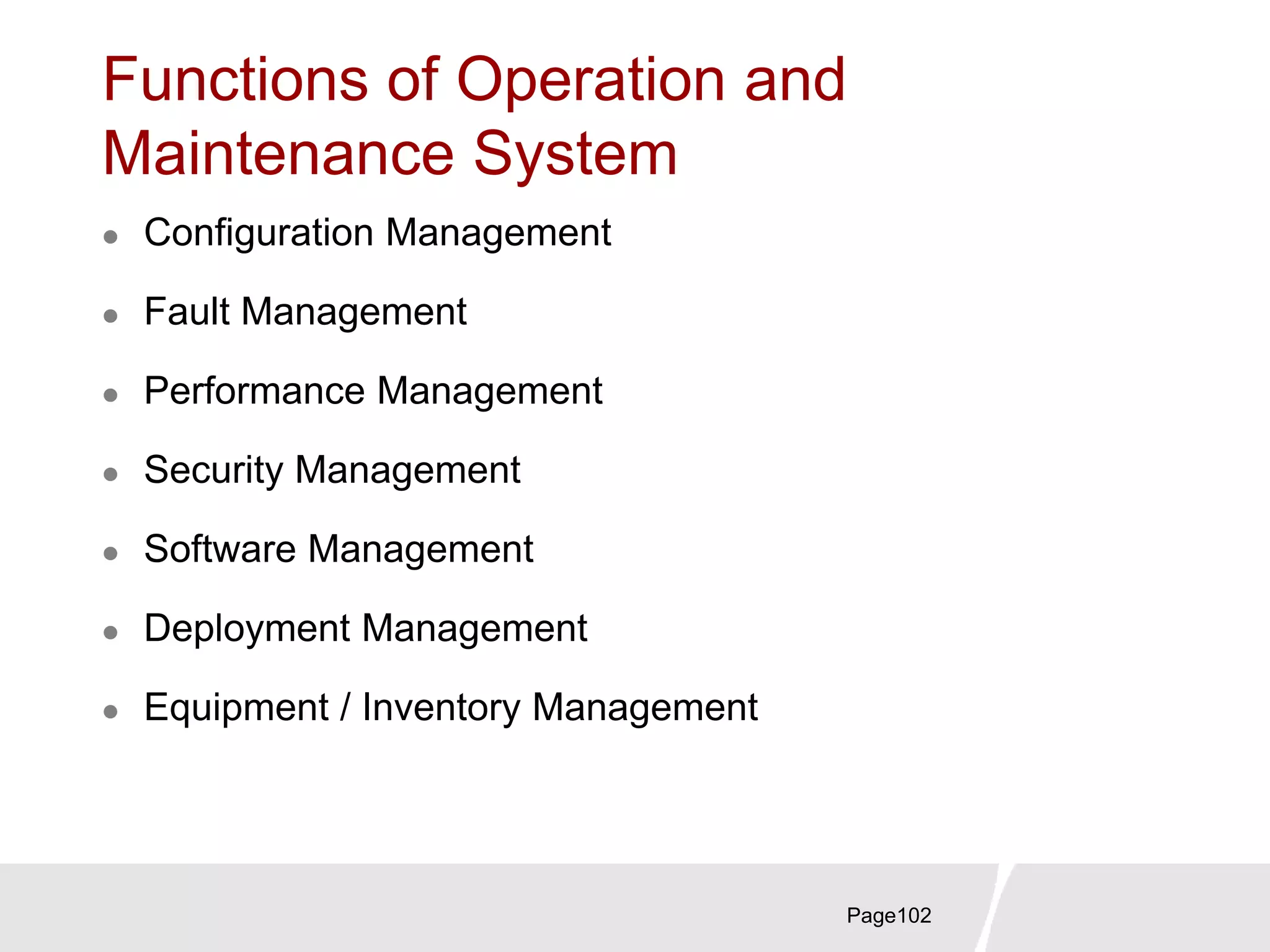
Functions of Operation and
Maintenance System
 Configuration Management
 Fault Management
 Performance Management
 Security Management
 Software Management
 Deployment Management
 Equipment / Inventory Management
Page102
Page103
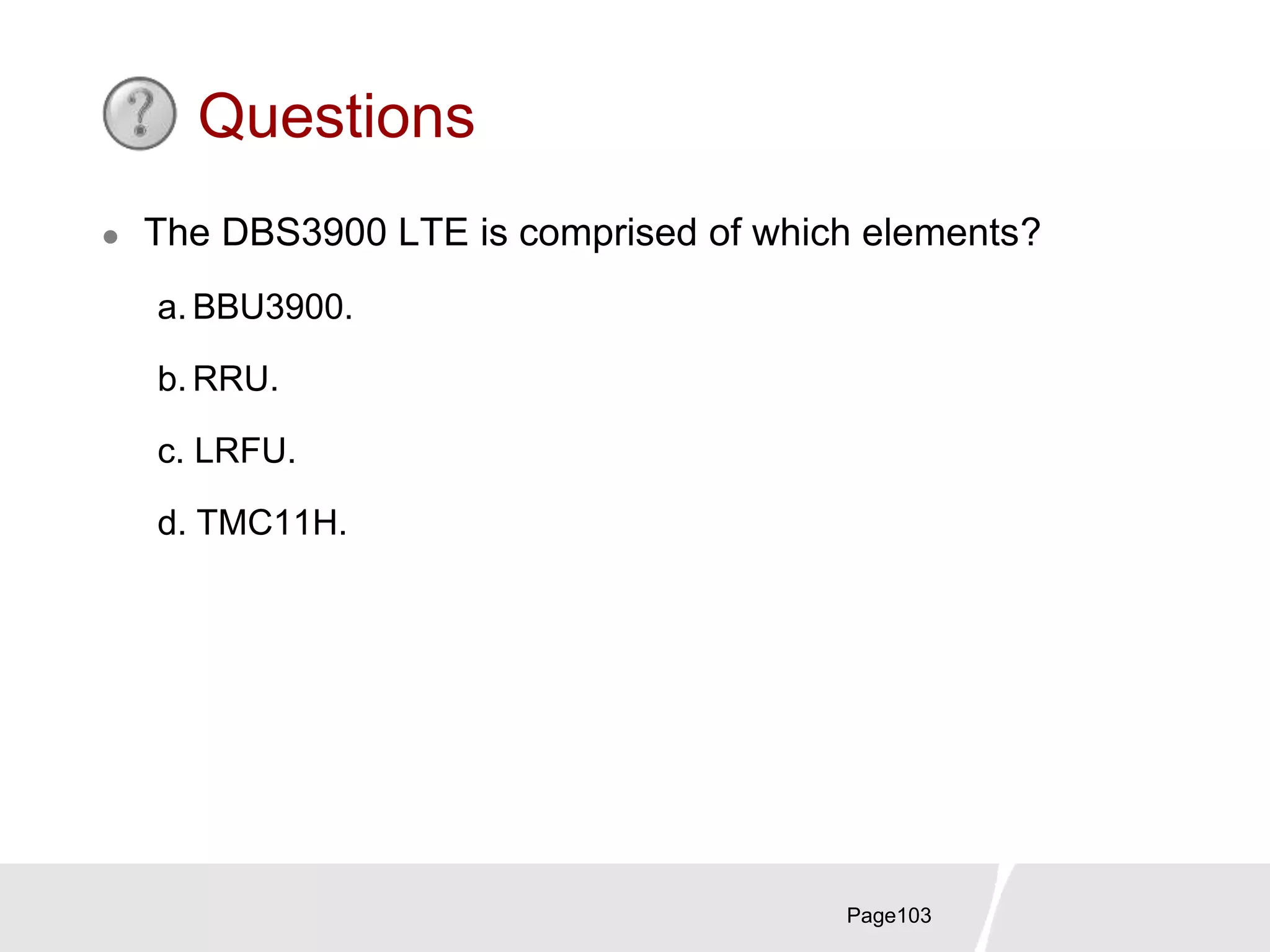
Questions
 The DBS3900 LTE is comprised of which elements?
a. BBU3900.
b. RRU.
c. LRFU.
d. TMC11H.
Page104
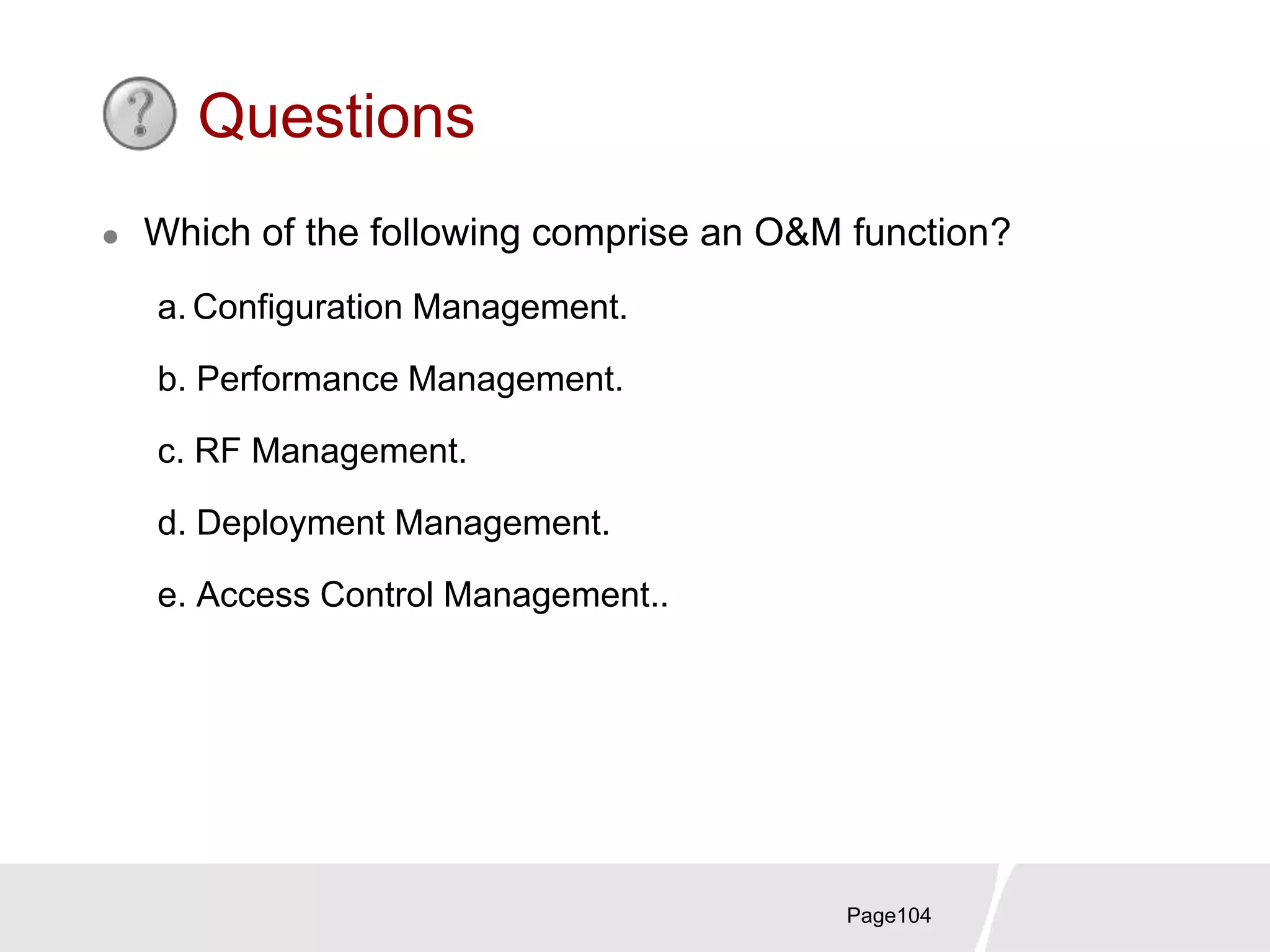
Questions
 Which of the following comprise an O&M function?
a. Configuration Management.
b. Performance Management.
c. RF Management.
d. Deployment Management.
e. Access Control Management..
Summary
1. LTE Industry Briefing
2. LTE Network Architecture
3. LTE Air Interface Principles
4. eNodeB Product Overview
Page105
Thank you
www.huawei.com

Lte principles overview

  • 1.
  • 2.
    Page1 Contents 1. LTE IndustryBriefing 2. LTE Network Architecture 3. LTE Air Interface Principles 4. eNodeB Product Overview
  • 3.
    Evolution of RadioTechnologies Page2 1Gbps LTE-A EV-DO Rel. 0 DL: 2.4Mbps UL:153.6kbps cdma2000 1x 153.6kbps DO Rel. A DL: 3.1Mbps UL: 1.8Mbps DO Rev B DL:46.5Mbps UL: 27Mbps HSPA+ DL>42M UL>11MWCDMA 384Kbps HSDPA DL:14.4Mbp s HSPA DL:14.4Mbps UL:5.8Mbps LTE FDD DL:100Mbps UL:50Mbps GSM EDGE TD-HSDPA DL:2.8Mbps TD-HSUPA UL:2.2Mbps LTE TDD DL:100Mbps UL:50Mbps TD-HSPA+ DL:>25.2Mbps UL:>19.2MbpsTD-SCDMA 384Kbps GPRS 3GPP 3GPP2 R97 R99 R5 R6 R7 R8/R9 R10
  • 4.
    3GPP Evolution :From LTE to LTE-A/B/C Page3 HomoNet LTE-A LTE-B LTE-C OFDMA, MIMO Small Cell CA, CoMP HO MIMO, eICIC 50xSmall Cell Per Macro, (4G certif., 1Gpbs DL Peak .) Fundamental (Capacity Boosting) (Optimized diverse service support) Performance 3GPP Time 2005~2007 2008~2012 2013~2016 2017~2020 10xSmall Cell Per Macro, 256QAM LTE HetNet Fusion-Net
  • 5.
    LTE Technical Objectives Page4 LTERequirements from ITU LTE Technical Features from 3GPP Flexible bandwidth 1.4MHz, 3MHz, 5MHz, 10Mhz, 15Mhz, 20MHz Higher spectrum efficiency DL: 5(bit/s)/Hz, 3~4 times than R6HSDPA UL: 2.5(bit/s)/Hz, 2~3 times than R6HSDPA Higher peak throughput (@20MHz) DL:100Mbps, UL: 50Mbps DL:100Mbps, UL: 50Mbps Control plane:< 100ms, User plane: < 10ms Control plane:< 100ms, User plane: < 10ms Shall support stationary/pedestrian/vehicular/high speed vehicular Shall support high speed vehicular(>350km/h) for 100kbps access service. Support inter-system handover Support interoperability between 3GPP existed and non- 3GPP VoIP Capacity Remove CS domain, CS service realized in PS domain which can support multiple service, especially voice service (such as VoIP). Decrease network evolution cost Remove BSC/RNC Reduce CAPEX and OPEX SON
  • 6.
    LTE Global SpectrumDistribution Page5 •1.8GHz is the most popular for commercialization •GL1800 refarming is hot in Europe and Asia Pacific area •Low frequency could be used for coverage •TD-LTE global main frequency bands: 2.3/2.6(Band 38/40); •Typical bandwidth resource≥20MHz •1.9/2.0GHz: Some bands which are applicable to TD-LTE are mainly used in Europe.
  • 7.
    Type Function AppearanceApplication Scenarios Dongle Data card B323 is a wireless signal converter of which the size is similar to a USB flash drive. It can be inserted into a SIM card to receive and transmit data signals. CPE(Custo mer Premise Equipment) Data services,VoIP services Safety services (firewall and PIN protection mechanism) Local O&M management (equipment management and network configuration) Optional functions: printing and faxing MiFi (Mobile WiFi) Functions of the modem, router, and access point Used for nomadic wireless access for individual subscriber. PAD or mobile phone User equipment that support circuit service and packet service Anywhere, anytime, anyone LTE Main Terminal Type Page6 Wi-Fi RJ45 RJ11 LAN switch or Hub Used for LTE network access in areas covered with strong signals for individual and enterprise customers. Used for broadband access for home or enterprise customers
  • 8.
    LTE Mobile Services Page7 P2P communications HD VoIP  HD video call  MIM  Mobile community  Dynamic and connected address book  High-speed data access, such as mobile Internet services  Social multimedia  Mobile HD music  Online gaming MBB connection Mobile HD video  Mobile 3DTV, IPTV  Video surveillance  Video conference  Video sharing and transferring, such as instant transferring after shooting  MBMS M2M  Public affairs, such as automatic data recording and electric meter  Transportation, such as vehicle communications, navigation, and tracing  Health care, such as remote medical treatment  Financial services, such as mobile vending and automatic selling  Smart homing, such as smart buildings and smart homes  Industrial manufacturing: such as equipment tracing and management Enhanced positioning services Ubiquitous mobile trade  Mobile payment and electronic money  Mobile advertisement  Mobile office  Interactive digital signs and virtual stylists Cloud computing  Cloud storage (photo storage and data backup)  Cloud services, such as public, private, community, and hybrid cloud services Local MobileSocial  GPS  LBS (Location based services)  AR (Augmented Reality)
  • 9.
    LTE Voice Solution Page9 IMS/SR-VCC:Voice over IMS over LTE; handover & roaming to 2G/3G is supported Data on LTE Voice on CS Voice & Data on LTE CS Fallback: UE is attached on LTE, and fallback to 2G/3G for voice calls (MTC and MOC) OTT Mode: To rely on OTT applications for voice service offering SVLTE (Dual Standby): Dual simultaneously radio access running on the same UE allowing data on LTE and voice on 2G/3G CS in parallel LTE Voice Solution
  • 10.
    Page10 Contents 1. LTE IndustryBriefing 2. LTE Network Architecture 3. LTE Air Interface Principles 4. eNodeB Product Overview
  • 11.
    Network Architecture Evolution Flat and simple network architecture  Less network nodes, reduced transmission and radio access delay  Reduced costs on network deployment and maintenance Page 11 UTRAN RNC NodeB NodeB NodeB SGSN eNodeB MMESGW X2 X2X2 S1-U S1-C S1-C S1-U E-UTRAN Iub Iub Iub Iu-CS Iu-PS eNodeB eNodeB CS PS EPC UMTS LTE GGSN MSC/VLR GMSC PSTN page CN HLR P-GW HSS
  • 12.
    EPS Network Architecture EPC is based on packet domain, and does not support circuit domain any longer. Page12 S1-U MME SGi E-UTRAN S1-C S11 Operator’s IP Service S6a HSS SGW S5 PDN-GW Rx Gx PCRF UE Uu S1-C S1-U X2 UE EPCUE Control Plane User Plane GERAN /UTRAN CS CN PS CN E-UTRAN EPC “LTE” “SAE” EPS
  • 13.
    EPS Control PlaneProtocol Page13
  • 14.
    EPS User PlaneProtocol Page14
  • 15.
    X2 Interface Page15 eNB eNB X2 IP Layer2 Layer 1 SCTP X2AP Control Plane IP Layer 2 Layer 1 UDP GTP-U User Plane
  • 16.
    Typical Packet Service eNodeB MME S-GWP-GW ICP/ISP internet Data Signaling 1 2
  • 17.
    Typical Voice Service eNodeB MME S-GWP-GW EPC Data (VOIP) EPC Signaling 1 4 CSCF IMS domain MGCF IMS-MGW MSC 2 4 IMS Signaling PLMN SS7 SS7 Signaling 3
  • 18.
    Page18 EPS Network Structureof GUL Access S-GW eNodeB MME SGSN HSS LTE NodeB RNC UTRAN BSC/PCUBTS GERAN Gx S1-U S1-MME S12 S4 S6a S3 S11 Operator's IP Services PCRF Rx SGi P-GW S5
  • 19.
    Page19 Questions  Which networkelements form parts of the EPC? a. UE. b. eNB. c. MME. d. S-GW. e. PDN-GW. f. HSS.
  • 20.
    Page20 Questions  Which interfacelinks the eNB to the MME? a. Uu. b. S1. c. X2 d. S5.
  • 21.
    Page21 Contents 1. LTE IndustryBriefing 2. LTE Network Architecture 3. LTE Air Interface Principles 4. eNodeB Product Overview
  • 22.
    Page22 Contents 3 LTE AirInterface Principles 3.1 Principles of OFDM 3.2 Multiple Access and Duplex Technologies 3.3 LTE Frame Structure 3.4 LTE Physical Channel 3.5 Physical Procedures 3.6 Key Technologies
  • 23.
    Division Multiplexing Overview Division Multiplexing (DM)  Multiplexed data streams can be used for one or multiple UEs. Page 23 Frequency Power Time Datastream1 Datastream2 Datastream3 Datastream4 Frequency Power Time Data stream 1 Data stream 2 Data stream 3 Data stream 4 Frequency Power Time Data stream 3 Data stream 4 Data stream 2 Data stream 1 FDM: Multiplex multiple data streams in the frequency domain TDM: Multiplex multiple data streams in the time domain CDM: Multiplex multiple data streams in the code domain
  • 24.
    OFDM Overview  OFDM(Orthogonal frequency division multiplexing) is essentially a FDM.  Multiple orthogonal frequencies are used to achieve data transmission on a greater bandwidth.  OFDM subcarriers are overlapping and orthogonal, greatly improving the spectral efficiency. Page 24 FDM OFDM
  • 25.
    eNB UE Page25 OFDM and MultipleAccess in LTE OFDM (OFDMA) OFDM (SC-FDMA)
  • 26.
    Page26 Contents 3 LTE AirInterface Principles 3.1 Principles of OFDM 3.2 Multiple Access and Duplex Technologies 3.3 LTE Frame Structure 3.4 LTE Physical Channel 3.5 Physical Procedures 3.6 Key Technologies
  • 27.
    Multiple Access Technology: DistinguishingUsers Page 27 OFDMA FDMA TDMA CDMA Frequency Power Time FDMA Each user is allocated with a specific sub- frequency band or channel. Frequency Power Time TDMA Each user is allocated with a specific time on a channel. Frequency Power Time CDMA Each user is allocated with a specific code on a channel. Frequency Power Time OFDMA Each user is allocated with a specific resource, which varies in the time domain and frequency domain.
  • 28.
    Comparison between DMand DMA Page28 Frequency Code Time DS1 DS2 DS4 DS3 CDM: Reuse data streams in code domain Frequency Time TDMA: Reuse users in time domain U1 U2 U3 U4 Code Frequency Time U1 U2 U4 U3 CDMA: Reuse users in code domain Code Frequency Code Time U 1 U 2 U 3 U 4 FDMA: Reuse users in frequency domain Multiplex data streams mapping to different users separately Frequency Time DS 1 DS 2 DS 3 DS 4 FDM: Reuse data streams in frequency domain Code Frequency Code Time TDM: Reuse data streams in time domain DS4 DS3 DS2 DS1 DS: Data Stream U: User
  • 29.
    From FDM/FDMA toOFDM/OFDMA Page29 f1 f2 Traditional FDM Spectrum f3 f4 Frequency Time D 1 D 2 D 3 D 4 Traditional FDM Code Frequency Code Time U 1 U 2 U 3 U 4 Traditional FDMA Time Frequency D 1 D 2 D 3 D 4 D 5 D 6 D 7 D 8 D 9 D 10 D 11 D 12 OFDM Code Time Frequency U 1 U 2 U 3 U 4 U 5 U 6 U 7 U 8 U 9 U 10 U 11 U 12 OFDMA Code Frequency Bandwidth High spectrum efficiency
  • 30.
    LTE DL MultipleAccess - OFDMA  OFDMA defines the technology of orthogonal frequency division multiple access.  OFDMA is essentially the combination of TDMA and FDMA. Page30 Subcarrier TTI: 1 ms Frequency Time Time and frequency resources allocated to user 1 System bandwidth Sub-frequency band: 12 subcarriers Time and frequency resources allocated to user 2 Time and frequency resources allocated to user 3
  • 31.
    LTE UL MultipleAccess - SC-FDMA  To eliminate the limitation of the high PAPR on the PA, LTE uses single carrier frequency division multiple access (SC- FDMA) in the uplink. Page310 Single carrier TTI: 1 ms Frequency Time Frequency bandwidth Sub-frequency band: 12 subcarriers Time and frequency resources allocated to user 1 Time and frequency resources allocated to user 2 Time and frequency resources allocated to user 3
  • 32.
  • 33.
    Duplex Technologies: Distinguishing UL/DLSignals  TDD: The uplink and downlink use different slots.  Applications: LTE TDD, TD-SCDMA, and WiMAX Page33  FDD: The uplink and downlink use different frequencies.  Applications: LTE FDD, WCDMA, CDMA2000
  • 34.
    Page34 Contents 3 LTE AirInterface Principles 3.1 Principles of OFDM 3.2 Multiple Access and Duplex Technologies 3.3 LTE Frame Structure 3.4 LTE Physical Channel 3.5 Physical Procedures 3.6 Key Technologies
  • 35.
    Page35 LTE Frame StructureType1-FDD One Slot,Tslot = 15360 x Ts=0.5ms Radio Frame Tf = 307200 x Ts = 10ms Subframe (1ms) 0 1 2 3 4 5 6 7 8 9 10 11 12 13 14 15 16 17 18 19 Ts = 1/(15000x2048) = 32.552083ns  Radio frame: 10ms  Subframe: 1ms  Slot: 0.5ms
  • 36.
    LTE Frame StructureType2-TDD  Special subframe = DwPTS+GP+UpPTS=1ms  GP is reserved for downlink to uplink transition. Page36 Type 2 Radio Frame Tf = 307200 x Ts = 10ms 0 2 3 4 5 7 8 9 One half-frame, 153600Ts=5ms One subframe, 30720Ts=1ms DwPTS (Downlink Pilot Time Slot) GP (Guard Period) UpPTS (Uplink Pilot Time Slot) Special Subframe Special Subframe
  • 37.
    Type 2 RadioFrame DL/UL Subframe Allocation Page37 DL-UL Configuration Switch-point periodicity Subframe number 0 1 2 3 4 5 6 7 8 9 0 5 ms D S U U U D S U U U 1 5 ms D S U U D D S U U D 2 5 ms D S U D D D S U D D 3 10 ms D S U U U D D D D D 4 10 ms D S U U D D D D D D 5 10 ms D S U D D D D D D D 6 5 ms D S U U U D S U U D D: Downlink subframe U: Uplink subframe S: Special subframe
  • 38.
    Special Subframe Configuration Page38 Special Subframe Configuration SpecialSubframe Length in Normal CP(Symbol Number ) RTD max (us) Largest coverage distance by theory (km)DwPTS GP UpPTS 0 3 10 1 677.06 101.56 1 9 4 1 248.42 37.26 2 10 3 1 177.06 26.56 3 11 2 1 105.71 15.86 4 12 1 1 34.35 5.15 5 3 9 2 605.71 90.86 6 9 3 2 177.06 26.56 7 10 2 2 105.71 15.86 8 11 1 2 34.35 5.15
  • 39.
    GP Functions inTDD system Page39 DwPTSDwPTS UpPTS L UpPTS DL subframe Gp UL subframe UL subframe DL subframe DwPTS T=2 △t UpPTS
  • 40.
    Page40 CP(Cyclic Prefix) Radio Frame= 10ms 0 1 2 3 4 5 6 7 8 9 10 11 12 13 14 15 16 17 18 19 7 OFDM Symbols (Normal CP) 6 OFDM Symbols (Extended CP) 0 1 2 3 4 5 6 0 1 2 3 4 5 CP Tsymbol Tsymbol  Extended CP is generally used in cells with extended coverage.
  • 41.
  • 42.
    Inter Symbol Interference 1stReceived Signal Delayed Signal Interference Caused Page42
  • 43.
    Cyclic Prefix CP CP CP CP CP CP CP CP CP CP CP CP Frequency Time Symbol PeriodT(s) T(g) Symbol Period T(s) Bit Period T(b) Cyclic Prefix Page43
  • 44.
    PRB and RE RadioFrame = 10ms 0 2 3 4 5 7 8 961 Slot 8 Slot 9 Subframe NRB DL NSC RBSubcarriers=12 Physical Resource Block Resource Element NSymbDL Page44
  • 45.
    Page45 Channel BW andRB Channel bandwidth BWChannel [MHz] 1.4 3 5 10 15 20 Transmission bandwidth configuration NRB 6 15 25 50 75 100 Transmission Bandwidth [RB] Transmission Bandwidth Configuration [RB] Channel Bandwidth [MHz] Resourceblock Channeledge Channeledge DC carrier (downlink only)Active Resource Blocks  For details, please refer to protocol 36.101
  • 46.
    Page46 Contents 3 LTE AirInterface Principles 3.1 Principles of OFDM 3.2 Multiple Access and Duplex Technologies 3.3 LTE Frame Structure 3.4 LTE Physical Channel 3.5 Physical Procedures 3.6 Key Technologies
  • 47.
    Page47 Location of LTEPhysical Channels RLC MAC PHY Logical Channels Transport Channels Physical Channels Radio Channel Logical channels indicate the type of information transferred. Transport channels describe what typical configuration the physical layer uses to provide transport services on the air interface. Physical channels describe the physical features of signals, such as coding and modulation. eNB UE Radio Channel FDD Radio Channel UE TDD Radio channel
  • 48.
    Downlink / UplinkChannel Mapping Page48 DL-SCH Physical Layer MAC Layer RLC Layer PDCP Layer RRC Layer Physical Channels Transport Channels Logical Channels PDSCHPDCCHPHICHPCFICHPBCH BCH PCH BCCH PCCH CCCH DCCH DTCH TM TM TM UM/AM UM/AM Ciphering Integrity Ciphering ROHC RRC ESM EMM IPNAS Layer PUSCHPUCCHPRACH RACH CCCH TM UM/AM UM/AM Ciphering Integrity Ciphering ROHC RRC ESM EMM IP UL-SCH DCCH DTCH Downlink Channel Uplink Channel
  • 49.
    • Sounding ReferenceSignal  Provides the eNB with uplink channel quality information(CQI) which can be used for scheduling. Reference Signals Page49 • Cell Specific Reference Signals (non-MBSFN) • MBSFN Reference Signals(only for MBSFN) • UE Specific Reference Signals (It is typically used for beamforming) • Demodulation Reference Signal  Used for channel estimation to help the demodulation of the control and data channels in the eNB. CRS DMRS SRS UL RS DL RS
  • 50.
    Cell Specific ReferenceSignals Page50  It is worth nothing that the position of the reference signals is dependent on the value of the Physical Cell ID. 0l 0R 0R 0R 0R 6l 0l 0R 0R 0R 0R 6l OneantennaportTwoantenna ports Resource element (k,l) Not used for transmission on this antenna port Reference symbols on this antenna port 0l 0R 0R 0R 0R 6l 0l 0R 0R 0R 0R 6l 0l 1R 1R 1R 1R 6l 0l 1R 1R 1R 1R 6l 0l 0R 0R 0R 0R 6l 0l 0R 0R 0R 0R 6l 0l 1R 1R 1R 1R 6l 0l 1R 1R 1R 1R 6l Fourantennaports 0l 6l 0l 2R 6l 0l 6l 0l 6l 2R 2R 2R 3R 3R 3R 3R even-numbered slots odd-numbered slots Antenna port 0 even-numbered slots odd-numbered slots Antenna port 1 even-numbered slots odd-numbered slots Antenna port 2 even-numbered slots odd-numbered slots Antenna port 3 R1:The RS of NO.1 antenna port R2: The RS of NO.2 antenna port R3: The RS of NO.3 antenna port R4: The RS of NO.4 antenna port
  • 51.
    RS Measurement  Afterreceiving all necessary system messages, UE starts to measure RS for cell selection and reselection  The following quantity should be evaluated for UE idle status measurement  RSRP: Reference Signal Received Power  RSRQ: Reference Signal Received Quality Page51
  • 52.
    eNodeB DL DataTransmission and Channel State Acquisition Page52 PDCCH: DL UEscheduling &PDSCH: DL UEdata eNB UE PUCCH/PUSCH: CQI, PMI, RI ReportC-RS PUCCH/PUSCH: ACK/NACK feedback
  • 53.
    eNodeB UL DataTransmission and Channel State Acquisition Page53 PDCCH: UL Grant eNB UE Sounding RS PHICH: ACK/NACK feedbackPUSCH: User UL Data PUCCH: SRor PUSCH: BSR&PHR
  • 54.
    Page54 Questions  True /False. A cyclic prefix is used to combat multipath delays. a. True. b. False.
  • 55.
    Page55 Questions  How manysymbols are there in a slot when a normal CP is used? a. 5. b. 6. c. 7. d. 8.
  • 56.
    Page56 Questions  Which ofthe following are downlink transport channels? a. BCH. b. PCH. c. RACH. d. UL-SCH. e. DL-SCH.
  • 57.
    Page57 Contents 3 LTE AirInterface Principles 3.1 Principles of OFDM 3.2 Multiple Access and Duplex Technologies 3.3 LTE Frame Structure 3.4 LTE Physical Channel 3.5 Physical Procedures 3.6 Key Technologies
  • 58.
    LTE Cell SearchProcedure Page58 Power On Cell Search PLMN/Cell Selection RACH Process Downlink Synchronization Complete Uplink Synchronization Complete
  • 59.
    Downlink Synchronization Signals eNB UE Page59 CellSearch and Downlink Synchronization cell (1) (2) (1) (2) Where: NID = 3NID + NID NID = 0,…..167 NID = 0, 1, or 2 eNB eNB eNB PSS- One of 3 Identities SSS- One of 168 Group Identities 504 Unique Cell Identities
  • 60.
    System Information Page60 System Information MIB SIB1 SI An MIBcontains SFN (8 bits), cell bandwidth, and PHICH configuration parameters. PLMN ID, Cell ID, TAC, Cell barred, cell selection parameters, SI scheduling information. SI message carriesSIB2~SIB13 SIB2 SIB10 SIB11 SIB12 SIB13 SIB3 SIB4 SIB5 SIB6 SIB7 SIB8 SIB9 Radio parameters shared by all UE in the cell: Access parameters, UE timer and common channel parameter configuration (RACH, PRACH, BCCH, PCCH, PDSCH, PUCCH, PUSCH, SRS…) cell reselection information intra-frequency neighboring cell information inter-frequency neighboring cell information UMTS neighboring cell information GSM neighboring cell information CDMA neighboring cell information Name of Home eNodeB primary notification of ETWS secondary notification of ETWS CMASnotification Information to request MBSFN control information related to one or more region The first three are key SIBs, including PLMN ID, cell selection parameters, etc.
  • 61.
    PLMN Selection Page61 Last RPLMN HPLMN& EHPLMN User Controlled PLMN Selector with Access Technology Operator Controlled PLMN Selector with Access Technology The PLMN with signals of high received quality Other PLMN Based On Wireless Quality Stored in UE Set in SIM Set in SIM Set in UE Suggested PLMN List in SIM card:  PLMN + E-UTRAN  PLMN + UTRAN  PLMN + GSM PLMN Select When UE Switch On The Timer of HPLMN Reselection is Saved in SIM Card (no less 6 min)
  • 62.
  • 63.
    Page63 Random Access Procedure UEeNB PRACH Preamble Sequence RACH MACScheduling Grant RRCConnection Request UL-SCH RRCConnection Setup Complete UL-SCH Signalling Radio Bearer (RRCConnected) RRC Connection Setup DL-SCH MAC Contention Resolution If two UEs send their s-TMSIs simultaneously, the eNodeB needs to choose a UE to connect.
  • 64.
    Page64 Contents 3 LTE AirInterface Principles 3.1 Principles of OFDM 3.2 Multiple Access and Duplex Technologies 3.3 LTE Frame Structure 3.4 LTE Physical Channel 3.5 Physical Procedures 3.6 Key Technologies
  • 65.
    Page65 Contents 3.6 Key Technologies 3.6.1MIMO 3.6.2 SON 3.6.3 CA 3.6.4 CoMP 3.6.5 HetNet 3.6.6 eMBMS
  • 66.
    Radio Channel AccessMode Page66  Diversity receiving mode  Diversity transmitting mode  MIMO mode Transmitting antenna Receiving antenna Physical channel SISO MISO SIMO MIMO  Traditional antenna mode
  • 67.
    Multiple-Input Multiple-Output (MIMO) Page67 Two-channel stereo, feel so good. Two speakers + two ears MIMO doubles network access rate Two receive antennas + two transmit antennas
  • 68.
    Forms of MIMO Page68 Spatial multiplexing UE A (f) I J K L M N O P Transmit Diversity A (f) A (f) A (f) UE Cell A Cell B Cell C Beamforming Attention please! Attention please! Attention please! Attention please!
  • 69.
    SU-MIMO/MU-MIMO Page69 Two different data streams AfterPrecoding, the two data streams mixed in different transmit antennas with different transmit power and phase •Uplink •Downlink •Uplink
  • 70.
    Benefits of MIMO Improve the system capacity  Increase the peak rate  Optimize the system coverage Page70
  • 71.
    High Order MIMO Page71 Provide Peak Data Rate  DL:  300 ~600 Mbps (4x4 MIMO, 8x8 MIMO) in 20MHz  >1Gbps (4x4 MIMO) with CA.  UL:  150 ~300 Mbps (2x4 MIMO, 4x4 MIMO) in 20MHz  >1Gbps (4x4 MIMO) with  Increase system capacity and spectral efficiency  DL HO MIMO up to 8x8, enhanced DL MU-MIMO  UL SU-MIMO up to 4T, enhanced UL MU-MIMO
  • 72.
    Page72 Contents 3.6 Key Technologies 3.6.1MIMO 3.6.2 SON 3.6.3 CA 3.6.4 CoMP 3.6.5 HetNet 3.6.6 eMBMS
  • 73.
    Deployment stage O&Mstage Network plan and design Installation and commissionin g Network performance improvement Network O&M Network upgrade and reconstruction Self-Organizing Network (SON) Page 73 Self-configuration Reduces CAPEX Self-optimization Reduces OPEX Self-healing Improves user experience
  • 74.
    Page75 Contents 3.6 Key Technologies 3.6.1MIMO 3.6.2 SON 3.6.3 CA 3.6.4 CoMP 3.6.5 HetNet 3.6.6 eMBMS
  • 75.
    CA Spectrum Schemesand Benefits Page76 Carrier 1 Carrier 2 Intra-band CA non-continuous Carrier 1 Carrier 2 Intra-band CA continuous Carrier 1 Inter-band CA Carrier 2 Band 1 Band 2 Spectrum Schemes for CA Peak Rate per User Doubled 150Mbps 150Mbps 300Mbps R10 UE Better Experience in Cell Edge DL 2*2MIMO @ 20MHz, CA: 40MHz Assign more RB for cell edge UE cente r edge Carrier 2 Carrier 1 No-CA CA Mbp s  CA requires R10 UE  Up to 5 Component Carriers defined in 3GPP R10
  • 76.
    Page77 Contents 3.6 Key Technologies 3.6.1MIMO 3.6.2 SON 3.6.3 CA 3.6.4 CoMP 3.6.5 HetNet 3.6.6 eMBMS
  • 77.
    CoMP Introduction Page78 Benefits:  Interferencefrom other transmission points is utilized to improve transmission  Improve Cell Edge User SNR  Reduce inter-cell-interference Downlink CoMP Intra-eNB CoMP Inter-eNB CoMP Features Uplink CoMP Homogeneous network with intra-site CoMP Homogeneous network with inter-site CoMP Cloud BB • UL intra-site CoMP has no dependency with UE and Backhaul • Inter-site CoMP bases on Cloud BB Architectur e
  • 78.
    Without CoMP Intra-eNBCoMP Cell0 Cell1 Cell2 UE1 UE2 Uplink Intra-eNodeB CoMP  Intra-site UL CoMP  2Rx (eRAN 3.0)  UL CoMP from Joint Reception  Signal combination Including Receiving diversity gain and Array gain  Interference rejection  Performance gain  2Cell CoMP@2Rx(vs. Non-CoMP 2Rx)  7% Cell Capacity,  up to 130% Edge Throughput Page79
  • 79.
    Site1 Site2 Cloud BB Uplink Inter-eNodeBCoMP@Cloud BB  Intra-site UL CoMP  2Rx (2 Cells)  Inter-Site Joint Receiving is coherently Not base on X2 but Cloud BB:  Latency of Inter-site CoMP should be ~us level which is much less than X2’s ~ms level.  X2 Capacity is insufficient to bear CoMP Data.  performance gain  2Cell CoMP@2Rx(vs. Non-CoMP 2Rx)  up to 220% Edge Throughput Page80
  • 80.
    Page81 Contents 3.6 Key Technologies 3.6.1MIMO 3.6.2 SON 3.6.3 CA 3.6.4 CoMP 3.6.5 HetNet 3.6.6 eMBMS
  • 81.
    HetNet Overview Page82 Macro Macro Micro Micro Macro Macro Micro Femto Femto Femto Micro 1- 5x 10 - 50x 100 - 500x Micro Micro Pico Femto Macro Macro Macro WiFi Telecom architecture becomes Flat, radio network becomes Heterogeneous
  • 82.
    Page83 Contents 3.6 Key Technologies 3.6.1MIMO 3.6.2 SON 3.6.3 CA 3.6.4 CoMP 3.6.5 HetNet 3.6.6 eMBMS
  • 83.
    Huawei eMBMS NetworkArchitecture  NEs working for Huawei eMBMS feature:  NE for higher layer: Content Provider, BM-SC, MBMS GW and MME  NE for eRAN: MCE, eNodeB and UE Content Provider M3 M2 Sm S11 S1-User Plane S1-Control Plane SG-mb SGi-mb M1 S5 SGi Service Gateway PDN Gateway MBMS Gateway BM-SCeNodeBUE MME MCE
  • 84.
    MBMS Areas Page85 •MBMS alsoutilize a number of “areas“. These include the MBSFN Synchronization Area, MBSFN Area and MBSFN Area Reserved Cell.
  • 85.
    Page 86 Comparison betweenUnicast Transmission and MBSFN Transmission MBSFN: Multimedia Broadcast Multicast Service Single Frequency Network SINR = P1 P1+P2+P3 N P2 P3 SINR = P1 P1 P2+P3+N P2 P3 Unicast transmission The signal of neighbor cells (P2,P3) and noise(N) can be a interference resource to the useful signal(P1). MBSFN transmission The UE combine signals of neighbor cells (P2,P3) and serving cell (P1), get a high MBSFN gain compare with uni-cast.  Unicast transmission is used for normal LTE service  MBSFN transmission is used for eMBMS service.
  • 86.
  • 87.
    LTE-A Key Technogies Page88 Carrier Aggregation HetNet HighOrder MIMO [06- 2012] Av. DL 3.7bps/Hz Av. UL 2.0bps/Hz Coordinate d Multi- Point 1. To boost LTE radio capacity and spectrum efficiency 2. To fulfill ITU-R “IMT- Advanced” recommendation
  • 88.
    LTE/LTE-A UE Categoriesand Capabilities Page89 3GPP R8/R9/R10 LTE UE (up to 20MHz): • Cat 1, 2, 3, 4 (MIMO DL2x2, UL1T2R) • Cat5 (MIMO DL4x4, UL1T4R) 3GPP R10/R11 LTE-A UE (up to 40MHz): • Cat 6 (MIMO DL4x4, UL1x2) • Cat 7 (MIMO DL4x4, UL2x4) • Cat 8 (MIMO DL8x8, UL4x4 or 4x8 )
  • 89.
    Page90 Contents 1. LTE IndustryBriefing 2. LTE Network Architecture 3. LTE Air Interface Principles 4. eNodeB Product Overview
  • 90.
    Page91 Contents 4 eNodeB ProductOverview 4.1 The Huawei eNB Family Overview 4.2 Operations and Maintenance
  • 91.
    Versatile Site solutionsfor Diversified Deployment Scenarios Page92 Outdoor eNodeB BTS 3900AL Indoor eNodeB BTS3900 Multimodal RRU • CDMA/WCDMA/LTE, or • GSM/UMTS//LTE Multimodal BBU • 2U 19-in rack mount design • Simultaneous 2G/3G/4G operation Distributed eNodeB DBS3900 BBU RFU RRU Outdoor eNodeB BTS3900A Micro- eNodeB BTS3202E All-in-one design. Compact, light weight. Support on wall / on pole installation. Indoor eNodeB BTS 3900L
  • 92.
    Page93 Application Scenario ofBTS3900  The BTS3900, the indoor macro base station, is applicable to the indoor centralized installation scenario
  • 93.
    Distributed Base Station DBS3900 for distributed base stations for large coverage area, site construction difficult scene. Page94
  • 94.
    Page95 DBS3900 Scenarios  Scenesincluding city coverage, rural coverage, indoor distribution, highway, railway
  • 95.
    SingleRAN Blade Site Page96 BladeRRU Blade BBU  Seamless Installation  “0” Footprint  All RATs, all bands with high capacity  Fast installation, saving 80% deployment time Blade Battery Blade Power 12 L 12 L 12 L 28 L
  • 96.
    Page97 Micro eNodeB BTS3203E The BTS3203E is an integrated base station  Low power consumption, simple installation, easy deployment, and loose site conditions  Supports LTE and WLAN accesses  Eliminate coverage holes and expand capacity for network hotspots in both indoor and outdoor
  • 97.
    LampSite Solution  TheLampSite solution is used for providing indoor coverage in heavy- traffic indoor scenarios, such as office buildings, shopping malls, and hotels. Page98
  • 98.
    LampSite Architecture Page99 RHUB pRRU BBU Cat5/6 Fiber • 3mode,UL+WiFi • U2.1GHz • L1.8/ 2.1/2.6GHz • Wi-Fi, 2.4&5GHz • Only 2.5L • POE for pRRU • 4 level cascade • 8pRRU/rHUB LampSite= BBU + RHUB + pRRU
  • 99.
    Page100 Contents 4 eNB ProductOverview 4.1 The Huawei eNB Family Overview 4.2 Operations and Maintenance
  • 100.
    Page101 Structure of Operationand Maintenance System M2000 ServereNodeB LMT M2000 Client Local Maintenance Remote Maintenance
  • 101.
    Functions of Operationand Maintenance System  Configuration Management  Fault Management  Performance Management  Security Management  Software Management  Deployment Management  Equipment / Inventory Management Page102
  • 102.
    Page103 Questions  The DBS3900LTE is comprised of which elements? a. BBU3900. b. RRU. c. LRFU. d. TMC11H.
  • 103.
    Page104 Questions  Which ofthe following comprise an O&M function? a. Configuration Management. b. Performance Management. c. RF Management. d. Deployment Management. e. Access Control Management..
  • 104.
    Summary 1. LTE IndustryBriefing 2. LTE Network Architecture 3. LTE Air Interface Principles 4. eNodeB Product Overview Page105
  • 105.