WiMAX vs LTE


Priyanka Gaggar
Priyadarshini
Khushboo Kalyani
Kunal Nadkarni
Ankush Gadodia
Introduction
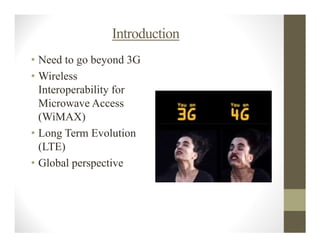
• Need to go beyond 3G
• Wireless
  Interoperability for
  Microwave Access
  (WiMAX)
• Long Term Evolution
  (LTE)
• Global perspective
Wide spread use of Broadband
• Widespread usage of the ‘INTERNET’
• Hunger for more speed and better quality of service.
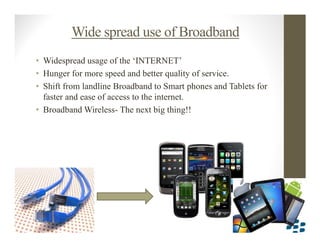
• Shift from landline Broadband to Smart phones and Tablets for
  faster and ease of access to the internet.
• Broadband Wireless- The next big thing!!
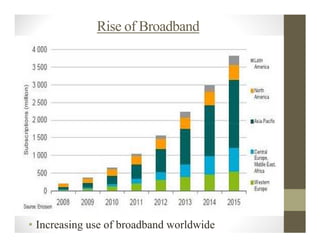
Rise of Broadband


• Increasing use of broadband worldwide
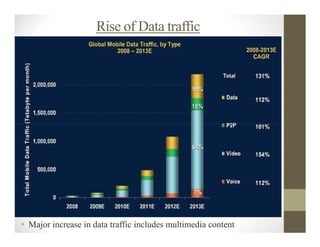
Rise of Data traffic


• Major increase in data traffic includes multimedia content
Motivation for 4G

•   Improve Spectral Efficiency
•   Spectrum flexibility
•   Higher peak data rates
•   Lower infrastructure costs
•   Lower Latency
•   Improved capacity
•   Deployment of Flattening architecture
Battle of the Megabytes
• WiMAX vs LTE- Clash of the Titans
• WiMAX- An IP based wireless broadband access technology
  that provides performance similar to Wi-Fi with coverage and
  QoS (Quality of Service) of cellular networks.
• Cellular-backed LTE, with overwhelming support from
  cellular operators, looks to be late starting favorite
• Intel, Samsung, Cisco etc. are supporting WiMAX whereas,
  NSN, Ericsson, Alcatel Lucent etc. are supporting LTE
WiMAX introduction
 • Need for the extension of the range of Wi-Fi
 • Key to Wi-Fi’s success:
1. Simple Time Division Duplex protocol and flat IP
    architecture.
2. Base station could be plugged into simple DSL line.
• Goal of WiMAX- to extend Wi-Fi like services to an entire
    community by using inexpensive components and licensed or
    unlicensed frequencies.
• Roger Marks founded 802.16 (WiMAX) working group in
    1998 and has chaired the committee since then.
• WiMAX combines the cellular range with the Wi-Fi speed. It
    plugs into Ethernet like Wi-Fi and provides roaming voice
    and data like cellular.
WiMAX standards
• First wireless MAN air interface standard in 2001 (use above
  10GHz)- approved WiMAX 802.16a original WiMAX specs in
  January 2003
• Followed by 802.16d (fixed WiMAX) in 2004 which added
  the MIMO.
• Further came in 802.16e (mobile WiMAX) which added the
  mobility factor
• Current version is 802.16j which added multihop relay
• Future standards of 802.16m, 802.16n and 802.16p are in
  progress which will bring in advanced air interface with higher
  data rates of 100mbps for mobile and 1Gbps for fixed services
  along with higher reliability of network and FDD along with
  TDD.
WiMAX specifications
• Distances up to 50kms (30 miles) for point to point(line of
  sight) communication and up to 8kms (5miles) for point to
  multipoint (non line of sight) communication
• 20MHz WiMAX channel - speeds of up to
  75Mbps(theoretically) for users near the B.S. , practically only
  up to 45Mbps
• Frequency reuse and B.W. range from 1.5MHz to 20MHz
• It uses licensed spectrum of : 2.3GHz, 2.5GHz and 3.5GHz as
  well as unlicensed spectrum of 3.65GHz and 5.8GHz.
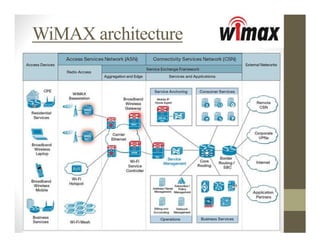
WiMAX architecture
LTE explained
•   Evolves form third generation technology based on WCDMA.
•   Supports higher peak data rate through wider bandwidth.
•   Provides Low Latency and Overhead (Radio Delay<5mSec)
•   Implements Scheduling at Base station to maintain Channel
    Quality.
•   All IP based network with reduction in cost per bit
•   Flexibility in use of new and existing frequency bands
    (Spectrum Flexibility)
•   Lower power consumption
•   Supports mobility speeds up to 350km/hr with 500km/hr
    under consideration.
LTE architecture
• Provide open interface to support multi vendor deployments
• Provide robustness – no single point of failure
• Support Multi- RAT(Radio Access Technology) with resources
  controlled from the network
• Support of seamless mobility to legacy systems as well as to
  other emerging systems including Inter-RAT handover and
  service based RAT selection.
• Maintain appropriate level of security.
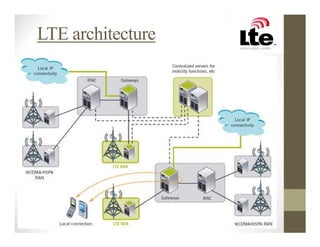
• LTE makes use of new e-NodeB’s and gets rid of the use of
  RNC.
• Simple network architecture with open interfaces
LTE architecture
LTE specifications
• Higher Peak data rates(20MHz operation):
  downlink: 100Mbps
  (150Mbps peak based on 2x2 MIMO)
  (300Mbps peak based on 4x4 MIMO)
  uplink: 50Mbps(75Mbps peak) (5Mbps individually)
• Improved latency (UE-RNC-UE) below 10ms (round trip time)
• Support of scalable B.W. – 1.4,3,5,10,15,20MHz
• Support of paired and unpaired spectrum (FDD and TDD)
• Uplink: QPSK, 16-QAM and 64-QAM (optional for handset)
• Downlink: QPSK, 16-QAM and 64-QAM
• Uplink- SC-FDMA and Downlink- OFDMA
Similarities

 • OFDMA(Orthogonal Frequency Division Multiple Access)
   on downlink
 • MIMO(Multiple Input Multiple Output) and beam forming
 • Backward compatibility
 • Speed
 • Error correcting codes- Viterbi and turbo coding
 • IP based technologies
 • Scalable Bandwidth
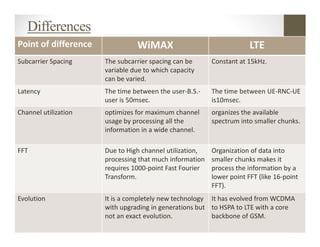
Differences
Point of difference             WiMAX                                 LTE
Subcarrier Spacing    The subcarrier spacing can be      Constant at 15kHz.
                      variable due to which capacity
                      can be varied.
Latency               The time between the user-B.S.-    The time between UE-RNC-UE
                      user is 50msec.                    is10msec.
Channel utilization   optimizes for maximum channel      organizes the available
                      usage by processing all the        spectrum into smaller chunks.
                      information in a wide channel.

FFT                   Due to High channel utilization,   Organization of data into
                      processing that much information   smaller chunks makes it
                      requires 1000-point Fast Fourier   process the information by a
                      Transform.                         lower point FFT (like 16-point
                                                         FFT).
Evolution             It is a completely new technology It has evolved from WCDMA
                      with upgrading in generations but to HSPA to LTE with a core
                      not an exact evolution.           backbone of GSM.
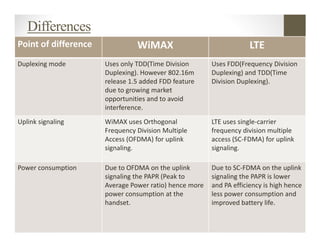
Differences
Point of difference             WiMAX                                LTE
Duplexing mode        Uses only TDD(Time Division       Uses FDD(Frequency Division
                      Duplexing). However 802.16m       Duplexing) and TDD(Time
                      release 1.5 added FDD feature     Division Duplexing).
                      due to growing market
                      opportunities and to avoid
                      interference.
Uplink signaling      WiMAX uses Orthogonal             LTE uses single-carrier
                      Frequency Division Multiple       frequency division multiple
                      Access (OFDMA) for uplink         access (SC-FDMA) for uplink
                      signaling.                        signaling.

Power consumption     Due to OFDMA on the uplink        Due to SC-FDMA on the uplink
                      signaling the PAPR (Peak to       signaling the PAPR is lower
                      Average Power ratio) hence more   and PA efficiency is high hence
                      power consumption at the          less power consumption and
                      handset.                          improved battery life.
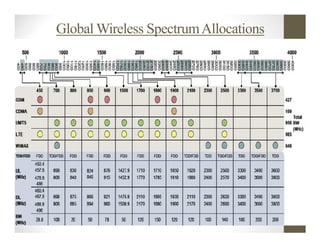
Global Wireless Spectrum Allocations
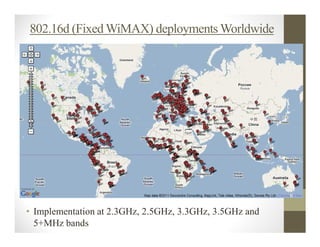
802.16d (Fixed WiMAX) deployments Worldwide


• Implementation at 2.3GHz, 2.5GHz, 3.3GHz, 3.5GHz and
  5+MHz bands
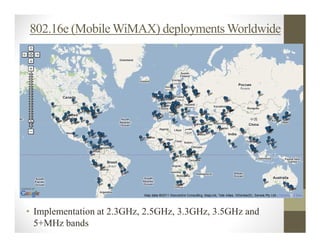
802.16e (Mobile WiMAX) deployments Worldwide


• Implementation at 2.3GHz, 2.5GHz, 3.3GHz, 3.5GHz and
  5+MHz bands
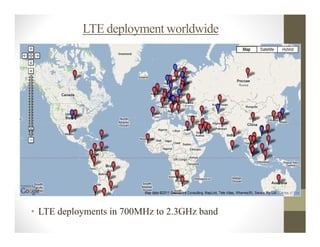
LTE deployment worldwide


• LTE deployments in 700MHz to 2.3GHz band
Further development
        LTE-A                           WiMAX 2.0
• Carrier aggregation            • Higher spectrum efficiency
• Relaying to improve coverage     through more advanced and
  and reduce deployment cost.      higher-order MIMO
• Extended multi-antenna           solutions.
  transmission                   • Higher peak and user data
• Coordinated multipoint           rates
  (CoMP) transmission/           • Seamless WiFi - WiMAX
  reception                        handover
                                 • Support for femto-cells
                                 • Enhanced coverage in high
                                   interference environments
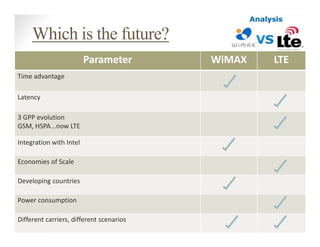
Which is the future?
                         Parameter        WiMAX   LTE
Time advantage

Latency

3 GPP evolution
GSM, HSPA...now LTE

Integration with Intel

Economies of Scale

Developing countries

Power consumption

Different carriers, different scenarios
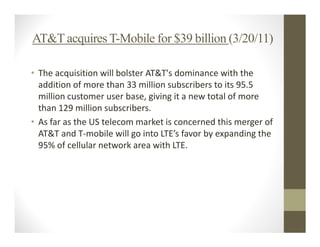
AT&T acquires T-Mobile for $39 billion (3/20/11)

• The acquisition will bolster AT&T's dominance with the
  addition of more than 33 million subscribers to its 95.5
  million customer user base, giving it a new total of more
  than 129 million subscribers.
• As far as the US telecom market is concerned this merger of
  AT&T and T-mobile will go into LTE’s favor by expanding the
  95% of cellular network area with LTE.
ZTE demonstrates WiMAX and LTE on the same
network (4/21/11)
 • If both of them are used on the same network then you
   get the best of both worlds and can imagine the
   increased level of possibilities and network robustness
   that can be achieved.
 • ZTE successfully demonstrated the same 2 weeks ago.
 • During the demonstration, ZTE said it used the same
   WiMAX system to upgrade it to a TD-LTE system in less
   than an hour without replacing any hardware.
 • The demonstration proved that ZTE's base-stations
   support a seamless upgrade from WiMAX to TD-LTE and
   that the company can provide a successful solution for
   the evolution for WiMAX and TD-LTE to co-exist.
Summary


 WiMAX v/s LTE is not a battle after all…
       Both are here to stay!!!
References
• http://www.dailywireless.org/2009/12/22/top-ten-wimax-lte-stories-
  of-the-decade/
• http://wimaxmaps.org/
• http://www.wimax.com/lte/why-the-wimax-vs-lte-battle-isnt-a-battle
• http://www.slideshare.net/CiscoSP360/comparison-of-lte-and-wimax
• http://www.wimax.com/lte/why-the-wimax-vs-lte-battle-isnt-a-battle
• http://www.linkedin.com/answers/technology/information-
  technology/telecommunications/TCH_ITS_TCI/376594-9925981
• http://www.4gwirelessjobs.com/articles/article-detail.php?Analysis-
  WiMax-&-LTE&Arid=MTA5&Auid=OTU=
• Articles on “AT&T acquires T-Mobile for $39 billion” and “ZTE
  demonstrates WiMAX and LTE on the same network”
• White paper on “LTE release 8 and beyond”
• Whitepaper on “Driving 4G: WiMAX & LTE”
• IEEE communications magazine October 2008
• IEEE communications magazine April 2009
THANK YOU

WiMAX vs LTE

  • 1.
    WiMAX vs LTE PriyankaGaggar Priyadarshini Khushboo Kalyani Kunal Nadkarni Ankush Gadodia
  • 2.
    Introduction • Need togo beyond 3G • Wireless Interoperability for Microwave Access (WiMAX) • Long Term Evolution (LTE) • Global perspective
  • 3.
    Wide spread useof Broadband • Widespread usage of the ‘INTERNET’ • Hunger for more speed and better quality of service. • Shift from landline Broadband to Smart phones and Tablets for faster and ease of access to the internet. • Broadband Wireless- The next big thing!!
  • 4.
    Rise of Broadband •Increasing use of broadband worldwide
  • 5.
    Rise of Datatraffic • Major increase in data traffic includes multimedia content
  • 6.
    Motivation for 4G • Improve Spectral Efficiency • Spectrum flexibility • Higher peak data rates • Lower infrastructure costs • Lower Latency • Improved capacity • Deployment of Flattening architecture
  • 7.
    Battle of theMegabytes • WiMAX vs LTE- Clash of the Titans • WiMAX- An IP based wireless broadband access technology that provides performance similar to Wi-Fi with coverage and QoS (Quality of Service) of cellular networks. • Cellular-backed LTE, with overwhelming support from cellular operators, looks to be late starting favorite • Intel, Samsung, Cisco etc. are supporting WiMAX whereas, NSN, Ericsson, Alcatel Lucent etc. are supporting LTE
  • 8.
    WiMAX introduction •Need for the extension of the range of Wi-Fi • Key to Wi-Fi’s success: 1. Simple Time Division Duplex protocol and flat IP architecture. 2. Base station could be plugged into simple DSL line. • Goal of WiMAX- to extend Wi-Fi like services to an entire community by using inexpensive components and licensed or unlicensed frequencies. • Roger Marks founded 802.16 (WiMAX) working group in 1998 and has chaired the committee since then. • WiMAX combines the cellular range with the Wi-Fi speed. It plugs into Ethernet like Wi-Fi and provides roaming voice and data like cellular.
  • 9.
    WiMAX standards • Firstwireless MAN air interface standard in 2001 (use above 10GHz)- approved WiMAX 802.16a original WiMAX specs in January 2003 • Followed by 802.16d (fixed WiMAX) in 2004 which added the MIMO. • Further came in 802.16e (mobile WiMAX) which added the mobility factor • Current version is 802.16j which added multihop relay • Future standards of 802.16m, 802.16n and 802.16p are in progress which will bring in advanced air interface with higher data rates of 100mbps for mobile and 1Gbps for fixed services along with higher reliability of network and FDD along with TDD.
  • 10.
    WiMAX specifications • Distancesup to 50kms (30 miles) for point to point(line of sight) communication and up to 8kms (5miles) for point to multipoint (non line of sight) communication • 20MHz WiMAX channel - speeds of up to 75Mbps(theoretically) for users near the B.S. , practically only up to 45Mbps • Frequency reuse and B.W. range from 1.5MHz to 20MHz • It uses licensed spectrum of : 2.3GHz, 2.5GHz and 3.5GHz as well as unlicensed spectrum of 3.65GHz and 5.8GHz.
  • 11.
  • 12.
    LTE explained • Evolves form third generation technology based on WCDMA. • Supports higher peak data rate through wider bandwidth. • Provides Low Latency and Overhead (Radio Delay<5mSec) • Implements Scheduling at Base station to maintain Channel Quality. • All IP based network with reduction in cost per bit • Flexibility in use of new and existing frequency bands (Spectrum Flexibility) • Lower power consumption • Supports mobility speeds up to 350km/hr with 500km/hr under consideration.
  • 13.
    LTE architecture • Provideopen interface to support multi vendor deployments • Provide robustness – no single point of failure • Support Multi- RAT(Radio Access Technology) with resources controlled from the network • Support of seamless mobility to legacy systems as well as to other emerging systems including Inter-RAT handover and service based RAT selection. • Maintain appropriate level of security. • LTE makes use of new e-NodeB’s and gets rid of the use of RNC. • Simple network architecture with open interfaces
  • 14.
  • 15.
    LTE specifications • HigherPeak data rates(20MHz operation): downlink: 100Mbps (150Mbps peak based on 2x2 MIMO) (300Mbps peak based on 4x4 MIMO) uplink: 50Mbps(75Mbps peak) (5Mbps individually) • Improved latency (UE-RNC-UE) below 10ms (round trip time) • Support of scalable B.W. – 1.4,3,5,10,15,20MHz • Support of paired and unpaired spectrum (FDD and TDD) • Uplink: QPSK, 16-QAM and 64-QAM (optional for handset) • Downlink: QPSK, 16-QAM and 64-QAM • Uplink- SC-FDMA and Downlink- OFDMA
  • 16.
    Similarities • OFDMA(OrthogonalFrequency Division Multiple Access) on downlink • MIMO(Multiple Input Multiple Output) and beam forming • Backward compatibility • Speed • Error correcting codes- Viterbi and turbo coding • IP based technologies • Scalable Bandwidth
  • 17.
    Differences Point of difference WiMAX LTE Subcarrier Spacing The subcarrier spacing can be Constant at 15kHz. variable due to which capacity can be varied. Latency The time between the user-B.S.- The time between UE-RNC-UE user is 50msec. is10msec. Channel utilization optimizes for maximum channel organizes the available usage by processing all the spectrum into smaller chunks. information in a wide channel. FFT Due to High channel utilization, Organization of data into processing that much information smaller chunks makes it requires 1000-point Fast Fourier process the information by a Transform. lower point FFT (like 16-point FFT). Evolution It is a completely new technology It has evolved from WCDMA with upgrading in generations but to HSPA to LTE with a core not an exact evolution. backbone of GSM.
  • 18.
    Differences Point of difference WiMAX LTE Duplexing mode Uses only TDD(Time Division Uses FDD(Frequency Division Duplexing). However 802.16m Duplexing) and TDD(Time release 1.5 added FDD feature Division Duplexing). due to growing market opportunities and to avoid interference. Uplink signaling WiMAX uses Orthogonal LTE uses single-carrier Frequency Division Multiple frequency division multiple Access (OFDMA) for uplink access (SC-FDMA) for uplink signaling. signaling. Power consumption Due to OFDMA on the uplink Due to SC-FDMA on the uplink signaling the PAPR (Peak to signaling the PAPR is lower Average Power ratio) hence more and PA efficiency is high hence power consumption at the less power consumption and handset. improved battery life.
  • 19.
  • 20.
    802.16d (Fixed WiMAX)deployments Worldwide • Implementation at 2.3GHz, 2.5GHz, 3.3GHz, 3.5GHz and 5+MHz bands
  • 21.
    802.16e (Mobile WiMAX)deployments Worldwide • Implementation at 2.3GHz, 2.5GHz, 3.3GHz, 3.5GHz and 5+MHz bands
  • 22.
    LTE deployment worldwide •LTE deployments in 700MHz to 2.3GHz band
  • 23.
    Further development LTE-A WiMAX 2.0 • Carrier aggregation • Higher spectrum efficiency • Relaying to improve coverage through more advanced and and reduce deployment cost. higher-order MIMO • Extended multi-antenna solutions. transmission • Higher peak and user data • Coordinated multipoint rates (CoMP) transmission/ • Seamless WiFi - WiMAX reception handover • Support for femto-cells • Enhanced coverage in high interference environments
  • 24.
    Which is thefuture? Parameter WiMAX LTE Time advantage Latency 3 GPP evolution GSM, HSPA...now LTE Integration with Intel Economies of Scale Developing countries Power consumption Different carriers, different scenarios
  • 25.
    AT&T acquires T-Mobilefor $39 billion (3/20/11) • The acquisition will bolster AT&T's dominance with the addition of more than 33 million subscribers to its 95.5 million customer user base, giving it a new total of more than 129 million subscribers. • As far as the US telecom market is concerned this merger of AT&T and T-mobile will go into LTE’s favor by expanding the 95% of cellular network area with LTE.
  • 26.
    ZTE demonstrates WiMAXand LTE on the same network (4/21/11) • If both of them are used on the same network then you get the best of both worlds and can imagine the increased level of possibilities and network robustness that can be achieved. • ZTE successfully demonstrated the same 2 weeks ago. • During the demonstration, ZTE said it used the same WiMAX system to upgrade it to a TD-LTE system in less than an hour without replacing any hardware. • The demonstration proved that ZTE's base-stations support a seamless upgrade from WiMAX to TD-LTE and that the company can provide a successful solution for the evolution for WiMAX and TD-LTE to co-exist.
  • 27.
    Summary WiMAX v/sLTE is not a battle after all… Both are here to stay!!!
  • 28.
    References • http://www.dailywireless.org/2009/12/22/top-ten-wimax-lte-stories- of-the-decade/ • http://wimaxmaps.org/ • http://www.wimax.com/lte/why-the-wimax-vs-lte-battle-isnt-a-battle • http://www.slideshare.net/CiscoSP360/comparison-of-lte-and-wimax • http://www.wimax.com/lte/why-the-wimax-vs-lte-battle-isnt-a-battle • http://www.linkedin.com/answers/technology/information- technology/telecommunications/TCH_ITS_TCI/376594-9925981 • http://www.4gwirelessjobs.com/articles/article-detail.php?Analysis- WiMax-&-LTE&Arid=MTA5&Auid=OTU= • Articles on “AT&T acquires T-Mobile for $39 billion” and “ZTE demonstrates WiMAX and LTE on the same network” • White paper on “LTE release 8 and beyond” • Whitepaper on “Driving 4G: WiMAX & LTE” • IEEE communications magazine October 2008 • IEEE communications magazine April 2009
  • 29.