Non coding RNA
Definition:
• A non-coding RNA (ncRNA) is a functional RNA molecule that is not
translated into a protein. Less-frequently used synonyms are non-protein-
coding RNA (npcRNA), non-messenger RNA (nmRNA) and functional
RNA (fRNA). The DNA sequence from which a non-coding RNA is
transcribed is often called an RNA gene
Non-coding RNA Overview:
• Non-coding RNAs (ncRNAs) are involved in many biological processes and
are increasingly seen as important. As is the case with proteins, it is the
overall structure of the molecule which imparts function. However, while
similar protein structures are often reflected in a conserved amino acid
sequence, sequences underlying RNA secondary structure are very variable;
this makes ncRNAs difficult to detect using sequence alone.
non-coding RNA gene types
• tRNA(transfer RNA)
• Mt-tRNA(transfer RNA located in the mitochondrial genome)
• rRNA(ribosomal RNA)
• scRNA(small cytoplasmic RNA)
• snRNA(small nuclear RNA)
• snoRNA(small nucleolar RNA)
• miRNA(microRNA precursors)
• misc_RNA (miscellaneous other RNA)
• lincRNA (Long intergenic non-coding RNAs)
Biological roles of ncRNA
• Noncoding RNAs belong to several groups and are involved in many cellular
processes. These range from ncRNAs of central importance that are
conserved across all or most cellular life through to more transient ncRNAs
specific to one or a few closely related species. The more conserved ncRNAs
are thought to be molecular fossils or relics from LUCA and the RNA world
and their current roles remain mostly in regulation of information flow from
DNA to protein
• NcRNAs in translation
• ncRNAs in DNA replication
• ncRNAs in gene regulation
• ncRNAs and genome defense
Mitrochondrial tRNA
• Mitochondria host numerous metabolic pathways, including the oxidative phosphorylation
pathway, citric acid cycle, fatty acid degradation, heme biosynthesis and urea cycle.
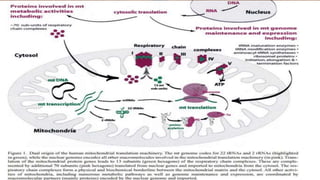
• mitochondrial genome has a small circular DNA coding for 13 proteins, 22 mt transfer
RNAs and 2 ribosomal RNAs (rRNAs).
• tRNA structural characteristics and tRNA interactions with different partners of the
protein synthesis apparatus.
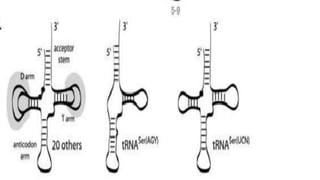
• The 22 tRNA genes lead to 18 tRNAs each specific for one amino acid, and 2 tRNAs
specific for leucine and to 2 tRNAs specific for serine.
Structure
• tRNAs have structural characteristics including a cloverleaf-like secondary structure
and an ‘L’-shaped three-dimensional structure.
• Mt tRNAs from different organisms present structural features which deviate more
or less strongly from the
classical ones.
• Some show cloverleaf structures very close to the canonical situation, as is the case
for "Saccharomyces cerevisiae" mt tRNAs, others are referred to as ‘bizarre’ tRNAs.
Role in development
• Involved in the conversion of the 4 nucleotide sequence into the 20 types of
amino acid protein language.
• Mammalian mitochondria require a complete translational apparatus for the
synthesis of only 13 proteins.
• These proteins are all subunits of the respiratory chain complexes, and are
involved in electron transfer and ATP synthesis.
• The 13 mitochondrial-encoded proteins are strongly hydrophobic
Mt-tRNA In Disease:
• tRNA gene mutations can cause Neurodegenerative disorders.
• Ineffective mt DNA repair mechanisms and high oxidative stress are responsible for the
high rate of mutations undergone by mt DNA.
• Some of the mutations are polymorphic while others are pathogenic.
• The phenotypes related to pathogenic mutations are numerous, ranking from mild e.g.
exercise intolerance, limb weakness to severe, including muscular and/or neuronal disorders
e.g. Myopathies, encephalomyopathies, cardiopathies, diabetes, deafness.
Long noncoding RNA
• LncRNA is defined as all transcribed RNA molecules greater than 200
nuclotides in length.
• Very broad category, so lncRNAs are a very large and functionally
heterogeneous group.
• Mouse transcriptome: ~180,000 total transcripts, ~20,000 protein coding
genes. The majority of the remaining 160,000 transcripts are lncRNAs
Evolution and Conservation
Transcriptional Noise
• Low affinity binding of RNA polymerase to randomly generated promoter sequences.
• More efficient to allow random transcripts than to downregulate nonspecific transcription.
• LncRNAs are generally expressed at low levels
• LncRNA sequences are not well conserved between species
• One piece of evidence for this hypothesis is that although the quantity of individual
lncRNA transcripts is much greater than mRNA transcripts, individual lncRNA transcripts
are transcribed at much lower levels than individual mRNAs
• Another explanation for the low sequence conservation of lncRNAs is that
they might not require very much nucleotide sequence conservation to
maintain their functionality.
• LncRNAs do not have the strict sequence conservation restraints that protein-
coding genes do.
• LncRNA promoter sequences are very well conserved
• In contrast to the lack sequence conservation in the lncRNA sequences themselves,
the promoters of lncRNAs show very high sequence conservation. In fact, a recent
study in mice calculated the sequence conservation of lncRNA promoters to be
higher than the sequence conservation of protein coding gene promoters
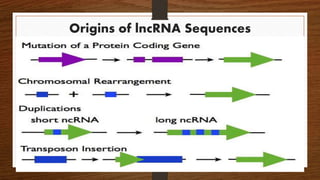
Origins of lncRNA Sequences
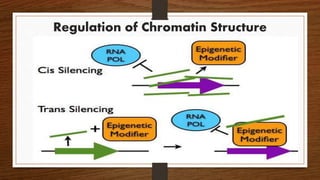
Regulation of Chromatin Structure
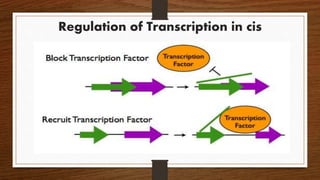
Regulation of Transcription in cis
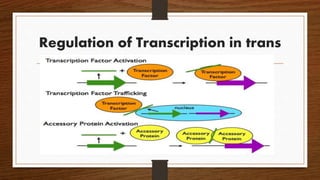
Regulation of Transcription in trans
Sno RNA
• Small Nucleolar RNA , Also called snoRNA are a type of small RNA
molecules that guide the modifications of other RNA s .
• Difference between SnRNA and snoRNA is based on their function .
• SnRNA is important for the processing of mRNA .
• snoRNA have 3 distinctive functions .
• They play a role in modifying RNA s such as mRNA , rRNA and tRNA .
• It modifies them by playing a role with spliceosomal RNA and removing
introns from gene transcripts before translation .
• It removes the intron regions of the transcript leaving behind the proper
coding regions .
• Play a role in methylation of RNA where a methyl group is added to 2 ‘
hydroxyl group of ribose of the nucleotide .
• This methylation protects RNA from hydrolytic degradation and stabilizes
the structure .
• Methylation also helps in distinction from mutated regions on the transcript
or from the further added extra non coding regions .
• Has a role in mRNA editing , where it plays a role in addition ( insertion ) or
deletion of nucleotides .
• mRNA transcripts can also be edited by snoRNA s by modifying ( a
systematic procedure ) from one nucleotide into another .
• This editing involves modifications such as cytidine to uridine or adenosine
to innosine .
• This editing changes the amino acid sequence imprinted by the DNA thus
has advantages over gene mutations .
• Plays a role in changing the non coding regions to coding regions through
editing .
• snoRNA s also play a role in genomic imprinting .
• Here they cause expressing and silencing og genes .
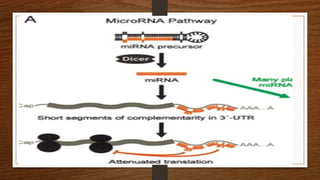
What is microRNA?
• MicroRNAs (miRNAs) are small, RNA molecules encoded in the genomes
of plants and animals. These highly conserved, ~21 nucleotides RNAs
regulate the expression of genes by binding to the 3'-untranslated regions (3'-
UTR) of specific mRNAs.
A model for miRNA function
Role in development
• Several research groups have provided evidence that miRNAs may act as key
regulators of these processes as
• early development
• cell proliferation
• cell death
• apoptosis
• fat metabolism
• cell differentiation.
• Recent studies of miRNA expression implicate miRNAs in
• brain development
• viral infection
• viral diseases
• neurodevelopment
• cancer.

Long non coding rna

  • 1.
    Non coding RNA Definition: •A non-coding RNA (ncRNA) is a functional RNA molecule that is not translated into a protein. Less-frequently used synonyms are non-protein- coding RNA (npcRNA), non-messenger RNA (nmRNA) and functional RNA (fRNA). The DNA sequence from which a non-coding RNA is transcribed is often called an RNA gene
  • 2.
    Non-coding RNA Overview: •Non-coding RNAs (ncRNAs) are involved in many biological processes and are increasingly seen as important. As is the case with proteins, it is the overall structure of the molecule which imparts function. However, while similar protein structures are often reflected in a conserved amino acid sequence, sequences underlying RNA secondary structure are very variable; this makes ncRNAs difficult to detect using sequence alone.
  • 3.
    non-coding RNA genetypes • tRNA(transfer RNA) • Mt-tRNA(transfer RNA located in the mitochondrial genome) • rRNA(ribosomal RNA) • scRNA(small cytoplasmic RNA) • snRNA(small nuclear RNA) • snoRNA(small nucleolar RNA) • miRNA(microRNA precursors) • misc_RNA (miscellaneous other RNA) • lincRNA (Long intergenic non-coding RNAs)
  • 4.
    Biological roles ofncRNA • Noncoding RNAs belong to several groups and are involved in many cellular processes. These range from ncRNAs of central importance that are conserved across all or most cellular life through to more transient ncRNAs specific to one or a few closely related species. The more conserved ncRNAs are thought to be molecular fossils or relics from LUCA and the RNA world and their current roles remain mostly in regulation of information flow from DNA to protein
  • 5.
    • NcRNAs intranslation • ncRNAs in DNA replication • ncRNAs in gene regulation • ncRNAs and genome defense
  • 6.
    Mitrochondrial tRNA • Mitochondriahost numerous metabolic pathways, including the oxidative phosphorylation pathway, citric acid cycle, fatty acid degradation, heme biosynthesis and urea cycle. • mitochondrial genome has a small circular DNA coding for 13 proteins, 22 mt transfer RNAs and 2 ribosomal RNAs (rRNAs). • tRNA structural characteristics and tRNA interactions with different partners of the protein synthesis apparatus. • The 22 tRNA genes lead to 18 tRNAs each specific for one amino acid, and 2 tRNAs specific for leucine and to 2 tRNAs specific for serine.
  • 7.
    Structure • tRNAs havestructural characteristics including a cloverleaf-like secondary structure and an ‘L’-shaped three-dimensional structure. • Mt tRNAs from different organisms present structural features which deviate more or less strongly from the classical ones. • Some show cloverleaf structures very close to the canonical situation, as is the case for "Saccharomyces cerevisiae" mt tRNAs, others are referred to as ‘bizarre’ tRNAs.
  • 9.
    Role in development •Involved in the conversion of the 4 nucleotide sequence into the 20 types of amino acid protein language. • Mammalian mitochondria require a complete translational apparatus for the synthesis of only 13 proteins. • These proteins are all subunits of the respiratory chain complexes, and are involved in electron transfer and ATP synthesis. • The 13 mitochondrial-encoded proteins are strongly hydrophobic
  • 11.
    Mt-tRNA In Disease: •tRNA gene mutations can cause Neurodegenerative disorders. • Ineffective mt DNA repair mechanisms and high oxidative stress are responsible for the high rate of mutations undergone by mt DNA. • Some of the mutations are polymorphic while others are pathogenic. • The phenotypes related to pathogenic mutations are numerous, ranking from mild e.g. exercise intolerance, limb weakness to severe, including muscular and/or neuronal disorders e.g. Myopathies, encephalomyopathies, cardiopathies, diabetes, deafness.
  • 12.
    Long noncoding RNA •LncRNA is defined as all transcribed RNA molecules greater than 200 nuclotides in length. • Very broad category, so lncRNAs are a very large and functionally heterogeneous group. • Mouse transcriptome: ~180,000 total transcripts, ~20,000 protein coding genes. The majority of the remaining 160,000 transcripts are lncRNAs
  • 13.
    Evolution and Conservation TranscriptionalNoise • Low affinity binding of RNA polymerase to randomly generated promoter sequences. • More efficient to allow random transcripts than to downregulate nonspecific transcription. • LncRNAs are generally expressed at low levels • LncRNA sequences are not well conserved between species • One piece of evidence for this hypothesis is that although the quantity of individual lncRNA transcripts is much greater than mRNA transcripts, individual lncRNA transcripts are transcribed at much lower levels than individual mRNAs
  • 14.
    • Another explanationfor the low sequence conservation of lncRNAs is that they might not require very much nucleotide sequence conservation to maintain their functionality.
  • 15.
    • LncRNAs donot have the strict sequence conservation restraints that protein- coding genes do. • LncRNA promoter sequences are very well conserved • In contrast to the lack sequence conservation in the lncRNA sequences themselves, the promoters of lncRNAs show very high sequence conservation. In fact, a recent study in mice calculated the sequence conservation of lncRNA promoters to be higher than the sequence conservation of protein coding gene promoters
  • 16.
  • 17.
  • 18.
  • 19.
  • 20.
    Sno RNA • SmallNucleolar RNA , Also called snoRNA are a type of small RNA molecules that guide the modifications of other RNA s . • Difference between SnRNA and snoRNA is based on their function . • SnRNA is important for the processing of mRNA . • snoRNA have 3 distinctive functions .
  • 21.
    • They playa role in modifying RNA s such as mRNA , rRNA and tRNA . • It modifies them by playing a role with spliceosomal RNA and removing introns from gene transcripts before translation . • It removes the intron regions of the transcript leaving behind the proper coding regions .
  • 22.
    • Play arole in methylation of RNA where a methyl group is added to 2 ‘ hydroxyl group of ribose of the nucleotide . • This methylation protects RNA from hydrolytic degradation and stabilizes the structure . • Methylation also helps in distinction from mutated regions on the transcript or from the further added extra non coding regions .
  • 23.
    • Has arole in mRNA editing , where it plays a role in addition ( insertion ) or deletion of nucleotides . • mRNA transcripts can also be edited by snoRNA s by modifying ( a systematic procedure ) from one nucleotide into another . • This editing involves modifications such as cytidine to uridine or adenosine to innosine .
  • 24.
    • This editingchanges the amino acid sequence imprinted by the DNA thus has advantages over gene mutations . • Plays a role in changing the non coding regions to coding regions through editing . • snoRNA s also play a role in genomic imprinting . • Here they cause expressing and silencing og genes .
  • 25.
    What is microRNA? •MicroRNAs (miRNAs) are small, RNA molecules encoded in the genomes of plants and animals. These highly conserved, ~21 nucleotides RNAs regulate the expression of genes by binding to the 3'-untranslated regions (3'- UTR) of specific mRNAs.
  • 26.
    A model formiRNA function
  • 27.
    Role in development •Several research groups have provided evidence that miRNAs may act as key regulators of these processes as • early development • cell proliferation • cell death • apoptosis • fat metabolism • cell differentiation.
  • 28.
    • Recent studiesof miRNA expression implicate miRNAs in • brain development • viral infection • viral diseases • neurodevelopment • cancer.