RNA,S
• Are known as Ribonucleic acids.
• These are chains of a Ribo nucleotides.
• Are the products of Central dogma of
molecular under transcription.
• The base of such nucleotides include Uracil
instead of that thymine in DNA
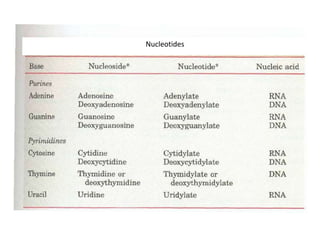
Nucleotides
Why RNA,s are essentially required?
• It is because,
 To proceed and maintenance of life / central dogma
 DNA needs proteins to replicate
 Proteins coded for by DNA
 RNA can be code and machinery
 Structural component
 Regulatory and catalytic functions
Non Coding RNA,S
• Non-coding RNA (ncRNA) is a RNA molecule
that functions without being translated into a
protein
• Most prominent examples: Transfer RNA
(tRNA), Ribosomal RNA (rRNA)
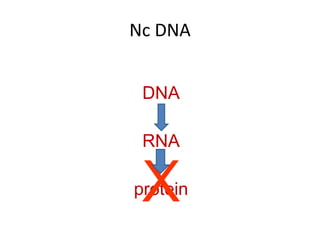
Nc DNA
DNA
RNA
proteinX
Non Coding RNA,S
• In higher eukaryotes, 98% are never translated
into proteins
• Of those 98%, about 50-70% are introns
• Others originate from non-protein genes,
including rRNA, tRNA and a vast number of other
non-coding RNAs (ncRNAs)
• Even introns have been shown to contain
ncRNAs, for example snoRNAs
• It is thought that there might be order of 10,000
different ncRNAs in mammalian genome
Types and Functions of RNAs
• CODING = messenger RNA (mRNA)
• translated into a protein
• NON-CODING (ncRNA) = not translated into a protein
• lot of different functions : splicing, translation, gene
• regulation ...
• rRNA Ribosomal RNA
• tRNA Transfer RNA
• snoRNA nucleosome, rRNA-editing
• miRNA Control of gene expression on the translation
• level
Ribosomal RNA
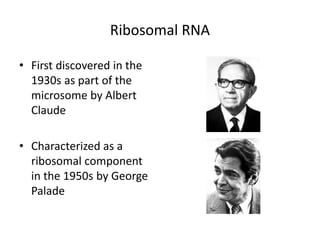
• First discovered in the
1930s as part of the
microsome by Albert
Claude
• Characterized as a
ribosomal component
in the 1950s by George
Palade
RRNA
Known as ribosomal RNA
The characteristics include,
• Stable RNA
• Constitute 80% of RNA in cell.
• Synthesize in Nucleolus.
• Found in Ribosomes
RRNA synthesize in
• Form in nucleolus from specified rDNA
• Bases are slightly modified
• Usually 4 types of rRNA found in eukaryotes
• rRNA plus ribosomal proteins form ribosomes
• Mitochondria and chloroplasts have their own
rRNA genes
functions
• Ribosomal RNA (rRNA) associates with a set of
proteins to form ribosomes.
• Involves ,catalyze & assembly of amino acids
into protein chains.
• They also bind tRNAs and various accessory
molecules necessary for protein synthesis.
• Being part of ribosomes component of
evolutionary characteristics.
tRNA
• Transfer RNA
• tRNAs function as carriers of amino acids and
participate in protein synthesis.
• Transfer RNA (tRNA) serves as the nucleic acid
decoding device that reads the triplet genetic
code of messenger RNA
• (Holley received the Nobel Prize on describing
structure of tRNA
tRNA
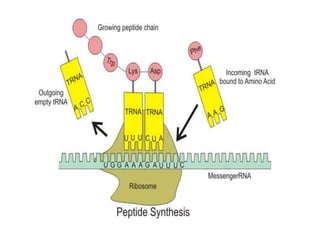
The genetic code is read during translation via
adapter molecules, tRNAs, that have 3-base
anticodons complementary to codons in mRNA.
"Wobble" during reading of the mRNA allows some
tRNAs to read multiple codons that differ only in the
3rd base.
There are 61 codons specifying 20 amino acids.
Minimally 31 tRNAs are required for translation, not
counting the tRNA that codes for chain initiation.
Mammalian cells produce more than 150 tRNAs.
functions
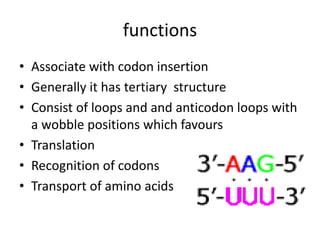
• Associate with codon insertion
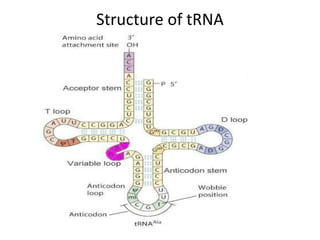
• Generally it has tertiary structure
• Consist of loops and and anticodon loops with
a wobble positions which favours
• Translation
• Recognition of codons
• Transport of amino acids
Structure of tRNA
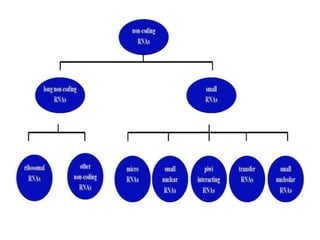
The two main classes of ncRNAs
1. Housekeeping ncRNAs, which are constitutively
expressed and required for normal function and
viability of cell
eg TRNAs. RRNAs
2. Regulatory ncRNAs are expressed only in certain
stages of organism development or as a response to
external stimuli.
• Regulatory ncRNAs can affect the expression of other
genes at the level of transcription or translation
Other nc RNAs
• MicroRNA
• new discovery,short noncodimg DNA
• Gene regulation on the translation level
• Short sequences (~22bp)
• Hairpin structure (processed)
• How is miRNA processed (Ghosh et al. 2007)
• Binding to mRNA
• Binding sites on 5' and 3' UTRs
• cleavage of mRNA
Functions
• Statistically biased (codon triplets)
Stop codons
• High CG content (hyperthermophiles)
• Promoter/Terminator identification (E. Coli)
• Primers
• Signal recognition Particles
• Gene silencing
• Regulation of translation
• Ligating ribozymes favours neurological functions
Housekeeping ncRNAs
• tRNA and rRNA - translation
• snRNA – Pre-mRNA splicing
• snoRNA – rRNA modification
• gRNA – guide RNA in RNA editing
• Telomerase RNA – primer for telomeric
DNA synhesis
• A few other...
Ribozymes
• RNA molecules with catalytical properties (Ribonucleic acid
enzymes)
• In nature ribozymes involves in
• self-splicing intrones
• RNA encoded parasites
• The catalytical efficiency of ribozymes is lower analogous protein
enzymes
• Several synthetic ribozymes are cabaple of performing other
reactions than RNA cleavage and ligation
• RNAse P cleaves the 5’ end of pre-tRNAs
• It is composed of 12 kDa P protein and about 400 nt long RNA
Cp RNA
• 3 rRNAs (23S, 16S, 5S)
• 30 tRNAs for recognition of
• all codons
• roughly 40 proteins of known function
• Proteins include TIC and Tocs
• subunits of ribosomes
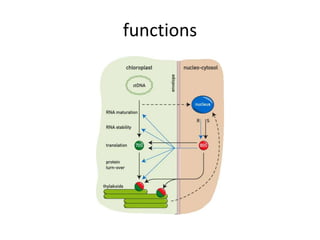
functions
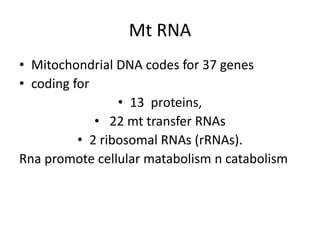
Mt RNA
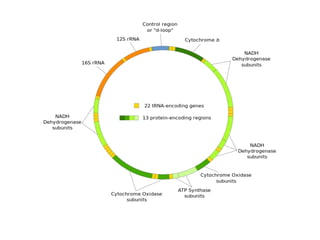
• Mitochondrial DNA codes for 37 genes
• coding for
• 13 proteins,
• 22 mt transfer RNAs
• 2 ribosomal RNAs (rRNAs).
Rna promote cellular matabolism n catabolism
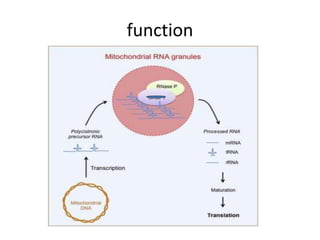
function
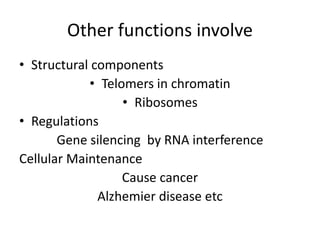
Other functions involve
• Structural components
• Telomers in chromatin
• Ribosomes
• Regulations
Gene silencing by RNA interference
Cellular Maintenance
Cause cancer
Alzhemier disease etc
THANKS!

Non coding rna

  • 1.
    RNA,S • Are knownas Ribonucleic acids. • These are chains of a Ribo nucleotides. • Are the products of Central dogma of molecular under transcription. • The base of such nucleotides include Uracil instead of that thymine in DNA
  • 2.
  • 3.
    Why RNA,s areessentially required? • It is because,  To proceed and maintenance of life / central dogma  DNA needs proteins to replicate  Proteins coded for by DNA  RNA can be code and machinery  Structural component  Regulatory and catalytic functions
  • 4.
    Non Coding RNA,S •Non-coding RNA (ncRNA) is a RNA molecule that functions without being translated into a protein • Most prominent examples: Transfer RNA (tRNA), Ribosomal RNA (rRNA)
  • 5.
  • 6.
    Non Coding RNA,S •In higher eukaryotes, 98% are never translated into proteins • Of those 98%, about 50-70% are introns • Others originate from non-protein genes, including rRNA, tRNA and a vast number of other non-coding RNAs (ncRNAs) • Even introns have been shown to contain ncRNAs, for example snoRNAs • It is thought that there might be order of 10,000 different ncRNAs in mammalian genome
  • 7.
    Types and Functionsof RNAs • CODING = messenger RNA (mRNA) • translated into a protein • NON-CODING (ncRNA) = not translated into a protein • lot of different functions : splicing, translation, gene • regulation ... • rRNA Ribosomal RNA • tRNA Transfer RNA • snoRNA nucleosome, rRNA-editing • miRNA Control of gene expression on the translation • level
  • 9.
    Ribosomal RNA • Firstdiscovered in the 1930s as part of the microsome by Albert Claude • Characterized as a ribosomal component in the 1950s by George Palade
  • 10.
    RRNA Known as ribosomalRNA The characteristics include, • Stable RNA • Constitute 80% of RNA in cell. • Synthesize in Nucleolus. • Found in Ribosomes
  • 11.
    RRNA synthesize in •Form in nucleolus from specified rDNA • Bases are slightly modified • Usually 4 types of rRNA found in eukaryotes • rRNA plus ribosomal proteins form ribosomes • Mitochondria and chloroplasts have their own rRNA genes
  • 12.
    functions • Ribosomal RNA(rRNA) associates with a set of proteins to form ribosomes. • Involves ,catalyze & assembly of amino acids into protein chains. • They also bind tRNAs and various accessory molecules necessary for protein synthesis. • Being part of ribosomes component of evolutionary characteristics.
  • 13.
    tRNA • Transfer RNA •tRNAs function as carriers of amino acids and participate in protein synthesis. • Transfer RNA (tRNA) serves as the nucleic acid decoding device that reads the triplet genetic code of messenger RNA • (Holley received the Nobel Prize on describing structure of tRNA
  • 14.
    tRNA The genetic codeis read during translation via adapter molecules, tRNAs, that have 3-base anticodons complementary to codons in mRNA. "Wobble" during reading of the mRNA allows some tRNAs to read multiple codons that differ only in the 3rd base. There are 61 codons specifying 20 amino acids. Minimally 31 tRNAs are required for translation, not counting the tRNA that codes for chain initiation. Mammalian cells produce more than 150 tRNAs.
  • 16.
    functions • Associate withcodon insertion • Generally it has tertiary structure • Consist of loops and and anticodon loops with a wobble positions which favours • Translation • Recognition of codons • Transport of amino acids
  • 17.
  • 18.
    The two mainclasses of ncRNAs 1. Housekeeping ncRNAs, which are constitutively expressed and required for normal function and viability of cell eg TRNAs. RRNAs 2. Regulatory ncRNAs are expressed only in certain stages of organism development or as a response to external stimuli. • Regulatory ncRNAs can affect the expression of other genes at the level of transcription or translation
  • 19.
    Other nc RNAs •MicroRNA • new discovery,short noncodimg DNA • Gene regulation on the translation level • Short sequences (~22bp) • Hairpin structure (processed) • How is miRNA processed (Ghosh et al. 2007) • Binding to mRNA • Binding sites on 5' and 3' UTRs • cleavage of mRNA
  • 20.
    Functions • Statistically biased(codon triplets) Stop codons • High CG content (hyperthermophiles) • Promoter/Terminator identification (E. Coli) • Primers • Signal recognition Particles • Gene silencing • Regulation of translation • Ligating ribozymes favours neurological functions
  • 21.
    Housekeeping ncRNAs • tRNAand rRNA - translation • snRNA – Pre-mRNA splicing • snoRNA – rRNA modification • gRNA – guide RNA in RNA editing • Telomerase RNA – primer for telomeric DNA synhesis • A few other...
  • 22.
    Ribozymes • RNA moleculeswith catalytical properties (Ribonucleic acid enzymes) • In nature ribozymes involves in • self-splicing intrones • RNA encoded parasites • The catalytical efficiency of ribozymes is lower analogous protein enzymes • Several synthetic ribozymes are cabaple of performing other reactions than RNA cleavage and ligation • RNAse P cleaves the 5’ end of pre-tRNAs • It is composed of 12 kDa P protein and about 400 nt long RNA
  • 23.
    Cp RNA • 3rRNAs (23S, 16S, 5S) • 30 tRNAs for recognition of • all codons • roughly 40 proteins of known function • Proteins include TIC and Tocs • subunits of ribosomes
  • 24.
  • 25.
    Mt RNA • MitochondrialDNA codes for 37 genes • coding for • 13 proteins, • 22 mt transfer RNAs • 2 ribosomal RNAs (rRNAs). Rna promote cellular matabolism n catabolism
  • 26.
  • 28.
    Other functions involve •Structural components • Telomers in chromatin • Ribosomes • Regulations Gene silencing by RNA interference Cellular Maintenance Cause cancer Alzhemier disease etc
  • 29.