Types of RNA:
RNA:
RNA or ribonucleic acid is a polymer of nucleotides which is made up of a ribose sugar, a
phosphate, and bases such as adenine, guanine, cytosine, and uracil.
It is a polymeric molecule essential in various biological roles in coding, decoding, regulation,
and expression of genes.
RNA
Coding-RNA Non-coding RNA
messenger RNA[mRNA] Ribosomal RNA (rRNA)
Transfer RNA (tRNA)
Small nuclear RNAs (snRNA; 150 nt)
Small nucleolar RNAs (snoRNA;60-300 nt)
Piwi-interacting RNAs
MicroRNAs (miRNA; 21-22 nt)
Long noncoding RNAs
Coding-RNA (messenger RNA; mRNA):
1. Messenger RNA (mRNA) carries the genetic code from DNA in a form that can be
recognized to make proteins.
2. The coding sequence of the mRNA determines the amino acid sequence in the protein
produced. Once transcribed from DNA, eukaryotic mRNA briefly exists in a form called
“precursor mRNA (pre-mRNA)” before it is fully processed into mature mRNA.
3. This processing step, which is called “RNA splicing”, removes the introns (non-coding
region) and joins exons (expressing region) of the pre-mRNA.
4. As part of post-transcriptional processing in eukaryotes, the 5’ end of mRNA is capped with
a guanosine triphosphate nucleotide, which helps in mRNA recognition during translation
or protein synthesis.
5. Similarly, the 3’ end of an mRNA has a poly A tail or multiple adenylate residues added to
it, which prevent enzymatic degradation of mRNA. Both 5’ and 3’ end of an mRNA imparts
stability to the mRNA.
Non-coding RNA (ncRNA)
Ribosomal RNA (rRNA):
Ribosomal RNA is the catalytic component of the ribosomes. In the cytoplasm, rRNAs and
protein components combine to form a nucleoprotein complex called the ribosome which binds
mRNA and synthesizes proteins (also called translation).
Table: 1 Composition of Eukaryotic Ribosome
80S [mass = 4220kD]
40S 60S
18S rRNA 28S rRNA
33 Different proteins 5.8S rRNA
5S rRNA
[49 Different proteins]
Courtesy: Biochemistry by Reginald H. Garrett, Charles M. Grisham (4th ed.)
Page No. 962
Prokaryotic Ribosomes Are Composed of 30S and 50S Subunits
Table: 2 Structural Organization of E.coli Ribosomes
70S [Mass=2520 kD]
30S 50S
16S ribosomal RNA (rRNA) 23S rRNA and 5S rRNA
[21 different proteins] [31 different proteins]
Courtesy: Biochemistry by Reginald H. Garrett, Charles M. Grisham (4th ed.)
Page No. 965
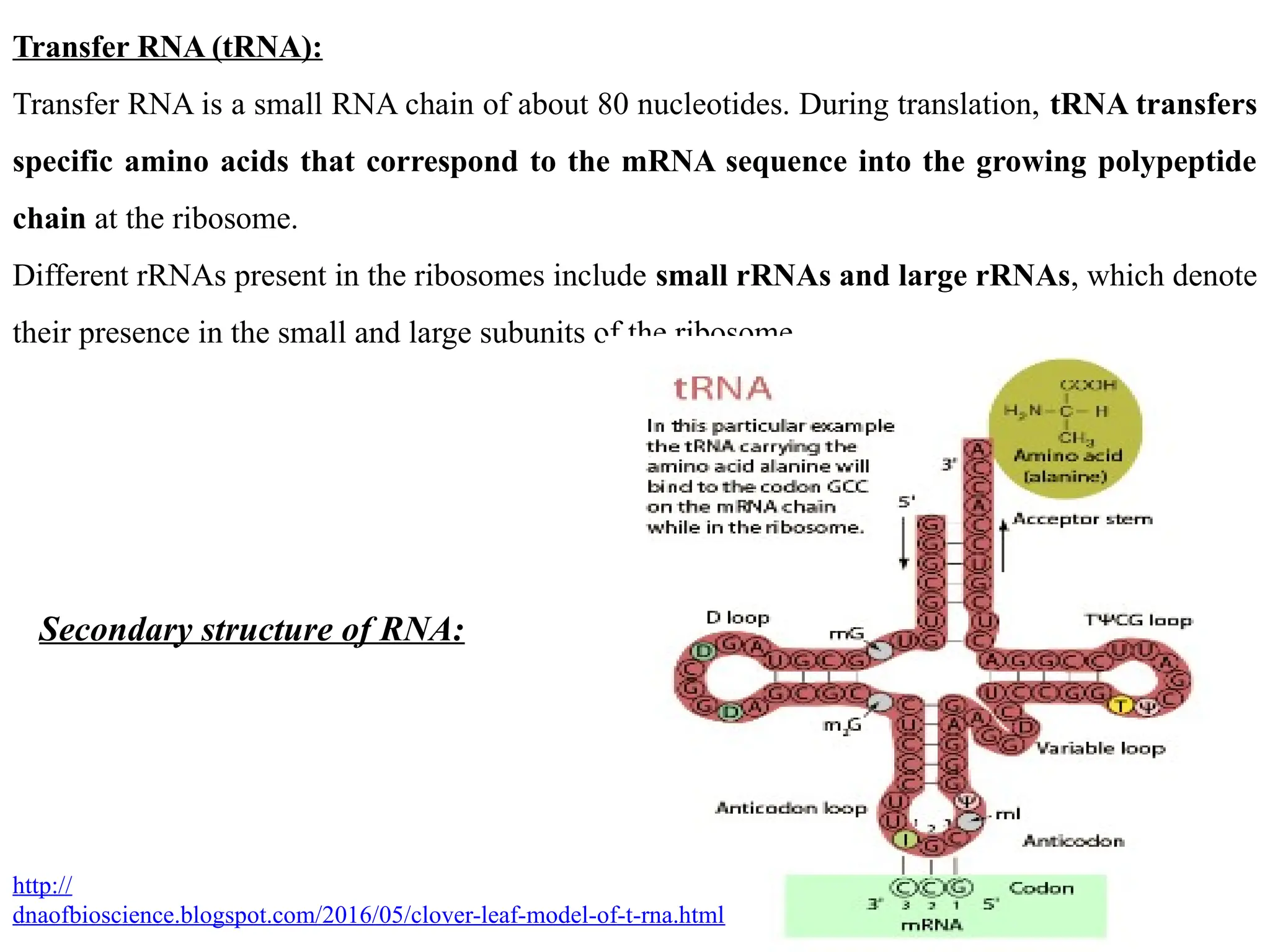
Transfer RNA (tRNA):
Transfer RNA is a small RNA chain of about 80 nucleotides. During translation, tRNA transfers
specific amino acids that correspond to the mRNA sequence into the growing polypeptide
chain at the ribosome.
Different rRNAs present in the ribosomes include small rRNAs and large rRNAs, which denote
their presence in the small and large subunits of the ribosome.
Secondary structure of RNA:
http://
dnaofbioscience.blogspot.com/2016/05/clover-leaf-model-of-t-rna.html
Unusal Bases in tRNA
1. Amino acid arm:
It has a seven base pairs stem formed by base pairing between 5′ and 3′ ends of tRNA. At 3′ end a
sequence of 5′-CCA-3′ is added. This is called CCA arm or amino acid acceptor arm. Amino
acid binds to this arm during protein synthesis.
2. D-arm:
Going from 5′ to 3′ direction or anticlockwise direction, next arm is D-arm. It has a 3 to 4 base
pair stem and a loop called D-loop or DHU-loop. It contains a modified base dihydrouracil.
3. Anticodon arm:
Next is the arm which lies opposite to the acceptor arm. It has a five base pair stem and a loop in
which there are three adjacent nucleotides called anticodon which are complementary to the
codon of mRNA.
4. An extra arm:
Next lies an extra arm which consists of 3-21 bases. Depending upon the length, extra arms are
of two types, small extra arm with 3-5 bases and other a large arm having 13-21 bases.
5. T-arm or TψC arm:
It has a modified base pseudouridine ψ. It has a five base pair stem with a loop.
There are about 50 different types of modified bases in different tRNAs, but four bases are more
common. One is ribothymidine which contains thymine which is not found in RNA. Other
modified bases are pseudouridine ψ, dihyrouridine and inosine.
Small nuclear RNAs (snRNA; 150 nt):
Small nuclear RNAs are always associated with a group of specific proteins to form the
complexes referred to as “small nuclear ribonucleoproteins (snRNP)” in the nucleus. Their
primary function is to process the precursor mRNA (pre-mRNA).
Small nucleolar RNAs (snoRNA; 60-300 nt):
Small nucleolar RNAs are components of small nucleolar ribonucleoproteins (snoRNPs), which
are complexes that are responsible for sequence-specific nucleotide modification.
Piwi-interacting RNAs (piRNA; 24-30 nt):
Piwi-interacting RNAs bind the PIWI subfamily proteins that are involved in maintaining
genome stability in germline cells. Piwi-interacting RNAs also play a role in gametogenesis.
MicroRNAs (miRNA; 21-22 nt):
MicroRNAs are small ncRNAs of ~22 nucleotides (nt) and the most widely studied class of
ncRNAs. These RNA species mediate post-transcriptional gene silencing through RNA
interference (RNAi), where an effector complex of miRNA and enzymes can target
complementary mRNA by blocking the mRNA from being translated or accelerating its
degradation. In human, miRNAs are estimated to regulate the translation of >60% of protein-
coding genes.
Long noncoding RNAs (lncRNA):
Long noncoding RNAs are a heterogeneous group of non-coding transcripts larger than 200 nt
in size and make up the largest portion of the mammalian non-coding transcriptome.
It is estimated that more than 8,000 lncRNAs encoded in the human genome.
lncRNAs are essential in many physiological processes.
Role of secondary structure in mRNA stability:
 secondary structure can increase mRNA half-life independent of codon usage.
 mRNA secondary structures affect translation initiation.
 Secondary structure motifs form binding sites for regulatory proteins.
 Secondary structures of mRNA act as translational coupling devices in the translation of
polycistronic mRNAs.
 mRNA secondary structures affect translation elongation.
 Stem-loop structures govern the recoding of the mRNA.

Types of RNA , structure and its functions.pptx

  • 1.
    Types of RNA: RNA: RNAor ribonucleic acid is a polymer of nucleotides which is made up of a ribose sugar, a phosphate, and bases such as adenine, guanine, cytosine, and uracil. It is a polymeric molecule essential in various biological roles in coding, decoding, regulation, and expression of genes. RNA Coding-RNA Non-coding RNA messenger RNA[mRNA] Ribosomal RNA (rRNA) Transfer RNA (tRNA) Small nuclear RNAs (snRNA; 150 nt) Small nucleolar RNAs (snoRNA;60-300 nt) Piwi-interacting RNAs MicroRNAs (miRNA; 21-22 nt) Long noncoding RNAs
  • 2.
    Coding-RNA (messenger RNA;mRNA): 1. Messenger RNA (mRNA) carries the genetic code from DNA in a form that can be recognized to make proteins. 2. The coding sequence of the mRNA determines the amino acid sequence in the protein produced. Once transcribed from DNA, eukaryotic mRNA briefly exists in a form called “precursor mRNA (pre-mRNA)” before it is fully processed into mature mRNA. 3. This processing step, which is called “RNA splicing”, removes the introns (non-coding region) and joins exons (expressing region) of the pre-mRNA. 4. As part of post-transcriptional processing in eukaryotes, the 5’ end of mRNA is capped with a guanosine triphosphate nucleotide, which helps in mRNA recognition during translation or protein synthesis. 5. Similarly, the 3’ end of an mRNA has a poly A tail or multiple adenylate residues added to it, which prevent enzymatic degradation of mRNA. Both 5’ and 3’ end of an mRNA imparts stability to the mRNA.
  • 3.
    Non-coding RNA (ncRNA) RibosomalRNA (rRNA): Ribosomal RNA is the catalytic component of the ribosomes. In the cytoplasm, rRNAs and protein components combine to form a nucleoprotein complex called the ribosome which binds mRNA and synthesizes proteins (also called translation). Table: 1 Composition of Eukaryotic Ribosome 80S [mass = 4220kD] 40S 60S 18S rRNA 28S rRNA 33 Different proteins 5.8S rRNA 5S rRNA [49 Different proteins] Courtesy: Biochemistry by Reginald H. Garrett, Charles M. Grisham (4th ed.) Page No. 962
  • 4.
    Prokaryotic Ribosomes AreComposed of 30S and 50S Subunits Table: 2 Structural Organization of E.coli Ribosomes 70S [Mass=2520 kD] 30S 50S 16S ribosomal RNA (rRNA) 23S rRNA and 5S rRNA [21 different proteins] [31 different proteins] Courtesy: Biochemistry by Reginald H. Garrett, Charles M. Grisham (4th ed.) Page No. 965
  • 5.
    Transfer RNA (tRNA): TransferRNA is a small RNA chain of about 80 nucleotides. During translation, tRNA transfers specific amino acids that correspond to the mRNA sequence into the growing polypeptide chain at the ribosome. Different rRNAs present in the ribosomes include small rRNAs and large rRNAs, which denote their presence in the small and large subunits of the ribosome. Secondary structure of RNA: http:// dnaofbioscience.blogspot.com/2016/05/clover-leaf-model-of-t-rna.html
  • 6.
    Unusal Bases intRNA 1. Amino acid arm: It has a seven base pairs stem formed by base pairing between 5′ and 3′ ends of tRNA. At 3′ end a sequence of 5′-CCA-3′ is added. This is called CCA arm or amino acid acceptor arm. Amino acid binds to this arm during protein synthesis. 2. D-arm: Going from 5′ to 3′ direction or anticlockwise direction, next arm is D-arm. It has a 3 to 4 base pair stem and a loop called D-loop or DHU-loop. It contains a modified base dihydrouracil. 3. Anticodon arm: Next is the arm which lies opposite to the acceptor arm. It has a five base pair stem and a loop in which there are three adjacent nucleotides called anticodon which are complementary to the codon of mRNA. 4. An extra arm: Next lies an extra arm which consists of 3-21 bases. Depending upon the length, extra arms are of two types, small extra arm with 3-5 bases and other a large arm having 13-21 bases. 5. T-arm or TψC arm: It has a modified base pseudouridine ψ. It has a five base pair stem with a loop. There are about 50 different types of modified bases in different tRNAs, but four bases are more common. One is ribothymidine which contains thymine which is not found in RNA. Other modified bases are pseudouridine ψ, dihyrouridine and inosine.
  • 7.
    Small nuclear RNAs(snRNA; 150 nt): Small nuclear RNAs are always associated with a group of specific proteins to form the complexes referred to as “small nuclear ribonucleoproteins (snRNP)” in the nucleus. Their primary function is to process the precursor mRNA (pre-mRNA). Small nucleolar RNAs (snoRNA; 60-300 nt): Small nucleolar RNAs are components of small nucleolar ribonucleoproteins (snoRNPs), which are complexes that are responsible for sequence-specific nucleotide modification. Piwi-interacting RNAs (piRNA; 24-30 nt): Piwi-interacting RNAs bind the PIWI subfamily proteins that are involved in maintaining genome stability in germline cells. Piwi-interacting RNAs also play a role in gametogenesis. MicroRNAs (miRNA; 21-22 nt): MicroRNAs are small ncRNAs of ~22 nucleotides (nt) and the most widely studied class of ncRNAs. These RNA species mediate post-transcriptional gene silencing through RNA interference (RNAi), where an effector complex of miRNA and enzymes can target complementary mRNA by blocking the mRNA from being translated or accelerating its degradation. In human, miRNAs are estimated to regulate the translation of >60% of protein- coding genes.
  • 8.
    Long noncoding RNAs(lncRNA): Long noncoding RNAs are a heterogeneous group of non-coding transcripts larger than 200 nt in size and make up the largest portion of the mammalian non-coding transcriptome. It is estimated that more than 8,000 lncRNAs encoded in the human genome. lncRNAs are essential in many physiological processes. Role of secondary structure in mRNA stability:  secondary structure can increase mRNA half-life independent of codon usage.  mRNA secondary structures affect translation initiation.  Secondary structure motifs form binding sites for regulatory proteins.  Secondary structures of mRNA act as translational coupling devices in the translation of polycistronic mRNAs.  mRNA secondary structures affect translation elongation.  Stem-loop structures govern the recoding of the mRNA.