MICRO RNA
BIOGENESIS &
FUNCTION
BY:
MOHAMED SAMIR EL-ASALY
PT, CKTP
UNDER THE SUPERVISION OF:
PROF. DR. HUSSEIN SABIT
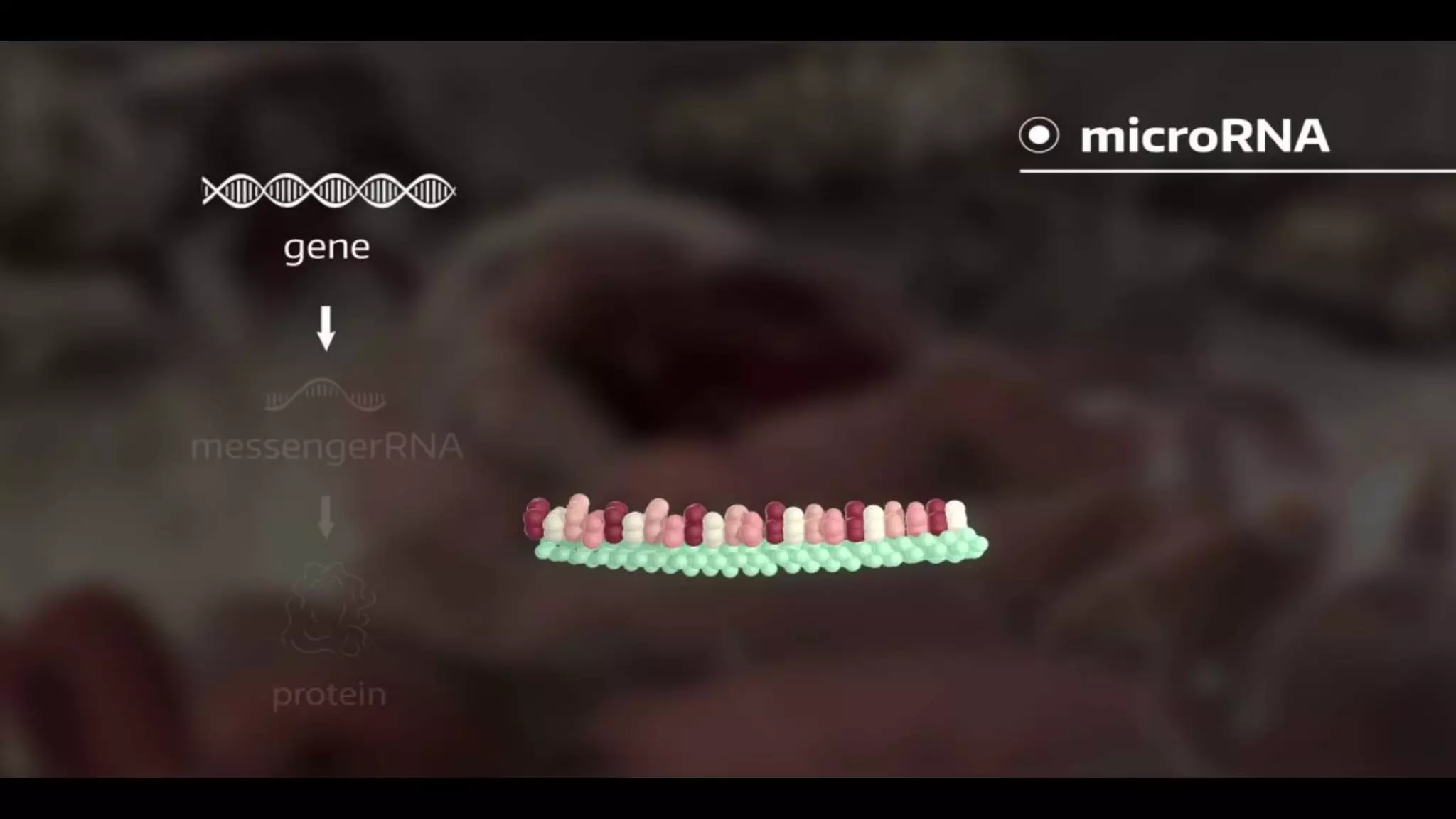
MIRNA
Small noncoding RNA molecule(~22
nucleotides).
Found in plants, animals, virus.
Functions in RNA silencing.
Human genome may encode over 1000
miRNAs.
HISTORY
• Two decades ago, the existence and importance of miRNAs was
completely unknown.
• Until then, the scientific community was focused on genes that
codify for protein.
• The classical dogma was put aside for the study of all the non-
protein coding sequences.
NOMENCLATURE
•The prefix “miR” is followed by a dash and a
number, the latter often indicating order of
naming.
•For example, miR-124 was named and
likely discovered prior to miR-456.
NOMENCLATURE
•A capitalized “miR-” refers to the mature form
of the miRNA, while the uncapitalized “mir-”
refers to the pre-miRNA and the pri-miRNA.
• The “MIR” refers to the gene that encodes
them
NOMENCLATURE
•miRNAS with nearly identical sequences except
for one or two nucleotides are annotated with
an additional lower case letter.
•For example, miR-124a is closely related to
miR-124b
NOMENCLATURE
•Species of origin is designated with a three
letter prefix.
•For example, hsa-miR-124 is a human
(Homo sapiens) miRNA and oar-miR-124 is
s sheep (Ovis aries) miRNA.
•Other common prefixes include ‘v’ for viral
miRNA and ‘d’ for Drosophila miRNA
NOMENCLATURE
• Pre-miRNAs, pri-miRNAs and genes that lead to 100%
identical mature miRNAs but that are located at different
places in the genome are indicated with an additional dash-
number suffix
• For example, the pri-miRNAs hsa-mir-194-1 and hsa-mir-
194-2 lead to an identical mature miRNA (hsa-miR-194)
but are from genes located in different genome regions.
NOMENCLATURE
•When two mature miRNAs originate from
the opposite arms of the same pre-miRNA
and are found in roughly similar amounts,
they are denoted with a -3p or -5p suffix.
•(In the past it used to be made ’s’ (sense)
and ‘as’ (antisense)).
NOMENCLATURE
• However, the mature miRNA found from one arm of
the hairpin is usually much more abundant than that
found from the other arm.
• So we use an asterisk following the name indicates
the mature species found at low levels from the
opposite arm of the hairpin
• For example, miR-124 and miR-124* share a pre-
miRNA hairpin but much more miR-124 is found in
the cell.
BIOGENESIS
•As many as 40% of miRNA genes may lie in
the introns or even exons of other genes.
•These are usually, though not exclusively,
found in a sense orientation, and thus usually
are regulated together with their host genes
•GENE DESSERTS?
STEPS IN BIOGENESIS
• Transcription
• Nuclear Processing
• Nuclear Export
• Cytoplasmic Processing
AND there, it is finally ready!!!!
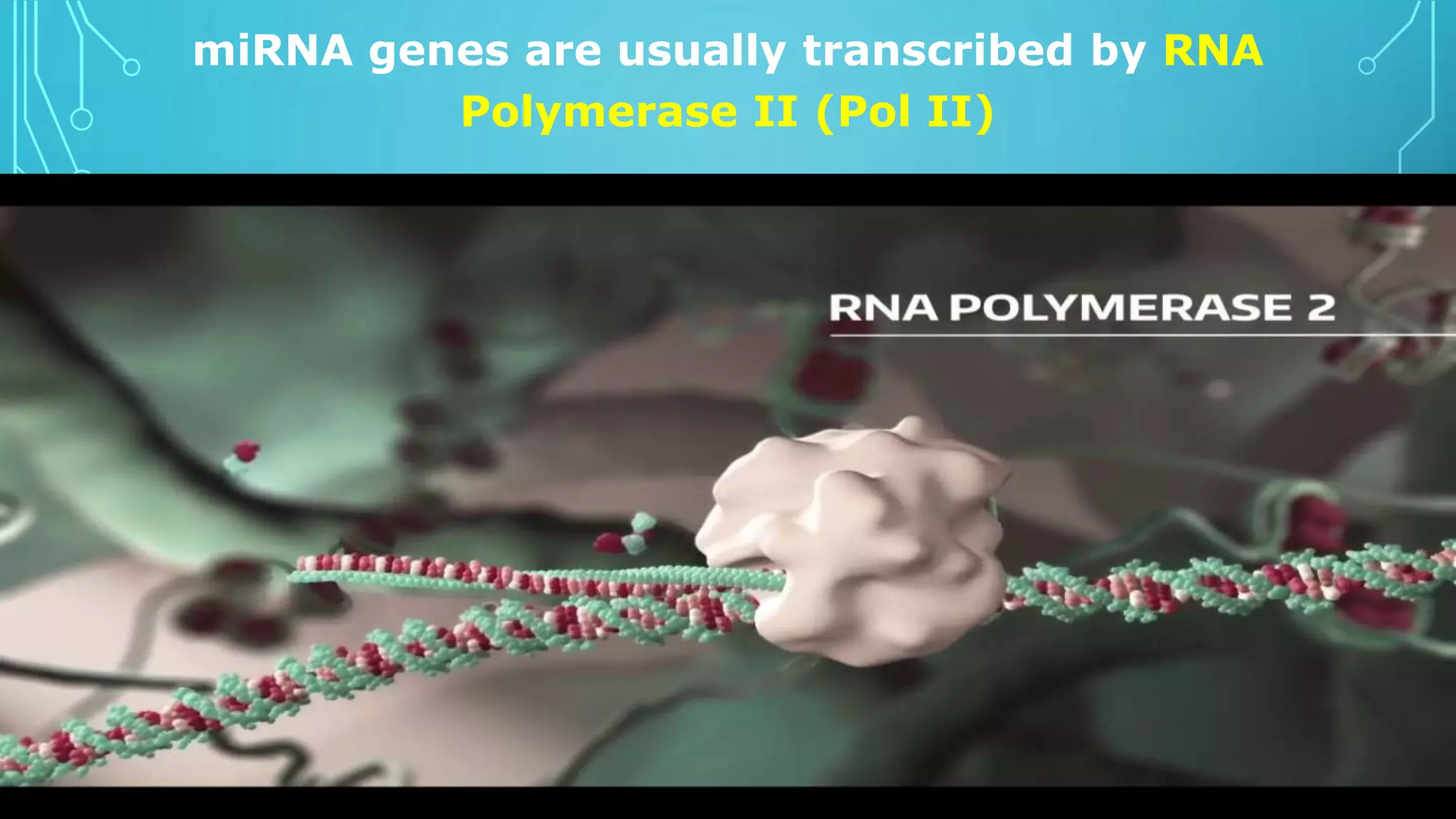
miRNA genes are usually transcribed by RNA
Polymerase II (Pol II)
PRI MICRO-RNA
• It will become the hairpin loop of the pri-
miRNA (primary miRNA)
• The resulting transcript is capped with a
specially modified nucleotide at the 5’
end, polyadenylated with
multiple adenosines (a poly(A) tail).
• Produced from single stranded RNA
• Sequence complementarity
• 100-120 nucleotide long
PRE MICRO-RNA
• DROSHA ENZYE & DGCR8 combine
together and act on the pri miRNA
and cut it to produce pre-miRNA.
• Precursor miRNA
• It’s approximately 70 nucleotides
long.
• It’s now ready to be sent out to the
cytoplasm.
EXPORTIN 5
•Protein that guide and
attach to the pre-
miRNA to be
exported out into the
cytoplasm.
•Through the nuclear
pores.
DICER
• It’s a type of RNAs III type
enzyme, RNA specific
endonuclease.
• In the cytoplasm DICER will
attach to the pre-miRNA
• It will prepare the pre-miRNA
to be properly activated.
DICER
• It will bind with pre-miRNA and it
will break down the hairpin
structure and it will become double
stranded RNA with a 3’ overhangs
of 2 nucleotides and 5’
monophosphate regions
• The structure now is called miRNA
miRNA* duplex (15 – 20
nucleotide long)
RISC
• RNA induced scilencing compex
• The RISC consists of:
1. Slicer
2.Argonaute protein (found in all
types of RISC)
3. TRNC6
• The miRNA: miRNA* duplex is
loaded on the RISC complex
RISC
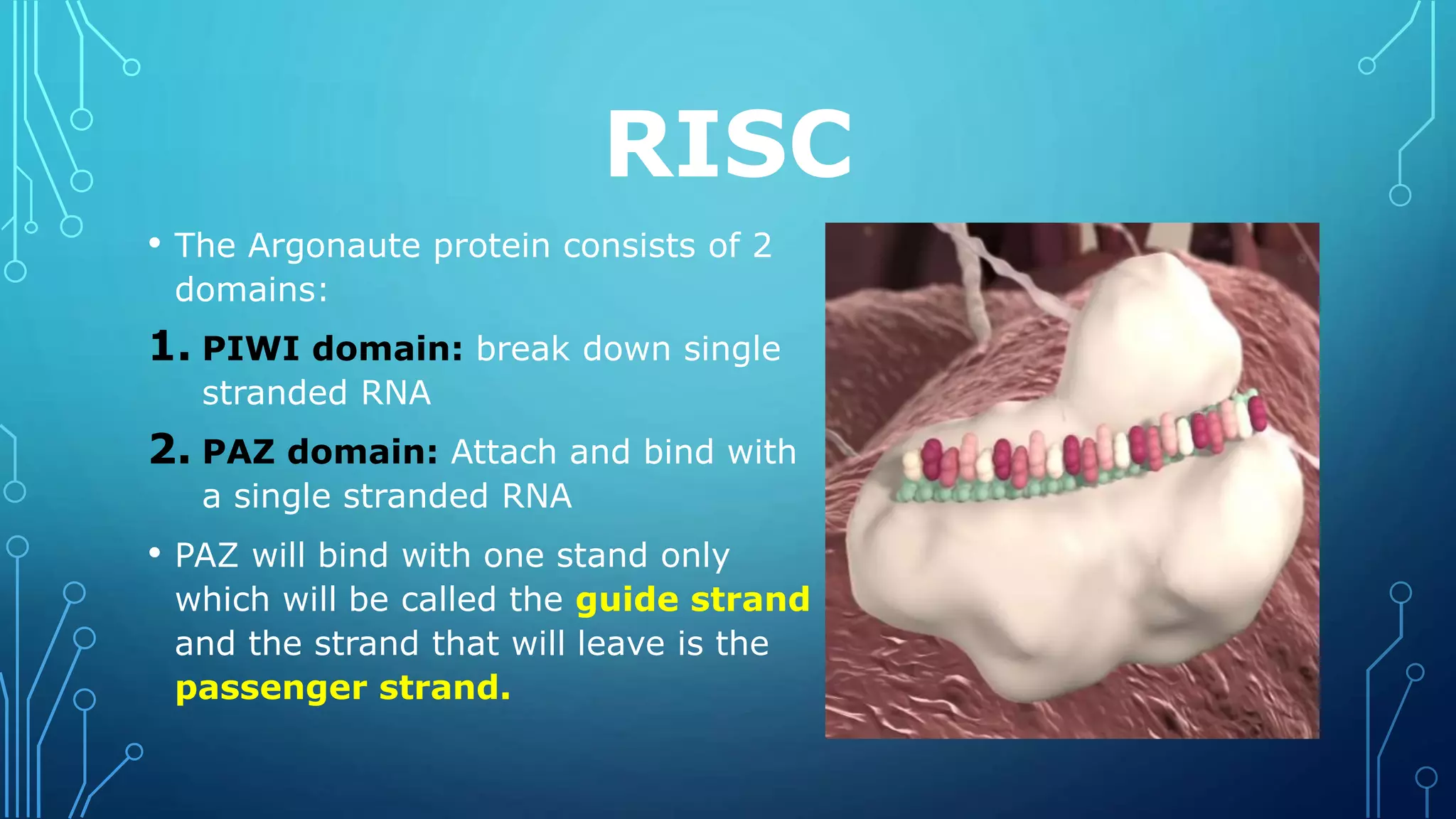
• The Argonaute protein consists of 2
domains:
1. PIWI domain: break down single
stranded RNA
2. PAZ domain: Attach and bind with
a single stranded RNA
• PAZ will bind with one stand only
which will be called the guide strand
and the strand that will leave is the
passenger strand.
FINALLY
Micro RNA biogenesis, function and nomenclature

Micro RNA biogenesis, function and nomenclature

  • 1.
    MICRO RNA BIOGENESIS & FUNCTION BY: MOHAMEDSAMIR EL-ASALY PT, CKTP UNDER THE SUPERVISION OF: PROF. DR. HUSSEIN SABIT
  • 2.
    MIRNA Small noncoding RNAmolecule(~22 nucleotides). Found in plants, animals, virus. Functions in RNA silencing. Human genome may encode over 1000 miRNAs.
  • 3.
    HISTORY • Two decadesago, the existence and importance of miRNAs was completely unknown. • Until then, the scientific community was focused on genes that codify for protein. • The classical dogma was put aside for the study of all the non- protein coding sequences.
  • 4.
    NOMENCLATURE •The prefix “miR”is followed by a dash and a number, the latter often indicating order of naming. •For example, miR-124 was named and likely discovered prior to miR-456.
  • 5.
    NOMENCLATURE •A capitalized “miR-”refers to the mature form of the miRNA, while the uncapitalized “mir-” refers to the pre-miRNA and the pri-miRNA. • The “MIR” refers to the gene that encodes them
  • 6.
    NOMENCLATURE •miRNAS with nearlyidentical sequences except for one or two nucleotides are annotated with an additional lower case letter. •For example, miR-124a is closely related to miR-124b
  • 7.
    NOMENCLATURE •Species of originis designated with a three letter prefix. •For example, hsa-miR-124 is a human (Homo sapiens) miRNA and oar-miR-124 is s sheep (Ovis aries) miRNA. •Other common prefixes include ‘v’ for viral miRNA and ‘d’ for Drosophila miRNA
  • 8.
    NOMENCLATURE • Pre-miRNAs, pri-miRNAsand genes that lead to 100% identical mature miRNAs but that are located at different places in the genome are indicated with an additional dash- number suffix • For example, the pri-miRNAs hsa-mir-194-1 and hsa-mir- 194-2 lead to an identical mature miRNA (hsa-miR-194) but are from genes located in different genome regions.
  • 9.
    NOMENCLATURE •When two maturemiRNAs originate from the opposite arms of the same pre-miRNA and are found in roughly similar amounts, they are denoted with a -3p or -5p suffix. •(In the past it used to be made ’s’ (sense) and ‘as’ (antisense)).
  • 10.
    NOMENCLATURE • However, themature miRNA found from one arm of the hairpin is usually much more abundant than that found from the other arm. • So we use an asterisk following the name indicates the mature species found at low levels from the opposite arm of the hairpin • For example, miR-124 and miR-124* share a pre- miRNA hairpin but much more miR-124 is found in the cell.
  • 11.
    BIOGENESIS •As many as40% of miRNA genes may lie in the introns or even exons of other genes. •These are usually, though not exclusively, found in a sense orientation, and thus usually are regulated together with their host genes •GENE DESSERTS?
  • 12.
    STEPS IN BIOGENESIS •Transcription • Nuclear Processing • Nuclear Export • Cytoplasmic Processing AND there, it is finally ready!!!!
  • 13.
    miRNA genes areusually transcribed by RNA Polymerase II (Pol II)
  • 14.
    PRI MICRO-RNA • Itwill become the hairpin loop of the pri- miRNA (primary miRNA) • The resulting transcript is capped with a specially modified nucleotide at the 5’ end, polyadenylated with multiple adenosines (a poly(A) tail). • Produced from single stranded RNA • Sequence complementarity • 100-120 nucleotide long
  • 15.
    PRE MICRO-RNA • DROSHAENZYE & DGCR8 combine together and act on the pri miRNA and cut it to produce pre-miRNA. • Precursor miRNA • It’s approximately 70 nucleotides long. • It’s now ready to be sent out to the cytoplasm.
  • 16.
    EXPORTIN 5 •Protein thatguide and attach to the pre- miRNA to be exported out into the cytoplasm. •Through the nuclear pores.
  • 17.
    DICER • It’s atype of RNAs III type enzyme, RNA specific endonuclease. • In the cytoplasm DICER will attach to the pre-miRNA • It will prepare the pre-miRNA to be properly activated.
  • 18.
    DICER • It willbind with pre-miRNA and it will break down the hairpin structure and it will become double stranded RNA with a 3’ overhangs of 2 nucleotides and 5’ monophosphate regions • The structure now is called miRNA miRNA* duplex (15 – 20 nucleotide long)
  • 19.
    RISC • RNA inducedscilencing compex • The RISC consists of: 1. Slicer 2.Argonaute protein (found in all types of RISC) 3. TRNC6 • The miRNA: miRNA* duplex is loaded on the RISC complex
  • 20.
    RISC • The Argonauteprotein consists of 2 domains: 1. PIWI domain: break down single stranded RNA 2. PAZ domain: Attach and bind with a single stranded RNA • PAZ will bind with one stand only which will be called the guide strand and the strand that will leave is the passenger strand.
  • 22.