Post transcriptional Modifications (occurs in Eukaryotes)
1. 5’ Capping
2. RNA Splicing
3. 3’ Poly A tail Dr. Manikandan Kathirvel
Assistant Professor,
Department of Life Sciences,
Kristu Jayanti College (Autonomous),
Bengaluru 560077
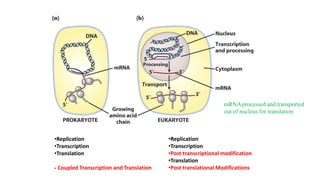
•Replication
•Transcription
•Translation
- Coupled Transcription and Translation
•Replication
•Transcription
•Post transcriptional modification
•Translation
•Post translational Modifications
mRNAprocessed and transported
out of nucleus for translation
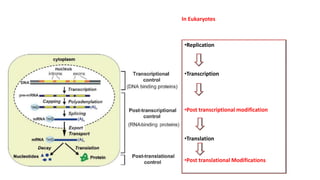
•Replication
•Transcription
•Post transcriptional modification
•Translation
•Post translational Modifications
In Eukaryotes
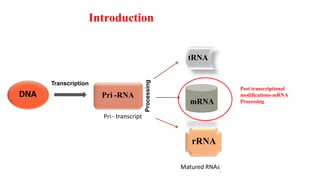
DNA
Transcription
Pri -RNA
tRNA
4
mRNA
rRNA
Matured RNAs
Processing
Introduction
Pri - transcript
Post transcriptional
modifications-mRNA
Processing
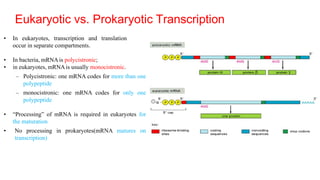
Eukaryotic vs. Prokaryotic Transcription
• In eukaryotes, transcription and translation
occur in separate compartments.
• In bacteria, mRNAis polycistronic;
• in eukaryotes, mRNAis usually monocistronic.
– Polycistronic: one mRNA codes for more than one
polypeptide
– monocistronic: one mRNA codes for only one
polypeptide
• “Processing” of mRNA is required in eukaryotes for
the maturation
• No processing in prokaryotes(mRNA matures on
transcription)
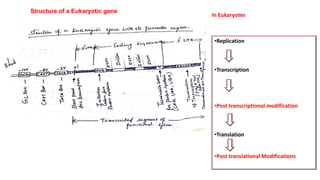
Structure of a Eukaryotic gene
•Replication
•Transcription
•Post transcriptional modification
•Translation
•Post translational Modifications
In Eukaryotes
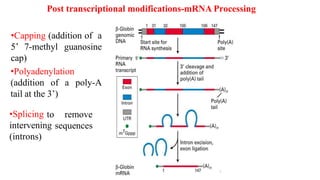
•Capping (addition of a
5’ 7-methyl guanosine
cap)
•Splicing
intervening
(introns)
to remove
sequences
•Polyadenylation
(addition of a poly-A
tail at the 3’)
Post transcriptional modifications-mRNA Processing
7
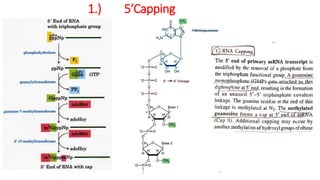
1.) 5’Capping
6
Cap Functions
Cap provides:
1. Protection from some ribonucleases degradation
2. Stabilizes mRNA
3. Enhanced translation and splicing
4. Enhanced transport from nucleus to cytoplasm
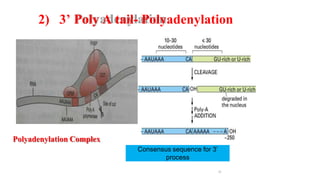
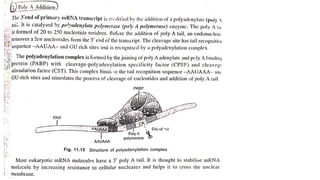
2) 3’ Poly A tail- Polyadenylation
Polyadenylation Complex
10
Consensus sequence for 3’
process
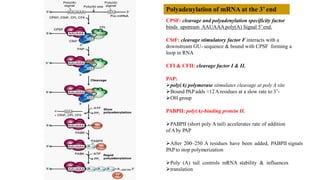
Polyadenylation of mRNA at the 3’ end
CPSF: cleavage and polyadenylation specificity factor
binds upstream AAUAAApoly(A) Signal 5’end.
CStF: cleavage stimulatory factor F interacts with a
downstream GU- sequence & bound with CPSF forming a
loop in RNA
CFI & CFII: cleavage factor I & II.
PAP:
poly(A) polymerase stimulates cleavage at poly A site
Bound PAP adds ≈12Aresidues at a slow rate to 3’-
OH group
PABPII: poly(A)-binding protein II.
PABPII (short poly A tail) accelerates rate of addition
ofAby PAP
After 200–250 A residues have been added, PABPII signals
PAPto stop polymerization
Poly (A) tail controls mRNA stability & influences
translation
1
3
•mRNA is called hnRNA (heterogenous nuclear RNA) before splicing
occurs
•The hnRNP proteins to help keep the hnRNAin a single-stranded form
and to assist in the various RNAprocessing reactions
• Exon and intron lengths & numbers vary in various genes
• Exon (Expressed sequences)is any segment of an interrupted gene
that is represented in the mature RNAproduct.
• Intron (intervening sequences )is a segment of DNA that is
transcribed, but removed from within the transcript by splicing
together the sequences (exons) on either side of it.
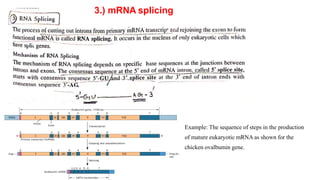
3.) mRNA splicing
3.) mRNA splicing
Example: The sequence of steps in the production
of mature eukaryotic mRNA as shown for the
chicken ovalbumin gene.
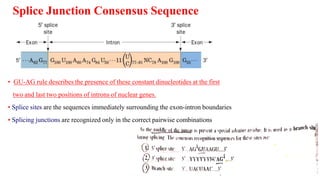
Splice Junction Consensus Sequence
• GU-AG rule describes the presence of these constant dinucleotides at the first
two and last two positions of introns of nuclear genes.
• Splice sites are the sequences immediately surrounding the exon-intron boundaries
• Splicing junctions are recognized only in the correct pairwise combinations
1
5
16
•Splicing is mediated by a large RNPs
(Ribonucleoproteins) complex called
"spliceosome"
• Spliceosome contains a specific set of
base Uracil-rich snRNPs (small nuclear
RNPs) associated with proteins
(snRNAcomplex with protein)
Function of snRNPs:
• Recognizing the 5’ splice site and the
branch site.
• Bringing those sites together.
• Catalyzing (or helping to catalyze) the
RNAcleavage.
mRNA splicing
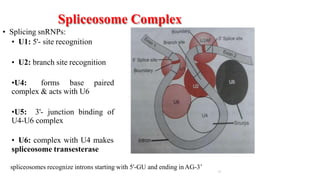
Spliceosome Complex
• Splicing snRNPs:
• U1: 5'- site recognition
• U2: branch site recognition
•U4: forms base paired
complex & acts with U6
•U5: 3'- junction binding of
U4-U6 complex
• U6: complex with U4 makes
spliceosome transesterase
spliceosomes recognize introns starting with 5'-GU and ending inAG-3’
17
U1
3′
5′
5′ splice site 3′ splice site
Branch site
A
GU
Exon 1 Exon 2
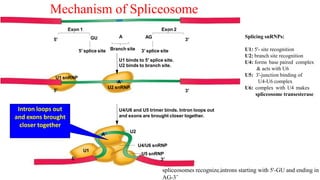
U1 binds to 5′ splice site.
U2 binds to branch site.
AG
3′
5′
U4/U6 and U5 trimer binds. Intron loops out
and exons are brought closer together.
U1 snRNP
A
U2 snRNP
3′
5′
A
U4/U6 snRNP
U5 snRNP
U2
Intron loops out
and exons brought
closer together
18
Mechanism of Spliceosome
Splicing snRNPs:
U1: 5'- site recognition
U2: branch site recognition
U4: forms base paired complex
& acts with U6
U5: 3'-junction binding of
U4-U6 complex
U6: complex with U4 makes
spliceosome transesterase
spliceosomes recognize introns starting with 5'-GU and ending in
AG-3’
U1
U4
5′
3′
5′
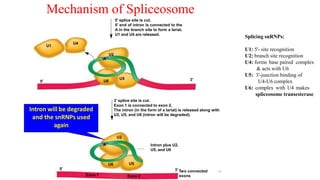
5′ splice site is cut.
5′ end of intron is connected to the
A in the branch site to form a lariat.
U1 and U4 are released.
3′ splice site is cut.
Exon 1 is connected to exon 2.
The intron (in the form of a lariat) is released along with
U2, U5, and U6 (intron will be degraded).
A
U5
U6
U5
U6
U2
A
Intron plus U2,
U5, and U6
3′ Two connected
exons
Exon 1 Exon 2
U2
Intron will be degraded
and the snRNPs used
again
Mechanism of Spliceosome
14
Splicing snRNPs:
U1: 5'- site recognition
U2: branch site recognition
U4: forms base paired complex
& acts with U6
U5: 3'-junction binding of
U4-U6 complex
U6: complex with U4 makes
spliceosome transesterase
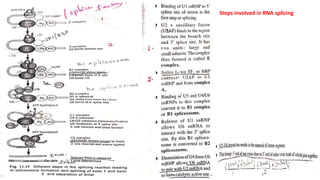
Steps involved in RNA splicing
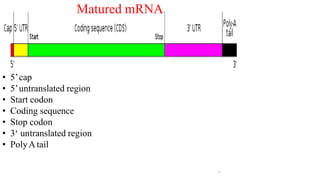
• 5’cap
• 5’untranslated region
• Start codon
• Coding sequence
• Stop codon
• 3‘ untranslated region
• PolyAtail
21
Matured mRNA
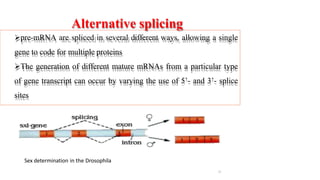
pre-mRNA are spliced in several different ways, allowing a single
gene to code for multiple proteins
The generation of different mature mRNAs from a particular type
of gene transcript can occur by varying the use of 5’- and 3’- splice
sites
Alternative splicing
Sex determination in the Drosophila
22
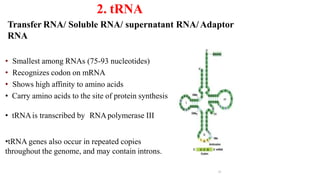
2. tRNA
Transfer RNA/ Soluble RNA/ supernatant RNA/Adaptor
RNA
• Smallest among RNAs (75-93 nucleotides)
• Recognizes codon on mRNA
• Shows high affinity to amino acids
• Carry amino acids to the site of protein synthesis
• tRNAis transcribed by RNApolymerase III
•tRNA genes also occur in repeated copies
throughout the genome, and may contain introns.
23
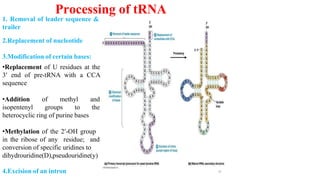
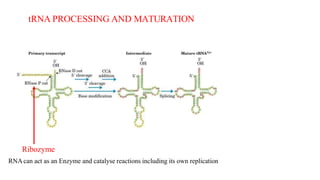
1. Removal of leader sequence &
trailer
2.Replacement of nucleotide
3.Modification of certain bases:
•Replacement of U residues at the
3′ end of pre-tRNA with a CCA
sequence
•Addition of methyl and
isopentenyl groups to the
heterocyclic ring of purine bases
•Methylation of the 2′-OH group
in the ribose of any residue; and
conversion of specific uridines to
dihydrouridine(D),pseudouridine(y)
4.Excision of an intron
Processing of tRNA
20
Ribozyme
RNAcan act as an Enzyme and catalyse reactions including its own replication
tRNA PROCESSING AND MATURATION
26
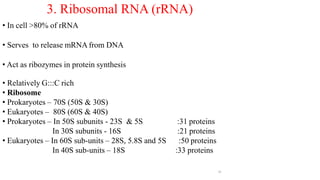
• In cell >80% of rRNA
• Serves to release mRNA from DNA
• Act as ribozymes in protein synthesis
• Relatively G:::C rich
• Ribosome
• Prokaryotes – 70S (50S & 30S)
• Eukaryotes – 80S (60S & 40S)
• Prokaryotes – In 50S subunits - 23S & 5S
In 30S subunits - 16S
• Eukaryotes – In 60S sub-units – 28S, 5.8S and 5S
In 40S sub-units – 18S
:31 proteins
:21 proteins
:50 proteins
:33 proteins
3. Ribosomal RNA (rRNA)
27
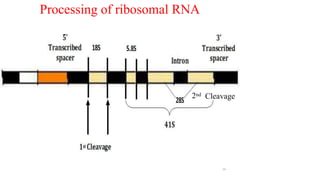
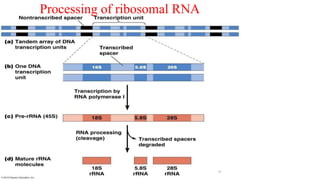
Processing of ribosomal RNA
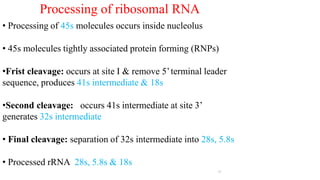
• Processing of 45s molecules occurs inside nucleolus
• 45s molecules tightly associated protein forming (RNPs)
•Frist cleavage: occurs at site I & remove 5’terminal leader
sequence, produces 41s intermediate & 18s
•Second cleavage: occurs 41s intermediate at site 3’
generates 32s intermediate
• Final cleavage: separation of 32s intermediate into 28s, 5.8s
• Processed rRNA 28s, 5.8s & 18s
2nd
24
Cleavage
Processing of ribosomal RNA
29
Synthesis of 5S rRNA
•rDNAcistron for 5S rRNAis present outside Nucleolar
organizer
•Transcription requires RNApol III + TFIIIA, TFIIIB &
TFIIIC
30

Lecture 3 Post Ts Modification-lecture notes.pdf

  • 1.
    Post transcriptional Modifications(occurs in Eukaryotes) 1. 5’ Capping 2. RNA Splicing 3. 3’ Poly A tail Dr. Manikandan Kathirvel Assistant Professor, Department of Life Sciences, Kristu Jayanti College (Autonomous), Bengaluru 560077
  • 2.
    •Replication •Transcription •Translation - Coupled Transcriptionand Translation •Replication •Transcription •Post transcriptional modification •Translation •Post translational Modifications mRNAprocessed and transported out of nucleus for translation
  • 3.
  • 4.
    DNA Transcription Pri -RNA tRNA 4 mRNA rRNA Matured RNAs Processing Introduction Pri- transcript Post transcriptional modifications-mRNA Processing
  • 5.
    Eukaryotic vs. ProkaryoticTranscription • In eukaryotes, transcription and translation occur in separate compartments. • In bacteria, mRNAis polycistronic; • in eukaryotes, mRNAis usually monocistronic. – Polycistronic: one mRNA codes for more than one polypeptide – monocistronic: one mRNA codes for only one polypeptide • “Processing” of mRNA is required in eukaryotes for the maturation • No processing in prokaryotes(mRNA matures on transcription)
  • 6.
    Structure of aEukaryotic gene •Replication •Transcription •Post transcriptional modification •Translation •Post translational Modifications In Eukaryotes
  • 7.
    •Capping (addition ofa 5’ 7-methyl guanosine cap) •Splicing intervening (introns) to remove sequences •Polyadenylation (addition of a poly-A tail at the 3’) Post transcriptional modifications-mRNA Processing 7
  • 8.
  • 9.
    Cap Functions Cap provides: 1.Protection from some ribonucleases degradation 2. Stabilizes mRNA 3. Enhanced translation and splicing 4. Enhanced transport from nucleus to cytoplasm
  • 10.
    2) 3’ PolyA tail- Polyadenylation Polyadenylation Complex 10 Consensus sequence for 3’ process
  • 12.
    Polyadenylation of mRNAat the 3’ end CPSF: cleavage and polyadenylation specificity factor binds upstream AAUAAApoly(A) Signal 5’end. CStF: cleavage stimulatory factor F interacts with a downstream GU- sequence & bound with CPSF forming a loop in RNA CFI & CFII: cleavage factor I & II. PAP: poly(A) polymerase stimulates cleavage at poly A site Bound PAP adds ≈12Aresidues at a slow rate to 3’- OH group PABPII: poly(A)-binding protein II. PABPII (short poly A tail) accelerates rate of addition ofAby PAP After 200–250 A residues have been added, PABPII signals PAPto stop polymerization Poly (A) tail controls mRNA stability & influences translation
  • 13.
    1 3 •mRNA is calledhnRNA (heterogenous nuclear RNA) before splicing occurs •The hnRNP proteins to help keep the hnRNAin a single-stranded form and to assist in the various RNAprocessing reactions • Exon and intron lengths & numbers vary in various genes • Exon (Expressed sequences)is any segment of an interrupted gene that is represented in the mature RNAproduct. • Intron (intervening sequences )is a segment of DNA that is transcribed, but removed from within the transcript by splicing together the sequences (exons) on either side of it. 3.) mRNA splicing
  • 14.
    3.) mRNA splicing Example:The sequence of steps in the production of mature eukaryotic mRNA as shown for the chicken ovalbumin gene.
  • 15.
    Splice Junction ConsensusSequence • GU-AG rule describes the presence of these constant dinucleotides at the first two and last two positions of introns of nuclear genes. • Splice sites are the sequences immediately surrounding the exon-intron boundaries • Splicing junctions are recognized only in the correct pairwise combinations 1 5
  • 16.
    16 •Splicing is mediatedby a large RNPs (Ribonucleoproteins) complex called "spliceosome" • Spliceosome contains a specific set of base Uracil-rich snRNPs (small nuclear RNPs) associated with proteins (snRNAcomplex with protein) Function of snRNPs: • Recognizing the 5’ splice site and the branch site. • Bringing those sites together. • Catalyzing (or helping to catalyze) the RNAcleavage. mRNA splicing
  • 17.
    Spliceosome Complex • SplicingsnRNPs: • U1: 5'- site recognition • U2: branch site recognition •U4: forms base paired complex & acts with U6 •U5: 3'- junction binding of U4-U6 complex • U6: complex with U4 makes spliceosome transesterase spliceosomes recognize introns starting with 5'-GU and ending inAG-3’ 17
  • 18.
    U1 3′ 5′ 5′ splice site3′ splice site Branch site A GU Exon 1 Exon 2 U1 binds to 5′ splice site. U2 binds to branch site. AG 3′ 5′ U4/U6 and U5 trimer binds. Intron loops out and exons are brought closer together. U1 snRNP A U2 snRNP 3′ 5′ A U4/U6 snRNP U5 snRNP U2 Intron loops out and exons brought closer together 18 Mechanism of Spliceosome Splicing snRNPs: U1: 5'- site recognition U2: branch site recognition U4: forms base paired complex & acts with U6 U5: 3'-junction binding of U4-U6 complex U6: complex with U4 makes spliceosome transesterase spliceosomes recognize introns starting with 5'-GU and ending in AG-3’
  • 19.
    U1 U4 5′ 3′ 5′ 5′ splice siteis cut. 5′ end of intron is connected to the A in the branch site to form a lariat. U1 and U4 are released. 3′ splice site is cut. Exon 1 is connected to exon 2. The intron (in the form of a lariat) is released along with U2, U5, and U6 (intron will be degraded). A U5 U6 U5 U6 U2 A Intron plus U2, U5, and U6 3′ Two connected exons Exon 1 Exon 2 U2 Intron will be degraded and the snRNPs used again Mechanism of Spliceosome 14 Splicing snRNPs: U1: 5'- site recognition U2: branch site recognition U4: forms base paired complex & acts with U6 U5: 3'-junction binding of U4-U6 complex U6: complex with U4 makes spliceosome transesterase
  • 20.
    Steps involved inRNA splicing
  • 21.
    • 5’cap • 5’untranslatedregion • Start codon • Coding sequence • Stop codon • 3‘ untranslated region • PolyAtail 21 Matured mRNA
  • 22.
    pre-mRNA are splicedin several different ways, allowing a single gene to code for multiple proteins The generation of different mature mRNAs from a particular type of gene transcript can occur by varying the use of 5’- and 3’- splice sites Alternative splicing Sex determination in the Drosophila 22
  • 23.
    2. tRNA Transfer RNA/Soluble RNA/ supernatant RNA/Adaptor RNA • Smallest among RNAs (75-93 nucleotides) • Recognizes codon on mRNA • Shows high affinity to amino acids • Carry amino acids to the site of protein synthesis • tRNAis transcribed by RNApolymerase III •tRNA genes also occur in repeated copies throughout the genome, and may contain introns. 23
  • 24.
    1. Removal ofleader sequence & trailer 2.Replacement of nucleotide 3.Modification of certain bases: •Replacement of U residues at the 3′ end of pre-tRNA with a CCA sequence •Addition of methyl and isopentenyl groups to the heterocyclic ring of purine bases •Methylation of the 2′-OH group in the ribose of any residue; and conversion of specific uridines to dihydrouridine(D),pseudouridine(y) 4.Excision of an intron Processing of tRNA 20
  • 25.
    Ribozyme RNAcan act asan Enzyme and catalyse reactions including its own replication tRNA PROCESSING AND MATURATION
  • 26.
    26 • In cell>80% of rRNA • Serves to release mRNA from DNA • Act as ribozymes in protein synthesis • Relatively G:::C rich • Ribosome • Prokaryotes – 70S (50S & 30S) • Eukaryotes – 80S (60S & 40S) • Prokaryotes – In 50S subunits - 23S & 5S In 30S subunits - 16S • Eukaryotes – In 60S sub-units – 28S, 5.8S and 5S In 40S sub-units – 18S :31 proteins :21 proteins :50 proteins :33 proteins 3. Ribosomal RNA (rRNA)
  • 27.
    27 Processing of ribosomalRNA • Processing of 45s molecules occurs inside nucleolus • 45s molecules tightly associated protein forming (RNPs) •Frist cleavage: occurs at site I & remove 5’terminal leader sequence, produces 41s intermediate & 18s •Second cleavage: occurs 41s intermediate at site 3’ generates 32s intermediate • Final cleavage: separation of 32s intermediate into 28s, 5.8s • Processed rRNA 28s, 5.8s & 18s
  • 28.
  • 29.
  • 30.
    Synthesis of 5SrRNA •rDNAcistron for 5S rRNAis present outside Nucleolar organizer •Transcription requires RNApol III + TFIIIA, TFIIIB & TFIIIC 30