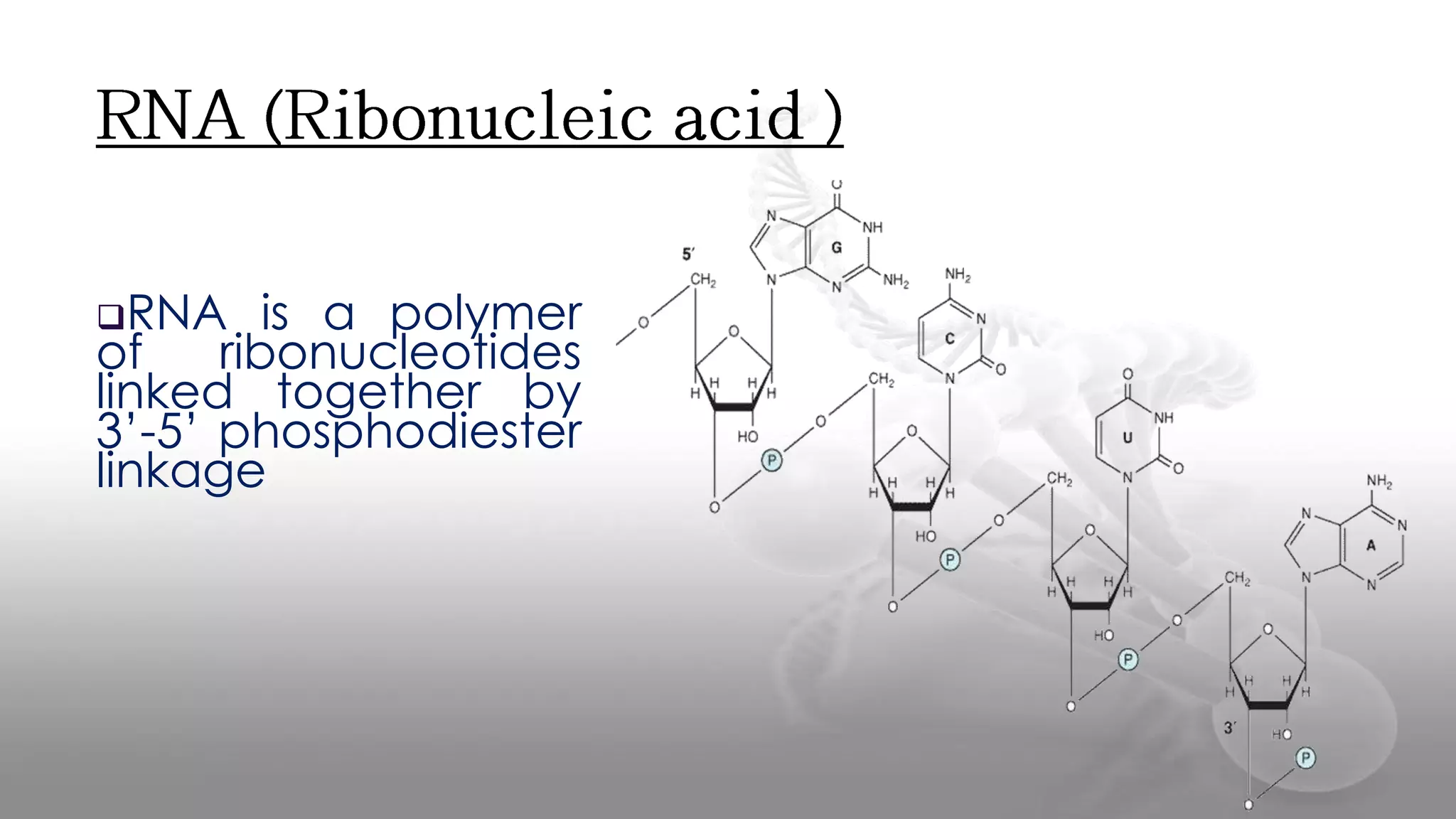
RNA is a polymer
of ribonucleotides
linked together by
3’-5’ phosphodiester
linkage
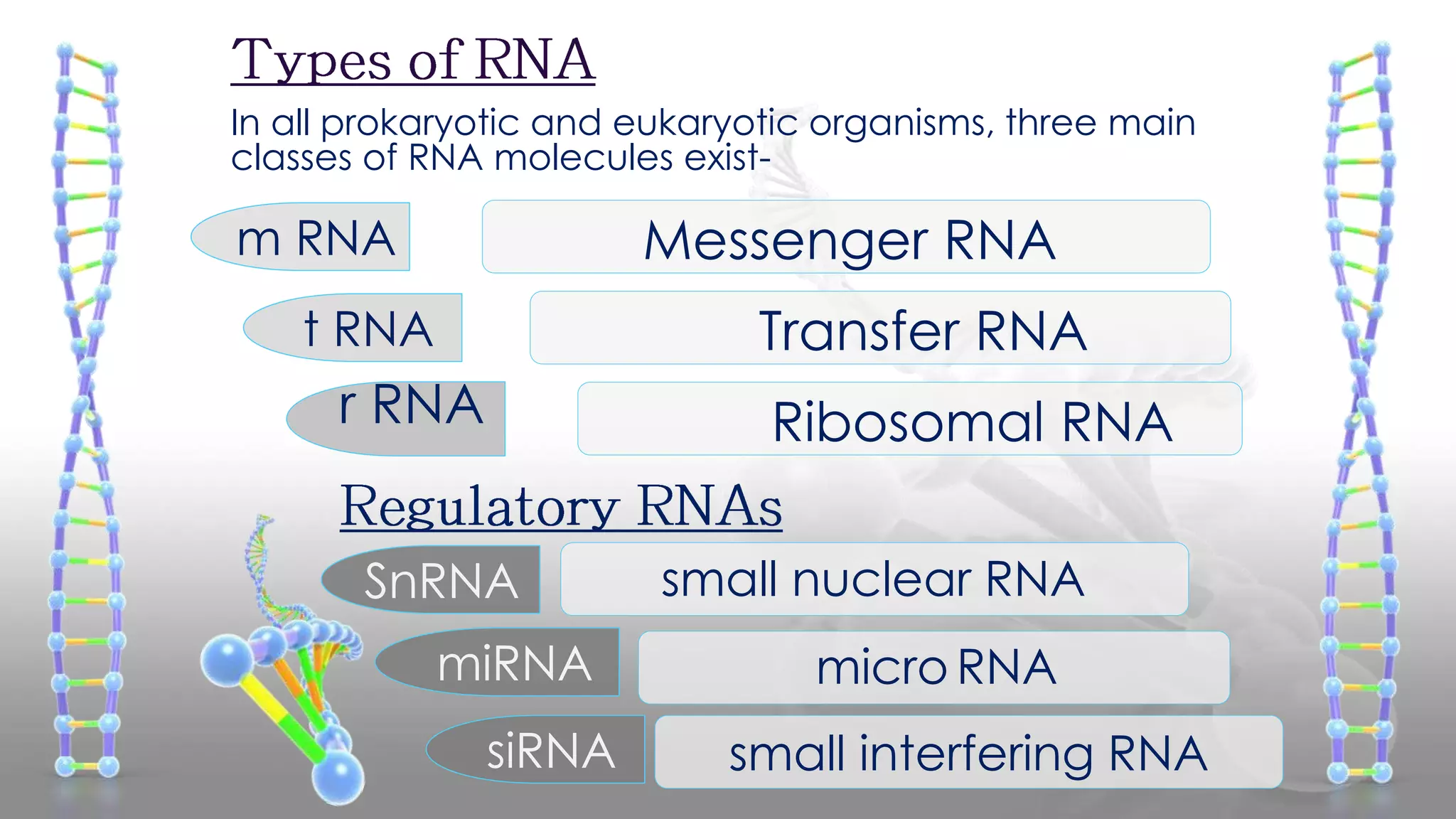
miRNA
Transfer RNA
Ribosomal RNA
Messenger RNA
small nuclear RNA
micro RNA
m RNA
t RNA
r RNA
SnRNA
In all prokaryotic and eukaryotic organisms, three main
classes of RNA molecules exist-
small interfering RNAsiRNA
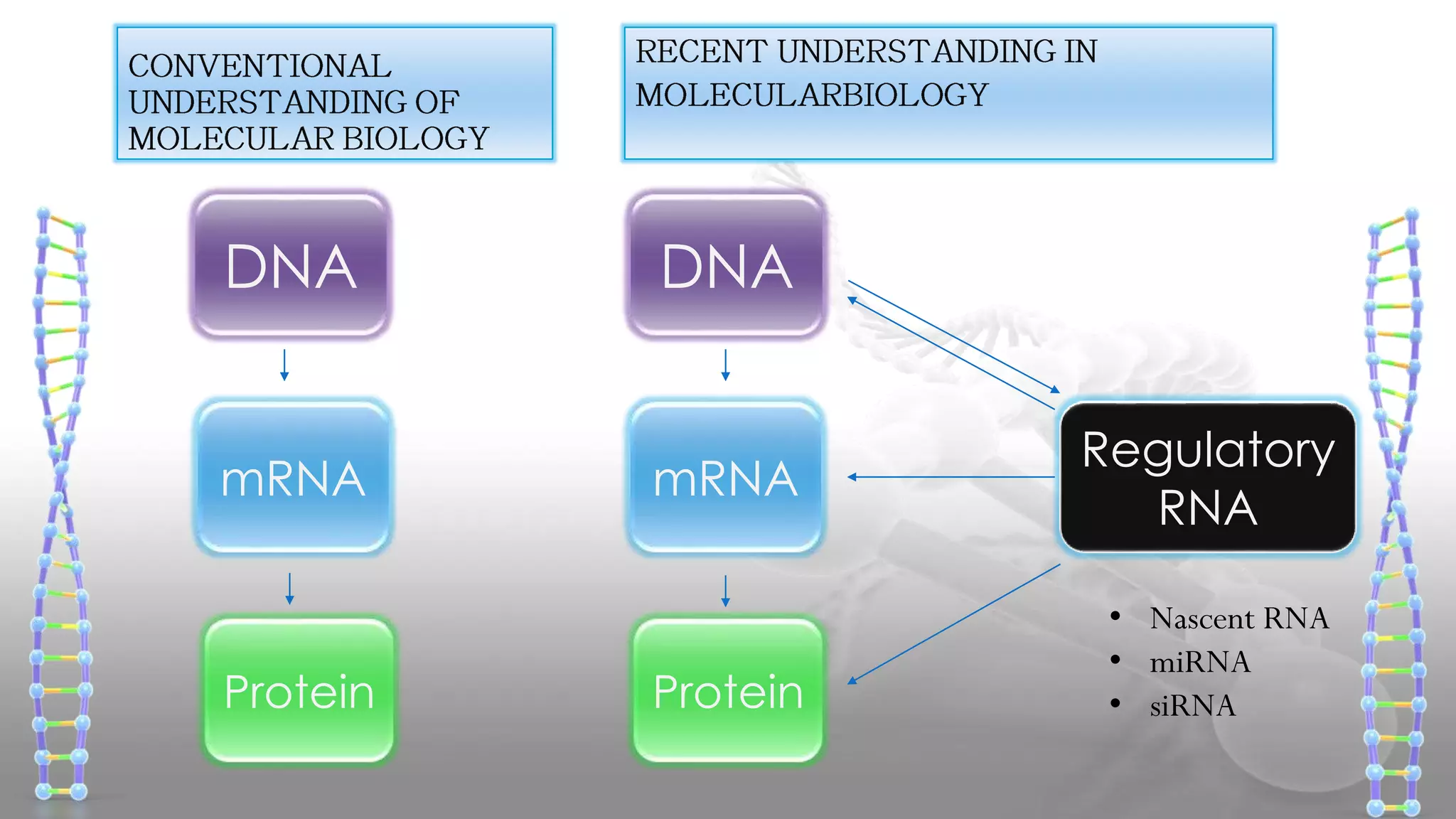
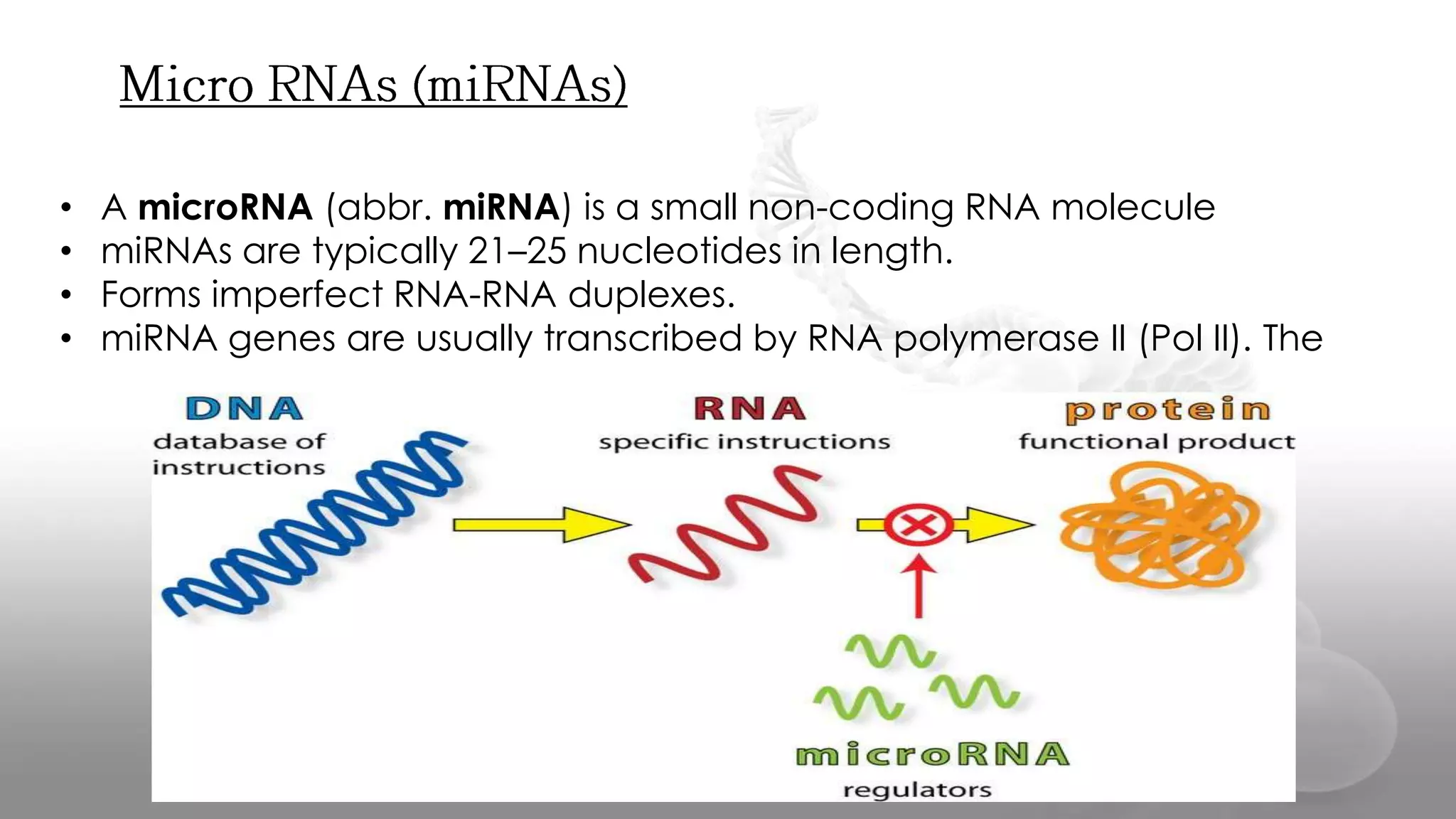
DNA
mRNA
Protein
DNA
mRNA
Protein
Regulatory
RNA
• Nascent RNA
• miRNA
• siRNA
• In prokaryotes, no RNA processing is necessary:
the nascent RNA is usually the mRNA.
• In eukaryotes, the nascent RNA is called primary transcript-RNA
Primary transcript-RNA
– needs to be processed
– and transported to the cytoplasm for translation to occur.
The processing steps are:
• capping
• Polyadenylation
• RNA splicing
• nascent RNA controls transcription elongation .
• regulate RNA chain elongation .
• Expression of the human immunodeficiency virus type 1 (HIV-1)
genome.
• insight into the virus's mechanism for RNA synthesis.
• knowledge on the spatial distribution of transcriptionally active
chromatin.
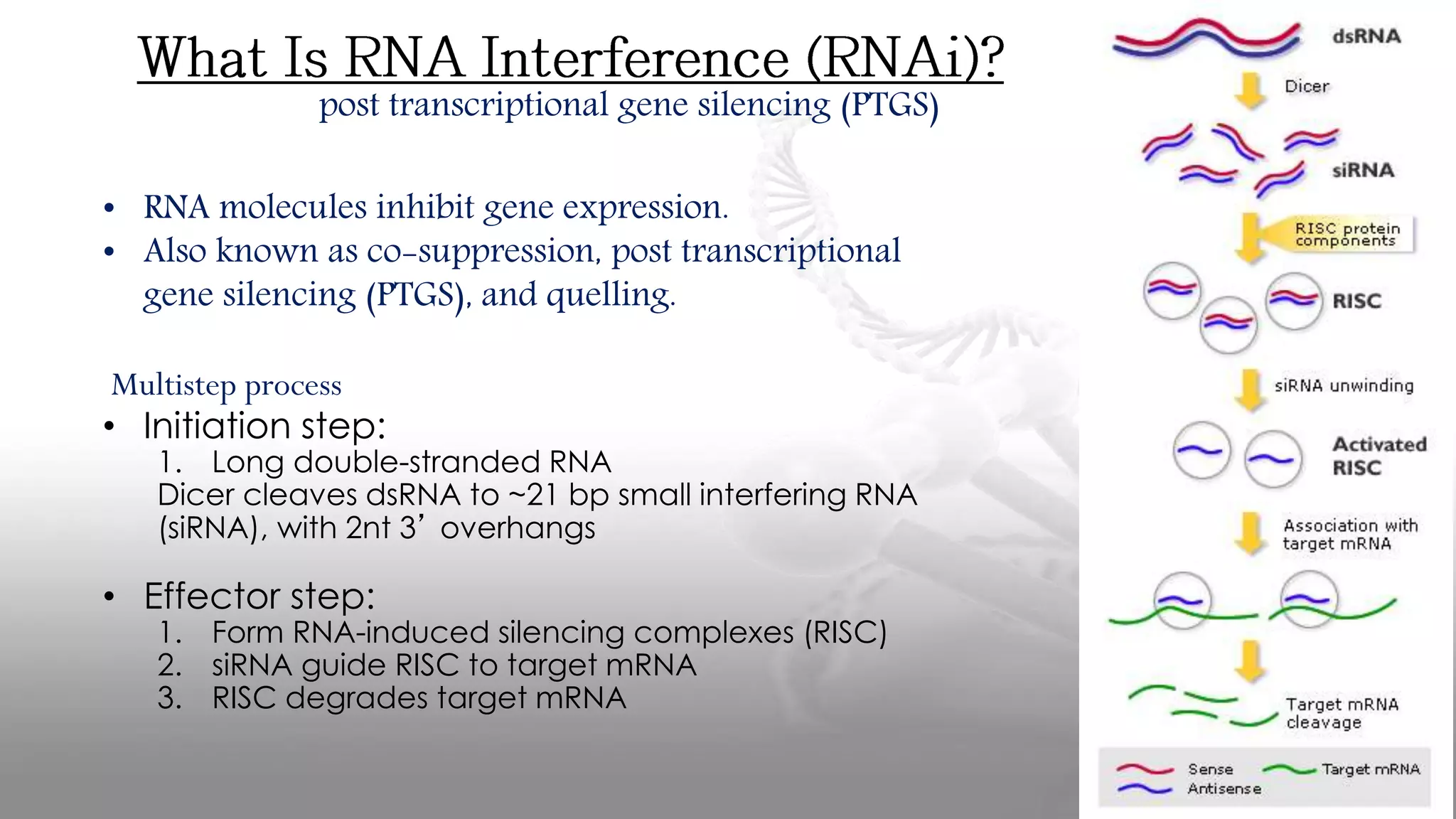
post transcriptional gene silencing (PTGS)
• RNA molecules inhibit gene expression.
• Also known as co-suppression, post transcriptional
gene silencing (PTGS), and quelling.
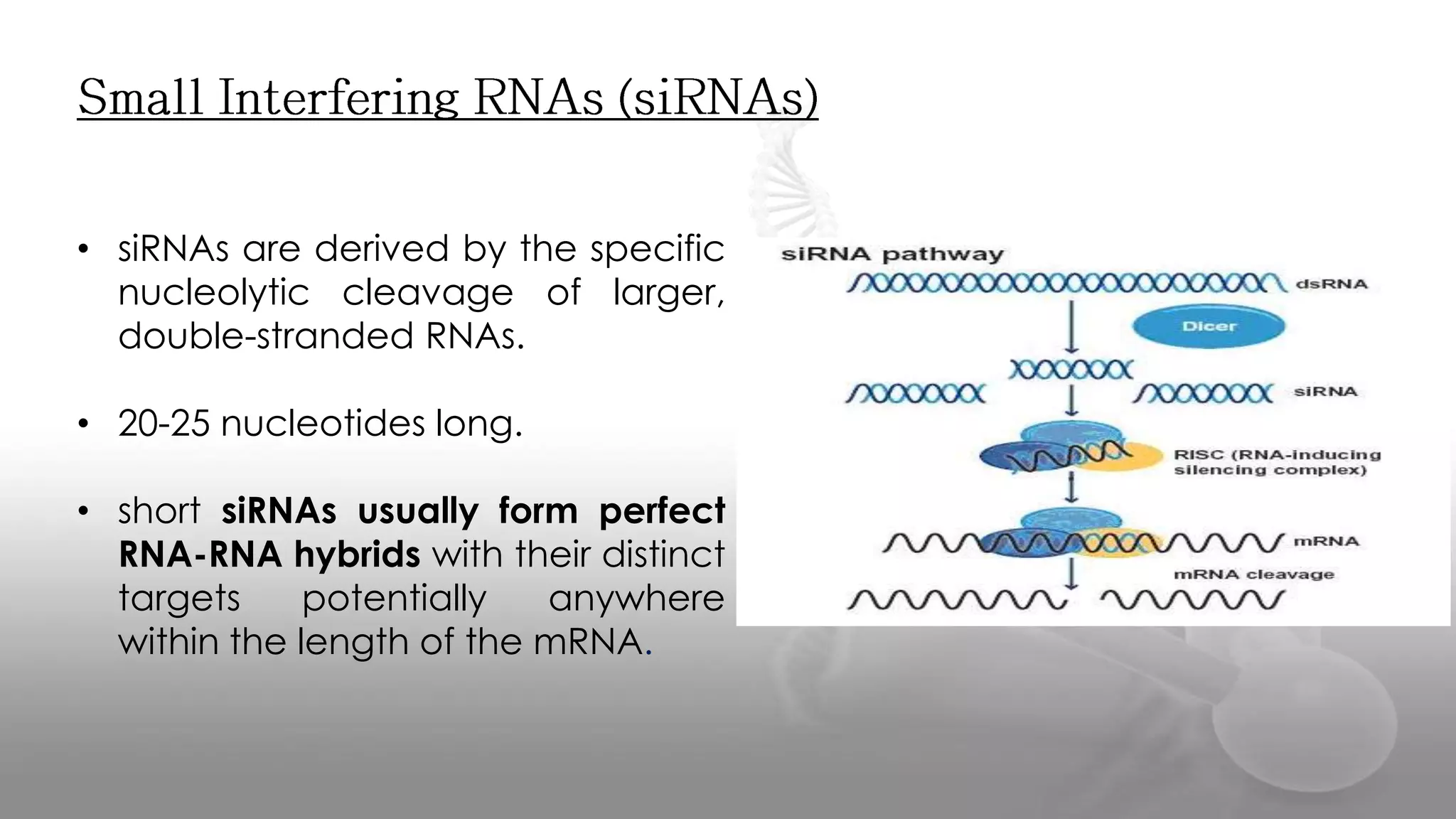
Multistep process
• Initiation step:
1. Long double-stranded RNA
Dicer cleaves dsRNA to ~21 bp small interfering RNA
(siRNA), with 2nt 3’ overhangs
• Effector step:
1. Form RNA-induced silencing complexes (RISC)
2. siRNA guide RISC to target mRNA
3. RISC degrades target mRNA
siRNAs & miRNAs
These two classes of RNAs represent a subset of small
RNAs; both play important roles in gene regulation.
miRNAs and siRNAs cause inhibition of gene expression
• A microRNA (abbr. miRNA) is a small non-coding RNA molecule
• miRNAs are typically 21–25 nucleotides in length.
• Forms imperfect RNA-RNA duplexes.
• miRNA genes are usually transcribed by RNA polymerase II (Pol II). The
Tumor suppression and oncogenes
• About 50% of the annotated human miRNAs map within fragile sites
of chromosomes
• evidence indicates that miRNAs can function as tumour suppressors
and oncogenes.
• Gene therapies that use miRNAs might be an effective approach
to block tumour progression
• The past several years have witnessed tremendous progress in our
understanding of miRNAs.
• Understanding how miRNAs are processed and how they are integrated into the
complex regulatory networks will be crucial.
• Considering the fundamental role of miRNAs in organismal development, cellular
differentiation and metabolism, viral infection, and oncogenesis, we can
anticipate many more sophisticated mechanisms for the regulation of their
biogenesis, function and catabolism to emerge in coming years.
• siRNAs are derived by the specific
nucleolytic cleavage of larger,
double-stranded RNAs.
• 20-25 nucleotides long.
• short siRNAs usually form perfect
RNA-RNA hybrids with their distinct
targets potentially anywhere
within the length of the mRNA.
Both miRNAs and siRNAs represent exciting new potential
targets for therapeutic drug development in humans.
In addition, siRNAs are frequently used to decrease or
"knock-down" specific protein levels.
• Chemical synthesis.
• In vitro transcription.
• Electroporation
- primary cells, suspension cells, and many difficult to transfected
cell lines
• Viral vector
- most all type of cells, in vivo application
- long-term silencing
- adenovirus, lentivirus, retrovirus
• RNA interference (RNAi) has become an almost-standard method for in vitro
knockdown of any target gene of interest.
• The use of RNAi for therapeutic purposes holds a great deal of potential for the
treatment of viral and genetic diseases, and cancer.
• The specific aim of siRNA therapies is to control gene expression by gene silencing.
• RNA interference is a vital part of the immune response to viruses and other
foreign genetic material
• Although animals generally express fewer variants of the dicer enzyme than plants,
RNAi in some animals has also been shown to produce an antiviral response.
• In both juvenile and adult Drosophila, RNA interference is important in antiviral innate
immunity and is active against pathogens such as Drosophila X virus.
• A similar role in immunity may operate in C. elegans, as argonaute proteins are
upregulated in response to viruses and worms that overexpress components of the RNAi
pathway are resistant to viral infection.
At molecular level
• The widespread regulation of microRNA biogenesis, function and decay by Jacek Krol, Inga Loedige
and Witold Filipowicz.
• MicroRNA Functions by Natascha Bushati and Stephen M. Cohen.
• MicroRNA-9a ensures the precise specification of sensory organ precursors in Drosophila by Yan Li,
Fay Wang, Jin-A Lee, et al.
• Oncomirs — microRNAs with a role in cancer by Aurora Esquela-Kerscher and Frank J. Slack
• Molecular biology of the gene by Watson ,Baker,Bell,Gann,Levine,Losick (Sixth edition)
THANKYOU
“Genes are the blueprints for Proteins, but Proteins are where the
action Is In Human Life and Health “
- Akhilesh Pandey

Regulatory RNA

  • 2.
    RNA is apolymer of ribonucleotides linked together by 3’-5’ phosphodiester linkage
  • 3.
    miRNA Transfer RNA Ribosomal RNA MessengerRNA small nuclear RNA micro RNA m RNA t RNA r RNA SnRNA In all prokaryotic and eukaryotic organisms, three main classes of RNA molecules exist- small interfering RNAsiRNA
  • 4.
  • 5.
    • In prokaryotes,no RNA processing is necessary: the nascent RNA is usually the mRNA. • In eukaryotes, the nascent RNA is called primary transcript-RNA Primary transcript-RNA – needs to be processed – and transported to the cytoplasm for translation to occur. The processing steps are: • capping • Polyadenylation • RNA splicing
  • 6.
    • nascent RNAcontrols transcription elongation . • regulate RNA chain elongation . • Expression of the human immunodeficiency virus type 1 (HIV-1) genome. • insight into the virus's mechanism for RNA synthesis. • knowledge on the spatial distribution of transcriptionally active chromatin.
  • 7.
    post transcriptional genesilencing (PTGS) • RNA molecules inhibit gene expression. • Also known as co-suppression, post transcriptional gene silencing (PTGS), and quelling. Multistep process • Initiation step: 1. Long double-stranded RNA Dicer cleaves dsRNA to ~21 bp small interfering RNA (siRNA), with 2nt 3’ overhangs • Effector step: 1. Form RNA-induced silencing complexes (RISC) 2. siRNA guide RISC to target mRNA 3. RISC degrades target mRNA
  • 8.
    siRNAs & miRNAs Thesetwo classes of RNAs represent a subset of small RNAs; both play important roles in gene regulation. miRNAs and siRNAs cause inhibition of gene expression
  • 9.
    • A microRNA(abbr. miRNA) is a small non-coding RNA molecule • miRNAs are typically 21–25 nucleotides in length. • Forms imperfect RNA-RNA duplexes. • miRNA genes are usually transcribed by RNA polymerase II (Pol II). The
  • 10.
    Tumor suppression andoncogenes • About 50% of the annotated human miRNAs map within fragile sites of chromosomes • evidence indicates that miRNAs can function as tumour suppressors and oncogenes. • Gene therapies that use miRNAs might be an effective approach to block tumour progression
  • 11.
    • The pastseveral years have witnessed tremendous progress in our understanding of miRNAs. • Understanding how miRNAs are processed and how they are integrated into the complex regulatory networks will be crucial. • Considering the fundamental role of miRNAs in organismal development, cellular differentiation and metabolism, viral infection, and oncogenesis, we can anticipate many more sophisticated mechanisms for the regulation of their biogenesis, function and catabolism to emerge in coming years.
  • 12.
    • siRNAs arederived by the specific nucleolytic cleavage of larger, double-stranded RNAs. • 20-25 nucleotides long. • short siRNAs usually form perfect RNA-RNA hybrids with their distinct targets potentially anywhere within the length of the mRNA.
  • 13.
    Both miRNAs andsiRNAs represent exciting new potential targets for therapeutic drug development in humans. In addition, siRNAs are frequently used to decrease or "knock-down" specific protein levels.
  • 14.
    • Chemical synthesis. •In vitro transcription. • Electroporation - primary cells, suspension cells, and many difficult to transfected cell lines • Viral vector - most all type of cells, in vivo application - long-term silencing - adenovirus, lentivirus, retrovirus
  • 15.
    • RNA interference(RNAi) has become an almost-standard method for in vitro knockdown of any target gene of interest. • The use of RNAi for therapeutic purposes holds a great deal of potential for the treatment of viral and genetic diseases, and cancer. • The specific aim of siRNA therapies is to control gene expression by gene silencing. • RNA interference is a vital part of the immune response to viruses and other foreign genetic material • Although animals generally express fewer variants of the dicer enzyme than plants, RNAi in some animals has also been shown to produce an antiviral response. • In both juvenile and adult Drosophila, RNA interference is important in antiviral innate immunity and is active against pathogens such as Drosophila X virus. • A similar role in immunity may operate in C. elegans, as argonaute proteins are upregulated in response to viruses and worms that overexpress components of the RNAi pathway are resistant to viral infection.
  • 16.
  • 17.
    • The widespreadregulation of microRNA biogenesis, function and decay by Jacek Krol, Inga Loedige and Witold Filipowicz. • MicroRNA Functions by Natascha Bushati and Stephen M. Cohen. • MicroRNA-9a ensures the precise specification of sensory organ precursors in Drosophila by Yan Li, Fay Wang, Jin-A Lee, et al. • Oncomirs — microRNAs with a role in cancer by Aurora Esquela-Kerscher and Frank J. Slack • Molecular biology of the gene by Watson ,Baker,Bell,Gann,Levine,Losick (Sixth edition)
  • 18.
    THANKYOU “Genes are theblueprints for Proteins, but Proteins are where the action Is In Human Life and Health “ - Akhilesh Pandey